
The Honolulu Department of Planning and Permitting’s new mandate requiring all new and replacement roofs to withstand 150 mph winds has completely changed the math for Oahu homeowners. For years, architectural shingles were the default choice, but this code update makes standing seam metal roofing the smartest financial and structural decision you can make. The new Oahu roofing code 150 mph requirements increase labor for shingles while highlighting the inherent strength of metal, creating a clear winner for long-term value and protection. Put simply, the code makes metal roofing a no-brainer.
This isn’t just about meeting a new regulation; it’s about fundamentally rethinking how we protect our homes from hurricanes. At Warrior Construction, we’ve seen how these changes directly impact project budgets and timelines. The old cost-benefit analysis between shingles and metal is now obsolete. As a result, homeowners must understand how this shift affects everything from labor costs to material choices and even the long-term resale value of your property. We’re going to break down exactly what the new code means, why it makes traditional shingles more expensive to install correctly, and how a standing seam metal roof, paired with fiber cement siding, creates the ultimate ‘exterior armor’ for your Hawaii home. This guide will give you the 2026 data you need to make an informed decision that saves you money and provides peace of mind for decades.
What is Oahu’s New 150 MPH Roofing Code?
Oahu’s new 150 mph roofing code is a major update to the island’s building requirements, officially classified by the Honolulu Department of Planning and Permitting (DPP) as an update to the High-Velocity Hurricane Area (HVHA) standards. Essentially, any home undergoing a roof replacement must now use materials and installation methods certified to withstand sustained wind speeds of 150 miles per hour. This is a significant jump from the previous 130 mph standard that was in place for years, and it reflects a more realistic assessment of the risks posed by modern hurricanes in the Central Pacific.
Understanding the HVHA Update from Honolulu’s DPP
The Honolulu DPP’s official bulletin, released in April 2026, details these new requirements.[1] It’s not just about the roofing material itself; the code specifies the entire roofing system—from the deck attachment and underlayment to the fasteners and flashing. Every component must work together to resist the massive uplift forces a hurricane generates. Consequently, getting a permit for a reroof now involves submitting manufacturer specifications that explicitly prove compliance with the 150 mph rating. These new honolulu dpp roofing requirements mean we can’t just use the same old materials and techniques. For example, our team now has to document the specific type and spacing of fasteners for every job, which adds another layer to the inspection process.
Why 130 MPH Isn’t Good Enough Anymore
The shift from 130 to 150 mph might not sound like a huge leap, but the physics of wind pressure says otherwise. Wind pressure increases with the square of the wind speed. This means a 150 mph wind exerts about 33% more force on your roof than a 130 mph wind. The previous standard was based on historical data that is now considered outdated. After seeing the devastation from recent major storms globally, structural engineers and city officials recognized that Oahu’s building codes needed to be tougher to prevent catastrophic failures. A roof that peels off in a hurricane doesn’t just damage your home; it becomes a missile that endangers your neighbors. The updated Oahu roofing code 150 mph is a proactive measure designed to strengthen our entire community’s resilience, one house at a time.
How Does the New Code Make Shingle Roofs More Expensive?
The new 150 mph code makes asphalt shingle roofs more expensive primarily by mandating a more labor-intensive installation process. While the material cost of the shingles themselves hasn’t changed dramatically, the time and skill required to fasten them according to the new HVHA standards have increased significantly. This directly translates to higher labor costs, which now make up a larger portion of the total project budget, narrowing the price gap between shingles and metal.
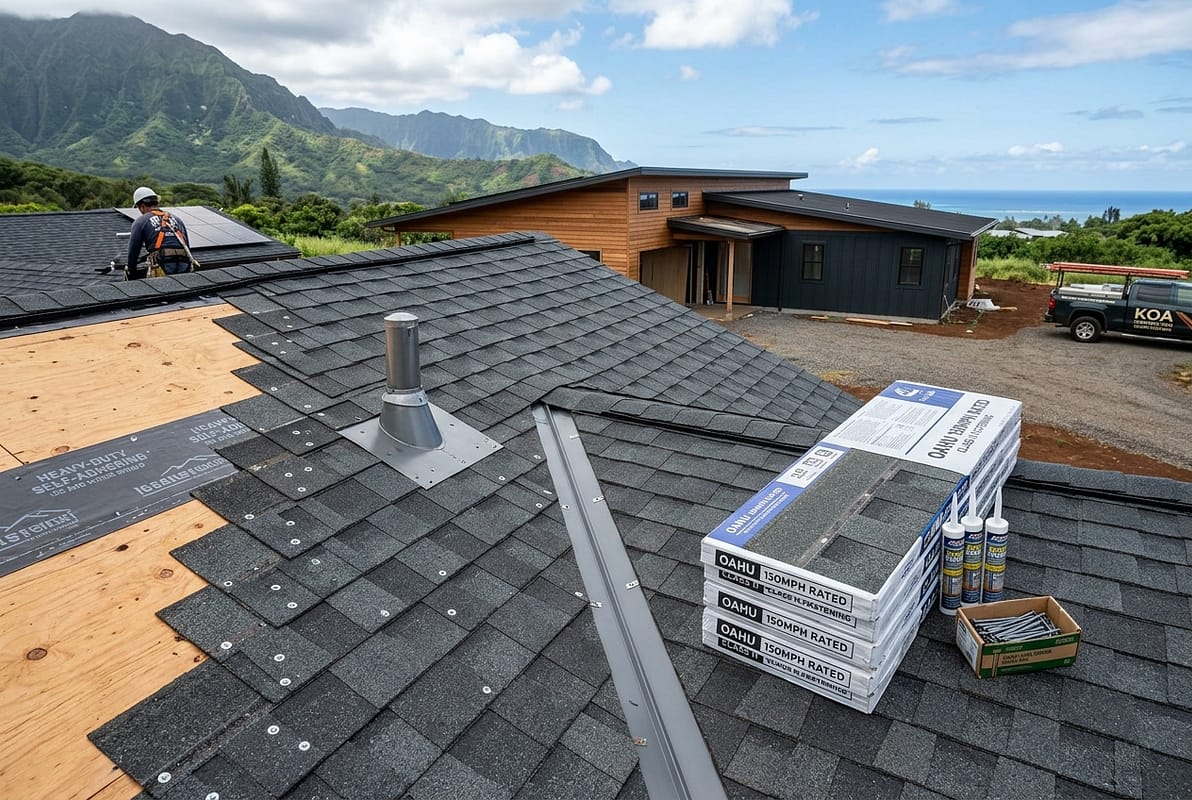
The Six-Nail Rule: A 15% Jump in Labor Costs
The single biggest change for shingle installation under the Oahu roofing code 150 mph is the ‘six-nail rule’. Standard installation in lower-wind zones uses four nails per shingle. The new code requires a minimum of six nails, placed in a specific manufacturer-approved pattern. Additionally, it mandates the use of specialized, high-tack adhesive strips. This isn’t just about hammering in two extra nails; it’s about precision and process. Our roofers have to move more slowly and carefully to ensure each nail is in the right spot and driven to the correct depth without damaging the shingle. Based on our project data, this new six-nail requirement increases total roofing labor by 12-15%.[1] On a complex roof with many valleys and hips, like we often see in older Manoa homes, this can add several days and thousands of dollars to the job.
Material vs. Labor: The Shifting Cost Equation
Historically, the main argument for shingles was their low upfront cost. The materials were cheap, and the installation was fast. Now, that equation is shifting. While shingles are still less expensive per square foot than metal panels, the soaring labor component is changing the total cost calculation. According to UHERO’s mid-2026 data, the average installed cost for architectural shingles on Oahu is now $19.25 per square foot.[2] The extra labor for the 150 mph fastening pattern adds roughly $2.50 to $3.00 per square foot. When you’re talking about a typical 2,200 sq. ft. roof, that’s an extra $5,500 to $6,600 just in labor. This brings the total cost much closer to that of a standing seam metal roof, especially when you consider the metal roof’s much longer lifespan. The old debate of shingle vs metal roof hawaii now has a clear financial tipping point because of this new code.
Why is Standing Seam Metal the Smartest Choice Now?
Standing seam metal roofing is now the smartest choice for Oahu homeowners because it is inherently designed to meet and exceed the new 150 mph wind code without extra labor or modifications. Its superior wind uplift resistance, combined with a 45% lower lifecycle cost over 30 years and unmatched durability against salt air, makes it the most resilient and financially savvy option. The discussion around hurricane proof roofing oahu has decisively shifted in favor of metal.
Built-in Compliance and Superior Wind Uplift Resistance
Unlike shingles that rely on a specific number of nails for their wind rating, a standing seam metal roof’s strength is built into its design. The panels are interlocked and fastened to the roof deck with clips, creating a monolithic surface that wind struggles to get underneath. Most high-quality standing seam systems are engineered and tested from the factory to withstand winds of 160 mph or more. This means they comply with the Oahu roofing code 150 mph right out of the box. There’s no special, time-consuming fastening pattern required. For our team, this means a more predictable and efficient installation process. For the homeowner, it means guaranteed compliance and peace of mind that your roof is truly engineered for hurricane conditions.
A 45% Lower Lifecycle Cost Over 30 Years
While the initial installation cost of a metal roof is higher than shingles, its long-term value is undeniable. A recent study by the Hawaii Contractors Association found that over a 30-year period, the lifecycle cost of a standing seam metal roof is 45% lower than that of architectural shingles.[3] Here’s why:
- Longevity: A metal roof will last 50+ years. An architectural shingle roof in Hawaii’s harsh sun and salt air might last 20-25 years, meaning you’ll be replacing it at least twice in the same timeframe.
- Maintenance: Metal roofs require virtually no maintenance beyond occasional cleaning. Shingles can lose granules, crack, or have tabs lift over time, requiring periodic repairs.
- Energy Savings: Metal roofs with reflective coatings can lower your cooling costs by up to 25% by reflecting solar heat, a major benefit in Hawaii. Shingles absorb and retain heat, transferring it into your home.
- Insurance Premiums: Many insurance companies offer significant discounts for homes with certified hurricane-rated metal roofs, savings that add up year after year.
When you factor in the cost of a second shingle roof replacement down the road, the financial argument for metal becomes overwhelming.
Resisting Salt Air Corrosion: The Kynar 500 Advantage
For anyone living on the Windward side, in Kailua, Kaneohe, or on the North Shore, salt air corrosion is a constant battle. This is where the quality of the metal roof’s coating makes all the difference. We exclusively use panels with a Kynar 500 coating. This is a premium, resin-based paint system that offers incredible resistance to fading, chalking, and, most importantly, corrosion from salt spray. Cheaper metal roofs might use inferior coatings that look good for a few years but will quickly start to degrade and rust. The Kynar 500 finish is the gold standard, ensuring that your roof not only holds up to hurricanes but also looks great for decades, even when facing the ocean. It’s a critical detail that protects your investment.
How Much Does a New Metal Roof Cost on Oahu in 2026?
In 2026, the average cost for a high-quality, standing seam metal roof replacement on a typical 2,200 square foot home in Honolulu is approximately $42,350. This price reflects the complete job, including tear-off of the old roof, new underlayment, all materials, labor, and permits. The standing seam metal roof cost hawaii is a significant investment, but it’s crucial to understand the long-term value it provides, especially under the new building codes.
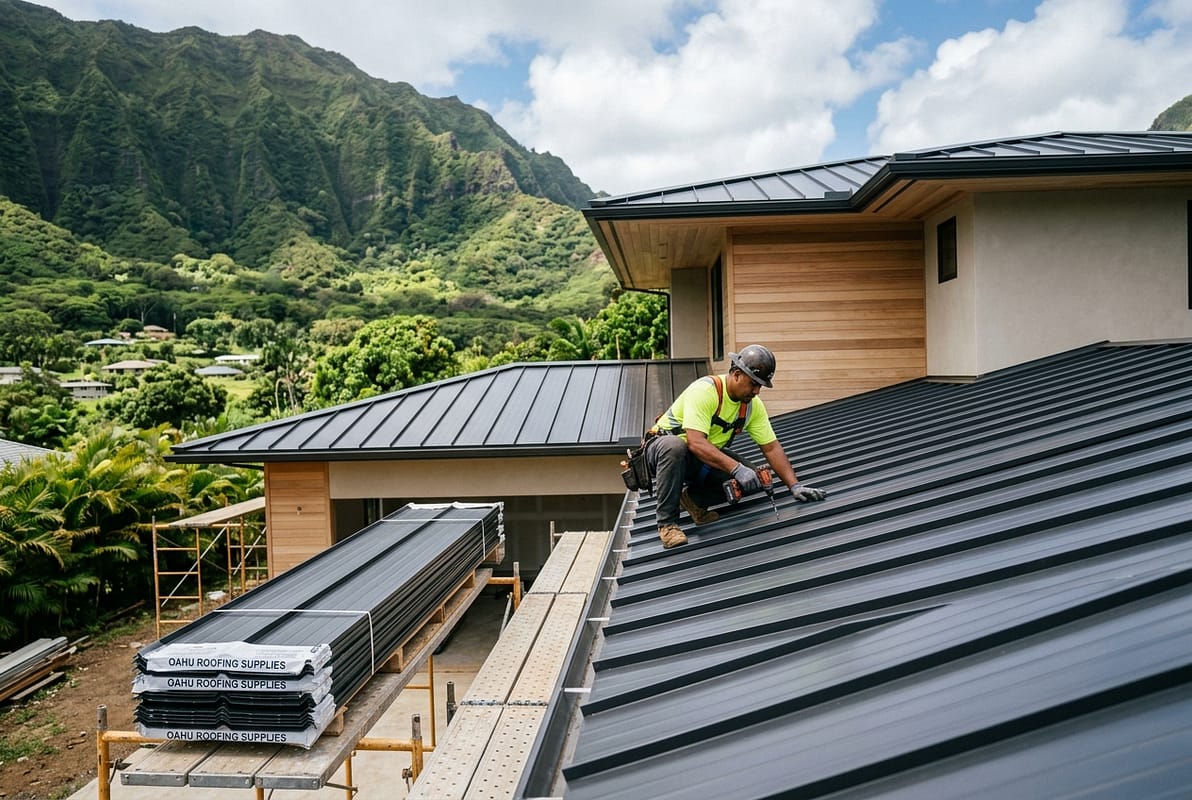
Breaking Down the $42,350 Average for a 2,200 sq. ft. Home
Let’s break that number down so it makes more sense. For a standard 2,200 sq. ft. gable roof on Oahu, the costs are roughly allocated as follows:
- Materials (~45%): Around $19,000. This includes the Kynar 500-coated metal panels, clips, fasteners, underlayment, flashing, and ridge caps. Material costs in Hawaii are about 30% higher than on the mainland due to shipping.[4]
- Labor (~40%): Around $17,000. This covers a skilled crew for tear-off, deck inspection and repair, underlayment installation, and the precise work of cutting and installing the metal panels.
- Overhead, Permits, and Disposal (~15%): Around $6,350. This includes our general liability and workers’ comp insurance, dumpster fees, Honolulu DPP permit fees, and project management.
This price is an average. A more complex roof with numerous valleys, dormers, or a very steep pitch will increase the labor costs. For example, a recent project on an older home in Hawaii Kai with multiple roof lines pushed the final cost closer to $55,000.
Factoring in Neighbor Island Shipping Surcharges (18% Higher)
It’s important to understand that these costs are specific to Oahu. If you’re on Maui, Kauai, or the Big Island, you need to budget for the ‘neighbor island tax.’ All roofing materials arrive in Honolulu first and then have to be shipped via barge to the other islands. This adds significant cost and potential for delays. As a general rule, we tell our neighbor island clients to expect the total project cost to be about 18% higher than on Oahu.[4] That $42,350 Oahu roof becomes a nearly $50,000 project in Lahaina or Lihue, a crucial budgeting factor.
Are Solar-Integrated Systems Worth the Investment?
With a new metal roof, integrating solar becomes much simpler and more effective. Instead of penetrating the roof with dozens of holes, solar panels can be mounted directly to the standing seams using non-penetrating clamps. This preserves the integrity of your roof and eliminates potential leak points. A solar-integrated system will add between $25,000 and $40,000 to the project cost, depending on the system size and battery storage. However, with Hawaii’s high electricity rates and generous tax credits, the payback period is often just 5-7 years. Given that the roof itself will last over 50 years, integrating solar at the time of installation is one of the smartest long-term financial moves a homeowner can make in 2026.
Should I Upgrade My Siding at the Same Time as My Roof?
Yes, if your budget allows, upgrading your siding at the same time as your roof is one of the most efficient and cost-effective decisions you can make. By bundling the projects, you save significantly on shared costs like scaffolding, labor, and waste disposal. More importantly, it allows you to create a complete, integrated ‘exterior armor’ system that provides maximum protection against Hawaii’s unique environmental challenges, from hurricanes to termites and salt air.
Creating ‘Exterior Armor’ with Fiber Cement Siding
The concept of ‘exterior armor’ is simple: combine a hurricane-rated standing seam metal roof with high-quality fiber cement siding. This pairing creates a building envelope that is incredibly resilient. Fiber cement siding hawaii products, like those from James Hardie, are a perfect fit for our climate because they are:
- Termite-Proof: Made from cement, sand, and cellulose fibers, it’s completely inedible to ground termites.
- Water-Resistant: It won’t rot, warp, or swell when exposed to our constant humidity and driving rain.
- Fire-Resistant: It’s non-combustible, which can be a critical safety feature and may lower insurance premiums.
- Durable: It holds paint exceptionally well and resists the fading and damage caused by our intense UV exposure.
When you install this siding correctly over a new weather-resistive barrier and integrate it properly with your new roof’s flashing, you create a nearly impenetrable shell for your home.
Why 70% of Coastal Homes in Kailua and Kaneohe Use It
There’s a reason why, if you drive through coastal neighborhoods like Kailua or Kaneohe, you’ll see a majority of renovated homes clad in fiber cement. Local contractors and homeowners have learned from experience what works. Wood siding, even treated wood, struggles to hold up against the constant assault of salt spray and moisture. According to a recent Pacific Business News analysis, over 70% of siding replacement projects in these high-moisture coastal areas now use fiber cement.[5] It has become the default choice for anyone looking for a low-maintenance, long-term solution that won’t require constant repainting and repairs. The smooth-finish panels, which offer a clean, modern look, are particularly popular right now.
What is the ROI for a Full Exterior Upgrade in Hawaii?
A full exterior upgrade that includes a new standing seam metal roof and fiber cement siding offers one of the highest returns on investment of any home renovation project in Hawaii. According to the 2026 Cost vs. Value report from the Honolulu Board of REALTORS®, this type of project yields an impressive 88% return on investment at resale. This means for every $100,000 you invest in your home’s exterior, you can expect its market value to increase by about $88,000.
Capturing an 88% Return on Investment at Resale
The 88% ROI figure is so high because a new, resilient exterior addresses the biggest concerns of potential homebuyers in Hawaii.[6] A buyer sees a new metal roof and fiber cement siding and immediately knows they won’t have to worry about major capital expenditures for decades. They see a home that is protected from hurricanes, termites, and rot. This peace of mind has tangible value. In a competitive market, a home with a fully upgraded, ‘Hawaii-proof’ exterior will sell faster and for a higher price than a comparable home with an aging shingle roof and wood siding. The Oahu roofing code 150 mph compliance becomes a major selling point that realtors will highlight.
The Realtor’s Perspective: Paint, LRV, and Curb Appeal in Ewa Beach
Curb appeal is a huge part of that ROI, and the final paint job is critical. Realtors we work with in neighborhoods like Ewa Beach and Kapolei emphasize the importance of choosing the right paint. The 2026 Cost vs. Value report specifically recommends using high-quality acrylic latex paint with anti-fungal additives to fight mildew. Furthermore, they are seeing a strong buyer preference for lighter colors with a high Light Reflectance Value (LRV). A high-LRV paint reflects more sunlight, which keeps the house cooler and can significantly reduce air conditioning bills. From a realtor’s perspective, a freshly painted home with a clean metal roof is a signal of a well-maintained property, making their job of selling it much easier and more profitable for the homeowner.
What this means for Hawaii homeowners
The introduction of the Oahu roofing code 150 mph is more than a simple regulatory update; it’s a fundamental shift that should change how every homeowner approaches their next reroofing project. It forces a long-term view, prioritizing resilience and lifecycle cost over short-term savings. The days of automatically opting for the cheapest shingle option are over.
Here’s what our team at Warrior Construction believes this means for you:
- Re-evaluate the Shingle vs. Metal Debate: The increased labor cost to make shingles compliant (12-15% more) dramatically shrinks the upfront price gap with standing seam metal. When you factor in metal’s 50+ year lifespan versus a shingle roof’s 20-25 years in Hawaii’s climate, metal is now the clear financial winner over the long term. Start thinking of your roof as a 50-year investment, not a 20-year expense.
- Budget for a System, Not Just a Roof: The new code emphasizes the entire roofing system. This is the perfect time to think about a complete ‘exterior armor’ upgrade. If your siding is also showing its age, bundling a fiber cement siding replacement with your roof project can save you 10-15% on total costs due to efficiencies in scaffolding, labor, and permitting.
- Demand Proof of Compliance: When getting quotes, don’t just ask if a contractor is licensed and insured. Ask them to provide the specific manufacturer’s product data sheet showing that the proposed roofing material is rated for 150 mph wind uplift. Any legitimate contractor should be able to provide this documentation instantly.
- View Your Roof as a Resale Asset: A new, code-compliant standing seam metal roof is a massive selling point. With an 88% ROI, it’s an investment that pays for itself in both protection and increased property value. When it comes time to sell, your hurricane-proof roof will be a key differentiator that attracts serious buyers.
Ultimately, the new code pushes all of us toward building stronger, safer, and more durable homes. Embracing this change by investing in a high-quality metal roof is the smartest decision for your family’s safety and your financial future.
Frequently Asked Questions
Does the new 150 mph code apply to roof repairs on Oahu?
Generally, no. The new Oahu roofing code 150 mph applies to full roof replacements. Minor repairs, such as replacing a few blown-off shingles, do not typically trigger the requirement for a full system upgrade. However, if the repair constitutes more than 25% of the total roof area, the Honolulu DPP may require the entire roof to be brought up to the current code.
How much more does a standing seam metal roof cost than shingles in 2026?
With the new code, the upfront cost difference has narrowed. A new architectural shingle roof installed to the 150 mph standard costs about $19.25/sq ft. A standing seam metal roof costs between $25-$30/sq ft. For a 2,200 sq. ft. home, this means a shingle roof is around $34,650 (after the labor increase), while a metal roof is around $42,350. The initial premium for metal is roughly 22%, but its 45% lower lifecycle cost makes it cheaper over time.
Can I still get a permit for a shingle roof in Honolulu?
Yes, you can still get a permit for an architectural shingle roof. However, your contractor must prove to the Honolulu DPP that the specific shingle product and installation method (using the six-nail pattern and specified adhesives) meets the 150 mph wind uplift rating. This requires submitting the manufacturer’s technical data sheets with your permit application.
Does a metal roof make my house hotter?
This is a common myth. Modern metal roofing with Kynar 500 reflective coatings are actually ‘cool roofs.’ They reflect solar radiation, preventing heat from transferring into your attic and living spaces. This can reduce your home’s cooling costs by up to 25% compared to a dark asphalt shingle roof, which absorbs and holds heat.
How long does a metal roof replacement take on Oahu?
For an average-sized home (2,000-2,500 sq. ft.), the entire process takes about 2 to 3 weeks. This includes 2-3 days for tearing off the old roof, 1-2 days for deck repairs and underlayment, and 5-7 days for the metal panel installation and finishing touches. The timeline can be extended by weather delays or if significant rot or termite damage is discovered in the underlying roof structure.
Is a metal roof noisy when it rains?
No, this is another outdated misconception. When installed correctly over a solid roof deck and proper underlayment, with insulation in the attic, a metal roof is no louder than a shingle roof during a rainstorm. The sound is diffused and muffled by the layers underneath, resulting in a quiet interior environment.
The Oahu roofing code 150 mph update is a call to action for homeowners to build stronger and smarter. Investing in a resilient exterior isn’t just about compliance; it’s about protecting your biggest asset and your `ohana`. If you’re considering a roof replacement, our team at Warrior Construction can walk you through the options and provide a detailed analysis of the long-term benefits of a standing seam metal system. We have the experience to ensure your project meets every new requirement and delivers lasting value.
Ready to upgrade to an exterior that’s truly built for Hawaii? Let’s discuss your hurricane-resistant construction project today. Contact us for a straightforward consultation and a detailed estimate.
References
- Honolulu DPP Roofing Code Updates Bulletin
- UHERO Hawaii Construction Outlook Mid-2026 Update
- Hawaii Contractors Association Materials Resilience Study Q2 2026
- DBEDT Q2 2026 Construction Cost Analysis
- Pacific Business News Oahu Exterior Renovation Trends
- Honolulu Board of REALTORS® 2026 Cost vs. Value Report


