
The most common question our team gets from Oahu homeowners is, “How long does it really take to build an ADU?” The real answer, from your first idea to handing keys to a tenant, is about 20 months. That number surprises a lot of people who think the timeline is just the 6-7 months of physical construction. But here in Hawaii, the actual build is only a fraction of the total project. The full Oahu ADU timeline is a marathon, not a sprint, dominated by pre-construction planning and the infamous Honolulu permitting process.
Over our 20+ years building on Oahu, we’ve guided hundreds of families through this exact process. We’ve seen it all, from straightforward builds in Kapolei to complex projects on sloping lots in Manoa. This isn’t a theoretical guide; this is our boots-on-the-ground playbook for the complete Oahu ADU timeline. Forget the mainland blogs that talk about 9-month turnarounds. They don’t account for island logistics. Our unique hurricane codes are also not considered. The biggest bottleneck of all is the Honolulu Department of Planning and Permitting (DPP).
This guide breaks down the entire 20-month journey into four distinct phases. We’ll give you real timelines and hard numbers for 2026 construction costs. You will also get an insider’s look at why each stage takes so long. By the end, you’ll understand the entire process and have a solid framework for your own Oahu ADU timeline.
What’s a Realistic Timeline for Building an ADU on Oahu?
A realistic Oahu ADU timeline, from the day you decide to build to the day you receive your Certificate of Occupancy, is approximately 20 months. This comprehensive timeline is heavily front-loaded. The vast majority of time is spent in planning and permitting. This happens before a single shovel ever hits the dirt. The physical construction itself is often the shortest part of the journey.
Here’s the high-level breakdown our team at Warrior Construction uses to set realistic expectations for our clients. It’s a project map that accounts for the realities of building in Hawaii today.
- Phase 1: Financial Modeling & Design: Months 1-2
- Phase 2: Permitting & Material Selection: Months 3-12
- Phase 3: Construction & Site Work: Months 13-19
- Phase 4: Final Inspections & Tenant Placement: Month 20
This 20-month average is for a standard project without major zoning variances or site complications. If your property has unique challenges, this timeline can extend. This includes being in a flood zone or having difficult volcanic soil conditions. Understanding these phases is the key to navigating the comprehensive Oahu ADU timeline without costly surprises.
The Full 20-Month Project Map: From First Call to First Rent Check
This initial pre-construction phase is where your vision starts to take shape, and it’s a period that homeowners frequently underestimate. The best local architects and engineers are in high demand. Getting on their schedule takes time. Working through the design process also takes time. During these crucial first two months, we focus on assembling your professional team. We conduct a thorough site analysis to confirm feasibility. Our team also develops conceptual floor plans. Finally, we help secure your financing pre-approval. This is the foundation of the entire project, setting the pace for a predictable Oahu ADU timeline.
Next comes the longest and most passive phase: permitting. For the next 8 to 10 months, your detailed construction documents will be in the queue at the Honolulu DPP. During this wait, our team works with you on material selections—cabinets, flooring, windows, fixtures—and begins placing long-lead-time orders. Proper management here ensures we are ready to break ground the moment the permit is issued.
Once we have that approved permit, things finally start moving on site. The construction phase itself takes about seven months for a standard 800 sq. ft. ADU. This includes site preparation, foundation work, framing, roofing, installing mechanical systems, and all interior and exterior finishes. Our project managers coordinate the complex logistics of material delivery and subcontractor scheduling to keep the project moving efficiently.
The final month is dedicated to crossing the finish line. This involves scheduling and passing final building, electrical, and plumbing inspections with the city. Once we receive the Certificate of Occupancy, the unit is legally habitable. Our team will do a final walkthrough with you. Then you can begin finding a tenant or moving family in. This marks the successful completion of your 20-month ADU journey.
How Much Will My Oahu ADU Cost in 2026?
For a standard 800-square-foot ADU on Oahu, you should budget for a total project cost between $380,000 and $440,000 in 2026. This all-in figure is based on a vertical construction cost of $475 to $550 per square foot. It also includes typical soft costs. This budget does not include unusually complex site work, which can be a major variable. Understanding how these costs are allocated across the full Oahu ADU timeline is crucial for financial planning.
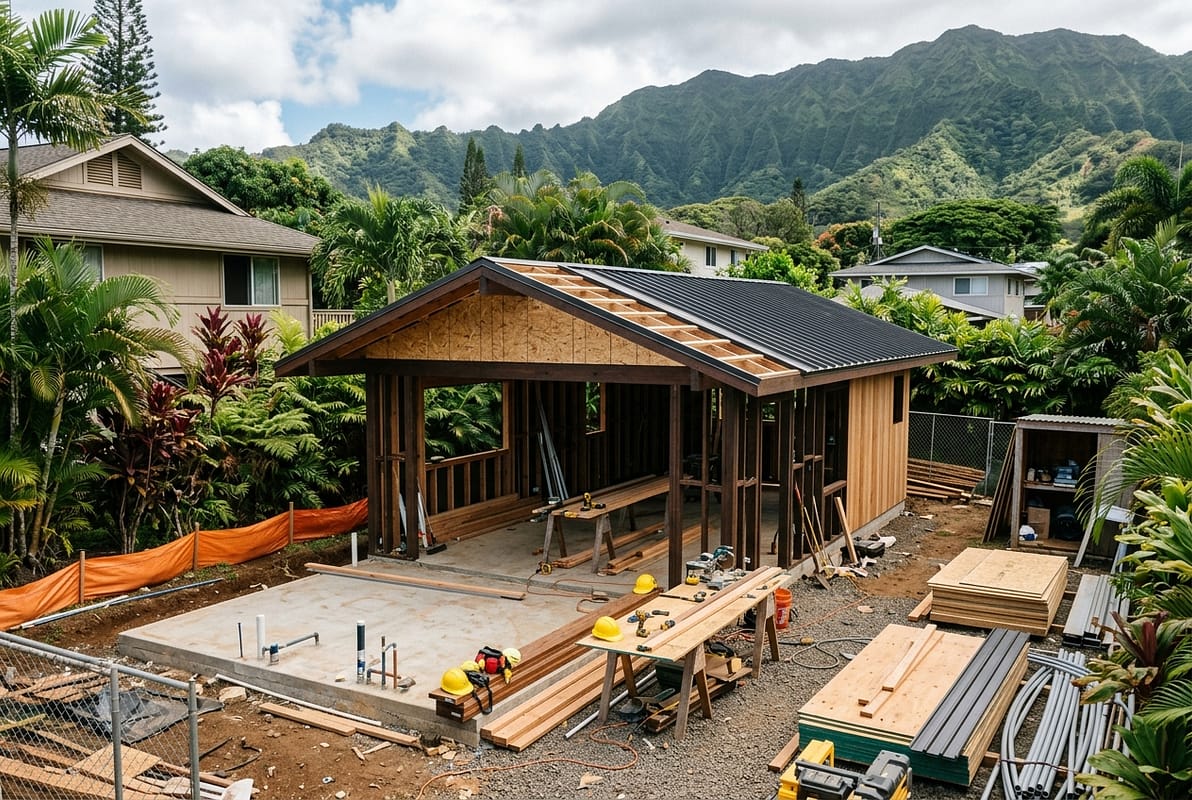
The latest data from the Hawaii Contractors Association confirms these numbers. It cites skilled labor shortages and high material shipping costs. These are the main drivers.[1] Let’s break down where that money goes during each phase of the project.
Phase 1: Financial Modeling & Design (Months 1-2)
This initial phase involves what we call “soft costs”—the necessary expenses for planning and design before construction begins. These fees are paid upfront to get the project off the ground. For a $400,000 build, expect to spend between $40,000 and $60,000 in this phase.
- Architectural & Design Fees: Typically 8-10% of the construction cost ($32,000 – $40,000). This gets you the complete set of blueprints required for permitting.
- Structural Engineering Fees: Around $5,000 – $8,000 for the calculations to ensure your ADU can withstand hurricane-force winds and seismic activity.
- Surveys: You may need a topographical or boundary survey to confirm property lines and setbacks, which costs $2,500 – $5,000.
Phase 2: Permitting & Material Selection (Months 3-12)
While you wait for the permit, other costs come due. These are primarily administrative fees and the initial deposits required to secure materials and lock in pricing.
- Honolulu DPP Permit Fees: Calculated based on project valuation, these fees generally run between $8,000 – $12,000 for an ADU. This is a critical part of the ADU cost Oahu budget.
- Construction Insurance: Builder’s Risk insurance is essential to protect the project during construction and can cost $3,000 – $6,000 for the policy term.
- Material Deposits: To lock in pricing for items like windows, cabinets, and appliances, we often place orders and put down deposits during the permitting wait. This can amount to 20-30% of the total material cost.
Phase 3: Construction & Site Work (Months 13-19)
This is where the bulk of your budget is spent. The cost of vertical construction, which is the actual building, will be paid in draws. The site-specific work to prepare your lot will also be paid in draws. Payments are made as work is completed. This is the most expensive part of the Oahu ADU timeline.
- Vertical Construction Cost (~$380,000 – $440,000): This covers all labor and materials for the structure itself, from foundation to roof. For an 800 sq. ft. unit at $475-$550/sf, this is your core construction budget.
- Site Work Costs ($25,000 – $75,000+): This is the biggest variable. It includes utility trenching, grading, and sewer connections. Hitting volcanic blue rock during excavation, for instance, requires heavy equipment and can add $20,000 to the budget overnight. This is why we detail potential site costs in our Oahu site prep guide.
Phase 4: Final Inspections & Tenant Placement (Month 20)
The final costs in the project are typically smaller and related to final utility connections and any marketing costs for finding a tenant. Most of the construction budget should be expended by this point.
- Final Utility Connection Fees: HECO and the Board of Water Supply may have final fees for meter installation and service activation, typically a few thousand dollars.
- Landscaping: Basic landscaping to finish the property might cost $3,000 – $7,000.
- Contingency Release: If you’ve made it through construction without tapping into your 10-15% contingency fund, this is when that money is released back into your budget.
What Permits Are Required for an Ohana Unit in Honolulu?
Successfully building an ADU in Hawaii hinges on navigating the complex permitting process. You need a building permit from the Honolulu DPP for any new ADU, or ohana unit. This single permit application, however, is reviewed by a half-dozen different agencies. Each agency has its own set of rules and backlogs. Understanding these requirements is the first step in planning a viable project.
Navigating the 8-10 Month Honolulu DPP Wait
The single longest part of the entire 20-month Oahu ADU timeline is, without question, the permit review phase. Pacific Business News recently confirmed what we see daily: review times are consistently hitting 8 to 10 months for a standard ADU.[2] The core issue is a combination of high application volume and chronic understaffing at the city. Your plans sit in a digital queue waiting for review by Zoning, Building, Electrical, Plumbing, and Wastewater Management. A backlog in any one of those departments holds up the entire process. Obtaining your ohana unit permit Honolulu requires a meticulously prepared application and a lot of patience.
Confirming Lot Size and Parking Requirements
Before you even think about design, you must verify your property qualifies. As of 2026, the key DPP rules state your lot must be at least 3,500 square feet to be eligible for an ADU. You must also provide one additional off-street parking space for the new unit, which can be a tandem space. Our team verifies these zoning requirements on day one. There is no point in designing a project the city will reject from the start. We often help homeowners figure out creative ways to meet the parking requirement on tight lots. This is a common challenge in older neighborhoods like Kaimuki or Liliha.
Why Wastewater and Drainage Plans Are So Critical Now
In recent years, the DPP has put a much greater focus on wastewater and drainage plans. For properties connected to the city sewer, we must provide detailed calculations. This proves the existing lateral can handle the additional load from the ADU. If your property is on a septic system, you’ll need a certified engineer to confirm its capacity. Furthermore, new stormwater regulations require a comprehensive drainage plan. This plan must show how runoff from the new roof and hard surfaces will be managed on-site. On a recent Ewa Beach project, the DPP required a revised drainage plan. This included a new dry well system. It added six weeks and about $8,000 to the project. We needed this before getting approval.
What Is the Rental Income Potential for a New ADU?
Beyond providing housing for family, many homeowners build ADUs as a powerful investment. The ADU rental income Hawaii can generate is substantial, thanks to a chronically tight housing market on Oahu. A new, well-designed ADU can provide a significant monthly cash flow. This can help offset the mortgage. It also covers the construction loan and builds long-term wealth.
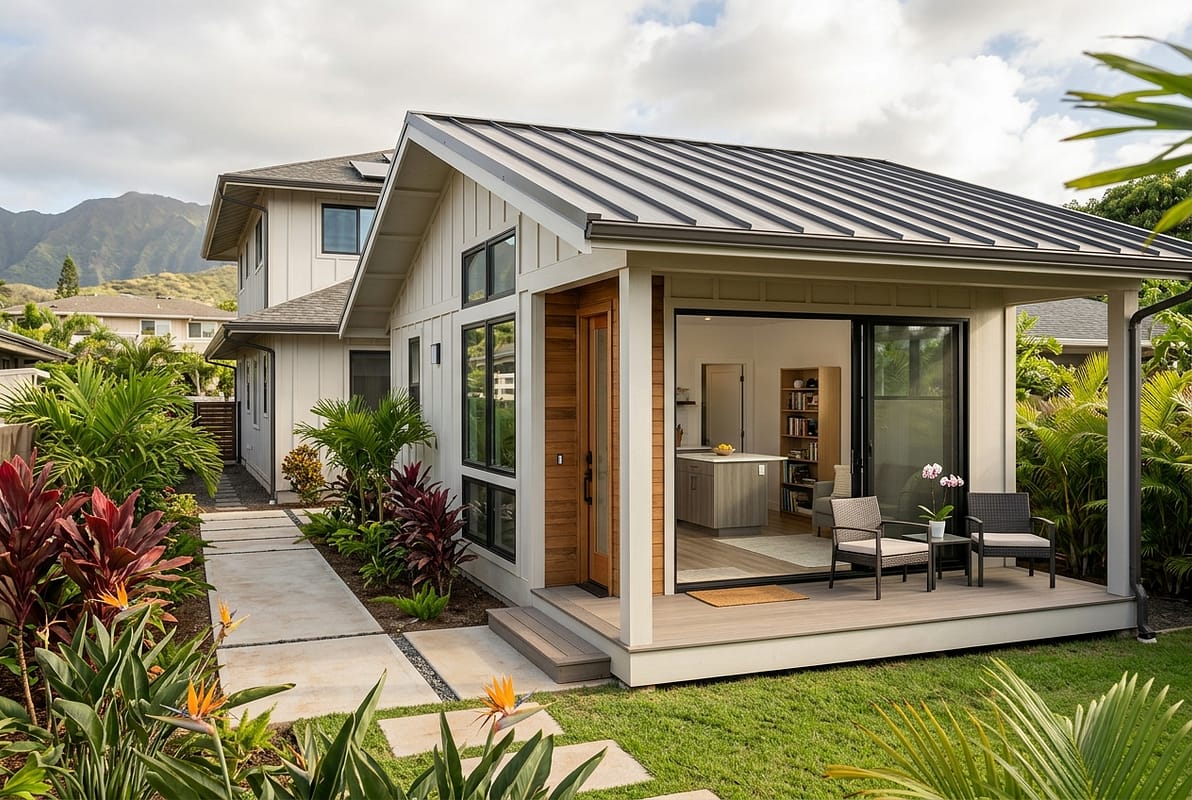
How We Project Monthly Rent from $3,400 to $3,700
The Honolulu Board of REALTORS®’ latest data from July 2026 shows the median rent for a 2-bedroom property on Oahu has hit $3,150 per month.[3] However, new construction commands a premium. For the modern, 800 sq. ft. 2-bedroom ADUs we build for clients in areas like Kailua or Mililani—with air conditioning, in-unit laundry, and modern finishes—we are consistently seeing them rent for $3,400 to $3,700 per month. Tenants are willing to pay more for a private, brand-new unit with amenities that older apartment buildings lack. This premium is a key factor in making the financial model for an ADU work.
Calculating Your ROI with a 2.9% Vacancy Rate
A crucial factor in your return on investment (ROI) calculation is the vacancy rate. According to the latest Hawaii Data Book from DBEDT. The rental vacancy rate on Oahu is still at a critically low 2.9%. In a healthy market, that number should be closer to 5-6%. For an ADU owner, this means you can expect almost zero downtime between tenants. Our clients are consistently getting multiple qualified applicants within days of listing their new units.
Let’s run a quick calculation:
- Annual Gross Rent: $3,500/month x 12 months = $42,000
- Vacancy Loss (2.9%): $42,000 x 0.029 = -$1,218
- Effective Gross Income: $40,782
With an annual income of nearly $41,000, you can see how an ADU quickly becomes a powerful financial asset, helping to justify the initial construction cost over the long term.
How Can I Avoid Delays on My Oahu ADU Timeline?
While some delays in the Oahu ADU timeline are unavoidable (like the DPP review), many of the most costly setbacks can be mitigated with smart planning. The key is to address the biggest risks—permitting errors and price volatility—head-on during the pre-construction phase. Proactive management here is what separates a smooth project from a stressful one.
The Design-Build Advantage: Getting in the Permit Queue Faster
The single best way to keep your project moving is to submit a complete, code-compliant, and error-free permit application on the first try. Every time the DPP has to send your plans back for corrections, you lose your place in line. This can add months to your wait. This is where a design-build approach offers a significant advantage. By having the architect, engineer, and contractor on the same team from day one. We can design the ADU with constructibility and budget in mind. Our pre-construction team uses a 50-point checklist to scrub the plans for common errors before they ever go to the city, dramatically reducing the risk of rejection and keeping the Oahu ADU timeline on track.
Locking in Material Prices to Beat the 4.5% Cost Increase
The second major risk to your budget and schedule is price volatility. We live on an island and are completely dependent on shipping for almost all building materials. The University of Hawaii Economic Research Organization (UHERO) is forecasting a 4.5% rise in residential building costs heading into 2027.[4] For a $400,000 ADU, a six-month delay could mean a price increase of $18,000.
Our strategy is to lock in prices as early as possible. During the long permit wait, we finalize material selections with our clients. We place firm orders with our suppliers for critical items. These include lumber packages, trusses, windows, and cabinets. By signing contracts and putting down deposits, we can secure today’s prices and protect our clients’ budgets from future inflation. This proactive procurement is an essential part of managing a predictable Oahu ADU timeline.
What this means for Hawaii homeowners
Understanding the real 20-month Oahu ADU timeline and the true costs involved is the first step to a successful project. Rushing into this without a realistic plan is a recipe for financial stress and disappointment. Homeowners may consider an ADU for family or for rental income. Here is our straightforward advice. It is based on what we are seeing in 2026.
Embrace the Pre-Construction Phase
Your project’s success is determined in the first 12 months, before any construction starts. You must embrace this long planning and permitting period. If you want to be breaking ground next summer, you need to be hiring your design-build team right now. The 8-10 month permit wait is the biggest factor. The only way to get through it is to get in line as soon as possible.
Secure Your Financing Early and Over-Budget
With a total project cost potentially exceeding $450,000, financing is a major hurdle. Talk to your bank or a mortgage broker at the very beginning of the process. Know exactly how much you can borrow and have your financing lined up before your permit is issued. Given UHERO’s forecast of rising construction costs, delays in financing can directly translate to a more expensive project. Furthermore, your biggest financial risks are in the site work. No one knows for sure what’s under the ground until we start digging. We advise every client to hold a construction contingency of 10-15% of the total project cost in reserve. For a $440,000 project, that’s an extra $44,000 to $66,000 set aside. This covers unexpected issues. For instance, hitting hard rock or discovering an old, undocumented cesspool.
Hire a Professional Team to Manage the Process
Building an ADU is not a DIY project for most people, especially given the complexities of the Honolulu permitting process. A good design-build firm or a contractor-architect team with a long track record on Oahu is your single best investment. They will navigate the DPP, manage subcontractors, and solve the inevitable problems that arise, saving you from costly mistakes and delays that can derail your entire Oahu ADU timeline. A good team makes the entire 20-month journey manageable.
How Do Site Conditions and Lot Size Affect My Oahu ADU Timeline?
Your property’s specific site conditions can dramatically extend your Oahu ADU timeline. This could be by three to six months. It can also add $30,000 to $100,000 or more to your budget. Factors like steep slopes, challenging soil, and limited machinery access require extensive site prep and specialized engineering. Consequently, this adds significant time before our team can even pour the foundation. A flat, clear lot in Ewa is a completely different project from a hillside lot in Manoa with tight access.
Grading, Slopes, and Soil: The Unseen Delays
Many homeowners look at their backyard and see a flat space, but the reality is often more complex. On Oahu, truly level lots are the exception, not the rule. For example, a property in Palolo or Aiea Heights might have a subtle slope that requires significant retaining walls and grading just to create a legal, buildable pad for the ADU.
As a result, one of the first steps is often a geotechnical survey. This report, which costs about $3,500 to $7,000 and takes four to six weeks to complete, tells us exactly what we’re building on—from expansive clay soil to solid volcanic blue rock. It’s a non-negotiable step for a predictable project.
The findings from that soil report directly influence the engineering and construction schedule. For instance, we sometimes discover expansive soils. These are common in Central Oahu. The foundation design must then be more robust, adding cost and complexity. If we hit dense blue rock, which we often see on the North Shore or Waianae Coast, we can’t just dig. We have to bring in hydraulic hammers and heavy equipment to break it up. This single issue can add two to three weeks to the site work phase. It can also add over $25,000. This causes a major ripple effect on the overall Oahu ADU timeline.
Utility Connections and Tight Access Challenges
Getting utilities to the new unit is another area where the property itself dictates the schedule. Connecting to sewer, water, and electrical mains is not a simple task. The distance from the main house to the ADU footprint determines trenching costs. These can run $150 per linear foot or more through difficult terrain. Furthermore, a long or complicated utility run requires detailed plans that need approval from the Board of Water Supply and HECO. This coordination alone can add an unexpected month or two to the pre-construction phase of the Oahu ADU timeline.
Logistical Hurdles on Tight Oahu Lots
Physical access to the build site is perhaps the biggest variable. In older neighborhoods like Kaimuki or Liliha, lots are narrow and houses are close together. We might not be able to fit an excavator or a concrete truck into the backyard. In these cases, our options become limited and more time-consuming. We may have to use smaller equipment. Our team might pump concrete from the street. Or, we may even bring in a crane to lift materials over the existing house. Each of these solutions adds layers of planning, cost, and time. These logistical hurdles are a huge factor in why a realistic Oahu ADU timeline must be customized to your specific lot.
- Manual Excavation: Adds weeks of labor when machinery can’t access the site.
- Crane Services: Requires permits, scheduling, and significant cost ($5,000+ per day) to lift trusses or wall panels.
- Long-Distance Concrete Pumping: Adds thousands to the foundation cost and requires careful coordination.
- Limited Staging Area: Means smaller, more frequent material deliveries, increasing shipping costs from the mainland or neighbor islands and risking delays.
This is where an experienced local contractor makes all the difference. We conduct a thorough site assessment early in the design phase to identify these potential bottlenecks. At Warrior Construction, we build these realities into your project plan from the start, ensuring a smoother process.
Frequently Asked Questions
What is the realistic all-in cost for an 800 sq. ft. ADU on Oahu in 2026?
A realistic all-in budget for a new 800 sq. ft. ADU on Oahu in 2026. It is between $380,000 and $440,000. This figure covers vertical construction and soft costs. You should also hold a contingency of $25,000 to $75,000. This covers site work and utility connections. These are the biggest variables depending on your specific lot conditions.
Can the 20-month Oahu ADU timeline be shortened?
It is very difficult to shorten the overall 20-month Oahu ADU timeline, as the city controls the longest phase. The best way to avoid extending the Oahu ADU timeline is to submit a perfect permit application from the start. You also need your financing secured. This allows us to begin construction immediately upon permit issuance.
How long is just the physical construction part of building an ADU in Hawaii?
The on-site construction phase runs from pouring the foundation to the final punch list items. This typically takes about 7 months for a standard ADU. This part of the process is relatively predictable. It is less variable compared to the pre-construction and permitting phases. Those phases are much longer and more variable.
What is the biggest hidden cost when planning an ADU cost for Oahu?
The biggest hidden cost is almost always site work, specifically utility connections. The cost to trench and run new sewer, water, and electrical lines from the street or main house to the ADU location can vary. We typically see costs from $25,000 to over $75,000. This depends on distance, soil conditions like volcanic rock, and existing infrastructure.
Does my ADU need its own separate utility meters?
An ADU is not required to have a separate water meter from the Board of Water Supply. However, it must have its own separate electrical meter from HECO. You will also need a separate, official address for the unit. Planning for the new meter base and HECO’s installation timeline is a key part of the construction schedule.
Is it possible to build an ADU for under $300,000 in Honolulu?
In 2026, building a new, fully-permitted ADU for under $300,000 is practically impossible on Oahu. Hard construction costs alone average $475-$550 per square foot. Even a small 400 sq. ft. unit would cost nearly $200,000. This is before adding soft costs and any necessary site work. Those additions would easily push the total well over the $300,000 mark.
How much rental income can a new ADU generate on Oahu?
The rental market is very strong. Median 2-bedroom rents are over $3,150. A new, well-built ADU in a desirable neighborhood can command a premium. It can fetch between $3,400 to $3,700 per month. This offers a significant potential return on investment once the unit is completed and generating income.
The journey to building an ADU on Oahu is long. However, the rewards are substantial. It could mean housing for ohana. Or it might be a powerful source of rental income. A significant increase in your property value is also possible. The key is to start with a realistic understanding of the timeline and a solid, all-inclusive budget.
If you’re ready to take the first step in the 20-month process, our team at Warrior Construction is here to help. We can provide a detailed site assessment and a preliminary budget to help you understand what’s possible on your property. Let’s start the conversation and get your project on the right track from day one.
Ready to start planning your Oahu ADU? The 20-month clock is ticking. Contact our ADU specialists at Warrior Construction today to schedule a consultation and get a clear, realistic plan for your project.


