“
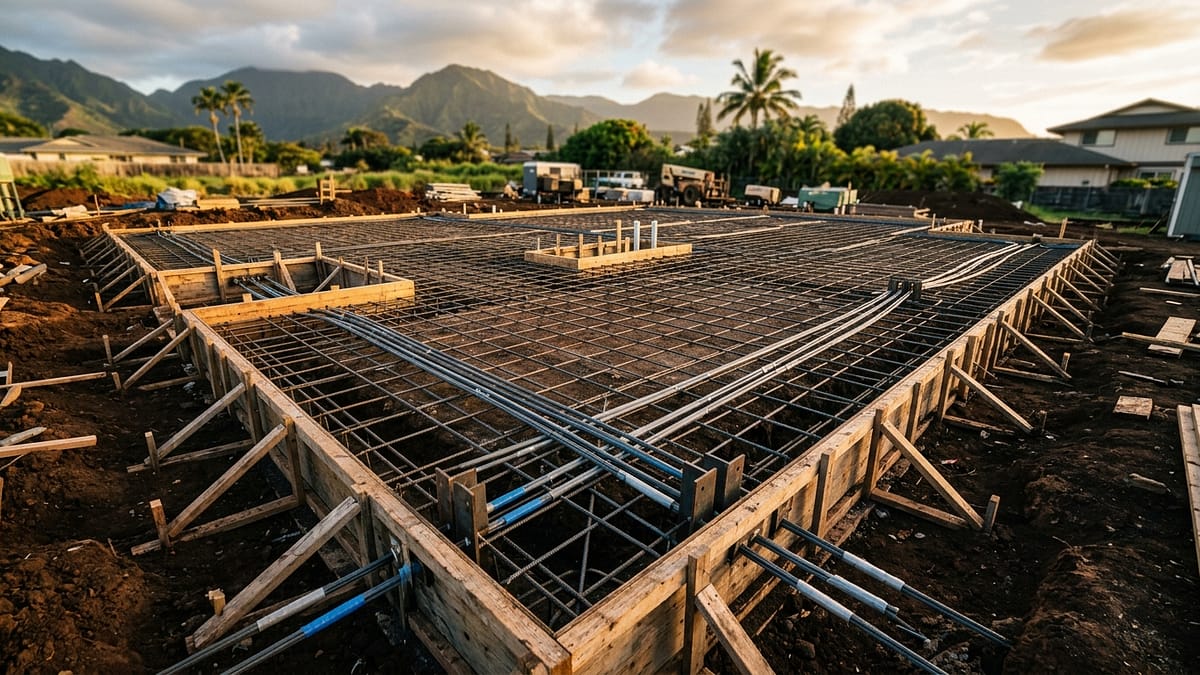
If you plan to build a home anywhere from Hawaii Kai to the Ewa Plain, the most critical decision you’ll make concerns the ground beneath your feet, not the floor plan. For any property with expansive soil Oahu, a specialized foundation is absolutely non-negotiable. Specifically, this usually means a post-tensioned slab. Our team finds this costs an additional $8 to $12 per square foot. This is compared to a standard monolithic slab. This upfront investment sounds significant. However, it’s essential for preventing massive future costs. We are talking about tens, or even hundreds, of thousands of dollars. These are for future structural repairs. At Warrior Construction, our team has spent over two decades tackling Hawaii’s unique geotechnical challenges. We’ve seen firsthand the financial devastation that occurs. This happens when a foundation isn’t built to handle our specific volcanic clay.
Consequently, this is not merely about building to code. It’s about constructing a home that will endure for generations. This is without constant, costly battles against nature. The forces exerted by the expansive soil Oahu is known for are powerful enough to lift, crack, and ultimately compromise a poorly designed foundation. Unfortunately, we often see homeowners and even some less experienced builders make critical errors during planning that lead to disaster. Most importantly, these mistakes are almost always irreversible without massive expense. We actively work to prevent these errors from the outset.
In this guide, we will walk you through the most common and costly issues we encounter when building on the expansive soil Oahu presents. Furthermore, we’ll break down the real costs for you. We will cover the latest engineering solutions recommended by the University of Hawaii. We will also detail the long-term financial implications of getting it wrong. Think of this as the conversation we’d have over coffee. This would happen before even looking at a blueprint. It’s the essential knowledge you need to protect your biggest investment.
What Is Expansive Soil and Why Is It a Problem on Oahu?
First and foremost, you should not underestimate what you are up against. The expansive soil Oahu contains is a type of volcanic clay that behaves like a powerful, slow-moving sponge. When it gets wet during our rainy seasons, it swells with incredible force. Subsequently, during dry spells, it shrinks and cracks. This constant shrink-swell cycle exerts tremendous pressure on anything built on it, especially a rigid concrete foundation. Therefore, it’s not a question of if the ground will move, but how much and how often.
From Hawaii Kai to the Ewa Plain: Identifying High-Risk Zones
This is not a niche issue confined to a few neighborhoods. In fact, a huge portion of Oahu’s residential land is challenging. This is due to its geological makeup. It is classified as having moderate to high shrink-swell potential. While our team sees these challenging conditions island-wide, the most notorious areas form a wide arc across the southern portion, including:
- East Honolulu: Neighborhoods stretching from Hawaii Kai, through Aina Haina and Kaimuki.
- Central Oahu: Large swaths of Mililani, Waikele, and parts of the Pearl City-Aiea ridge.
- The Ewa Plain: The rapidly developing areas of Kapolei, Ewa Beach, and Makakilo are prime examples of highly expansive soil Oahu is famous for.
Just because your lot looks flat and stable doesn’t mean the soil beneath is. For example, on a recent project in Kapolei, our client’s property appeared perfect. But the geotechnical report showed a plasticity index. It was entirely off the charts. Ignoring that report would have been a catastrophic error. As a result, a professional site evaluation is non-negotiable for anyone serious about building on clay soil hawaii.
The Shrink-Swell Cycle: How Volcanic Clay Damages Foundations
To fully understand the damage, picture your home’s foundation resting on a giant sponge. When heavy rains hit, the edges of the sponge (the soil around your foundation’s perimeter) absorb water and swell upwards. This phenomenon, called “heave,” lifts the edges of your slab while the center, which stays drier under the house, remains lower. This differential movement creates immense stress, leading to classic signs of foundation failure:
- Large, diagonal cracks in your drywall, especially around door and window frames.
- Doors that stick or won’t close properly because the frames are no longer square.
- Visible cracks in the concrete slab itself or in exterior brickwork.
- Floors that become noticeably unlevel.
During a dry summer, the process reverses. The soil around the perimeter shrinks and pulls away from the foundation, causing the edges to settle downwards. This constant seesaw of movement, year after year, eventually compromises the structural integrity of a standard foundation. For this reason, before any construction begins, obtaining a thorough geotechnical report oahu is the only way to know the exact characteristics of your soil and design a foundation that can withstand these forces from the expansive soil Oahu has.
How Much More Does a Post-Tensioned Slab Cost in Hawaii?
When you are faced with the reality of expansive soil Oahu, choosing a foundation based on upfront cost rather than long-term performance is a major misstep. A post-tensioned slab will cost you an extra $8 to $12 per square foot over a standard monolithic slab. For a typical 2,000-square-foot home, this translates to a premium of about $16,000 to $24,000. While it’s a number that gives some homeowners pause, skimping here is the definition of being penny-wise and pound-foolish.
Cost Breakdown: A Standard Slab vs. a Post-Tensioned System
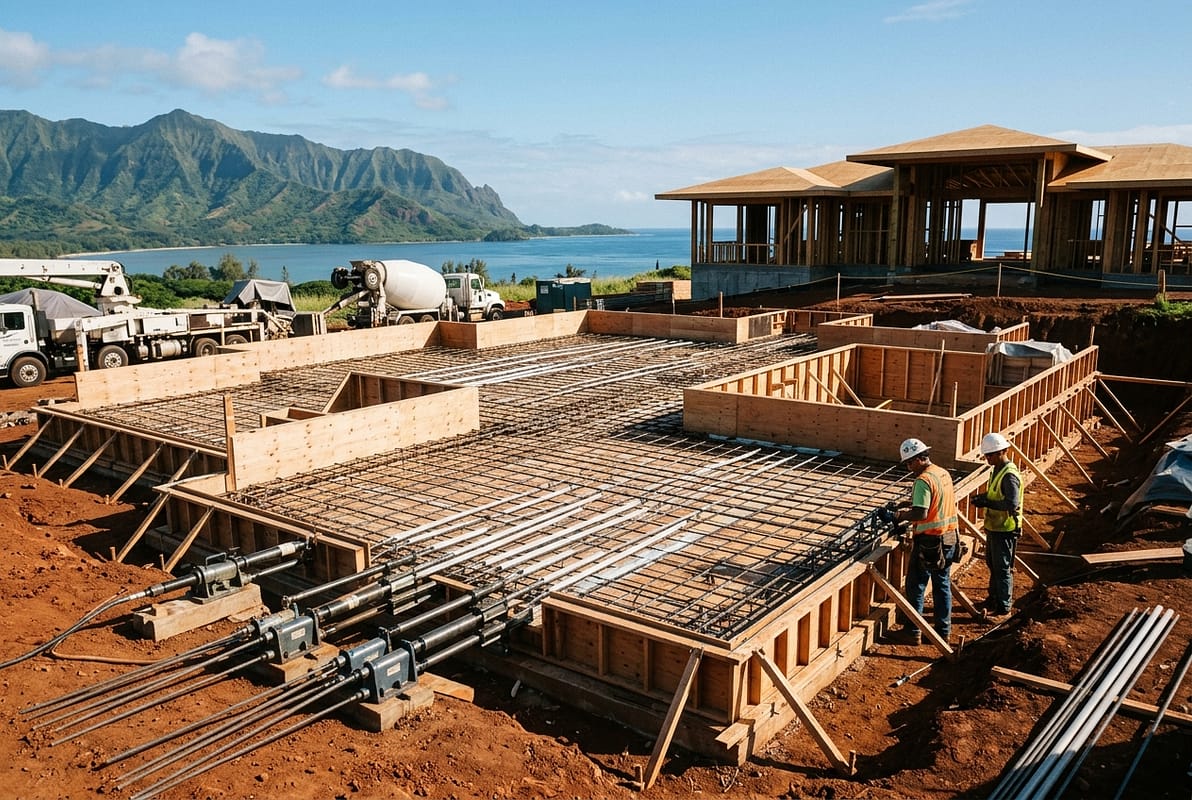
Let’s break down the numbers for a hypothetical 2,000 sq. ft. foundation to see where the extra money goes. A standard monolithic slab is relatively simple. It’s a single pour of concrete. It has a grid of steel rebar for tensile strength. In contrast, a post-tensioned slab is a more complex, engineered system designed specifically for problematic soils.
Here’s a simplified comparison of the foundation cost oahu for these two systems in 2026:
| Line Item | Standard Monolithic Slab (2,000 sq ft) | Post-Tensioned Slab (2,000 sq ft) |
|---|---|---|
| Engineering & Design | $3,000 – $5,000 | $6,000 – $9,000 (Requires specialized engineering) |
| Formwork & Prep | $8,000 – $10,000 | $8,000 – $10,000 |
| Reinforcement Materials | $6,000 (Rebar) | $12,000 (Sheathed steel tendons/cables) |
| Concrete (4,000 PSI Mix) | $15,000 | $15,000 |
| Specialized Labor | $0 | $7,000 (Certified post-tensioning crew) |
| Estimated Total | $32,000 – $36,000 | $48,000 – $56,000 |
| Cost Per Sq. Ft. | $16 – $18 | $24 – $28 |
The key differences are the cost of the high-strength steel tendons and the absolute necessity of a certified crew to stress them with hydraulic jacks after the concrete cures. This process puts the slab under constant compression, essentially squeezing it together. This gives it the strength to float over the moving expansive soil Oahu is known for, without cracking. Consequently, the increased post tensioned slab cost hawaii directly reflects this higher level of engineering and specialized labor.
Is the Extra Investment Worth It? A Long-Term Value Analysis
Absolutely, and it’s not even a close call. The Honolulu Board of REALTORS®’ latest data for 2026 clearly shows something. Underpinning a failing foundation for a small 1,200 sq. ft. home is expensive. It now costs between $50,000 and $75,000.[1] That’s more than double the premium for building it right the first time. Furthermore, homes with visible foundation issues take a 15-20% hit on their valuation. Lenders are extremely wary of financing properties with structural defects, making them difficult to sell at any price. In short, paying an extra $20,000 upfront on a new build is wise. It can avoid a $75,000 repair. It also prevents a $150,000 loss in equity. This makes it one of the smartest financial decisions a homeowner on Oahu can make when facing expansive soil Oahu.
What Concrete Mix Does UH Recommend for Volcanic Soil?
Assuming all concrete is the same is a critical error. For the unique challenges of expansive soil Oahu, the specific mix design is just as important as the reinforcement system. The University of Hawaii College of Engineering’s 2026 geotechnical report has new recommendations. It now formally recommends a minimum 4,000 PSI concrete. This concrete must include specific sulfate-resistant admixtures. These are for all new construction in expansive soil zones.[2] This isn’t just a suggestion; for our team at Warrior Construction, it’s our standard practice. You can have a perfectly engineered post-tensioned slab. But filling it with a standard, low-grade concrete mix is a mistake. That is building in a future failure. The soil doesn’t just push on the foundation; it can chemically attack it.
Why 4,000 PSI is the New Minimum
PSI stands for “pounds per square inch,” and it measures the concrete’s compressive strength. A typical residential slab used to be 2,500 or 3,000 PSI. However, we now consider 4,000 PSI the baseline. This applies to these specific soil conditions. Upping the requirement to 4,000 PSI provides a denser, less permeable, and significantly stronger final product. Most importantly, this added strength is crucial for two reasons:
- Resisting Bending Forces: A stronger concrete mix better resists the bending and flexing forces (tensile stresses) imposed by heaving soil, especially when combined with a post-tensioning system.
- Durability: Denser concrete has fewer microscopic pores, making it more resistant to moisture and chemical intrusion from the ground, which leads to a longer lifespan.
This is not just about raw strength. Our team must coordinate carefully with our suppliers like Ameron or Hawaiian Cement to ensure the specified concrete mix for volcanic soil is available and can be delivered to the job site in places like Kailua or the North Shore without compromising its integrity. The logistics of a concrete pour in Hawaii are complex, and we plan every step meticulously.
The Role of Sulfate-Resistant Admixtures
This is the part many builders miss. Our volcanic soils can be rich in sulfates. When water seeps through the ground, it dissolves these sulfates, which then penetrate porous concrete. Over time, a chemical reaction occurs that forms new crystals within the concrete matrix. These crystals expand, creating immense internal pressure that causes the concrete to spall, delaminate, and crumble from the inside out. In essence, it’s a cancer for your foundation.
Sulfate-resistant admixtures are important for Hawaii construction. They often incorporate Type V cement or specific pozzolans like fly ash. These are chemical agents added to the concrete mix at the plant. They alter the concrete’s chemistry to make it inert to sulfate attack. While this adds a small additional cost per cubic yard of concrete, it’s essential for the foundation’s long-term durability in our island’s unique geological environment, particularly in areas with expansive soil Oahu.
What Are the Real Site Prep Costs Before Pouring a Foundation?
A well-designed foundation can still fail if the ground it sits on isn’t properly prepared. We often see homeowners under-budget for and rush through site preparation and drainage. The goal is to create a stable, predictable base for the foundation. We must also manage the one thing that activates expansive soil. That one thing is water. In 2026, basic excavation and grading for a 10,000 sq. ft. lot on Oahu now costs between $65,000 and $70,000—and that’s before adding new, mandatory stormwater systems.[3]
Excavation and Grading: The First Big Line Item
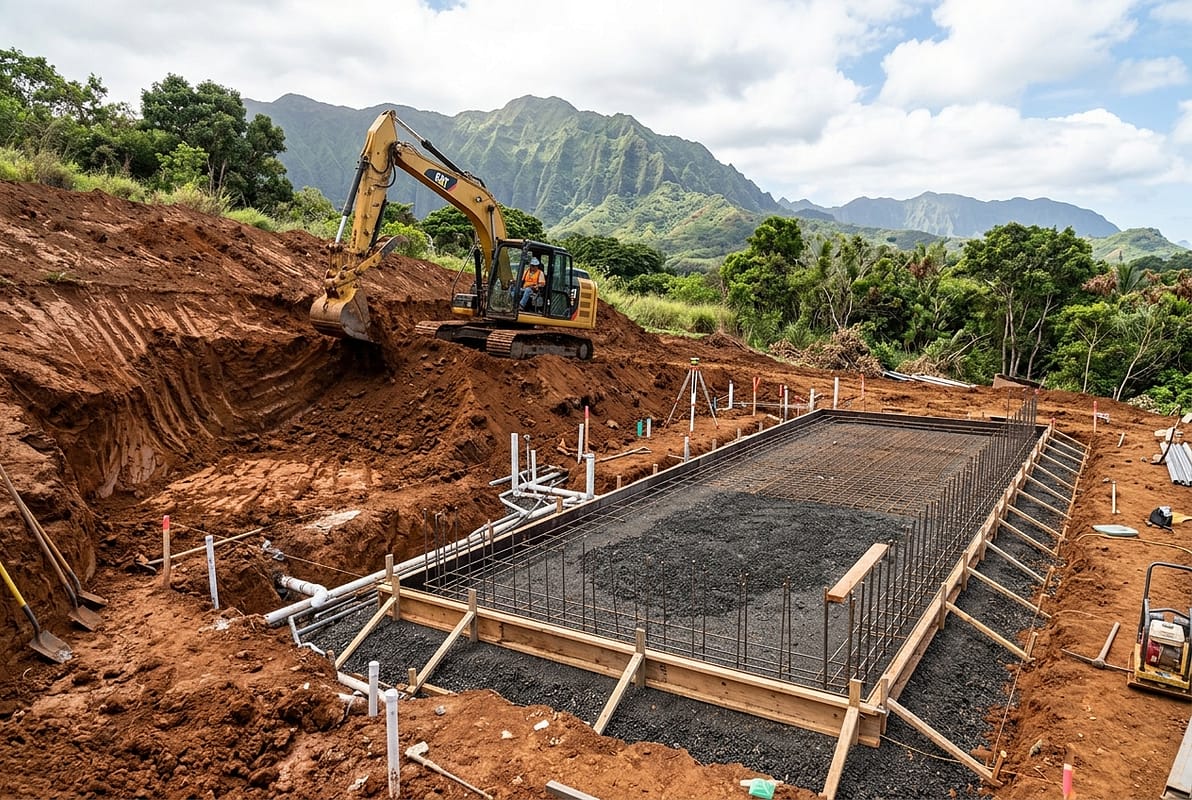
Proper site prep for expansive soil oahu goes far beyond simply leveling the dirt. It’s an engineered process that we manage carefully:
- Over-Excavation: We typically have to excavate 2 to 4 feet of the most highly reactive topsoil from the entire building footprint.
- Importing Engineered Fill: This native soil is then replaced with a non-expansive, structural fill material (like crushed coral or basalt) that is brought in by the truckload.
- Moisture Conditioning: The new fill is laid down in thin layers, or “lifts,” and our team moisture-conditions and mechanically compacts each lift to a specific density (usually 95% of its maximum dry density).
- Third-Party Testing: A third-party inspector must be on-site to test and certify that each lift meets the compaction requirements specified by the geotechnical engineer.
This process is expensive and time-consuming, driven by high diesel costs for heavy equipment and tipping fees at Waimanalo Gulch. Nevertheless, it creates a stable building pad that isolates the foundation from the worst of the soil’s movement.
New BWS Rules: Factoring in Stormwater Management
Controlling water doesn’t stop once the pad is built. As of early 2026, the Honolulu Board of Water Supply (BWS) is enforcing much stricter rules for on-site stormwater management.[4] For any project that disturbs more than 5,000 square feet, you are now required to submit a detailed grading and drainage plan showing how you will capture and retain rainwater on your own property. This is especially true for hillside lots in areas like Tantalus or Waialae Iki.
For our clients, this means incorporating systems like dry wells, rain gardens, or underground retention tanks. The goal is to prevent runoff. Critically for the foundation, we must prevent water from pooling near the slab. This stops it from over-saturating the soil. These new BWS rules can easily add $15,000. They also add an extra month of review time. This is with the Department of Planning and Permitting (DPP). It all happens in your pre-construction phase. Consequently, a good contractor will plan for this from day one, especially on lots with known expansive soil Oahu.
What Happens If You Don’t Build the Right Foundation?
The final and most painful error is this. It is failing to connect the dots between an upfront investment. There are massive long-term financial consequences. If you ignore the advice of a geotechnical engineer and use the wrong foundation on expansive soil Oahu, the outcome is predictable: major structural damage that costs anywhere from $50,000 to $75,000 for basic repairs, and a permanent scar on your home’s resale value, often by 15-20%.[1]
The Impact on Your Home’s Resale Value
Imagine trying to sell your home in a competitive market like Honolulu. Your property looks great, but the home inspector finds significant differential settlement, slab cracks, and recommends a structural engineer’s evaluation. That’s a huge red flag for any potential buyer, who sees not just a current problem, but an ongoing, expensive one.
According to the Honolulu Board of REALTORS®, this scenario plays out all the time in older neighborhoods like Manoa or Kaimuki. A home that should be worth $1.5 million might only get offers of $1.2 million, if it gets any at all. Buyers will demand a massive credit for the repairs. Lenders may also refuse to finance the loan altogether. This will happen until the foundation is certified as sound. As a result, initial savings of $20,000 on the foundation are deceptive. They can easily evaporate into a $300,000 loss in equity. This happens when it’s time to sell the home.
Understanding Foundation Repair Costs in Honolulu
Fixing a failed foundation is not a simple patch job; it’s a highly invasive and expensive process. Some common repair methods for homes built on expansive soil Oahu include:
- Underpinning: This involves excavating sections under the existing foundation and pouring new concrete footings or driving steel piers deep into the ground to more stable soil or bedrock. This is the $50,000-$75,000+ job for a small home.
- Epoxy Injection: For smaller, non-structural cracks, a high-strength epoxy can be injected to seal them. According to UHERO’s 2026 construction forecast, costs for this type of specialized work are rising fast, now around $275 per linear foot.
- Slab Jacking (Mudjacking): This involves pumping a slurry mixture under a sunken slab to lift it back into place. It’s less common for widespread expansive soil issues but can be used in certain situations.
These aren’t just line items on a budget. They involve heavy equipment in your yard. Expect dust and disruption inside your home. There is also the very real possibility. You might have to move out during the repairs. Our structural repair team is often called in to fix problems that were entirely preventable from the start.
What Does a Geotechnical Report for Expansive Soil on Oahu Actually Tell Us?
A geotechnical report is the foundation’s roadmap, plain and simple. It tells our structural engineer precisely how much your soil will swell and shrink with moisture changes. It also details its load-bearing capacity. This provides the exact data needed to design a foundation that won’t crack. Essentially, it takes the huge unknown of building on tricky ground and turns it into a solvable engineering problem.
Before we can even think about a foundation design, we have to understand the ground we’re working with. This isn’t guesswork. It involves bringing a specialized geotechnical engineering firm to your property with a drill rig. Their team will drill several boreholes, typically three to five for a standard residential lot, going down 15 to 25 feet deep. They extract core samples of the soil at different depths. The soil five feet down might be completely different. It can differ from the soil twenty feet down. These physical samples are then bagged, labeled, and taken back to a local laboratory for analysis. The on-site work usually takes a day, but the lab work and final report generation can take three to four weeks. On Oahu, a comprehensive geotechnical report for a residential project typically costs between $5,000 and $8,000.
The On-Site Borings and Lab Testing Process
In the lab, technicians run a series of tests that give us hard numbers. They’ll perform tests to determine the soil’s moisture content, density, and classification. Most importantly for us, they conduct Atterberg limits tests to find the Plasticity Index (PI), a key indicator of shrink-swell potential. They also run swell-consolidation tests. In these, they literally add water to a confined soil sample. This measures how much it expands under a specific load. It mimics what will happen under your house when heavy rains hit. The results are not just a pass/fail grade; they provide a detailed profile of your land. Furthermore, the report identifies the depth of the water table. It also notes any potential for soil liquefaction during an earthquake. This is another critical consideration here in Hawaii. This whole process is the only way to get empirical data. It is required by the City and County of Honolulu’s building code. This applies to areas with known soil issues.
Translating Soil Data into Foundation Design
The final report, usually a 40 to 60-page document, is dense with data, charts, and recommendations. It doesn’t just say, “You have bad soil.” It quantifies the problem. For instance, the report will specify the soil’s bearing capacity in pounds per square foot (PSF). We might find that the top layer of soil can only safely support 1,500 PSF. This is not enough for a conventional slab. However, the soil at ten feet down might have a capacity of 3,000 PSF.
This is the data our structural engineer uses to design the foundation system. It’s what tells us if we need a post-tensioned slab, a mat slab, or even piers drilled down to more stable soil. The report’s recommendations are the basis for the engineer’s calculations. When we’re dealing with the highly reactive expansive soil Oahu is known for, this step is non-negotiable. It dictates everything from the thickness of the concrete slab to the amount and tensioning sequence of the steel tendons inside it. This detailed analysis separates a home that will last for generations from one that will develop major structural cracks within a decade.
Key Metrics We Look For in the Report
When our team reviews a geotechnical report, we immediately focus on a few critical numbers that will drive the entire project’s engineering and budget. These are the data points that tell us exactly what kind of challenge we’re facing with the expansive soil Oahu on a particular lot.
- Plasticity Index (PI): A PI above 25 signals significant shrink-swell potential. We’ve seen readings over 50 in parts of Kapolei, which demands a robust engineering solution.
- Swell Potential: Measured as a percentage. A value of 3% or higher means the soil can increase in volume by that amount when saturated, requiring serious engineering controls.
- Allowable Bearing Capacity: Given in pounds per square foot (PSF), this tells the engineer how much weight the soil can support without failing. A low number often means a more expensive foundation.
- Recommended Foundation Type: The report will recommend specific foundation options (e.g., post-tensioned slab-on-grade, structural mat slab) suitable for the site’s specific expansive soil Oahu conditions.
- Site Preparation Guidelines: It details required over-excavation, moisture conditioning of the soil pad, and the type of fill material to use. This directly impacts the site work budget.
How Should You Approach a Build on Oahu’s Expansive Soil?
Your approach should be proactive, informed, and focused on long-term value, not short-term savings. Navigating the complexities of building on Oahu’s challenging soil boils down to a few key, non-negotiable principles. If you are planning a new custom home or a major addition, your goal is clear. Your primary goal must be to build a foundation. It needs to be engineered specifically for your lot’s conditions. Treating the foundation as an area to cut costs is very dangerous. It is the single most dangerous financial decision. You can make this in the entire construction process.
Here is your action plan for success:
- Prioritize the Geotechnical Report: Before you hire an architect or fall in love with a floor plan, invest in a comprehensive geotechnical report oahu. This $5,000 to $8,000 report is the roadmap for your entire project. Do not proceed without it.
- Budget for a Post-Tensioned Slab: Assume your project will require a post-tensioned foundation. Build the $8-$12 per square foot premium into your budget from day one. See it as essential insurance against the expansive soil Oahu has, not an optional upgrade.
- Focus on Water Management: Your site plan must aggressively manage water. This means proper grading to slope water away from the house. We install functional gutters and downspouts. They discharge far from the foundation. We also ensure compliance with all BWS rules for on-site stormwater retention.
- Hire an Experienced Local Team: Your project’s success hinges on a team—builder, architect, and engineer—with a proven track record of building on expansive soil oahu. Verify their experience and check their references specifically for this type of work. Ask to see examples of projects in Kapolei or Mililani.
- Don’t Value-Engineer the Foundation: When looking for cost savings, look at finishes, fixtures, or landscaping. Never compromise on the structural elements below ground. The money saved today will be spent tenfold on repairs tomorrow.
By following these steps, you shift from a reactive position. You move away from fixing future problems. Instead, you proactively build a resilient, durable home. This protects your family and your financial investment for decades to come.
Frequently Asked Questions
How do I know for sure if my Oahu property has expansive soil?
Visual inspection is unreliable. The only definitive way to know is by hiring a licensed geotechnical engineer to perform soil testing. They will take core samples from your property. These are then analyzed in a lab. This determines the soil’s composition and Plasticity Index. The Plasticity Index is the key measure of its shrink-swell potential. This information is compiled into a formal geotechnical report, which is essential for any construction on suspected expansive soil Oahu.
What are the early warning signs of foundation problems in an existing home?
The earliest signs are often subtle. For instance, look for doors that begin to stick. They might also not latch properly. Look for small hairline cracks appearing in the drywall. These are usually above door and window frames. Additionally, windows that become difficult to open or close are also a clear sign. Outside, look for cracks in the visible portion of your slab or any brickwork. If you see these signs, especially in a newer home, it’s time to call a structural engineer.
Is a post-tensioned slab my only option for the expansive soil Oahu has?
For most residential projects on expansive soil oahu, a post-tensioned slab-on-grade foundation is the most common and cost-effective engineered solution. However, in cases of extremely reactive soil, an engineer might specify a different system. This also applies to properties on steep hillsides. They might specify a drilled pier and grade beam foundation. Another type of deep foundation system could also be used. These are typically much more expensive than a post-tensioned slab but provide superior stability in extreme conditions.
How much does a geotechnical report cost on Oahu in 2026?
For a standard single-family residential lot, you should budget between $5,000 and $8,000 for a comprehensive geotechnical report oahu. The cost can increase for larger or more complex properties. This includes those on a steep slope. It also includes properties with difficult access for drilling equipment. While it may seem like a high upfront cost, it’s a tiny fraction of the potential $50,000+ repair costs it helps you avoid when dealing with expansive soil Oahu.
Can I still get a home loan if an inspection reveals foundation issues?
It is extremely difficult. Most conventional lenders will require a clean bill of health from a structural engineer before approving a loan. If an inspector finds issues, lenders will typically require the seller to perform repairs. These repairs can cost upwards of $50,000. They must be completed before the sale can close. As a result, this makes properties with known foundation problems very challenging to sell.
Does my standard Hawaii homeowner’s insurance cover damage from expansive soil?
Almost certainly not. Standard homeowner’s insurance policies in Hawaii, like on the mainland, explicitly exclude damage from earth movement. This exclusion covers earthquakes, landslides, sinkholes, and damage from soil expansion and contraction. Consequently, the financial responsibility for preventing or repairing this type of damage falls entirely on the homeowner.
How much longer does a post-tensioned foundation take to build?
The process adds about one to two weeks to the construction schedule compared to a standard monolithic slab. This extra time accounts for the careful placement of the tendon grid and, most importantly, the waiting period after the concrete pour. The concrete must reach a specific strength, usually around 3,000 PSI, before the tendons can be stressed by a specialized crew. This curing and stressing process typically takes 7-10 days.
Building a home on Oahu is a significant undertaking. The foundation is the single most important component. It ensures the home’s longevity and value. Getting it right on our unique volcanic clay soils isn’t just a matter of following code. It requires local expertise, specialized engineering, and a commitment. We must invest in the right systems from the very beginning. Ultimately, the peace of mind that comes from knowing your home is built on a solid, stable foundation is priceless.
If you’re planning a new home construction project on land with potential soil issues, don’t leave your foundation to chance. The team at Warrior Construction has the local knowledge and technical experience. We will guide you through the entire process. This goes from geotechnical analysis to the final concrete pour. We build foundations designed to last a lifetime in Hawaii, specifically for the challenges posed by expansive soil Oahu.
Protect your investment from the ground up. If you’re ready to discuss your project and ensure your foundation is engineered for Oahu’s unique challenges, contact our team at Warrior Construction for a consultation today.
References
- Honolulu Board of REALTORS® Q3 2026 Home Repair Cost vs. Value Report
- University of Hawaii College of Engineering Geotechnical Research: Volcanic Soil-Concrete Interaction 2026 Report
- Pacific Business News: Oahu Excavation Costs Hit Record Highs
- Honolulu Board of Water Supply: 2026 Residential Grading & Stormwater Rules


