Hawaii’s Construction Forecast 2024-2026: What Homeowners and Developers Need to Know About Growth, Decline, and Island-Specific Opportunities
Hawaii’s dynamic construction landscape is set for a period of both challenges and opportunities from 2024 through 2026. As an expert general contractor deeply rooted in the islands, Warrior Construction understands that navigating this environment requires precise insights for homeowners and developers alike. This forecast provides a detailed look into the economic indicators, project pipelines, and island-specific trends shaping Hawaii’s building industry.
Hawaii’s Construction Economy: 2024-2026 Overview
The construction sector is a vital pillar of Hawaii’s economy. The coming years are anticipated to bring a mixed bag of trends, influenced by both private investment and significant public sector spending.
Key Takeaways: Growth, Decline, and Stabilization
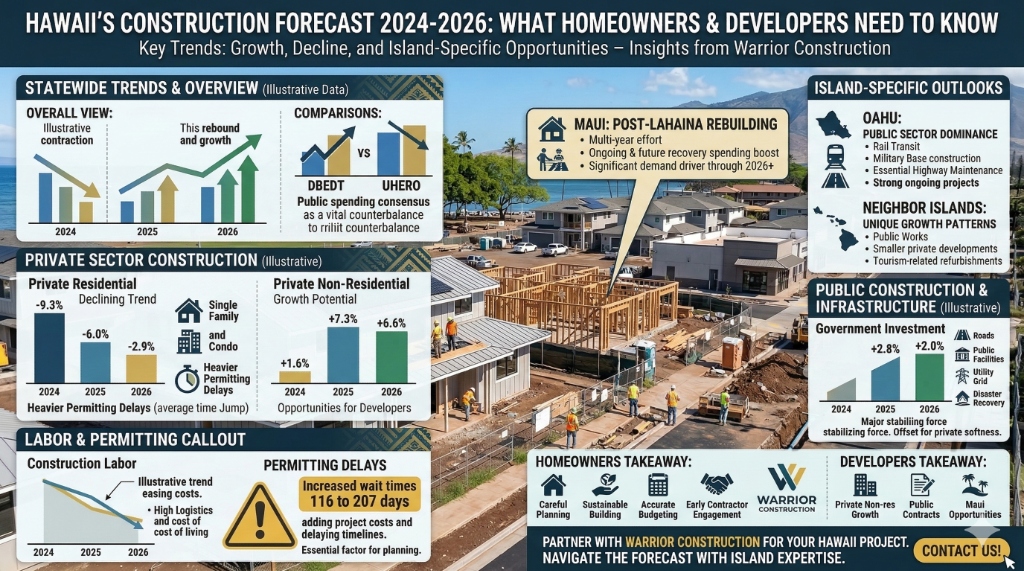
Overall, the statewide construction picture points to an initial dip followed by a rebound. The Department of Business, Economic Development & Tourism (DBEDT) forecasts a 4.2% decrease in real construction put-in-place for 2024, followed by growth of 2.2% in 2025 and 2.0% in 2026. Construction sector employment is also expected to decline slightly in 2024 before stabilizing in subsequent years [1].
Diverging Forecasts: DBEDT vs. UHERO Insights
While DBEDT anticipates an initial contraction, the University of Hawaii Economic Research Organization (UHERO) projects overall real construction spending to rise by 2.5% in 2025 and 3.0% in 2026, indicating a more direct upward trajectory after mid-2024 stabilization of private construction. Both agree on the significant boost expected from public construction activity [1, 2].
Statewide Construction Projections (2024-2026)
A closer look at the numbers reveals specific trends within spending and employment.
Overall Real Construction Put-in-Place & Spending
- DBEDT: Real construction put-in-place is projected to decrease by 4.2% in 2024, then grow by 2.2% in 2025 and 2.0% in 2026 [1].
- UHERO: Overall real construction spending is forecast to increase by 2.5% in 2025 and 3.0% in 2026 [2].
Construction Sector Employment Trends
The construction labor market experienced some easing at the end of 2023. DBEDT projects a 1.7% decline in construction sector employment in 2024, followed by stabilization in 2025 and 2026 [1, 2]. This trend could influence labor availability and project costs in the short term.
Deep Dive: Private Sector Construction Trends
The private sector remains a crucial, albeit complex, component of Hawaii’s construction activity.
Residential Construction: Outlook for Homeowners
Private residential construction is expected to face headwinds. DBEDT forecasts declines of 9.3% in 2024, 6.0% in 2025, and 2.9% in 2026 [1]. UHERO notes a sharp fall in residential permitting, though the pace of decline has recently eased [2]. This suggests a more cautious approach from developers and homeowners in the near term.
Non-Residential Construction: Developer Opportunities
In contrast to residential, the non-residential private sector shows promise. DBEDT projects growth of 1.6% in 2024, accelerating to 7.3% in 2025 and 6.6% in 2026 [1]. This indicates potential opportunities for commercial, industrial, and institutional developers, despite UHERO reporting a 12% decline in nonresidential permitting at the end of 2023 [2].
Permitting Trends Impacting Private Projects
Permitting delays continue to be a significant challenge across Hawaii. The average time for a building permit increased from 116 days in 2017 to 207 days in 2022, adding potentially millions to project costs and delaying timelines [3]. While efforts are underway to streamline processes, such as Maui’s initiatives and Oahu’s online permitting, these delays will continue to be a critical factor for private developers and homeowners planning projects. Understanding the local permitting landscape is essential for successful project planning.
The Driving Force: Public Construction & Infrastructure
Public sector projects are poised to be a major stabilizing and growth-inducing force for Hawaii’s construction industry.
Major Public Projects Fueling Growth Across Islands
Public construction is forecast by DBEDT to decline by 2.9% in 2024, but then rebound with growth of 2.8% in 2025 and 2.0% in 2026 [1]. UHERO emphasizes that robust public construction activity will provide a significant boost to the overall economy [2].
Government Spending’s Role in Economic Stability
Government investment in infrastructure, public facilities, and disaster recovery will play a crucial role in offsetting some of the private sector’s softening. These projects ensure a baseline of activity, support employment, and lay the groundwork for future economic development.
Island-Specific Outlooks & Opportunities
While statewide trends provide a general picture, each island presents unique circumstances and opportunities.
Oahu: Public Sector Dominance (Rail, Highways, Military)
Oahu is expected to continue experiencing strong public sector project activity. This includes ongoing work on the rail transit system, essential highway maintenance and repair, and significant military construction projects [2]. These initiatives will drive a substantial portion of Oahu’s construction activity in the coming years.
Maui: The Future of Post-Lahaina Recovery & Rebuilding
Maui’s construction future is heavily influenced by the imperative of post-Lahaina disaster recovery. While immediate efforts have been extensive, UHERO indicates that the significant recovery spending is largely anticipated to occur in the future, suggesting a sustained boost for Maui’s construction sector beyond 2024 [2]. This will be a multi-year effort, requiring substantial planning and resources.
Neighbor Islands: Unique Growth Patterns & Projects
The Neighbor Islands, while benefiting from statewide trends, will also experience unique growth patterns. Public works projects, smaller-scale private developments, and tourism-related refurbishments will contribute to their individual construction outlooks. Understanding local regulations and community needs is paramount for any project outside of Oahu and Maui.
Implications for Homeowners and Developers
Understanding these forecasts is essential for making informed decisions.
Navigating Market Fluctuations: Strategic Planning
Both homeowners considering renovations or new builds and developers planning large-scale projects need a strategic approach. Given the anticipated fluctuations, meticulous planning, robust feasibility studies, and flexibility will be key to success.
What this means for Hawaii homeowners
For Hawaii homeowners, the forecast suggests a period where careful consideration is paramount. While residential construction is predicted to decline, it doesn’t necessarily mean costs will plummet across the board, particularly with persistent permitting delays and the high cost of living. If you’re considering a major renovation or new home construction, now is the time to engage with experienced contractors for accurate budgeting and timeline estimates. Focus on sustainable building practices and long-term value. Exploring options for new construction or significant renovations requires a clear understanding of current market conditions and a reliable partner to navigate them.
Labor Market Insights: Availability and Costs
The easing of construction labor markets noted by UHERO could potentially mitigate some labor cost increases. However, the overall cost of materials, supply chain dynamics, and Hawaii’s unique logistical challenges will continue to influence project budgets. Experienced contractors can help you understand the current Hawaii construction costs.
Best Practices for New Project Feasibility
For new projects, whether residential or commercial, conducting thorough due diligence is critical. This includes detailed cost analysis, understanding current permitting timelines, and identifying reliable partners. Partnering with a general contractor who has deep local knowledge and strong relationships can significantly improve project feasibility and execution.
Client FAQs: Your Questions on Hawaii’s Construction Future
Will construction costs go down in Hawaii 2024-2026?
While labor markets have eased, overall construction costs in Hawaii are influenced by many factors, including material costs, supply chain, and permitting delays. A significant decrease across the board is unlikely, though specific material costs may fluctuate. Strategic planning with an experienced contractor can help manage costs effectively.
Is it a good time to build a house in Hawaii?
The residential construction sector is forecast to decline, which means there may be less competition for contractor services. However, permitting delays persist, and overall costs remain high. It’s a good time to build if you have a well-defined project, secure financing, and partner with a knowledgeable contractor to navigate the complexities.
What are the biggest construction projects planned?
Major public projects, particularly on Oahu (rail, highway maintenance, military bases), and future recovery and rebuilding efforts on Maui (post-Lahaina) will dominate the landscape. Private non-residential projects are also expected to see growth.
How does the economy influence Hawaii’s construction?
Hawaii’s construction industry is directly tied to the broader economic health. Factors like tourism performance, interest rates, employment figures, and government spending all impact private investment and public funding for projects. Current forecasts show public spending acting as a vital counterbalance to some private sector softening.
Resources for Staying Informed on Construction Trends
Staying abreast of the latest economic reports and industry news is vital. Key resources include:
Frequently Asked Questions
What are the expected construction costs in Hawaii from 2024 to 2026?
Construction costs in Hawaii are projected to rise due to increased material costs and labor shortages. Homeowners should budget for these higher expenses, especially when considering the logistics of transporting materials to islands like Maui and Oahu.
How might the Hawaii construction regulations change by 2026?
Hawaii’s construction regulations are expected to adapt to more stringent environmental standards, particularly in sustainable building practices, to preserve the island’s natural resources. Homeowners may need to comply with updated building codes aimed at enhancing energy efficiency and hurricane resilience.
Will the permitting process in Hawaii become more streamlined by 2026?
Efforts are being made to streamline Hawaii’s permitting process with the introduction of digital platforms, aiming to reduce wait times and improve efficiency. This should enhance project timelines for homeowners, especially in high-demand areas.
How is climate change expected to influence Hawaii construction projects in the coming years?
With rising sea levels and increased storm activity, construction in Hawaii will likely focus on enhanced flood defenses and more durable building materials. Property owners may need to invest in structures that are adaptable to these environmental changes.
What trends are predicted for residential construction in Hawaii from 2024 to 2026?
The adoption of eco-friendly designs, such as photovoltaic systems and water-saving technologies, is anticipated to grow in Hawaii due to their long-term cost benefits and regulatory incentives. Homeowners are increasingly seeking sustainable options to align with the state’s focus on renewable energy.