
Building a termite proof home hawaii isn’t an upgrade or a luxury; for any new construction project on these islands, it’s a fundamental necessity for protecting your biggest investment. The most effective approach requires a multi-layered system. First, we start with a permanent physical barrier like a Basaltic Termite Barrier (BTB) under your foundation. Second, we build an inedible superstructure, using light-gauge steel framing. Finally, we finish with borate-treated wood for any essential connections and termite-resistant finishes. This strategy permanently moves termite protection from a recurring, temporary chemical treatment into a structural, lifelong solution.
Here in Hawaii, we deal with some of the most destructive termite species on the planet, particularly the Formosan subterranean termite. The conversation isn’t about if you’ll have a termite problem, but when and how severe it will be. For decades, the standard response was to pump the ground full of chemicals. Then, you would put a tent over the house every few years. Our team at Warrior Construction (License BC-34373) knows there’s a better, more permanent way. By investing in the right materials during new construction, you can eliminate the cycle of damage, repair, and fumigation for good. This guide breaks down the materials, the real-world 2026 costs, and the long-term return on investment for building a proper termite proof home hawaii the first time.
Why is Building a Termite-Proof Home in Hawaii So Critical?
The simple answer is because of Formosan subterranean termites. These aren’t your mainland garden-variety pests. They are aggressive, highly organized, and capable of causing catastrophic structural damage in a shockingly short amount of time. Building a termite proof home hawaii is the only method to truly secure your property against this constant, silent threat that every single homeowner on every island faces. They are a force of nature here. This is just like the salt air and the tropical storms. You have to build accordingly.
Understanding Formosan Subterranean Termites: Hawaii’s Silent Destroyers
The University of Hawaii’s College of Tropical Agriculture and Human Resources (CTAHR) has studied these pests for decades, and their findings are sobering.[1] Formosan termite colonies are massive, often numbering in the millions, and can forage up to 300 feet from their nest. Unlike drywood termites that live within the wood they consume, these subterranean terrors build their nests in the ground and commute to your house for dinner. To do this, termites construct protective mud tubes. These go over concrete foundations, brick, and other inedible materials. Their goal is to reach the wood framing of your home.
On our job sites, we see the results firsthand. We’ve pulled off drywall in a Manoa home. There, we found a 2×6 support beam. It looked perfectly fine on the outside. But it crumbled into dust when touched. That’s because termites eat the wood from the inside out, leaving just a paper-thin veneer of painted wood. On a recent project in Mililani, a homeowner was facing over $150,000 in structural repairs. A colony had gone undetected in their walls for years. It was compromising the integrity of their second-story floor joists. This is precisely the kind of damage that standard homeowner’s insurance almost never covers, making a preventative approach to a termite proof home hawaii essential for your financial security.
The Long-Term Financial Drain of Tent Fumigation and Repairs
Tent fumigation, or ‘tenting,’ is a reactive measure, not a preventative one. It kills the termites currently in your house. But it does absolutely nothing to stop the main colony in the ground. That colony will send a new army back in a year or two. The direct cost for tenting a typical 2,000-square-foot home on Oahu in 2026 runs between $3,500 and $5,000. But the financial hit doesn’t stop there.
You must consider the total cost of a single fumigation cycle:
- Direct Cost: $3,500 – $5,000 for the tenting company.
- Relocation: 2-3 nights in a Waikiki hotel can easily add $800 – $1,200.
- Pet Boarding: Another $200 – $300 for your animals.
- Landscaping Damage: Tents and crews can damage expensive tropical landscaping, leading to replacement costs.
- Food Spoilage: You have to bag or remove all food, and anything left unsealed is often discarded.
- Repair Costs: Tenting doesn’t fix the wood that’s already been damaged. That’s a separate, and often much larger, expense that requires hiring a contractor like us.
This is a cycle homeowners repeat every 5 to 7 years. Over the life of a 30-year mortgage, you could spend over $25,000 on fumigation alone, without ever addressing the root cause. Furthermore, the Hawaii DCCA’s Pest Control Board is enforcing stricter documentation requirements for termite treatments during property sales.[2] A home with a permanent, built-in solution like steel framing has a clear and quantifiable advantage on the resale market, making the upfront investment in a termite proof home hawaii pay off at closing.
What Are the Best Termite-Proof Building Materials for a New Hawaii Home?
The core principle of building a termite proof home hawaii is to create a structure that offers termites absolutely nothing to eat. This means replacing traditional wood framing with materials they simply cannot digest. When selecting the best termite resistant building materials hawaii offers, our approach at Warrior Construction focuses on a three-part system of proven, durable components that work together to create a fortress.
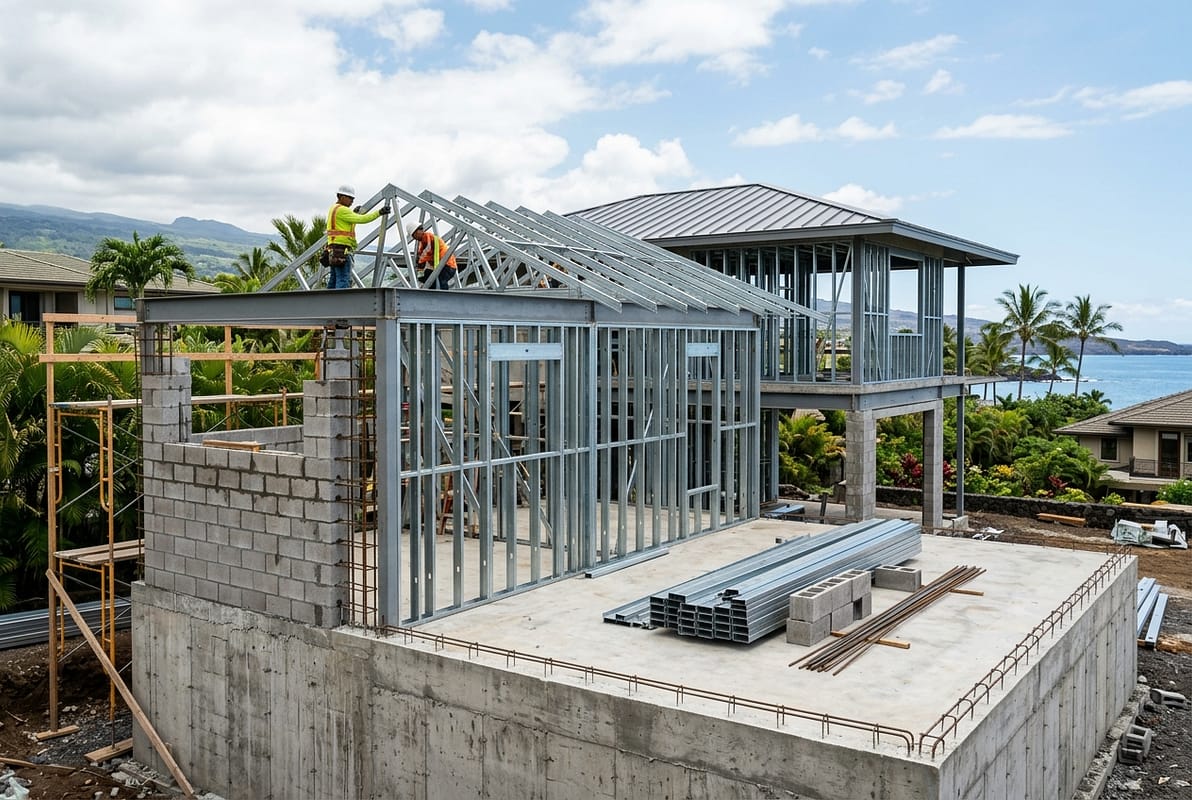
Light-Gauge Steel Framing: The Gold Standard for Termite-Heavy Areas like Kapolei
The single most effective step you can take is to build your home’s skeleton out of light-gauge steel studs and joists instead of Douglas fir. Termites cannot eat steel. It’s that simple. We build frequently in high-pressure termite areas. These include Mililani, Ewa Beach, and Kapolei. In such places, we consider steel framing to be the responsible choice. This is true for any new construction project.
Homeowners often ask our team two questions about steel:
- Doesn’t it rust? Yes, steel can rust, which is why we only use G90 galvanized steel for structural framing. This zinc coating provides excellent protection against corrosion. For homes right on the water in places like Kailua or the North Shore, our team takes it a step further. We use 316-grade stainless steel fasteners for all connections. This adds an extra layer of defense against the harsh salt air.
- Is it hard to live with? The day-to-day experience is virtually identical to a wood-framed home. Hanging a picture might require a specific type of screw, but that’s a minor adjustment. In fact, steel offers benefits beyond being termite-proof. It doesn’t warp, twist, or shrink with Hawaii’s humidity, which means fewer nail pops and drywall cracks over time. It’s also non-combustible, which can sometimes lead to lower homeowner’s insurance premiums.
Concrete & CMU Block: A Time-Tested Foundation
Your foundation is the first line of defense. A well-poured monolithic concrete slab is a formidable barrier, but termites are relentless and can exploit the tiniest cracks or openings. The most vulnerable points are the penetrations where plumbing and electrical conduits come up through the slab. We meticulously seal these gaps with specialized sealants and physical barriers to close off these superhighways for termites. For homes on sloped lots or those requiring a raised floor, our team uses CMU block. CMU stands for Concrete Masonry Unit. We use it for the foundation walls. This provides the same inedible barrier as a concrete slab. Exploring foundation options is a key step, detailed further in our guide to Hawaii home foundation costs.
Using Borate-Treated Wood for Essential Connections
Even in a steel-framed house, there are a few places where wood is still the most practical material, such as the sill plate that connects the foundation to the wall framing, or for backing inside walls to hang cabinets. For these limited applications, we exclusively use borate-treated lumber (often recognizable by its blue or green tint). Borates are minerals infused into the wood under pressure. They are non-toxic to humans and pets, but they make the wood indigestible to termites and resistant to fungal rot. It’s a critical component that ensures every single piece of the structural system in a termite proof home hawaii is protected.
How Much More Does Steel Framing Cost Compared to Wood in Hawaii?
Let’s talk brass tacks. Choosing to build with steel framing is an upfront investment. However, when you look at the numbers over the long haul, it’s one of the smartest financial decisions. It is one you can make for a new build here in Hawaii. The hawaii steel frame homes cost is a critical factor, and we believe in being transparent about it so our clients can make an informed choice for their termite proof home hawaii.
The Upfront Material Investment: A 20% Difference
As of 2026, the material cost for a light-gauge steel framing package is roughly 20% higher than for traditional Douglas fir lumber delivered to a job site on Oahu. Let’s break that down for a typical 2,200-square-foot, two-story home:
- Standard Wood Framing Package (Lumber, Connectors, Sheathing): Approximately $45,000
- Light-Gauge Steel Framing Package (Steel Studs, Tracks, Joists, Connectors, Sheathing): Approximately $54,000
That’s an upfront difference of about $9,000. Labor costs are often comparable. While steel can be faster to erect once on site, it requires more planning and precise layout. Our crews are experienced with both systems. For budgeting purposes, we tell our clients to plan for that 20% material delta. So, for that extra $9,000, what are you actually buying?
Calculating Your ROI: The Savings from Skipping a Single Fumigation
The return on that $9,000 investment begins the moment you move in. A wood-framed home in a place like Ewa Beach will likely require its first fumigation within 7-10 years. As we established, that’s a $5,000+ expense cycle including relocation and other costs.
Let’s chart the 30-year cost of ownership:
Wood-Framed Home:
- Year 7: Fumigation #1 (-$5,000)
- Year 12: Spot treatment and minor wood repair (-$3,000)
- Year 18: Fumigation #2 (-$6,000, accounting for inflation)
- Year 25: Fumigation #3 (-$7,500)
- Year 28: Significant structural repair from hidden damage (-$20,000+)
- Total 30-Year Termite Cost: $41,500+
Steel-Framed Home:
- Total 30-Year Termite Cost for Framing: $0
Your initial $9,000 investment in steel pays for itself by the time you would have scheduled your second fumigation. Every dollar you don’t spend on tents, chemicals, and repairs after that point is pure return on investment. This doesn’t even factor in the peace of mind or the increased resale value from owning a verifiably termite proof home hawaii.
What is a Basaltic Termite Barrier (BTB) and Is It Worth the Cost?
A Basaltic Termite Barrier, or BTB, is a physical, non-chemical method of termite protection installed under your home’s concrete slab. Think of it as a layer of permanent, impenetrable armor for your foundation. For homeowners serious about building a truly termite proof home hawaii, it’s the critical first step in the entire system, stopping subterranean termites before they even reach the house.
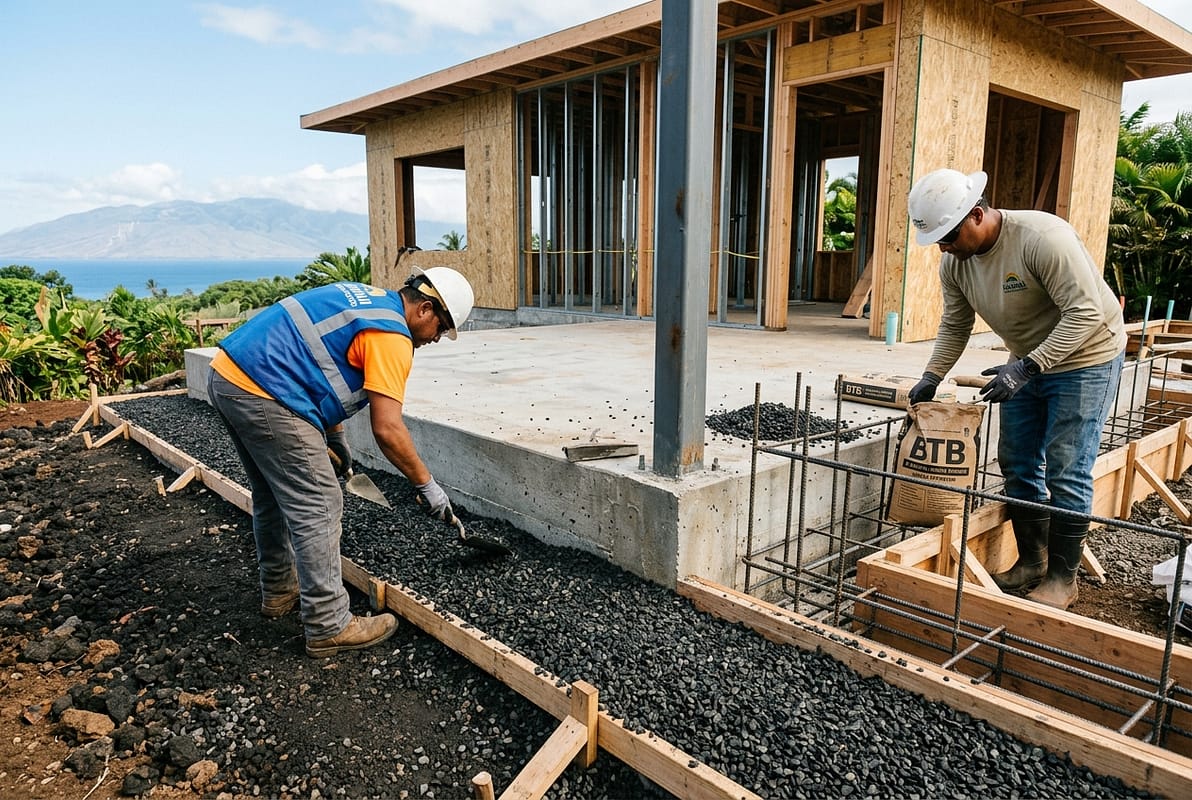
How BTB Works: A Physical, Non-Toxic Barrier Under Your Slab
The concept is brilliantly simple. BTB consists of precisely sized particles of hard, volcanic rock (basalt) that are quarried, crushed, and shaped. The particles are too large for termites to move with their mandibles. They are too hard for them to chew through. The particles are also packed too tightly. Termites cannot crawl through the gaps.
During construction, we first lay the underslab plumbing. Then, before we pour the concrete, our certified installers get to work. They lay a thick, uniform layer of this basaltic aggregate. This covers the entire footprint of the home. We pack and grade it carefully, especially around pipe penetrations, which are the most common entry points. The concrete slab is then poured directly on top of this barrier. The result is a permanent, non-toxic shield that physically stops subterranean termites from ever reaching your home’s structure from below. It doesn’t degrade, it doesn’t get washed away, and it doesn’t need to be reapplied. It lasts for the life of the home.
The Cost Breakdown: Adding $6 to $8 Per Square Foot to Your Foundation
The basaltic termite barrier cost is calculated on a per-square-foot basis. In 2026, homeowners on Oahu can expect to pay between $6 and $8 per square foot. This is for a full, professionally installed BTB system. This is a one-time cost added directly to the foundation phase of a new build.
Let’s apply this to a few typical new home sizes:
- 1,500 sq. ft. single-family home in Kapolei: 1,500 sq. ft. x $7/sq. ft. = $10,500
- 2,200 sq. ft. custom home in Kailua: 2,200 sq. ft. x $7/sq. ft. = $15,400
- 800 sq. ft. ADU unit in Pearl City: 800 sq. ft. x $7/sq. ft. = $5,600
Is it worth it? Compare that one-time cost of $15,400 to the alternative: chemical soil treatment. A chemical treatment might cost $2,000-$3,000. But it has a limited lifespan of about 10 years at best. After that, your home is completely unprotected from below. Since you cannot re-treat the soil under a concrete slab, you’re left completely vulnerable. The BTB is a one-and-done investment that provides permanent peace of mind, making it an essential component of any well-built termite proof home hawaii.
Are Chemical Soil Treatments Still Used for New Construction on Oahu?
The short answer is yes, some builders still use them. But at Warrior Construction, we view them as an outdated and inferior solution compared to modern physical barriers. The approach to termite treatment new construction oahu has evolved significantly, and our focus is on providing permanent protection, not temporary chemical solutions for our clients’ homes.
The Shift from Chemical Sprays to Permanent Physical Barriers
For decades, the standard practice was to drench the soil with a liquid termiticide like Termidor before pouring the foundation. This creates a chemical barrier that kills or repels termites attempting to pass through it. The problem is that this chemical barrier doesn’t last forever. The effectiveness degrades over time due to soil conditions, moisture, and microbial action. The EPA-approved lifespan for these treatments is typically around 10 years. But in Hawaii’s constantly damp, volcanic soil, that can be even shorter.
Once that chemical barrier is gone, there is no way to reapply it under the slab of your home. You’ve essentially lost your first and most important line of defense. This is why our industry has seen a major shift towards physical barriers like BTB. A physical barrier doesn’t lose effectiveness. The rock doesn’t expire. It provides a level of permanence that a chemical spray simply cannot match. It’s the difference between taking a temporary painkiller and performing a corrective surgery for your home.
Why We Advocate for a Multi-Layered Defense System
Relying on a single method of termite defense is a recipe for failure. Termites are too persistent. That’s why we build a defense-in-depth system that makes a home fundamentally unattractive and impenetrable to them. This system is the core of how we build a termite proof home hawaii:
- Layer 1: The Ground Barrier (BTB). We stop them before they can even get to the foundation. This is the most crucial layer.
- Layer 2: The Inedible Structure (Steel Framing). Even if a termite could somehow bridge the foundation (which is highly unlikely), they would find nothing to eat. The frame of the house is steel. There is no food source.
- Layer 3: Targeted Protection (Borate-Treated Wood). For the few non-structural wood elements required, we use wood that is poison to them. This eliminates any potential for localized, minor infestations in places like cabinet backings.
When you combine these three layers, you create a home that is truly fortified against termites for its entire lifespan. You move from a reactive cycle of chemical treatments to a proactive, permanent structural solution. This is the modern standard for a termite proof home hawaii. It’s a key part of building for durability, a concept we explore in our guide to resilient building materials in Hawaii.
How does building a termite proof home in Hawaii affect the construction timeline and permit process?
Building a termite proof home hawaii with steel framing can actually shorten your on-site framing schedule by weeks, but it also adds significant upfront lead time for material fabrication and shipping from the mainland. Additionally, the permit process with the Honolulu Department of Planning and Permitting (DPP) requires specialized structural engineering plans. These plans can add a month or more to the initial design phase. This is compared to a standard wood-framed home.
Navigating DPP and Engineering for Steel Homes
When we commit to light-gauge steel, the first shift happens in the design phase. Wood framing is so common that architects and engineers have standard details ready to go. Steel, conversely, requires a completely different set of structural calculations and connection designs. We work with a structural engineer who specializes in steel. They create a detailed blueprint package. This includes specifics on load-bearing walls, truss connections, and seismic bracing. These elements are unique to the material.
For example, the DPP will scrutinize how we anchor the frame to the concrete slab, a critical detail for hurricane-rated construction. This specialized engineering work typically adds between $5,000 and $10,000 to the design fees. It can also extend the pre-permit timeline by a good four to six weeks. This upfront investment is a non-negotiable step for a properly constructed termite proof home hawaii.
Material Lead Times and Island Logistics
Unlike lumber, which we can source from local suppliers like HPM or Honsador, steel framing packages are not sitting in a warehouse on Oahu. The entire package is custom-fabricated on the mainland based on our engineer’s approved plans. The fabrication process itself takes about 8 to 12 weeks. After that, we have to account for ocean freight. This is another three to four weeks from the West Coast to Honolulu. Consequently, we order the steel package the moment our building permit is approved to keep the project on track. Any delays at the Port of Honolulu can add another week or two.
For neighbor island projects on Maui or Kauai, we then factor in another leg of shipping from Honolulu. This adds more cost and time to the project. However, once that container of steel arrives on site, construction moves very quickly. Our framing crew can often erect the entire structure of a 2,500-square-foot home in about two weeks. This is significantly faster. A traditional stick-built home requires three to four weeks. The key is coordinating these upfront logistical hurdles to reap the benefits of speed during the framing phase. This process defines the modern approach to building a long-lasting termite proof home hawaii.
Case Study: A Steel-Framed New Build in Ewa Beach
To make these concepts concrete, let’s look at a recent project we completed for a family building their dream home in Ewa Beach, a known hotspot for Formosan termites. They were building a 2,400 sq. ft., two-story home and were determined to never have to tent.
Their decision-making process is a perfect example of the upfront investment strategy. We presented them with two options:
- Option A (Standard Wood): Wood frame, chemical soil treatment. Initial structural cost was lower.
- Option B (Termite-Proof): Basaltic Termite Barrier, light-gauge steel framing, borate-treated lumber for backing.
The cost difference was clear. The BTB system added $18,000. This covered 2,400 sq. ft. at $7.50/sq. ft. The steel framing package cost approximately $11,000 more than the equivalent wood package. The total upfront investment for Option B was about $29,000 higher. While this was a significant number, we mapped out the 30-year ownership costs. We showed them that they would likely spend over $45,000 on fumigation, repairs, and spot treatments with the wood home. The math was compelling.
The timeline was also a key discussion. Choosing steel meant our pre-construction phase was about 14 weeks longer to account for engineering, fabrication, and shipping. However, once the materials arrived, we framed the entire house in 11 days. This was about 10 days faster than the wood-frame schedule. Ultimately, they moved in with the absolute confidence that their home’s structure was secure. For them, that peace of mind was the biggest return on their investment in a termite proof home hawaii.
Beyond the frame, what other materials help create a termite proof home in Hawaii?
A steel frame is the backbone, but creating a truly termite proof home hawaii requires a holistic approach to materials that addresses all the finishes and fixtures where ground termites can still find a food source. This includes siding, cabinetry, doors, and flooring. Choosing inorganic or termite-resistant options for these components is just as critical as the structural frame itself for ensuring long-term protection.
Protecting Your Home’s Exterior Envelope
Your home’s exterior is its first line of defense. Traditional wood siding, even if treated, is a major vulnerability that ground termites will eventually exploit. For this reason, we almost always recommend fiber cement siding, like the products from James Hardie. It is completely inedible to termites. It resists rot and moisture. It also stands up remarkably well to the salt air. This applies especially in coastal areas like Kailua or the North Shore. Furthermore, we specify metal roofing and composite decking for lanais, which termites cannot consume. For windows and exterior doors, fiberglass and vinyl frames are superior choices over wood. They provide excellent insulation and less maintenance. This also eliminates another potential food source. Building a comprehensive termite proof home hawaii means securing every part of the exterior shell, not just the walls.
Termite-Proofing Your Interior Finishes
Even with a steel frame and a perfect foundation barrier, termites can still find their way inside and cause damage if you give them something to eat. Interior finishes are a common oversight. For example, standard kitchen and bathroom cabinets made from particleboard are like a termite buffet. Our team advises clients to use cabinets with solid wood boxes. These should be made from naturally resistant species like teak. More commonly, we suggest composite materials like medium-density fiberboard (MDF). Termites tend to avoid these due to the glues used. For flooring, the best choices are polished concrete, ceramic or porcelain tile, or luxury vinyl plank (LVP)—all 100% termite-proof. Finally, even small details like baseboards and interior trim should be addressed. Using PVC or composite trim instead of pine or poplar completely removes another common food source.
What this means for Hawaii homeowners
Deciding to build a termite proof home hawaii is a proactive choice to invest in permanence and peace of mind. It’s a shift from the old mindset of reactive, cyclical repairs and chemical treatments to a modern, integrated system of durable materials. For homeowners planning a new build or a significant renovation, this means a few key takeaways.
A Shift in Mindset and Budget
You should plan for a 15-25% higher cost for your structural package (foundation barrier + steel framing). For a 2,200 sq. ft. home, this translates to roughly $25,000 extra in your total budget. This breaks down to $15,400 for BTB. Plus, there is $9,000 for the steel upgrade. This investment typically pays for itself within 10-15 years by eliminating fumigation and repair costs. Furthermore, embrace a longer pre-construction phase. A steel-framed home requires more upfront planning. Your design, engineering, and material ordering phase will likely be 3-4 months longer. This is longer than a conventional wood-framed project. This is due to specialized engineering and mainland fabrication lead times. Build this extra time into your project timeline from day one.
Most importantly, think holistically about materials. Don’t stop at the frame. A truly termite proof home hawaii considers every material choice, from fiber cement siding and composite decking to PVC trim and tile floors. The goal is to eliminate termite food sources throughout the entire house. When it comes time to sell, having a home built with a permanent termite solution is a massive selling point. The DCCA is tightening regulations on treatment disclosures. Being able to provide engineering documents for a steel frame and BTB system can increase your home’s value. It can also significantly shorten your time on the market. Building it right the first time costs more upfront. But it is unequivocally the more economical and responsible choice. This ensures the long-term health and value of your home in the islands.
Frequently Asked Questions
Can you make an existing wood home termite-proof?
You cannot make an existing wood home completely termite-proof in the same way as a new build with steel framing. However, you can make it highly termite-resistant through diligent spot treatments, replacing damaged wood with borate-treated lumber during renovations, and installing perimeter baiting systems. This becomes a process of ongoing management, rather than the one-time permanent solution of a new termite proof home hawaii.
How long does a Basaltic Termite Barrier last?
A Basaltic Termite Barrier (BTB) is designed to last for the entire life of the structure. Because it’s a physical barrier made of crushed rock, it does not degrade, expire, or break down from soil or moisture. It’s a one-time installation that provides permanent protection from subterranean termites entering through the foundation, a key part of any termite proof home hawaii.
Does steel framing interfere with Wi-Fi or cell signals?
This is a common myth, but in modern construction, it’s a non-issue. A solid steel box would create a Faraday cage. However, a home is framed with individual studs. This leaves plenty of space for signals to pass through. Signals can go through windows, doors, and drywall. In over 20 years of building, we have never had a client report a noticeable difference in signal strength. This applies to their new steel-framed home. It also applies to a previous wood-framed one.
What’s the real cost of tenting a house in Honolulu in 2026?
In 2026, the direct cost to tent and fumigate typically ranges from $3,500 to $5,000. This is for an average 1,800-2,200 sq. ft. single-family home in Honolulu. This price can increase for larger homes or those with complex rooflines. This figure does not include indirect costs. These include hotel stays ($800+) and pet boarding ($200+). There can also be potential landscaping damage. Such damage can add another $1,000-$1,500 to the total expense.
Does homeowner’s insurance cover termite damage in Hawaii?
Almost universally, the answer is no. Standard homeowner’s insurance policies in Hawaii specifically exclude damage from termites and other pests. They are considered a preventable maintenance issue. The responsibility falls squarely on the homeowner. This is why a proactive investment in building a termite proof home hawaii is so critical—you are self-insuring against a risk that your policy will not cover.
Are there any naturally termite-resistant woods useful for a termite proof home hawaii?
Yes, certain species like teak have natural oils and resins. Some types of redwood and cedar also have these. They make them resistant to termites. However, using these woods for an entire structural frame in Hawaii is prohibitively expensive and not practical from a supply standpoint. We sometimes use them for high-end decorative elements, but for structural integrity and cost-effectiveness, the combination of steel and borate-treated lumber is the superior solution for a termite proof home hawaii.
What is the actual ROI on building a termite proof home in Hawaii?
The ROI is multi-faceted. Financially, an upfront investment of around $25,000 on a 2,200 sq. ft. home can save money. It can save over $40,000 in fumigation and repair costs over 30 years. You also gain a significant resale value advantage, as a certified termite-proof structure is a major draw for buyers. The unquantifiable ROI is the peace of mind knowing your home’s structure is permanently secure from silent destruction.
Does the DPP have special requirements for a steel frame termite proof home hawaii?
Yes, the Honolulu DPP requires a full structural engineering package specifically for light-gauge steel. This includes detailed calculations for wind loads, seismic activity, and connection points that differ significantly from wood framing. Our team handles this specialized engineering as part of our pre-construction services, ensuring the plans meet all current building codes before submission.
Building a home that can withstand the unique challenges of our island environment is crucial. This is at the core of what we do at Warrior Construction. A home that doesn’t require constant chemical treatments isn’t just a smarter financial asset. It’s also a healthier place for your family to live. Are you planning a new home build or a major renovation? Our team is here to walk you through the specifics. We design and build truly resilient, termite-resistant structures. This will be the last home you’ll ever worry about termites in.
Ready to build a home that lasts a lifetime without the threat of termites? Learn more about our Termite-Resistant Building services or contact our team to discuss your project today.


