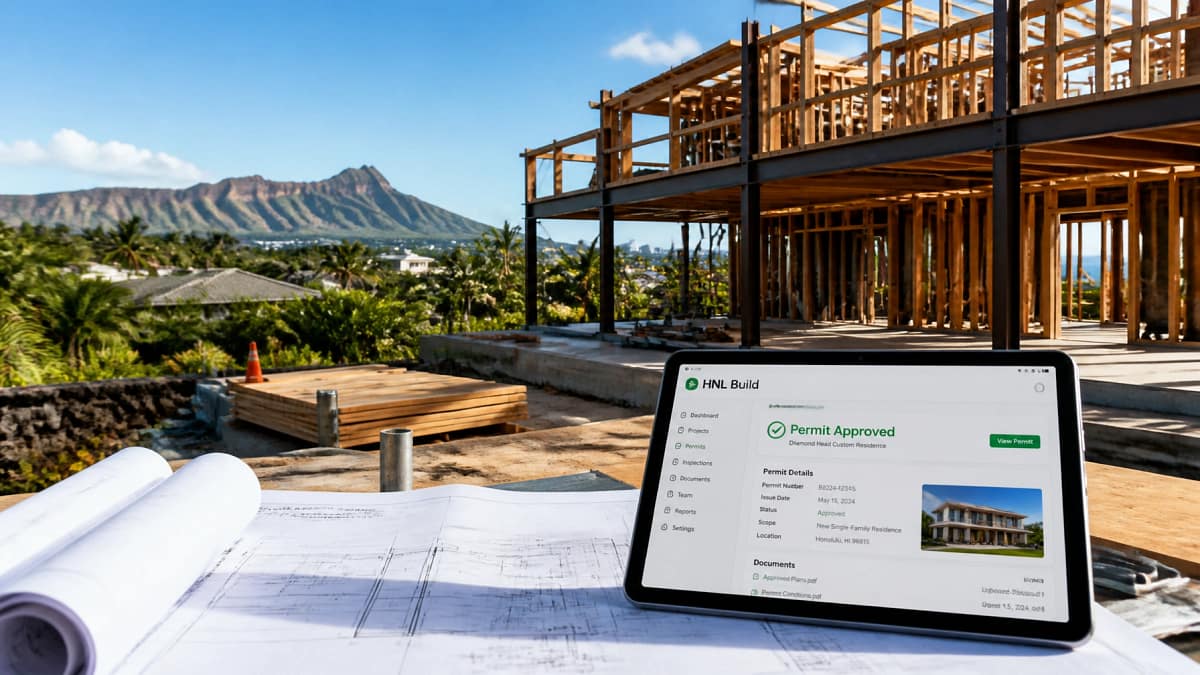
Getting an Oʻahu building permit now takes under 3 months with HNL Build. Learn about CivCheck AI and new FEMA maps. Get a free estimate from Warrior Construction. BC-34373.
Navigating the process for an Oʻahu building permit has historically been one of the most frustrating hurdles for homeowners and developers in Hawaii, but the landscape changed significantly in 2026. Thanks to the full implementation of the HNL Build system and the integration of AI-driven pre-screening tools, residential permit approval times have plummeted from a staggering eight months to an average of just 2.5 months. If you are planning a renovation, an ADU, or a new custom home, understanding how to use these new digital tools is the difference between starting your project this summer or waiting until next year.
In Hawaii, construction timelines are dictated as much by the City & County of Honolulu Department of Planning and Permitting (DPP) as they are by material shipping schedules. For years, the "permit backlog" was a legendary deterrent to local investment, with thousands of applications stuck in a manual, paper-heavy queue. However, the $7.3 million investment into HNL Build, a Salesforce-based platform that replaced the aging POSSE system, has finally begun to deliver on its promise of transparency and speed. As your trusted partner in Hawaii construction, we’ve tracked these changes in real-time to help you navigate the new 2026 regulations, including the crucial FEMA flood map updates that took effect this June.
This guide will walk you through the exact steps to secure your permit in under 90 days, the impact of recent legislation like SB2887, and how our team at Warrior Construction handles the heavy lifting of preconstruction planning so you can focus on your vision.
What is HNL Build and how does it speed up your Oʻahu Building Permit?
HNL Build is the digital backbone of Honolulu’s modern permitting process, designed to centralize every step of your application from initial submission to final inspection. Launched in August 2025, this Salesforce-powered platform replaced the fragmented ePlans and POSSE systems that had plagued the DPP for decades. By creating a unified cloud-based environment, HNL Build allows you, your architect, and your contractor to track the status of your Oʻahu building permit in real-time, eliminating the "black hole" where applications used to disappear for months at a time.
The system was a massive undertaking, costing the City roughly $7.3 million to develop and implement. Unlike the old system, HNL Build is "intelligent", it won't let you submit an incomplete application. It flags missing documents or incorrect fee calculations instantly, which prevents the back-and-forth emails that used to add weeks to the timeline. Since its launch through mid-April 2026, the system has processed over 17,000 permits, a massive jump from the 12,000 processed in the same period the previous year.

Caption: Large-scale commercial projects on O'ahu now utilize HNL Build for more transparent tracking, though residential projects currently see the greatest speed benefits.
For you as a homeowner or business owner, this means higher accountability. You can see exactly which desk your permit is sitting on and whether the delay is due to a DPP reviewer or a pending correction from your design team. At Warrior Construction, we’ve integrated our internal project management software with HNL Build, allowing us to provide our clients with a "single pane of glass" view of their project's regulatory progress.
How long does it actually take to get an Oʻahu Building Permit in 2026?
As of mid-2026, the average wait time for a residential Oʻahu building permit is approximately 2.5 months (75 days). This represents a 40% improvement compared to the eight-month averages seen just two years ago. However, these timelines are highly dependent on the type of project you are undertaking and whether you leverage the "Quick Permit" pathway or the newly streamlined SB2887 review process for smaller homes.
While residential permits are moving at record speeds, commercial permits are currently averaging about 4 months. This is slightly slower than pre-2025 levels as the DPP continues to migrate complex commercial codes into the Salesforce logic. If you are planning a commercial renovation or a multi-unit development, it is vital to factor in this four-month window before you break ground. The "Quick Permit" system, which allows for instant approval of simple electrical or plumbing work, is still a staple of the DPP, though it was briefly suspended in June 2026 for a critical software update to accommodate new federal regulations.
Typical 2026 Permit Timelines on O'ahu:
- Simple Residential Renovations (No structural changes): 2–4 weeks via Quick Permits.
- Standard Single-Family Homes (< 3,000 SF): 8–10 weeks via SB2887 streamlined review.
- Custom Luxury Homes (> 5,000 SF): 3–5 months depending on site-specific factors (slopes, coastal zones).
- Commercial Tenant Improvements: 4–5 months.
- ADUs / Ohana Units: 2.5 months.
To hit the "under 3 months" target, your application must be "clean" upon submission. The DPP's "First-Time Right" initiative means that applications with zero errors are fast-tracked, while those requiring corrections are pushed to the back of the queue. This is where having a contractor who understands the specific quirks of Honolulu’s building code becomes your greatest asset.
What is the CivCheck AI pre-screening tool for Oʻahu Building Permits?
CivCheck AI is the "secret sauce" that has enabled the DPP to slash pre-screening delays by 71% in its 2026 rollout. Functioning like a "TurboTax" for construction, CivCheck is an AI-guided platform that architects and engineers use to prepare your application before it ever hits a human reviewer's desk. It automatically checks your plans against thousands of pages of the Honolulu Building Code, zoning ordinances, and the Land Use Ordinance (LUO).
Before CivCheck, an application might sit for three weeks just waiting for a clerk to verify that the margins on the blueprints were correct or that the north arrow was present. Now, the AI does this in seconds. If your plans have a staircase that is 2 inches too narrow or a window that doesn't meet egress requirements, CivCheck flags it immediately. This allows your design team to fix the error before submission, ensuring that when the DPP receives your Oʻahu building permit application, it is already 95% compliant with the law.
Currently, CivCheck AI is primarily utilized for residential projects, but the City has announced plans to expand its capabilities to commercial construction by late 2026. Using this tool is not just a suggestion, it is becoming a standard expectation for professionals in the industry. At Warrior Construction, we require all our design partners to use CivCheck pre-screening because it virtually guarantees a smoother ride through the HNL Build system. It’s about working smarter, not harder, to get your project out of the "pending" pile and into the "approved" pile.

Caption: Advanced structural projects like this steel framework in Honolulu benefit from AI pre-screening to ensure complex code compliance before the first beam is placed.
How do the new 2026 FEMA flood maps affect your Oʻahu Building Permit?
On June 10, 2026, new FEMA Flood Insurance Rate Maps (FIRMs) officially became effective for the entire City and County of Honolulu, and they have a massive impact on your ability to get an Oʻahu building permit. These maps cover over 400 stream miles and 75% of the county, with significant changes in areas like Lāʻie, Kāneʻohe, Waiʻanae, and East Honolulu. If your property was recently mapped into a Special Flood Hazard Area (SFHA), your permit requirements just got much more complex.
One of the most immediate changes is that properties newly classified in high-risk zones no longer qualify for "Quick Permits" for many types of work. Even simple renovations might now require a certified elevation certificate and a more rigorous structural review to ensure the home can withstand potential flooding. Conversely, some properties have been mapped out of flood zones, which can significantly lower your construction costs by removing the need for expensive flood vents or elevated foundations.
Key 2026 Flood Map Impacts:
- Mandatory Flood Insurance: If you have a federally backed mortgage and your home is now in an SFHA, you will likely see a notice from your bank requiring new or increased flood insurance.
- Substantial Improvement Rule: If the cost of your renovation exceeds 50% of the market value of the structure, and you are in a flood zone, the entire house must be brought up to current flood codes (usually meaning it must be elevated).
- Design Requirements: New builds in flood zones now require "V" or "A" zone certified foundations, which can add $30,000–$60,000 to your site prep costs.
Before you spend a dime on blueprints, you must verify your zone on the Hawaii Flood Hazard Assessment Tool (FHAT). We recommend doing this on "day zero" of your project planning. Our preconstruction team at Warrior Construction includes a site-specific flood risk assessment as part of our initial feasibility study for every client on Oʻahu.
What is the SPEED Task Force and how does SB2887 help you?
The SPEED Task Force (Simplifying Permitting for Enhanced Economic Development), chaired by Representative Greggor Ilagan, has been the legislative engine driving these recent improvements. Their work culminated in the passage of SB2887, a landmark bill that has fundamentally changed the rules for residential construction on Oʻahu. The goal of the task force was simple: remove the bureaucratic "red tape" that was making it impossible for local families to build homes.
SB2887 introduced several critical "fast-track" mechanisms for an Oʻahu building permit:
- The 3,000 SF Rule: Any single-family residence under 3,000 square feet now undergoes a streamlined review process. Instead of being poked and prodded by multiple departments for months, these applications are reviewed by a dedicated "Express Team" within the DPP.
- Expanded OTC Eligibility: "Over-the-Counter" (OTC) permits have been expanded to include more types of minor structural repairs and solar installations that previously required a full permit.
- Third-Party Review: The bill solidified the use of certified third-party reviewers, private engineers who can sign off on plans, which the DPP is then legally required to accept within a shortened timeframe.
To combat the chronic staffing shortages at the DPP, the task force is also considering innovative solutions like loan forgiveness for engineers who commit to working for the City for at least four years. This is intended to solve the "reviewer bottleneck" by ensuring there are enough qualified hands to actually look at the digital files being uploaded via HNL Build. For you, this legislative push means that the City is finally on your side, viewing the permit process as a service rather than a barrier.

Caption: Thanks to SB2887, custom homes under 3,000 square feet can now move from the framing stage to completion much faster due to streamlined inspections.
What are the steps to apply for an Oʻahu Building Permit through HNL Build?
If you are ready to start your project, you need to follow the new 2026 digital workflow. Gone are the days of driving down to the Fasi Municipal Building with three rolls of paper plans. Everything now happens through your browser. Here is the tactical step-by-step process for securing your Oʻahu building permit:
Step 1: Create Your HNL Build Account
Visit the HNL Build Portal and register for an account. You will need to verify your identity and, if you are a homeowner acting as your own contractor (owner-builder), you must sign specific disclosures regarding your responsibilities and liabilities.
Step 2: Site Verification (Flood & Zoning)
Before drawing a single line, check the DPP Parcel and Zoning Map and the new 2026 FEMA flood maps. Determine your setbacks, height limits, and whether you are in a Special Management Area (SMA).
Step 3: CivCheck AI Pre-Screening
Work with your architect to run your plans through CivCheck. This tool will catch about 90% of the common errors that lead to permit rejections. Once the AI gives you the "green light," you will receive a digital certificate of pre-screening.
Step 4: Digital Submission
Upload your plans, the CivCheck certificate, and all required forms (e.g., Contractor’s Statement, Water Supply approval) to HNL Build. You will be required to pay the filing fee, usually a few hundred dollars, at this stage via credit card or ACH.
Step 5: The Review Cycle
The DPP will conduct several concurrent reviews: Building, Zoning, Wastewater, and Board of Water Supply. You can track this in the "My Applications" tab of HNL Build. If a reviewer has a question, they will leave a "sticky note" on your digital plan. Your architect must respond to these comments directly in the portal.
Step 6: Permit Issuance & Inspections
Once all departments sign off, you will receive an email notification to pay the final permit fee. After payment, you can download and print your building permit. Do not start work until the permit is in your hand. Throughout the build, your contractor will use the HNL Build app to schedule inspections.
For a more visual guide, the DPP has released a series of YouTube tutorials that walk you through the HNL Build interface. We highly recommend watching these before your first submission.
What Does an Oʻahu Building Permit Cost in Hawaii?
Understanding the financial side of permitting is just as important as the technical side. In Hawaii, permit fees are based on the "valuation" of the work, the total cost of materials and labor. However, the permit fee itself is only one part of the total "soft cost" of getting a project approved.
| Project Type | Permit Fee (Estimate) | Impact Fees / Other | Total Approval Cost |
|---|---|---|---|
| Kitchen Remodel ($60k) | $800 – $1,200 | N/A | $1,500 – $2,500 |
| New 2,500 SF Home ($800k) | $6,000 – $9,000 | $4,500 (Water/Sewer) | $15,000 – $25,000 |
| ADU / Ohana Unit ($250k) | $2,500 – $3,500 | $2,000 (Sewer) | $6,000 – $10,000 |
| Commercial Build-out ($1M) | $8,000 – $12,000 | Varies by Use | $20,000+ |
Hawaii-Specific Permit Insights:
- Valuation Strategy: Some homeowners try to lowball the valuation to save on permit fees. Don't do this. The DPP uses a standard square-footage cost calculator; if your estimate is significantly lower than their baseline, they will flag your permit for an audit, adding weeks to your timeline.
- The "Owner-Builder" Trap: If you pull the permit yourself as an owner-builder, you are legally responsible for the safety of the site and the workers. This can complicate your homeowners' insurance and make it difficult to sell the home within one year of completion.
- Timeline Reality: Even with HNL Build, "under 3 months" assumes you have a professional team. If you are doing this for the first time without a contractor, expect the process to take 4–6 months due to the learning curve of the software and code requirements.
At Warrior Construction, we treat the Oʻahu building permit as a milestone in our preconstruction planning process. We don't just wait for the permit; we use that 2.5-month window to finalize material orders, secure subcontractors, and prepare the site so that the day the permit is issued, we are ready to pour concrete.

Caption: Our team meets regularly at active project sites to ensure that the work being performed matches the digital permit records in the HNL Build system.
Frequently Asked Questions
How long does it take to get a kitchen remodel permit on O’ahu?
For a standard kitchen remodel that doesn’t involve moving structural walls or changing the footprint of the home, you can often secure a “Quick Permit” through HNL Build in 2–4 weeks. If you are adding square footage or changing the plumbing and electrical layout significantly, expect a standard residential review timeline of 8–10 weeks.
Do I need a permit to build a deck or lanai in Honolulu?
Yes, if the deck is more than 30 inches above the ground or has a roof (lanai), you need an Oʻahu building permit. Even if it is low-profile, if it is attached to the house, a permit is required to ensure it meets structural and fire separation codes. Non-permitted lanais are one of the most common issues found during home inspections during a sale.
What happened to the “Quick Permits” in June 2026?
The City temporarily suspended the Quick Permit system from June 10–11, 2026, to perform a critical software update for HNL Build. This update was necessary to integrate the new June 10 FEMA flood maps into the automated approval logic. The system is now back online, but properties in newly designated flood zones may no longer be eligible for the automated “Quick” pathway.
Can I use HNL Build if I am an owner-builder?
Yes, HNL Build has a specific portal for homeowners. However, you will need to upload a signed and notarized “Owner-Builder Disclosure Statement.” Be aware that as an owner-builder, you assume all the risks of a general contractor, including workers’ compensation liability for any uninsured workers on your property.
Does CivCheck AI cost extra to use?
The City currently provides access to the CivCheck pre-screening tool as part of the standard permit application ecosystem. While there is no direct “fee” to use the AI, your architect or designer may charge for the time spent performing the pre-screening and adjusting the plans based on the AI’s feedback. This is a worthwhile investment to avoid months of delays later.
How do I know if my property is affected by the 2026 FEMA maps?
You can visit the Hawaii Flood Hazard Assessment Tool (FHAT) and enter your Tax Map Key (TMK) or address. Look for the “Effective Date” of June 10, 2026. If your zone has changed from “X” (low risk) to “A” or “V” (high risk), you will face stricter building codes and likely higher insurance premiums.
Ready to Start Your Project?
Warrior Construction has completed 80+ residential and commercial projects across O'ahu and Maui. We're a licensed Hawaii general contractor (BC-34373) with deep experience navigating local permits, island material costs, and Hawaii's unique building conditions. We take the stress out of the Oʻahu building permit process by handling all the digital submissions and agency coordination as part of our full-service approach.
Get Your Free Instant Estimate →
No pressure, no obligation : just a clear picture of what your project will cost and how long it will take.
Built on Integrity. Driven by Innovation. Rooted in Hawai'i.


