If you’re wondering about the oahu foundation repair cost, you’re asking the right question. Here on the islands, our homes face unique challenges you just don’t see on the mainland. In 2026, the cost for helical pier installation to fix a settling foundation is running between $2,800 and $3,500 per pier. For concrete spalling repair caused by our salt air, a typical project will cost between $35,000 and $50,000. These aren’t small numbers, but ignoring them can cost you far more down the line, both in safety and property value.
Over my 20+ years in construction here in Hawaii, I’ve seen it all. The two biggest foundation headaches we deal with at Warrior Construction are settling foundations, especially in areas built on expansive soil like Hawaii Kai and Salt Lake, and concrete spalling, the ‘concrete cancer’ that eats away at homes along our coastlines in places like Kailua and Portlock. They have different causes, different warning signs, and very different price tags to fix.
This isn’t about scaring you. It’s about giving you the straight numbers and honest insights from a contractor’s perspective so you can protect your biggest investment. We’ll break down the real-world costs for both major types of repair, show you the warning signs to look for, explain why these problems happen here specifically, and run the numbers on whether it makes financial sense to fix the problem before you sell your home. Let’s get into it.
How Much Does Foundation Repair Cost on Oahu?
Let’s get straight to the numbers. The cost of foundation repair on Oahu isn’t a simple, one-size-fits-all answer because we’re dealing with two fundamentally different problems: structural settling and concrete degradation (spalling). A settling house in Mililani requires a completely different solution than a spalling lanai in Kailua, and the costs reflect that. Here’s a breakdown based on what our team sees in the field every week.
Real Costs for Helical Piers (Settling Foundations)
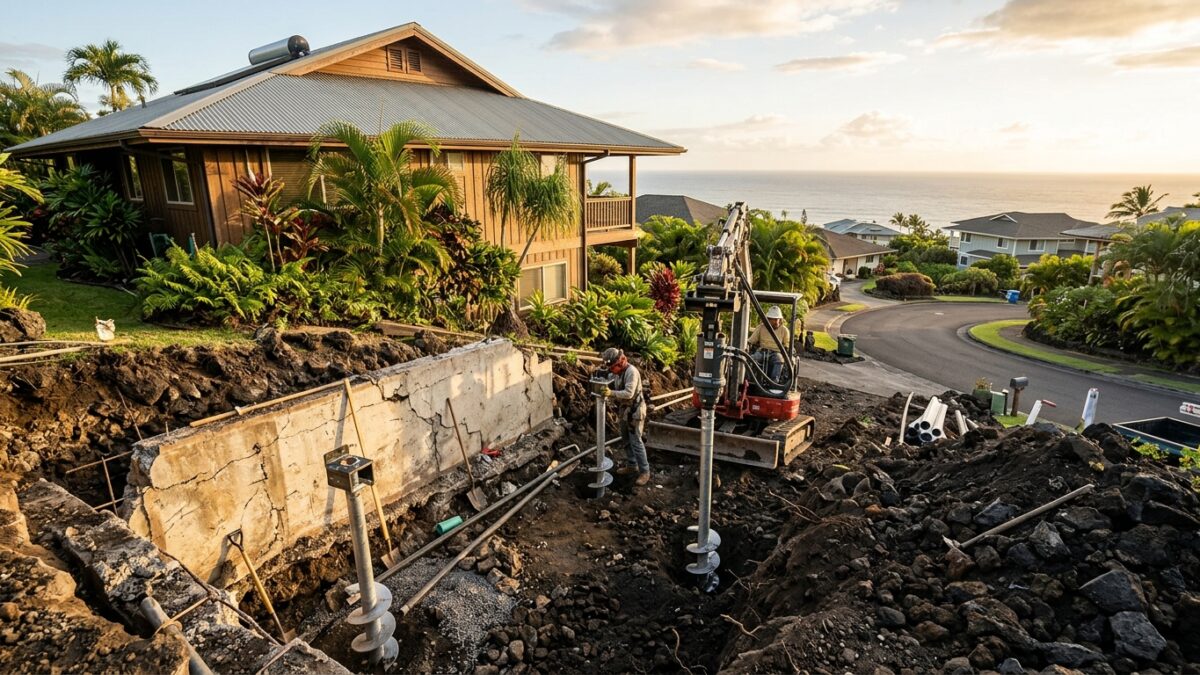
For a home that’s sinking or settling, the modern solution is installing helical piers. These are basically giant steel screws that we drive deep into the ground until they hit stable, load-bearing soil or bedrock, effectively creating new, stable footings underneath your existing foundation. This process lifts and stabilizes the structure.
According to the state’s 2026 Construction Cost Outlook, the average cost for helical pier installation here on Oahu is between $2,800 and $3,500 per pier.[1] For a typical 1,500-square-foot single-family home experiencing moderate settlement along one wall, you might need 8 to 12 piers. Let’s do the math:
- Number of Piers: 10 (a common scenario)
- Cost per Pier: $3,200 (average)
- Total Project Cost: $32,000
This price includes more than just the steel pier itself. It covers:
- Structural Engineering: A licensed engineer must design the repair plan. This is not optional and costs several thousand dollars.
- Permitting: We handle all the paperwork and plans submission to the Honolulu Department of Planning and Permitting (DPP).
- Excavation: Our crew has to dig down to the foundation footing at each pier location.
- Installation: This requires specialized hydraulic equipment to drive the piers to the proper depth and torque.
- Stabilization & Lifting: We attach hydraulic jacks to the brackets, transfer the load, and, if possible, lift the foundation back toward its original position.
- Restoration: Backfilling the excavation sites and patching any concrete we had to break.
Just last year, we worked on a home in Salt Lake where the back corner had dropped nearly three inches. It took 14 piers to secure the structure, bringing the total to just over $45,000. It’s a significant investment, but it saved the home.
Typical Costs for Concrete Spalling Repair (Coastal Corrosion)
Concrete spalling repair is a different beast entirely. This isn’t about lifting the house; it’s about painstakingly removing damaged concrete, treating the corroded rebar within, and rebuilding the structural element. This is highly common for post-and-pier foundations, lanai edges, and concrete columns in our coastal communities.
The Honolulu Board of REALTORS’ market report confirms what we’re seeing: the average cost for comprehensive spalling repair on a coastal home is now running between $35,000 and $50,000.[2] Unlike piers, this cost isn’t priced ‘per spot.’ It’s a total project cost based on labor hours, scaffolding, and specialized materials.
A typical $40,000 spalling project on a home in Portlock might look like this:
- Scaffolding & Containment: $5,000 – $8,000
- Demolition: Our crew uses pneumatic chippers to carefully remove all the loose, delaminated concrete, exposing the rebar. This is labor-intensive.
- Rebar Treatment: We wire-brush the rusty rebar down to clean steel and apply a specialized anti-corrosion coating. If the rebar is too far gone (more than 25% section loss), we have to splice in new steel.
- Patching: We apply a high-strength, polymer-modified repair mortar, often building it up in multiple layers. This isn’t just regular concrete mix.
- Finishing & Coating: After the patch cures, we grind it smooth to match the surrounding profile and then apply a high-performance elastomeric or waterproofing coating to prevent future salt and moisture intrusion.
This is meticulous, time-consuming work that has to be done right. A bad patch job will fail in a couple of years, and you’ll be right back where you started. The price reflects the high level of skill and specialized materials required.
What Are the Warning Signs of Foundation Failure in Hawaii?
Your house usually tells you when it’s in trouble. The key is knowing how to listen. The signs for a settling foundation are very different from the signs of spalling. Here’s what to look for around your property.

Signs of a Settling Foundation (Common in Hawaii Kai & Salt Lake)
Settlement happens when the soil underneath your home can no longer support the weight. This is a huge issue in areas built on expansive volcanic clay soils or poorly compacted fill. It rarely happens overnight; it’s a slow process. Look for these clues:
- Stair-Step Cracks in Block Walls: This is the classic sign. If you have a CMU (concrete block) foundation or retaining wall, look for cracks that follow the mortar joints, stepping up or down.
- Doors and Windows That Stick: A door that suddenly starts jamming at the top or a window that’s tough to open can mean the frame has been racked out of square by the house shifting.
- Drywall Cracks: Look for cracks extending from the corners of door and window frames. This is a tell-tale sign of stress from differential movement.
- Uneven Floors: Do you feel a slope in the floor? Try placing a marble on the floor in different rooms. If it consistently rolls to one side, you may have a problem.
- Cracks in the Slab Floor: While small hairline cracks can be normal, large, separated cracks (wide enough to fit a quarter in) or cracks where one side is higher than the other are red flags.
We got a call from a homeowner in Hawaii Kai who was frustrated that his interior doors kept sticking. He’d had them planed down twice. Our team went out and used a laser level, and we found one side of his house was a full two inches lower than the other. The sticking doors were just a symptom of the much larger problem.
Signs of Concrete Spalling (Look for this in Kailua & Portlock)
Spalling is caused by salt and moisture getting into the concrete and corroding the steel rebar inside. As the rebar rusts, it expands with incredible force, blowing chunks of the concrete off. This is a serious threat to any home within a mile of the coast, especially on the windward side. Here’s what to watch for:
- Flaking or Bubbling Paint: On concrete columns, lanai ceilings, or beam soffits, this is often the very first sign. Moisture is getting trapped behind the paint, indicating a problem within the concrete.
- Exposed, Rusty Rebar: This is an advanced sign that the problem is severe. If you can see the steel skeleton of your home, you need to call a professional immediately.
- Concrete Chunks on the Ground: Finding pieces of concrete on your lanai or driveway that have fallen from the structure above is a major red flag.
- Rust Stains: Brownish or reddish stains bleeding through the paint on a concrete surface. This is the rust from the rebar leaching out.
On a recent Kailua project, the homeowner noticed rust stains on the ceiling of their ground-floor lanai. When we started investigating, we found the rebar in the slab above was so corroded from years of salt spray that we had to perform extensive structural repairs to ensure its safety. The kailua foundation problems are often tied directly to this corrosive salt air.
Why Do Foundations Fail on Oahu?
Foundation problems in Hawaii aren’t random. They are a direct result of our unique island environment. From the ground beneath our feet to the air we breathe, the forces of nature are constantly testing our homes. Understanding these root causes is key to preventing and fixing the issues.
Expansive Volcanic Clay Soil in Central Oahu
Much of Oahu, particularly Central Oahu areas like Mililani, Wahiawa, and parts of Ewa, is built on what are known as expansive volcanic clay soils. The local name for this is the ‘Wahiawa series’ soil. This stuff acts like a sponge. During our rainy season, it absorbs water and swells up. During the dry summer months, it shrinks and hardens. This constant cycle of expansion and contraction puts immense stress on a home’s foundation, causing it to heave and settle unevenly over time. A traditional slab-on-grade foundation, if not engineered correctly for these soil conditions, can easily crack and fail under this pressure. This is why we see so much foundation settling in these central island communities.
Salt Air Corrosion Along the Coastline
If you live near the ocean, your biggest enemy is the air itself. The trade winds carry a fine mist of salt spray, or chloride ions, inland. This salt settles on your home and, when mixed with rain or humidity, it soaks into the porous concrete. Once it reaches the steel rebar, it kickstarts an aggressive corrosion process. The rusting rebar expands to many times its original size, creating an unstoppable force that cracks the surrounding concrete from the inside out. This is concrete spalling. It’s particularly aggressive on the windward side (Kailua, Kaneohe) but affects any coastal property from Portlock to the North Shore. It’s a relentless attack on the structural integrity of your home.
Poor Drainage and Grading on Sloped Lots
Many Oahu neighborhoods are built on hillsides—think Manoa, St. Louis Heights, or Aina Haina. On these properties, water management is everything. If the lot isn’t graded properly, or if gutters and downspouts are clogged, rainwater will pool against the foundation. This oversaturates the soil on one side of the house, reducing its load-bearing capacity and creating hydrostatic pressure that can push against foundation walls. This is a recipe for differential settlement, where one part of the house sinks while another stays put. The Honolulu DPP has gotten much stricter on this, now requiring engineered drainage plans for lots with even moderate slopes, but many older homes were built before these rules were in place.
Is It Worth Fixing Your Foundation Before Selling a House?
This is a question we get all the time from homeowners getting ready to put their house on the market. They see a repair bill for $40,000 or $50,000 and wonder if they can just sell the house ‘as-is’ and let the next owner deal with it. From a purely financial standpoint, that is almost always a bad idea.
The Math: Repair Costs vs. Sale Price Reduction
The numbers don’t lie. According to the Honolulu Board of REALTORS’, failing to address known foundation issues upfront is resulting in sellers having to reduce their sale price by $75,000 or more.[2]
Let’s look at a real-world scenario:
- Your Home’s Value (Fixed): $1,200,000
- Cost to Repair Spalling: $45,000
- Net Sale Value After Repair: $1,155,000
Now, let’s say you try to sell ‘as-is’:
- Your Home’s Value (Unrepaired): $1,200,000
- Buyer’s Price Reduction Request: -$80,000 (minimum)
- Net Sale Value As-Is: $1,120,000
In this common scenario, you would lose an extra $35,000 by not doing the repair. Why is the price reduction so much higher than the repair cost? Because buyers price in the risk, the headache, and the uncertainty of managing a major structural repair themselves.
Why Buyers Are Wary of Foundation Issues in Hawaii
Beyond the simple math, there are other major factors at play. A home with a known structural defect is a huge red flag for potential buyers and their lenders.
- Financing Issues: Many lenders will not approve a mortgage for a property with significant, un-repaired foundation problems. This shrinks your pool of potential buyers to only those who can pay cash.
- Inspection Reports: Any savvy buyer will hire a home inspector and likely a structural engineer. When that engineering report comes back detailing settlement or spalling, it can kill the deal instantly.
- Disclosure Laws: In Hawaii, you are legally required to disclose any known material defects with the property. Hiding a foundation problem is not an option and can lead to lawsuits after the sale.
Fixing the problem before you list gives you control. You get the work done by a reputable contractor like Warrior Construction, you have the engineering reports and permits to prove it was done correctly, and you can present a clean, structurally sound home to the market, allowing you to command top dollar.
What is the Process for Repairing a Foundation with Warrior Construction?
Tackling a foundation repair can feel overwhelming, but a professional contractor will have a clear, step-by-step process. Our goal is to make it as transparent and straightforward as possible for the homeowner. Here’s how we handle these projects from start to finish.
Step 1: The Initial On-Site Assessment
It all starts with a thorough visit to your property. One of our project managers will meet with you to walk the site, inside and out. We’ll document all the visible signs of distress—the cracks, the sticking doors, the spalling concrete. We use tools like laser levels and zip levels to measure floor elevations and determine the extent of any settlement. This initial meeting is about listening to your concerns and gathering the data we need to understand the scope of the problem.
Step 2: Engineering & Permitting with DPP
Foundation repair is not handyman work; it’s an engineered solution. Based on our assessment, we bring in a licensed third-party structural engineer. They will analyze the situation and design the official repair plan. This could be a drawing showing the exact placement and specifications for helical piers, or a detailed protocol for spalling repair. These engineered plans are required to get a building permit from the Honolulu Department of Planning and Permitting (DPP). Our team manages this entire permitting process, which can take several months on Oahu, so it’s critical to start early.
Step 3: The Repair Work (Piers or Spalling)
Once we have the approved permit in hand, our crew gets to work.
If we’re installing helical piers, we’ll carefully excavate at each location, mechanically drive the piers to the specified depth, and then transfer the load of the house onto the new, stable piers.
If it’s a spalling project, our concrete restoration specialists will set up containment and begin the meticulous process of chipping away bad concrete, treating the rebar, and applying the new repair mortar. Throughout the process, we maintain a clean and safe job site.
Step 4: Final Inspection and Site Restoration
After the structural work is complete, we coordinate with the DPP for a final inspection. A city inspector will visit the site to verify that the work was performed according to the engineered plans and building code. Once we pass that inspection, our job isn’t done. We focus on restoring your property—backfilling and compacting soil, patching landscaping, and ensuring the site is as clean, or cleaner, than when we arrived. You’ll receive all the final paperwork, including the closed permit and engineering documents, for your records.
What this means for Hawaii homeowners
Living in paradise comes with the responsibility of protecting your home from our unique environmental challenges. Foundation issues are not something you can afford to ignore. They don’t get better on their own; they only get worse and more expensive to fix over time. Here is our direct advice:
- Be Proactive, Not Reactive. Walk the perimeter of your house every six months. Look for new cracks in your foundation walls, check for flaking paint on your lanai, and make sure your gutters are clear and draining away from the house. Early detection is your best defense.
- Address Small Issues Immediately. That small crack in the stucco or the little bubble of paint on a concrete column is a warning sign. Sealing a small crack costs a few hundred dollars. Ignoring it could lead to a $40,000 spalling repair in five years.
- Understand Your Soil and Location. If you live in Mililani or Hawaii Kai, be vigilant for signs of settlement. If you live in Kailua or anywhere near the water, spalling is your primary threat. Knowing your specific risk helps you know what to look for.
- Don’t DIY Major Repairs. Patching a crack with a tube of caulk is one thing, but structural issues require professional diagnosis and repair. A bad repair can make the problem worse or mask a serious underlying issue. Always hire a licensed, insured contractor with proven experience in structural repairs in Hawaii.
- Get a Professional Opinion. If you see something that concerns you, don’t wait and wonder. It costs you nothing to have a professional from a company like ours come out for an initial assessment. Getting a clear answer, even if it’s bad news, gives you the power to make an informed plan.
Frequently Asked Questions
How long does foundation repair take on Oahu?
The timeline varies significantly by project type. Installing helical piers for a typical home might take 1 to 2 weeks for the on-site work, but the total project time is closer to 3-4 months when you factor in engineering and the Honolulu DPP permit approval process. A comprehensive spalling repair project can take 3 to 6 weeks on-site, depending on the extent of the damage.
Does homeowners insurance in Hawaii cover foundation repair?
Generally, no. Standard homeowners insurance policies in Hawaii typically exclude damage from earth movement (settling, sinking, shifting) and gradual deterioration like rust and corrosion (spalling). Coverage might apply if the foundation damage was the direct result of a covered peril, like a hurricane or a burst pipe, but it’s rare. You should always check your specific policy.
Can I live in my house during foundation repairs?
In most cases, yes. For helical pier installation, the work is primarily done on the exterior of the home, so disruption is minimal. Spalling repair can be more intrusive, creating noise and dust, especially if we are working on a lanai attached to your living space. We use containment systems to minimize the impact on your family.
What’s the cost difference for foundation repair on a neighbor island versus Oahu?
Foundation repair on Maui, Kauai, or the Big Island typically costs 15-25% more than on Oahu. This premium is due to inter-island shipping costs for specialized materials and equipment, as well as mobilization costs for bringing in an experienced crew. It’s a significant logistical challenge that adds to the bottom line.
How do I know if a crack in my foundation is a serious problem?
The key indicators of a serious crack are its width, direction, and whether it’s growing. Horizontal cracks, stair-step cracks in block walls, or any crack wider than 1/4 inch are cause for concern. If you mark the ends of a crack with a pencil and notice it getting longer over a few months, it’s a sign of active movement and should be evaluated by a professional immediately.
Your home’s foundation is its most critical component. Addressing issues promptly not only ensures your family’s safety but also protects the immense value of your Hawaii property. If you’ve noticed any of the warning signs discussed here, the next step is to get a professional assessment.
At Warrior Construction, our team has the local expertise to accurately diagnose foundation problems and the skilled crews to execute engineered repairs correctly the first time. If you’re concerned about your home’s foundation, let’s talk. We provide clear, honest evaluations and detailed proposals to give you a path forward. Contact our team to schedule a consultation for your Oahu structural repair needs.