
The single most costly mistake we see Oahu homeowners make is treating the building permit process as dead time. At Warrior Construction, we see it as your project’s greatest opportunity. Our Oahu pre-construction strategy, a system we call ‘Phase Zero,’ transforms the mandatory 9 to 10-month wait for a Honolulu building permit from a passive delay into an active, strategic planning and procurement period. This proactive approach saves our clients an average of $25,000 in material and shipping costs. Most importantly, it shortens the actual on-site construction timeline by up to six months. It’s the fundamental difference between breaking ground prepared and breaking ground hopeful.
For decades, the standard island process was linear and inefficient. First, you would get your plans. Next, you submitted them to the Department of Planning and Permitting (DPP). After that, you just waited. Once the permit was finally in hand, a frantic scramble began. We had to find available subcontractors and order materials. This meant dealing with the inevitable price hikes. Lead times had ballooned during the wait. That old model is broken. Consequently, it exposes homeowners to rampant material inflation, logistical nightmares, and a second, hidden waiting period for backed-up tradesmen. Our Phase Zero construction method flips the script entirely. Specifically, we use that built-in DPP review time to front-load every logistical decision, purchase, and commitment possible. In this guide, our team will walk you through exactly how this Oahu pre-construction strategy works. We will explain it step-by-step. Our team will show you the real numbers behind the savings.
What is Warrior Construction’s ‘Phase Zero’ Strategy?
At its core, Phase Zero is a disciplined project management system that redefines the period between permit submission and permit approval. We view the 9-10 month Honolulu building permit wait time differently. We do not see it as a hurdle. Instead, we see it as a built-in window for execution. This is the most valuable asset in any major Oahu construction project. It is often the most wasted asset, too. During this time, we accomplish all the critical-path planning and procurement that most builders postpone until after the permit is issued. This includes finalizing every single finish selection. We even decide down to the grout color. Our team also pre-purchases materials to lock in 2026 pricing. We consolidate all mainland orders into efficient container shipments. Finally, we secure commitments from Oahu’s best—and busiest—subcontractors. A well-executed Oahu pre-construction strategy is the bedrock of a successful project.
Think of it like a world-class kitchen. The chefs don’t wait for the first dinner order to come in before they start chopping vegetables and making sauces. For example, they spend the entire afternoon on mise en place—getting every single ingredient prepped, measured, and organized. When the dinner rush hits, they can execute flawlessly because they did all the preliminary work. Phase Zero construction is our version of mise en place. By the time the DPP gives us the green light, our project isn’t starting from a standstill; it’s launching from a full sprint. All the materials are either on-island or on the water. The foundation crew is already on the schedule. We have also ironed out all the complex engineering details for months. This methodical Oahu pre-construction strategy removes the vast majority of variables that cause delays and budget overruns during the actual build.
Redefining the Permit Wait as Your Project’s Most Valuable Asset
The traditional construction model creates a series of costly domino effects. First, you wait 10 months for the permit. Then, you wait another six months for the good framing crew. After that, you discover your beautiful, hurricane-rated windows have a 24-week lead time, so you wait again. Finally, the specific tile you selected for the master bath in Kailua is backordered from Italy, causing yet another delay. Each pause costs money in supervision, equipment rental, and exposure to rising Hawaii construction costs. Phase Zero eliminates these sequential delays by running all these tasks concurrently during the permit wait. While the DPP reviews architectural plans, our team is simultaneously finalizing plumbing fixtures with you. We are also ordering your custom cabinets from the mainland. Our team confirms our electrician’s start date. The 24-week lead time for your windows doesn’t happen *after* the 10-month permit wait; it happens *during* it. This simple shift in mindset and process is what allows us to compress the post-permit construction timeline so dramatically. As a result, it turns a period of immense frustration into a powerful strategic advantage.
How Long is the Wait for a Honolulu Building Permit?
Let’s be direct: the average wait for a new single-family home permit in Honolulu is between 9 and 10 months. This isn’t an exaggeration or a worst-case scenario; it is the operational standard reported directly by the Honolulu Department of Planning and Permitting (DPP) for Q3 2026[1]. For major renovations or additions that alter a home’s footprint, that timeline can easily stretch to 12 months. Any Oahu contractor might tell you they can break ground on a significant project. They might claim this will happen in less than six months. If so, they are either inexperienced. Or, they are not being transparent about the DPP process realities. This extended Honolulu building permit wait time is the central challenge that our Oahu pre-construction strategy is specifically designed to overcome.
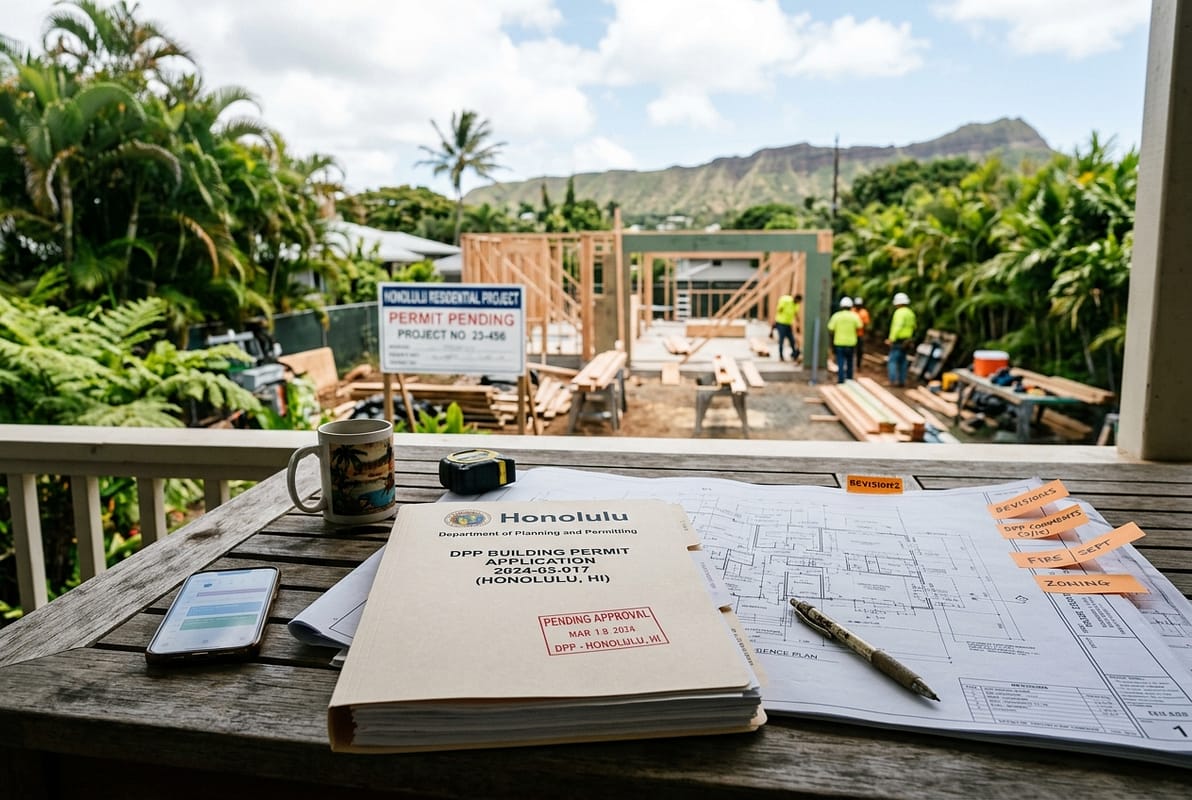
These delays stem from a perfect storm of factors. The DPP is processing a historic volume of applications. This is driven by new ADU construction. Relentless housing demand in areas like Kapolei and Ewa Beach also contributes. Furthermore, Hawaii’s building codes are becoming increasingly complex. This is especially true with recent amendments to the International Building Code (IBC). These focus on hurricane resistance and energy efficiency. Each set of plans requires multiple, sequential reviews by different departments—zoning, architectural, structural, electrical, and plumbing. A simple error or omission can occur in the initial submission. This happens through the city’s ePlans portal. Such an error can send your application back to the end of the line. That adds months to the wait. A huge part of our pre-construction work is ensuring the plans we submit are meticulously detailed. They must also be compliant from day one. This helps to minimize the risk of preventable setbacks.
The 9-10 Month Reality from the DPP
It’s crucial for homeowners to internalize this timeline. This 9 to 10-month period is not a buffer; it’s the baseline. Consequently, we build our entire project schedule around this fact. The moment we submit your plans, we immediately start the clock on two parallel paths. These are the DPP review path and our Phase Zero procurement path. We track the plan’s progress through the city’s public portal, but we don’t sit idly and wait for it to move. Instead, we use that time to make productive, money-saving decisions. This acceptance of the DPP reality, rather than fighting against it, is what makes Phase Zero construction so effective. We aren’t trying to magically speed up the city; we are maximizing the value of the time they force us to wait. This pragmatic approach is central to a successful Oahu pre-construction strategy.
How Does Phase Zero Save You Money on Construction Costs?
The Phase Zero approach directly attacks the two biggest drivers of budget overruns in Hawaii construction: material price inflation and exorbitant shipping costs. We are hyper-proactive during the 10-month permit review period. We lock in today’s prices for materials that won’t be installed for nearly a year. Our team also consolidates shipping to achieve massive economies of scale. The result is an average direct savings of over $25,000 for a typical custom home project. This isn’t a theoretical number; it’s the tangible result of a disciplined and well-managed Oahu pre-construction strategy.
Beating Material Inflation by Ordering Early
Here’s the hard reality: Hawaii building material costs are relentlessly climbing. The University of Hawaii Economic Research Organization (UHERO) projects a sustained 6-8% year-over-year increase for the foreseeable future, driven by mainland manufacturing costs and trans-Pacific freight charges[2]. In the old model, waiting 10 months for a permit is common. Ordering anything before that time guarantees you will pay 6-8% more. This applies to your entire materials package. It’s like willingly walking into a price hike.
Our Phase Zero construction method avoids this entirely. Once your design is finalized, we immediately place orders for all major components. For instance, consider a standard materials package for a new build in Kailua, where the windows and doors must be high-performance, salt-air-resistant units. Here’s a breakdown of the savings:
- Total Materials Package (Lumber, Windows, Roofing, Finishes): $200,000
- Projected Inflation Rate (over 10 months): 7%
- Cost if Ordered After Permit Approval: $214,000
- Direct Inflation Savings with Phase Zero: $14,000
For example, just ordering a $75,000 window, door, and custom cabinet package at the start of Phase Zero saves over $5,250. We apply this principle to everything: lumber, roofing, flooring, fixtures, appliances. Those savings add up fast, protecting your budget from market volatility. This is a core tenet of saving money on new construction Hawaii and a key benefit of a robust Oahu pre-construction strategy.
Slashing Shipping Costs with Consolidated Freight
Living on an island means everything arrives on a boat, and that freight costs money. The Hawaii Contractors Association confirms that ocean freight adds a significant premium to all materials, with container rates continuing to rise[3]. The most expensive way to ship is through piecemeal orders. These are called Less than Container Load, or LCL. Air freight for last-minute items is even worse. Our proactive Oahu pre-construction strategy avoids these costly methods completely.
During Phase Zero, we finalize all your selections, down to the specific bathroom tiles and exact kitchen cabinet pulls. This process allows us to aggregate everything into one or two fully optimized 40-foot container shipments. These are called Full Container Loads, or FCL, from the West Coast. For a typical 3,000 sq. ft. custom home, our meticulous planning easily cuts over $10,000. That’s for ocean freight and handling costs. This compares to a dozen separate LCL shipments spread out over the build. Additionally, we coordinate with our mainland suppliers to have all materials delivered to a single consolidation warehouse. Once every last box has arrived, we pack the container efficiently and ship it. This not only saves our clients thousands of dollars. It also dramatically reduces the risk of damage or lost items in transit. This is a common cause of delays and re-ordering costs.
Can Proactive Planning Shorten a Construction Timeline in Hawaii?
Absolutely. Our Phase Zero strategy cannot speed up the DPP’s internal process. However, it dramatically shortens the actual construction timeline. This happens *after* the permit is approved. The reduction is often by as much as six months. The key is eliminating the “second wait.” This is a hidden delay that occurs when a project has a permit in hand. However, there is no crew to start the work. Also, no materials are on the island. Our disciplined Oahu pre-construction strategy ensures readiness. On Day 1 of permit approval, we are ready to break ground. We have people, materials, and a locked-in schedule.

Locking In Elite Subcontractors Before They’re Booked
Oahu is facing a significant skilled labor shortage. Consequently, the best, most reliable subcontractors are in extremely high demand—from foundation crews who know how to work with our expansive volcanic soil to framers who are experts in hurricane-rated construction and electricians who master modern smart-home systems. As Pacific Business News has reported, premier Oahu subcontractors are now scheduling their projects 8 to 10 months in advance[4]. If you wait until your permit is approved to start calling them, you’ll discover their next opening is half a year away. Your fully permitted project will sit on a vacant lot, waiting.
During Phase Zero, as soon as we have a finalized architectural plan, we get on the books. First, we send the plans to our trusted team of subcontractors. Next, we secure a place in their schedule. This is timed to coincide with our projected permit approval date. We also sign contracts to lock them in. This single step is one of the most powerful elements impacting the new build timeline Oahu. It means that when the permit is issued, we aren’t starting a search for labor; our crew is already assembling. On a recent North Shore project, this foresight prevented a five-month delay. The island’s top roofing contractor was completely booked for the remainder of the year. This was true by the time the permit was physically in hand.
Completing Complex Engineering for Hurricane Codes
Hawaii’s building codes are some of the most stringent in the nation, and for good reason. The state’s 2026 enforcement of the latest International Building Code is approaching. This code includes Hawaii-specific amendments. It requires an incredible amount of detailed engineering. This is particularly for structural integrity. Our engineers spend a significant portion of the Phase Zero period working on complex calculations. We design hurricane tie-down systems and shear walls capable of withstanding 165 mph wind loads. Our team also analyzes geotechnical soil reports. This helps us design foundations. These foundations handle the expansive volcanic clay. This clay is found in parts of Hawaii Kai and Central Oahu. This isn’t just a rubber-stamp process; it’s a rigorous back-and-forth with the structural reviewers at the DPP. We complete and submit this highly detailed engineering package upfront. This ensures it gets through the review queue concurrently with the architectural plans. It does not get submitted after.
Securing Allocated Materials Before Groundbreaking
With construction activity remaining at a five-year high across the state, according to DBEDT data, the supply chain for basic materials is under constant strain. Key commodities are often on allocation. These include concrete, steel rebar, and certain types of lumber. Major island suppliers like HC&D and Hawaiian Cement often provide them this way. This means there’s a finite amount available, and contractors are all competing for it. Waiting until your permit is approved to order rebar for your foundation is a recipe for disaster. In fact, it is not uncommon for projects to be delayed four to six weeks mid-build. This happens because on-island concrete supplies have run dry. Then everyone is waiting for the next barge. Our Oahu pre-construction strategy mitigates this risk through proactive procurement. During Phase Zero, we calculate the exact quantities of these critical path materials, pre-purchase them, and arrange for storage. When the permit is approved, the rebar is already in our laydown yard. The foundation crew is also ready. The concrete pour is already confirmed on the supplier’s schedule.
How Does an Oahu Pre-Construction Strategy Work on a Real Project?
A proactive Oahu pre-construction strategy translates abstract savings into real-world results by front-loading decisions and procurement. To see this in action, let’s look at a recent project in Kailua. Our Phase Zero approach saved a family over $28,000. It also shaved five months off their build time. This turned a period of anxious waiting into one of productive progress.
The homeowners, the Jones family, wanted to build a 3,200 sq. ft. modern coastal home. They were excited, but their hearts sank when we explained the 10-month permit reality. They felt their dream was being put on hold for almost a year.
This is where we introduced our Phase Zero method. Instead of waiting, we immediately got to work. In the first three months, while their plans were in the initial DPP queue, we guided them through every single design decision. For example, they selected their Fleetwood sliding doors. They also picked impact-rated Pella windows designed to resist salt-air corrosion. The specific ipe for their lanai decking was chosen. Finally, the entire Sub-Zero and Wolf appliance package was selected. By the end of Month 4, we had placed over $225,000 worth of material orders. Simultaneously, we locked in our go-to Windward-side foundation crew and our best framing team, both of whom were already booking 9 months out. We scheduled them to start work in Month 11, anticipating the permit’s approval.
The Financial and Timeline Impact
Here’s the bottom-line result of this proactive work:
- Inflation Savings: By ordering materials early, the Jones family avoided a projected 7.5% price increase on their package. Total Savings: $16,875.
- Shipping Savings: By consolidating everything from appliances to tile into two 40-foot containers instead of 15-20 separate shipments, we cut their freight and handling costs dramatically. Total Savings: $11,500.
- Time Savings: When their permit was approved in just over 9 months, our crews were on site within two weeks. Their neighbors had their permit approved a month earlier. They used a traditional builder. Still, they were waiting for their foundation contractor to become available. Our Phase Zero strategy cut 5 months off their post-permit construction timeline.
For the Jones family, the Phase Zero construction method turned a period of anxiety into a productive and empowering experience, saving them a total of $28,375 and getting them into their dream home half a year sooner. This case study demonstrates the power of a superior Oahu pre-construction strategy.
What Are the Exact Steps in a Winning Oahu Pre-Construction Strategy?
A successful Phase Zero isn’t a vague concept; it’s a structured, disciplined playbook with clear milestones. It requires intense collaboration between our team, the homeowner, the architect, and our suppliers. Here is the step-by-step process we follow during the 9 to 10-month permit review period. Executing this comprehensive Oahu pre-construction strategy is how we deliver predictable timelines and budgets.
Phase Zero Kickoff: The First 60 Days
The initial stage is about establishing momentum and securing critical resources immediately after the plans are submitted to the city.
- Finalize & Submit Plans (Month 1): The clock starts the moment the architect’s final plans are complete. First, we conduct a final review for constructability and code compliance. Then, we officially submit the entire package to the Honolulu DPP via their ePlans portal. This action formally begins the 9-10 month review period.
- Lock-In Subcontractor Schedules (Months 1-2): With the plans submitted, we immediately distribute them to our core team of trusted subcontractors. Next, we negotiate pricing based on current labor rates. Most importantly, we secure their commitment, getting your project onto their long-term schedule, targeting a start date 10 months out.
The Procurement & Logistics Gauntlet: Months 3-10
This is the longest and most intensive phase, where all materials are selected, purchased, and transported to the island in parallel with the DPP’s review.
- Complete All Finish Selections (Months 2-4): This is the most intensive period for homeowner decisions. We guide you through the selection of every single finish material. This is not a general idea. Instead, we specify the exact faucet model number. We also pick the paint color by name and the tile SKU. We also select the hardwood flooring supplier. Absolute finality is required to make this Oahu pre-construction strategy work. For more on this, our guide to interior finish costs is a great resource.
- Place Long-Lead Time Orders (Month 4): With selections finalized, we immediately place purchase orders for all items with significant manufacturing and shipping lead times. This primarily includes windows, exterior doors, trusses, and custom cabinetry, which can often take 20-24 weeks from order to delivery. This step ensures they arrive on-island right when we need them.
- Execute Materials Procurement (Months 5-7): We move on to purchasing all other materials, including flooring, tile, plumbing fixtures, lighting, and appliances. By purchasing now, we lock in 2026 pricing and protect your budget from the 6-8% annual inflation that UHERO forecasts.
- Consolidate & Ship Freight (Months 8-9): As materials arrive at our mainland consolidation warehouse, we meticulously inventory everything. Once all items are accounted for, we strategically load one or two 40-foot containers for ocean freight to Honolulu. This bulk shipment method is the key to achieving the $10,000+ in shipping savings.
Final Coordination and Mobilization
- Final Pre-Construction Planning (Month 10): As we get word from the DPP that the permit is nearing approval, we conduct a final pre-construction conference with you and our project superintendent. We review the schedule. Our team confirms material delivery dates. We also walk the site to plan logistics. This includes portable toilets, temporary power, and material staging areas. The day the permit is issued, we are ready to mobilize.
Is the Phase Zero Strategy Right for My Oahu Project?
Our Phase Zero Oahu pre-construction strategy delivers the most significant time and money savings. This applies to new custom home builds, large-scale gut renovations, and major home additions. Essentially, your project may involve a complex architectural permit from the DPP. That process is guaranteed to take the better part of a year. If so, this approach is not just beneficial. It is essential for a successful outcome in Hawaii’s challenging building environment. The more complex the logistics, the more material selections required, and the longer the lead times, the more value Phase Zero provides.
What Kind of Homeowner Thrives with Phase Zero?
The strategy does require a certain mindset from the homeowner. Specifically, you must be prepared to make firm, final decisions on all your finishes much earlier in the process than you might expect. The entire system hinges on our ability to finalize selections and place orders months before breaking ground. For homeowners who are decisive and want to mitigate as much risk as possible, it’s a perfect fit. It provides cost certainty and a predictable timeline, two things that are notoriously difficult to achieve in Hawaii construction. For example, we had a custom home build in Manoa where the client finalized their kitchen design in month three. This allowed us to order a specialized appliance package from Italy. It arrived on island in month nine, just in time for installation. This avoided what would have been a seven-month delay under the traditional model.
While the full, multi-container Phase Zero approach might be overkill for a simple bathroom remodel, the core principles still apply. Even on smaller projects, ordering is important. Order your vanity, tile, and fixtures as soon as the design is complete. This can avoid frustrating delays from a single backordered item. For any project involving a DPP permit, thinking proactively about procurement and scheduling during the wait is always a smart move. An Oahu pre-construction strategy, tailored to your project’s scale, is always the right call.
Frequently Asked Questions
What is the biggest risk of not using an Oahu pre-construction strategy?
The biggest risk is a “second wait” and significant cost overruns. After waiting 10 months for your permit, you could wait another 6-8 months for top-tier subcontractors to become available. During this entire period, you’re exposed to material price increases, which UHERO projects at 6-8% annually. A proper Oahu pre-construction strategy eliminates this second wait and locks in material prices early.
Can I really save $25,000 with this approach?
Yes, the savings are real and quantifiable. On a typical 3,000 sq. ft. custom home, you can save over $10,000 in consolidated shipping alone. Furthermore, you can save another $10,000-$15,000 by pre-purchasing a $200,000 materials package and avoiding a 6-8% inflationary price hike during the permit wait. These figures are based on current shipping rates and documented material cost increases.
What if I change my mind on selections after they are ordered?
This is the critical commitment of the Phase Zero process. Once custom or long-lead time items are ordered, changes generally cannot be made. This applies to windows and cabinets. Such changes come without significant financial penalties. These include restocking fees and forfeited deposits. That’s why our team spends so much time from months 2-4 ensuring every selection is 100% final before placing orders.
Does Warrior Construction charge extra for Phase Zero planning?
No. We consider this intensive pre-construction management part of our standard service for major projects. Our project management fee is structured to cover this crucial planning phase because it leads to a smoother, more efficient, and more predictable build. The cost savings we generate for you far outweigh the management investment; it’s a core part of our value proposition and a key element of our Oahu pre-construction strategy.
How does the Honolulu building permit wait time in 2026 compare to previous years?
The current 9-10 month average for a new build is consistent with the past 2-3 years and has become the new normal. Pre-2020, the timeline was closer to 6-7 months, but increased demand, more complex building codes, and city staffing challenges have lengthened it. Our entire Oahu pre-construction strategy is built around this new 10-month baseline.
How do you store thousands of dollars of materials safely before my project starts?
This is a key logistical component. We have established relationships with secure, insured warehousing facilities both on the mainland and here in Honolulu. Materials are delivered, inventoried, and stored professionally until they are needed on site, protecting them from theft, damage, and the elements. The cost of this storage is minimal compared to the savings on inflation and shipping.
What happens if a selected material is discontinued during the 10-month wait?
This is a rare but possible scenario that our proactive approach helps mitigate. Because we place orders early in Phase Zero, we find out about supply chain issues like a discontinued tile immediately, not a year later. This gives us 6-8 months to work with you to select a suitable replacement without impacting the construction start date. This is a key advantage of a forward-thinking Oahu pre-construction strategy.
Is this Oahu pre-construction strategy only for new builds?
While it delivers the biggest impact on new builds, the principles are invaluable for major renovations and additions too. Any project requiring an architectural permit from the DPP will benefit. This is especially true for those with significant material orders. Think of a full kitchen and bathroom gut remodel. Using the permit wait to order cabinets, appliances, and tile can easily shave 2-3 months off the backend of the renovation timeline.
Take Control of Your Project Timeline and Budget
The difference between a successful project and a stressful one often comes down to the planning that happens months before a single hammer swings. The Phase Zero approach is our commitment to proactive, transparent, and strategic management from day one. If you are planning a major build or renovation on Oahu, we can turn the island’s biggest challenge into your greatest advantage. Our team is ready to build your playbook.
Learn more about how our expert planning can set your project up for success. Explore our Preconstruction Planning services and let’s start a conversation about your vision.


