
A successful aging in place Hawaii renovation is about much more than installing a few grab bars; it’s about creating a truly independent, safe, and comfortable living space for your kupuna. For most local families, this means designing and building a dedicated ground-floor “Kupuna Suite.” This project typically involves reconfiguring an existing space to include an accessible bedroom, a zero-threshold bathroom, and sometimes a small kitchenette, with costs on Oahu starting around $150,000. While that’s a significant one-time investment, it’s a smart financial decision when compared to the relentless annual cost of elder care facilities, which now easily top $120,000 per year in Honolulu.
For over 20 years, our team at Warrior Construction has helped Oahu families adapt their homes for the future. We understand the unique challenges, from working with older single-wall construction to navigating the long lead times for shipping materials to the islands. Furthermore, we know that this isn’t just a construction project—it’s about keeping ohana together. This guide will walk you through the real-world costs, timelines, material choices, and funding options you need to consider for a successful multigenerational renovation in 2026.
What is a ‘Kupuna Suite’ and why is it so common in Hawaii?
Snippet Answer: A Kupuna Suite is a ground-floor living space designed for aging parents, often as part of a multigenerational home. With over 30% of Oahu households being multigenerational and elder care costs topping $10,000 a month, these renovations are a practical, culturally-fitting solution for local families.
On the mainland, they might call it an in-law suite or an accessory dwelling unit. Here in Hawaii, we have a better name for it: the Kupuna Suite. It reflects a cultural value that is deeply ingrained in our islands—taking care of our elders and keeping the family under one roof. It’s not a trend; it’s a tradition. The latest 2026 data from Hawaii’s Department of Business, Economic Development & Tourism (DBEDT) shows that over 30% of Oahu households are multigenerational.[1] That’s one of the highest rates in the nation, and it’s why these renovations are so central to our work.
A Kupuna Suite isn’t just a spare bedroom. It’s a thoughtfully designed, self-contained area that gives an aging parent both independence and immediate access to family support. Most importantly, it’s a proactive solution to a growing financial and logistical challenge for local families.
The Financial Reality: A One-Time Renovation vs. Annual Care Costs
Let’s be blunt about the numbers. The cost of a room in an assisted living facility or nursing home in Honolulu is staggering. As of 2026, families are looking at costs that can easily exceed $10,000 a month, which adds up to more than $120,000 per year. And that cost never goes away; it increases annually. Now, compare that to a one-time construction investment. A comprehensive Kupuna Suite renovation might cost $150,000 to $225,000. While that’s a serious number, in less than two years, the renovation has paid for itself compared to the alternative. After that, you’re not just saving money—you’re building equity in your home and, most importantly, providing a higher quality of life for your loved one in a familiar, loving environment.
Here’s a simple breakdown of the financials:
- Assisted Living Facility (Honolulu): $10,000+/month = $120,000+/year
- Kupuna Suite Renovation (One-Time Cost): $150,000 – $225,000
- Financial Break-Even Point: Approximately 15-22 months
After the break-even point, you are effectively saving over $100,000 every single year, while also adding significant, functional value to your property.
Beyond the Bathroom: Designing a Truly Livable Space
A common mistake is focusing only on an accessible bathroom remodel. While a zero-threshold shower and grab bars are critical, a true Kupuna Suite is a holistic living environment. A properly designed suite should include:
- A Ground-Floor Location: This is non-negotiable. Stairs are the biggest barrier to aging in place.
- Wide Doorways and Hallways: We aim for a minimum of 36-inch-wide doorways to accommodate walkers and wheelchairs, now or in the future.
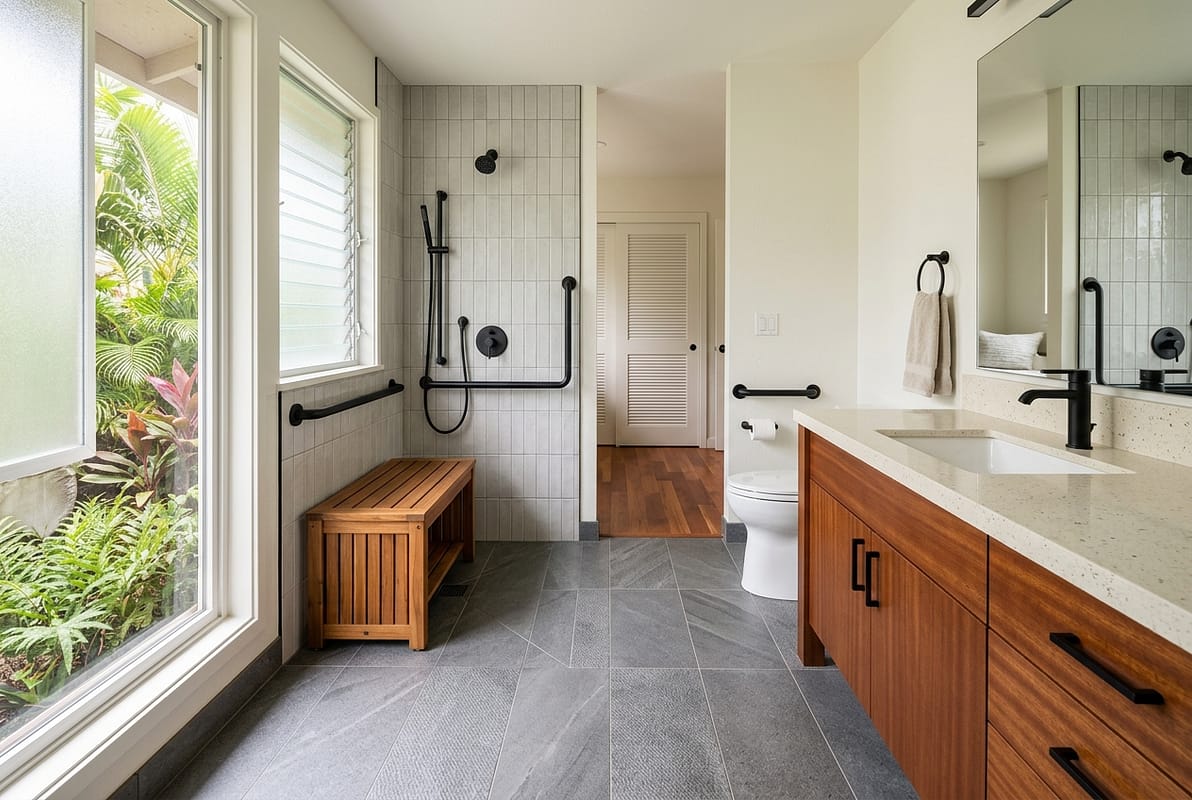
- An Accessible Bathroom: This includes a roll-in, zero-threshold shower with a bench, a comfort-height toilet, and reinforced walls for secure grab bar installation.
- A Small Kitchenette or Wet Bar: A mini-fridge, microwave, sink, and some counter space provide independence for morning coffee or simple meals.
- Good Lighting and Smart Technology: Rocker-style light switches, easy-to-reach outlets, and even voice-activated controls can make a huge difference.
- Durable, Non-Slip Flooring: This is a key safety feature we’ll discuss in more detail later.
The goal is to create a space that feels like a private apartment within the home, not just a modified bedroom. This preserves dignity and autonomy for your kupuna while keeping them close.
How much does an aging-in-place renovation cost on Oahu?
Snippet Answer: A full Kupuna Suite renovation often starts around $150,000, while a single ADA-compliant bathroom remodel averages $35,000 to $55,000. These costs reflect the high price of shipping every fixture to the island and the specialized labor needed for our unique housing stock.
Building in Hawaii is expensive; there’s no way around it. Every single piece of material, from the lumber to the specialized non-slip tile to the specific Moen grab bars, has to be put on a boat and shipped thousands of miles across the Pacific. That reality is baked into every construction budget on Oahu. For an aging in place Hawaii project, the costs are even more specific because the materials and fixtures are often specialized.
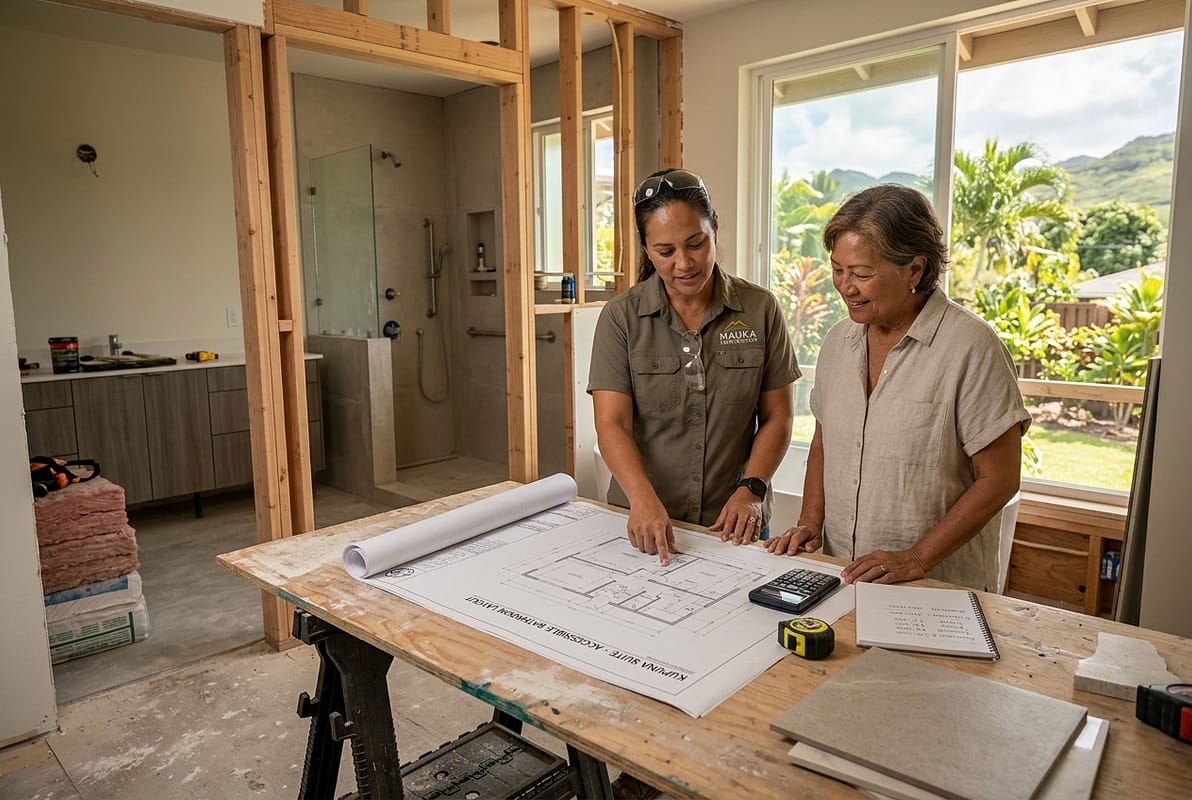
The Hawaii Contractors Association’s 2026 cost survey confirms what we see on our job sites: a full, ADA-compliant bathroom remodel now averages between $35,000 and $55,000.[2] This isn’t for a cosmetic refresh; this is for the real work of moving plumbing, installing a zero-threshold shower pan, reinforcing walls, and using high-quality, durable fixtures. When you expand that scope to a full Kupuna Suite—which includes a bedroom, the bathroom, and a kitchenette—the budget naturally grows. An accessible home remodel cost in Honolulu for a complete suite of around 400 square feet will generally start in the $150,000 range and can go up depending on the level of finishes and the complexity of the existing structure.
Sample Budget for a 400 sq. ft. Kupuna Suite in a Mililani Home
To make this more concrete, let’s break down the costs for converting a ground-floor den and an adjacent powder room into a 400 sq. ft. Kupuna Suite in a typical 1980s Mililani hollow-tile home. This is a common scenario our team handles.
- Architectural & Engineering Plans / Permitting: $12,000 – $18,000 (Includes structural calculations for widening doorways)
- Demolition & Site Prep: $8,000 – $10,000
- Framing & Structural Changes (Widening 2 doorways): $9,000 – $14,000
- Electrical (New subpanel, accessible outlets, lighting): $11,000 – $16,000
- Plumbing (Converting powder room, new shower drain): $15,000 – $22,000 (Cutting into the concrete slab is labor-intensive)
- Drywall, Insulation & Paint: $10,000 – $15,000
- Flooring (400 sq. ft. of Luxury Vinyl Tile): $6,000 – $9,000
- Bathroom Tile & Waterproofing (Roll-in shower): $12,000 – $18,000
- Fixtures (ADA toilet, grab bars, sink, shower system): $7,000 – $11,000
- Kitchenette Cabinetry & Countertop (Small wet bar): $8,000 – $12,000
- Windows & Doors (New wider, accessible units): $9,000 – $15,000
- General Conditions, Project Management & Overhead: $30,000 – $45,000
- Total Estimated Cost: $137,000 – $205,000
As you can see, the bathroom is a significant portion of the cost, but the structural, electrical, and plumbing modifications required for the entire suite are what drive the overall budget. Every project is different, but this provides a realistic baseline for planning.
The Unique Challenges of Renovating Older Single-Wall Homes
Many of the homes in older Oahu neighborhoods like Manoa, Kaimuki, and parts of Kailua are classic single-wall construction. These homes present specific challenges for an accessibility renovation. Consequently, they require an experienced ADA contractor in Oahu who knows how to handle them. For example, in a modern home, we can run new wiring and plumbing inside the wall cavity between two sheets of drywall. In a single-wall home, there is no cavity. The wall is a solid plane of wood planks.
This means we often have to build out a new, secondary wall (a “furring wall”) just to create space for electrical outlets at the proper height or to run plumbing lines for a new sink. Another major issue is structure. Widening a doorway in a single-wall home isn’t as simple as reframing a header; you might be cutting into the primary structure of the house. This requires careful engineering and is not a job for an amateur. When we open up these walls, we also frequently discover hidden termite damage or rot that has to be addressed before we can move forward, which is a common source of unforeseen costs in older Hawaii homes.
How long does a multigenerational renovation take in Honolulu?
Snippet Answer: You need to plan for a total timeline of about a year. This includes the current 7-month backlog for a Honolulu building permit, a 12 to 16-week lead time for specialized materials to be shipped, plus the actual 3-4 months of on-site construction.
The most common surprise for homeowners planning a major renovation is the timeline. The actual time our crew is on-site swinging hammers is only one piece of the puzzle. For a Kupuna Suite project in Honolulu, a realistic timeline from your first call to a contractor to the final inspection is about 12 to 14 months in 2026. This is crucial to understand, especially if the need for the space is becoming urgent.
Here’s how that timeline typically breaks down:
- Phase 1: Design & Planning (1-2 months): This involves working with our team and an architect or designer to finalize the layout, select all your materials and fixtures, and create the detailed construction drawings.
- Phase 2: Permitting (7-9 months): Once the plans are complete, we submit them to the Honolulu Department of Planning and Permitting (DPP). This is currently the longest phase of any project.
- Phase 3: Material Procurement (3-4 months): This overlaps with the end of the permitting phase. We order all specialized items as soon as the design is locked.
- Phase 4: Construction (3-4 months): This is the on-site work, from demolition to the final coat of paint.
Planning Around the 7-Month Honolulu DPP Permit Backlog
The single biggest factor dictating your project start date is the permitting process. As of mid-2026, the backlog for a residential building permit review at the Honolulu DPP is still hovering around 7 months for any project involving structural changes.[3] If your Kupuna Suite involves moving or widening a load-bearing wall, or significant plumbing and electrical work, a permit is absolutely required. There is no way to speed this up. The only solution is to start the planning and design process long before you need the space to be ready. We submit the permit application as early as possible so that the long wait can happen while we are coordinating other aspects of the project.
The 16-Week Wait: Hawaii’s Supply Chain for Accessible Materials
The second major timeline factor is Hawaii’s supply chain. While we can get standard building materials like lumber and drywall relatively quickly, specialized items for aging-in-place renovations are another story. Pacific Business News has been tracking these supply chain issues, and the reality for 2026 is that we have to plan for long lead times.[4]
Here are some real-world examples:
- Walk-in Tubs or Specialized Shower Pans: 12-16 weeks from order to arrival at Honolulu Harbor.
- Specific Non-Slip Tile: If it’s not a standard item stocked locally, it can take 10-14 weeks.
- Custom-Sized ADA-Compliant Vanities: 8-12 weeks.
- High-Quality, Corrosion-Resistant Fixtures: Even popular brands can have an 8-10 week lead time for specific models.
Our process is to order every single one of these items the day the contract is signed and the design is finalized. We can’t afford to wait for the permit to be in hand, or we’d add another four months of dead time to the project. This requires meticulous project management and planning, which is a core part of what we do.
What are the best materials for an accessible home in Hawaii’s climate?
Snippet Answer: We prioritize materials that are non-slip, low-maintenance, and resistant to our salt air and humidity. Luxury Vinyl Tile (LVT) is our standard for flooring, and we use stainless steel or specially coated fixtures to combat corrosion from the ocean air.
Material selection for any Hawaii home is critical, but for an aging-in-place renovation, safety and durability are paramount. We’re not just thinking about aesthetics; we’re thinking about preventing slips, reducing maintenance for an elderly resident, and choosing products that won’t fall apart in our humid, salty environment.
Flooring That’s Safe and Durable: Why We Recommend LVT
The single most important material choice for safety is the flooring. We almost exclusively recommend high-quality Luxury Vinyl Tile (LVT) or Luxury Vinyl Planking (LVP) for Kupuna Suites. Here’s why:
- It’s Non-Slip: LVT has a textured surface that provides excellent grip, even when wet. This is a huge advantage over smooth, polished tile or laminate. We look for products with a high coefficient of friction (COF) rating.
- It’s Waterproof: Unlike wood or laminate, LVT is 100% waterproof. Spills, moisture from a wheelchair coming in from the rain, or bathroom humidity won’t cause it to swell or buckle.
- It’s Softer Underfoot: LVT has more give than hard tile. This is more forgiving on aging joints and can reduce the severity of injury in a fall.
- It’s Low Maintenance: It’s incredibly easy to clean and doesn’t require sealing like natural stone or grout lines.
While some clients love the look of tile, the countless grout lines can be a tripping hazard for walkers and are difficult to keep clean. For a deeper dive into flooring options, check out our Hawaii flooring guide, but for accessibility, LVT is our top choice.
Fixtures and Finishes that Fight Salt Air Corrosion
If you live anywhere on the Windward side, from Hawaii Kai to Kailua and up to the North Shore, you know what salt air does to metal. We’ve seen cheap chrome fixtures on bathroom sinks start to pit and corrode in less than a year. For a Kupuna Suite, we need fixtures that will last without constant polishing or replacement.
Our recommendations are:
- 316 Stainless Steel: This marine-grade stainless steel has extra molybdenum, which makes it far more resistant to chloride and salt corrosion than the more common 304 grade. It’s more expensive, but it’s worth it for faucets, grab bars, and shower heads.
- PVD Finishes: Physical Vapor Deposition (PVD) is a modern finishing process that bonds the finish to the metal at a molecular level. It’s much tougher and more corrosion-resistant than standard electroplating. Brands like Kohler and Brizo offer excellent PVD options in finishes like brushed nickel and matte black.
- Solid Brass: High-quality, heavy solid brass fixtures are also an excellent choice as they don’t rust.
Designing a Zero-Threshold, Roll-In Shower for a Hawaii Home
The centerpiece of any accessible bathroom is the zero-threshold, or roll-in, shower. This design eliminates the curb or step that is a major trip hazard and barrier for wheelchair users. Creating one properly, especially in a renovation on a concrete slab, is a technical process.
Here’s what’s involved:
- Recessing the Floor: We often have to cut and lower a section of the concrete slab in the shower area to create the necessary slope for drainage without having a curb.
- Proper Slope: The shower floor must be perfectly sloped—typically a quarter-inch drop per foot—towards the drain. Too little slope, and water pools. Too much, and it becomes difficult for a wheelchair to navigate.
- Waterproofing: This is the most critical step. We use a multi-layer waterproofing system, like the Schluter-KERDI membrane, which covers the floor and runs up the walls. A flood test is always performed before any tile is laid to ensure it’s 100% watertight.
- Linear Drains: We prefer to use linear drains placed against a wall. This allows us to slope the entire shower floor in a single plane, which is safer and easier for a wheelchair than the four-way slope required for a center drain.
A properly built roll-in shower is a complex system that requires a highly skilled contractor. It’s the cornerstone of a safe and functional aging-in-place bathroom.
How can you fund a Kupuna Suite renovation in Hawaii?
Snippet Answer: Many of our clients use a HELOC or cash-out refinance for funding. For veterans, the VA’s Specially Adapted Housing (SAH) grant is a major resource, providing over $110,000 in some cases, while the state’s Kupuna Grant offers a smaller, more competitive option.
Funding a six-figure renovation is a major consideration for most families. The good news is that there are several excellent options available, including some specific to veterans and kupuna here in Hawaii. It’s smart to explore these avenues early in your planning process.
Using a VA Specially Adapted Housing (SAH) Grant on Oahu
For our many clients who are veterans or have veterans in the family, the VA housing grants are a phenomenal resource. We have a lot of experience working with the VA and navigating their process. The Specially Adapted Housing (SAH) grant is designed for veterans with certain service-connected disabilities and can be used to build or remodel a home to be completely accessible. As of 2026, the maximum grant amount is over $110,000.[5]
This is a life-changing amount of money that can cover a huge portion of a Kupuna Suite renovation. The process involves an application to the VA, who will then assign an agent to the case. As the contractor, we provide detailed plans and line-item bids that meet the VA’s specific requirements. They conduct inspections during the construction process to ensure the work meets their high standards for accessibility. If you think you or a family member might qualify, this should be the very first funding option you investigate. We are proud to be a trusted VA home modification grant Hawaii contractor.
The State’s HHFDC Kupuna Grant: A Race to Apply
The state of Hawaii, through the Hawaii Housing Finance and Development Corporation (HHFDC), also offers a program called the Kupuna Home Modification Grant. It’s a smaller grant, typically offering up to $15,000 in matching funds for accessibility modifications. The main challenge with this grant is that funding is very limited and highly competitive. The application window is usually short, and the funds are exhausted almost immediately.
Our advice for clients interested in this grant is to be prepared. This means having our formal bid, your financial documents, and the project scope ready to go the moment the application portal opens for the 2026-2027 fiscal year. It’s a race, and being prepared is the only way to have a chance.
Traditional Financing: HELOCs and Home Equity
For most homeowners, the most straightforward way to fund the project is by tapping into their home’s equity. With the significant appreciation in Oahu real estate over the last decade, many families are sitting on substantial equity. The two primary tools are:
- Home Equity Line of Credit (HELOC): This works like a credit card secured by your home. You can draw funds as needed during the construction process and only pay interest on what you use. This is very flexible for a renovation project where costs are incurred over several months.
- Cash-Out Refinance: This involves refinancing your existing mortgage for a higher amount and taking the difference in cash. This can be a good option if you can also secure a lower interest rate on your primary mortgage, but it does reset your loan term.
We always recommend speaking with a mortgage broker or your local credit union to understand the current rates and find the product that best suits your financial situation. Getting pre-approved for financing is a critical step before signing a construction contract.
Do aging-in-place modifications increase a home’s resale value in Hawaii?
Snippet Answer: Absolutely. An ADA-compliant bathroom can recoup around 65% of its cost at resale, which is often higher than a purely cosmetic upgrade. In neighborhoods like Hawaii Kai or Mililani with older housing stock, a home with a true ground-floor suite is highly desirable for multigenerational buyers.
While the primary reason for building a Kupuna Suite is to care for family, it’s also a smart financial investment in your property. Many homeowners worry that these modifications might limit their buyer pool in the future, but in Hawaii, the opposite is often true. The features that define universal design—wider doorways, zero-threshold entries, ground-floor living—are simply features of a more comfortable and functional home for everyone.
The ROI Breakdown for Oahu Neighborhoods
The latest Q2 2026 data from the Honolulu Board of REALTORS® shows that accessibility modifications have a strong return on investment (ROI). A universal design bathroom remodel, for instance, recoups about 65% of its cost at resale. That’s significantly higher than a high-end, purely cosmetic master bathroom renovation, which might only see a 50-55% return.
The value is even more pronounced in specific neighborhoods. Consider areas with a large inventory of older, multi-level homes like Hawaii Kai, Manoa, or Aina Haina. A home in one of these areas that has a fully built-out, permitted, ground-floor Kupuna Suite is a rare and highly sought-after commodity. It immediately stands out to the 30%+ of local buyers who are specifically looking for a multigenerational living Hawaii solution. For them, your home isn’t just a 4-bedroom house; it’s a turnkey solution that saves them the year-long headache and expense of the renovation you’ve already completed.
Why an Accessible Home Stands Out in the Hawaii Real Estate Market
As Hawaii’s population continues to age, the demand for accessible housing will only increase. UHERO’s 2026 demographic reports consistently point to this trend as a major factor in our future housing market.[6] A home that is already equipped for aging in place is future-proofed. It appeals not only to families with elderly parents but also to buyers who are planning for their own futures. They see it as a home they can live in for the rest of their lives without needing major modifications down the road.
Ultimately, a well-designed Kupuna Suite adds a tremendous amount of functional square footage and utility to your home. In the competitive Oahu real estate market, that translates directly to higher resale value and a shorter time on the market.
What does this mean for Hawaii homeowners?
Navigating a major renovation for aging in place in Hawaii requires careful planning, patience, and the right professional team. Given the realities of permitting delays and supply chain logistics, the single most important piece of advice we can give is to start the process well before the need becomes a crisis. The 12 to 14-month timeline is real, so planning ahead is essential.
Here are the key takeaways and your first steps:
- Assess Your Needs: Have an honest conversation with your family and the kupuna who will be living in the suite. What are their current and anticipated future mobility needs? This will guide the design.
- Understand the True Cost: Use the budget numbers in this guide as a starting point. Realize that this is a major investment, but one that pays for itself over time compared to the alternative.
- Explore Your Funding Options Now: If you are a veteran, start the VA grant process immediately. For others, talk to a lender about a HELOC or refinance to understand your budget.
- Hire an Experienced Contractor: Choose a licensed general contractor who has specific experience with aging-in-place modifications, Honolulu permitting, and renovating older Hawaii homes. Ask to see examples of their work. A qualified aging-in-place renovation specialist can make all the difference.
- Be Patient but Proactive: Accept the long timeline for permits and materials, and use that waiting period to finalize every single design detail. The more decisions you make upfront, the smoother the construction phase will be.
Frequently Asked Questions
Can I just convert my garage into a Kupuna Suite?
Yes, a garage conversion is a popular option, but it’s a full-scale renovation, not a simple cosmetic job. It requires a building permit, proper insulation, waterproofing, running new electrical and plumbing lines, and ensuring the space meets all residential building codes for light and ventilation. It often falls into the same $150,000+ budget range as converting interior space.
What’s the difference between ‘ADA-compliant’ and ‘accessible’?
‘ADA-compliant’ refers to the strict legal standards of the Americans with Disabilities Act, which applies to public and commercial spaces. In residential projects, we use those standards as a guideline to create a home that is ‘accessible’ or follows ‘universal design’ principles. For example, we’ll install grab bars at ADA-recommended heights, but we have more flexibility in a home than a business would.
How much value does a Kupuna Suite add to a home in Hawaii?
While it varies by neighborhood, a permitted, well-designed ground-floor suite can add significant value. An ADA-compliant bathroom alone can recoup 65% of its cost. More importantly, it makes your home marketable to the large and growing demographic of multigenerational buyers, often allowing it to sell faster and for a premium compared to similar homes without the feature.
Do I need an architect for an aging-in-place renovation?
If your project involves moving load-bearing walls, changing the exterior of the home, or significantly altering the floor plan, you will need a licensed architect or structural engineer to draw the plans for the Honolulu DPP permit. For simpler projects that don’t involve structural changes, a design-build contractor like us can often handle the design and drawings in-house.
What are the most common hidden costs we should budget for?
In older Hawaii homes, the most common surprises are discovering extensive termite damage or wood rot once we open up walls, and finding old, unpermitted electrical or plumbing work that needs to be brought up to current code. We always recommend including a contingency fund of 10-15% of the total construction cost to cover these potential unforeseen issues.
Is a Kupuna Suite the same as an ADU or Ohana Unit?
Not necessarily. A Kupuna Suite is typically a renovation within the existing footprint of the main house. An Accessory Dwelling Unit (ADU) or Ohana Unit is a separate, detached or attached structure with its own kitchen and bathroom, governed by a different set of zoning rules and regulations on Oahu. While an ADU can certainly be designed as a Kupuna Suite, not all Kupuna Suites are ADUs.
Build a Safe and Comfortable Future for Your Ohana
Creating a Kupuna Suite is one of the most rewarding projects we undertake at Warrior Construction. It’s a renovation that strengthens families and provides peace of mind. By planning ahead and working with an experienced team, you can create a space that allows your loved ones to age in place with dignity, comfort, and safety, surrounded by their ohana. If you’re ready to start the conversation about your own aging in place Hawaii project, our team is here to help you navigate every step of the process, from initial design to final inspection.
Ready to plan a safe and accessible future for your family? Contact Warrior Construction today to schedule a consultation for your aging-in-place renovation.
References
- Hawaii State Department of Business, Economic Development & Tourism (DBEDT) Databook 2026
- Hawaii Contractors Association 2026 Residential Remodeling Cost Guide
- Honolulu Department of Planning and Permitting (DPP)
- Pacific Business News, Hawaii Construction Costs & Supply Chain Report 2026
- U.S. Department of Veterans Affairs, Disability Housing Grants
- University of Hawaii Economic Research Organization (UHERO), Hawaii Housing Demographic Shift Outlook 2026


