
For most 1990s-era Kapolei homes, a major gut renovation is the smarter financial move, especially if your foundation and core structure are solid. However, a full teardown becomes the clear winner when you need to fix extensive legacy issues like single-wall construction or want to seamlessly integrate an Accessory Dwelling Unit (ADU) from the ground up. The decision to pursue a Kapolei renovate vs rebuild project comes down to a clear-eyed look at the numbers, the hidden problems in your walls, and your long-term goals for your family.
Over the years, our team at Warrior Construction has sat down for this exact conversation with dozens of homeowners across the Ewa Plain. They love their neighborhood but feel constrained by a dated layout, failing plumbing, or the simple need for more space for ohana. The choice isn’t just about aesthetics; it’s about making the best investment for the next 30 years. This guide breaks down the real costs, return on investment (ROI), and critical factors we analyze on-site to help our clients make the right call. We’ll compare the typical $250-$300 per square foot for a major renovation against the $425-$475 per square foot for a new build, and show you why a new build can save you over $45,000 when adding an ADU for multigenerational living.
Should I Renovate or Rebuild My 1990s Kapolei Home?
You should choose to renovate your 1990s Kapolei home if its foundation, framing, and roof structure are in good condition and your primary goals are updating finishes and modernizing the layout. Conversely, you should opt for a full rebuild if the home has significant structural problems, widespread termite damage, failing single-wall construction, or if your desired changes are so extensive that they approach the cost of new construction anyway. For example, if you plan to add a second story and reconfigure the entire first floor, a rebuild is often cleaner and more cost-effective.
The ‘Coffee Talk’ Breakdown: Good Bones vs. a Blank Slate
The first thing we do on a potential project site in Ewa or Kapolei is what I call the “good bones” test. We’re not just looking at the cracked countertops or the avocado-green bathroom tiles. We’re looking deeper. Is the concrete slab foundation free of major cracks and settling? Are the load-bearing walls straight and true? Do we see signs of significant, untreated termite damage in the attic trusses? If the answers are mostly positive, you have a solid foundation for a major renovation. The value here is that you’re leveraging the existing structure, which saves a tremendous amount on demolition, engineering, and new foundation work.
A renovation allows you to focus your budget on the things you see and touch every day: a brand-new kitchen with custom cabinets, a spa-like master bathroom, new flooring, and energy-efficient windows. Consequently, you can transform the feel and function of your home for a lower price per square foot. It’s about working with what you have to create something new.
On the other hand, a blank slate offers total freedom. A teardown and rebuild means you are not constrained by the original footprint or layout. You can design the exact home you want for your family’s future, built to 2026 hurricane and energy codes, with every wire, pipe, and stud being brand new. Furthermore, this approach eliminates the risk of discovering unexpected problems hidden in the walls—a common budget-buster in renovations. For many, the peace of mind that comes with a completely new, warrantied home is worth the higher upfront investment.
Why Older Ewa Plain Homes Have Unique Challenges
Homes built in the Ewa Plain during the development boom of the late 80s and 90s have their own specific set of issues that we see time and time again. Understanding these is critical to your Kapolei renovate vs rebuild decision.
First and foremost, many of these homes were built using single-wall construction. This technique, while fast and cheap for developers at the time, offers very poor insulation and almost no soundproofing between rooms. It also makes running new electrical or plumbing a major headache, as there’s no wall cavity to work within. Fixing these single-wall construction problems during a renovation can be surprisingly expensive, often requiring us to build out new interior walls, which eats into your living space and your budget.
Additionally, we frequently encounter original, low-quality aluminum wiring that is now considered a fire hazard, as well as galvanized steel or copper plumbing that is nearing the end of its functional life. A simple kitchen remodel can quickly escalate when we open a wall and discover corroded pipes that need to be replaced all the way back to the main line. Lastly, these homes were built before modern hurricane codes were fully implemented post-Hurricane Iniki. This means they often lack proper hurricane straps and other structural connectors, which would need to be addressed in any major renovation to meet today’s safety standards.
How Much Does it Cost to Renovate vs. Rebuild in West Oahu?
In 2026, a major gut renovation in Kapolei will cost between $250 and $300 per square foot, while a complete teardown and rebuild will run between $425 and $475 per square foot. These figures, backed by data from the Hawaii Contractors Association[1], represent the all-in cost for a turnkey project, including design, permitting, labor, and standard-grade finishes. The key difference lies in what that money buys you: a renovation updates an existing structure, while a rebuild creates a brand new asset from the ground up.
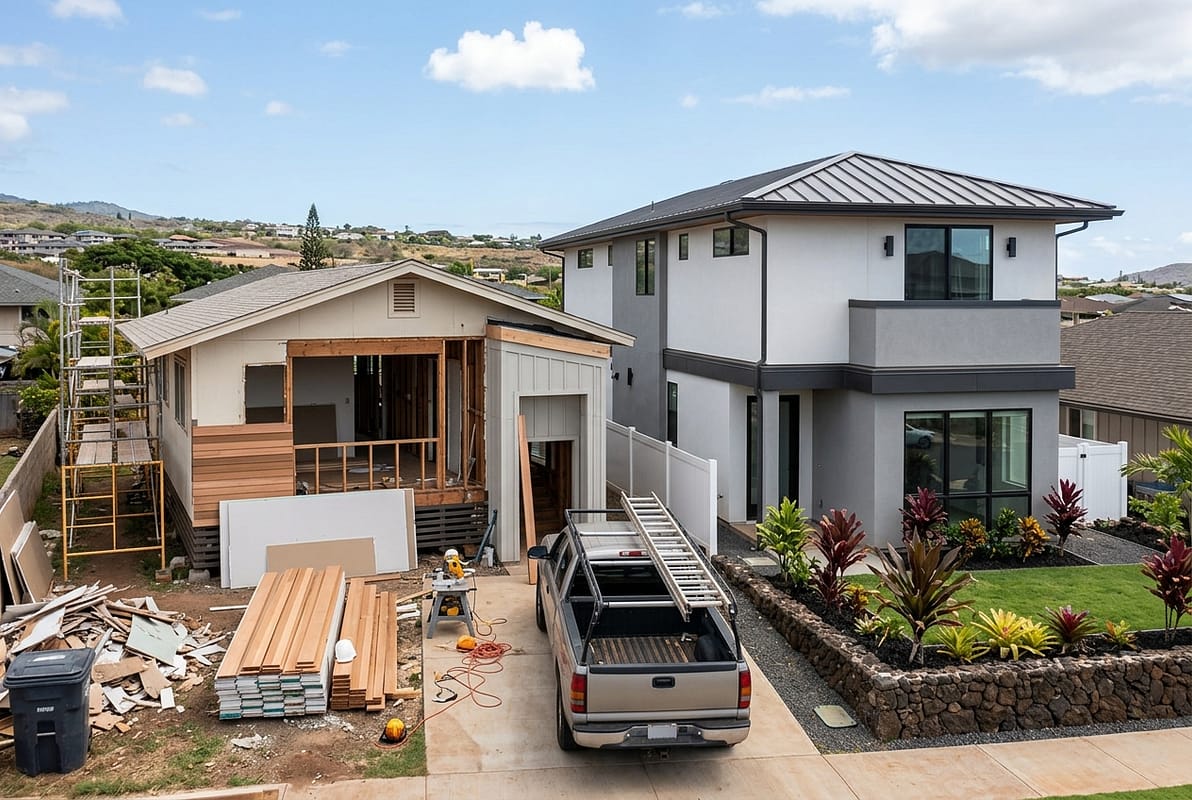
The Math on a Major Gut Renovation: ~$250-$300 per Square Foot
Let’s take a typical 1,800-square-foot, single-story home in Kapolei. A major gut renovation means we’re taking the interior down to the studs. This includes:
- A full kitchen and bathroom overhaul (new cabinets, countertops, fixtures, appliances).
- New flooring throughout the entire house.
- Complete interior repainting.
- Replacing all windows and doors with modern, energy-efficient models.
- Updating all electrical outlets, switches, and lighting fixtures.
- Minor, non-structural layout changes (e.g., widening a doorway).
Using the $250-$300 per square foot metric, this project would land in the $450,000 to $540,000 range. The final cost depends heavily on the level of finishes you choose. For example, custom koa wood cabinets and high-end Sub-Zero appliances will push you toward the top of that range, while quality stock cabinets and Bosch appliances will keep you closer to the lower end. This is a substantial investment, but it’s significantly less than the cost of a new build.
The All-In Cost for a New Teardown/Rebuild: ~$425-$475 per Square Foot
Now, let’s consider the same 1,800-square-foot property but for a complete teardown and rebuild. This process is more involved and includes demolition of the old house, site work, pouring a new foundation, and building a completely new home to your specifications.
At $425-$475 per square foot, the budget for this new 1,800-square-foot home would be $765,000 to $855,000. While this is a higher upfront cost, it’s important to understand what you’re getting. Every single component of the house is new: the foundation, the framing (built with termite-treated lumber), the roof, the plumbing, the electrical system, the insulation, and the HVAC. You get a modern, open-concept floor plan designed for your family, superior energy efficiency, and a home that meets the latest hurricane-resistant building codes. The cost to build a house oahu from scratch provides a level of certainty and long-term durability that a renovation can’t always guarantee.
The Hidden Costs: Fixing Single-Wall Construction & Legacy Plumbing
The biggest risk in an Ewa Plain home renovation is the unknown. The initial quote for a renovation assumes the home’s core systems are serviceable. But what happens when we open up a wall for your new kitchen and find that the old cast iron plumbing has corroded through? That’s no longer a kitchen remodel; it’s now a partial re-piping project. On a recent project in Ewa Gentry, a simple master bath renovation uncovered extensive, hidden termite damage in the wall studs and floor joists, adding nearly $25,000 in structural repairs to the project scope.
As a recent analysis pointed out, the cost of fixing legacy issues can quickly erode the financial advantage of renovating[2]. Correcting single-wall construction by adding a new layer of drywall with insulation can cost $15-$20 per square foot of wall space. A whole-home electrical rewire can run $20,000-$30,000. A complete plumbing re-pipe can be $15,000-$25,000. If your home needs all of these systemic upgrades, the renovation cost can climb well over $350 per square foot, making the predictable, all-in cost of a new build much more attractive.
What is the Financial Return on a Kapolei Renovation?
The financial return on a Kapolei renovation is strong for targeted updates like kitchens and bathrooms, which typically recoup 70-80% of their cost at resale. However, for a whole-house gut renovation, the return is more complex. While it makes the home more desirable, you may not see a dollar-for-dollar increase in appraisal value compared to the total project cost. In contrast, a new build replaces an old asset with a new one, resetting the property’s effective age to zero and often capturing a higher appraisal value that better reflects the total investment.
The Solid 70-80% ROI on Kitchens & Baths
Kitchen and bathroom remodels consistently offer the best bang for your buck. According to a recent Pacific Business News analysis, these projects have a powerful emotional appeal to buyers and a tangible impact on a home’s value[2]. If you spend $80,000 on a modern kitchen renovation in your Kapolei home, you can reasonably expect the appraised value of your home to increase by about $56,000 to $64,000. This is because these are the functional heart of the home, and an updated kitchen can make an entire 30-year-old house feel fresh and new.
This high ROI is why, for homeowners planning to sell within the next 5-7 years, a targeted renovation focused on these key areas is often the most prudent financial strategy. It improves your quality of life while you’re there and gives you a measurable financial return when you leave. Most importantly, it avoids the risk of over-improving the property beyond the ceiling of what the neighborhood market can bear.
When a New Build’s Long-Term Value Outweighs Renovation ROI
The concept of ROI changes when you shift your timeline from 5 years to 30 years. A new build is less about immediate cost recoupment and more about long-term value, lower ownership costs, and future-proofing. Think about it this way: a renovated 1995 home is still, fundamentally, a 31-year-old home with new finishes. You’ll still have to worry about the lifespan of the foundation and other original structural elements.
A new home, however, has a 30+ year lifespan ahead of it for all major systems. Your maintenance costs for the first 10-15 years will be minimal. Your homeowner’s insurance will be lower because the structure is built to modern hurricane codes. Your electricity bills will be lower due to superior insulation and energy-efficient systems. Over decades, these savings add up. Furthermore, a new home built in 2026 will hold its value better over the long run compared to a renovated older home in the same neighborhood. This is a key factor for families who see their Kapolei property as a legacy to pass on to the next generation.
Is it Cheaper to Add an ADU During a New Build?
Yes, it is significantly cheaper to add an Accessory Dwelling Unit (ADU) during a new build compared to adding one to an existing property. Integrating an 800 sq. ft. ADU into new home construction plans costs approximately $180,000. In contrast, building that same 800 sq. ft. unit as a standalone project next to an existing home costs closer to $225,000. The savings come from economies of scale in site work, utility connections, and labor.
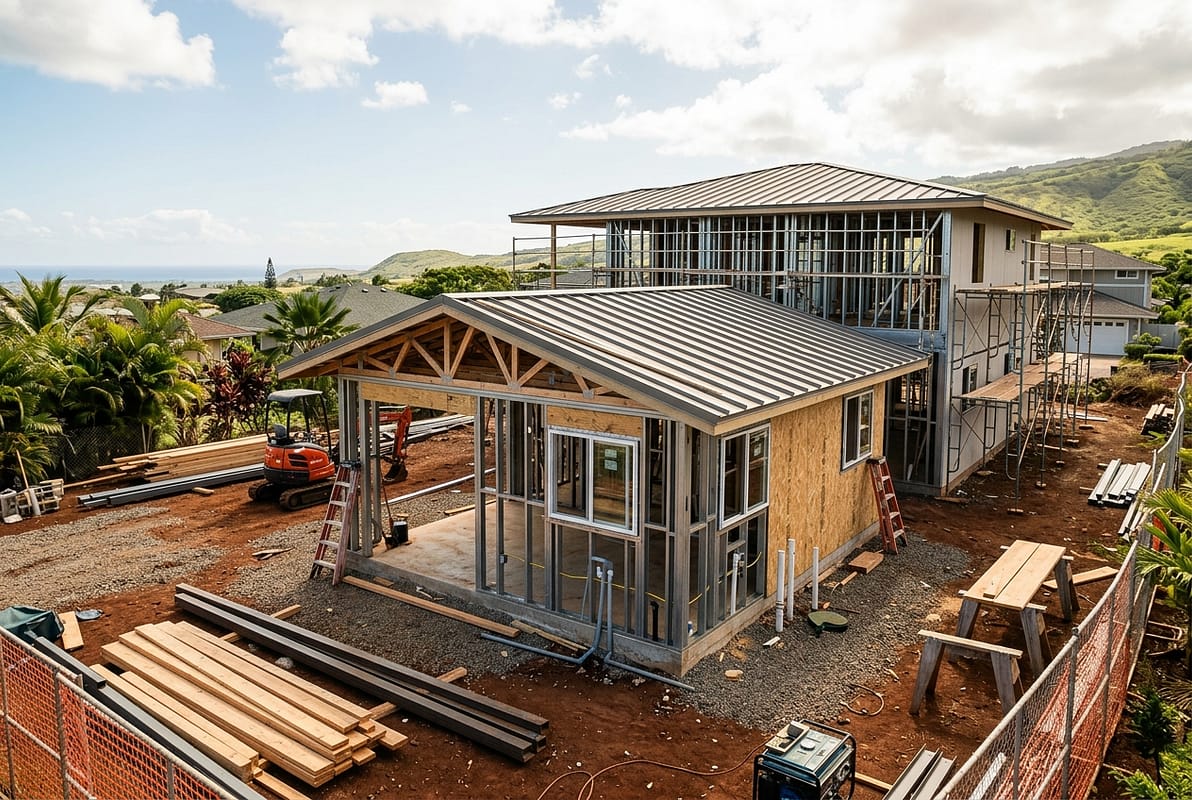
The Smart Money: An Integrated 800 sq. ft. ADU for ~$180,000
When we design a new home with an attached or detached ADU from the start, we can achieve massive efficiencies. For example:
- Shared Site Work: We only need to mobilize excavation and grading equipment once for both structures.
- Unified Foundation: An attached ADU can be part of the main home’s foundation pour, saving on concrete and labor costs.
- Simplified Utilities: We can run a single, larger water main and electrical service from the street and then branch them off to the main house and the ADU. This avoids the high cost of trenching and connecting a second set of utilities later.
- Streamlined Permitting: The ADU is included in the main new home permit set, which is a much smoother process with the Honolulu Department of Planning and Permitting (DPP) than applying for a separate ADU permit on an existing lot.
This integrated approach is why we can build an 800-square-foot, two-bedroom ADU for around $180,000 as part of a new home package. That breaks down to just $225 per square foot—a phenomenal value and a smart investment from day one. This makes the Kapolei renovate vs rebuild question much simpler for those needing more space for family.
The Higher Cost of a Standalone ADU Addition: ~$225,000+
Adding an ADU to your property after the fact is a different story. The costs are higher because it’s essentially a small, separate construction project with its own overhead. The site may have limited access for heavy machinery, requiring more manual labor. We have to carefully trench new utility lines across your existing landscaping without disturbing the main house’s services. All the trades—plumbers, electricians, framers—have to be scheduled for a smaller, less efficient project.
These factors drive the cost of that same 800-square-foot standalone ADU up to $225,000 or more, which is about $281 per square foot. The $45,000 difference is purely a result of lost efficiencies. If you know that an ADU is in your future, planning for it as part of a teardown and rebuild is, without a doubt, the most cost-effective path forward. The adu cost hawaii is always lower when planned from the beginning.
Meeting the Demand for Multi-Generational Living in Ewa
The demand for multi-generational housing in West Oahu is stronger than ever. A recent report from the Department of Business, Economic Development & Tourism (DBEDT) highlighted this as a major driver in the Ewa district’s housing market[3]. We see it every day. Families want to keep their kupuna close, or they need a place for adult children who are struggling with Hawaii’s high cost of living. An ADU provides both independence and proximity.
For many of our Kapolei clients, the ability to build a new home with an integrated ADU is the single biggest factor that pushes them toward a rebuild over a renovation. It’s a solution that addresses a real, pressing family need while also creating a valuable rental income opportunity down the road. It transforms the property from a single-family home into a flexible, multi-family asset.
What’s the Final Verdict for My Ewa Plain Property?
The final verdict on whether to renovate or rebuild your Ewa Plain property depends entirely on the condition of your existing home and your long-term family needs. A renovation is best for structurally sound homes needing cosmetic and system updates, while a rebuild is superior for homes with major foundational or systemic flaws, or for those planning to add an ADU.
Our Recommendation: Choose Renovation If…
- Your home’s foundation and structural framing are in good shape.
- You are generally happy with the existing layout and footprint.
- Your primary goals are to update the kitchen, bathrooms, and finishes.
- You plan to sell the home within the next 5-7 years and want to maximize your immediate ROI.
- Your budget is firmly under the $550,000 mark.
Our Recommendation: Choose a Teardown/Rebuild If…
- Your home has significant issues like a cracked slab, widespread termite damage, or failing single-wall construction.
- You want to completely change the layout, add a second story, or significantly expand the footprint.
- You plan to add an ADU for multi-generational living or rental income.
- You are building your ‘forever home’ and prioritize long-term durability, low maintenance, and energy efficiency.
- Your all-in budget is in the $750,000+ range.
Frequently Asked Questions
How long does a Kapolei renovate vs rebuild project take?
A major gut renovation of a 1,800 sq. ft. home in Kapolei typically takes 6-9 months from the start of construction. A complete teardown and rebuild is a longer process, usually taking 12-16 months from demolition to handing over the keys. These timelines do not include the design and permitting phase, which can add another 8-12 months on Oahu.
Are there any surprise costs I should budget for?
Yes, for any project, we recommend a contingency fund of 10-15% of the total construction cost. For renovations, this covers unforeseen issues like hidden termite damage or outdated wiring. For new builds, it can cover things like unexpected volcanic rock during excavation or material price increases due to shipping delays to the island.
Is it hard to get a permit for a teardown in Kapolei?
Permitting for a teardown and new build is a straightforward but lengthy process with the Honolulu DPP. It’s not necessarily harder than getting a permit for a major renovation, but it is more comprehensive. As long as the new home design complies with zoning setbacks and height limits, it is generally approved. The key is having a complete and accurate set of architectural and engineering plans from the start to avoid delays.
Can I live in my house during a major renovation?
For a major gut renovation on the Ewa Plain, it is almost always impossible to live in the home. With the interior taken down to the studs and major systems like water and electricity shut off for extended periods, the house will be an active and unsafe construction zone. We require clients to make alternative living arrangements for the duration of the project.
Does a new build appraise for the full cost of construction?
Not always, and this is a critical point to discuss with your lender. An appraisal is based on ‘comps’—the sale prices of similar homes in your immediate area. If you build a $900,000 home in a neighborhood where the highest comp is $800,000, the appraisal may come in low. However, in a rapidly appreciating market like Kapolei, new construction often sets a new benchmark for value, and appraisals are more likely to align with the cost to build.
What is the biggest mistake homeowners make when deciding between renovating and rebuilding?
The biggest mistake is underestimating the cost and complexity of fixing the ‘unseen’ problems in an older home. Many homeowners get a quote for a cosmetic renovation, only to have the budget spiral when systemic issues like bad plumbing, faulty wiring, or structural termite damage are uncovered mid-project. A thorough pre-construction investigation is key to making an informed decision about your Kapolei home renovation.
How does the cost of building in Kapolei compare to other parts of Oahu?
Kapolei and the Ewa Plain are generally more affordable for new construction than areas like Kailua or East Honolulu. Our new build cost of $425-$475 per square foot here is a good value compared to the Windward side or Kahala, where the same home could easily cost $550-$650 per square foot due to higher land values and more complex site logistics. The decision to pursue a Kapolei renovate vs rebuild project is influenced by these more favorable construction costs.
Let’s Talk About Your Project
Making the right choice between a renovation and a rebuild is one of the biggest financial decisions your family will make. It requires a clear understanding of the costs, the condition of your current home, and your goals for the future. You don’t have to make that decision alone.
Our team at Warrior Construction can provide a detailed assessment of your property and walk you through a transparent, side-by-side cost-benefit analysis. If you’re considering a project in Kapolei or the Ewa Plain, let’s start the conversation.
Ready to find out the best path for your Kapolei home? Contact our West Oahu team for a professional project consultation.


