
“
Aging in Place Financing Oahu: 5 Essential Steps for Grants & Costs
The most effective strategy for aging in place financing oahu involves a three-pronged approach: first, establishing a realistic budget based on current local costs—like the $32,000 to $48,000 price tag for an ADA-compliant bathroom remodel in Honolulu. Second, actively pursuing local grants and loans, such as the City & County of Honolulu’s Rehabilitation Loan Program. Finally, integrating these financial timelines with the reality of the Honolulu Department of Planning and Permitting (DPP), which often takes 5-7 months for approvals. For many Oahu families, this isn’t just a home improvement project; it’s a critical investment in keeping multiple generations of their ‘ohana under one roof, safely and comfortably.
Over our 20+ years on job sites across Oahu, we’ve seen a major shift. What used to be calls for kitchen upgrades or lanai extensions are now increasingly focused on accessibility. Families in established neighborhoods like Manoa and Aina Haina are looking for ways to adapt their classic Hawaii homes for their kupuna. They need a clear financial roadmap that accounts for Hawaii’s unique challenges, from the high cost of materials shipped to the island to navigating the specifics of local aid programs. This guide is that roadmap. We’ll walk you through the real numbers, the specific programs available to you, and how to build a timeline that won’t fall apart when it meets the DPP.
Why are aging-in-place remodels so important on Oahu right now?
On the surface, an aging-in-place remodel looks like any other construction project—there’s dust, noise, and a budget. But underneath, the motivation is completely different. This isn’t about aesthetics or boosting resale value for a quick flip. Instead, it’s a non-discretionary investment driven by one of the biggest demographic shifts in Hawaii’s history. It’s about preserving a way of life and keeping family together.
The demographic shift: Hawaii’s growing kupuna population
The numbers from the state Department of Business, Economic Development and Tourism (DBEDT) tell a clear story. By 2027, Hawaii’s 65-and-over population is projected to be more than 20% of all residents, making it the fastest-growing demographic group in the islands.[1] We see this trend firsthand in the calls we get at Warrior Construction. For example, a family in Kailua recently needed to convert a ground-floor den into a full master suite for their mother, complete with a zero-threshold shower and wider doorways. This wasn’t a ‘nice-to-have’ project; it was an absolute necessity for her to continue living at home safely. This demographic wave is fundamentally reshaping residential construction demand away from speculative projects and toward essential, multi-generational living solutions.
A non-discretionary investment in your family’s future
Unlike a cosmetic kitchen update that you can put off if the economy gets shaky, adapting a home for an elderly parent is a need, not a want. Consequently, these projects are more resilient to economic fluctuations. The University of Hawai’i Economic Research Organization (UHERO) noted in its Spring 2026 forecast that residential alterations are a key pillar of stability for our local construction industry precisely because of this non-discretionary nature. When a doctor says your father needs a wheelchair ramp and grab bars in the shower, that project happens. It’s about health and safety. Furthermore, the alternative—assisted living facilities in Hawaii—can cost upwards of $6,000 to $10,000 a month. A one-time investment of $45,000 in a home remodel that allows a kupuna to live at home for several more years offers a powerful financial and emotional return. It’s a strategic decision to invest in the family home as a long-term care solution.
How much does an ADA-compliant bathroom remodel cost in Honolulu?
For a full, ADA-compliant bathroom remodel on Oahu in 2026, you should budget between $32,000 and $48,000. This isn’t just for new tile and a vanity; this is a top-to-bottom renovation focused on safety and accessibility. It includes crucial features like a zero-threshold, walk-in (or roll-in) shower, reinforced walls with properly installed grab bars, an ADA-height toilet, and a wider doorway. Most importantly, this price range reflects the real costs of licensed labor and island-priced materials here in Honolulu.
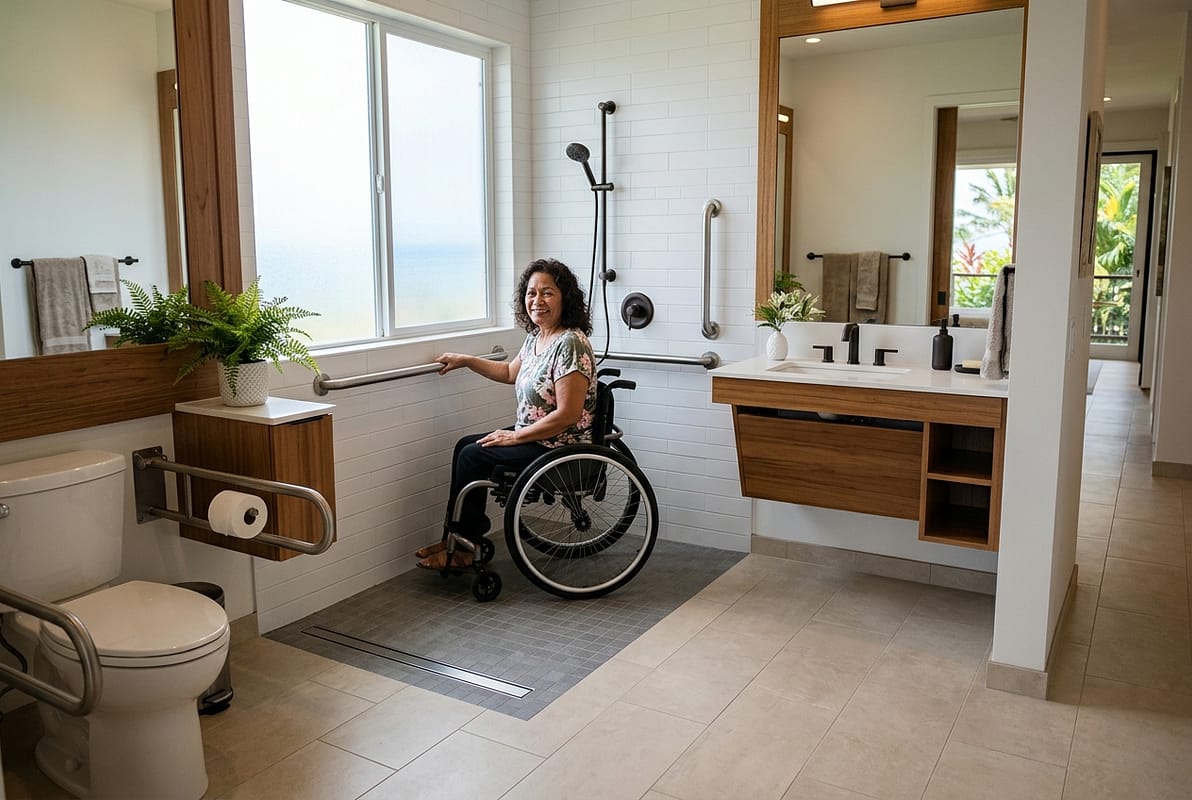
Breaking down the $32,000 to $48,000 budget
Where does that money go? It’s not just in the finishes you see. A huge portion of the budget is allocated to the work behind the walls and under the floor, which is essential for safety and compliance. Here’s a typical breakdown for a standard 5’x9′ bathroom conversion on Oahu:
- Demolition and Haul Away: $2,500 – $3,500. This involves carefully tearing out the old tub, toilet, vanity, flooring, and sometimes wall sections, then properly disposing of the materials.
- Plumbing Modifications: $7,000 – $10,000. This is a major cost driver. Converting a standard tub/shower to a zero-threshold shower requires moving the drain, which often means cutting into the concrete slab foundation—a labor-intensive job.
- Structural & Framing Work: $4,000 – $6,000. Widening a doorway from the standard 28-30 inches to a wheelchair-accessible 36 inches requires reframing the opening and installing a new header. Additionally, we install solid wood blocking inside the walls around the shower and toilet to ensure grab bars are anchored into something solid, not just drywall.
- Electrical Work: $3,500 – $5,000. This includes installing GFCI-protected outlets, improving lighting with brighter, moisture-rated fixtures, and adding an exhaust fan to control humidity.
- Waterproofing and Tile: $9,000 – $14,000. A high-quality waterproofing system like Schluter-KERDI is non-negotiable for a curbless shower to prevent leaks. The cost of non-slip tile and skilled installation is also a significant part of this line item.
- Fixtures and Finishes: $4,000 – $7,000. This covers the ADA-compliant toilet, a wall-mounted sink or accessible vanity, specialized faucets, and of course, the stainless-steel grab bars.
- Permitting and Project Management: $2,000 – $3,000. This includes the architect or designer’s plans, the city permit fees (which average around $1,800 for this scope), and the contractor’s oversight.
As you can see, the functional requirements—plumbing, structural changes, and robust waterproofing—make up the bulk of the expense in this type of specialized bathroom remodel.
Why older Hawaii homes often land on the higher end
Many of Oahu’s homes, especially those built before 1980 in areas like Palolo or Kaimuki, present unique challenges that can push costs toward that $48,000 figure. The Hawaii Contractors Association’s 2026 Cost Index specifically points to these issues.[2] For instance, many older houses were built with single-wall construction. Reinforcing these walls for grab bars is more complex than in a modern double-wall home. We often have to add new framing to create the necessary structural support. Furthermore, we frequently discover outdated galvanized plumbing or ungrounded electrical wiring during demolition. Bringing these systems up to current code is not optional; it’s a required part of the permitted renovation, and those costs must be factored in. This is a key reason why getting a firm, detailed bid from an experienced local contractor is so vital—we know what to look for in these older homes.
What grants and loans are available for kupuna remodels on Oahu?
Financing an accessibility remodel doesn’t have to fall entirely on your shoulders. Thankfully, there are specific local and federal programs designed to help homeowners with the costs. Navigating the paperwork can be a job in itself, but the potential savings make it well worth the effort. The search for aging in place financing oahu should always start with these government-backed options before turning to private loans.
Primary Source: The City & County of Honolulu’s Rehabilitation Loan Program
For most Oahu homeowners, the single best resource is the City & County of Honolulu’s Rehabilitation Loan Program. This is a powerful tool specifically designed for this purpose. The program is funded by federal Community Development Block Grant (CDBG) money, as outlined by the local HUD office, and its goal is to help low-to-moderate-income households make health and safety improvements to their homes.[3]
Here’s how it typically works:
- What it is: It provides very low-interest loans (sometimes as low as 0-3%) to qualified homeowners. In some cases, for very low-income kupuna, portions of the loan may be forgivable, effectively turning it into a grant.
- What it covers: The funds are explicitly for work that removes architectural barriers and improves accessibility for seniors or persons with disabilities. A tub-to-shower conversion, wheelchair ramp, or doorway widening are perfect examples of covered projects.
- Who qualifies: Qualification is based on household income and size, benchmarked against Honolulu’s Area Median Income (AMI). You’ll need to provide documentation like tax returns and proof of homeownership.
- The Process: You apply directly through the City’s Department of Community Services. They will guide you through the application, and once you’re pre-approved, you can begin getting bids from licensed contractors like us. The City inspector will also be involved to ensure the work meets program standards.
This program is the first stop for any family looking for kupuna housing grants hawaii. It’s a bit bureaucratic, but it’s designed to make these essential projects affordable.
Understanding State-Level Support from HHFDC
The Hawaii Housing Finance and Development Corporation (HHFDC) is another key player, though their support is often less direct. While HHFDC primarily focuses on funding large-scale affordable housing developments, they also administer funds that trickle down to county-level programs. For instance, they may provide grants to non-profits or county agencies that then offer direct assistance to homeowners for accessibility modifications. It’s always worth checking the HHFDC website and your local county housing office for any special programs or grants that might be available, as these can change annually based on legislative funding. These are a potential source for hhfdc grants for homeowners looking to make their homes safer for kupuna.
Other financing options to consider
If you don’t qualify for the city or state programs based on income, there are still excellent ways to finance your project:
- Home Equity Line of Credit (HELOC): If you have equity in your home, a HELOC is often the most flexible and cost-effective option. You can draw funds as you need them to pay your contractor, and the interest rates are typically lower than personal loans.
- Reverse Mortgage (for homeowners 62+): A reverse mortgage can be a strategic tool for house-rich, cash-poor seniors. It allows you to convert a portion of your home equity into cash, which can be used for any purpose, including renovations. The loan doesn’t have to be repaid until the homeowner leaves the home.
- VA Renovation Loans: For veterans, the VA offers special loan products that can include the cost of renovations. If the accessibility modifications are medically necessary, you may be eligible for a Specially Adapted Housing (SAH) or Special Home Adaptation (SHA) grant.
Each of these has different implications, so talking with a financial advisor is a crucial step before deciding which path is right for your family’s situation.
How do you create a realistic project timeline with Honolulu’s permit delays?
One of the biggest mistakes we see homeowners make is underestimating the timeline, especially the permitting phase. An ADA bathroom remodel on Oahu is not a one-month project. From the first design sketch to the final inspection, you should realistically plan for a 10- to 12-month process. The bottleneck, without a doubt, is the Honolulu Department of Planning and Permitting (DPP). The official honolulu dpp permit timeline for a project involving structural and plumbing changes is currently averaging 5 to 7 months.[4] This wait time dictates the entire project schedule.
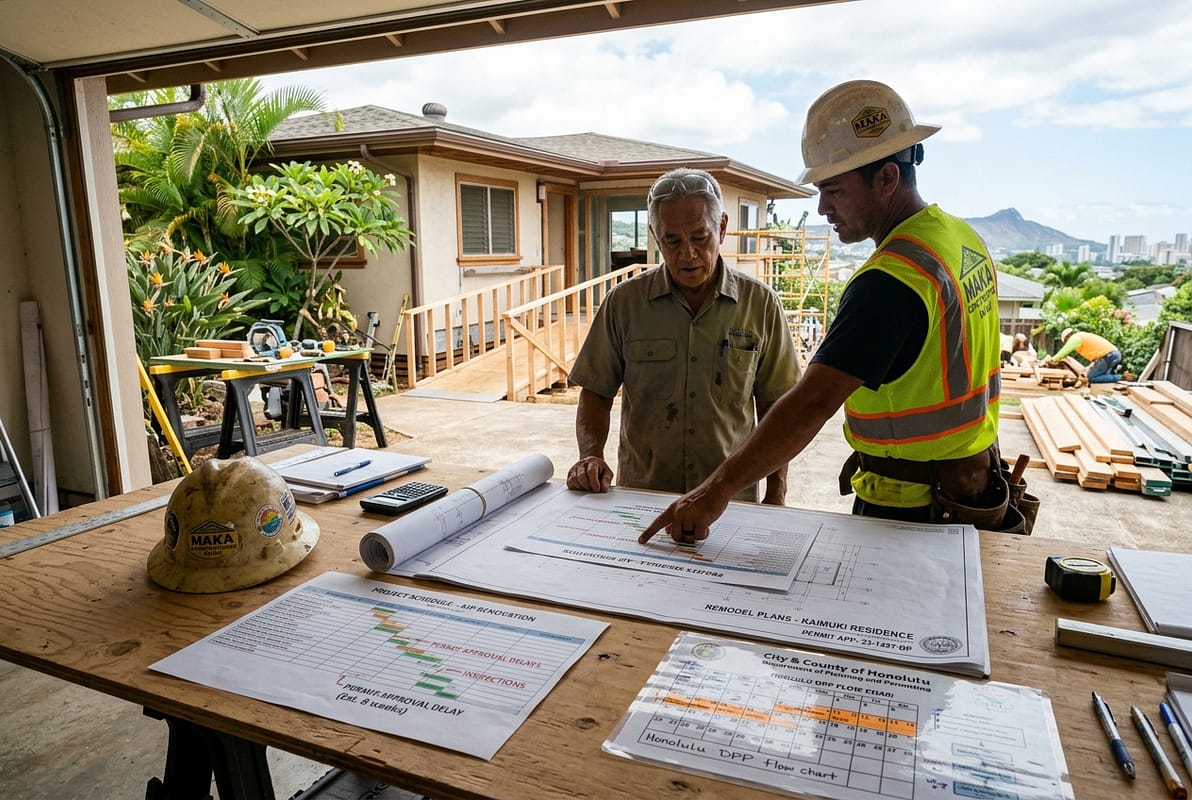
Step 1: Design & Grant Application (Months 1-2)
This initial phase is all about planning. You can’t just start breaking down walls. Furthermore, you need to work with a designer or a design-build contractor like us to create a detailed set of plans that are both functional for your needs and compliant with building codes. These plans are the foundation for everything that follows.
- Week 1-2: Initial consultation and design concept. We measure the space, discuss your specific accessibility needs (walker vs. wheelchair, right-handed vs. left-handed assistance, etc.), and create a preliminary layout.
- Week 3-4: Finalize the architectural plans. These are the formal drawings that will be submitted to the DPP. They specify everything from the exact location of grab bars to the slope of the shower floor and the width of the new door.
- Week 5-8: Submit grant and loan applications. While the plans are being finalized, you should be simultaneously gathering your financial documents and submitting your application for the City & County of Honolulu’s Rehabilitation Loan Program or other financing. This process runs parallel to the design phase. Getting pre-approved for funding early is critical.
Step 2: The DPP Waiting Game (Months 3-9)
Once the plans are complete, they are submitted to the DPP for review. This is where patience becomes essential. Your project enters a queue, and there is very little a contractor or homeowner can do to speed it up. The plans are reviewed by multiple departments—planning, structural, electrical, plumbing—to ensure they comply with all city codes.
- Month 3: Permit submission. Your contractor or architect submits the full plan set to the DPP. You’ll pay the initial intake fees, and the long wait begins.
- Months 4-8: The review period. During this time, the DPP may issue comments or corrections. For instance, they might require a different type of waterproofing detail or clarification on how a load-bearing wall is being reframed. Your designer or contractor will need to respond to these comments promptly to keep the process moving. This back-and-forth is normal.
- Month 9: Permit issuance. If all goes smoothly, you’ll receive the email that your permit is approved and ready to be issued. This is the green light to finally start construction.
Step 3: Construction & Finishing Touches (Months 10-12)
With the permit in hand, the physical work can begin. A typical ADA bathroom remodel takes about 8 to 12 weeks of active construction time, assuming materials have been ordered and are on-island.
- Weeks 1-2 (Month 10): Demolition and rough-in. We’ll tear out the old bathroom and our licensed plumbers and electricians will complete the “rough-in” work inside the walls and floor. This is followed by a city inspection.
- Weeks 3-6 (Month 11): Structural work, waterproofing, and tile. This is the core of the project: widening the door, installing grab bar blocking, applying the waterproofing membrane, and setting the tile.
- Weeks 7-8 (Month 12): Finishes and final inspection. We install the fixtures—toilet, sink, grab bars, shower controls—and complete painting and trim work. The final step is the city’s final inspection to close out the permit.
Understanding this 12-month arc from the beginning is key to managing stress and expectations. It’s a marathon, not a sprint, and planning accordingly is the best way to ensure a successful outcome.
What this means for Hawaii homeowners
Navigating an aging-in-place remodel on Oahu requires a shift in mindset. It’s less about picking out tile and more about strategic financial planning and timeline management. Given the high costs and long permit waits, proactive planning is your single greatest asset. Here is what you need to focus on:
- Start the Financial Conversation Early. Don’t wait until the need for a remodel is urgent. Begin researching the City and County of Honolulu Rehabilitation Loan Program and other kupuna housing grants hawaii at least a year before you anticipate needing the modifications. Gather your financial documents and understand the income eligibility requirements now.
- Build a Permitting Buffer into Your Timeline. The 5- to 7-month DPP wait is not a worst-case scenario; it is the average. Assume your project will take at least six months just to get a permit. If a family member is returning from a hospital stay and needs the modifications immediately, a full permitted remodel is not a viable short-term solution. You may need to consider temporary measures while the permit is in process.
- Get an Itemized, All-Inclusive Bid. The real ada remodel cost honolulu includes more than just labor and materials. A trustworthy contractor’s bid will explicitly include line items for architectural plans, engineering (if needed), all DPP permit fees, and a contingency fund (typically 10-15%) for unforeseen issues like termite damage or old plumbing.
- Prioritize Function Over High-End Finishes. The primary goal is safety and accessibility. Allocate your budget first to the non-negotiable items: a high-quality waterproofing system, solid blocking for grab bars, non-slip flooring, and excellent lighting. You can save money by choosing a standard, durable tile over imported marble. The investment should be in the bones of the project, not just the skin.
Ultimately, a successful aging-in-place project is one that is planned with foresight. By tackling the financing and permitting hurdles head-on, you can transform a stressful, reactive situation into a controlled, proactive process that ensures the safety and comfort of your ‘ohana for years to come.
Frequently Asked Questions
Can I get a grant to cover the entire cost of an aging-in-place remodel on Oahu?
It’s highly unlikely. While programs like the City & County of Honolulu’s Rehabilitation Loan Program are incredibly helpful, they are designed to make projects affordable, not completely free. They often come in the form of a low-interest loan, and any grant portion is typically reserved for very low-income households and may not cover the full $32,000+ cost of a comprehensive ADA bathroom remodel.
How long does it take to get approved for aging in place financing oahu through the City?
The application and approval process for the City & County’s Rehabilitation Loan Program can take 2 to 4 months. This runs concurrently with your design phase but happens *before* your building permit is submitted. You need to provide extensive financial documentation, and the agency needs time to process and verify your eligibility before issuing a funding commitment.
Do I really need a permit for an ADA bathroom remodel in Honolulu?
Yes, absolutely. Any project that involves moving plumbing (like converting a tub to a roll-in shower), altering framing (like widening a doorway), or significant electrical work requires a permit from the Honolulu DPP. Attempting this work without a permit can result in fines, orders to tear out the work, and major problems when you eventually sell your home.
Is it cheaper to do an aging-in-place remodel on a Neighbor Island?
Not necessarily. While labor rates might be slightly lower on some Neighbor Islands, those savings are often erased by higher material costs due to inter-island shipping and logistics. A roll of waterproofing membrane or a pallet of tile that has to be barged from Oahu to Maui or Kauai will have that extra shipping cost built into the price, keeping the total project cost in a similar range.
What is the most common unforeseen cost in an Oahu kupuna remodel?
The most common surprise we find in older Oahu homes is extensive, hidden termite damage, especially in the walls around old, leaky tubs and toilets. When we open up a wall for a remodel, we often discover studs and floor joists that need to be completely replaced. This is why a 10-15% contingency fund is not just a suggestion; it’s a necessity for any renovation budget in Hawaii.
Let’s Build a Safe Future for Your ‘Ohana
Planning an aging-in-place renovation can feel overwhelming, but you don’t have to navigate the costs, grants, and permit process alone. Our team at Warrior Construction has spent decades helping Oahu families adapt their homes for the future. We understand the nuances of local programs and the realities of building in Hawaii.
If you’re ready to create a safe, accessible, and comfortable space for your kupuna, the next step is a real conversation about your specific needs and budget. Let’s talk about how to make it happen.
Schedule a consultation with our aging-in-place specialists today.
References
- Hawaii State Department of Business, Economic Development and Tourism (DBEDT) 2026 Data Book
- Hawaii Contractors Association 2026 Labor and Materials Cost Index
- U.S. Department of Housing and Urban Development (HUD) Hawaii Programs 2026
- Honolulu Department of Planning and Permitting (DPP) Q2 2026 Processing Times


