
The only way to execute a multi-million dollar Waikiki hotel renovation while maintaining 89% occupancy is with a military-grade logistics plan executed with minute-by-minute precision. For hotel general managers and developers, the budget is just one part of the puzzle. The real question is operational: how do you gut and rebuild guest rooms, lobbies, and restaurants without cratering your revenue stream or destroying the guest experience? This is the core challenge of Waikiki hotel renovation logistics, a field where success is measured in quiet hallways and on-time material deliveries in the dead of night.
It’s a ballet of complex moving parts. With Waikiki’s occupancy rates holding strong at 89% in 2026[1], closing down is not an option. This means the construction itself becomes a live performance, carefully choreographed around paying guests. Forget sprawling laydown yards and flexible work hours. We operate in a world of zero-lot-line buildings, single loading docks, and a non-negotiable 2 AM to 5 AM window for any major material movement on Kalakaua Avenue. Pulling this off requires a different mindset—one that prioritizes operational planning as much as the physical construction.
At Warrior Construction, we’ve spent over two decades mastering this unique brand of urban infill renovation. This playbook will walk you through the five critical phases of our operational strategy, detailing how we manage the intricate logistics of a live hotel renovation in one of the world’s densest urban environments.
How Do You Renovate a Hotel Without Closing It?
Renovating a hotel while it remains open is fundamentally about containment and communication. You must surgically isolate the construction zone from the guest areas, controlling noise, dust, and crew movement with absolute discipline. This phase of a live hotel renovation plan is less about hammers and nails and more about strategic isolation and impeccable guest management.
Phasing Work Around 89% Occupancy Rates
The first strategic decision is how to phase the work. We typically approach this in one of two ways, depending on the hotel’s layout, infrastructure, and the scope of the Property Improvement Plan (PIP).
- Vertical Phasing: This is often the most efficient method. We take an entire vertical stack of rooms—for example, all the ’05’ rooms from the 5th to the 30th floor—out of service at once. This allows our crews to work on plumbing risers, electrical conduits, and other systems that run vertically through the building without impacting adjacent rooms on each floor. It consolidates the work zone, making it easier to manage logistics through a single service elevator. The downside is it requires careful coordination with the hotel’s reservation system to block out that specific room type for the duration of the phase.
- Horizontal Phasing: In this approach, we take an entire floor, or a wing of a floor, out of service. This is common for hallway corridor upgrades, fire sprinkler retrofits, or when the renovation scope is less intensive on the building’s core systems. While it can feel less disruptive to hotel operations floor-by-floor, it can be logistically slower as crews and materials have to be distributed across a wider horizontal area, often competing for limited elevator time.
For a recent project at a 400-room hotel in Waikiki, we implemented a vertical phasing plan, taking two stacks of 25 rooms each out of commission for 12-week intervals. This 50-room block allowed us to complete a full gut renovation, from framing and drywall to FF&E (Furniture, Fixtures, and Equipment) installation, before moving to the next two stacks. Consequently, the hotel was able to maintain over 87% of its room inventory throughout the 18-month project.
Mastering Guest Communication & Experience
You can have the best construction plan in the world, but if the guests are unhappy, the project is a failure. Furthermore, effective guest communication is non-negotiable. Our project managers work directly with the hotel’s front office team to develop a multi-pronged communication strategy:
- Pre-Arrival Notifications: Informing guests at the time of booking about the renovation is key to managing expectations.
- Check-In Briefings: A brief, positive script for the front desk staff explaining the work being done and the hours of operation.
- In-Room Communication: Professionally designed letters or door hangers delivered daily, explaining what work is happening the next day and in which areas.
- Dedicated Liaison: We often place a dedicated project liaison in the lobby during peak hours to answer guest questions directly, taking the burden off hotel staff.
- Visual Barriers: High-quality, branded construction barriers and signage that look professional and clearly delineate work zones from guest areas.
Scheduling Low-Decibel Work During Peak Hours
Noise is the number one complaint during any hotel renovation while open. Our entire on-site schedule is built around minimizing acoustical impact. We enforce a strict “no loud work” policy before 9:00 AM and after 4:30 PM. The loudest work, like core drilling or demolition, is scheduled in very tight, pre-communicated windows, typically from 10:00 AM to 2:00 PM. Additionally, our teams utilize modern, low-decibel tools wherever possible, from quieter screw guns to hydraulic bursting for concrete demolition instead of deafening jackhammers. We also employ sound-dampening insulation blankets around work areas and implement negative air pressure systems with HEPA filters to ensure construction dust and odors never migrate into guest-occupied hallways.
What Are Waikiki’s Biggest Construction Logistics Challenges?
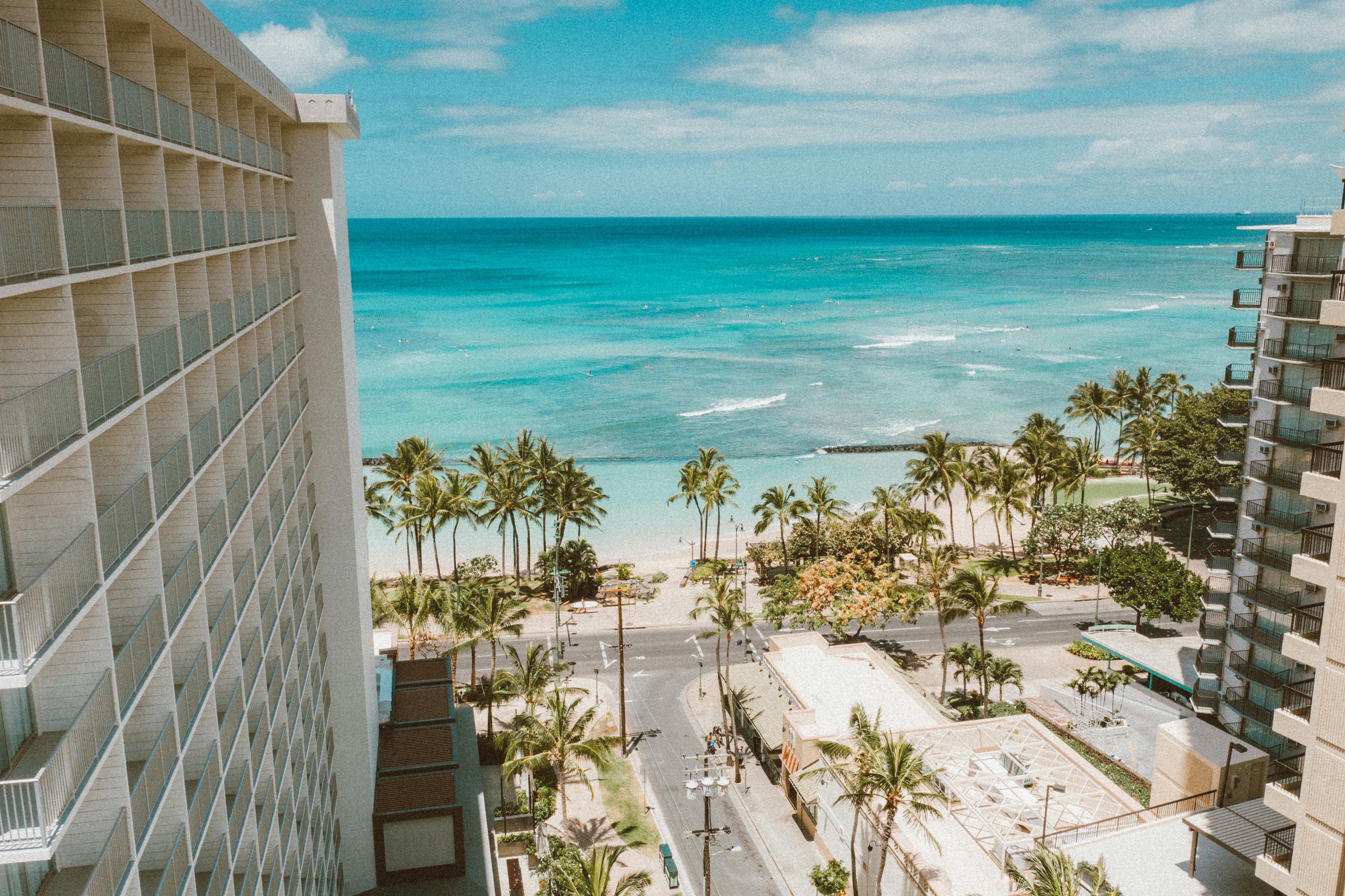
The primary challenge for any significant Honolulu commercial renovation, especially in Waikiki, is space—or the complete lack of it. Waikiki construction logistics are a unique beast. Unlike a new build in Kapolei with acres for staging, a vertical renovation on Kalakaua Avenue has a footprint that is essentially the building itself. This reality dictates every aspect of the project’s operational flow, from material delivery to waste removal.
The Zero Laydown Area Problem on Kalakaua Avenue
Imagine trying to build a house, but you’re not allowed to place any materials on the ground around it. That’s the daily reality in Waikiki. There is no “laydown area”—no space to store pallets of drywall, bundles of steel studs, or crates of tile. Sidewalks must remain clear for pedestrians, and streets must remain open for traffic. Therefore, every single piece of material must be delivered on a “just-in-time” basis. This means the material is lifted directly from the delivery truck into the building at the exact moment it is needed. It requires an extraordinary level of coordination between our off-site warehouse, our trucking partners, and our on-site crews.
Executing 2 AM Crane Lifts & Street Closures
The solution to the zero laydown problem is the pre-dawn crane lift. For any bulky materials—from window assemblies to bundles of drywall—the only way in is up the side of the building. The City and County of Honolulu has strict regulations for this. As detailed in a recent Pacific Business News feature on vertical renovations, these major lifts must be executed between 2 AM and 5 AM.[2]
Executing a single lift is a massive undertaking:
- Permitting: We must secure a street closure permit from the city weeks in advance, detailing the exact location, time, and traffic control plan.
- Coordination: We coordinate with the Honolulu Police Department for an officer detail to manage traffic and secure the area.
- The Setup: At 1:30 AM, our team arrives to set up traffic control, followed by the crane. The crane operator must expertly position and balance the massive machine on often-uneven city streets.
- The Lift: At precisely 2:00 AM, the first truck arrives from our warehouse. The rigging crew attaches the load, and the crane operator carefully lifts it, sometimes 30 stories high, to a designated floor where a crew is waiting to pull it inside through a temporarily removed window.
- The Reset: This process repeats with military precision. The last truck pulls away by 4:45 AM, the crane is broken down, and the street is swept and reopened to traffic before the first city bus of the day rolls through at 5:00 AM.
Our Kapolei Warehouse: The Off-Site Staging Solution
This entire just-in-time system would be impossible without a sophisticated off-site hub. Our 40,000-square-foot warehouse in Kapolei is the heart of our Waikiki hotel renovation logistics operation. This is our laydown area. All materials, from containers of Italian tile to domestic light fixtures, are shipped here first. In this controlled environment, we:
- Receive and inspect every item for damage from shipping.
- Un-crate and dispose of packaging waste, which is too bulky to handle in Waikiki.
- Pre-assemble components where possible (e.g., building headboard units).
- Stage materials by floor and room number, creating “kits” for our on-site crews.
- Load flatbed trucks with the exact materials needed for that night’s crane lift, in the correct order.
This off-site preparation transforms chaos into a predictable, repeatable process, ensuring our on-site teams have exactly what they need, exactly when they need it.
How Do You Manage a Hawaii Hotel Renovation Supply Chain?
Managing the supply chain for a Hawaii construction project is all about accounting for time and distance. Every nail, screw, and fixture has to travel 2,500 miles across the ocean. This introduces costs, delays, and risks that simply don’t exist for mainland projects. A successful project hinges on a proactive procurement strategy that starts months, or even years, before groundbreaking.
Factoring in the 18-22% Ocean Freight Cost
The first dose of reality for any developer is what we call the “island tax.” As the Hawaii Contractors Association confirms, ocean freight from the mainland adds a baseline of 18-22% to the cost of most materials.[3] This isn’t a contingency; it’s a hard-coded line item in every budget we build. For a $20 million PIP, that’s roughly $1.5 to $2 million in freight costs alone, before the materials even touch the island. We work with clients during pre-construction to analyze material choices, sometimes opting for high-quality, locally available substitutes to mitigate these costs where possible, but for the most part, it’s a non-negotiable cost of building in paradise.
Early Procurement for Long-Lead International Items
The project timeline is dictated by the item with the longest lead time. For high-end hotel renovations, these are often custom-specified items from overseas.
- Custom Millwork & Casegoods: Often sourced from Asia or Europe, these can have lead times of 24-30 weeks from shop drawing approval to delivery.
- Elevator Packages: Modernization of elevators often requires components from manufacturers in Germany or Finland, with lead times easily exceeding 52 weeks.
- Specialty Finishes: Custom-designed Axminster carpets from the UK or specific marble from an Italian quarry require extensive procurement timelines.
Our procurement team identifies these long-lead items during the design phase. We work to finalize these specifications first and place orders a year or more before they are needed on site. This proactive approach is the only way to build a realistic construction schedule and avoid months of costly delays waiting for a critical component to arrive.
Coordinating Just-In-Time Deliveries from the Port
Once materials arrive at the Port of Honolulu, the final leg of the logistical journey begins. It’s a carefully managed process. Our logistics manager coordinates with the shipping lines and trucking companies to move containers from the port to our Kapolei warehouse as soon as they are offloaded. We can’t afford to let materials sit at the port and accrue demurrage fees. At the warehouse, the containers are unloaded, and the contents are cross-referenced with the purchase orders and inspected for damage. This immediate verification is crucial; if there’s an issue, we need to know right away to reorder, not when the installer is waiting for it on the 25th floor. This entire system, from port to warehouse to project site, is the backbone of our live hotel renovation plan.
How Long Do Permits Take for a Waikiki Commercial Renovation?
For any major commercial project on Oahu, the Honolulu Department of Planning and Permitting (DPP) process is the single biggest variable impacting the start date. The timeline for securing a permit for a major commercial alteration in the Waikiki Special District is now consistently running 12-14 months.[4] This is not a worst-case scenario; it’s the current 2026 average. Understanding and planning for this timeline is absolutely critical for project feasibility.
Navigating the 12-14 Month Honolulu DPP Review
Why does it take so long? A full renovation plan isn’t reviewed by a single person. It circulates through a half-dozen different city and state departments, each with its own backlog and review criteria. These departments typically include:
- Building Division (for structural and life safety compliance)
- Electrical Division
- Plumbing Division
- Planning Division (for zoning and Waikiki Special District design compliance)
- Fire Department (for fire alarms, sprinklers, and egress)
- Board of Water Supply
A rejection or request for clarification from any one of these departments can send the plans back to the start of the review queue for that department, potentially adding another 60-90 days to the process. Common sticking points include ADA compliance details, fire-rated assembly specifications, and mechanical system calculations. For more information on budgeting for these projects, see our complete guide to Waikiki hotel renovation costs.
Why We Start the Permit Process a Year Before Groundbreaking
Because the permit timeline is so lengthy and unforgiving, our pre-construction process begins exceptionally early. We advise clients to engage us and their design team 18-24 months before their target construction start date. This allows a solid 6-8 months for design development and consultant coordination before we even submit the plans to the DPP. We use this time to meticulously vet the architectural, structural, and MEP (Mechanical, Electrical, Plumbing) plans, ensuring they are 100% complete and coordinated. Our in-house permit expediters manage the submittal process, tracking the plans through each department and proactively addressing any questions from plan reviewers. Treating the permitting process as a project in itself, with a dedicated team and an early start, is the only way to avoid having a fully designed, multi-million dollar project sit idle for a year and a half waiting for a piece of paper.
Why is a Logistics Plan Crucial for Your Renovation Budget?
A detailed logistics plan is not an administrative extra; it is the primary tool for protecting your renovation budget. In Hawaii’s 2026 construction market, inefficiency is a luxury no project can afford. With skilled labor costs rising another 6% this year, having a crew of highly-paid professionals standing around waiting for materials is the fastest way to blow your budget. Every aspect of the operational plan is designed to maximize productivity and eliminate downtime.
Avoiding Costly Downtime with High Oahu Labor Rates
Let’s put this in concrete terms. According to UHERO’s latest data, the high cost of skilled labor is a primary driver of overall construction costs.[5] A single hour of downtime for a 15-person crew on-site can represent over $1,500 in wasted direct labor costs and associated overhead. If a mismanaged delivery causes a half-day delay, that’s a $6,000 mistake. If it happens once a week over the course of an 18-month project, you’re looking at a budget overrun of nearly half a million dollars from logistical failures alone. This is the financial risk that a robust Waikiki hotel renovation logistics strategy mitigates. When materials are kitted, staged, and delivered precisely when needed, crews can work continuously and efficiently, a concept known as lean construction. This maximizes the value of every labor dollar spent.
How Pre-Construction Planning Protects Your Bottom Line
The vast majority of this critical logistics work happens during our pre-construction planning phase. This is where we save our clients millions of dollars before a single hammer is swung. During this phase, we:
- Model the entire supply chain: We map out every material’s journey from factory to installation, identifying potential bottlenecks and building in contingencies.
- Develop a detailed site logistics plan: This plan dictates crew access, trash removal routes via debris chutes, material hoisting schedules, and coordination with hotel operations like housekeeping and room service.
- Create the master schedule: We integrate procurement lead times, the 12-14 month permit review, and the phased construction sequence into a single, comprehensive master schedule. This document becomes the playbook for the entire project.
Investing heavily in this upfront planning is the difference between a project that runs smoothly and on-budget versus one that is plagued by reactive decision-making, costly delays, and constant change orders. It transforms the project from a series of emergencies into a predictable manufacturing process.
What this means for Hawaii homeowners
While the scale of a multi-million dollar hotel renovation seems worlds away from a residential remodel, the core principles of logistical planning are surprisingly universal and directly apply to your own projects. The challenges we solve in Waikiki offer valuable lessons for any homeowner on Oahu.
- Permitting is a Marathon, Not a Sprint: That 12-14 month timeline for a Waikiki commercial permit isn’t an anomaly. A major home renovation or ADU project in Honolulu can easily take 8-10 months at the DPP. You must factor this into your timeline from day one. Start talking to your contractor and architect a year before you hope to break ground.
- You Have a “Zero Laydown Area” Too: Your driveway and street have limits. A poorly planned material delivery can block your neighbors, violate city ordinances, and create a huge mess. A good contractor will have a clear plan for where materials will be stored, how debris will be contained, and when deliveries will arrive to minimize disruption on your property and in your neighborhood.
- Supply Chain Delays Affect Everyone: Those custom cabinets from the mainland or specific tiles you love have to cross the same ocean. We are constantly seeing lead times of 16-20 weeks for semi-custom cabinetry. Ordering all your long-lead items before demolition even begins is critical to keeping your home remodel on schedule.
- Labor Costs Demand Efficiency: With Hawaii’s high labor rates, a contractor who manages their crew’s time efficiently will save you money. A well-planned project where materials are on-site before the crews arrive means you’re paying for work, not for waiting. This is why detailed pre-construction planning is just as important for a $200,000 kitchen remodel as it is for a $20 million hotel PIP.
Ultimately, the key takeaway is this: sophisticated planning isn’t just for big commercial jobs. It’s the hallmark of a professional contractor and the single best way to ensure your residential project stays on time and on budget.
Frequently Asked Questions
How do you manage construction noise for hotel guests?
We manage noise through a strict scheduling and communication protocol. All high-impact noise (like demolition or drilling) is restricted to a pre-defined window, typically 10:00 AM to 2:00 PM, which is communicated to guests daily. Our teams use sound-dampening blankets and low-decibel tools whenever possible, and we work closely with hotel management to place guests in rooms furthest from the active work zone.
What’s the real cost impact of these logistical challenges on a hotel PIP?
The intense logistical requirements of a Waikiki renovation can add 20-25% to the project’s general conditions budget compared to a similar project in an area with ample staging space like Kapolei. This covers the costs of night work, crane rentals, police details, off-site warehousing, and the additional project management staff required to coordinate the just-in-time deliveries.
Are there any alternative material staging areas in Waikiki?
Unfortunately, no. Usable, long-term staging areas within Waikiki are virtually nonexistent. Public spaces like Kapiolani Park or Fort DeRussy are not available for private construction staging. This is why every major project must operate on a just-in-time delivery model coordinated from an off-site warehouse outside the urban core.
How do you handle construction dust and odors in an occupied hotel?
We create a fully contained work area using sealed plastic barriers and dedicated entrances. Critically, we use negative air machines with HEPA filters. These machines pull air from the occupied hallways into the construction zone, ensuring that dust and odors can’t escape into guest areas. It’s a hospital-grade approach to dust control.
How far in advance does a hotel need to start planning a major renovation with you?
We recommend engaging a general contractor 18 to 24 months before the desired construction start date. This timeline allows 6-8 months for design and pre-construction planning, followed by the 12-14 month average for securing permits from the Honolulu DPP. Starting any later creates a significant risk of project delays.
What is the single biggest point of failure in a live hotel renovation plan?
The biggest risk is a breakdown in the supply chain. A delay in a critical material—like custom-milled flooring or bathroom vanities—can halt progress on an entire phase of the project. This is why we dedicate so much time in pre-construction to verifying lead times, placing orders early, and tracking shipments from the factory to our warehouse in Kapolei.
Can you work on multiple floors at once in a vertical phasing plan?
Yes, a vertical phasing plan means we are working on multiple floors simultaneously within the same vertical stack of rooms. For instance, drywall might be going up on floors 10-15 while demolition is happening on floors 16-20. However, all work is constrained by the capacity of the single service elevator dedicated to construction, which becomes the central traffic hub we must manage minute by minute.
Executing a seamless renovation in a high-occupancy Waikiki hotel is the ultimate test of a contractor’s planning and operational capability. It’s a challenge where success is defined not by the noise you make, but by the quiet confidence of a well-run, precisely executed plan. If your property is facing a PIP or major renovation, the time to build your logistics playbook is now.
Ready to develop a logistical master plan for your next commercial renovation? Contact Warrior Construction to discuss our Pre-Construction Planning services and see how we can protect your budget and timeline.


