
When you’re weighing the options for a new roof on Oahu, the core question is always the same: is a standing seam metal roof worth the significant upfront cost compared to architectural asphalt shingles? For most homeowners in Hawaii, the answer is a clear yes. While a code-compliant shingle roof on a typical 1,800 sq. ft. Mililani home runs about $21,500, a high-quality standing seam metal system costs around $38,000.[1] But that initial price tag doesn’t tell the whole story. The long-term value proposition of metal roof vs shingles hawaii comes down to its 50+ year lifespan, superior hurricane resistance, and unmatched durability against our relentless salt air and UV exposure.
At Warrior Construction, we’ve spent over two decades installing every type of roof imaginable across the islands, from Kapolei to Kaneohe. We’ve seen firsthand how a cheap shingle job on a Kailua beachfront home can fail in under a decade, while a properly installed metal roof from the same era still looks brand new. The decision isn’t just about the initial check you write; it’s about total cost of ownership, peace of mind during hurricane season, and complying with Hawaii’s increasingly strict building codes.
This guide breaks down the real numbers and performance factors you need to consider. We’ll cover the upfront costs, the long-term math, how the new 2026 building codes have changed the game, and why the logistics of getting materials to an island play a huge role in the final price.
Is a Metal Roof Worth the Higher Cost on Oahu?
Absolutely, for most homeowners planning to stay in their home for more than ten years. The financial argument for metal roofing isn’t about saving money today; it’s about avoiding the cost of re-roofing two or even three times over the life of a single metal roof system. It’s a classic “buy it nice or buy it twice” scenario, amplified by Hawaii’s harsh climate.
Upfront Cost Breakdown: The Real Numbers for an 1,800 sq. ft. Home
Let’s get specific. When we quote a roof, we’re looking at a complete system. This isn’t just the surface material; it includes tear-off of the old roof, new underlayment, flashing, fasteners, labor, and disposal fees. Here’s a typical 2026 cost comparison for a standard single-story home in a neighborhood like Mililani or Ewa Beach:
- Architectural Asphalt Shingles: Approximately $21,500. This gets you a good quality shingle that meets the new 2026 wind codes, including the required six-nail fastening pattern and enhanced underlayment. Material costs are lower, but labor is still significant.
- 24-Gauge Standing Seam Metal Roof: Approximately $38,000. This includes a G90 galvanized steel base with a premium Kynar 500 (PVDF) paint finish, which is the minimum spec our team will install for long-term performance against salt air corrosion. The material cost is much higher, and the specialized labor required adds to the price.
The upfront difference is about $16,500. For many, that’s a significant number. However, the analysis can’t stop there. You have to look at the expected lifespan in our specific environment.
Long-Term Value: A 50-Year Roof vs. a 15-Year Roof
Here in Hawaii, a shingle manufacturer’s “30-Year Limited Warranty” is often misleading. The intense, year-round UV radiation and salt spray accelerate the breakdown of the asphalt and the loss of the protective granules. A recent technical brief from the Hawaii Contractors Association confirms our field experience: many asphalt shingle wind warranties are effectively voided within 10-12 years due to this advanced degradation.[2] Realistically, you should expect to get about 15-18 years out of a high-quality asphalt shingle roof on Oahu before it needs a full replacement.
Now let’s do the math over a 50-year period:
- Asphalt Shingles: You will likely replace the roof at least twice after the initial installation. Assuming a conservative 5% cost increase per decade for materials and labor, your total outlay looks something like this:
– 2026 Installation: $21,500
– 2042 Replacement: ~$28,000
– 2058 Replacement: ~$36,000
– Total 50-Year Cost: ~$85,500 - Standing Seam Metal: One installation is all you need. With minimal maintenance (like an occasional freshwater rinse), the roof will last 50 years or more.
– Total 50-Year Cost: $38,000
The long-term savings are over $47,000. Furthermore, this calculation doesn’t even account for the hassle of multiple tear-offs or the risk of interior damage from a leak on an aging shingle roof. This stark difference in lifecycle cost is the primary reason why the debate of a metal roof vs shingles in Hawaii so often favors metal for savvy homeowners.
Factoring in Insurance Savings and Resale Value
There are other financial benefits to consider. Many insurance carriers in Hawaii offer discounts for homes with a documented, high-wind-rated metal roof. Given its superior performance in hurricanes, it’s considered a form of home hardening. These savings can add up to several hundred dollars per year.
Additionally, a standing seam metal roof is a major selling point. When a potential buyer sees a newer metal roof, they see 50 years of not having to worry about one of the biggest capital expenditures on a home. In a competitive market like East Honolulu or Kailua, this can translate into a higher sale price and fewer days on the market.
How Do the New 2026 Oahu Building Codes Affect My Roofing Choice?
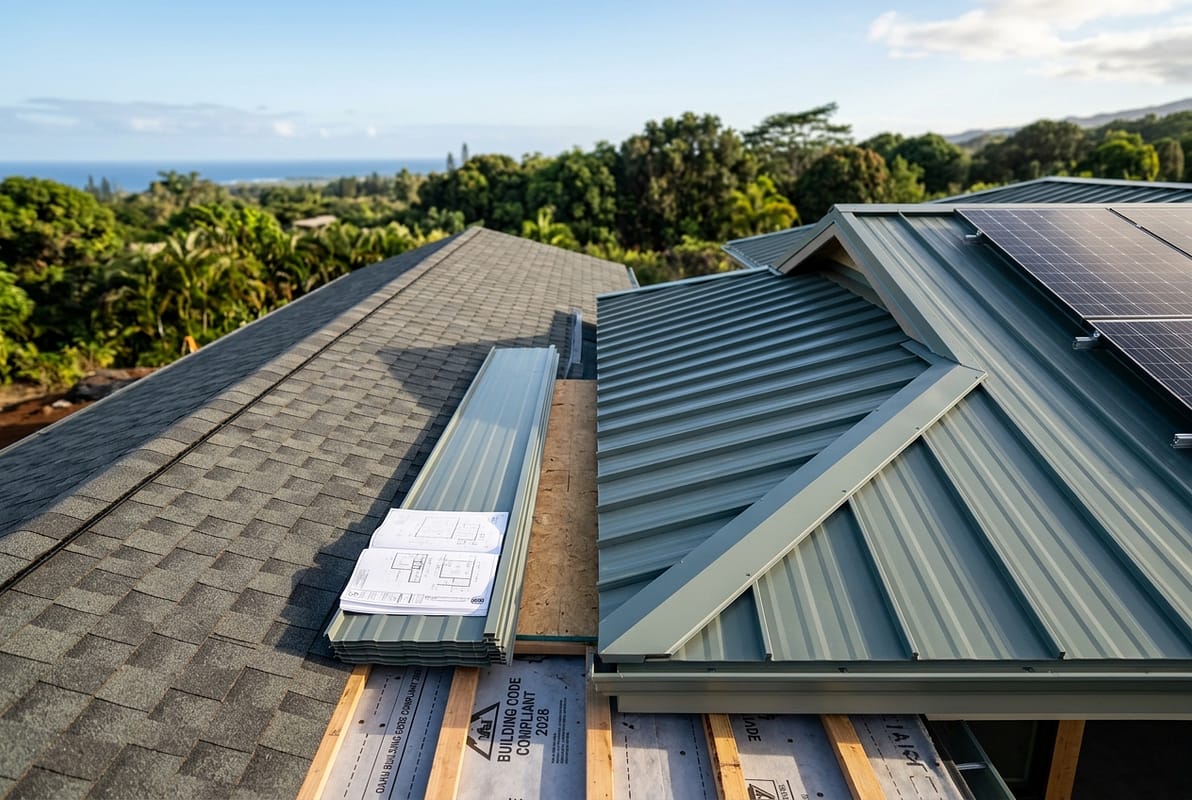
The 2026 updates to the Honolulu building code have fundamentally changed the requirements for roofing systems on Oahu. After years of relying on older standards, the Honolulu Department of Planning and Permitting (DPP) fully adopted provisions based on ASCE 7-22, which is a much stricter engineering standard for wind load.[3] This directly impacts the hawaii building code roofing requirements and narrows the performance gap between materials—forcing shingles to become more robust (and expensive) to even be legal.
Understanding the 130 MPH Wind Uplift Requirement
The biggest change is the mandate that all new residential roofs must be rated to withstand a minimum of 130 mph wind speeds. This isn’t just about the material itself, but the entire system: the underlayment, the fasteners, and the installation pattern. The code now recognizes that a roof doesn’t fail because a single shingle flies off; it fails when wind gets underneath and creates a catastrophic peeling effect, known as uplift.
For a project on the North Shore or in a high-wind area like Kaneohe, the engineering requirements can be even higher. The DPP now requires specific calculations for different zones of the roof (field, edges, and corners), with corners requiring the most robust fastening. This level of detail is something we haven’t had to contend with on standard residential projects in the past.
What Shingles Need to Pass Code (Six-Nail Fastening & Corner Zones)
To meet the new 130 mph standard, standard architectural shingles can no longer be installed with the old four-nail pattern. The code now mandates a six-nail pattern for all shingles. This means 50% more fasteners, which increases both material cost and labor time.
Furthermore, in the critical corner zones of the roof, the DPP now requires additional measures. A new bulletin clarifies that these areas often require a specialized adhesive strip applied to each shingle and an even denser nailing pattern.[4] This complexity adds another layer of cost and makes proper installation absolutely critical. A crew that isn’t up-to-date on these specific zone requirements can easily fail a final inspection, causing major delays for the homeowner.
Why Metal Systems Are the Architects’ Choice for Hurricane-Ready Homes
Standing seam metal roofing inherently excels under these new rules. The system is designed for high wind performance from the ground up. Here’s why it’s becoming the standard for new hurricane-resistant construction in Hawaii:
- Interlocking Panels: Each panel mechanically locks into the next, creating a single, monolithic surface. Wind has no edges to catch and lift, unlike individual shingles.
- Concealed Fasteners: The clips and screws that hold the roof down are protected beneath the panels, shielded from the elements and from direct wind force. This eliminates the primary failure point of an asphalt shingle, where nails are exposed and can back out over time.
- System-Wide Engineering: Metal roofing manufacturers provide detailed engineering tables that specify clip spacing for different wind zones. For example, in the main field of the roof, we might use clips every 24 inches. But in the corner zones, the spec will call for spacing to be reduced to 16 inches or even 12 inches to handle the increased uplift forces.
As a result, most standard 24-gauge standing seam metal systems meet or exceed the 130 mph requirement with their standard installation details. This engineering confidence is why, as Pacific Business News reported, a growing number of Honolulu architects are specifying metal roofing by default on their projects post-2026. They see it as the most reliable way to create a truly resilient building envelope.
Which Roof Lasts Longer in Hawaii’s Salt Air and Sun?
This is where the material science really matters. A roof on Oahu isn’t just battling rain; it’s in a constant fight against two of the most corrosive elements on earth: intense ultraviolet radiation and airborne salt. The performance difference between metal and asphalt shingles in this environment is not subtle; it’s dramatic. The key issue is how each material handles the inevitable salt air corrosion roof degradation.
Metal’s Defense: Why a Kynar 500 Finish is Non-Negotiable
Not all metal roofs are created equal, especially in Hawaii. The secret to a 50+ year lifespan is the coating. At Warrior Construction, we exclusively use panels with a Kynar 500 (or equivalent PVDF) paint finish over a G90 galvanized steel base. Here’s what that means:
- G90 Galvanized Steel: This refers to the thickness of the zinc coating that protects the steel core from rust. G90 is a heavier commercial-grade coating that provides a robust first line of defense. For homes within a mile of the coast—think Ewa Beach, Kailua, or parts of Diamond Head—this is the absolute minimum we would recommend.
- Kynar 500 (PVDF) Finish: This is the high-performance paint system applied on top of the galvanization. It’s a fluoropolymer resin known for its exceptional resistance to fading, chalking, and chemical degradation. While a cheaper polyester paint (SMP) might look good for a few years, it will start to break down and fade under our intense sun in as little as 5-7 years. Kynar 500 is formulated to hold its color and protective qualities for 30 years or more, even with constant UV and salt spray exposure.
On a recent coastal home project in Lanikai, the architect specified an even higher grade of material: solid aluminum panels. While more expensive, aluminum is inherently rust-proof, offering the ultimate protection in a marine environment. For most residential applications, however, a properly coated G90 steel panel provides the perfect balance of performance and cost.
Shingles’ Weakness: Rapid Granule Loss and Voided Warranties
Asphalt shingles have a fundamental vulnerability in our climate. They are essentially a fiberglass mat soaked in asphalt and covered with a top layer of ceramic-coated mineral granules. Those tiny granules do all the work: they provide the color and, most importantly, they protect the asphalt from the sun’s UV rays.
Here’s the problem in Hawaii:
- The constant, high-angle sun bakes the asphalt, causing the volatile oils to evaporate. The shingle becomes brittle.
- As the shingle loses its flexibility, the granules begin to break loose more easily. You’ll see them accumulating in your gutters—that’s your roof’s sunblock washing away.
- Once enough granules are gone, the underlying asphalt is exposed directly to UV radiation, which causes it to crack and break down rapidly.
- This accelerated aging process is why a “30-year” shingle rarely lasts more than 15-18 years here. As mentioned, this granule loss is often cited by manufacturers as a reason to deny wind damage warranty claims, leaving homeowners unprotected.
We see it all the time during inspections for a re-roof. A 12-year-old shingle roof in Wahiawa might look fine from the street, but up close, we can see significant granule loss and hairline cracks. It’s only a matter of time before the next big Kona storm drives water right through it.
Why is There Such a Big Price Difference Between Metal and Shingles in Hawaii?
When clients see a quote for a metal roof that’s nearly double the cost of shingles, they often ask where that extra money goes. The difference in the oahu roofing cost comes down to three main factors unique to our island economy: material sourcing, shipping logistics, and specialized labor. It’s not just the product itself; it’s the entire supply chain required to get it onto your roof.
The Logistics Tax: Shipping Long Panels vs. Dense Pallets
Everything is more expensive in Hawaii because nearly everything has to arrive on a boat. However, the way roofing materials are packaged dramatically affects their shipping cost. DBEDT’s latest quarterly report confirms that shipping costs for construction materials are a major driver of overall project prices.[5]
- Asphalt Shingles: Shingles are dense, heavy, and stack perfectly onto standard 4×4 pallets. A shipping container can be packed incredibly efficiently with dozens of pallets, maximizing every square foot of space. This results in a relatively low shipping cost per square foot of roofing material.
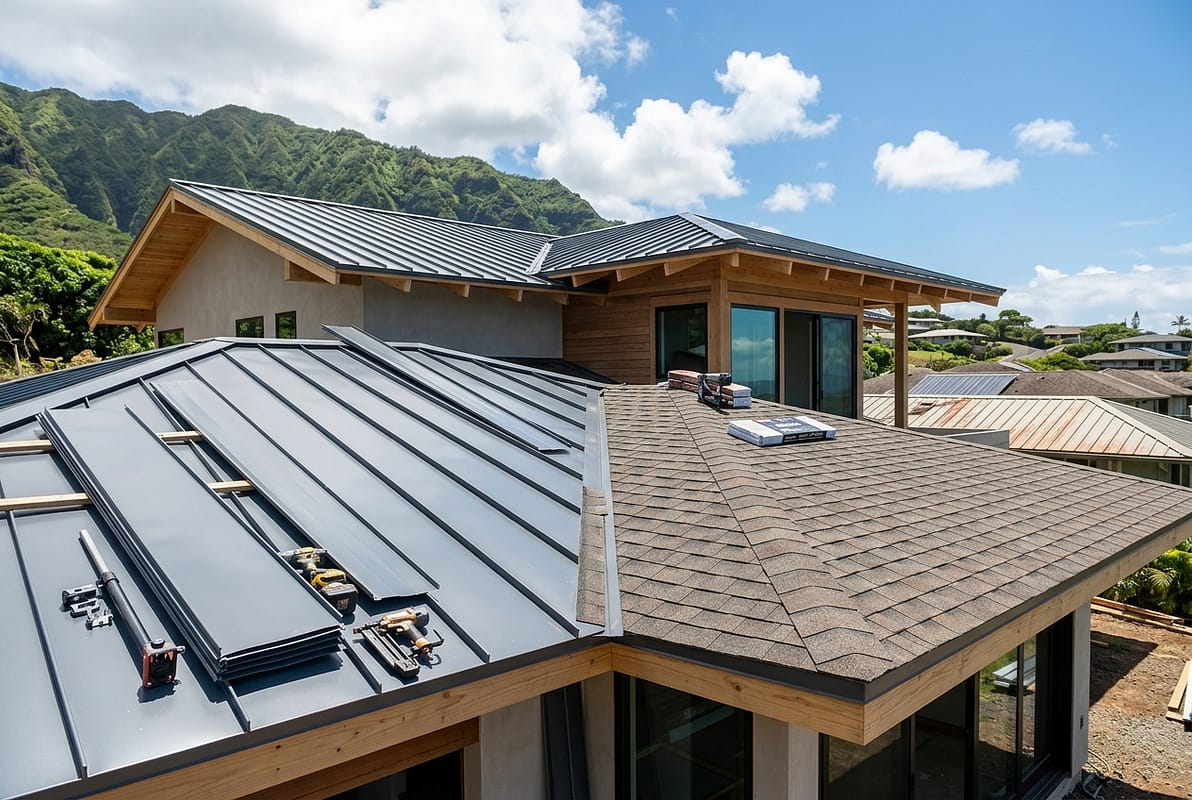
- Standing Seam Metal: Metal roofing panels are often custom-formed to the exact length needed for a roof plane, sometimes over 40 feet long. These long panels must be shipped in custom-built, oversized wooden crates. These crates are bulky, awkward, and create a lot of wasted space in a shipping container. Shipping companies like Matson and Pasha charge based on volume, so a half-empty container with a few long crates can cost just as much to ship as a full container of shingles. This “logistics tax” on inefficiency is a primary reason for the higher material cost of a standing seam metal roof hawaii.
Even when panels are formed locally at a place like Campbell Industrial Park, the raw steel coils still have to be shipped from the mainland, so the freight cost is baked into the price one way or another.
The Neighbor Island Factor: Calculating Inter-Island Barge Costs
If you think shipping to Oahu is expensive, the costs are amplified for projects on Maui, Kauai, or the Big Island. Once the materials arrive in Honolulu, they have to be offloaded and then re-loaded onto an inter-island barge like Young Brothers. This adds another layer of cost and complexity.
For bulky items like metal roofing crates, these inter-island barge fees can be substantial. As a general rule, we budget an additional 15-20% on top of the material cost just for neighbor island shipping. A $20,000 material package for an Oahu metal roof can easily become $24,000 by the time it lands in Kahului or Lihue. This is a critical factor we discuss with clients when planning projects outside of Oahu, and it further widens the price gap between easily transportable asphalt shingles hawaii and metal panels.
This is also why planning and lead times are so critical. A delay with the barge can push a whole project back by a week or more, which has a cascading effect on labor scheduling and project completion dates.
What this means for Hawaii homeowners
So, how should you, an Oahu homeowner, decide between these two very different roofing systems in 2026? It boils down to your specific situation, your timeline, and your tolerance for future risk and expense.
Here’s a simple decision framework our team uses when advising clients:
- If you plan to sell your home in the next 3-5 years: A new, code-compliant architectural shingle roof might be the most financially prudent choice. It will pass inspection, satisfy buyers, and allow you to avoid the higher upfront cost of metal, which you may not fully recoup in a short-term sale.
- If this is your “forever home” or you plan to stay 10+ years: A standing seam metal roof is almost certainly the smarter long-term investment. The lifecycle cost is significantly lower, and you get decades of superior protection and peace of mind. You’ll avoid the disruption and escalating costs of future re-roofing projects.
- If you live within a mile of the coast (Kailua, Lanikai, Ewa Beach, North Shore): We strongly recommend a metal roof. The constant salt spray is brutal on asphalt shingles and their fasteners. A metal system with a G90 galvanized base and a Kynar 500 finish is specifically designed to withstand this harsh marine environment. Investing in a lesser material here is asking for premature failure. A great supplement to this is our guide to building a Hawaii-proof home.
- If your budget is the primary constraint: A high-quality asphalt shingle roof, installed correctly to the new 2026 codes, is still a solid and safe option. Just go into it with the realistic expectation that you are buying a 15 to 18-year solution, not a 30-year one, regardless of what the warranty says. Plan for its eventual replacement in your long-term home maintenance budget.
Ultimately, the best roof is one that is installed correctly by a licensed, insured, and experienced contractor who understands Hawaii’s unique challenges. A poorly installed metal roof will fail just as surely as a cheap shingle one.
Frequently Asked Questions
Can I install a metal roof over my old asphalt shingles to save money?
While some jurisdictions allow this, we strongly advise against it on Oahu. A full tear-off allows us to inspect the underlying roof deck for any rot or termite damage, which is a common issue here. It also ensures the new, high-performance underlayment is installed correctly on a clean surface, which is critical for your warranty and for passing a DPP inspection.
How much does a roofing permit cost from the Honolulu DPP in 2026?
Permit fees are based on the total project valuation. For a typical residential re-roofing project on Oahu, you should budget between $1,500 and $3,000. This covers the DPP’s plan review and inspection fees. Working with an experienced contractor helps streamline this process, which can otherwise be a source of major delays.
Is a metal roof really noisy when it rains in Hawaii?
This is a common myth based on old metal roofs on barns or sheds that were installed without solid sheathing. Modern standing seam roofs are installed over a solid plywood deck and a layer of underlayment. With your attic insulation below, a metal roof is no louder during a rainstorm than an asphalt shingle roof.
What color roof is best for saving energy in Hawaii?
Lighter colors are significantly better for energy efficiency. Look for metal roof colors with a high Solar Reflectance Index (SRI). A white or light beige Kynar 500 finish can reflect a huge amount of solar radiation, keeping your attic and home cooler and reducing your air conditioning bills. This is a key part of complying with Hawaii’s strict energy code.
How long does a full roof replacement take on Oahu?
This depends on the size and complexity of your roof, but a general timeline is 3-5 days for a complete tear-off and installation of asphalt shingles. A standing seam metal roof takes longer due to the more precise nature of the work, typically 7-10 days. This includes the time for multiple DPP inspections at different stages of the project.
Will a new roof affect my solar (PV) panels?
Yes, absolutely. If you have an existing PV system, the panels and racking must be removed by a licensed solar contractor before we can begin the re-roofing process, and then reinstalled afterward. This adds significant cost and coordination to the project, so it’s critical to factor it into your budget and timeline from the very beginning.
Your Roof is Your Home’s First Line of Defense
Choosing a new roof in Hawaii is one of the most important decisions you’ll make as a homeowner. It protects your family and your biggest investment from sun, rain, and hurricanes. While the upfront cost of a standing seam metal system is higher, its incredible durability, longevity, and performance under the new 2026 building codes make it the superior long-term choice for most Oahu families.
If you’re trying to navigate the complexities of a metal roof vs shingles in Hawaii, our team is here to help. We can provide a detailed, transparent estimate based on the specific needs of your home and help you understand the real, long-term value of your investment. At Warrior Construction, we build things to last—especially the roof over your head. Contact us today to schedule a consultation and ensure your home is ready for the next storm season.
References
- Hawaii Construction Forecast (Q2 2026), UHERO
- Material Performance in Marine Environments (June 2026), Hawaii Contractors Association
- Code Update 2026: Roofing Uplift Requirements, Honolulu Department of Planning and Permitting
- Bulletin B-26-04: Roof Fastening Zones, Honolulu Department of Planning and Permitting
- Quarterly Statistical & Economic Report (Q2 2026), Hawaii DBEDT


