
A successful hawaii construction schedule is not a simple Gantt chart; it’s a proactive, disciplined playbook designed to anticipate and absorb the unique shocks of building in the middle of the Pacific. After more than 20 years on job sites from Kailua to Kapolei. Our team can tell you the number one source of homeowner anxiety. It is always the same: delays and cost overruns. Consequently, a family sees their project start, then stall for weeks, and they can’t understand why. The truth is, most of these delays aren’t surprises to an experienced local contractor. They are predictable friction points in our island system.
Hoping for the best isn’t a strategy. Instead, a realistic hawaii construction schedule is built on a foundation of logistical buffers, early procurement, and locked-in labor—a system that acknowledges our realities from day one. For instance, this means ordering hurricane-rated windows. We do this before we’ve even poured the foundation. It also means booking our electrician six months before they’re needed. This playbook isn’t about working faster; it’s about eliminating the idle time that kills budgets and timelines. Here, our team at Warrior Construction will walk you through the seven core strategies. We use these to mitigate Hawaii’s unique challenges. These challenges range from the notorious Honolulu permit backlog. They also include skilled labor shortages and supply chain delays. Such issues can sink a poorly planned project.
Why Do Hawaii Construction Projects Go Off Schedule?
Projects here go off schedule for reasons that mainland contractors rarely, if ever, face. Primarily, it’s a combination of our geographic isolation. We also have limited resources. The sheer volume of construction on our small islands is another factor. This isn’t about a single point of failure. Rather, it is a series of cumulative delays. These can add months to a project. This happens if not aggressively managed from the preconstruction phase. At Warrior Construction, we build our entire approach to construction project management hawaii around anticipating these issues. Our first strategy is accepting reality and planning for it.
Strategy 1: Build a 30-Day ‘Mainland Lag’ Buffer
Here’s a hard truth: almost everything that goes into your home—from framing lumber and trusses to windows and appliances—arrives here on a boat. That journey from a West Coast port like Long Beach to Honolulu Harbor is the first major variable. A new Pacific Business News report highlights this ‘mainland lag’ as a massive wildcard in any project timeline.[1]
Even with priority booking, you’re looking at a 3-4 week transit time for a container. However, that’s only if everything goes perfectly. Containers get bumped, ships get delayed by weather, and port congestion in Honolulu can easily add days of waiting time. To combat this, our standard operating procedure is to build a mandatory 30-day logistics buffer into the hawaii construction schedule for all critical materials arriving from the mainland. Our team doesn’t just place an order; we actively track that container from the moment it leaves the factory. For example, we know when it’s on the rail to the port. We know when it’s loaded onto the ship. And we know when it’s offloaded in Honolulu. As a result, we schedule our crews to be ready the day it’s planned to arrive on site. This means not a moment before. This active management prevents the most common cause of hawaii construction delays: a crew of framers standing around a bare foundation, waiting for a lumber package that’s still sitting on a dock in California.
The Final Bottleneck: Inter-Island Shipping
If you’re building on Maui, Kauai, or the Big Island, you have another layer of logistics to manage. Once that container lands in Honolulu, it must be transferred to a barge for the final leg of its journey. This adds another 5-10 business days to the timeline and introduces another potential point of failure. According to the Hawaii Contractors Association, inter-island shipping costs have jumped. They increased by 15% this year alone. This reflects high demand and limited capacity.[2]
On a recent custom home project on Maui, for example, the specialty roofing material was delayed by four days in Honolulu waiting for space on a barge. Four days might not sound like much. But it meant we missed our window with the roofing crew. They were already booked on another job. Their next availability was two weeks later. In that time, we had two major rain storms. This small inter-island shipping hiccup cascaded. It forced us to re-sequence the entire schedule for drywall. We also had to re-sequence for flooring and painting. A well-thought-out hawaii construction schedule anticipates these issues. Proper construction project management hawaii means having a plan B and C for these exact scenarios.
How Long Does a Building Permit Really Take on Oahu?
Before a single shovel hits the ground, every project on Oahu must navigate the Honolulu Department of Planning and Permitting (DPP). The honolulu building permit timeline is, without a doubt, the longest and most unpredictable phase of any build. Underestimating this process is the first, and often most costly, mistake homeowners make. Our second strategy transforms this waiting period from a frustrating delay into a strategic advantage.
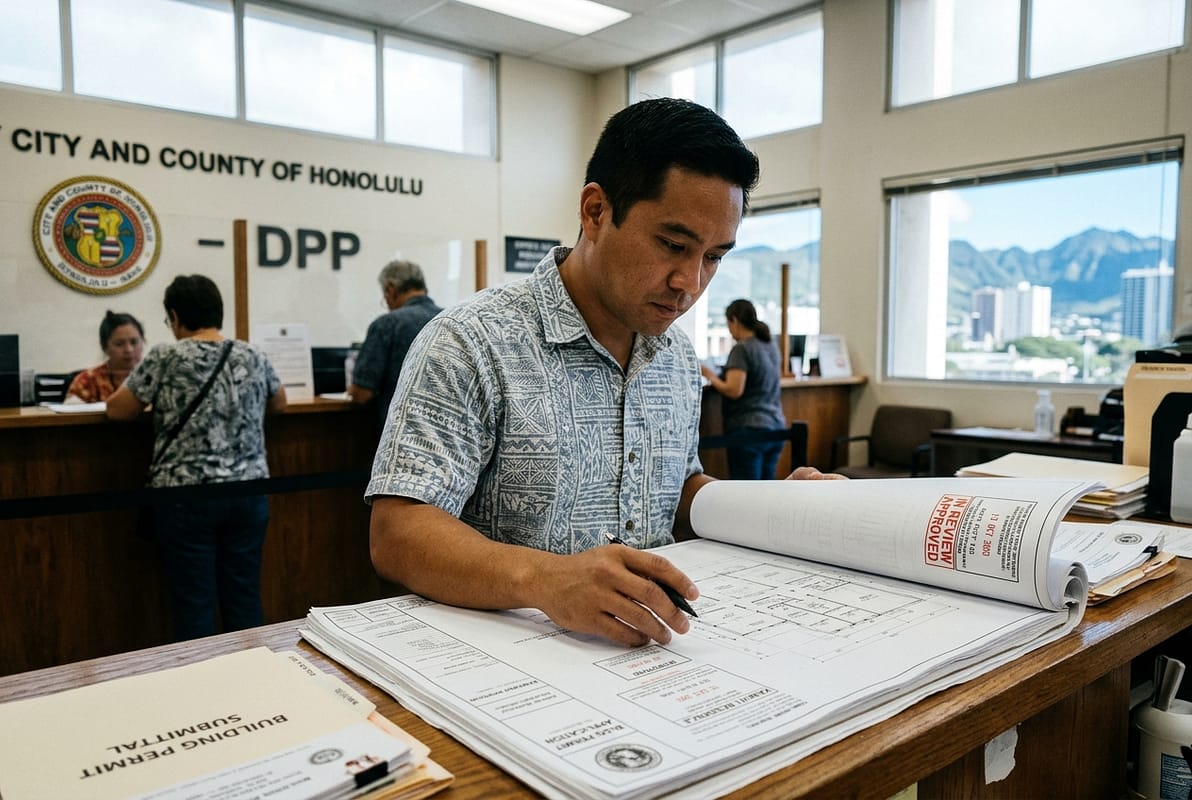
Strategy 2: Master ‘Phase Zero’ During the 10-12 Month DPP Timeline
Let’s be perfectly clear: as of Q3 2026, the DPP’s own data shows that a permit for a new, standard single-family home is taking between 10 and 12 months to get through the review process.[3] For a smaller interior renovation, you should still budget for 6-8 months. This isn’t just paperwork. Different city departments, including zoning, building, electrical, and plumbing, conduct a series of sequential reviews. Sometimes, specialized reviews for things like shoreline setbacks or grading in hilly areas are also needed.
Our team actively treats the permitting period as ‘Phase Zero’ of the project. This is not dead time. While we wait for the city, we are incredibly busy. We finalize every single material selection with you, from faucet models to grout color. Furthermore, we get binding quotes from our subcontractors. We also create a detailed procurement schedule. Then we begin placing orders for the longest lead-time items. By the time that permit is in hand, we have every decision made. Critical materials are already on a container ship heading our way. This proactive approach turns the biggest delay into a strategic advantage, ensuring we can break ground immediately and maintain momentum. Failing to use this wait time effectively is a hallmark of an amateur hawaii construction schedule.
The Real Cost of a DPP Revision Request
The single best thing you can do to protect your timeline is to ensure your plans are 100% complete and compliant before the first submittal. Any mistake, no matter how small, can trigger a revision request—or a ‘Reviewer Note’—from a DPP plan checker. This is catastrophic for a hawaii construction schedule. A revision request doesn’t just pause your application; it effectively sends you to the back of the line to wait for your turn to be reviewed again, a process that can add another 3-4 months to the already long honolulu building permit timeline.
We recently took over a project in Kailua. The owner’s initial architect had made a small miscalculation. This was on the lot coverage percentage. The DPP kicked the plans back. By the time the architect corrected the drawing and resubmitted, four months had passed. During that time, material prices for lumber increased by 6%, adding nearly $25,000 to the framing package. That’s the real cost of a simple mistake during the permitting phase. It’s why we collaborate so closely with trusted architects and engineers, scrubbing every detail before anything goes to the DPP.
What Are ‘Long-Lead’ Items and How Do They Impact a Schedule?
In Hawaii construction, the critical path of your schedule is dictated by the items that take the longest to procure. We call these ‘long-lead’ items. Managing their acquisition is the secret to a smooth-flowing project. Waiting to order materials until you need them is a recipe for disaster here. Instead, our third strategy for a successful hawaii construction schedule is built around ordering these items months in advance, a strategy we call ‘phased procurement’.
Strategy 3: Front-Load Procurement of 18-20 Week Lead Time Items
As soon as we submit the building permit application, our procurement process begins. Certain items have exceptionally long lead times due to custom manufacturing and the long journey to our islands. The Hawaii Contractors Association confirms that lead times for hurricane-rated windows and custom-fabricated roof trusses are now consistently hitting 18-20 weeks.[2] That’s five months. If you wait until the house is framed to order your windows, your project will sit idle. It will be exposed to the elements for half a year.
Here are some of the items on our immediate order list during the permitting phase:
- Hurricane-Rated Windows & Doors: 18-20 weeks
- Custom Roof Trusses: 18-20 weeks
- Custom Cabinetry: 12-16 weeks
- Appliances (especially high-end): 10-14 weeks
- Specialty Tile & Flooring: 8-12 weeks
- Plumbing Fixtures & Faucets: 6-10 weeks
By ordering these items before the foundation is even poured, we ensure they arrive on a ‘just-in-time’ basis that aligns with the construction sequence, not months after they were needed. This front-loading is a cornerstone of a functional hawaii construction schedule and prevents costly downtime.
Phased Procurement: Aligning Orders with Your Build Timeline
Phased procurement is more than just ordering early; it’s a cash-flow management strategy validated by recent DBEDT economic reports.[4] This means we don’t order everything at once. We strategically align our purchase orders with the project’s construction loan draw schedule and the physical build timeline. This prevents having thousands of dollars of materials sitting on-site, vulnerable to weather or theft, months before they are needed.
Here’s how it works in practice on a typical custom home build:
- During Permitting (Months 1-12): We order the longest lead items: windows, doors, and trusses. The deposit for these items is often paid for with initial funds, separate from the main construction loan draw.
- During Foundation Pour (Month 14): As the bank releases the first loan draw, we order the framing lumber package, roofing material, and exterior siding.
- During Framing (Months 15-16): With the next draw, our team orders drywall, insulation, and all rough-in plumbing and electrical components.
- During Drywall (Months 17-18): The final major draws fund the purchase of flooring, tile, cabinets, and countertops for delivery right as the painters are finishing up.
This disciplined approach to managing the supply chain hawaii keeps the project moving without interruption and helps manage the budget effectively, forming a critical part of the overall hawaii construction schedule.
How Do You Manage Subcontractors to Avoid Delays?
Materials and permits are only two-thirds of the scheduling puzzle. The final, and arguably most complex, piece is managing the human element: the subcontractors. There is a critical shortage of skilled labor in Hawaii. Coordinating the schedules of our trusted trade partners is an art form. These partners include plumbers, electricians, masons, and painters. This requires deep local relationships and a scheduling philosophy that rejects the mainland’s ‘just-in-time’ approach.
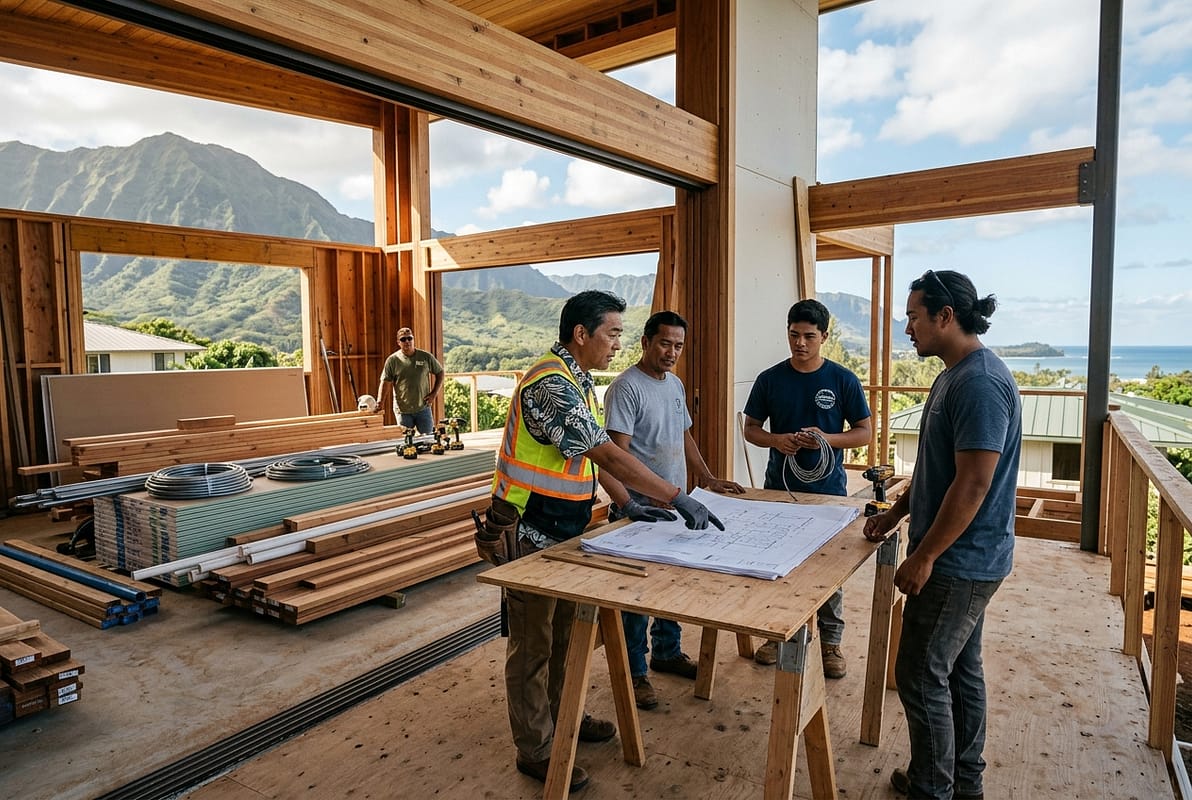
Strategy 4: Lock In Top-Tier Talent Months in Advance
The best subcontractors in Hawaii are not waiting by the phone. They are booked 4-6 months out, sometimes longer for highly specialized work. At Warrior Construction, we don’t just build homes; we build relationships that allow us to construct a reliable hawaii construction schedule. As soon as we have an approved building permit. We also need a firm start date. Then we are on the phone with our core group of trade partners. This is to lock their crews into our project timeline.
For a new build in Kapolei, for instance. We will have the foundation contractor confirmed. The framer, plumber, and electrician will be scheduled on a master calendar. This happens before we even clear the lot. We provide them with the plans and a target start week months in advance. This isn’t a tentative hold; it’s a firm commitment backed by a deposit. This is the only way to guarantee access to high-quality labor and avoid a situation where we’re scrambling to find an available crew, which often means settling for a less experienced team and creating massive hawaii construction delays.
Why ‘Just-in-Time’ Crew Scheduling Fails in Hawaii
On the mainland, some large builders use a ‘just-in-time’ model where they call a sub a few days before they’re needed. That simply does not work here. The labor pool is too small, and the demand is too high. A recent UHERO report quantified the problem: there’s a 12% gap between the demand for licensed electricians and plumbers and the available workforce.[5] A one-week delay waiting for materials can have a devastating ripple effect on this tight subcontractor schedule.
Imagine the framing is delayed by a week because a lumber container was held up. We need a strong, long-standing relationship with our plumbing subcontractor. If we don’t have this, they can’t just push their start date back by a week. They will move on to the next project on their list to keep their crew busy. Consequently, their next opening for our project might be three or four weeks away. Now, the electrician who was scheduled to follow the plumber is also pushed back. And the drywall crew after them. A single one-week delay at the beginning has now turned into a month-long stall in the middle of the project. This is exactly how construction cost overruns hawaii happen—your timeline expands, but your carrying costs for your construction loan keep ticking up every single day.
How Do We Build a Budget That Accounts for Hawaii’s Realities?
A resilient hawaii construction schedule and a realistic budget are two sides of the same coin. You simply cannot have one without the other. Our fifth strategy is to create budgets from the ground up to reflect the true costs of building here. This means incorporating unavoidable premiums on materials and labor. Most importantly, it means building in a contingency fund. This is not an afterthought. Rather, it is a critical line item. It helps manage the predictable unpredictability of a Hawaii build.
Strategy 5: Factor in the ‘Paradise Tax’ and a 15% Contingency
There’s a reason it costs more to build here, a premium we often call the ‘Paradise Tax.’ It’s a combination of three factors:
- Shipping Costs: Every nail, every 2×4, every window has to be shipped thousands of miles across the ocean. This adds a baseline of 20-25% to the cost of most materials compared to mainland pricing.
- General Excise Tax (GET): Unlike a sales tax, Hawaii’s GET is applied at every stage of the supply chain. The importer pays it. The distributor pays it. We pay it as the contractor. Then it gets passed on to you. It compounds at each step.
- Limited Local Inventory: For many items, there are only one or two major suppliers on the island. This lack of competition means they can command higher prices. If you need a specific type of plumbing valve right away, you pay what they’re asking.
A budget that uses mainland cost-per-square-foot averages will be wrong by at least 30%. For this reason, our estimating process is based on real-time quotes from our local suppliers. This reflects the true, on-island cost of every component.
The Critical Role of a 15% Contingency Fund
A contingency fund is not for design changes. It’s a planned financial buffer to absorb unforeseen but necessary costs that arise during construction. The Honolulu Board of REALTORS® recently issued a report. They strongly advised homeowners to secure a 15% contingency fund. This should happen before starting any major project. This isn’t a slush fund; it’s a crucial tool for keeping the project on track when issues arise.
What does it actually cover?
- Unforeseen Site Conditions: We might start excavating for a foundation in Manoa and hit a massive nest of blue rock that requires expensive heavy equipment and several extra days to break up.
- Hidden Damage in Renovations: On recent major renovations in a 1970s home in Aina Haina, we opened a wall and discovered decades of hidden termite damage that required extensive structural repairs not in the original scope.
- Material Price Escalations: If a sudden spike in fuel costs causes a mid-project surcharge on shipping, the contingency covers it without derailing the entire budget or project timeline.
Without this fund, these common issues can cause a complete work stoppage while the homeowner scrambles to secure more financing, leading to the exact construction cost overruns hawaii that everyone fears.
How Do Change Orders Wreck a Hawaii Construction Schedule?
Change orders are the single biggest threat to your project’s timeline and budget after the project has started. They don’t just add time for the new work. More importantly, these changes trigger a cascade of delays. This forces us to reschedule subcontractors. We also must re-order materials from the mainland. Sometimes, we even re-submit plans to the DPP. Our sixth strategy is a system to proactively manage these changes, which is critical to protecting the original hawaii construction schedule our team builds for you.
Strategy 6: Implement a Rigorous Change Order Management System
Think of the hawaii construction schedule as a line of dominoes. A change order doesn’t just knock over one; it hits the whole line. For example, let’s say you decide to move an interior wall in your Kailua home by three feet during framing. That sounds simple. However, the electrician was scheduled for Tuesday. But now we must move plumbing and HVAC ducts first. He’s booked solid on a job in Kapolei. Because of this, the electrician cannot come back for two weeks. Consequently, the drywall crew we had lined up for Friday now has to be pushed back. As a result, the painter and flooring installer are also delayed. That simple three-foot wall move just added three weeks of chaos to a tight schedule. It also created friction with subcontractors. They rely on predictable workflow.
The financial impact also goes far beyond the direct cost of the change itself. In Hawaii, these costs are magnified. Let’s break down the true cost of adding a different bathroom vanity after the plumbing is already roughed-in. We insist on a formal Change Order Request (COR) process for this exact reason, so everything is priced and the impact on the hawaii construction schedule is calculated before you approve it. Here’s what that really looks like:
- Direct Costs: The price difference for the new vanity, plus freight from California. Perhaps $800.
- Subcontractor Re-mobilization Fee: Our plumber has to make a special trip back to the site to move the pipes. That’s a minimum $450 charge.
- Lost Time Costs: Two days of delay waiting for the plumber impacts the entire project’s overhead, which can be hundreds of dollars per day.
- Administrative Fees: Our project manager spends hours processing the paperwork, adjusting the hawaii construction schedule, and coordinating with everyone involved. This is typically billed at $125 per hour.
Our System for Proactive Change Prevention
At Warrior Construction, we believe the best way to handle change orders is to prevent them from happening in the first place. This starts with an extremely detailed planning phase during ‘Phase Zero’. We build key decision deadlines directly into the initial project plan. For instance, we schedule a mandatory electrical and plumbing walkthrough with you *after* framing but *before* drywall. This gives you a final chance to see outlet locations and fixture placements in the real space. At this point, changes are still relatively easy and inexpensive. Once the walls are closed up, moving a light switch becomes a major operation that disrupts the delicate hawaii construction schedule.
What Is the Role of Communication in a Hawaii Construction Schedule?
The final, and perhaps most important, strategy for keeping a project on track is not about materials or permits, but about information. Delays often start as small misunderstandings that fester over weeks. A client thinks one thing, the project manager another, and a subcontractor a third. To prevent this, our seventh strategy is to build a hawaii construction schedule that includes a framework for radical transparency and constant communication.
Strategy 7: Utilize Centralized Communication and Daily Reporting
An email here, a text message there, and a voicemail left on a cell phone—this is how information gets lost and mistakes happen. We centralize all project communication through dedicated project management software. This creates a single source of truth for the entire team, including you, the homeowner. You get a private login. There you can see the up-to-date schedule. You can approve selections and view change orders. You also access all project documents 24/7.
Furthermore, we leverage this technology to keep you in the loop every single day. Our project managers post a daily log at the end of each workday, complete with photos of the progress made. Even if you are on Maui, your project might be on the North Shore of Oahu. You can see exactly what is happening without getting on a plane. This transparency is key. It allows you to spot a potential issue or ask a question immediately. We can address concerns in real-time instead of having them become costly change orders weeks down the line. A successful project hinges on a meticulously planned and rigorously defended hawaii construction schedule, and clear communication is the glue that holds it all together.
Case Study: A Proactive Schedule for a Kailua Custom Build
To see how this playbook works in the real world, let’s look at a recent 3,200 sq. ft. custom home we built in Kailua. The goal was to complete the project within 18 months of breaking ground.
Phase 0: The 12-Month Permit Wait (Months 1-12)
- Month 1: Submitted permit application to Honolulu DPP.
- Month 2: Finalized all exterior selections with the client: windows, roofing, siding.
- Month 3: Placed the purchase order for the custom hurricane-rated window and door package. The manufacturer quoted a 20-week (5-month) lead time.
- Month 6: Finalized all interior selections: cabinetry, flooring, tile, plumbing fixtures.
- Month 7: Placed the order for the kitchen and bathroom cabinets (16-week lead time).
- Month 12: Building permit approved by DPP.
Phase 1: Construction (Months 13-30)
- Month 13: Broke ground. Site work and excavation begin.
- Month 14: Foundation poured. Our window package, ordered 11 months prior, ships from the mainland factory.
- Month 15: Framing begins.
- Month 16: The window and door container arrives at the job site exactly as the framing crew is finishing the window openings. There is zero downtime.
- Month 18: House is dried-in. The custom cabinets, ordered a year ago, arrive on-site just as the drywall is being finished.
The Outcome: By front-loading all procurement into the permitting phase, we completely eliminated the two most common choke points: waiting for windows and waiting for cabinets. A competing builder waited until framing to order windows. That builder would have faced a 5-month delay. This would push their project well past the 18-month target. It would also incur thousands in additional carrying costs. This is the tangible result of a proactive hawaii construction schedule.
What This Means For Your Hawaii Build
Understanding these local realities is the key to a successful building experience. Your project’s success is determined long before construction starts. Here are the key takeaways:
- Embrace the Permit Timeline: Don’t see the 10-12 month DPP wait as a delay. See it as a crucial planning window. Use this time to finalize every single design choice and material selection with your contractor. This is the foundation of a solid hawaii construction schedule.
- Question a Short Schedule: If a contractor gives you a timeline that seems too good to be true, it is. A schedule that doesn’t explicitly account for the 30-day mainland lag, inter-island shipping, and long-lead item procurement is not a real schedule.
- Your Job is to Make Decisions: The biggest thing you can do to keep your project on track is to make decisions promptly when your contractor needs them. Indecision on things like tile or faucets early on can cause weeks of delay later.
- The Contingency is Not Optional: Budget for a 15% contingency from day one. It is the essential safety net. This allows your project to absorb the inevitable surprises. These are common when building in Hawaii. It prevents a financial crisis or work stoppage.
Frequently Asked Questions
What is the single biggest cause of Hawaii construction schedule delays?
The two biggest factors are the Honolulu building permit timeline, currently running 10-12 months for a new home, and supply chain logistics. Waiting for long-lead items is common. Windows, for example, can take 18-20 weeks to arrive from the mainland. This is the most common reason for a project to stall after breaking ground. A professional hawaii construction schedule must account for these realities from day one.
How can I speed up my Honolulu building permit?
While you cannot directly speed up the DPP’s internal review process, you can prevent unnecessary delays. The key is ensuring your architectural plans are 100% complete. They must also be compliant with all building codes and zoning ordinances. This is crucial *before* the initial submission. A single error can trigger a revision request. This sends your application to the back of the queue. It also adds 3-4 months to your wait time.
Does building on a neighbor island add more time to the schedule?
Yes, absolutely. Our team typically adds another 2-4 weeks of buffer to a neighbor island project schedule specifically for inter-island shipping. All materials first arrive in Honolulu. Then they must be unloaded. They are loaded onto a barge for transit. This barge goes to Maui, Kauai, or the Big Island. This final step adds significant time and another potential point of delay that must be managed.
How much should my contingency fund be for a Hawaii build?
We strongly advise all our clients to establish a contingency fund. This fund should be at least 15% of the total construction cost. This fund is not for design upgrades. It is a planned buffer for unforeseen conditions. For example, we might discover extensive termite damage in a renovation. Our team could hit unexpected volcanic rock during excavation. It also absorbs sudden material price hikes.
Why does my contractor need my final material selections so early?
We need your final selections for items like windows. This includes custom trusses and cabinets. We need these during the permitting phase. Then we can place orders immediately. This is due to the extreme lead times for materials coming to Hawaii. If we wait until we need these items, the project will be forced to a halt. It will stop for months while we wait for them to be manufactured and shipped. This discipline is essential to an effective hawaii construction schedule.
How do weather events like hurricanes affect a Hawaii construction schedule?
Weather is a major factor. We can work through light rain. However, a hurricane warning will shut down a job site for several days. This is for preparation and post-storm cleanup. Furthermore, heavy rain seasons can delay foundation work or exterior painting for weeks. A realistic hawaii construction schedule includes a buffer of ‘weather days’ based on the time of year, but a major storm can still cause significant, unavoidable delays.
How does the hawaii construction schedule impact my construction loan?
Banks in Hawaii are very aware of our local timelines. They now underwrite construction loans for longer terms, typically 15-18 months for a new build, to account for potential delays. Many lenders, like First Hawaiian Bank, will not allow you to close on the loan. You cannot start drawing funds until your building permit has been fully issued by the DPP. Therefore, efficient permit processing is critical not just for your timeline, but for your financing as well.
Set Your Project Up for Success from Day One
A successful build in Hawaii doesn’t happen by accident. It’s the result of a disciplined, proactive strategy that turns our island’s challenges into a well-managed plan. If you’re ready to start planning your custom home or major renovation, our team’s deep understanding of the local landscape can help. Our preconstruction planning services are designed to build a realistic schedule and budget before you ever break ground.
References
- Pacific Business News: Hawaii Construction Scheduling & Logistics Report
- Hawaii Contractors Association: 2026 Industry Survey on Supply Chain & Logistics
- Honolulu Department of Planning and Permitting: Review Processing Times – Q3 2026
- DBEDT: Quarterly Statistical & Economic Report – Q3 2026
- UHERO: Hawaii Construction Forecast – Q4 2026


