
Long-Lead Items Hawaii: 7 Critical Timelines for Your 2026 Build
For any Hawaii home build in 2026, the single biggest driver of your construction schedule after the permit is issued isn’t the crew, the weather, or the inspections—it’s the procurement of long-lead items Hawaii. Critical components like custom windows, specialty cabinetry, and PV battery systems now have lead times stretching from 16 to over 22 weeks. Essentially, the very day your long-awaited building permit from the Honolulu DPP is approved, a separate, multi-month clock starts ticking. Mismanaging this critical procurement phase is the number one reason projects stall. This happens on Oahu and the neighbor islands. Budgets spiral, and homeowners get frustrated. Getting a handle on these specialized timelines is paramount.
For over two decades, our team at Warrior Construction has navigated this complex supply chain for our clients. We’ve seen it all. On a recent North Shore build, the custom Fleetwood doors we ordered were delayed by three weeks. This was due to a labor dispute at the Port of Long Beach. Such a delay threatened to expose our newly framed structure to the corrosive salt air. We had to scramble and pay a premium for temporary weatherproofing to protect thousands of dollars in lumber.
On another Kailua project, a crate of custom tile arrived damaged. A third of the pieces were cracked. This forced a costly re-order. It also caused a six-week pause on two bathroom finishes. These aren’t edge cases; they are the baked-in realities of island building. Being 2,500 miles from the nearest mainland port means logistics aren’t just a line item—they are the central challenge of our job. Consequently, our team plans for these specific long-lead items Hawaii as the most important part of our pre-construction work.
This guide breaks down the procurement puzzle for Hawaii homeowners in 2026. We will identify the top seven long-lead items Hawaii with the longest timelines, explain the precise moment you need to order each one, and walk through the financial and scheduling strategy needed to keep your project moving forward. Most importantly, understanding this process is key to a smoother build. It leads to a more predictable project. This prevents months of costly delays before we even pour the concrete.
What Are ‘Long-Lead’ Items in Hawaii Construction?
Simply put, a long-lead item is any building material, fixture, or component. It is not stocked locally in Hawaii. It must be custom-fabricated by a manufacturer. Then, it ships to the islands. While this is a factor on the mainland, it’s a dominant, schedule-defining force here. The infamous “tyranny of the boat” adds a non-negotiable buffer of 4-6 weeks. This accounts for shipping, customs clearance, and processing. It applies to every single thing we bring in. For truly custom pieces, our team layers this on top of the manufacturer’s own production timeline, creating the extended waits that define the procurement process for long-lead items Hawaii.
A 2026 analysis from the University of Hawaii Economic Research Organization (UHERO) confirmed our daily observations. The supply chain for specialty construction materials remains fragile and extended.[1] As a result, items that a contractor in California can get in 8 weeks will take us 14, minimum. These aren’t just luxury finishes; we’re talking about fundamental components needed to make a home watertight and functional.
We can’t start drywall until the windows are in. We can’t install countertops until we set the cabinets. These dependencies create a domino effect. A single delayed shipment can bring an entire project to a standstill. This leaves our crews and subcontractors on the sidelines. Effectively managing these long-lead items Hawaii is what separates a professional build from a chaotic one.
The ‘Tyranny of the Boat’: Hawaii’s Unique Challenge
Managing the procurement of these items is a specialized skill that falls under professional construction project management Hawaii. It involves a meticulous, multi-step process our team perfects on every project:
- Early Specification: We finalize every selection with you, the homeowner, and the architect during the design and permitting phase—well before we break ground. This proactive approach is central to handling long-lead items Hawaii effectively.
- Vendor Vetting: Our team works exclusively with suppliers and manufacturers who have a proven, successful track record of crating, insuring, and shipping to Hawaii. We know who pads their crates correctly and who understands the nuances of Honolulu Harbor.
- Order Timing: We place deposits the very moment the building permit is issued to start the manufacturing clock. Any hesitation at this stage is a direct delay to your move-in date.
- Logistics Coordination: Our project managers use dedicated software to track each item from the factory floor to the West Coast port, across the Pacific, through Honolulu Harbor’s clearance process, and finally to your job site. We have a full-time logistics coordinator for this very reason.
- Subcontractor Alignment: We schedule our electricians, plumbers, and installers to be ready the week the materials are confirmed to arrive, not a day sooner or later. This precision prevents costly downtime for our trade partners.
Getting this complex sequence right is, without a doubt, the true driver of the post-permit construction schedule in 2026. This is where decades of on-the-ground experience make all the difference, turning potential chaos into a predictable workflow.
What Are the Top 7 Long-Lead Items for a Hawaii Build in 2026?
For a Hawaii build in 2026, the top long-lead items Hawaii consistently include custom windows and doors, specialty cabinetry, PV battery systems, and high-end appliances, each with a timeline that dictates the entire project schedule. Custom windows, cabinetry, and PV battery systems have a 16-20 week lead time on Oahu. Expect an additional 4 weeks for neighbor islands. Our decades of experience building and remodeling homes across Oahu, from Kapolei to Kaneohe, has given us a very clear list. These are the items that consistently have the longest production and shipping timelines. Our team tracks these seven long-lead items Hawaii with military precision from the moment a project starts. Understanding these timelines is crucial for any homeowner.
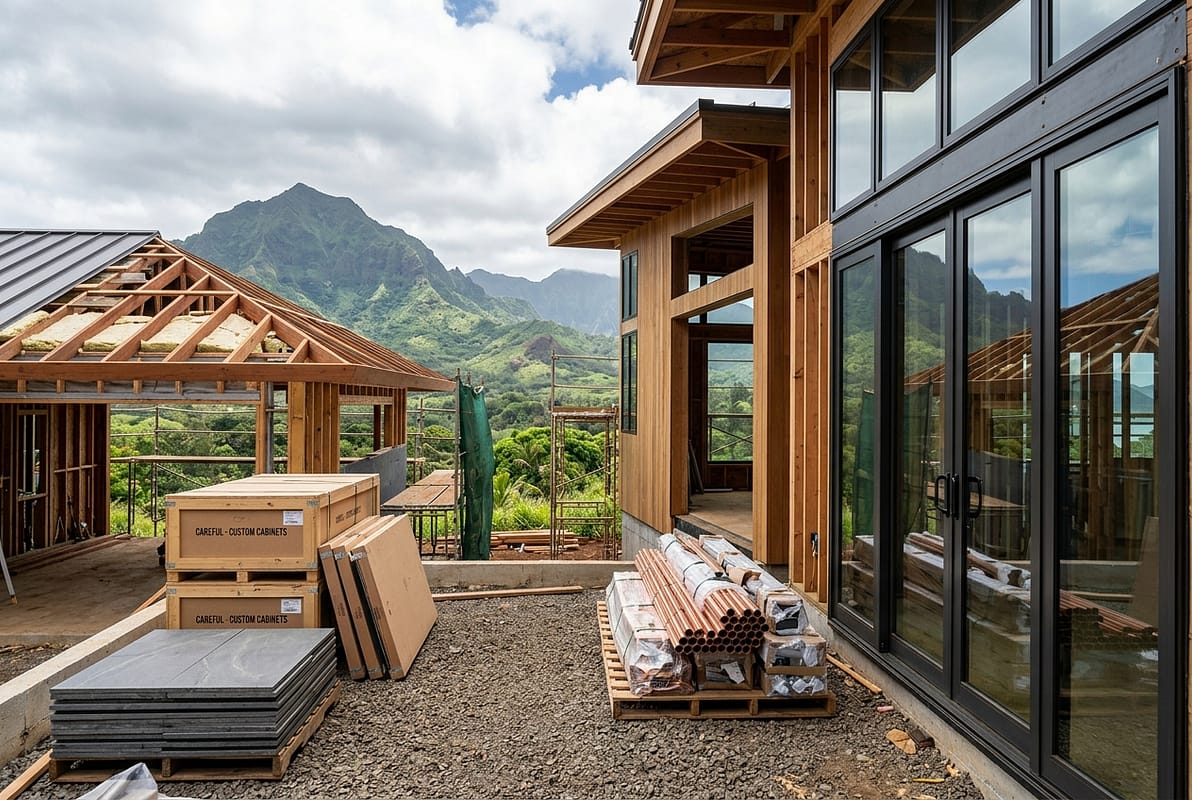
1. Custom Windows & Doors (18-22 Weeks)
This is, and always has been, the number one item on the list of long-lead items Hawaii. The reason is threefold. First, almost every window in a new custom home is a non-standard size, requiring custom manufacturing. Second, Hawaii’s building codes are very specific. This is especially true in coastal and high-wind zones, such as the North Shore or Hawaii Kai. They demand specific performance ratings for hurricane resistance. For example, a recent DPP code interpretation now requires impact-rated glazing for many new builds, adding 25% to the cost and four weeks to the custom windows lead time. Third, specialized coatings are essential for longevity to resist the corrosive salt air—another custom step in the production line.
The process for brands like Fleetwood, LaCantina, or even high-end Andersen series looks like this:
- Finalize window schedule with architect (1-2 weeks post-permit).
- Submit for shop drawings from the manufacturer (2-3 weeks).
- Architect and our team review and approve shop drawings (1 week).
- We release the order to the factory for production (10-12 weeks).
- The factory crates and ships windows to a West Coast port (1 week).
- Ocean freight, unloading at Honolulu Harbor, and delivery to your Oahu site (4-5 weeks).
As you can see, the weeks add up quickly. We must order the window and door package the very day the permit is issued. This ensures they arrive on site right as we complete framing. A delay in these specific long-lead items Hawaii means the entire house sits open to the elements, stopping all interior work cold. For a deeper dive into local requirements, our guide on the Hawaii hurricane window code is essential reading.
2. Custom Cabinetry (16-20 Weeks)
Whether you’re choosing a high-end mainland brand like Crystal or Plato, or working with a local custom shop in Kalihi, the timeline for cabinetry is significant. The bottleneck is rarely the assembly itself; it’s the detailed design process and the procurement of specific materials and finishes. This process is similar to what we do for windows. It involves a meticulous back-and-forth with shop drawings. We ensure every drawer, door, and appliance panel is perfect. This happens before a single piece of wood is cut. For mainland brands, the 16-20 week lead time is standard; for neighbor islands, that can easily stretch to 24 weeks. This is a critical component of long-lead items Hawaii procurement.
For example, let’s consider a full kitchen and three bathrooms in a new Kapolei home. After our team takes final field measurements post-framing, the cabinet maker needs 3-4 weeks to produce detailed shop drawings. The homeowner, interior designer, and our team then review these drawings. This often involves a revision or two. That process can take another 2 weeks. Only then does the order go into their production queue, which can be 8-10 weeks long. Finally, add the 4-week shipping time for mainland cabinets. It’s a solid four to five-month process from start to finish. This is why we must finalize all your appliance models. This needs to happen before the cabinet order can even be placed.
3. PV Battery Systems (16-20 Weeks)
With Hawaii’s high electricity costs and HECO’s Battery Bonus program driving demand, nearly every new build or major renovation now includes a solar PV system with battery storage. This has created a huge demand surge for systems like the Tesla Powerwall, Enphase IQ Battery, and SolarEdge Energy Bank. These are complex electronic systems with their own global supply chain challenges, particularly for the battery cells themselves. Distributors do not stock them in large quantities in Hawaii, making them key long-lead items Hawaii.
Ordering a multi-battery system for a Mililani home can easily have a 16-20 week lead time. This timeframe starts from placing the deposit with the distributor. It lasts until the units finally arrive on island. We must place this order early in the process and coordinate closely with our licensed electrical subcontractor. They need to schedule their rough-in work. It must align with our framing progress. Then, they plan their final installation and commissioning months later. This occurs right after the house is powered up. The availability of these systems directly impacts your project timeline. It also affects when you can get your final electrical inspection. Lastly, it impacts when you receive permission to operate from HECO.
4. High-End Appliances (12-18 Weeks)
If your project includes a professional-grade appliance package—think Sub-Zero refrigerators, Wolf ranges, or Miele dishwashers—expect a long wait. Manufacturers often build these appliances, especially panel-ready models that integrate seamlessly with your cabinetry, to order. A client for a Diamond Head renovation recently wanted a specific 48-inch Wolf dual-fuel range. The factory lead time alone was 14 weeks. This was before shipping could even begin. Planning for these appliance long-lead items Hawaii is essential.
The key here is coordination. We need the exact specification sheets for every single appliance *before* we can even finalize the cabinet shop drawings. The cabinet maker needs to know the precise rough opening dimensions, utility connection points, and panel requirements. A delay in selecting your refrigerator can cause a cascading delay for your entire kitchen. We advise clients to make their appliance selections during the architectural design phase, well before we ever break ground, to prevent these types of delays in the construction procurement Hawaii process.
5. Specialty Flooring & Tile (10-14 Weeks)
While basic ceramic tile or luxury vinyl plank (LVP) is often available locally from distributors in Mapunapuna, many custom homes feature specialty Hawaii building materials that must be sourced from off-island. This could be large-format Italian porcelain, handmade Moroccan zellige tile, or wide-plank engineered European oak flooring. These materials have their own manufacturing timelines and, of course, the long boat ride to Hawaii.
On a recent Kailua project, the homeowner selected a beautiful patterned cement tile for their entryway from a small company in California. The production time was 8 weeks, plus 4 weeks for shipping. That’s a three-month wait for a relatively small but critical design element. We had to carefully schedule the installation to ensure it didn’t hold up the baseboard and door casing installers. It’s crucial to order enough material, including a 15% overage for cuts and waste, because getting a few extra boxes of these long-lead items Hawaii can take just as long as the initial order.
6. Engineered Roof Trusses (10-12 Weeks)
For homes with complex rooflines, vaulted ceilings, or long spans, we use engineered wood trusses. These are custom-designed by an engineer and fabricated off-site in a controlled environment. They are a critical path item for us. Until the trusses are manufactured, delivered, and installed, you cannot begin roofing. You also cannot dry in the house. The process begins once we pour the foundation and have confirmed wall plate dimensions. The truss manufacturer’s engineer designs the system, which our project structural engineer must then review and approve. Only then does fabrication begin. The entire cycle, from design to delivery at a job site in Waialua, is a solid 10-12 week process for these essential long-lead items Hawaii.
7. Custom Countertops (8-10 weeks after cabinet install)
This one surprises people because the material itself—a slab of quartzite or marble—might be in stock at a local stone yard like Polycor or TGM. The long lead time here is not for the material itself. Instead, it is for the fabrication and installation process. This happens *after* another long-lead item, the cabinets, is already in place. It’s a sequential challenge. Countertop fabricators cannot create a template until the base cabinets are fully installed, perfectly level, and secured. Once they take those digital measurements, their own shop backlog is typically 2-4 weeks. Add in the time it takes to get on their templating schedule. The total time from cabinet installation to a functional countertop can then easily be 8 weeks or more. This is a sequential delay our team must build into every kitchen and bathroom remodel schedule.
When Should You Order Long-Lead Items for Your Project?
The answer is unequivocal: we place orders for the most critical long-lead items Hawaii the very same week your building permit is issued by the Honolulu Department of Planning and Permitting (DPP). This moment is the official starting gun for the entire construction phase, and procurement is the first and most important race.
According to the DPP’s Q3 2026 performance reports, review times are staggering. The average review time for a new single-family home on Oahu is now 10-12 months.[2] During this long waiting period, our team works with you to finalize every selection—from the exact model of window to the finish on the cabinet hardware. We gather quotes, prepare purchase orders, and get everything staged. The moment we receive that permit card, we have you sign off on the orders and immediately send deposits to the vendors. There is absolutely no time to waste.
The Critical Link Between Permits and Purchases
Why not order before the permit is issued? There are two primary reasons our team advises against it:
- Financial Risk: Construction lenders will not release funds for material purchases until a permit is secured. Ordering materials beforehand requires homeowners to pay large, non-refundable deposits. These are often 50% or more, totaling tens of thousands of dollars. They must pay entirely out of pocket. There is no guarantee the permit will be approved as-is.
- Plan Changes: The DPP review process can sometimes require changes to the architectural plans. A planner might require a window to be moved or a wall shifted, which would render any pre-ordered custom materials useless. The risk of wasting a $40,000 window deposit is simply too high.
The permit is the crucial link; it signifies that the plans are approved and financing can be released, making it the one and only responsible time to kick off the procurement process for all long-lead items Hawaii. To understand this waiting game better, our guide to Oahu Pre-Construction Strategy details how to use that permit time effectively.
How Do You Financially Plan for Long-Lead Item Deposits?
Financially preparing for the procurement phase is a critical step in your project’s pre-construction planning. The deposits for long-lead items Hawaii represent a significant, front-loaded expense that occurs right at the beginning of the build. It’s not uncommon for deposits on the window, cabinet, and appliance packages for a new custom home. These can easily total over $100,000.
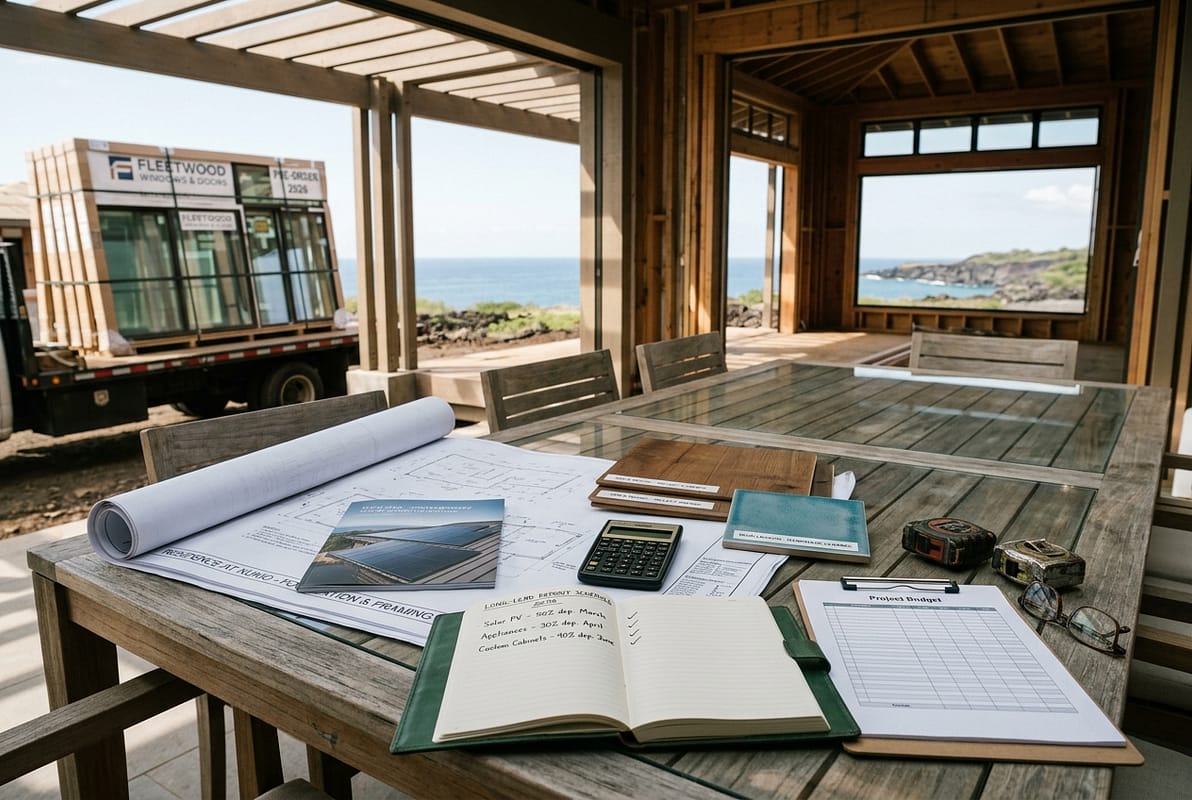
Most manufacturers and suppliers require a 50% non-refundable deposit to begin custom fabrication. This secures your place in their production schedule and allows them to order the raw materials. The remaining 50% is typically due when the items are ready to ship from their facility. Here’s how our team helps our clients manage this:
- Detailed Budgeting: During the pre-construction phase, we develop a line-item budget that specifically calls out the cost and deposit amount for each long-lead item. This becomes part of the financial package you submit to your lender.
- Draw Schedule Coordination: We work with your bank to structure the construction loan draw schedule so that the very first draw, released after the permit is issued and the loan closes, is dedicated almost entirely to funding these material deposits.
- Contingency Planning: Given ongoing price volatility and the potential for shipping surcharges, it’s more important than ever to have a healthy contingency fund. Most local Hawaii lenders now explicitly require homeowners to hold a contingency fund. This fund must be at least 25% of the construction cost. It covers potential overages and delays. This is a critical financial safeguard for all long-lead items Hawaii.
Coordinating Deposits with Your Construction Loan Draw
This detailed financial planning ensures that as soon as the permit is in hand, we have the capital ready to deploy. Hesitation at this stage can add months to the final timeline. Proper financial readiness is a cornerstone of effective construction procurement Hawaii. We make sure the loan documents align perfectly with the procurement schedule, preventing cash flow issues that could stall orders.
How Do Neighbor Island Logistics Affect Timelines and Costs?
Building on Maui, Kauai, or the Big Island adds a minimum of 4 weeks to any project. It also adds a 12-15% cost premium. This is due to inter-island freight and the double-handling of materials. Oahu benefits from Honolulu Harbor. It is the main entry point for goods. However, projects on other islands face an extra logistical hurdle. This adds significant time and expense to every single long-lead item.
Here’s the reality of the neighbor island shipping costs and timeline impacts:
- Additional Time: We automatically add a minimum of 4 weeks to any lead time quoted for Oahu. A container of windows, for example, arrives in Honolulu. It must be unloaded and processed. Then, it is booked on a Young Brothers barge. This sends it on its trip to Kahului or Nawiliwili. Weather or barge availability can delay this process, making the timeline for neighbor island long-lead items Hawaii even more challenging.
- Increased Cost: A recent analysis in Pacific Business News noted that general contractors now quote neighbor island projects with a 12-15% premium over Oahu projects.[3] This premium directly covers inter-island freight, the need for more robust crating, and often the cost of housing skilled labor crews flown in for specialized installations.
- Higher Risk of Damage: Every time a package is moved, there’s a risk of damage. A single cracked custom window has to be re-ordered. This can set a Maui project back five months. We wait for just one replacement piece. This is the stark reality of island logistics.
Mitigating Risk and Damage in Inter-Island Transit
Our team mitigates this by working with vendors who specialize in crating for inter-island transit and by having our neighbor island representative inspect materials the moment they arrive at the port. For our neighbor island clients, we build these extended timelines and costs for all long-lead items Hawaii into the project plan from day one. Transparent communication and meticulous tracking are essential. For a deeper look at these expenses, our guide on Neighbor Island Construction Costs breaks down the numbers.
How Does Procurement Affect Your Subcontractor Schedule?
The procurement schedule is the absolute master of the subcontractor schedule. Our project managers must book key trades like plumbers and electricians months in advance. We align these bookings with the arrival dates of critical materials. Effective construction project management Hawaii is like conducting an orchestra; each trade is a different section, and the arrival of long-lead items Hawaii is the sheet music. We can’t have them show up to an empty stage.
Here’s how it works in practice:
- Windows Set the Pace: The Estimated Time of Arrival (ETA) for the window package is one of the most critical dates on our calendar. Once we have a firm delivery date, we can schedule our exterior sheathing, waterproofing, and roofing teams. This allows us to get the house “dried-in” immediately after the windows are installed. Only then can we safely start interior work like insulation and drywall.
- Cabinets Trigger the Finishers: The arrival of kitchen and bath cabinets is the next major milestone. This date allows us to schedule the countertop fabricator for templating. It also lets us schedule the plumber for sink and faucet rough-ins. We also schedule the electrician for under-cabinet lighting.
- Booking in Advance: In Hawaii’s tight labor market, the best subcontractors are booked months out. The Hawaii Contractors Association’s 2026 survey confirmed that securing licensed electricians and HVAC specialists requires booking them 3-4 months in advance. Our detailed procurement schedule, with its clear ETAs for all long-lead items Hawaii, allows us to secure these key trades and lock them into a reliable start date. Without it, we’d lose our spot in their queue.
The Domino Effect: Aligning Trades with Material Landings
The entire construction timeline is a sequence of dependencies. The materials must arrive in the correct order, at the correct time, to allow each subcontractor to perform their work efficiently. A well-managed procurement plan is the backbone of a schedule that actually works. If the Fleetwood sliding doors are stuck in port for three weeks, that doesn’t just delay the door installers. It delays our flooring team. They can’t install wood floors in an unsecure house. It also delays the drywall team. They can’t hang board in a space exposed to moisture. And it delays the painters. This cascade of delays is what turns a 12-month build into an 18-month ordeal. Proactive management of long-lead items Hawaii is the only way to prevent it.
What this means for Hawaii homeowners
Navigating the world of long-lead items Hawaii can feel daunting, but it really boils down to two things: early planning and decisive action. Your role as the homeowner is most critical during the design and permitting phase—the long, quiet period before construction begins. Being prepared is the best way to ensure a smooth process.
Your Pre-Construction Procurement Checklist
Here is your actionable checklist for success:
- Finalize Selections Early. Use the 10-12 month DPP permit review period to make every single design decision. Work with your architect and our team to choose your window styles, cabinet layouts, appliance models, and tile. Indecision during this phase is the only thing you can fully control; eliminate it. This is your chance to get ahead of the timeline for long-lead items Hawaii.
- Embrace a ‘No Changes’ Mindset. Once our team places orders for custom items, any change—even a small one—can be catastrophic to the schedule and budget. Changing the size of a window after we’ve ordered it isn’t possible. Changing your mind on a cabinet finish might mean forfeiting your 50% deposit and starting the 16-week clock all over again.
- Trust the Process. Weeks might go by after groundbreaking where it seems like little is happening on site. Understand that our team is intensely managing logistics behind the scenes. We are tracking shipments. We coordinate with freight forwarders. Our team aligns subcontractor schedules for the moment materials arrive. This logistical work is just as critical as pouring concrete.
- Fund Your Contingency. That 25% contingency fund required by lenders isn’t just a suggestion; it’s a vital safety net. It provides a buffer to absorb unexpected shipping cost increases or material price hikes. It can also pay to air-freight a critical replacement part. This helps us avoid a multi-week delay.
Ultimately, understanding and preparing for these procurement realities transforms potential frustration. It creates a smooth, well-executed project phase. This sets the stage for a successful build.
Frequently Asked Questions
What’s the single biggest cause of delay for long-lead items in Hawaii?
In 2026, the biggest and most unpredictable cause of delay remains West Coast port congestion and ocean freight logistics. Even after a manufacturer finishes an item, it can sit at a port in California. It waits there for weeks. This wait is for a container and a spot on a vessel. This is the one part of the timeline where we have the least control, which is why our team tracks shipments daily and builds buffer time into our schedules for all long-lead items Hawaii.
Can I order materials myself to save money?
We strongly advise against this. While it might seem cheaper upfront, you become responsible for logistics, freight, insurance, and warehousing. If an item arrives damaged, you have to manage the claim, which can be a nightmare. Most importantly, it creates a break in the chain of liability. If we don’t procure the item, we cannot warranty its installation. This can also cause significant issues with your construction lender.
How much is the typical deposit for custom windows in Hawaii?
For a custom window and door package, expect a 50% non-refundable deposit. For a 2,500 sq. ft. new home in Kailua, the window package might be $80,000 to $120,000. This means a deposit of $40,000 to $60,000 is required the day the permit is issued to start the 22-week production clock for these essential long-lead items Hawaii.
Does the Honolulu DPP permit delay affect material ordering?
Yes, profoundly. The 10-12 month average wait for a new build permit creates a mandatory waiting period. Our team cannot safely order any long-lead items Hawaii until the permit is in hand because the DPP could require plan changes. This means the 16-22 week procurement timeline begins *after* the year-long permit wait, extending the total project timeline significantly.
What happens if a long-lead item arrives damaged?
If an item our team procured arrives damaged, we handle it immediately. We document the damage, file a claim with the freight carrier and/or manufacturer, and expedite a replacement order. This is a worst-case scenario, as a replacement custom item often goes to the back of the production line, potentially starting the long lead-time clock all over again for these long-lead items Hawaii. This is a key risk we manage.
How do you track all these long-lead items for a Hawaii project?
Our team uses dedicated construction project management software, like Procore, for every build. This creates a detailed procurement log that tracks each of the long-lead items Hawaii from purchase order to production, shipping, and final delivery. This gives our clients real-time visibility. It allows us to proactively manage the schedule. We can also anticipate delays before they impact work on site.
Are there any long-lead items with improving timelines in 2026?
For the most part, custom items remain challenging. However, we have seen some improvement for standard-sized, non-custom appliances. We have also seen it for certain Luxury Vinyl Plank (LVP) flooring. Distributors are increasing their local inventory for common sizes and finishes. However, anything custom or high-end still qualifies as one of the major long-lead items Hawaii and requires the same rigorous planning and extended timeline.
Master Your Project with Proactive Procurement
The success of your Hawaii home construction project hinges on a masterfully executed procurement strategy. It’s a complex dance of timing, logistics, and communication that begins months before the first foundation is poured. Getting it right prevents delays, controls costs, and ensures a smooth workflow for the entire construction team managing your list of long-lead items Hawaii.
At Warrior Construction, this proactive management is the cornerstone of our process. We don’t just build homes; we build timelines and logistical plans that work in the real world of Hawaii construction. If you’re planning a new build or major renovation and want a partner who understands how to navigate these challenges, let’s talk.
Our Pre-Construction Planning services are designed to tackle these issues head-on, ensuring every selection is made and every material is ordered to keep your project on track from Day One. Reach out to our team to schedule a consultation and learn how we can bring predictability to your project.


