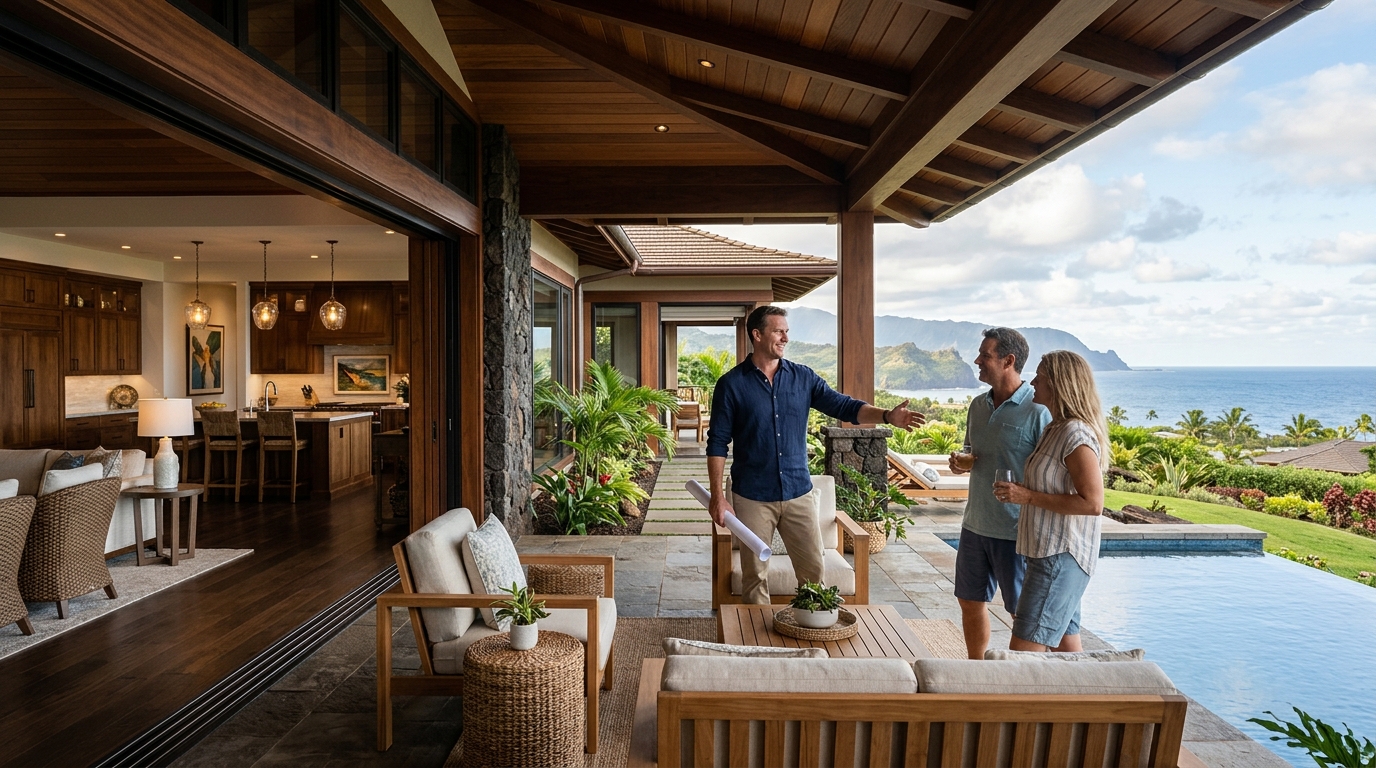
Building a custom home in Kapa’a, Kaua’i in 2026 is a significant undertaking, requiring a deep understanding of local conditions and a realistic budget. From our 20+ years of experience on the ground, a well-managed project costs between $550 and $800 per square foot for construction and typically takes 18 to 24 months from the first architectural sketch to moving in. As a premier custom home builder Kapa’a trusts, our team at Warrior Construction (License BC-34373) has navigated every challenge the Garden Isle can present, from navigating the Kaua’i County permitting process to sourcing materials that withstand the east side’s salt-laden trade winds.
This isn’t like building on the mainland. Here, every choice—from the grade of stainless steel fasteners to the type of window flashing—has long-term consequences. The unique combination of heavy rainfall, corrosive salt air, and a challenging supply chain means you need a partner who has seen it all. Our goal is to demystify this process for you. We’ll walk you through the real costs, the actual timelines you can expect in 2026, the specific permits required by Kaua’i County, and the critical design considerations that make a home last for generations on the Coconut Coast. Furthermore, we will show you how to vet and select a contractor who can actually deliver on their promises. This is your guide to getting it right the first time.
Why Kapa’a Homeowners Trust Warrior Construction for Custom Home Builder
When you decide to build a home in Kapa’a, you’re not just hiring a crew to stack lumber; you’re choosing a partner to manage a complex, multi-year investment on an island with its own set of rules. Homeowners trust Warrior Construction because we are a licensed, local general contractor (BC-34373) with decades of specific experience building on Kaua’i. We understand the nuances that mainland or even Oahu-based builders often overlook. For example, the microclimate along the Kapa’a coastline is intensely corrosive. We’ve seen metal roof fasteners start to rust in under five years because a contractor tried to save a few thousand dollars by using galvanized steel instead of 316-grade stainless steel. That’s a mistake we simply don’t make.
Our experience extends deep into the local landscape and regulatory environment. We have long-standing relationships with Kaua’i’s best architects, engineers, and surveyors who know the land and the local planning department’s expectations. On a recent project in the Wailua Homesteads, our initial site survey revealed a potential drainage issue that wasn’t immediately obvious. Because we anticipated the County’s scrutiny on water runoff plans, we engaged a civil engineer early in the design phase. As a result, we developed a comprehensive grading and drainage plan that was approved on the first submission, saving the client at least three months of delays and redesign fees. It’s this proactive, on-the-ground knowledge that separates a seasoned home builder in Kapa’a from the rest.
Most importantly, our entire process is built on transparency. We operate on an open-book basis, meaning you see every invoice and every bid. We provide detailed monthly reports and hold regular site meetings to ensure you are always in control of your budget and schedule. Building a custom home is a long journey, and clear communication is the foundation of a successful project. Our team is committed to being your advocate from start to finish, ensuring your vision for a Kaua’i home becomes a reality, built to last.
What Does Custom Home Builder Cost in Kapa’a?
For a mid-to-high-end custom home in Kapa’a, you should budget between $550 and $800 per square foot for vertical construction costs in 2026. To be clear, this figure covers the structure itself—from foundation to finishes—but does not include the cost of the land, architectural and engineering fees, landscaping, a pool, or furniture. These other costs can add another 30-50% to your total project investment. We believe in giving clients real numbers, not vague ranges, so you can plan effectively from day one.
Here’s a realistic breakdown of where the money goes for a hypothetical 2,500-square-foot custom home in Kapa’a:
- Land Acquisition: Highly variable, but a good building lot in the Kapa’a area can easily range from $600,000 to over $1.5 million.
- Soft Costs (15-25% of Construction): These are the pre-construction expenses.
- Architectural & Engineering Fees: $80,000 – $150,000
- Permit & County Fees: $25,000 – $40,000
- Surveys (Topographical, Geotechnical): $10,000 – $20,000
- Financing & Insurance: Varies based on loan structure
- Hard Costs (Construction): 2,500 sq ft @ an average of $675/sq ft = $1,687,500
- Site Work & Landscaping:
- Grading, Utilities, Driveway: $75,000 – $125,000
- Landscaping & Irrigation: $50,000 – $100,000+
- Pool/Spa: $100,000 – $200,000+
- Contingency Fund (10-15% of Hard Costs): $168,750 – $253,125. This is non-negotiable for unforeseen conditions or design upgrades.
So, the total estimated project cost for this 2,500 sq ft home, excluding land, would realistically fall in the $2.1 million to $2.5 million range. Why are costs higher on Kaua’i? First, every single component—from lumber and concrete to appliances and tile—must be shipped across the ocean, then barged from Honolulu. This adds a significant logistics premium. Second, the available pool of skilled labor is smaller than on Oahu, leading to higher wages. Finally, building to withstand our hurricane-force winds and corrosive salt air requires more expensive materials and more robust construction methods, which adds to the bottom line for any reputable home builder Kapa’a.
How Long Does a Custom Home Builder Take in Kapa’a?
A realistic timeline for building a custom home in Kapa’a, from your first meeting with an architect to receiving the keys, is 18 to 24 months in 2026. Anyone promising a 12-month turnaround for a true custom project is either inexperienced with Kaua’i’s realities or not being upfront with you. The process is lengthy, with the permitting phase often being the most unpredictable and time-consuming part. Our team manages schedules proactively, but it’s crucial for homeowners to understand the distinct phases involved.
Here is a step-by-step timeline you can expect for a new home construction Kapa’a project:
- Phase 1: Design and Planning (4-6 Months): This is the creative phase where your vision takes shape. It involves selecting your architect and builder, developing initial concepts (schematic design), refining the floor plans and elevations (design development), and finally, producing detailed construction documents with all material specifications.
- Phase 2: Permitting with Kaua’i County (6-10 Months): This is the biggest hurdle. Once plans are complete, they are submitted to the Kaua’i County Planning Department and Department of Public Works[1]. The plans go through multiple reviews, including structural, zoning, wastewater, and sometimes shoreline management. Each review can take weeks or months, and any requests for information or revisions will restart the clock on that department’s review period. Having a builder who knows the local code and the reviewers’ common concerns is invaluable here.
- Phase 3: Final Bidding and Financing (1-2 Months): While permits are in process, we finalize bids from our subcontractors and suppliers. This allows us to lock in a final construction cost for you to present to your lender for loan closing.
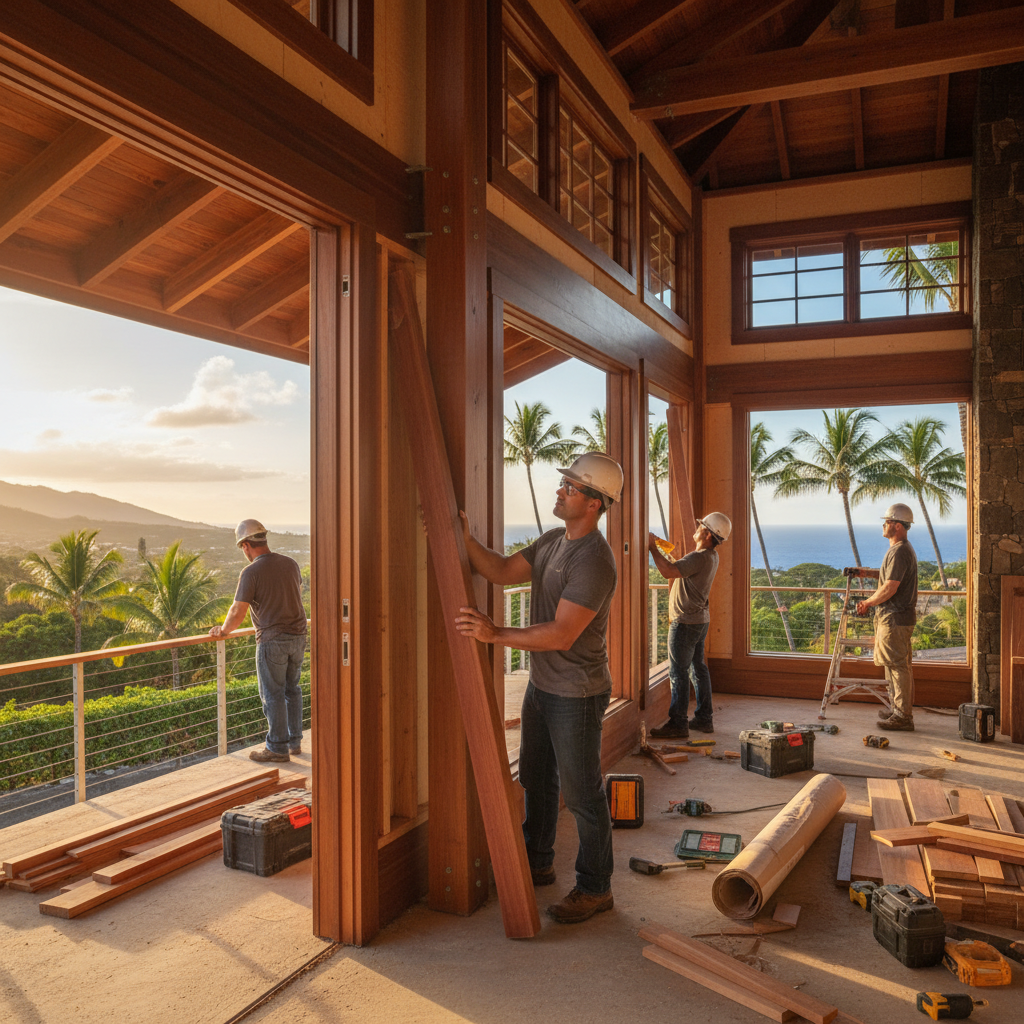
- Phase 4: Construction (10-14 Months): Once the permit is in hand, we break ground. This phase includes site preparation, foundation, framing, roofing, installing windows and doors, running electrical and plumbing (rough-in), drywall, and then all the finish work like flooring, cabinets, tile, and painting.
- Phase 5: Final Inspections, Landscaping, and Move-In (1 Month): The final stretch involves passing all county inspections, completing the landscaping, final cleaning, and conducting a detailed punch-list walk-through with you before handing over the keys.
A critical factor that can extend this timeline is material availability. On a recent luxury home we built in Poipu, the custom, hurricane-rated sliding glass door system had a 26-week lead time from the manufacturer. We ordered it the day the foundation was poured to ensure it arrived on schedule. Anticipating these long-lead items is a key part of our project management process to keep your project moving forward smoothly.
What Permits Do You Need for Custom Home Builder in Kapa’a?
Navigating the permitting process for a custom home in Kapa’a requires submitting a comprehensive package to various divisions within the Kaua’i County government. The primary approval you need is the Building Permit, issued by the Department of Public Works, but achieving that requires sign-offs from several other agencies. A seasoned local contractor manages this entire complex process on your behalf, ensuring all paperwork is filed correctly to minimize delays.
Here are the essential permits and reviews your project will likely undergo:
- Building Permit: This is the master permit from the Building Division. The application must include complete architectural plans, structural engineering calculations (stamped by a Hawaii-licensed engineer), and details on how the home will meet current building, fire, and hurricane codes.
- Zoning Clearance: The Planning Department reviews your plans to ensure they comply with all zoning regulations for your specific parcel, including setbacks from property lines, building height restrictions, and lot coverage limits.
- Grading and Grubbing Permit: If you are moving a significant amount of dirt to prepare your site, a separate permit is required. This involves a site plan showing existing and proposed contours and an erosion control plan.
- Electrical and Plumbing Permits: While part of the overall building permit process, these are reviewed by specialized inspectors. The plans must be drafted by licensed professionals.
- Wastewater System Approval: You must show how the home will connect to the county sewer system or, if in a rural area, submit plans for a septic system that must be approved by the Department of Health.
- Shoreline Management Area (SMA) Permit: If your property is near the coast, you will fall within the SMA. This triggers a much higher level of scrutiny and may require additional studies and a more extensive permit application to assess the project’s impact on coastal resources.
The biggest mistake we see homeowners or inexperienced builders make is submitting an incomplete package. The county’s plan reviewers are meticulous. If a single required calculation or form is missing, the entire application is rejected and sent back to the end of the line. Our team conducts a thorough pre-submission review to catch these issues before they cause months of delay. We know what the plan examiners are looking for, and we make sure the package is complete and clear on the first go.
Kapa’a-Specific Considerations: Climate, Materials, Regulations
Building in Kapa’a is not like building anywhere else, not even like building in Kapolei or Kailua. The environment on Kaua’i’s east side is uniquely demanding, and a successful home must be designed and constructed specifically for these conditions. Ignoring these local factors leads to premature aging, constant maintenance headaches, and costly repairs down the road.
Climate and Materials
Kapa’a sits directly in the path of the trade winds, which carry a constant, fine mist of corrosive salt air. This is the single biggest threat to your home’s longevity. Here’s how our team counters it:
- Fasteners and Hardware: We exclusively specify 316-grade (marine grade) stainless steel for all exterior fasteners, screws, nails, and structural connectors. Using anything less, like 304 stainless or hot-dip galvanized, is asking for rust streaks and structural weakness within a decade.
- Windows and Doors: We recommend fiberglass or vinyl window frames over aluminum, which can pit and corrode. All window and door packages must be hurricane-impact rated and installed with painstaking attention to waterproofing, using high-quality flashing tapes and sealants.
- Roofing: While architectural shingles are common on the mainland, they have a shorter lifespan here. We often guide clients toward standing seam metal roofs with a Kynar 500 paint finish or Monier concrete roof tiles, both of which offer superior resistance to wind, sun, and salt.
- Exterior Finishes: A high-quality, 100% acrylic paint is a must. For homes with lanais and decking, we recommend resilient hardwoods like Ipe or composite decking materials that won’t rot, warp, or be targeted by termites.
Regulations and Site Conditions
Beyond the climate, Kaua’i has its own set of rules and land characteristics that a builder must master:
- Hurricane Code: Ever since Hurricane Iniki devastated the island in 1992, Kaua’i has had some of the most stringent hurricane-resilience building codes in the nation. Every home we build incorporates a continuous load path, with steel straps and connectors tying the roof structure all the way down to the foundation. This is not an optional upgrade; it is a requirement for survival.
- Red Dirt and Drainage: The iconic red volcanic soil of Kaua’i can be tricky. Some areas have expansive clay, while others have drainage issues during heavy rains. A geotechnical report is often the first thing we recommend. This tells us what kind of foundation is needed and informs the site’s grading and drainage plan to keep water away from the home.
- Height and View Planes: Kaua’i is fiercely protective of its natural beauty. Building height restrictions are strictly enforced, especially near the coast, to protect public view planes. A good design works with the land’s topography to maximize views without violating these important local ordinances. As a local luxury home builder Kapa’a, we are experts in designing homes that respect these regulations while delivering stunning results.
How to Choose the Right Custom Home Builder Contractor in Kapa’a
Selecting the right general contractor is the single most important decision you will make for your custom home project. The right partner will protect your investment, manage complexity, and deliver a high-quality home, while the wrong one can lead to budget overruns, endless delays, and defects. Here’s a checklist we recommend every potential homeowner use when vetting a builder in Kapa’a.
- Verify Their License and Insurance. This is non-negotiable. First, go to the Hawaii Department of Commerce and Consumer Affairs (DCCA) Professional & Vocational Licensing (PVL) website[2]. Use their public search tool to look up the contractor’s license number (for example, our is BC-34373). Ensure their license is current, active, and free of complaints. Next, ask for proof of General Liability insurance (we recommend at least a $2 million policy) and Worker’s Compensation insurance. Without these, you could be held liable for accidents on your property.
- Demand Kaua’i-Specific Experience. A contractor who primarily builds on Oahu or the mainland will not be prepared for Kaua’i’s unique supply chain, subcontractor market, and permitting quirks. Ask to see a portfolio of their completed projects specifically on Kaua’i. Better yet, ask for the addresses of a few homes they’ve built in the Kapa’a area so you can drive by and see the quality of their work firsthand.
- Interview Past Clients. A great builder will be happy to provide you with a list of recent client references. Don’t just ask if they were happy. Ask specific questions: How was the communication throughout the project? Did the builder provide clear and timely financial statements? How did they handle unexpected problems or changes? Were there any surprises with the final budget or timeline?
- Evaluate Their Communication and Professionalism. From the very first phone call, pay attention to how they operate. Do they respond to your inquiries promptly? Do they provide clear, detailed answers to your questions? The building process is long, and you will be in constant communication with your builder. You need a team that is organized, professional, and transparent.
- Insist on a Detailed, Transparent Bid. A one-page bid with a single number is a major red flag. A professional builder will provide a comprehensive proposal that breaks down the costs by construction phase (e.g., foundation, framing, electrical, finishes). It should clearly state what is included and, just as importantly, what is excluded. This level of detail is the foundation for a transparent financial relationship and helps prevent costly misunderstandings later on.
Real Kapa’a Custom Home Builder Project Example
To make these concepts concrete, let’s walk through a recent, albeit fictionalized, project our team completed that showcases the unique challenges and solutions involved in building a custom home in Kapa’a.
The Project: A 3,200 sq. ft. contemporary plantation-style home on a 3/4-acre sloping lot in the hills above Kapa’a town, designed for a family relocating from California.
The Vision: The clients wanted a home that blended indoor and outdoor living, maximized the stunning mauka-to-makai (mountain-to-ocean) views, and was built with durable, low-maintenance materials suited for Kaua’i’s climate.
The Challenge: The primary challenge was the site itself. The lot had a significant cross-slope and was located in an area known for heavy rainfall and potential soil erosion. The design, which featured large pocketing glass doors and a wide, wrap-around lanai, required meticulous structural engineering to meet hurricane code while maintaining the open, airy feel the clients desired. Furthermore, the clients were managing the project from afar, making clear, constant communication essential.
The Warrior Construction Solution:
- Pre-Construction: We engaged a geotechnical engineer before the architect even finalized the home’s placement. The soil report led us to design a stepped concrete foundation with deep footings and an extensive sub-surface drainage system to manage the heavy water flow during storms. This upfront investment in engineering prevented major potential issues with foundation stability and moisture intrusion.
- Material Selection: We worked with the clients to select materials for beauty and resilience. This included a commercial-grade standing seam metal roof, impact-rated Fleetwood door systems, and solid Ipe decking for the lanai. All exterior hardware, from the gate hinges to the lanai railing screws, was specified as 316 marine-grade stainless steel.
- Communication: We established a robust communication protocol. This included a dedicated project website with weekly progress photos, detailed monthly budget reports tracking every dollar spent, and bi-weekly video conference calls with the client, architect, and our project manager.
The Outcome:
- Final Construction Cost: $2.24 Million (3,200 sq ft @ $700/sq ft).
- Project Timeline: 23 months from initial design consultation to move-in. The permitting phase took 9 of those months.
- Result: A breathtaking home that perfectly captures the clients’ vision, is engineered to last for generations against the elements, and was delivered through a transparent and collaborative process. The clients felt connected and in control throughout the build, despite being thousands of miles away.
What this means for Hawaii homeowners
Embarking on a custom home build in Kapa’a is an exciting journey, but it requires a mindset grounded in the realities of building in paradise. Understanding these key principles from the start will save you time, money, and stress, ensuring your project is a success.
- Adjust Your Budget Expectations: Building on Kaua’i is fundamentally more expensive than on the mainland. Everything from labor to materials carries a premium due to shipping and logistics. Budget generously, and most importantly, hold a contingency fund of at least 10-15% of your construction cost in reserve. It is the best tool for handling the inevitable surprises that come with any custom project.
- Embrace “Island Time” (for Permitting): The one part of the process you cannot rush is the county permitting phase. It is bureaucratic, detailed, and slow. Work with a builder who has a proven track record of getting plans approved by the Kaua’i County Planning Department. Patience during this phase is not just a virtue; it’s a necessity.
- Prioritize Durability Over Flash: The Kapa’a climate is unforgiving. Investing in the right materials from the start—like stainless steel fasteners, robust waterproofing systems, and hurricane-rated windows—is far cheaper than replacing failing components in five to ten years. Listen to your builder’s recommendations on materials designed for a coastal, high-rainfall environment.
- Hire a True Local Expert: Your general contractor should be your expert guide. Their knowledge of Kaua’i’s specific building codes, their relationships with reliable local subcontractors, and their experience with the island’s unique logistical challenges are their most valuable assets. Choosing a builder with deep roots on Kaua’i is the best way to protect your investment.
Frequently Asked Questions About Custom Home Builder in Kapa’a
How much does it cost to build a custom home in Kapa’a in 2026?
In 2026, the construction cost for a mid-to-high-end custom home in Kapa’a typically ranges from $550 to $800 per square foot. This figure does not include the price of land, architectural design fees, permits, or landscaping. For a 2,500 sq. ft. home, this means a construction budget of approximately $1.4M to $2M, with total project costs often exceeding $2.5M when all other expenses are included.
What is the timeline for new home construction in Kapa’a?
A realistic timeline from initial architectural design to move-in is 18 to 24 months. This breaks down into roughly 4-6 months for design, 6-10 months for Kaua’i County permitting, and 10-14 months for the actual construction phase. The permitting stage is often the longest and most unpredictable part of the process.
Can I use an architect from the mainland for my Kaua’i home?
Yes, you can, but it is highly recommended that they partner with a local architect and a local general contractor. An off-island architect may not be familiar with Kaua’i’s specific building codes, hurricane requirements, and the nuances of designing for our tropical climate. A local team can ensure the design is both beautiful and buildable according to local regulations, which prevents costly redesigns and permit delays.
What’s the biggest mistake people make when building a custom home in Kapa’a?
The most common mistake is underestimating the impact of the salt air and humid climate. Homeowners may try to save money by choosing materials that are standard on the mainland, such as galvanized hardware or non-impact-rated windows. These choices lead to rapid deterioration, rust, and water intrusion, resulting in far more expensive repairs and maintenance down the road. Investing in durable, climate-appropriate materials from the start is crucial.
How does the cost of a luxury home builder Kapa’a differ from a standard build?
A luxury home builder in Kapa’a will typically work on projects costing $800 per square foot and up, sometimes exceeding $1,200/sq ft. The price difference comes from higher-end finishes (e.g., imported stone, custom millwork), more complex architectural designs, premium appliance and fixture packages, and integrated systems like home automation and extensive landscaping with features like infinity pools. The level of project management and attention to detail is also significantly higher.
Is it cheaper to build on Kaua’i than on Oahu?
Generally, no. While land might be slightly less expensive in some parts of Kaua’i compared to prime Honolulu real estate, construction costs are often higher. This is due to the added expense of shipping all materials from Honolulu to Kaua’i and a smaller pool of available skilled labor, which can drive up wages. The logistical complexity of building on a neighbor island adds a premium to the overall project cost.
How do you handle shipping delays for materials to Kaua’i?
We handle this proactively through meticulous planning and early procurement. As soon as the design is finalized, we identify all long-lead-time items like windows, custom cabinetry, and specialized roofing. We order these materials months in advance, often before we even break ground, to build a buffer into the schedule. Constant communication with our suppliers in Honolulu and on the mainland is key to tracking shipments and adjusting the construction schedule as needed.
Building your home in Kapa’a is a major investment, and it’s one you want to get right. It requires a contractor who not only knows how to build a beautiful house but how to build a house that belongs on Kaua’i—one that will stand strong against the elements for decades. At Warrior Construction, we bring that deep local expertise to every project.
If you’re ready to discuss your vision for a custom home on Kaua’i, our team is here to provide the realistic advice and transparent process you need. Explore our custom home building services and let’s start the conversation about making your dream a reality.