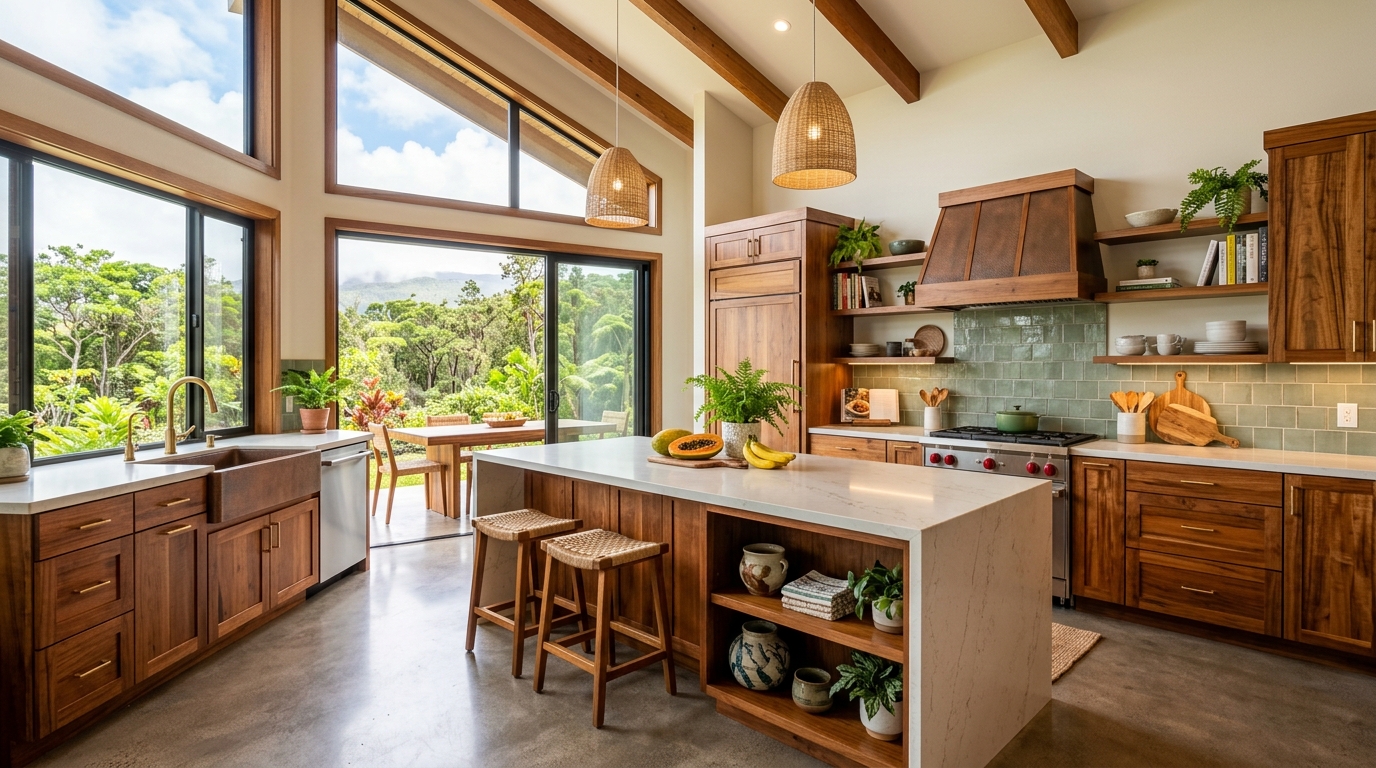
A full kitchen remodel in Volcano, Hawaii, for a standard 200-square-foot space will typically cost between $95,000 and $175,000 in 2026. The complete process, from initial design to final walkthrough, usually takes 5 to 8 months. These figures aren’t just numbers; they reflect the unique realities of building at elevation on the Big Island—from material logistics and shipping costs to designing for a cool, damp climate that demands specific construction techniques. Remodeling a kitchen here isn’t like doing it on the mainland, or even in Honolulu. It requires a deep understanding of local conditions, supply chains, and Hawaii County building codes.
At Warrior Construction, we’ve spent more than two decades managing projects across the islands, and we’ve learned that a successful kitchen remodel Volcano homeowners love is built on a foundation of realistic expectations and hyper-local expertise. It’s about more than just picking pretty cabinets; it’s about specifying marine-grade plywood boxes that won’t delaminate in the humidity, installing powerful ventilation to handle moisture, and planning for a shipping container of materials to arrive in Hilo weeks before demolition ever begins. This guide walks you through the nine most critical tips we share with our clients, covering everything from accurate budgeting to choosing materials that will stand up to the unique environment of Volcano.
Why Volcano Homeowners Trust Warrior Construction for Kitchen Remodel
Choosing a general contractor for your kitchen remodel is the single most important decision you’ll make. Here on the Big Island, and especially in a unique community like Volcano, you need more than just a builder; you need a logistics expert and a partner who understands the specific environmental challenges. Our team at Warrior Construction brings a statewide perspective with a deep appreciation for the nuances of neighbor island projects. Our Hawaii General Contractor license, BC-34373, is a testament to our long-standing commitment and qualification to build anywhere in the state.
What sets us apart is our hands-on experience with the Big Island’s distinct building environment. We’re not an Oahu-based company that occasionally flies over. We have established relationships with suppliers in both Hilo and Kona, which is critical for sourcing materials efficiently and managing costs. We know which vendors stock hurricane ties rated for this windward side and which ones can get us the specific mold-resistant drywall we need without a six-week wait. This network prevents the kind of delays that can derail a project timeline and budget.
Furthermore, navigating the Hawaii County Department of Public Works for permits is a different ballgame than dealing with Honolulu’s DPP. We understand the local submission requirements, the specific plan details the examiners look for, and how to coordinate inspections in a rural area. On a recent project in Puna, just down the mountain, we were able to get plans approved in 12 weeks because our architect knew exactly how the county wanted the seismic calculations presented for that specific lava zone. An off-island firm might have faced months of back-and-forth revisions. This local knowledge saves our clients time and money, turning a potentially stressful process into a well-managed one.
What Does Kitchen Remodel Cost in Volcano?
The most common question we get is about the bottom line: what is the real kitchen remodel cost volcano homeowners should expect in 2026? For a mid-range, 200-square-foot kitchen remodel in Volcano, a realistic budget is between $95,000 and $175,000. A high-end, larger kitchen with custom cabinetry, professional-grade appliances, and significant structural changes can easily exceed $250,000. These numbers often surprise homeowners who are used to mainland pricing, but they reflect the hard costs of building in a remote, high-elevation area of Hawaii.
Let’s break down where that money goes. This isn’t just about materials; it’s about the entire chain of events required to get them installed in your home.
- Design, Engineering, and Permitting: $8,000 – $18,000. This covers architectural plans, structural engineering if you’re moving walls, and the fees for submitting to and managing the process with Hawaii County.
- Cabinetry & Installation: $30,000 – $70,000. This is the largest part of the budget. Semi-custom cabinets from a brand like KraftMaid will be on the lower end, while fully custom koa or mango wood cabinets built by a local craftsman will be on the high end. We always recommend plywood box construction over particle board for Volcano’s damp climate.
- Countertops: $10,000 – $25,000. Quartz is the most popular choice for its durability and non-porous nature. Granite is another great option. The cost includes the material, fabrication on-island (usually in Hilo or Kona), and installation.
- Appliances: $15,000 – $40,000. This includes the refrigerator, range, dishwasher, microwave, and a high-CFM range hood (which is non-negotiable for moisture control). The price variation depends on the brand (e.g., GE vs. Sub-Zero/Wolf) and includes the significant cost of shipping and delivery to Volcano.
- Labor (Plumbing, Electrical, Framing, Tile, etc.): $35,000 – $60,000. This covers all the skilled trades. In Volcano, you’re often paying for travel time for specialized technicians coming from Hilo. This includes demolition, framing, new wiring to meet 2026 code, replumbing water and drain lines, drywall, painting, and flooring.
- Shipping & Logistics: This is often baked into material costs, but it’s a huge factor. A dedicated container from Honolulu to Hilo can run $3,000-$5,000. Less-than-container-load shipments add up quickly.
- Contingency Fund (15-20%): $14,000 – $35,000. We tell every client doing a kitchen renovation volcano project to have a 15% contingency, minimum. On neighbor islands, 20% is even safer. This covers unforeseen issues like discovering termite damage or rot once walls are opened, or a specific tile being backordered and needing to air-freight a replacement.
The key takeaway is that every single item, from a box of screws to a Sub-Zero refrigerator, has to travel across an ocean and then be trucked up a mountain. This baked-in cost, combined with a limited pool of skilled labor, is what defines the price of remodeling in paradise.
How Long Does a Kitchen Remodel Take in Volcano?
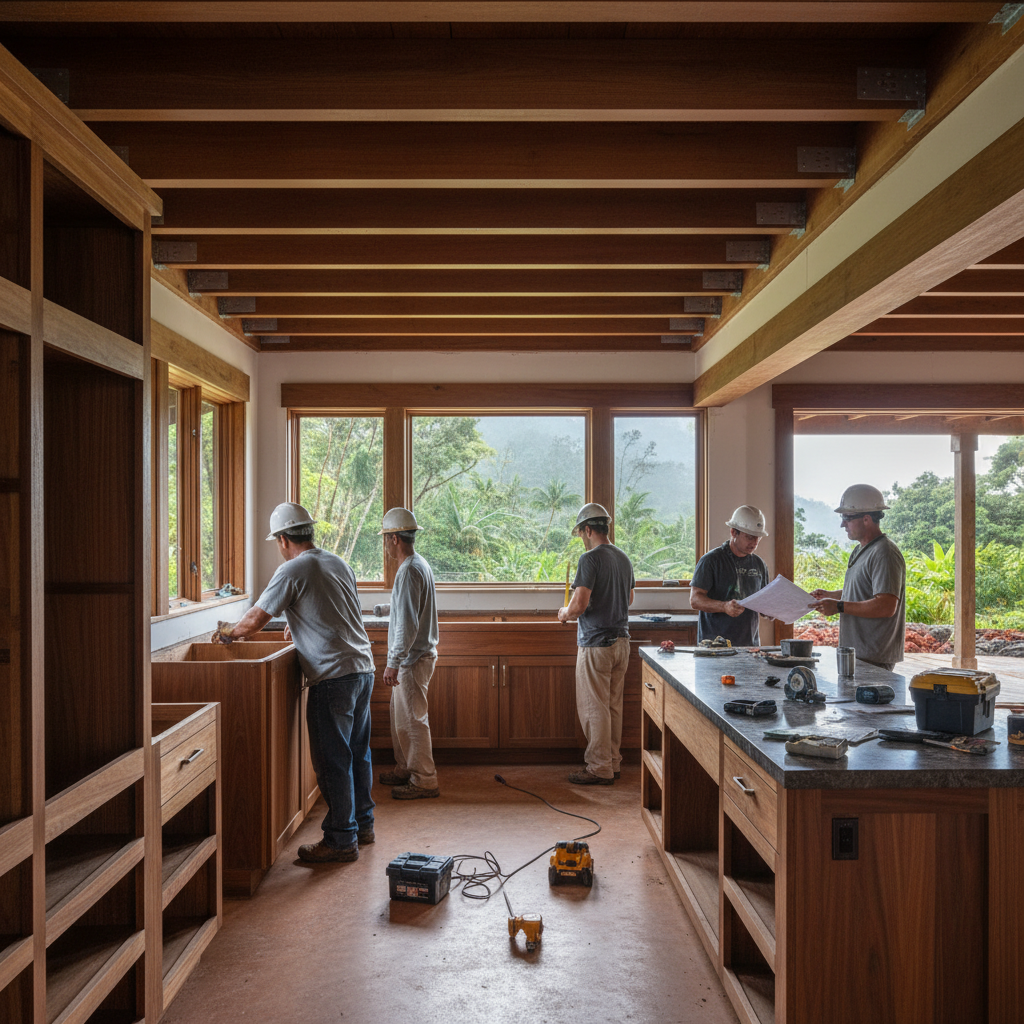
Patience is a virtue in Hawaii construction, and this is especially true for a kitchen remodel in Volcano. From our first conversation to you cooking your first meal, a realistic timeline is 5 to 8 months. The actual on-site construction is only one piece of this puzzle; the pre-construction phase is often the longest and most critical part. Rushing this stage is the number one mistake we see homeowners make, leading to costly changes and delays down the road.
Here’s a phase-by-phase breakdown of a typical 2026 project timeline:
- Phase 1: Design and Selections (4 – 8 weeks). This is where we work with you and an architect or designer to finalize the layout, cabinet styles, countertops, appliances, flooring, and lighting. Every single item must be selected and specified *before* we apply for a permit. Changing your mind about the refrigerator model after plans are submitted can trigger a revision process that adds months.
- Phase 2: Permitting with Hawaii County (8 – 16 weeks). Once the design is locked, we submit the architectural and structural plans to the Hawaii County Department of Public Works. Unlike Honolulu’s often year-long waits, the Big Island is generally faster, but it’s not instantaneous. The plans go through multiple reviews (zoning, building, electrical, plumbing). If the reviewer has questions, the clock stops until we provide answers. A clean, thorough submission is the key to a faster approval.
- Phase 3: Material Procurement and Shipping (6 – 12 weeks). This phase runs concurrently with permitting. The moment you sign off on the selections, we place the orders. Cabinets can take 8-12 weeks to be built and shipped. Appliances, especially high-end models, can have similar lead times. We consolidate everything possible in a warehouse on Oahu or the mainland and then ship it all at once in a container to Hilo. Nothing is worse than having a crew ready to work but the cabinets are still on a boat in the Pacific.
- Phase 4: Construction (8 – 14 weeks). This is the part everyone looks forward to. It begins only after the permit is in hand and all materials are on-site.
- Weeks 1-2: Demolition, site protection, and rough-in framing.
- Weeks 3-4: Rough-in plumbing, electrical, and HVAC. This is followed by the first major inspections.
- Weeks 5-7: Insulation, drywall installation, taping, and mudding.
- Weeks 8-9: Priming, painting, and flooring installation.
- Weeks 10-11: Cabinet installation and countertop templating.
- Weeks 12-13: Countertop installation, backsplash tiling, and final plumbing/electrical connections (sinks, faucets, lighting).
- Week 14: Appliance installation, final touch-ups, and final inspections.
As you can see, almost half the total project time is spent in planning and waiting for materials. A smooth project is a well-planned project.
What Permits Do You Need for Kitchen Remodel in Volcano?
For any significant kitchen remodel in Volcano, you absolutely need a building permit from the Hawaii County Department of Public Works (DPW). The idea that you can do major work without one is a myth that can lead to huge fines, stop-work orders, and problems when you eventually sell your home. The county’s goal is to ensure all work is done safely and to current building codes, which protects you and future owners.
So, what triggers the need for a permit? A good rule of thumb is that if you are changing anything inside the walls or altering the footprint of the kitchen, you need a permit. This includes:
- Moving or removing walls: Any structural change requires a permit and stamped engineering drawings.
- Altering electrical circuits: Adding new outlets for an island, installing new dedicated circuits for appliances, or moving light fixtures all require a permit and work by a licensed electrician.
- Changing plumbing locations: Moving a sink, dishwasher, or adding a pot filler is not a simple DIY job. It involves a plumbing permit to ensure proper drainage and venting.
- Replacing windows or exterior doors: This affects the building envelope and requires a permit to ensure proper waterproofing and adherence to hurricane code.
Cosmetic updates like painting, replacing a faucet in the same location, or swapping cabinet hardware generally do not require a permit. However, a full cabinet replacement often does because it involves disconnecting and reconnecting plumbing and electrical. It’s always best to assume you need one and let your licensed general contractor handle the determination.
The permit process on the Big Island involves submitting a full set of drawings prepared by a Hawaii-licensed architect or designer. We handle this entire process for our clients. We submit the application package to the DPW in Hilo and manage all communications with the plan reviewers. While it can feel slow, it’s a crucial quality control step. For perspective, the process is often more streamlined than on Oahu, where getting a permit through the Honolulu DPP[1] can be notoriously complex and lengthy. Having a contractor who knows the specific requirements and personnel at the Hawaii County offices is a major advantage.
Volcano-Specific Considerations: Climate, Materials, Regulations
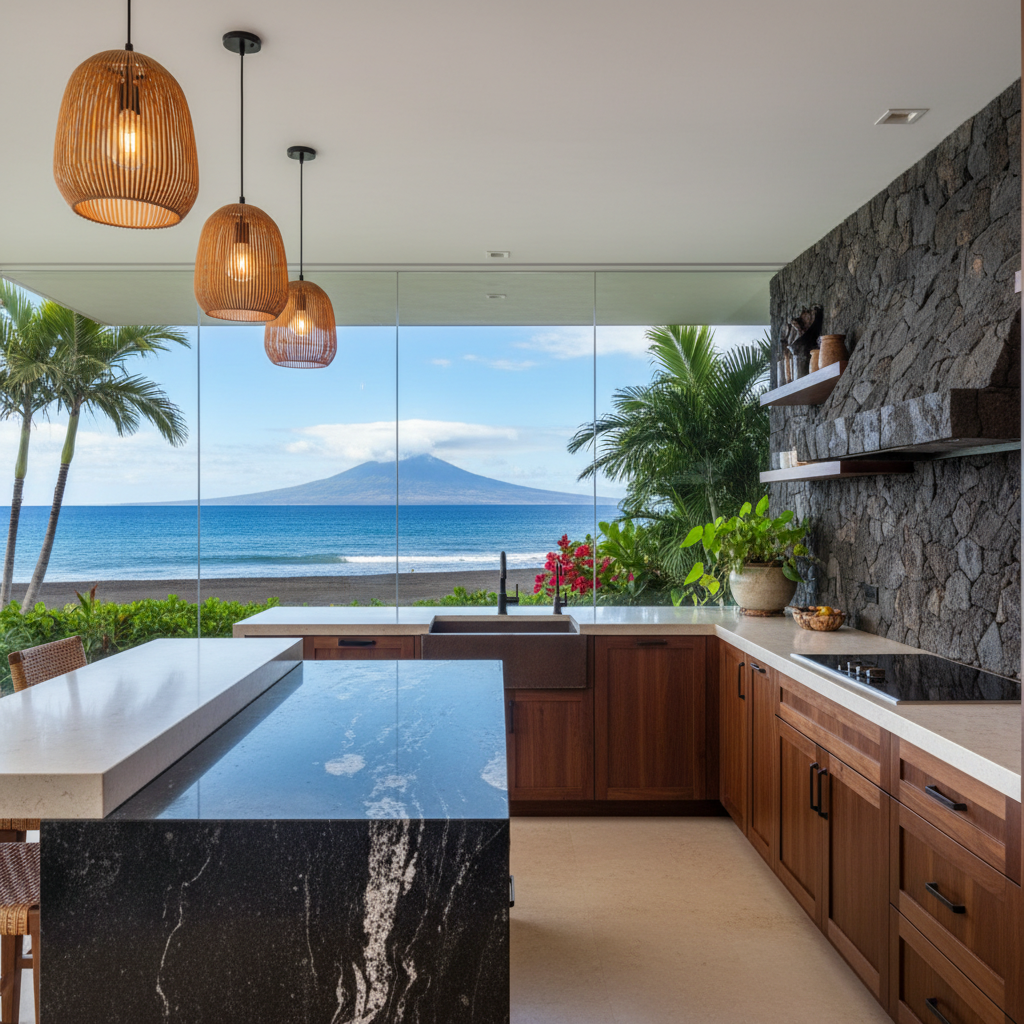
Remodeling a kitchen in Volcano is unlike anywhere else in Hawaii. You’re dealing with a unique microclimate defined by high elevation (around 4,000 feet), frequent rain, cool temperatures, and vog. These factors must dictate your material choices and design decisions. A kitchen designed for sunny Kailua-Kona will fail quickly in Volcano if you don’t account for the environment.
Fighting the Damp: Moisture and Mold Resistance
Moisture is your number one enemy. The persistent dampness can lead to mold, mildew, and material degradation.
- Ventilation is King: A cheap, recirculating microwave fan won’t cut it. We specify powerful range hoods ducted directly to the exterior, with a capacity of at least 400 CFM (cubic feet per minute). This physically removes moisture-laden air from cooking. We also recommend incorporating a humidistat-controlled exhaust fan for general ambient moisture control.
- Material Choices: We build our cabinet boxes with marine-grade plywood, not standard particle board which acts like a sponge in damp environments. For walls, we use mold-resistant drywall (purple board) in the entire kitchen envelope. For flooring, forget solid hardwood. Luxury Vinyl Plank (LVP) or porcelain tile are far better choices as they are completely waterproof.
- Cabinet Finishes: We recommend factory-applied, baked-on finishes for cabinets, as they are more durable and moisture-resistant than finishes applied on-site.
Logistics and Material Sourcing
Everything gets to Volcano on a truck from the port in Hilo, which means it first had to arrive on a barge. This two-step shipping process adds time and cost that must be factored into the plan from day one.
- Order Early and All at Once: We order every single component—from appliances to tile to light fixtures—before demolition starts. We aim to have everything consolidated and shipped in a single container. This minimizes the risk of one delayed item (like a specific faucet) holding up the entire project for weeks.
- Local vs. Shipped: While most finished goods are shipped in, we leverage our relationships with Hilo suppliers for commodity materials like lumber, drywall, and concrete. This saves on shipping costs and provides a buffer if we need extra materials unexpectedly.
Building Codes and Natural Forces
The Big Island is geologically active and exposed to hurricanes. The building code reflects this.
- Seismic Requirements: Hawaii County is in a high seismic zone. Any new framing or structural connections must meet strict earthquake-resistant standards. This influences how we anchor cabinets and secure appliances.
- Hurricane Codes: If your remodel involves touching an exterior wall, we must ensure all connections meet current hurricane code. This often means upgrading hurricane straps and window/door fasteners, even if the original plan didn’t call for it. It’s about building for resilience.
A successful kitchen renovation volcano project is a science. It’s about respecting the `āina and its unique climate by building smarter, not just prettier.
How to Choose the Right Kitchen Remodel Contractor in Volcano
Finding the right kitchen contractor in Volcano is about more than just getting a few bids. You’re entering a long-term relationship and trusting someone with your home and a significant financial investment. The right contractor can make the process smooth and successful, while the wrong one can turn it into a nightmare of delays and budget overruns. Here’s our insider’s checklist for vetting potential contractors.
-
Verify Their License and Insurance. Period.
This is non-negotiable. Any contractor you consider must have a valid Hawaii General Contractor’s license (like our BC-34373). You can and should verify this yourself on the state’s Professional & Vocational Licensing (PVL) website[2]. Also, ask for a copy of their current General Liability and Worker’s Compensation insurance certificates. If they can’t produce these immediately, walk away. A contractor without proper insurance puts all the liability on you, the homeowner.
-
Demand Big Island-Specific Experience.
A contractor based solely on Oahu may not understand the realities of a Volcano project. Ask them specifically: “How many projects have you completed on the Big Island in the last three years?” They should be able to talk about their Hilo-based suppliers, their relationship with the Hawaii County building inspectors, and how they manage project logistics from another island. If they sound vague, it’s a red flag.
-
Check Recent, Relevant References.
Don’t just accept a list of names. Ask for references from the last 1-2 years, preferably for kitchen remodels or projects on the Big Island. When you call, ask specific questions: Did they stick to the budget? How did they handle unexpected problems? Was communication clear and consistent? How was the final quality of the work?
-
Evaluate Their Communication and Project Management Style.
Especially for a neighbor island project, communication is everything. Ask about their process. Do they use a project management software? How often will you get updates? Who is your single point of contact? On our projects, we provide clients with a detailed schedule and weekly progress reports with photos. You should feel confident that you know what’s happening on-site, even if you’re not there every day.
-
Analyze the Bid for Detail, Not Just Price.
Never choose a contractor on price alone. A cheap bid is often a sign of desperation or that something is missing. A professional bid will be highly detailed, breaking down costs for labor, materials, permits, and subcontractor work. It should include specific allowances for items you’ll select, like countertops and appliances. A vague, one-page estimate is a sign of an unprofessional operation.
Finding the right kitchen contractor volcano partner is an interview process. Take your time, do your homework, and trust your gut. The goal is to find a team that gives you confidence, not anxiety.
Real Volcano Kitchen Remodel Project Example
To make all this information concrete, let’s walk through a recent project our team completed in Volcano Village. The home was a classic 1980s cedar build with a small, dark, and poorly ventilated kitchen that was showing its age with peeling laminate counters and warped cabinet doors.
The Homeowner’s Goals:
- Open up the kitchen to the living area by removing a non-load-bearing wall.
- Create a functional island with seating.
- Upgrade to durable, moisture-resistant materials.
- Drastically improve lighting and ventilation.
- Keep the aesthetic in line with the home’s rustic, upcountry feel.
The Plan and The Process:
We started with a design phase that lasted six weeks. The homeowner chose semi-custom shaker-style cabinets with plywood boxes, a durable quartz countertop that resembled soapstone, and a suite of reliable Bosch appliances. We specified a powerful, 600 CFM Vent-A-Hood liner ducted straight through the roof. For flooring, we selected a luxury vinyl plank with a warm wood look that could handle the moisture and temperature fluctuations.
Permitting with Hawaii County took 10 weeks. During that time, we ordered all materials. The cabinets, appliances, and special-order tile were consolidated on Oahu and shipped to Hilo in one 40-foot container. This shipment arrived two weeks before the permit was issued, which allowed us to start demolition the very next day.
The Challenge We Encountered:
Upon removing the old cabinets under the sink, we discovered what we often find in older Volcano homes: significant rot in the subfloor and wall framing from a slow, decades-long leak combined with high ambient humidity. This is why a healthy contingency fund is so important. We notified the client immediately, documented the damage with photos, and presented a change order to replace the affected framing and subfloor with new, pressure-treated lumber. This added four days and about $3,500 to the project, but it was essential for the long-term integrity of the home.
The Outcome:
- Total Project Timeline: 6 months (from first meeting to final inspection).
- On-Site Construction Time: 11 weeks.
- Final Cost: $142,000, which included the contingency used for the rot repair.
The result was a transformation. The new, open-concept kitchen is now the bright, inviting heart of the home. It’s functional, beautiful, and most importantly, built with materials and techniques designed to last in Volcano’s challenging climate. This is the kind of thoughtful, problem-solving approach we bring to every project.
What this means for Hawaii homeowners
For homeowners in Volcano contemplating a kitchen remodel, this information boils down to a clear set of strategic principles. Building in this unique environment requires a shift in mindset from a purely aesthetic focus to one that prioritizes durability, logistics, and professional project management. Getting this right is the difference between a kitchen that you love for decades and one that starts having problems within a few years.
Here are your key takeaways:
- Budget Realistically: Understand that neighbor island logistics and the need for durable materials mean costs are higher. Your budget for a kitchen remodel in Volcano should be 20-30% higher than for an equivalent project in a mainland city. Plan for a 15-20% contingency fund and treat it as part of the real cost.
- Prioritize Performance Over Pure Looks: In a damp climate, material science matters more than trends. Insist on plywood cabinet boxes, mold-resistant drywall, waterproof flooring, and powerful, externally-ducted ventilation. These aren’t upgrades; they are essentials for Volcano.
- Embrace the Pre-Construction Phase: The majority of your project’s success is determined before a single hammer swings. Be prepared to spend 2-4 months on design, selections, and permitting. Rushing this phase is the most expensive mistake you can make. Finalize every single decision before construction begins.
- Hire a Licensed, Experienced Local Pro: Your general contractor is your most important asset. Choose a company with a proven track record of completing projects on the Big Island. They will have the supplier relationships, subcontractor networks, and familiarity with Hawaii County’s permitting process that are essential for a smooth project. Verify their license and insurance without fail.
By approaching your project with this knowledge, you can navigate the process with confidence and ensure your investment results in a beautiful, functional, and long-lasting kitchen that truly enhances your Volcano home. Our services are designed to guide you through every one of these steps.
Frequently Asked Questions About Kitchen Remodel in Volcano
Can I save money by buying materials myself?
While it might seem like a way to save, we generally advise against it. Contractors get trade pricing that is often better than retail. More importantly, we manage the incredibly complex logistics of ordering, tracking, receiving, and inspecting all materials. If a cabinet arrives damaged or the wrong sink is delivered, we handle the return and replacement, which can be a nightmare for a homeowner to manage from a neighbor island.
How much does a permit for a kitchen remodel cost in Hawaii County?
Permit fees are calculated based on the total valuation of the project. For a typical kitchen remodel in Volcano valued at $120,000, you can expect the building permit fees from Hawaii County to be in the range of $1,500 to $2,500 in 2026. This does not include the cost of drafting the architectural plans, which can be several thousand dollars more.
What is the best countertop material for a kitchen in Volcano?
Engineered quartz is our top recommendation for Volcano’s climate. It’s non-porous, so it won’t harbor mold or mildew and is highly resistant to staining. Granite is another excellent, durable choice. We would generally advise against porous materials like marble or butcher block, which require significant sealing and maintenance to prevent moisture issues in such a damp environment.
Do I really need an architect for a kitchen remodel?
If you are moving or removing any walls, or changing the location of windows or doors, you will need plans stamped by a Hawaii-licensed architect or structural engineer to get a building permit. For a simpler, cosmetic-only remodel within the existing footprint, you may not need an architect, but a professional kitchen designer is still highly recommended to ensure a functional and efficient layout.
How long will I be without a functioning kitchen?
For a full gut remodel, you should plan to be without a functioning kitchen for the entire on-site construction period, which is typically 8 to 14 weeks. We help our clients set up a temporary kitchen in another part of the house, often the garage or a laundry room, with their old refrigerator, a microwave, a hot plate, and a temporary sink if possible.
Is it more expensive to remodel in Volcano compared to Hilo or Kona?
Yes, it is typically slightly more expensive. The main factors are travel time and delivery costs. Most skilled subcontractors (electricians, plumbers, tilers) are based in Hilo, and they factor travel time up the mountain into their bids. Similarly, there’s an extra delivery charge for getting materials from suppliers in Hilo up to Volcano, which adds to the overall cost.
What’s the biggest mistake to avoid in a Volcano kitchen remodel?
The biggest mistake is underestimating the impact of moisture and failing to budget for proper ventilation and materials. Skimping on a high-quality, externally-ducted range hood or choosing standard particle board cabinets to save a few thousand dollars will inevitably lead to much costlier repairs due to mold, mildew, and material failure down the road. Build for the climate you have, not the one you wish you had.
Start Your Volcano Kitchen Transformation
A kitchen remodel is a significant undertaking, but with the right team, it can be a rewarding investment in your home. At Warrior Construction, we combine decades of statewide construction experience with a deep understanding of the unique challenges and opportunities of building on the Big Island. Our process is designed to provide clarity, transparency, and peace of mind from start to finish.
If you’re ready to discuss your kitchen remodel in Volcano, our team is here to help you navigate every step. Let’s build something that is not only beautiful but is built to last in the heart of Hawai’i Volcanoes National Park.
Ready to plan your project? Learn more about our kitchen remodeling services and request a free, no-obligation estimate today.