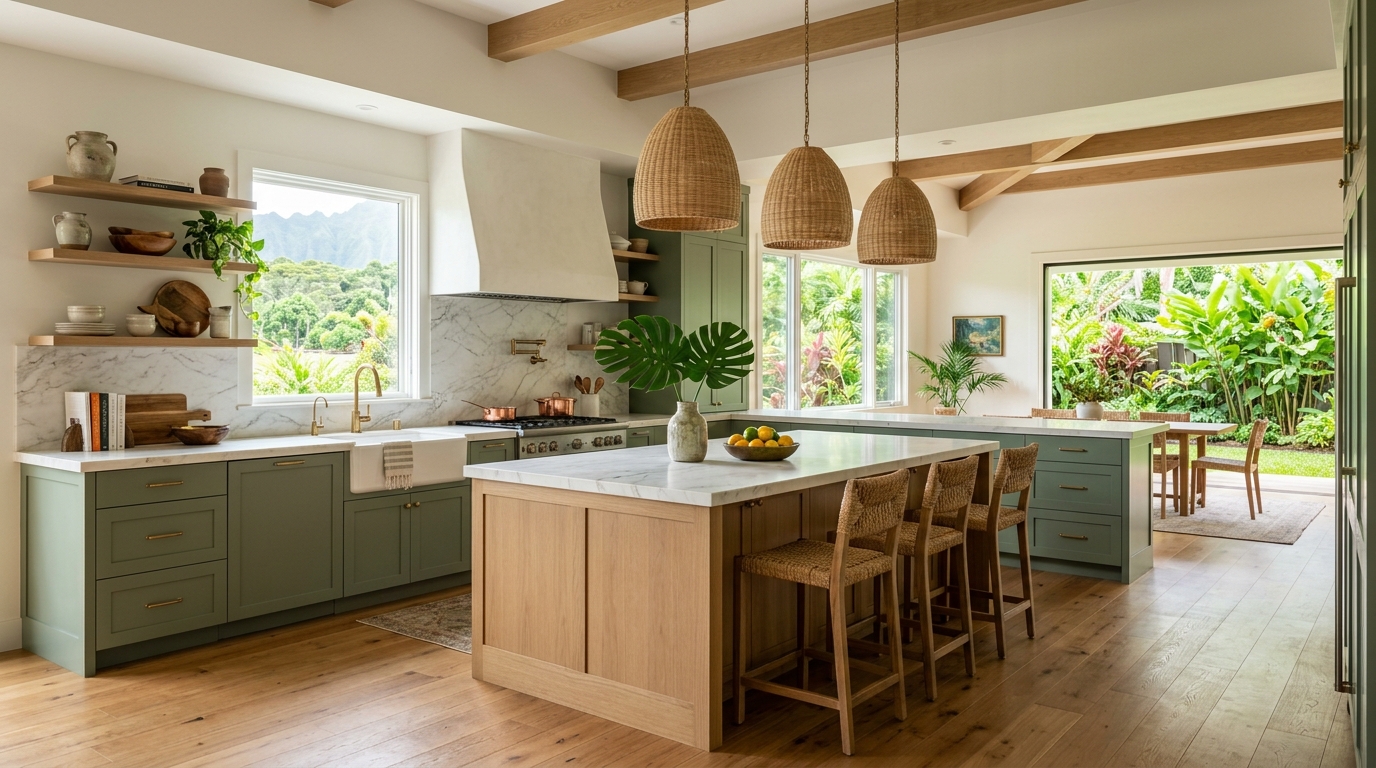
If you’re planning a kitchen remodel Manoa homeowners often ask us two questions right out of the gate: how much will it cost, and how long will it take? Here’s the straight answer for 2026: a typical mid-range kitchen renovation in a classic Manoa home, roughly 180-250 square feet, will run you between $85,000 and $160,000. From our first conversation to your first meal, you should realistically budget for 9 to 14 months. The biggest variable isn’t construction; it’s the permitting process with the Honolulu Department of Planning and Permitting (DPP) and the long lead times for shipping materials to O’ahu.
Manoa is a special place. The homes have character, deep roots, and a style you don’t find in the newer developments out in Kapolei or Ewa Beach. But that charm comes with unique challenges. We’re talking about older electrical systems, original cast-iron plumbing, single-wall construction, and the constant battle against moisture and termites that the valley’s climate throws at us. At Warrior Construction (License BC-34373), we’ve spent over two decades working in these homes. We understand the specific complexities of a Manoa project, from respecting the original architecture to engineering solutions that bring modern function into a classic space.
This isn’t just about picking new cabinets and countertops. A successful kitchen renovation in Manoa is about making smart, durable choices that will save you money and headaches for years to come. In this guide, our team will walk you through the real costs, timelines, and critical considerations for remodeling your kitchen in this unique part of Honolulu. We’ll give you five actionable, money-saving tips based on our direct experience on job sites right here in the valley.
Why Manoa Homeowners Trust Warrior Construction for Kitchen Remodels
When you undertake a kitchen remodel in a Manoa home, you’re not just hiring a crew to hang cabinets; you’re bringing on a partner who understands the DNA of your house. Many of these homes date back to the 1940s, 50s, and 60s. They were built differently, with materials and techniques you just don’t see anymore. Our team at Warrior Construction has built a reputation in Manoa because we specialize in navigating the quirks of these older properties.
For example, on a recent project off Oahu Avenue, we opened up a kitchen wall expecting to find standard 2×4 framing. Instead, we found original single-wall construction with redwood tongue-and-groove boards. A less experienced contractor might have just torn it all out. But we understood this was part of the home’s structural integrity. Our solution involved carefully integrating new structural supports and electrical wiring without compromising the home’s original character, a process that requires a surgeon’s touch, not a sledgehammer. This kind of institutional knowledge is what sets us apart.
Here’s what our experience means for your project:
- Deep Local Knowledge: We know the common issues in Manoa homes—from problematic post-and-pier foundations to the specific type of ground termite treatment needed. We also know the valley’s microclimate and recommend materials that stand up to the constant humidity and rain, preventing mold and rot down the line.
- Permitting Expertise: Navigating the Honolulu DPP is a major hurdle for any renovation. We have a dedicated team that handles the entire submittal process. We know the examiners, we understand what they’re looking for in the plans, and we can often anticipate their questions, which helps streamline a process that can otherwise stall a project for months. For a kitchen involving moving walls or major plumbing, this expertise is invaluable.
- Trusted Network of Suppliers: Island logistics are no joke. Getting quality materials—from cabinetry to specific tile—to O’ahu on time and on budget is a constant challenge. We have long-standing relationships with local and mainland suppliers, which helps us manage lead times and secure better pricing than a homeowner could get on their own. This helps mitigate the infamous neighbor island shipping costs and delays.
- Transparent Communication: As a licensed general contractor (BC-34373), our process is built on clear communication. You get a detailed project schedule, weekly progress updates, and a clear budget with line items for every phase. There are no surprises. When we uncover an unexpected issue, like discovering an ungrounded electrical panel that needs a full replacement to meet current code, we present you with clear options and costs immediately.
Choosing a contractor is the single most important decision you’ll make. In Manoa, you need a team that respects the past while building for the future. Take a look at our portfolio of past projects to see the quality of work we bring to every home.
What Does a Kitchen Remodel Cost in Manoa?
Let’s get right to the numbers. The biggest factor in any kitchen remodel cost Manoa homeowners face is the sheer price of doing business in Hawaii. Everything from a box of screws to a high-end refrigerator has to be shipped across the Pacific, and our skilled labor costs are among the highest in the nation. For 2026, a good rule of thumb is to budget between $450 and $750 per square foot for a complete kitchen gut and remodel.
So, for a typical 200-square-foot Manoa kitchen, you’re looking at a range of $90,000 to $150,000. A smaller-scale cosmetic update (new countertops, backsplash, paint, and appliances without changing the layout) might be closer to $45,000-$65,000. Conversely, a high-end luxury project with custom cabinets, Sub-Zero appliances, and significant structural changes could easily exceed $200,000.
To make it more concrete, here’s a sample budget breakdown for a mid-range, $120,000 remodel of a 200 sq. ft. kitchen in Manoa:
- Design & Permitting: $8,000 – $12,000 (Includes architect/designer fees, structural engineering if needed, and DPP submittal fees)
- Demolition & Hauling: $3,500 – $5,000
- Framing & Structural Changes: $7,000 – $15,000 (This can vary widely if load-bearing walls are moved)
- Plumbing & Electrical: $12,000 – $20,000 (Often involves upgrading old galvanized pipes to copper or PEX and running new dedicated circuits to meet modern code)
- Cabinetry & Installation: $25,000 – $40,000 (Semi-custom cabinets are the bulk of this cost. Add 20-30% for full custom.)
- Countertops (Quartz or Granite): $8,000 – $12,000
- Appliances: $10,000 – $18,000 (Mid-range suite: refrigerator, range, dishwasher, microwave hood)
- Flooring (LVP or Tile): $5,000 – $8,000
- Drywall, Paint & Finishes: $6,000 – $9,000
- Backsplash & Lighting: $4,000 – $7,000
- Contractor’s Fee (Overhead & Profit): 15-20% of the project cost
It’s also critical to include a contingency fund of 15-20% on top of this budget. In a Manoa home, it’s not a question of *if* we’ll find something unexpected, but *what* we’ll find. It could be termite damage in a subfloor, an unvented plumbing stack, or wiring that’s dangerously outdated. That contingency fund is your buffer to handle these issues correctly without derailing the project or compromising on your vision.
How Long Does a Kitchen Remodel Take in Manoa?
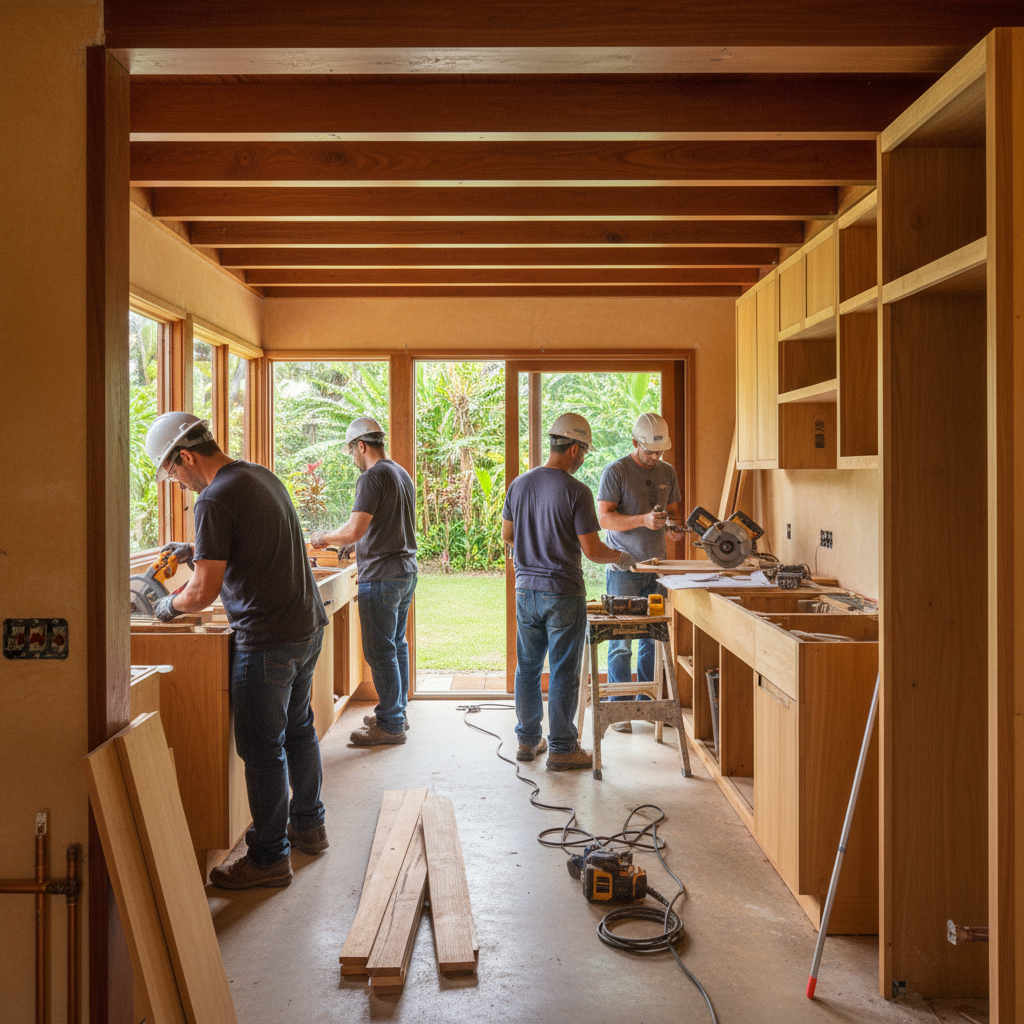
The timeline for a kitchen remodel in Manoa is often longer than homeowners expect, primarily due to factors outside of the actual construction work. While the physical transformation might only take 8-12 weeks, the total project duration from the first design meeting to completion is typically 9 to 14 months in 2026. Anyone who tells you they can do a full gut remodel in 3 months is either cutting corners on permits or hasn’t done a project in Honolulu recently.
Here’s a realistic phase-by-phase breakdown:
- Phase 1: Design & Planning (4-8 weeks)
This is where we work with you and an architect or designer to finalize the layout, select all your materials (cabinets, countertops, appliances, flooring, etc.), and create the detailed construction drawings needed for permitting. Making every single decision upfront is one of our biggest money-saving tips. Changing your mind on the tile after it’s been ordered can add weeks of delay and significant cost. - Phase 2: Permitting with Honolulu DPP (4-8 months)
This is the great variable and the longest phase. Once we submit the plans to the Department of Planning and Permitting, the review process begins. A simple project might get through in 4 months, but we’ve seen complex remodels take up to a year. DPP is thorough, and if your project involves any structural changes, electrical upgrades, or major plumbing work, it will require review by multiple departments. There is simply no way to rush this. We manage the process proactively, but the timeline is ultimately in the city’s hands. - Phase 3: Material Procurement & Shipping (8-16 weeks)
This phase runs concurrently with permitting. As soon as the design is locked, we order your long-lead-time items. Custom cabinetry can take 10-14 weeks to be built and shipped from the mainland. Certain high-end appliances or specialty tiles can have similar lead times. We track everything meticulously, because having all materials on-island *before* we start demolition is crucial to keeping the construction phase on schedule. - Phase 4: Construction (8-12 weeks)
This is when the real action happens. Once we have the approved permit in hand and all materials are staged, our crew gets to work. This phase includes demolition, any structural work, rough-in for electrical and plumbing, inspections, drywall, painting, cabinet installation, flooring, countertop templating and installation, final plumbing and electrical hookups, and backsplash installation. We choreograph this process carefully to minimize downtime and ensure a smooth flow from one trade to the next.
Just last year, on a remodel in upper Manoa, the DPP plan reviewer requested additional structural calculations for an LVL beam we specified to open the kitchen to the dining room. This added five weeks to the permit timeline while we had our engineer run the new numbers. By planning for these kinds of potential delays, we keep our clients informed and the project stress to a minimum.
What Permits Do You Need for a Kitchen Remodel in Manoa?
This is a question we get on almost every project, and the answer is simple: if your kitchen renovation manoa project involves more than just painting cabinets or replacing a faucet, you almost certainly need a building permit from the Honolulu Department of Planning and Permitting (DPP)[1].
The City and County of Honolulu’s building code is very clear. A permit is required for any work that involves altering, moving, or adding to the structural, electrical, or plumbing systems of your home. Here’s what that means for a kitchen project:
- Moving or removing any wall? You need a permit. Even if the wall isn’t load-bearing, you still need a permit.
- Changing the location of a sink, dishwasher, or refrigerator with an ice maker? You’re altering the plumbing, so you need a permit.
- Adding new outlets, dedicated circuits for appliances, or moving light fixtures? You’re altering the electrical system, so you need a permit.
- Relocating a gas stove? This involves both plumbing (gas lines) and electrical, so you definitely need a permit.
- Replacing a window or exterior door? You need a permit.
Work that is purely cosmetic and doesn’t touch those systems generally does not require a permit. This includes:
- Painting
- Refacing cabinets
- Replacing flooring in the same footprint
- Swapping out a countertop on existing cabinets
- Replacing a light fixture or faucet in the exact same location
Some contractors might suggest you can save time and money by skipping the permit process. This is terrible advice and a massive red flag. Working without a permit can lead to serious consequences. Firstly, the city can issue a stop-work order and levy significant fines. Secondly, and more importantly, unpermitted work can void your homeowner’s insurance policy. If a fire starts due to faulty, uninspected electrical work, your insurance company could deny the claim. Finally, when you go to sell your home, unpermitted renovations create huge problems with disclosures and financing, often forcing you to either tear out the work or go through the expensive and time-consuming process of permitting it after the fact.
At Warrior Construction, we handle the entire permitting process as part of our comprehensive services. It’s not just about compliance; it’s about safety and protecting your home’s value for the long term.
Manoa-Specific Considerations: Climate, Materials, and Regulations
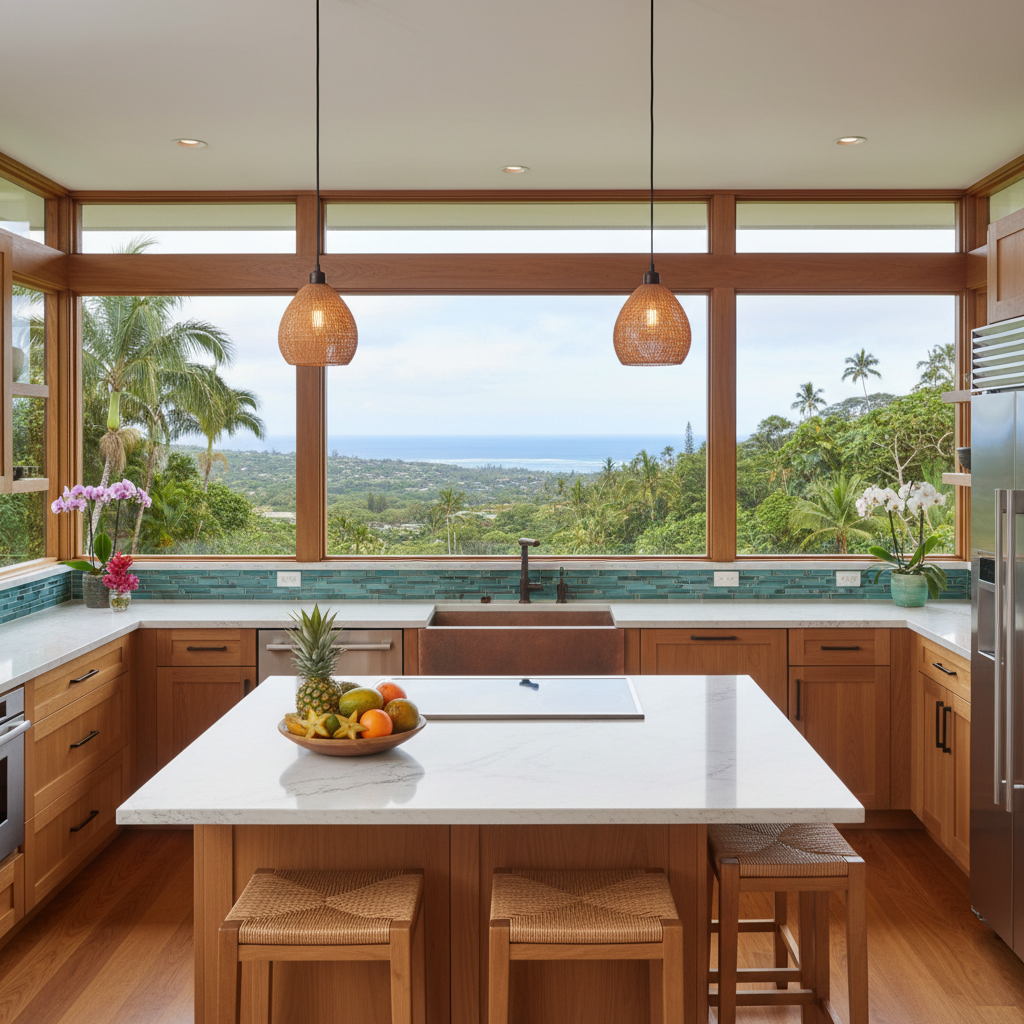
Remodeling a kitchen in Manoa isn’t like remodeling one in Arizona or even on the leeward side of O’ahu. The valley has its own unique set of environmental and structural challenges that we have to engineer around. Ignoring them leads to problems like mold, rot, and material failure down the road.
The Humidity and Rain Factor
Manoa is one of the wettest spots on the island, which means humidity is a constant. This affects material choices significantly.
- Cabinetry: We often steer clients away from MDF (medium-density fiberboard) cabinets, especially for under-sink bases. One small, slow leak can cause MDF to swell up like a sponge and delaminate. Solid wood or high-grade plywood boxes are a much more durable investment for Manoa’s climate. Marine-grade plywood is an excellent, albeit more expensive, option for ultimate durability.
- Ventilation: A powerful range hood that vents directly to the exterior is non-negotiable. Recirculating fans just move greasy, moist air around the room. Proper ventilation is your number one defense against mold and mildew growth inside your new kitchen.
- Flooring: Luxury Vinyl Plank (LVP) has become our go-to recommendation for Manoa kitchens. It’s 100% waterproof, extremely durable, and comes in realistic wood and stone looks. It’s far more forgiving than hardwood, which can warp in the high humidity, and more comfortable underfoot than ceramic tile.
Termite Pressure
Hawaii has some of the most aggressive ground termites in the world. Any time we open up walls or floors in a Manoa home, we are on high alert for termite damage. For any new framing we install, we use borate-treated lumber as a standard practice. We also ensure that any new construction is properly detailed to prevent termite entry points, working in tandem with your pest control company’s recommendations.
Older Home Quirks and Codes
The charming 1950s homes in Manoa were built to a different code. A kitchen remodel often triggers a requirement to bring related systems up to today’s much stricter standards, which are designed for safety and hurricane-resistance.
- Electrical Upgrades: It’s very common to discover an old panel with insufficient capacity or outdated knob-and-tube or ungrounded wiring. The current electrical code requires dedicated 20-amp circuits for kitchen appliances like microwaves, dishwashers, and refrigerators. This often means a full panel upgrade and running new, grounded wiring is necessary, which adds to the budget but is a critical safety improvement.
- Structural Integrity: Many homeowners want to take down walls to create an open-concept kitchen. In older Manoa homes, identifying which walls are load-bearing requires a careful eye. We always consult with a structural engineer to specify the correct size LVL (Laminated Veneer Lumber) beam and support posts to carry the load safely, ensuring your home remains structurally sound.
How to Choose the Right Kitchen Remodel Contractor in Manoa
Finding the right kitchen contractor Manoa homeowners can trust is the most critical step in the entire process. A great contractor can make a complex project feel smooth and deliver a beautiful result, while a bad one can turn your dream into a nightmare of delays, budget overruns, and shoddy work. After more than 20 years in the business on O’ahu, we’ve seen it all.
Here’s a checklist to use when vetting potential contractors:
- Verify Their License and Insurance. This is non-negotiable. Any legitimate contractor in Hawaii must have a license. You can and should verify their status on the Hawaii Department of Commerce and Consumer Affairs (DCCA) Professional & Vocational Licensing (PVL) website[2]. Our license is BC-34373. Also, ask for proof of general liability insurance and worker’s compensation insurance. If a worker gets hurt on your property and the contractor isn’t insured, you could be held liable.
- Ask for Manoa-Specific References. Don’t just ask for general references; ask to speak with their last two or three clients with homes in Manoa or similar older Honolulu neighborhoods. Ask them about the contractor’s communication, how they handled unexpected problems, whether they stuck to the budget and schedule, and the quality of the finished work.
- Insist on a Detailed, Itemized Bid. A one-page estimate with a single bottom-line number is a red flag. A professional bid should be several pages long, breaking down the costs for each phase of the project: demolition, framing, plumbing, electrical, cabinets, etc. This shows they’ve thoroughly thought through your project and provides a clear basis for comparison and discussion.
- Evaluate Their Communication Style. During the bidding process, how responsive are they? Do they answer your questions clearly and patiently? The way a contractor communicates before you sign a contract is a good indicator of how they’ll communicate once the project is underway. You want a partner who is proactive and transparent.
- Never Choose on Price Alone. It’s tempting to go with the lowest bid, but this is often a recipe for disaster. An unusually low bid can mean the contractor missed something in the scope, is using subpar materials, is uninsured, or plans to hit you with expensive change orders later. A quality remodel is an investment; focus on value and expertise, not just the cheapest price.
A good contractor is more than just a builder; they are your project manager, advocate, and problem-solver. Do your homework upfront to find a reliable partner you can trust with your home.
Real Manoa Kitchen Remodel Project Example
To put all this theory into practice, let’s walk through a project we completed recently on Woodlawn Drive. It’s a perfect example of a classic Manoa kitchen renovation.
The Home: A 2,200 sq. ft. single-family home built in 1962, with a small, dark, and closed-off 180 sq. ft. kitchen that hadn’t been touched in 30 years.
The Homeowner’s Goal: The clients wanted to create a bright, open-concept space where they could cook and entertain, connecting the kitchen to the main living and dining areas. They needed more storage, better workflow, and modern, durable finishes that could stand up to a busy family life while respecting the home’s mid-century character.
The Plan:
- Remove a 12-foot load-bearing wall separating the kitchen and dining room.
- Relocate the sink and dishwasher to a new, large island with seating for four.
- Upgrade the entire electrical system, including a new 200-amp panel and dedicated circuits for all new appliances.
- Replace the original cast-iron drain lines under the slab with new ABS plumbing.
- Install semi-custom shaker-style cabinets, quartz countertops, a professional-grade gas range, and waterproof LVP flooring throughout the new, larger space.
The Challenges We Encountered:
- Structural Engineering: Removing the load-bearing wall required us to install a substantial 14-inch LVL beam, flush-mounted into the ceiling for a clean look. This required precise engineering and careful support of the second floor during installation.
- Plumbing Under Slab: When we jackhammered the slab to move the sink drain, we discovered the original cast-iron pipes were severely corroded and on the verge of failure. We replaced all the kitchen drain lines back to the main stack, preventing a future plumbing disaster.
- Permit Delay: The initial plan review took 6 months. Then, the DPP required a minor revision to the electrical plan, which added another 4 weeks to the process. This is a typical scenario we plan for.
The Outcome:
- Final Cost: $142,500 (This included a $15,000 contingency for the unexpected plumbing and some additional electrical work).
- Total Timeline: 11 months from initial design to final inspection (7 months for design/permitting, 4 months for construction).
- The Result: The clients were thrilled with their new space. It’s now the heart of their home, filled with natural light and perfect for both daily life and hosting parties. The durable materials and professional installation mean they have a beautiful, functional kitchen that has significantly increased their home’s value and will serve their family for decades.
What this means for Hawaii homeowners
Embarking on a kitchen remodel in Manoa is a significant undertaking, but with the right planning and professional team, it’s one of the best investments you can make in your home. The unique climate, older housing stock, and complex regulatory environment on O’ahu require a thoughtful and experienced approach.
Here are the key takeaways to guide your planning:
- Plan for the Real Timeline: The biggest mistake we see is underestimating the pre-construction phase. Start your planning and hire your general contractor at least a year before you want your project to be finished. The long permitting and material lead times are unavoidable realities in Hawaii.
- Budget for the Unknown: In a Manoa home, a contingency fund of 15-20% isn’t optional; it’s essential. You will almost certainly encounter hidden issues like termite damage, outdated wiring, or corroded plumbing when you open up the walls. A healthy contingency turns these discoveries from a crisis into a manageable part of the process.
- Prioritize Durability Over Trends: Manoa’s humidity is tough on building materials. Invest in quality, moisture-resistant products like solid wood or plywood cabinets, waterproof flooring, and excellent ventilation. These choices will pay for themselves by avoiding costly repairs from mold, rot, and delamination. According to the National Kitchen & Bath Association, durable materials are a key driver of long-term satisfaction.
- Hire a Licensed, Local Expert: Do not cut corners when choosing your contractor. Verify their license, check their Manoa-specific references, and make sure they have a deep understanding of the challenges of renovating older homes in Hawaii. A contractor who insists on proper permitting is protecting you and your investment.
A successful kitchen remodel isn’t just about achieving a new look; it’s about improving your home’s safety, functionality, and resilience. By embracing a realistic timeline, a comprehensive budget, and a focus on quality, you can create a space that truly enhances your life in the beautiful Manoa valley.
Frequently Asked Questions About Kitchen Remodel in Manoa
What is the biggest hidden cost in a Manoa kitchen remodel?
The most common and significant hidden cost our team finds in Manoa homes is the need for a full electrical system upgrade. Many homes still have original 60 or 100-amp service panels and ungrounded wiring. Modern kitchens require much more power and dedicated circuits to meet safety codes. A full panel and service upgrade can cost between $5,000 and $10,000, which is why a healthy contingency fund is so critical.
Can I save money by buying my own materials or appliances?
While it seems like a good idea, it often creates more problems and costs. As general contractors, we get trade discounts that we can pass on. More importantly, we manage the incredibly complex logistics of ordering, shipping, receiving, and inspecting all materials. If a cabinet arrives damaged or the wrong faucet is shipped, we handle the return and replacement, which can take weeks and stall the project if not managed by a professional.
How much value does a kitchen remodel add to a Manoa home?
A well-done, mid-range kitchen remodel in Honolulu typically offers one of the best returns on investment of any home improvement project. While the exact percentage fluctuates with the market, you can generally expect to recoup between 60% and 75% of the project cost at resale. More importantly, a modern, functional kitchen is a huge selling point that can make your home sell much faster than a comparable one with a dated kitchen.
Is it worth it to move my sink or stove to create an island?
Moving major plumbing and electrical/gas lines is a significant cost driver. Relocating a sink can involve jackhammering the concrete slab to move drain lines, costing $5,000-$10,000 extra. Moving a gas range can be similarly complex. However, if it dramatically improves the kitchen’s workflow and functionality—like creating a highly usable island—it is often worth the investment for the daily quality of life improvement it brings.
What cabinet material is best for Manoa’s high humidity?
For Manoa’s climate, we strongly recommend cabinets with solid wood or plywood boxes over those made from particle board or MDF. Plywood is more dimensionally stable and resistant to moisture-induced swelling. For cabinet doors, solid wood or high-quality wood veneers are excellent choices. Thermofoil finishes can sometimes peel in high humidity over many years, so it’s a trade-off between cost and long-term durability.
Do I need an architect for my Manoa kitchen remodel?
If you are not moving any walls or changing windows/doors, a good kitchen designer and our experienced team may be all you need. However, if your project involves removing any walls (especially load-bearing ones), altering the exterior of your home, or making significant layout changes, you will need plans stamped by a licensed Hawaii architect or structural engineer for the DPP permit submittal. We facilitate this process as part of our design-build services.
How does Honolulu’s Bill 7 (large capacity cesspools) affect my kitchen renovation plans?
Bill 7 primarily targets cesspool conversions, but it can be triggered by a major renovation. If your Manoa home is still on a cesspool and your kitchen remodel is part of a larger project valued at over 50% of the property’s assessed value, you may be required to connect to the sewer system or upgrade to a modern septic system. This is a complex determination, and we review the project scope against the property’s specifics to advise you early in the planning phase.
Ready to Transform Your Manoa Kitchen?
A successful kitchen remodel in Manoa requires a team with deep local experience, a commitment to quality, and a transparent process. At Warrior Construction, we bring over two decades of O’ahu construction expertise to every project, ensuring your new kitchen is not only beautiful but also built to last in our unique island environment. If you’re ready to discuss your vision, our team is here to help you navigate every step, from initial design to final walkthrough.
Let’s build a space that your family will love for years to come. Learn more about our kitchen remodeling services and request a free, no-obligation estimate today.