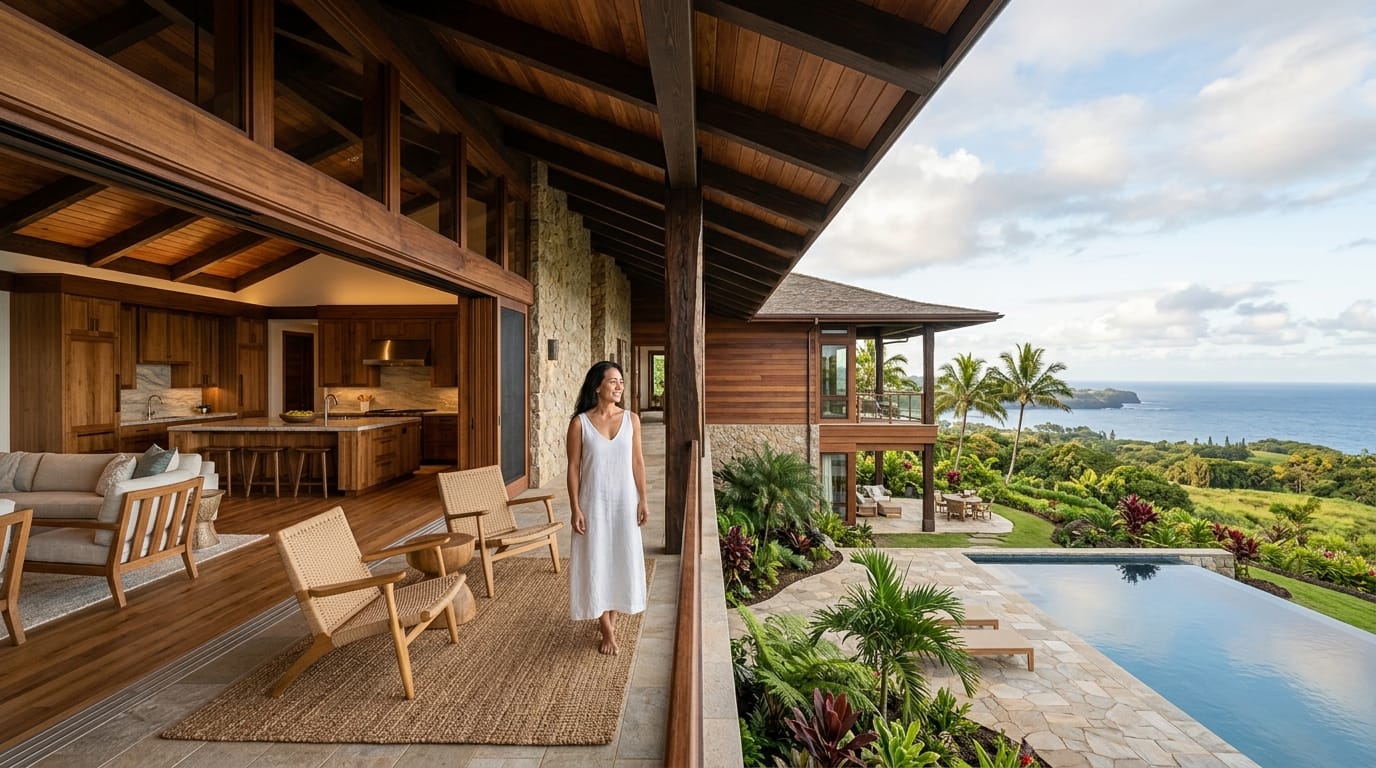
Building a custom home in Hilo is unlike building anywhere else in the world, and that’s not an exaggeration. For homeowners planning a project in 2026, the key to success is embracing Hilo’s unique environment with smart design and material choices. The best upgrades aren’t just about luxury; they’re about long-term durability against torrential rain, high humidity, and volcanic soil. The eight most critical upgrades for a Hilo custom home in 2026 include enhanced waterproofing, high-performance roofing, whole-home dehumidification, non-corrosive hardware, termite-resistant framing, robust seismic and hurricane engineering, off-grid capable energy systems, and modern water catchment solutions. As a custom home builder Hilo residents have trusted for years, we’ve seen firsthand how these specific choices make the difference between a home that thrives and one that struggles on the windward side of the Big Island.
Here’s the thing: you can’t take a blueprint from Arizona or even Honolulu and expect it to work here. The constant moisture, corrosive salt air, and unique geological conditions demand a specialized approach. Our team at Warrior Construction (License BC-34373) has spent over two decades perfecting construction methods specifically for these challenging Hawaiian environments. We understand the nuances of Hawaii County permitting, the logistics of getting materials to the Big Island, and most importantly, how to build a structure that will stand strong for generations. This article breaks down everything you need to know—from real 2026 costs and timelines to navigating permits and choosing materials that will withstand everything the Hilo side can throw at them. We’ll walk you through the entire process, sharing the kind of on-the-ground knowledge that only comes from years of experience as a premier home builder in Hilo.
Why Hilo Homeowners Trust Warrior Construction for Custom Home Builder
Choosing a custom home builder is the single most important decision you’ll make in your project, and in a place like Hilo, local experience is non-negotiable. Homeowners trust our team at Warrior Construction because we’re not just builders; we’re Hawaii-based specialists who live and breathe island construction. Our license, BC-34373, isn’t just a number—it represents decades of commitment to quality and a deep understanding of what it takes to build successfully across the islands, especially on the Big Island. We’ve managed complex projects from the rainy slopes of Hilo to the sunny, dry side of Kona, and we know they require completely different strategies.
Our approach is built on a foundation of transparency and expertise. When we take on a new home construction Hilo project, we begin with a detailed preconstruction process. This isn’t just about giving you a rough budget; it’s about digging into the specifics of your lot. We’ve dealt with it all: properties covered in dense lava rock that require specialized excavation, lots with poor drainage that need sophisticated water management systems, and sites that fall under specific county regulations that can trip up less experienced contractors. For example, on a recent project near Waiākea, we identified a potential drainage issue during the initial site survey that could have led to major foundation problems down the line. By engineering a system of French drains and proper grading from day one, we saved the homeowner tens of thousands of dollars and future headaches. This proactive, problem-solving mindset is what sets us apart.
Furthermore, our design-build methodology streamlines the entire process. Instead of you having to juggle an architect, an engineer, and a contractor, we bring everyone to the table as a unified team. This integration is crucial for a place like Hilo. It means the architect is designing with real-time feedback on material costs affected by Young Brothers shipping, and the engineer is creating plans that are practical for our construction crew to execute on-site. This collaborative process eliminates the blame game that can happen in traditional builds, reduces delays, and ultimately keeps the project on budget. As your trusted home builder Hilo partner, we handle the complexities of permitting, material logistics, and site management so you can focus on the vision for your new home. Our reputation is built on the homes we’ve constructed and the relationships we’ve forged with our clients, one successful project at a time.
What Does Custom Home Builder Cost in Hilo?
Let’s get straight to the point. For a quality custom home builder in Hilo, your starting costs in 2026 will be around $450 per square foot for the structure itself. For a luxury home builder Hilo experience with high-end finishes, expect that number to climb to $700 per square foot or more. So, for a 2,000-square-foot home, you’re looking at a baseline construction cost of $900,000 to $1.4 million. This doesn’t include the land, landscaping, or significant site preparation, which can be a major variable on the Big Island.
These costs are driven by several factors unique to our island environment. Here’s a realistic breakdown of where the money goes:
- Soft Costs (15-25% of Total Budget): This is everything that happens before we break ground. It includes architectural design fees (8-12%), structural engineering (which is more intensive here due to seismic and hurricane requirements), surveys, and permitting fees with Hawaii County. While Hilo’s permitting office is generally more manageable than Honolulu’s notorious DPP[1], you should still budget around $15,000 – $25,000 for standard permits on a new build.
- Site Preparation (Varies Wildly, $30,000 – $100,000+): This is the biggest unknown until we get a soil report and survey. Is your lot on solid volcanic rock? We’ll need a hydraulic hammer to excavate for the foundation, which is far more expensive than digging soil. Does the lot have drainage issues? In Hilo, with its 130+ inches of annual rain, proper grading and drainage systems aren’t optional; they’re essential to protect your foundation. This phase alone can vary by $70,000 or more between an easy lot and a difficult one.
- Hard Costs (The Structure Itself):
- Foundation: A standard slab-on-grade foundation for a 2,000 sq. ft. home will run approximately $50,000 – $80,000. This includes the concrete, rebar, and labor, all engineered to withstand seismic activity.
- Framing: Whether you choose traditional wood or steel framing, this is a significant cost. We strongly recommend borate-treated lumber (like Hi-bor) to combat termites. Expect framing to cost between $65 – $90 per square foot, including labor and materials, which all have to be shipped to the island.
- Exterior Finishes: This is where you build your defense against Hilo’s weather. A standing seam metal roof is the gold standard and will cost about $18 – $25 per square foot installed. For siding, fiber cement (like James Hardie) is an excellent choice for its resistance to moisture and pests, running about $12 – $16 per square foot installed.
- Interior Finishes: This is where your personal taste most affects the budget. A basic package with LVP flooring, stock cabinets, and laminate countertops might be $75 per square foot. A luxury package with custom koa wood cabinets, quartz countertops, and high-end appliances can easily exceed $200 per square foot. Remember, every cabinet, faucet, and tile has to be shipped over, adding to the final cost.
To put it in perspective, a mainland cost-per-square-foot calculator is useless here. The logistics of shipping every single 2×4, sheet of drywall, and box of nails via Matson or Young Brothers adds a significant premium. When we build your budget, we account for these real-world island costs from the very beginning to avoid surprises.
How Long Does a Custom Home Builder Take in Hilo?
From our first conversation about your vision to the day we hand you the keys, a typical custom home build in Hilo takes between 18 and 24 months in 2026. Anyone who tells you they can do it in a year is either incredibly optimistic or hasn’t built on the Big Island recently. The timeline is dictated by three main phases: design, permitting, and construction, and each has its own set of Hawaii-specific hurdles that can cause delays.
Here’s a detailed breakdown of what that 18-24 month timeline looks like:
- Phase 1: Design and Planning (4-6 Months)
This initial phase is where we work with you and the architect to turn your ideas into a buildable set of plans. This involves initial sketches, detailed architectural drawings, structural engineering, and selecting all your major materials and finishes. This is a critical stage. Making decisions here is easy and cheap; changing your mind after construction starts is what leads to delays and budget overruns. We guide our clients through this process meticulously. For a recent project in Keaʻau, the client wanted a specific type of window that had a 6-month lead time. By identifying this during the planning phase, we were able to place the order well in advance so it didn’t delay the entire project. - Phase 2: Permitting (6-10 Months)
This is often the most frustrating part for homeowners. Once the plans are finalized, we submit them to the Hawaiʻi County Planning Department. The plans are then reviewed by multiple agencies—planning, building, public works, and sometimes the Department of Health. Each agency has its own queue and review process. While it’s not quite the bottleneck you see in Honolulu, a 6-month wait for a building permit is optimistic for 2026; 8-10 months is more realistic for new home construction in Hilo. If your property is in a Special Management Area (SMA) or requires other specific land use permits, that can add several more months. Our team has dedicated permit expediters who know the county system inside and out, which helps to ensure the plans are submitted correctly the first time to avoid unnecessary rejections and delays. - Phase 3: Construction (8-12 Months)
This is when you finally see physical progress, but it’s also subject to the realities of building in Hilo.- Site Prep & Foundation (1-2 months): Clearing the lot, grading for drainage, and pouring the concrete foundation. Heavy rains can easily cause a week’s delay in this stage.
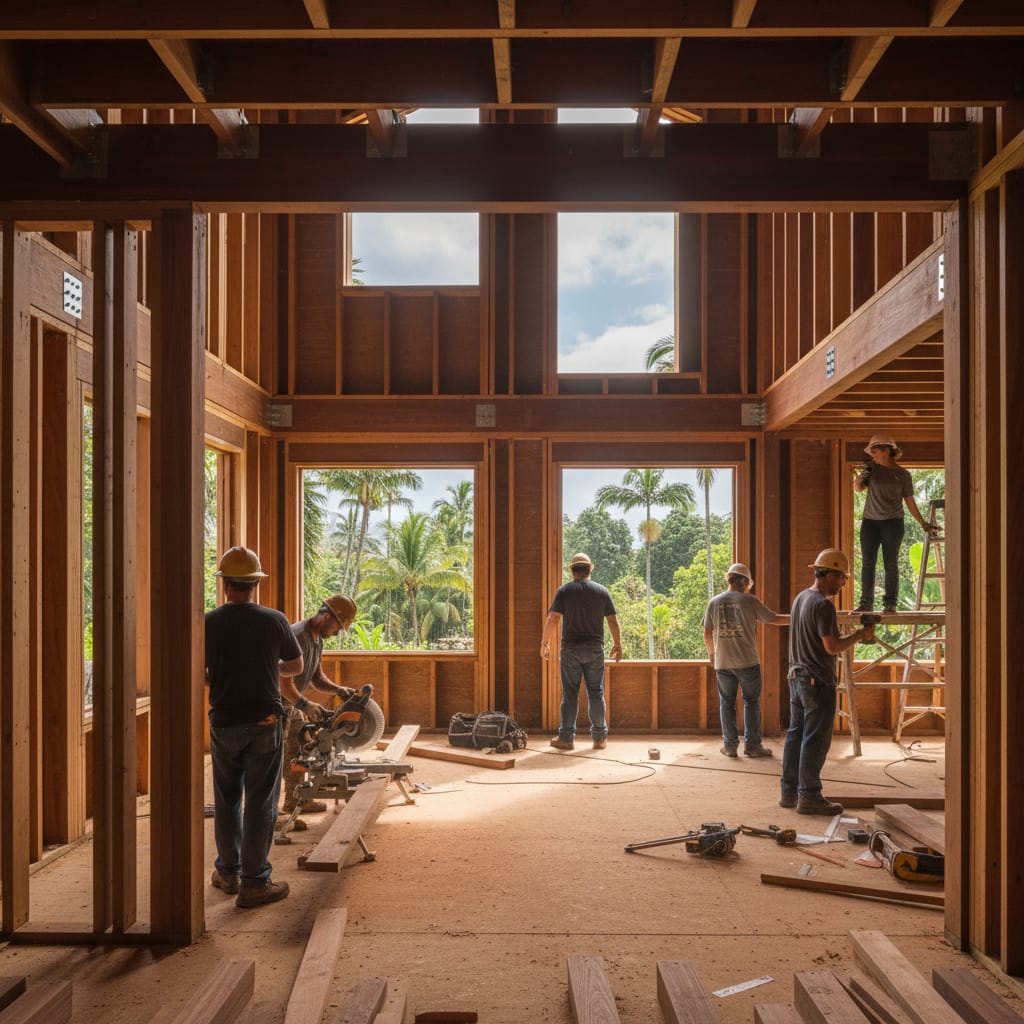
- Framing & Rough-Ins (2-3 months): The skeleton of the house goes up, along with initial plumbing, electrical, and HVAC lines.
- Exterior & Dry-In (2-3 months): We install the roofing, windows, and siding to make the house watertight. This is a huge milestone in rainy Hilo.
- Interior Finishes (3-4 months): This is the longest part of the active build. Drywall, painting, flooring, cabinets, countertops, and fixtures are all installed. Material availability is key here. If the specific tile you chose is backordered on Oahu, it can hold up the entire sequence of work.
- Finals & Handover (1 month): This involves final inspections from the county, utility hookups, final paint touch-ups, and a thorough cleaning before the final walkthrough with you.
It’s a marathon, not a sprint. A realistic understanding of this timeline from the outset is crucial for a smooth and successful project. We build a detailed project schedule from day one and provide regular updates so you always know exactly where we are in the process.
What Permits Do You Need for Custom Home Builder in Hilo?
Navigating the permitting process is one of the most complex parts of any custom home build, and it’s a key area where an experienced general contractor proves their worth. For new home construction in Hilo, you’re not just getting one permit; you’re coordinating a series of approvals from different divisions within the Hawaiʻi County government. A complete and properly sequenced submission is essential to avoid months of delays.
At a minimum, for a standard single-family home project in Hilo, our team will secure the following permits on your behalf:
- Building Permit: This is the main permit that covers the structure itself. The application requires complete architectural and structural plans, engineering calculations (especially for wind and seismic loads), and sometimes a soil report. This is the application that goes through the most extensive review process.
- Plumbing Permit: A separate permit is required for all plumbing work, from underground lines to the final fixture installation. This requires plans signed by a licensed plumbing contractor.
- Electrical Permit: Similar to plumbing, all electrical work needs its own permit and plans signed by a licensed electrician. This covers everything from the temporary power pole during construction to the final outlets and light switches.
- Grading & Grubbing Permit: If you are moving a significant amount of earth to prepare your building site—which is common on the sloped lots around Hilo—you will need a grading permit. This ensures your site work won’t cause erosion or drainage problems for your neighbors.
Beyond these standard four, your specific lot may require additional permits. For instance:
- Septic System Permit: If your property isn’t connected to the county sewer system, you’ll need a permit from the Department of Health for an individual wastewater system (septic tank). This involves its own design and inspection process.
- Driveway Permit: If you are creating a new access point from a county road, you’ll need a permit from the Department of Public Works to ensure it meets safety and construction standards.
- Special Management Area (SMA) Permit: If your property is located near the coastline, you may fall within the SMA. Any development in this zone requires a special permit to ensure it doesn’t negatively impact coastal resources. This is a much more intensive and time-consuming permit to obtain.
The process involves submitting these applications to the Hawaiʻi County Planning Department. Their staff then routes the plans to the relevant agencies for review. A single error or missing piece of information on the application can result in a rejection, sending you to the back of the line and adding months to your timeline. This is why we manage the entire process in-house. We have long-standing relationships with the staff at the county offices and understand exactly what they need to see for an approval. We ensure all paperwork is filed correctly, follow up consistently, and address any questions from reviewers promptly. This diligence is a critical part of our service as a custom home builder in Hilo, saving our clients time, money, and immense frustration.
Hilo-Specific Considerations: Climate, Materials, Regulations
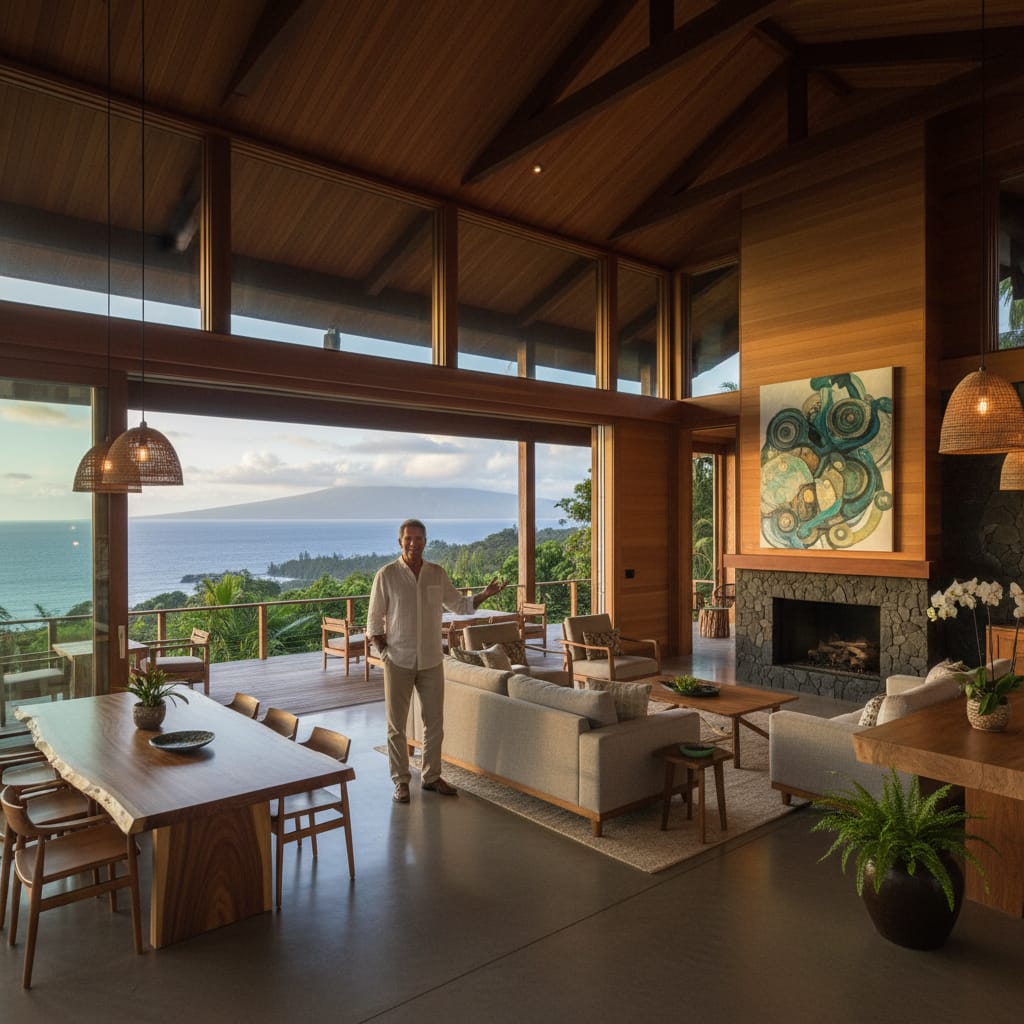
Building in Hilo means building for the environment. You can’t fight the rain, humidity, or geology—you have to design and build in harmony with it. Over our 20+ years in Hawaii, we’ve developed a set of best practices specifically for the windward side of the Big Island. These aren’t just suggestions; they are fundamental choices that determine the longevity and comfort of your home. Here are the eight key upgrades we integrate into our projects.
1. Enhanced Waterproofing & Drainage
With an average of 130-200 inches of rain per year, water is your number one enemy. We start below the ground, with extensive French drain systems to channel water away from your foundation. We apply robust waterproofing membranes to all foundation walls. This isn’t just a ‘nice to have’; it’s the first line of defense against moisture intrusion and foundation damage.
2. High-Performance Roofing Systems
Asphalt shingles don’t last in Hilo’s damp climate; they encourage moss and algae growth and can be torn off in high winds. The only roofing material we recommend is a 24-gauge standing seam metal roof with a Kynar finish. It’s more expensive upfront, but it sheds water efficiently, resists corrosion, and will last 50+ years. We couple this with wide roof overhangs (3 to 4 feet is ideal) to protect your walls and windows from driving rain.
3. Whole-Home Dehumidification
Standard air conditioning isn’t enough to combat Hilo’s pervasive humidity. We strongly recommend integrating a whole-home dehumidifier into your HVAC system. This actively removes moisture from the air, preventing the musty smell and inhibiting the growth of mold and mildew within your walls. It makes the home healthier and more comfortable year-round.
4. Stainless Steel & Non-Corrosive Hardware
Even if you’re not directly on the coast, Hilo’s air carries a salty mist that corrodes metal at an astonishing rate. Every exterior screw, nail, flashing, and piece of hardware must be 316-grade stainless steel or a similarly high-performance, non-corrosive material. Using cheaper galvanized hardware is a classic mistake we see on older homes; it will rust and fail within a few years, leading to structural issues and water leaks.
5. Termite-Resistant Framing
Ground termites are a constant threat in Hawaii. Building with untreated lumber is asking for trouble. We use borate-treated lumber (such as Hi-bor) for all framing and sheathing. Another excellent option for a luxury home builder Hilo project is light-gauge steel framing, which is completely impervious to termites and rot. It’s a premium investment that provides total peace of mind.
6. Seismic & Hurricane-Ready Engineering
The Big Island is one of the most seismically active places on Earth and is also vulnerable to hurricanes. Your home’s engineering must account for this. This means using hurricane straps and clips at every connection from the foundation to the roof rafters, installing impact-rated windows and doors, and using shear walls to provide lateral stability. We work with structural engineers who specialize in Hawaii’s hurricane code to ensure your home is a fortress.
7. Off-Grid Capable Energy Systems
Power outages are a fact of life on the neighbor islands. A grid-tied solar PV system is a great start, but we encourage clients to take it a step further with battery storage (like Tesla Powerwalls or Enphase batteries). This gives you true energy independence, allowing your home to run seamlessly when the grid goes down. With the cost of electricity in Hawaii, these systems often pay for themselves much faster than on the mainland.
8. Modern Water Catchment Systems
For many properties in Hilo, a water catchment system is the primary source of household water. Modern systems are a far cry from the old rusty tanks of the past. We install systems with food-grade liners, multi-stage filtration, and UV sterilization to provide water that is perfectly safe and often tastes better than county water. Given the abundant rainfall, it’s a sustainable and reliable solution for many homeowners.
How to Choose the Right Custom Home Builder Contractor in Hilo
Finding the right contractor is more than just comparing bids; it’s about finding a partner you can trust to manage a multi-million dollar, multi-year project. For a `new home construction hilo` project, local knowledge is paramount. A contractor based on Oahu or the mainland simply won’t have the on-the-ground relationships and experience needed to navigate the unique challenges of building on the Big Island.
Here’s our checklist for vetting a potential builder:
- Verify Their License and Insurance. This is the absolute first step. You can and should verify any contractor’s license using the Hawaii DCCA Professional & Vocational Licensing (PVL) search tool[2]. Make sure their license is active, in good standing, and that they are a General Contractor (B license). For example, our license is Warrior Construction, BC-34373. Also, ask for certificates of general liability and workers’ compensation insurance. Do not work with anyone who can’t provide these immediately.
- Demand Big Island References. Ask for the names and numbers of at least three homeowners they’ve built custom homes for *in the Hilo area* within the last five years. Call those references and ask them the tough questions: How was the communication? How did the builder handle problems or change orders? Was the project completed on time and on budget?
- Scrutinize Their Portfolio. Look at their past projects. Do the homes look like they belong in Hilo? Look for details like deep roof overhangs, appropriate siding materials, and smart window placement. If their portfolio is full of stucco homes that look like they belong in a desert, they probably don’t understand how to build for our rainy climate. Look for evidence of quality craftsmanship and attention to detail.
- Understand Their Process and Communication. A professional builder will have a clearly defined process for design, bidding, construction, and change orders. How often will you have meetings? Who will be your primary point of contact? How will they keep you updated on progress and costs? We use construction management software that gives our clients real-time access to schedules, photos, and budget tracking. This level of transparency is the standard you should expect.
- Get a Detailed, Itemized Bid. A one-page bid with a single number is a massive red flag. A legitimate bid from a professional home builder in Hilo will be many pages long and break down the costs by category (e.g., foundation, framing, plumbing, finishes). This shows they’ve done their homework and thought through your specific project. It also gives you a clear basis for comparing bids and understanding where your money is going.
Choosing your builder is a long-term commitment. Take your time, do your research, and trust your gut. The right partner will not only build you a beautiful home but will also make the entire journey a positive and collaborative experience.
Real Hilo Custom Home Builder Project Example
To illustrate how these principles come together, let’s look at a recent project we completed in the Hilo area, which we’ll call the “Saddle Road Mauka Estate.”
The Client: A family relocating from California who purchased a 3-acre lot mauka (towards the mountain) of Hilo. They wanted a modern, single-story, 3,000-square-foot home that maximized views and embraced indoor-outdoor living, but they were very concerned about Hilo’s reputation for rain and humidity.
The Challenge: The lot was on a slope with significant outcroppings of pahoehoe lava. The location, at a slightly higher elevation, experienced both heavy rainfall and a persistent cool mist, making moisture management the top priority. The clients also wanted a large, covered lanai for entertaining that felt connected to the main living space without creating a dark interior.
Warrior Construction’s Solution: Our team took a comprehensive approach, starting with the site itself.
- Site Preparation: Instead of costly and extensive blasting, we worked with the architect to site the home in a way that integrated the natural lava formations into the landscape design. We used a rock hammer for precise excavation of the foundation footings, minimizing disturbance. A sophisticated drainage plan involving French drains and swales was engineered to divert the heavy mauka rainfall safely around the building pad.
- Architectural Design: We collaborated on a design featuring a large central great room with 12-foot ceilings and clerestory windows above the main roofline. This allowed natural light to flood the interior, solving the dark lanai problem. The lanai itself was designed with a 4-foot overhang and built-in infrared heaters for comfort during cooler, misty evenings.
- Material Selection: We built the home with steel framing for ultimate termite and rot resistance. The exterior was clad in a combination of smooth-panel fiber cement and natural cedar with a protective sealant. A dark bronze standing seam metal roof was chosen to absorb warmth from the sun. All windows were high-end Marvin coastal series with impact-rated glass.
- Systems: A state-of-the-art HVAC system was installed, incorporating both an Energy Recovery Ventilator (ERV) for fresh air and a whole-home dehumidifier. For energy, we installed a 15kW solar array coupled with three Tesla Powerwalls, making the home nearly self-sufficient during frequent power outages.
The Result: The Saddle Road Mauka Estate was completed in 23 months with a final construction cost of approximately $1.95 million, or about $650 per square foot. The clients received a stunning, durable home perfectly tailored to its unique Hilo environment. This project is a prime example of our philosophy: work with the land, not against it, and invest in the building envelope and systems to create a home that is truly sustainable in this beautiful but demanding climate. It’s a showcase for what a dedicated `luxury home builder hilo` can achieve.
What this means for Hawaii homeowners
Building a custom home in Hilo in 2026 is an incredible opportunity, but it requires a shift in mindset from typical mainland construction. You aren’t just building a house; you’re building a shelter specifically designed to coexist with one of the wettest, most unique climates in the United States. Cutting corners on materials or choosing a builder without specific, deep-seated local knowledge is the fast track to costly problems like rot, mold, and structural failure.
Here’s the actionable advice our team gives every potential client:
- Prioritize Your Building Envelope Over Everything Else. Your budget should be allocated first and foremost to the things that keep water and pests out: the best roof you can afford (standing seam metal), a robust waterproofing system, termite-resistant framing (treated lumber or steel), and high-quality windows and doors. Fancy countertops are nice, but they won’t matter if your walls are rotting from the inside out.
- Hire Your Builder Early in the Process. Bring a qualified Hilo-based general contractor onto your team *before* the architectural plans are finalized. We can provide critical feedback on constructability and material costs that can save you thousands in redesign fees and ensure the plans are realistic for our island environment. This is the core of the design-build advantage.
- Embrace the Timeline. Understand and accept that permitting and construction take time here. The 18-24 month timeline is realistic. Rushing the process leads to mistakes and compromises. Plan accordingly and build a healthy contingency of 15-20% into your budget to cover unexpected site conditions (like hitting a giant lava tube) or supply chain disruptions.
- Think in Systems, Not Just Rooms. A Hilo home is a system. Your drainage, HVAC with dehumidification, and roofing all work together. A water catchment system needs proper filtration. A solar array is most effective with battery backup. Focus on how these systems integrate to create a healthy, resilient, and comfortable living environment.
Ultimately, a successful custom home project in Hilo comes down to meticulous planning and partnering with a team that has proven experience on the windward side of the Big Island. That’s the core of our promise at Warrior Construction.
Helpful resources:
City & County of Honolulu DPP ·
Hawaii DCCA Licensing
Frequently Asked Questions
What are the top 3 mistakes people make when building a custom home in Hilo?
The top three mistakes we see are: 1) Underestimating the importance and cost of site work and drainage, leading to water problems later. 2) Choosing a mainland architect or using stock plans not designed for Hilo’s extreme rainfall and humidity. 3) Selecting cheaper, non-corrosive materials for hardware and fasteners, which then rust and fail within a few years.
Is it cheaper to build in Hilo than in Kona or on Oahu?
Generally, yes, but with caveats. Labor and land costs are typically lower in Hilo than in Kona or Honolulu. However, the specialized construction required to deal with the high rainfall (enhanced waterproofing, drainage, dehumidification systems) can offset some of those savings. As of 2026, Hilo’s starting cost of ~$450/sq ft is more affordable than Kona’s ~$550/sq ft or Oahu’s ~$600+/sq ft, but a Hilo build requires a higher investment in climate-specific systems.
How do you handle volcanic rock on my property during construction?
It depends on the type of rock. For softer ‘a’ā lava rock, a powerful excavator can often break it up. For hard pāhoehoe lava, we must use a hydraulic hammer attachment on the excavator, which is slower and more expensive. In some cases, we can work with the architect to design the foundation around major rock outcroppings to minimize excavation costs. A geotechnical survey is crucial to determine the best approach before we finalize the budget.
What’s the real timeline for getting a building permit in Hawaii County in 2026?
For a new single-family home in Hilo, homeowners should realistically budget for a 6 to 10-month wait time from submission to receiving the approved permit. While the county is working to improve timelines, a backlog still exists. Submitting a complete and error-free application package is the single best way to avoid getting sent to the back of the queue, which is a key part of our preconstruction service.
Are water catchment systems safe and practical in Hilo?
Absolutely. Modern water catchment systems are both safe and highly practical for Hilo. With the abundant rainfall, they provide a reliable water source. We install systems with food-grade tank liners, first-flush diverters, multi-stage sediment and carbon filtration, and a final UV sterilization light. This process produces clean, safe drinking water that meets or exceeds health standards.
Can I use a mainland architect for my Hilo home?
While you can, we strongly advise against it unless they partner with a local architect or a design-build firm like us. A mainland architect, no matter how talented, will likely not have the deep understanding of Hilo’s microclimate, material durability in high humidity, or the specific requirements of the Hawaii County building code. This often leads to designs that are impractical, expensive to build, or will perform poorly over time.
What is a Lava Flow Hazard Zone and how does it affect building?
The Big Island is mapped into Lava Flow Hazard Zones, from 1 (most hazardous) to 9. Much of the Puna and Kaʻū districts near Hilo are in Zones 1, 2, and 3. Building in these zones, particularly 1 and 2, can be extremely difficult or impossible. It dramatically affects your ability to get financing and homeowners insurance. Most residential construction in the Hilo area occurs in Zone 3, which is generally acceptable to insurers and lenders, though it still requires adherence to all seismic building codes.
Build Your Hilo Home the Right Way
Building a custom home on the Big Island is a significant journey. Don’t leave it to chance. At Warrior Construction, we bring decades of specialized Hawaii construction experience to every project, ensuring your home is not only beautiful but also built to endure the unique challenges of the Hilo climate. Our integrated design-build process and commitment to transparent communication make building your dream home a seamless and rewarding experience.
If you’re ready to build a home in Hilo that’s designed for the realities of the Big Island, our team is here to guide you. Explore our detailed approach to custom home building, and when you’re ready to start the conversation, reach out for a comprehensive, no-obligation estimate.