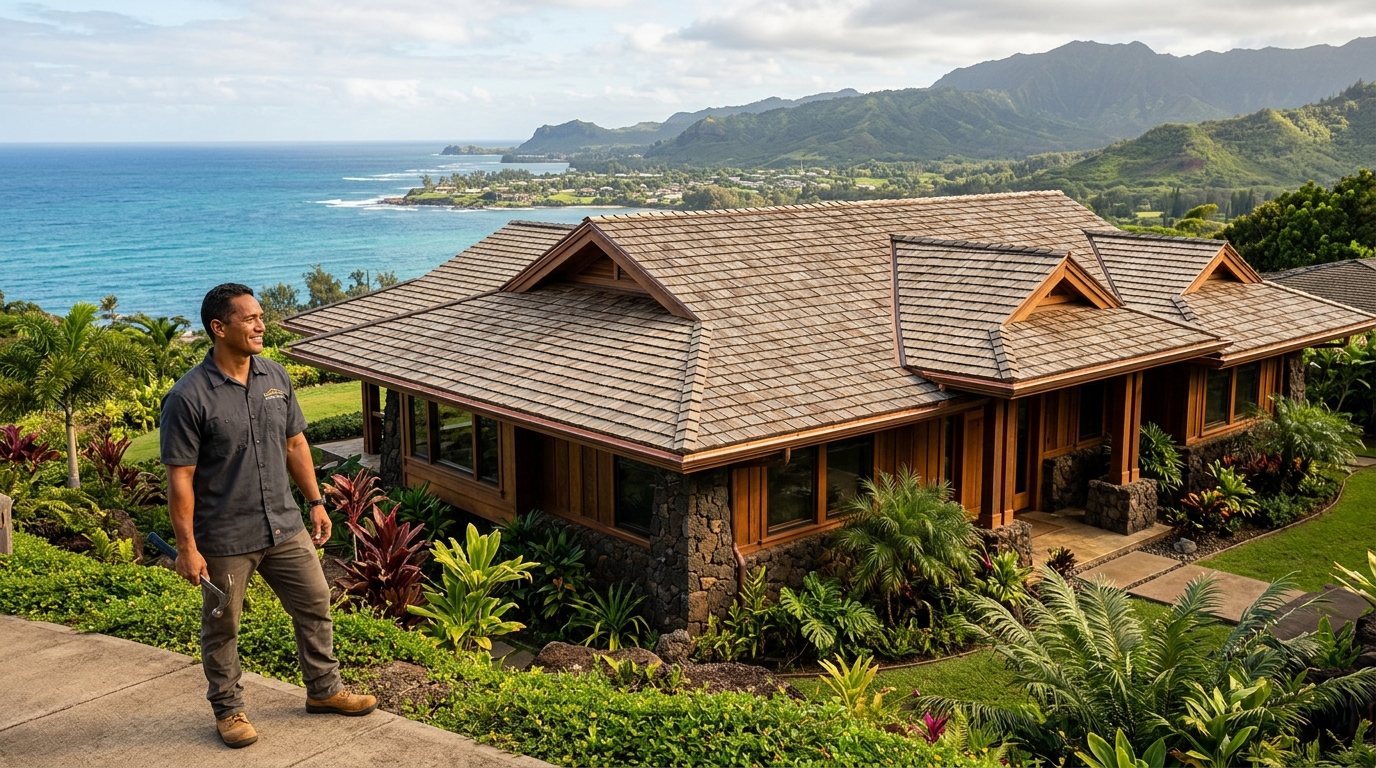
Finding the right roofing contractor in Kapa’a is the single most important decision for protecting your home from Kaua’i’s unique weather. A full roof replacement in 2026 can range from $18 per square foot for architectural asphalt shingles to over $45 for high-grade standing seam metal, but the real cost is getting it wrong. On Kaua’i, a cheap roof isn’t a bargain; it’s a future leak, a rust problem waiting to happen, and a liability in the next big storm. The difference between a roof that lasts 10 years and one that lasts 40 isn’t just the material—it’s the contractor who understands how to fasten it against hurricane-force winds and seal it against windward-side rain.
For over 20 years, our team at Warrior Construction has been building and roofing homes across the islands, and we’ve seen firsthand what happens when mainland techniques are applied to our tropical climate. Fasteners rust from salt spray, underlayment fails from constant humidity, and poorly braced trusses lift in high winds. This isn’t just about nailing down some shingles. It’s about engineering a complete system that works for Kapa’a’s specific environment. This guide walks you through our seven-step process for a successful roof replacement, covering everything from real 2026 costs and timelines to navigating the Kaua’i County permitting process and selecting materials that will stand up to the elements. We’ll give you the straight talk you need to make an informed decision for your home.
Why Kapa’a Homeowners Trust Warrior Construction for Roofing
When you’re looking for a roofing contractor, especially on an island like Kaua’i, you’re not just hiring a crew; you’re trusting a team with the most critical component of your home’s structure. At Warrior Construction (License BC-34373), we’ve built our reputation on understanding the nuances of building in Hawaii. A roof in Kapa’a faces challenges that a contractor from Arizona or California simply wouldn’t anticipate. It’s about more than just keeping the rain out; it’s about battling salt air, intense UV exposure, and the ever-present threat of hurricane-force winds. Our approach is built on decades of local, on-the-ground experience.
First, we are a fully licensed and insured General Contractor. This is a crucial distinction. While a specialty roofing contractor (C-42 license) can replace shingles, what happens when they tear off your old roof and discover significant rot in the trusses or damage to the underlying structure? Their license stops there. They’d have to bring in another contractor, causing delays and cost overruns. As a General Contractor, we have the license and the in-house expertise to handle any structural repairs that arise, from replacing rafters to reinforcing connections. This creates a seamless process for the homeowner. For example, on a recent project in the Wailua Homesteads, we uncovered severe termite damage in the roof beams that was completely hidden. We were able to frame in sister beams and treat the area properly without missing a beat, something a specialty roofer would not have been equipped to do.
Furthermore, our team understands the local supply chain. Getting materials to Kaua’i isn’t as simple as a trip to a big-box store. Everything comes by barge, and coordinating logistics is key to keeping a project on schedule. We have long-standing relationships with suppliers on Kaua’i and O’ahu, allowing us to source the best materials—like Kynar 500-coated standing seam metal and GAF Timberline HDZ shingles with LayerLock™ Technology—and manage shipping schedules effectively. We know which suppliers stock hurricane-rated products and which fasteners are truly stainless steel, not just coated. This inside knowledge prevents the kinds of delays and material substitutions that can plague less experienced contractors. We build the lead time for barge shipments right into our project schedule, so there are no surprises for our clients.
What Does a Roofing Contractor Cost in Kapa’a?
Let’s get straight to the numbers. In 2026, the cost for a professional roof replacement in Kapa’a is significantly different from mainland pricing due to materials, labor, and inter-island logistics. Vague estimates don’t help you budget, so here’s a realistic breakdown of what our team is seeing for a standard single-story, 2,000-square-foot home.
The total cost is driven by the material you choose, the complexity of your roof, and any necessary structural repairs. Here are the most common options and their all-in costs, which include tear-off of the old roof, new underlayment, all materials, labor, and disposal fees:
- Architectural Asphalt Shingles (GAF Timberline HDZ or similar): This is a popular and durable option. For a full replacement in Kapa’a, you can expect to pay between $18 to $25 per square foot. For our 2,000 sq. ft. example home, that’s a total project cost of $36,000 to $50,000. This is a solid choice for many homes, offering a 30-year lifespan if installed correctly.
- Presidential or Luxury Asphalt Shingles: These are heavier, thicker shingles that mimic the look of wood shake. They offer enhanced durability and wind resistance. The cost runs from $26 to $34 per square foot, putting our example project in the $52,000 to $68,000 range.
- Standing Seam Metal Roofing (24-gauge with Kynar 500 finish): This is the gold standard for tropical roofing in Hawaii, especially for homes near the coast. It offers superior longevity (50+ years) and the best resistance to wind and corrosion. The investment is higher, typically $30 to $45 per square foot. For the same 2,000 sq. ft. home, the total would be between $60,000 and $90,000.
Several factors can increase these base costs:
- Roof Pitch and Complexity: A steep roof (anything over a 6/12 pitch) requires more safety equipment and slower, more careful work, adding 10-20% to the labor cost. Multiple valleys, dormers, and skylights also add complexity and time.
- Structural Rot or Termite Damage: This is the biggest unknown. We always budget a contingency for replacing plywood sheathing. In 2026, a 4×8 sheet of pressure-treated plywood, including labor to install it, costs about $135 per sheet on Kaua’i. If we find 10 rotten sheets, that’s an additional $1,350.
- Two-Story Homes: Working on a second story requires more extensive scaffolding and safety measures, which can add another 10-15% to the overall cost.
- The “Kaua’i Factor”: Shipping materials via Young Brothers or Matson and higher disposal fees at the Kekaha landfill are baked into these numbers. It’s simply more expensive to do business on a neighbor island compared to O’ahu.
When you get an estimate from our team, it will be a line-item proposal showing exactly where every dollar goes. We believe in complete transparency so you can make the best financial decision for your property. We can handle every aspect, from simple shingle jobs to complex structural repairs found during tear-off.
How Long Does a Roofing Contractor Take in Kapa’a?
Time is a critical factor in any construction project, and a roof replacement is no exception. In Kapa’a, the timeline is influenced less by the physical work and more by the island-specific logistics of permitting and material delivery. A homeowner might see crews on-site for only a week or two and wonder why the whole process took three months. Here’s a realistic timeline for a full roof replacement in 2026, broken down into phases.
Total Project Duration: 8 to 16 weeks from contract signing to completion.
- Phase 1: Planning & Contract (1 Week): This initial phase moves quickly. After our first meeting and site inspection, we typically deliver a detailed proposal within 2-3 business days. Once you decide to move forward, we finalize the contract, select materials and colors, and get everything signed.
- Phase 2: Permitting (4 to 8 Weeks): This is often the longest waiting period. A full roof replacement requires a building permit from the County of Kaua’i Department of Public Works. We prepare and submit all the necessary documents, including structural plans that detail the fastening patterns and hurricane tie-down specifications required by code. The county’s review process can take anywhere from one to two months, sometimes longer if they have follow-up questions. We manage this entire process, but the timeline is ultimately up to the county’s workload.
- Phase 3: Material Ordering & Delivery (3 to 6 Weeks): This phase happens concurrently with permitting. As soon as the contract is signed, we order your materials. If they are in stock on Kaua’i, this can be quick. However, for specific colors of metal roofing or specialty shingles, the materials often have to be shipped from O’ahu or the mainland. This involves booking space on a barge, which can add several weeks to the lead time. We’ve seen shipping times get pushed out due to weather or port congestion, so we plan for this buffer.
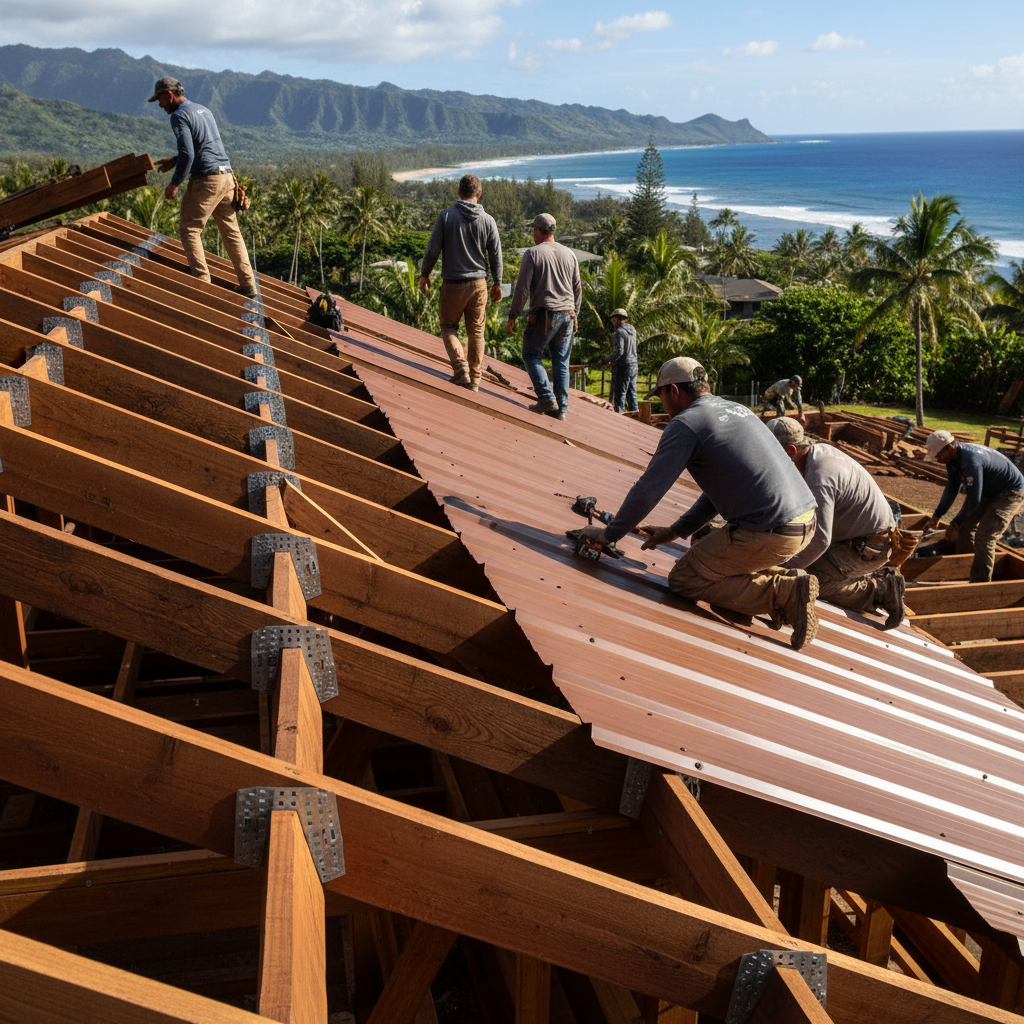
- Phase 4: On-Site Work (1 to 2 Weeks): Once permits are in hand and materials are on-site, our crew works very efficiently. For a typical 2,000 to 2,500 sq. ft. home, the physical replacement looks like this:
- Day 1-2: Tear-off of the old roofing material and inspection of the underlying sheathing.
- Day 2-3: Replacement of any damaged plywood or structural wood.
- Day 3-5: Installation of new underlayment, flashing, and drip edge. This is a critical step for waterproofing.
- Day 5-9: Installation of the new shingles or metal panels.
- Day 10: Final detailing, ridge cap installation, and thorough site cleanup.
- Phase 5: Inspections & Closeout (1 Week): After our work is complete, we schedule a final inspection with the county building inspector. Once that passes, we do a final walkthrough with you to ensure you are 100% satisfied with the work.
The key takeaway is that the hands-on work is the shortest part of the process. The real variables are the administrative and logistical hurdles unique to building on Kaua’i. Our job as your contractor is to manage these phases proactively to keep your project moving forward as smoothly as possible.
What Permits Do You Need for Roofing in Kapa’a?
Navigating the permitting process is one of the most important services a qualified roofing contractor provides. For a homeowner, it can be a confusing and time-consuming ordeal. In Kapa’a, all construction is governed by the County of Kaua’i Department of Public Works, Building Division. The rules are clear: a building permit is almost always required for a full `roof replacement kapa’a`.
A common question we get is, “Do I need a permit just to fix a few shingles?” The answer is generally no. Minor repairs, defined as replacing less than one square (100 square feet) of roofing material, typically do not require a permit. This covers small patch jobs for a `roof repair kapa’a`. However, the moment you decide to tear off the entire existing roof and replace it—what’s known as a “re-roof”—a permit is mandatory. This is not just red tape; it’s a critical consumer protection measure. The permit process ensures that the new roof is installed to meet the latest building codes, particularly the stringent hurricane code requirements that have been in place since Hurricane Iniki.
As your general contractor, Warrior Construction handles the entire permitting process from start to finish. Here’s what it involves:
- Plan Preparation: We create detailed plans for the Kaua’i Building Division. These aren’t full architectural blueprints but specific roofing plans that show the type of material being used, the underlying sheathing, the type and spacing of fasteners (e.g., 6 nails per shingle), the layout of the hurricane straps, and details for flashing around vents and valleys.
- Permit Application Submission: We complete and submit the full application package to the county. This includes the plans, the permit application form, and proof of our contractor’s license and insurance. While the main government portal for Honolulu is the DPP[1], Kaua’i has its own distinct process that we are intimately familiar with.
- Plan Review and Revisions: A county plan reviewer will examine our submission to ensure it complies with all local building codes. They might have questions or require minor adjustments, which we handle directly. This back-and-forth is a normal part of the process.
- Permit Issuance: Once the plans are approved, the county issues the building permit, and only then can we begin on-site work. The permit card must be posted visibly at the job site throughout the project.
- Scheduling Inspections: The permit requires at least one, and sometimes two, inspections. A “sheathing inspection” may be required after the old roof is off to verify the condition of the wood deck and the nailing pattern. A “final inspection” is always required after the new roof is installed to sign off on the completed work. We coordinate and attend these inspections with the county inspector.
Attempting a re-roof without a permit is a major risk. If caught, the county can issue a stop-work order and impose significant fines. More importantly, unpermitted work can create major problems when you try to sell your home or file an insurance claim. The permitting process is our responsibility, ensuring your project is done legally, safely, and to the highest standards of modern construction.
Kapa’a-Specific Considerations: Climate, Materials, and Regulations
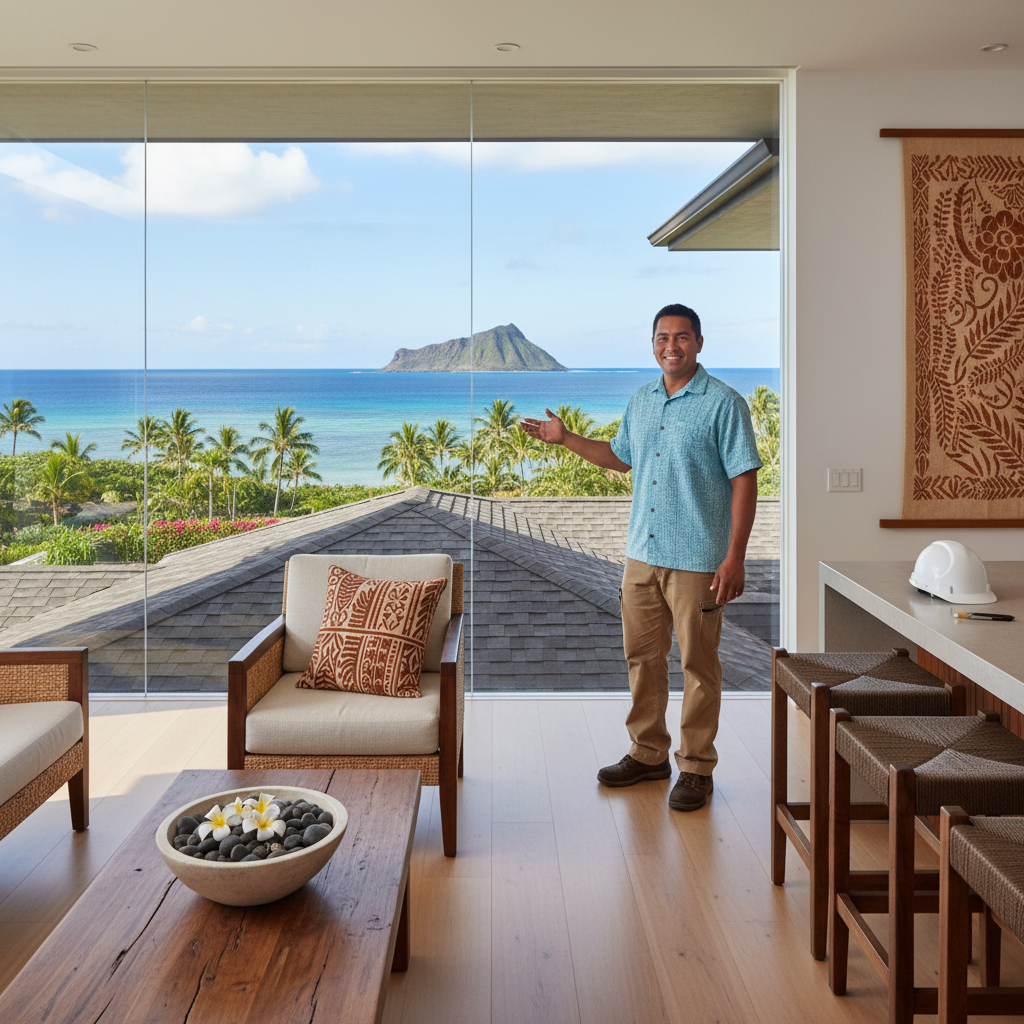
A roof in Kapa’a is not just a roof; it’s the first line of defense against a unique and demanding environment. As a contractor with decades of experience on Kaua’i’s windward side, we know that a one-size-fits-all approach fails every time. You have to build for the specific conditions of the location. Here are the critical factors we consider for every roofing project in Kapa’a.
Climate: Relentless Rain and Sun
Kapa’a sits on the windward side of the island, meaning it gets consistent trade winds and significant rainfall, especially in the winter months. This isn’t a light drizzle; it’s often heavy, wind-driven rain that will find any weakness in a roof system.
- High-Performance Underlayment: Standard roofing felt isn’t enough here. We exclusively use high-performance synthetic underlayment. It’s far more tear-resistant and provides a superior secondary water barrier if wind ever lifts a shingle. For metal roofs, we use a high-temp version that can withstand the heat transfer.
- Flashing is Everything: The most common leak points are around penetrations (vents, pipes) and in valleys. We use corrosion-resistant metal flashing and employ advanced techniques like open-valley systems with a continuous metal liner to channel water off the roof effectively.
- Intense UV Exposure: The Hawaiian sun is brutal and will degrade cheap roofing materials quickly. We recommend materials with high UV-reflectivity ratings (like light-colored metal roofs) or shingles with advanced granule technology that resists fading and degradation. This is a key part of `tropical roofing kapa’a`.
Materials: Battling Salt-Air Corrosion
If your home is anywhere near the ocean in Kapa’a—and most are—salt-air corrosion is your roof’s number one enemy. Salt spray is carried by the trade winds and deposits on every surface, where it accelerates rust and decay.
- The Right Metal: If you choose a metal roof, the type of coating is non-negotiable. Standard galvanized (G-60 or G-90) steel will show rust within 5-7 years. We only install steel panels with a Galvalume substrate coated in Kynar 500 or Hylar 5000 resin-based paint. This finish provides the best long-term protection against corrosion and fading and is backed by a real-world warranty that holds up in coastal environments.
- Stainless Steel Fasteners: The best metal panels in the world will fail if they are attached with cheap fasteners. The screws, clips, and nails must be 304 or 316-grade stainless steel. We’ve seen entire roofs compromised because a contractor tried to save a few hundred dollars by using zinc-coated screws that rusted out in a few years, causing panels to lift and leak.
Regulations: Hurricane Code is Law
Hurricane Iniki in 1992 was a defining event for Kaua’i, and its legacy is written into our building code. The regulations for roofing are designed to prevent the catastrophic failures seen during that storm. Complying isn’t optional; it’s the only way we build.
- Enhanced Fastening: The code specifies a high-wind nailing pattern, typically requiring six nails per shingle instead of the standard four. For metal roofs, the clip spacing is reduced to handle higher wind uplift pressures.
- Hurricane Ties: A strong roof is only as good as its connection to the house. The code requires metal connectors (hurricane straps or clips) at every connection point, from the rafter to the top plate of the wall, and all the way down to the foundation. During a re-roof, we inspect these ties and upgrade them if necessary to ensure a continuous load path.
- Perimeter and Corner Zones: Wind pressures are highest at the edges and corners of a roof. The building code requires enhanced fastening in these specific zones to prevent the wind from getting a foothold and peeling the roof back. We pay meticulous attention to these critical areas.
Choosing the right materials and following these regulations isn’t just about passing an inspection. It’s about giving you peace of mind that your home and family are protected when the next big storm rolls through.
How to Choose the Right Roofing Contractor in Kapa’a
Selecting a roofing contractor on Kaua’i is a decision that will impact your home for decades. A great contractor provides not just a product, but a service and a long-term relationship. A bad one can lead to endless headaches, costly repairs, and a roof that fails prematurely. Here is our checklist for vetting any contractor you consider for your Kapa’a home.
- Verify Their License and Credentials. This is the absolute first step. In Hawaii, any construction project over $1,000 requires a licensed contractor. You can and should verify any contractor’s license number on the Hawaii Department of Commerce and Consumer Affairs (DCCA) Professional & Vocational Licensing (PVL) website[2]. Our license, for instance, is BC-34373. Check that the license is active, in good standing, and that the company name matches exactly. Be wary of anyone operating without a license or using someone else’s.
- Confirm They Carry Proper Insurance. A valid license is just the start. The contractor must carry two key types of insurance: General Liability and Worker’s Compensation.
- General Liability protects your property from damage caused by the contractor’s work. Ask for a Certificate of Insurance (COI) that names you as an additional insured. A minimum of $1 million in coverage is standard.
- Worker’s Compensation covers their employees if they get injured on your property. Without it, you could be held liable for medical bills. Never hire a contractor who claims their workers are all “independent contractors” to get around this requirement.
- Ask About Their Kaua’i-Specific Experience. This is crucial. Ask them directly: How many roofs have you completed in Kapa’a or on the windward side? Do you have a full-time crew based on Kaua’i, or do you fly them in from O’ahu? Do you have accounts with local suppliers like Honsador or Home Depot? A contractor with a permanent presence on the island understands the local logistics, has relationships with the building department, and will be there to stand behind their work long after the project is done.
- Demand a Detailed, Written Proposal. A one-page estimate with a single price is a red flag. A professional proposal should be several pages long and include:
- A detailed scope of work (tear-off, sheathing inspection, underlayment, new roofing, flashing, cleanup).
- The specific brand and type of materials to be used (e.g., “GAF Timberline HDZ in Charcoal,” not just “asphalt shingles”).
- The cost per sheet for replacing any rotten or damaged plywood.
- Details on workmanship and material warranties.
- A clear payment schedule.
- An estimated start and completion date.
- Check Their Past Work and References. Don’t just rely on a glossy website. Ask for addresses of recent projects in your area that you can drive by. Ask for a list of 3-5 past clients you can call. When you call, ask about their communication, cleanliness of the job site, whether they stuck to the budget, and how they handled any unexpected issues. You can also view our completed projects in our online portfolio. A reputable contractor will be proud to share their work and connect you with happy customers.
Real Kapa’a Roofing Project Example
To make this tangible, let’s walk through a typical `roof replacement kapa’a` project our team at Warrior Construction recently completed in 2026. This case study illustrates the process and highlights the specific challenges of working on Kaua’i’s windward coast.
- The Property: A 2,200-square-foot, single-story home built in the 1990s, located about a half-mile from Kealia Beach. The home had its original architectural shingle roof, which was well past its lifespan.
- The Problem: The homeowners were experiencing several leaks during heavy rains. A visual inspection showed widespread granule loss on the shingles, algae growth, and heavily rusted flashing and fasteners—a classic case of salt-air corrosion. The existing roof was failing and not up to current hurricane codes.
- Our Recommendation: Given the home’s proximity to the ocean, we strongly recommended against another shingle roof. The best long-term investment was a 24-gauge standing seam metal roof with a Kynar 500 (PVDF) coastal paint finish in a light, reflective color. We specified 316 stainless steel clips and fasteners to eliminate the risk of future corrosion. This system would provide a 50+ year service life and superior protection against wind uplift.
- The Process in Action:
- Permitting & Logistics: We submitted the permit package to the Kaua’i Building Division, which took about 6 weeks for approval. Simultaneously, we ordered the custom-rolled metal panels from our supplier on O’ahu. The material took 4 weeks to be fabricated and shipped by barge to Nawiliwili Harbor.
- Tear-Off & Discovery: Once the permit was issued and materials were staged, our crew began the tear-off. As anticipated, we found moderate rot in the plywood sheathing around the roof edges and in one valley. In total, we replaced 8 sheets of 5/8″ pressure-treated plywood.
- Installation: Our team installed a high-temperature, self-adhering water and ice shield over the entire roof deck for maximum protection. Then, the new standing seam panels were installed using the specified stainless steel clips. We fabricated custom Z-bar flashing and counter-flashing for all penetrations to ensure a watertight seal.
- The Outcome:
- Timeline: The entire project, from contract signing to final inspection, took 12 weeks. The on-site work was completed in just 9 working days.
- Cost: The total project cost was approximately $89,200. This broke down to about $40 per square foot for the premium metal roof system ($88,000), plus an additional $1,080 for the 8 sheets of replacement plywood ($135/sheet). The homeowners were kept informed of the extra cost for the sheathing with a written change order, so there were no budget surprises.
The result was a beautiful, durable roof that dramatically improved the home’s curb appeal, increased its value, and provided the family with peace of mind knowing they have a system engineered to last for decades in Kapa’a’s demanding coastal climate.
What this means for Hawaii homeowners
For any homeowner in Kapa’a considering a roofing project in 2026, the details matter immensely. Your roof is the single most important barrier protecting your family and your investment from wind, rain, and sun. Choosing the cheapest bid without understanding the underlying materials and methods is a recipe for disaster in our climate. The key takeaway is to view your roof not as a commodity, but as an engineered system designed specifically for coastal Kaua’i.
Here are your actionable next steps:
- Prioritize Longevity Over Upfront Cost: A standing seam metal roof might cost 60-80% more than asphalt shingles initially, but its lifespan is often double. In a high-corrosion environment like Kapa’a, that initial investment often translates to a lower total cost of ownership over the life of your home. It means you do the job once, the right way.
- Insist on a Contractor Who Understands Hurricane Code: Don’t just ask if they are licensed. Ask them to explain how they meet Hawaii’s high-wind requirements. They should be able to talk confidently about nailing patterns, clip spacing, and the importance of a continuous load path with hurricane ties. If they can’t, they are not the right contractor for the job.
- Vet Your Contractor’s Local Experience: Ask for proof of their experience on Kaua’i. An O’ahu-based contractor might have a great reputation in Honolulu, but they may not have the logistical relationships or understanding of the unique conditions on the Garden Isle. We pride ourselves on being a trusted builder across all islands.
- Plan for the Real Timeline: Understand that in Hawaii, especially on a neighbor island, projects take time. A quality roof replacement will likely take 2-4 months from the day you sign the contract, with most of that time spent on permitting and material logistics. Be wary of any contractor who promises to start next week.
Ultimately, your goal is to hire a professional partner who will guide you through the process, install a system that will perform for decades, and be there to stand behind their work. Your roof is too important to leave to chance.
Frequently Asked Questions About Roofing in Kapa’a
How much does a simple roof repair in Kapa’a cost in 2026?
For a minor `roof repair kapa’a`, like replacing a few blown-off shingles or sealing a leaking vent flashing, you can expect a minimum service charge of $500 to $850. This typically covers the first hour or two of a skilled roofer’s time and materials. More extensive repairs, like fixing a damaged valley or replacing a small section of plywood, can cost between $1,500 and $3,000.
Can I just install a new roof over my old one to save money?
This is called a “roof-over” or “layover,” and we strongly advise against it in Hawaii. While it may be allowed in some mainland states, it’s a poor practice here. It traps moisture and heat, accelerating rot in the underlying structure. It also prevents a proper inspection of the roof deck for damage and makes it impossible to install a modern, high-performance underlayment correctly. A complete tear-off is the only way to ensure a long-lasting, code-compliant roof.
What is the best roofing material for Kaua’i’s rainy climate?
For maximum longevity and performance in a place like Kapa’a, a properly installed standing seam metal roof is the superior choice. The interlocking panels and concealed fasteners create a nearly impenetrable barrier to wind-driven rain. For homeowners on a tighter budget, modern architectural asphalt shingles from brands like GAF or CertainTeed are also an excellent option, provided they are installed with a high-wind nailing pattern and a premium synthetic underlayment.
How long should a new roof last in Kapa’a?
With professional installation and proper materials for our climate, you can expect a new architectural asphalt shingle roof to last 25 to 30 years. A high-quality standing seam metal roof with a Kynar 500 finish should last 40 to 50 years, or even longer. These lifespans assume the roof is installed correctly to handle salt air and high winds.
Does your estimate include hauling away the old roofing debris?
Yes, absolutely. Every proposal from Warrior Construction is all-inclusive. Our price includes the complete tear-off of your old roof, the rental of a dumpster, and all fees for hauling and disposing of the debris at the county landfill. We leave every job site clean and free of all construction materials.
Do you work in other parts of Kaua’i, like Princeville or Poipu?
Yes, our teams serve the entire island of Kaua’i. While the climate can vary slightly—Poipu is drier and Princeville can be even wetter than Kapa’a—the core principles of building to hurricane code and using corrosion-resistant materials remain the same. We have completed projects all over the island and are familiar with the specific conditions in each area.
What kind of warranty do you offer on a new roof?
We provide a comprehensive warranty package. First, you get the manufacturer’s material warranty, which can range from 30 years to a lifetime, depending on the product. More importantly, Warrior Construction provides its own workmanship warranty, typically for 10 years. This covers any issues related to the installation itself, giving you peace of mind that if a leak appears due to our work, we will be there to fix it.
Your roof is the most critical shield protecting your home from Kaua’i’s elements. Choosing the right contractor and the right materials isn’t just a repair—it’s a long-term investment in your property’s safety and value. At Warrior Construction, we bring decades of Hawaii-specific experience to every project, ensuring your roof is built not just to code, but to last.
If you’re ready to discuss your Kapa’a roofing project, our team is here to provide a detailed, transparent estimate. We’ll walk you through your options and engineer a roofing system that’s perfect for your home and budget. Learn more about our approach to building durable, storm-ready homes by exploring our hurricane-resistant construction services or reaching out to us for a no-obligation consultation today.