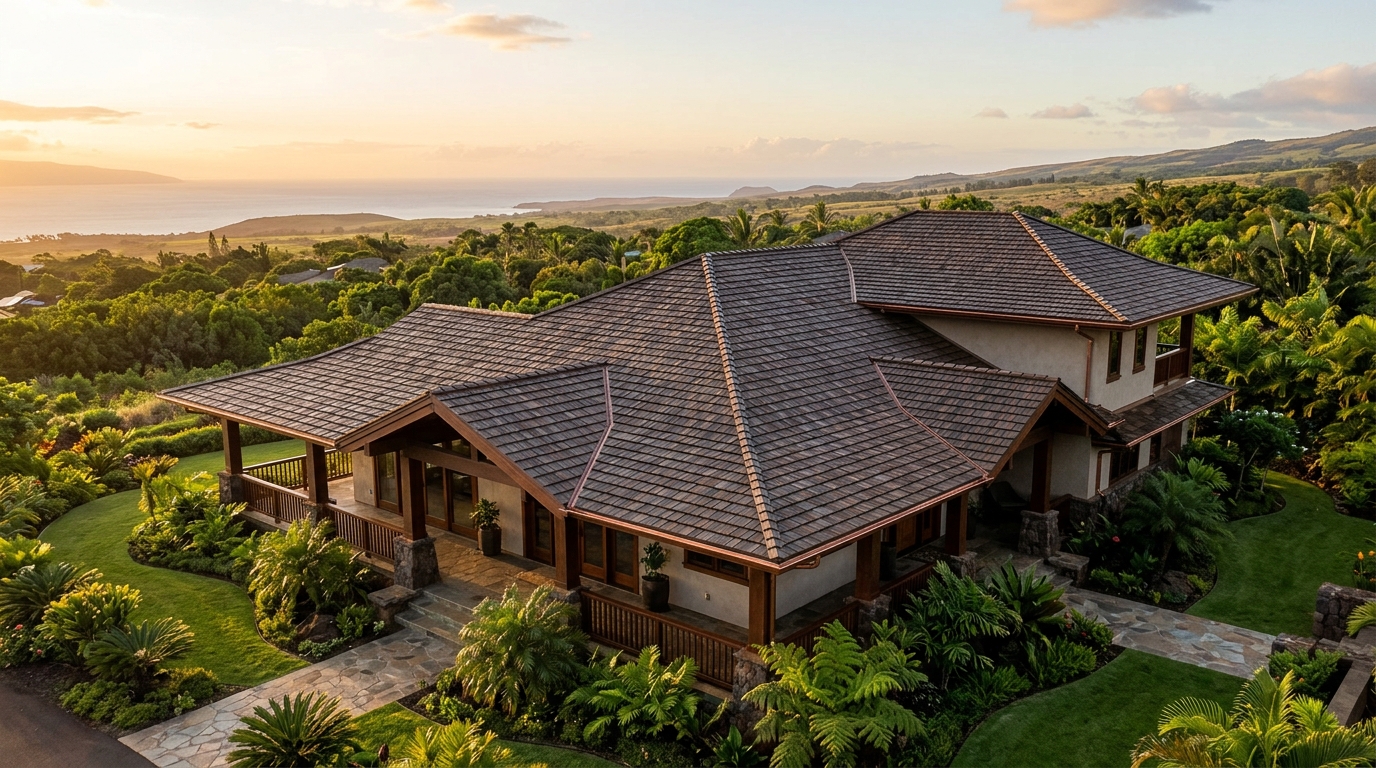
A roof replacement with a professional roofing contractor in Lanai City typically costs between $25 and $45 per square foot in 2026, including all materials, labor, and the significant expense of inter-island logistics. For a standard 1,800 square-foot home, this translates to a project cost of $45,000 to $81,000. The biggest variable isn’t the shingles or the nails; it’s the cost of getting every single component—and our skilled crew—over to the island on a barge. Here at Warrior Construction, we’ve spent over two decades navigating these neighbor island challenges, and we’ve learned that a successful Lanai City roofing project is 50% craftsmanship and 50% expert logistics management.
Working on Lana’i is a different world compared to a project in Honolulu or Kapolei. There’s no Home Depot to run to for a forgotten box of screws. Every piece of lumber, every roll of underlayment, every hurricane strap has to be meticulously planned, ordered weeks in advance, and shipped from Oahu. This reality dramatically impacts cost, timelines, and the type of contractor you can trust. A team that doesn’t have deep experience with neighbor island work can quickly turn a straightforward roof replacement into a logistical nightmare of delays and budget overruns.
This guide cuts through the noise. We’re going to share five real, actionable insights we’ve gained from years of managing complex projects on Lana’i and across Hawaii. You’ll learn the true costs beyond the materials, how to plan for realistic timelines, what makes a roof truly ready for our tropical climate, and how to spot a contractor who is genuinely prepared for the unique demands of working in Lanai City.
Why Lanai City Homeowners Trust Warrior Construction for Roofing
When you’re choosing a contractor for a project on Lana’i, you’re not just hiring a team to nail down shingles. You’re hiring a logistics partner. Our team at Warrior Construction (License BC-34373) has built a reputation on neighbor islands because we understand this fundamental truth. We’ve managed ground-up builds on Maui and complex renovations on Kauai, and each project has reinforced the same lesson: meticulous pre-planning is everything. For our Lanai City clients, this means we create a comprehensive material and equipment manifest weeks before we ever set foot on the island. We triple-check every item, from the specific gauge of standing seam metal panels to the exact number of stainless steel fasteners needed to combat potential salt-air corrosion.
Our approach is built on a deep understanding of Hawaii’s unique building challenges. We don’t apply mainland solutions to island problems. For example, we know the intense UV radiation in the Palawai Basin requires roofing materials with superior solar reflectivity and color retention, like a PVDF (Kynar 500) finish on a metal roof, which will prevent chalking and fading far longer than a cheaper SMP finish. This isn’t just an aesthetic choice; it’s a long-term value proposition for your home. We also build every roof to exceed the current hurricane code requirements, incorporating enhanced fastening patterns and robust underlayment systems as our standard practice—a lesson the entire Hawaii construction industry learned the hard way after Hurricane Iniki.
Furthermore, our status as a licensed general contractor, not just a roofing specialist, gives our clients a significant advantage. A roof replacement often uncovers hidden issues like rotted fascia boards, compromised structural framing, or termite damage. A simple roofing company might have to stop work and wait for another subcontractor. Our team has the in-house expertise to address these structural repairs immediately, keeping the project on track and ensuring the entire roofing system is sound from the rafters up. It’s this comprehensive capability and our proven track record of successful neighbor island projects that give Lanai City homeowners the confidence to partner with us.
What Does a Roof Replacement Cost in Lanai City?
In 2026, a complete roof replacement in Lanai City will cost between $35,000 for a simple 1,500 sq. ft. roof with architectural shingles and can exceed $90,000 for a larger 2,500 sq. ft. home with a premium standing seam metal roof and complex geometry. The single biggest factor driving these costs, unique to Lana’i, is logistics. We typically budget an additional 20-25% on top of Oahu-based project costs just to cover barge fees for materials and equipment, inter-island flights, and housing for our crew.
Let’s break down the costs for a typical 2,000 square-foot, single-story home in Lanai City to give you a clearer picture:
- Architectural Asphalt Shingles: This is the most common and budget-friendly option. Expect a total project cost of approximately $48,000 – $60,000. This includes tear-off of the old roof, any minor sheathing repairs, high-performance synthetic underlayment, new flashing, the shingles themselves, and all associated logistical costs.
- Standing Seam Metal Roofing: This is our most recommended option for longevity and hurricane resistance in Hawaii. For the same 2,000 sq. ft. home, the cost for a 24-gauge standing seam system would be around $75,000 – $95,000. While the upfront cost is higher, its 50+ year lifespan and superior performance against wind and sun make it a smarter long-term investment.
- Concrete or Clay Tile: Often seen on Mediterranean or Spanish-style homes, tile is very durable but also very heavy. This often requires a structural assessment and potentially reinforcement. The cost is comparable to metal, typically running $80,000 – $100,000+, with shipping weight being a major cost driver.
Beyond the primary material, several other factors influence the final price of a roof replacement lanai city project:
- Structural Repairs: If we remove the old roofing and find significant rot in the plywood sheathing or the roof trusses, repairs are essential. We budget a contingency for this, but widespread damage can add $5,000 to $15,000 or more to the project.
- Roof Complexity: A simple gable roof is far less expensive to work on than a roof with multiple valleys, dormers, and skylights. Each of these features requires more labor-intensive flashing and cutting, increasing costs by 10-20%.
- Underlayment Choice: The standard is a synthetic underlayment. Upgrading to a self-adhering “peel-and-stick” ice and water shield over the entire roof deck provides a superior secondary water barrier and can add $2.00 – $3.00 per square foot, or about $4,000-$6,000 to the project. We highly recommend this for homes in areas prone to wind-driven rain.
At Warrior Construction, our estimates for Lanai City are transparent and all-inclusive. We detail the logistical costs separately so you can see exactly where your money is going. Getting this right is key to a project that finishes on time and on budget.
How Long Does a Roofing Contractor Take in Lanai City?
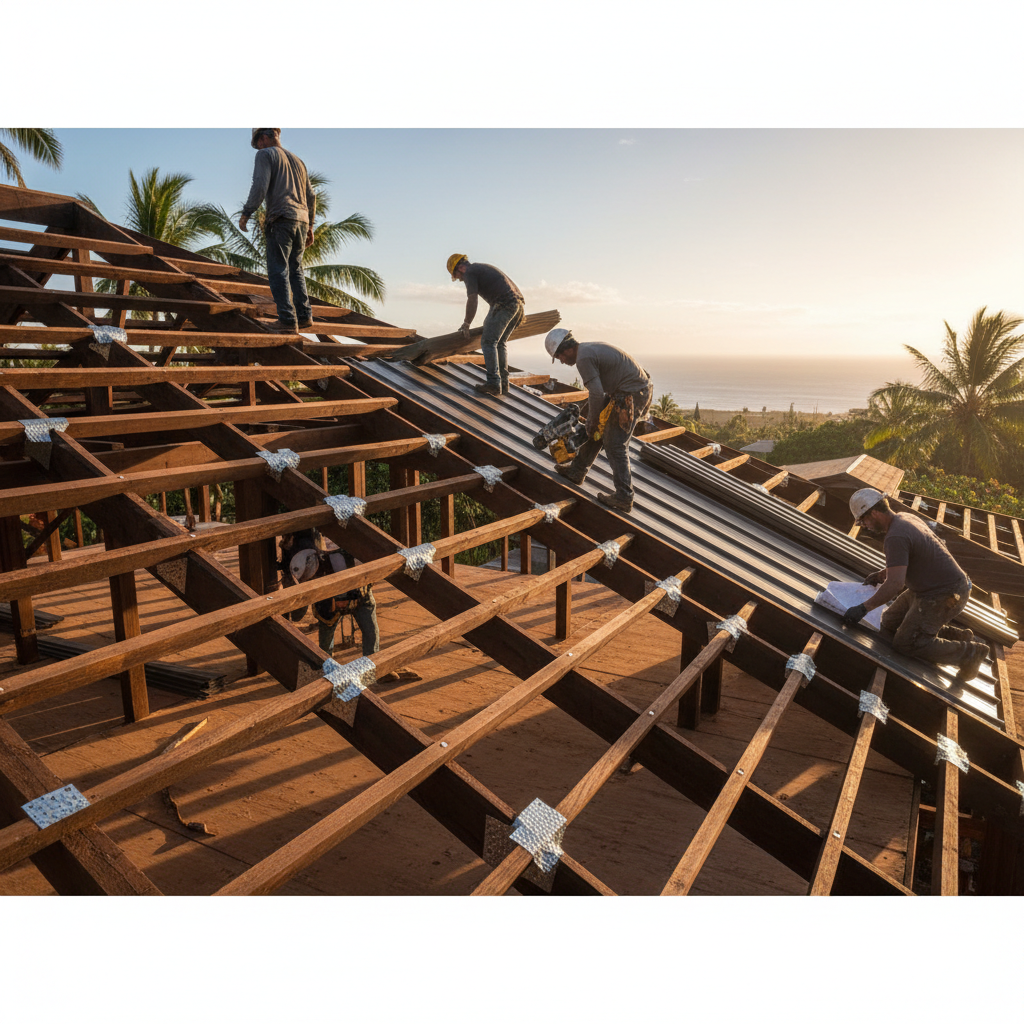
While the actual on-site work for a roof replacement on a standard Lanai City home might only take 7 to 12 days, the total project timeline from signing the contract to the final inspection is typically 10 to 16 weeks. The extended duration is almost entirely due to the front-end logistics of working on a neighbor island. Homeowners need to adjust their expectations from what might be typical on the mainland or even on Oahu.
Here’s a realistic breakdown of the phases for a Lanai City roofing project:
- Phase 1: Planning, Engineering, and Permitting (2-4 Weeks): Once you approve our proposal, we get to work on the formal plans. If any structural elements are changing, we may need an engineer’s stamp. We then submit the permit application to the Maui County Department of Public Works. While Maui County is generally efficient, this initial phase requires careful preparation of documents.
- Phase 2: Material Sourcing and Shipping (6-10 Weeks): This is the longest and most critical phase. Many roofing materials, especially specific colors of standing seam metal, are not stocked in Hawaii and must be ordered from the mainland. This can take 4-6 weeks alone. Once materials arrive in our Honolulu yard, we consolidate them into a dedicated container for shipment to Lana’i via Young Brothers. We have to book barge space in advance, and the schedule dictates our project start date. Rushing this step is the number one cause of costly project delays.
- Phase 3: On-Site Mobilization and Construction (1-2 Weeks): Once the container with all materials and equipment arrives on Lana’i, our crew flies over. This phase includes tearing off the old roof, making any necessary structural repairs, installing the new roofing system, and conducting a thorough cleanup. We work efficiently during this time because every day our crew is on-island incurs costs for lodging and per diem.
- Phase 4: Inspections and Project Closeout (1 Week): After our work is complete, we schedule the necessary inspections with a Maui County building inspector. Once we pass the final inspection, we can officially close out the permit and complete the project.
Compare this to a project in Kailua. We can have materials delivered from our local suppliers in a day or two. If we need something extra, we can get it within an hour. That flexibility doesn’t exist on Lana’i. A single forgotten tool or a shortage of 100 fasteners can halt the entire project for a week or more while we wait for the next barge. This is why our logistical planning is so rigorous and why a contractor without neighbor island experience can get into serious trouble.
What Permits Do You Need for Roofing in Lanai City?
For any significant roofing work in Lanai City, you will need a building permit issued by the Maui County Department of Public Works. Specifically, a permit is required if you are replacing or repairing more than one square of roofing (which is a 10-foot by 10-foot area, or 100 square feet) or if you are doing any work that involves structural components like trusses, rafters, or sheathing. A simple `roof repair lanai city` on a few shingles likely won’t need a permit, but a full replacement always will.
The permitting process in Hawaii’s counties, while having their own specific nuances, follows a similar framework. As a licensed general contractor, Warrior Construction manages this entire process for our clients. We prepare the architectural plans, fill out all the necessary application forms, and submit the package to the county. While the provided resource from Honolulu’s Department of Planning and Permitting (DPP)[1] outlines their specific system, the requirements for Maui County are conceptually the same: they need to see that the proposed work complies with the building code, especially regarding wind resistance and structural integrity.
Here’s what the permitting process generally entails for a Lanai City roofing project:
- Plan Preparation: We create detailed drawings showing the existing roof structure and the proposed new roofing system. This includes specifications for the type of material, the fastening pattern, the underlayment, and the flashing details.
- Application Submission: We submit the plans and application to Maui County. They will review them for compliance with the International Building Code and any local amendments. This review process can take anywhere from a few days to several weeks, depending on their workload.
- Permit Issuance: Once the plans are approved, the county issues a building permit. Work cannot legally begin until this permit is posted at the job site.
- Required Inspections: During the project, a county inspector will need to visit the site at key milestones. For roofing, this typically includes a “sheathing and nailing” inspection after the old roof is off but before the new underlayment goes on, and a final inspection once the project is complete.
Attempting to bypass the permitting process is a huge risk. It can lead to fines, stop-work orders, and major problems when you try to sell your home. More importantly, the permit and inspection process is a crucial form of consumer protection. It ensures that the work done by your contractor meets the minimum safety and quality standards set by the county, which is especially critical for something as important as your roof in a hurricane-prone region.
Lanai City-Specific Considerations: Climate, Materials, Regulations
A roof in Lanai City isn’t just a roof; it’s a shield against a unique set of environmental challenges. Unlike the misty, salt-heavy air of Windward Oahu, Lanai City’s climate is generally drier and sunnier. However, this brings its own demands for a proper `tropical roofing lanai city` system. At Warrior Construction, we engineer our roofing solutions specifically for the local microclimate.
Climate and Material Selection
The number one enemy of a roof in Lanai City is the relentless, high-altitude UV radiation. It breaks down materials, causes colors to fade, and cooks attics. This is why we are cautious about recommending standard asphalt shingles unless budget is the absolute primary concern. The granules wear off faster, and the asphalt becomes brittle, significantly shortening the roof’s effective lifespan from a stated 30 years to maybe 15-20 functional years.
Our top recommendation is almost always a 24-gauge standing seam metal roof with a full Kynar 500 (PVDF) paint finish. Here’s why:
- UV Resistance: The Kynar 500 finish is the industry gold standard for resisting color fade and chalking. A light-colored metal roof can reflect up to 70% of solar energy, keeping your home cooler and lowering your energy bills.
- Wind Resistance: Standing seam panels are interlocked and fastened with concealed clips, creating a monolithic surface that is extremely resistant to wind uplift, a key factor in our hurricane-prone state.
- Longevity: A properly installed metal roof will last 50 years or more on Lana’i, making it the most cost-effective solution over the life of your home.
While the center of Lanai City is somewhat shielded from direct coastal spray, `salt-air corrosion` is still a factor to consider for the entire island. We always specify G90 galvanized steel for metal roofing and use stainless steel fasteners and clips to prevent premature rusting and failure, especially for homes closer to the coast.
Regulations and Hurricane Code
Since Hurricane Iniki in 1992, Hawaii has adopted some of the most stringent building codes in the nation, particularly for roofing. Every roof we build, whether on Oahu or Lana’i, is designed to meet or exceed the latest `hurricane code`. This isn’t just about following the rules; it’s about protecting your family and your biggest investment.
Key hurricane-hardening features we incorporate include:
- Enhanced Nailing Patterns: We use more nails, spaced closer together, to secure the roof sheathing to the trusses. This is the first line of defense against the roof deck being peeled off in high winds.
- Hurricane Straps and Clips: We ensure that the connection from the roof trusses down to the walls is properly secured with metal connectors (straps or clips), creating a continuous load path to the foundation.
- Secondary Water Barrier: We strongly recommend a self-adhering membrane (peel-and-stick underlayment) across the entire roof deck. If shingles or panels are ever blown off, this layer remains as a waterproof barrier, preventing catastrophic water damage to your home’s interior.
While Oahu-specific regulations like Bill 7 (which governs ADUs) don’t directly apply, the statewide building code enforced by Maui County is just as rigorous when it comes to wind-resistant construction. Choosing a contractor who understands these codes inside and out is non-negotiable.
How to Choose the Right Roofing Contractor in Lanai City
Choosing a roofing contractor Lanai City homeowners can trust involves more than just picking the lowest bid. For a project on a neighbor island, your contractor’s experience with logistics is just as important as their roofing skill. A low bid from a company that has never worked on Lana’i can quickly balloon with unforeseen costs for shipping, travel, and project delays.
Here’s a checklist to vet any contractor for your Lanai City project:
1. Verify Licensing and Insurance
This is the absolute first step. Any contractor performing work over $1,000 in Hawaii must have a state-issued contractor’s license. You can and should verify their license status on the Hawaii Department of Commerce and Consumer Affairs (DCCA) Professional & Vocational Licensing (PVL) website[2]. Warrior Construction holds license BC-34373, which you can look up yourself. Additionally, demand proof of two key insurance policies:
- General Liability Insurance: This protects your property from damage caused by the contractor’s work. A minimum of $1 million in coverage is standard.
- Workers’ Compensation Insurance: This covers their employees if they are injured on your property. Without it, you could be held liable.
2. Ask for Specific Neighbor Island Experience
This is the critical differentiator. Don’t just ask, “Have you worked on a neighbor island?” Ask specific, probing questions:
- “Can you provide addresses or references for 2-3 projects you’ve completed on Lana’i or Moloka’i?”
- “How do you manage material shipments? Do you use a consolidator in Honolulu?”
- “What is your contingency plan if a material shipment is delayed or incorrect?”
- “Where does your crew stay while working on Lana’i, and how are those costs factored into the bid?”
A contractor with real experience will have immediate, confident answers. Hesitation or vague responses are a major red flag.
3. Analyze the Proposal in Detail
A professional proposal should be more than a single number. It should be a detailed document outlining the entire scope of work. Look for:
- Specific Materials: It should list the exact brand and type of shingle or metal panel, the underlayment, and the type of fasteners. “Architectural shingles” is not enough detail.
- Scope of Work: It should clearly state that the price includes tear-off of the existing roof, disposal of debris, sheathing inspection and replacement allowance, installation of new flashing, and all labor.
- Logistics Costs: A transparent bid for a Lana’i project will often break out the costs for shipping, barging, and crew travel.
Choosing the right partner is the most important decision you’ll make for your roofing project. Taking the time to properly vet your options will save you immense stress and money in the long run.
Real Lanai City Roofing Project Example
To make this tangible, let’s walk through a recent project we completed that’s typical for Lanai City. We were contacted by a homeowner with a 1,800 square-foot, single-story plantation-style home built in the late 1990s. Their original dark brown asphalt shingle roof was failing. It was brittle from 25+ years of sun exposure, had lost most of its granules, and had developed several persistent leaks that were staining the interior ceilings.
The Challenge: The homeowner wanted a permanent solution. They were tired of temporary patches and wanted a roof that would last for the rest of their time in the home, improve energy efficiency, and stand up to Hawaii’s weather. They also needed the project to be managed seamlessly, as they couldn’t be on-site every day.
Our Solution & Process:
After a thorough inspection, we recommended a complete `roof replacement lanai city` system. We specified a 24-gauge standing seam metal roof in a light, reflective “Stone White” Kynar 500 finish. This choice directly addressed their goals: the metal’s 50+ year lifespan provided the permanence they wanted, and the light color would significantly reduce heat absorption, lowering their cooling costs.
The project timeline was 12 weeks from contract signing to final inspection. The breakdown was:
- Weeks 1-2: Finalized plans and submitted the permit application to Maui County.
- Weeks 3-9: Placed the custom order for the metal panels from our mainland supplier. While waiting, we sourced all other materials (underlayment, fasteners, flashing, lumber for potential repairs) and consolidated them in a 20-foot container at our Honolulu yard. Once the metal panels arrived, they were added to the container.
- Week 10: Shipped the container on a Young Brothers barge to Kaumalapau Harbor on Lana’i.
- Weeks 11-12: Our four-person crew flew to Lanai City, transported the container to the job site, and began work. We tore off the old roof, replaced about 15% of the plywood sheathing due to past leaks, installed new hurricane straps to bring the home up to the current code, and then installed the full new metal roof system. The on-site portion took 9 working days.
The Numbers: The total, all-inclusive project cost was $68,500. This included all materials, labor, permits, taxes, and approximately $13,000 in dedicated logistical costs (barge fees, container rental, crew flights, and lodging).
The Outcome: The homeowner now has a beautiful, durable, and energy-efficient roof that is fully compliant with modern hurricane codes. They have peace of mind knowing the job was done right, with the logistical complexities handled professionally from start to finish.
What this means for Hawaii homeowners
For homeowners in Lanai City, replacing a roof is a major decision with a unique set of challenges that don’t exist in most other places. The key takeaway is that logistics and material choice are paramount. A cheap, poorly planned job will inevitably lead to costly failures and long-term frustration. You have to think differently about your roofing project and prioritize resilience and contractor experience over chasing the lowest possible upfront price.
Here are the immediate, actionable steps you should take if you’re considering a roof project on Lana’i in 2026:
- Budget for Logistics: When you start saving or planning for your new roof, mentally add 20-25% to any preliminary cost estimate you see online. This is a realistic buffer to account for the unavoidable costs of shipping materials and mobilizing a skilled crew to Lana’i.
- Prioritize Long-Term Materials: Given the high fixed costs of just getting a project started on Lana’i, it makes little financial sense to install a short-lived material like basic asphalt shingles. The cost difference to upgrade to a 50-year standing seam metal roof is a smart investment that pays for itself over time by avoiding a premature second replacement.
- Vet Contractors on Their Neighbor Island Process: Your most important interview question for any potential contractor should be, “Walk me through your exact process for a project on Lana’i.” Listen for details about material consolidation, barge scheduling, crew housing, and contingency planning. If they can’t answer this fluently, they are not the right partner for the job.
- Plan Far in Advance: A roof replacement on Lana’i cannot be done on short notice. Because of the 10-16 week timeline, you should start the process of getting estimates and selecting a contractor at least 4-6 months before you want the work to actually begin. This allows ample time for proper planning and material acquisition without rushing.
By approaching your roofing project with this mindset, you can navigate the unique challenges of building on Lana’i and ensure you get a high-quality, long-lasting roof that protects your home for decades to come.
Frequently Asked Questions About Roofing in Lanai City
How much does a simple roof repair cost on Lana’i?
A simple roof repair in Lanai City, like sealing a leaking flashing or replacing a few blown-off shingles, is disproportionately expensive due to travel costs. Expect a minimum service charge of $1,500 to $2,500 for a qualified team to come from Oahu or Maui for a one-day job. This covers flights, travel time, and the repair itself. This is why we encourage bundling repairs with other projects if possible.
Is a metal roof too noisy in the rain?
This is a common myth. Modern metal roofs installed over a solid plywood deck with a quality underlayment are not significantly louder than an asphalt shingle roof. The noise is dampened by the sheathing and the attic insulation below. The sound is more of a gentle pitter-patter than the loud drumming on an old corrugated tin roof over open purlins.
What’s the best color for a roof in Lanai City for energy efficiency?
Lighter colors are always better for energy efficiency in Hawaii’s climate. Whites, beiges, light grays, and light blues reflect the most solar radiation, which keeps your attic and home cooler. Look for materials with a high Solar Reflectance Index (SRI) rating. A high-SRI standing seam metal roof can reduce your home’s cooling costs by up to 20% compared to a dark asphalt shingle roof.
Can I get a roofing estimate remotely?
Yes, we can often provide a very accurate preliminary estimate remotely. Using high-resolution satellite imagery and online tools, we can measure your roof’s dimensions and complexity. We’ll then have a detailed video call with you to discuss material options and logistics. For a final, binding contract, we will typically need to schedule an in-person site visit to confirm all measurements and assess the underlying structure.
What warranties should I expect from a roofing contractor in Lanai City?
You should expect two separate warranties. The first is the manufacturer’s warranty on the materials, which can range from 30 years for architectural shingles to 40-50 years for a Kynar 500 metal finish. The second, and arguably more important, is the contractor’s workmanship warranty. At Warrior Construction, we provide a comprehensive workmanship warranty that covers any issues related to installation quality, typically for 5 to 10 years.
How does the lack of big box stores on Lana’i affect my roofing project?
It has a massive impact and is the primary reason for our intensive pre-planning. On Oahu, we can run to a supplier if we’re short a few pieces of flashing. On Lana’i, every single nail, screw, sealant tube, and tool must be packed in the container before it leaves Honolulu. A simple oversight can cause a week-long delay and thousands in extra costs waiting for the next barge, which is why hiring a contractor with proven neighbor island logistics experience is critical.
Does my homeowner’s insurance cover a roof replacement due to age?
Generally, no. Standard homeowner’s insurance policies do not cover replacing a roof simply because it is old and has reached the end of its natural service life. Insurance is designed to cover sudden, accidental, or unforeseen damage, such as from a hurricane, a fire, or a fallen tree. A roof that fails due to age and normal wear-and-tear is considered a homeowner maintenance responsibility.
Navigating a roof replacement on Lana’i requires a partner who understands both high-performance tropical building science and the realities of inter-island logistics. At Warrior Construction, we bring over two decades of experience to ensure your project is built to last, on time, and on budget. Our focus on detailed planning and quality installation means you get a roof that not only looks great but provides true, long-term protection for your home.
If you’re ready to discuss a roof that can withstand the unique challenges of Lanai City, our team is here to help. We can provide a detailed assessment and a transparent, all-inclusive estimate for your project. Learn more about our commitment to building resilient, hurricane-ready homes by exploring our Hurricane-Resistant Construction services or reach out today to schedule your consultation.