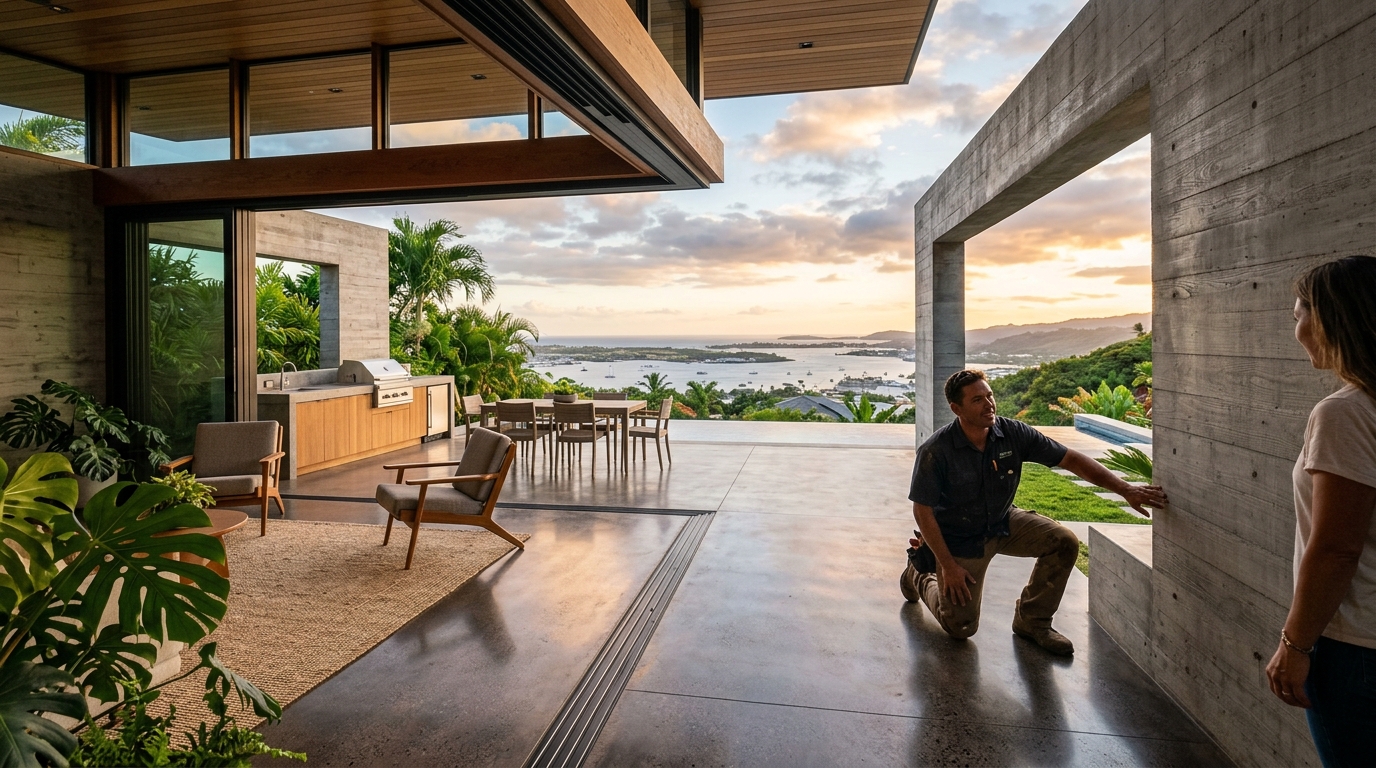
As a leading concrete contractor in Pearl City, the first thing we tell homeowners is that concrete work here isn’t like on the mainland. From the red volcanic soil to the persistent humidity and strict hurricane codes, getting it right demands local expertise. Your driveway, foundation, or retaining wall is a long-term investment in your home’s safety and value, and cutting corners is the most expensive mistake you can make. At Warrior Construction, we’ve spent over two decades pouring concrete across O’ahu, and we’ve seen firsthand what happens when jobs are rushed or done with the wrong materials for our island environment. It’s not just about mixing cement and water; it’s about understanding how our unique climate affects curing, how to properly prep soil that can shift, and how to navigate the permitting process at the Honolulu DPP without waiting a year.
Many homes in Pearl City, especially in the older neighborhoods up the ridge, were built decades ago. We often find that existing slabs are cracked, retaining walls are failing, or foundations need significant reinforcement to meet modern standards. This isn’t just an aesthetic issue; it’s a structural one. Whether you’re planning a new addition, replacing a crumbling driveway, or shoring up a hillside, the concrete work is the literal foundation of the project. Our goal with this guide is to share some of our on-the-job knowledge gained from years of working right here in your community. We’ll break down the real costs you can expect in 2026, walk you through the often-confusing permitting process, and give you the right questions to ask any contractor you’re considering. This is about giving you the confidence to make a smart, informed decision for your property.
Why Pearl City Homeowners Trust Warrior Construction for Concrete Contractor
Choosing a concrete contractor in Pearl City goes beyond finding someone who can pour a slab. You need a team that understands the ground beneath your feet. The soil composition in areas like Manana and Waiau can be tricky, with expansive clay that requires specific sub-base preparation to prevent cracking down the road. This isn’t something a mainland-trained crew would necessarily know. Our team at Warrior Construction (License BC-34373) brings over 20 years of specific, on-the-ground O’ahu experience to every project. We’ve managed everything from complex hillside foundations in Aiea Heights to simple driveway replacements near Pearlridge.
For example, on a recent project building a new `concrete foundation pearl city` for an ohana unit, the homeowner had plans drawn up by an off-island architect. The plans were beautiful but didn’t account for the specific grading and drainage requirements of their lot, which had a significant slope. We identified the issue during our pre-construction review, worked with a local structural engineer to revise the foundation plan, and incorporated a French drain system to manage water runoff. The initial contractor the homeowner spoke with was just going to build to the original plan, which would have led to major water intrusion issues within the first year. That’s the kind of local knowledge that saves you tens of thousands of dollars and countless headaches.
Here’s what sets us apart:
- Local Licensing and Insurance: We are a fully licensed and insured general contractor in the state of Hawaii. You can verify our license, BC-34373, on the Department of Commerce and Consumer Affairs website[1]. This protects you and ensures we adhere to all state and county building codes.
- Deep Permitting Knowledge: The Honolulu Department of Planning and Permitting (DPP) has its own unique rhythm. We have a dedicated team member who handles our permit applications, and we know the reviewers and the process inside and out. This helps us anticipate potential roadblocks and keep projects on schedule.
- Materials Expertise: We know which concrete mix designs work best for Hawaii’s humid climate and which types of rebar and sealant resist salt-air corrosion. We source our materials from trusted local suppliers like Hawaiian Cement and Grace Pacific, ensuring quality and consistency.
- Transparent Communication: You’ll never be in the dark about your project. We provide detailed, itemized estimates and maintain open lines of communication from the first handshake to the final walkthrough.
Ultimately, trust is built on a track record of successful projects. Our portfolio speaks for itself, but it’s the long-term performance of our work that truly matters. A driveway we poured ten years ago in Pearl City still looks great because we focused on the prep work and used the right materials. That’s the Warrior Construction difference.
What Does Concrete Contractor Cost in Pearl City?
Let’s get straight to the numbers. In 2026, the cost of concrete work in Pearl City is driven by three main factors: on-island material costs (everything is shipped in), high demand for skilled labor, and the engineering required to meet our building codes. Providing a vague “it depends” answer doesn’t help you budget, so here are the real-world figures our team uses for estimates on O’ahu.
For a standard project, you should budget based on the type of work. A simple broom-finished concrete slab, like for a patio or walkway, will be the most affordable. Things get more expensive when you add thickness, significant steel reinforcement (rebar), complex formwork for curves or steps, or extensive site preparation for a proper `concrete foundation pearl city`.
Here’s a breakdown of typical 2026 costs in Pearl City:
- Standard Driveway or Patio Slab (4″ thick with light rebar): Expect to pay between $18 to $25 per square foot. For a typical two-car driveway of about 600 square feet, this translates to $10,800 – $15,000. This includes basic excavation, a gravel sub-base, formwork, rebar, concrete pour, and a broom finish.
- Structural Foundation Slab (6″ thick with engineered rebar): For a new home or a large addition, the cost increases to $28 to $40 per square foot. This is due to the thicker slab, heavier and more complex rebar grid, integrated footings, and potential for vapor barriers and termite treatment. A 1,500 sq. ft. foundation could range from $42,000 to $60,000.
- CMU Retaining Walls (Hollow Tile): The cost for a `retaining wall pearl city` is usually calculated per linear foot and depends heavily on height. A 4-foot high wall will cost around $120 to $180 per linear foot. A 6-foot high engineered wall could be closer to $200 to $275 per linear foot. This includes excavation, a concrete footing, CMU blocks, rebar reinforcement, grout fill, and waterproofing.
- Demolition and Removal: If we’re replacing an old, cracked driveway, add $4 to $7 per square foot for breaking up the old concrete and hauling it away.
Sample Project Cost Comparison: Pearl City
| Project Type | Typical Size | Estimated Cost per SqFt/LinFt | Total Estimated Cost (2026) |
|---|---|---|---|
| Driveway Replacement | 600 sq. ft. | $18 – $25/sq. ft. (+ Demo) | $13,200 – $19,200 |
| New Home Foundation | 1,500 sq. ft. | $28 – $40/sq. ft. | $42,000 – $60,000 |
| Backyard Retaining Wall | 50 linear feet (4′ high) | $120 – $180/lin. ft. | $6,000 – $9,000 |
These figures can be influenced by site access (can a concrete truck get close, or do we need to pump it?), soil conditions (extensive excavation or fill adds cost), and the level of finish (stamped or colored concrete is more expensive than a simple broom finish). The key is to get an itemized quote that clearly separates labor, materials, permitting, and any other associated costs. That’s how we do it at Warrior Construction, so you know exactly where your money is going.
How Long Does a Concrete Contractor Take in Pearl City?
Time is a critical factor for any construction project, and concrete work is no exception. Homeowners are often surprised that the actual concrete pour is one of the shortest parts of the process. The real time is spent in planning, permitting, and preparation. In Pearl City, you have to factor in the Honolulu DPP’s review timeline, which has been notoriously slow in recent years.
Here’s a realistic timeline for a typical concrete project on O’ahu in 2026:
- Initial Consultation & Design (1-2 weeks): This is where we meet with you, assess the site, understand your goals, and develop a preliminary plan. For anything structural like a foundation or a retaining wall over four feet, this phase includes engaging a structural engineer.
- Engineering & Permitting (8-16 weeks): This is often the longest and most unpredictable phase. The engineer will create detailed plans, which we then submit to the DPP. A simple `driveway concrete pearl city` permit might move faster, but a new foundation or a complex retaining wall will require a full plan review. We budget for at least two to four months for this step alone. Rushing this is not an option.
- Site Preparation & Formwork (1-2 weeks): Once the permit is in hand, our crew gets to work. This involves excavation, grading the site, laying down and compacting the gravel sub-base, installing any necessary plumbing or electrical conduits that go under the slab, and meticulously building the wooden forms that will hold the wet concrete.
- Rebar Installation & Inspection (2-4 days): We carefully place and tie the steel rebar grid according to the engineering plans. Before we can pour, a city inspector must visit the site and sign off on the rebar placement and formwork. This is a critical checkpoint.
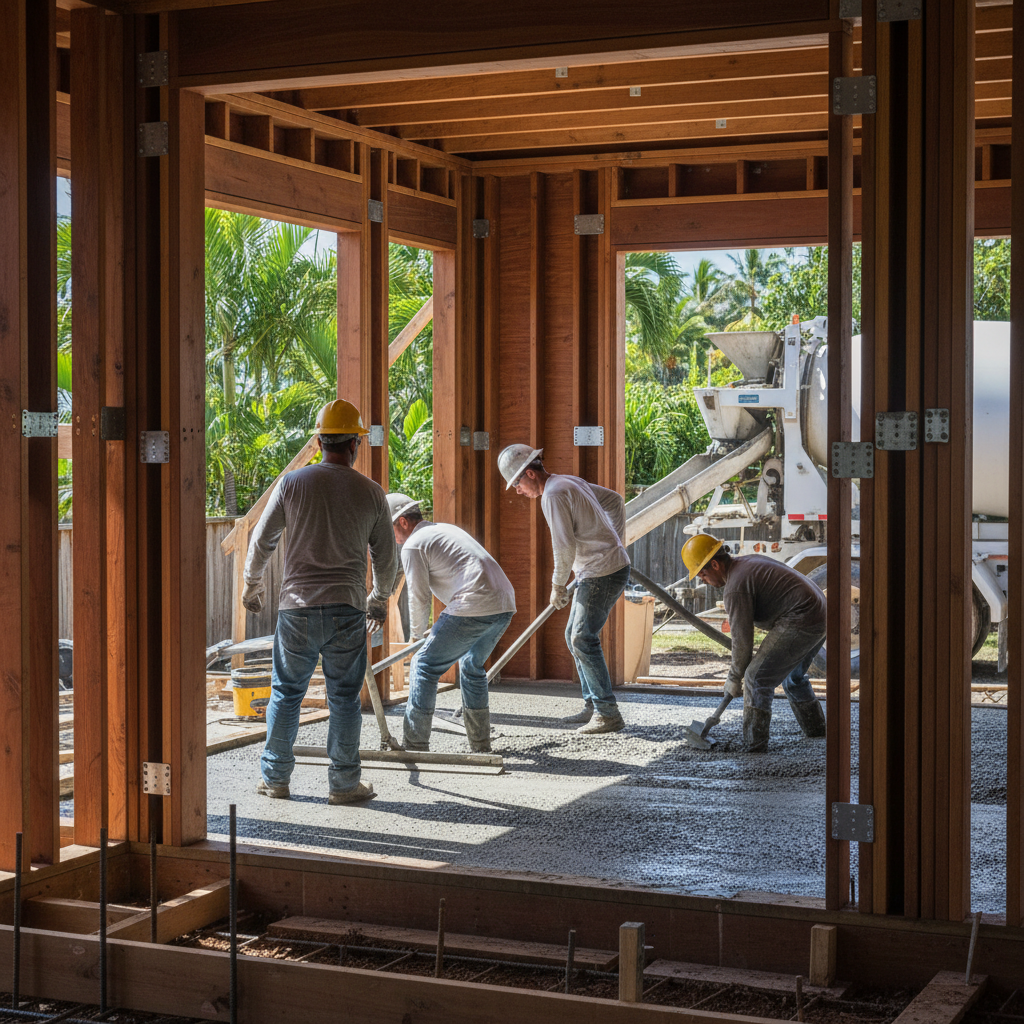
- The Concrete Pour (1 day): The concrete truck arrives, and we pour, spread, and level the concrete. For a large pour, this is an all-hands-on-deck day to ensure everything is done quickly and correctly before the concrete starts to set.
- Finishing & Curing (1-28 days): Immediately after the pour, we apply the final finish (e.g., broom, trowel, or stamped). Then, the most important and patient part begins: curing. While the concrete will be hard enough to walk on in a day or two, it doesn’t reach its full design strength for about 28 days. We take specific steps to control moisture during this period to ensure maximum durability.
So, for a relatively simple driveway replacement that requires a permit, the total project time from signing the contract to being able to park your car on it is realistically 3 to 5 months. A new home foundation will be on the longer end of that, closer to 4 to 6 months, because of the more complex engineering and inspection process. Patience, especially with the permitting stage, is key.
What Permits Do You Need for Concrete Contractor in Pearl City?
Navigating the permitting process with the Honolulu Department of Planning and Permitting (DPP) is one of the most significant challenges for any construction project on O’ahu. Many homeowners assume small concrete jobs don’t need a permit, but that’s a risky assumption that can lead to fines, stop-work orders, and problems when you eventually sell your home. As a licensed general contractor, we handle this entire process, but it’s important for you to understand what’s required.
Here’s the general rule of thumb from the DPP[2]: if the concrete work is structural, it needs a permit. If it’s purely flatwork for cosmetic purposes and doesn’t support anything, you might not. But the lines can be blurry.
Projects that almost always require a permit in Pearl City:
- New Foundations: Any new `concrete foundation pearl city` for a home, addition, or ADU absolutely requires a full building permit with stamped engineering plans.
- Retaining Walls: Any retaining wall over 4 feet in height (measured from the bottom of the footing to the top of the wall) requires a permit and engineered drawings. Even smaller walls near a property line might trigger a permit requirement.
- Driveways and Slabs: A permit is typically required if you are creating a new driveway, expanding an existing one, or pouring a slab that will support a structure like a carport or a large, covered lanai. Simply replacing an existing driveway of the same size sometimes falls into a repair category, but it’s always best to check with the DPP.
- Structural Repairs: If we are repairing spalling concrete on columns or post-and-pier foundations, that is considered a structural repair and requires a permit.
Projects that may not require a permit:
- Small Patios or Walkways: A small, on-grade concrete patio in your backyard that isn’t attached to the house foundation and doesn’t have a roof structure over it generally does not require a permit.
- Minor Crack Repair: Filling minor cracks in an existing slab is considered maintenance and does not require a permit.
The process involves submitting architectural and structural plans to the DPP for review. They check for compliance with the building code, zoning regulations (like setbacks from property lines), and other city ordinances. For example, they’ll verify that a new driveway or patio doesn’t cause you to exceed your lot’s maximum allowable coverage. This process is meticulous and can take several months. A good contractor will have experience packaging these submittals correctly to minimize back-and-forth with the plan reviewers. Trying to do work without a required permit is a serious gamble. If a neighbor complains or an inspector drives by, you could be forced to tear out all the work and start over, with significant fines on top.
Pearl City-Specific Considerations: Climate, Materials, Regulations
Building in Hawaii is unlike anywhere else, and Pearl City has its own set of environmental and regulatory factors that a good concrete contractor must master. These aren’t just minor details; they are fundamental to the longevity and safety of the work.
Climate and Environment
While not directly on the coast like Kailua, Pearl City still experiences high humidity and significant rainfall, especially in the winter months. This affects concrete in two primary ways:
- Curing Process: High humidity can slow down the evaporation of water from the surface of fresh concrete. This can be a good thing, promoting a slower, stronger cure (a process called hydration). However, a sudden downpour during a pour can be disastrous, washing away the cement paste from the surface and weakening the final product. We constantly monitor the weather and may use additives in the concrete mix called accelerators or retarders to control the setting time based on the day’s forecast.
- Corrosion: The air in Hawaii is always laden with some amount of salt, even in central O’ahu. This salt attacks the steel rebar inside concrete, causing it to rust and expand. This expansion cracks the concrete from within, a process known as spalling. To combat this, the building code mandates a minimum amount of concrete cover over the rebar—typically 3 inches for foundations—and we often recommend using epoxy-coated rebar or adding a corrosion-inhibiting admixture to the concrete mix for critical structural elements.
Materials and Logistics
Every single component of concrete—cement, sand, aggregate (rock), and steel rebar—is either manufactured on-island or shipped here at great expense. This is a primary driver of cost. There are no surprise runs to a mainland quarry for more material. A skilled contractor plans meticulously.
- Aggregate Quality: The volcanic rock aggregate available on O’ahu is excellent for making strong concrete, but its properties must be understood by the mix designer. We work with our suppliers to ensure the mix design is optimized for the specific type of pour, whether it’s for a high-strength foundation or a more workable slab.
- Supply Chain: While we have local concrete plants, any specialty items, from specific admixtures to epoxy coatings, are subject to Pacific shipping schedules. We learned during the supply chain disruptions of the last few years to order materials well in advance to avoid project delays. A two-week delay waiting for a specific type of rebar can throw an entire project timeline off course.
Local Regulations
Beyond the standard building permits, there are other rules in play:
- Hurricane Codes: Ever since Hurricane Iniki in 1992, Hawaii’s building codes have been some of the strictest in the nation regarding wind resistance. For concrete, this primarily impacts foundations. The code dictates the size and depth of footings and the specific types of steel connectors (like hurricane straps) that must be embedded in the concrete to tie the foundation to the walls and roof structure.
- Bill 7 and Lot Coverage: In 2022, Honolulu passed Bill 7 to regulate large “monster homes.” While aimed at new builds, it has implications for concrete work. It tightened the rules on how much of your lot can be covered by impermeable surfaces. Adding a large new patio or driveway could push you over the limit, so we always perform a zoning check as part of our initial project assessment.
A contractor who doesn’t understand these local nuances is learning on your dime. Our deep roots in Hawaii construction mean these considerations are second nature to our planning process.
How to Choose the Right Concrete Contractor Contractor in Pearl City
Hiring the right concrete contractor is the single most important decision you’ll make for your project. A great contractor ensures the job is done safely, to code, and will last for decades. A bad one can leave you with a cracked, unsafe liability that costs a fortune to fix. Here’s a checklist to use when vetting potential contractors in Pearl City.
- Verify Their License and Insurance. This is non-negotiable. Ask for their contractor’s license number (ours is BC-34373) and verify it on the Hawaii DCCA Professional & Vocational Licensing (PVL) website[1]. The site will show if the license is active and if there are any complaints against them. Also, ask for a Certificate of Insurance showing they carry both General Liability and Worker’s Compensation. If an uninsured worker gets hurt on your property, you could be held liable.
- Look for Local Experience. Ask them about specific projects they’ve completed in Pearl City, Aiea, or nearby areas. Can they talk intelligently about the soil conditions on the Waipio peninsula or the permitting quirks for hillside lots above Kaahumanu Street? A portfolio of beautiful projects in Kailua is nice, but experience in your specific area is better.
- Get a Detailed, Itemized Bid. Never accept a one-line quote or a verbal estimate. A professional bid will break down the costs for demolition, site prep, materials (specifying concrete strength, or PSI), labor, rebar, finishing, cleanup, and permit fees. This transparency prevents surprise charges later and allows you to compare bids on an apples-to-apples basis. Be wary of a bid that is significantly lower than others; it often means they are cutting corners on materials, insurance, or proper site prep.
- Check Their References. Don’t just ask for a list of happy clients. Ask for the contact information of their last three clients. Call them and ask specific questions: Did the project stay on budget? Was the crew professional and clean? How did they handle unexpected issues? Were you happy with the final result? A reputable contractor will be proud to share their references.
- Discuss the Project Plan. A good contractor should be able to walk you through the entire process. How will they protect the rest of your property during demolition and pouring? What is their plan for daily cleanup? What is the expected timeline, and how will they communicate delays? Their answers will reveal their level of professionalism and experience.
The contractor you choose becomes your partner for the duration of the project. You should feel comfortable with their communication style and confident in their expertise. Take your time with this decision; it will pay dividends in the quality of the finished product.
Real Pearl City Concrete Contractor Project Example
To make this all more concrete (pun intended), let’s walk through a typical project we handled recently. A homeowner on Hoolaulea Street in Pearl City had an old, cracked asphalt driveway that was a neighborhood eyesore and a tripping hazard. Their goal was simple: a new, durable, and clean-looking `driveway concrete pearl city` that would last for the next 30 years.
The Problem: The existing 550-square-foot driveway was badly deteriorated. Tree roots from a nearby monkeypod tree had pushed up sections, and years of use had created a web of cracks. It also had poor drainage, causing water to pool near the garage during heavy rains.
Our Solution and Process:
- Phase 1: Planning & Permitting (6 weeks): Because we were changing the slope slightly for drainage and it was a full replacement, a simple building permit was required. We submitted the application to the DPP with a site plan showing the new dimensions and drainage plan.
- Phase 2: Demolition & Site Prep (3 days): Once the permit was approved, our crew came in. We used a bobcat with a breaker attachment to demolish the old asphalt. We hauled away all debris and then excavated an additional 6 inches of soil. We identified and trimmed the problematic tree roots and installed a root barrier to prevent future issues. Then, we brought in 4 inches of compacted gravel (CSB) to create a solid, stable base.
- Phase 3: Formwork & Rebar (2 days): We built the wooden forms, carefully ensuring the new slope would direct water away from the garage and towards the street. We then installed a grid of #3 rebar, spaced at 18 inches on-center, and used plastic ‘chairs’ to hold it in the middle of the slab where it provides the most tensile strength.
- Phase 4: Pour & Finish (1 day): We poured 8 cubic yards of 3000 PSI concrete. Our finishers expertly screeded it level, bull-floated the surface, and then applied a standard broom finish for traction. We also cut control joints to encourage any future cracking to happen in a controlled, straight line.
The Results:
- Timeline: The total project, from permit submission to final cure, took about 8 weeks. The on-site work was completed in just under a week.
- Cost: The total project cost was approximately $12,500. This broke down to about $2,200 for demolition/hauling and $10,300 for the new concrete work ($18.70 per square foot).
- Outcome: The homeowner now has a safe, beautiful, and functional driveway that enhances their home’s curb appeal and will stand up to the elements for decades. The drainage issue is completely resolved.
This project highlights the importance of addressing the root cause of the problem (literally, in this case) and not just putting a new surface on a bad foundation. Proper preparation is everything in concrete work.
What this means for Hawaii homeowners
For a homeowner in Pearl City, this all boils down to a few key principles. Concrete work is not a place to look for the cheapest bid. The potential cost of failure—a cracked foundation, a collapsed retaining wall—is immense, both financially and in terms of your family’s safety. Your focus should be on finding a qualified, experienced, and trustworthy partner.
Here’s your action plan:
- Budget Realistically: Use the cost figures we’ve provided ($18-$25/sqft for driveways, $28-$40/sqft for foundations) to create a realistic budget for your project in 2026. Remember to account for a 10% contingency for unforeseen issues, especially on older properties.
- Plan for the Timeline: Understand that professional, permitted work takes time. The 8-16 week wait for DPP permits is a reality on O’ahu. Start the process well before you want the work to be completed.
- Do Your Homework: Vet any contractor thoroughly. Use the DCCA’s website to check their license[1], demand proof of insurance, and call their recent references. Don’t be afraid to ask tough questions about their experience with Pearl City’s specific conditions.
- Insist on a Detailed Contract: Your contract should clearly specify the scope of work, materials to be used (including concrete strength), payment schedule, and timeline. This document protects both you and the contractor and ensures everyone is on the same page.
Investing in quality concrete work is investing in the core of your home. By taking a measured, informed approach, you can ensure your project is a lasting success.
Frequently Asked Questions About Concrete Contractor in Pearl City
Do I need a special concrete mix for Hawaii’s climate?
Yes, absolutely. We typically specify a concrete mix with a lower water-to-cement ratio to increase strength and durability in our humid environment. For projects near the coast or with high moisture exposure, we often add a corrosion-inhibiting admixture to protect the internal rebar from salt and moisture, significantly extending the life of the concrete structure.
How much does it cost to replace a 500 sq ft driveway in Pearl City?
In 2026, you should budget between $11,000 and $16,000 for a full replacement. This includes about $2,000-$3,500 for demolition and hauling of the old driveway, and $9,000-$12,500 for the new 4-inch thick, broom-finished concrete slab with rebar reinforcement. Costs can increase if there is difficult site access or significant grading required.
Can you pour concrete over an existing cracked slab?
We strongly advise against it. Pouring a thin layer of new concrete over a cracked base is a temporary, cosmetic fix. The cracks from the old slab will almost always transfer up into the new layer within a year or two, a process called reflective cracking. The proper, long-term solution is to demolish the old slab and pour a new one on a properly prepared and compacted base.
How long do I have to wait before I can drive on my new driveway?
You can typically walk on the new concrete after 24-48 hours. However, we recommend waiting a minimum of 7 full days before driving a standard passenger car on it. For heavier vehicles like a large truck or SUV, it’s best to wait 10-14 days. The concrete doesn’t reach its full 99% design strength until 28 days of curing.
Is a poured concrete retaining wall better than a CMU (cinder block) wall?
Both can be excellent solutions when engineered and built correctly. A poured concrete wall is monolithically stronger and can be formed into curves, but it’s generally more expensive due to the extensive formwork required. A CMU block wall is more common for residential projects in Hawaii. It’s cost-effective and, when properly reinforced with rebar and filled with grout, is incredibly strong and durable for most residential applications.
Does my concrete foundation need termite treatment?
Yes. While the concrete itself is impervious to termites, they can travel through tiny cracks or utility penetrations to get to the wood framing of your house. Hawaii building code requires preventative termite treatment for new foundations. This usually involves treating the soil beneath the slab before the pour (ground treatment) and sometimes installing a physical pest barrier.
What is the difference between a quote and an estimate?
An estimate is a rough approximation of cost, often given early in the process. A quote, which is what we provide at Warrior Construction, is a firm, detailed price for a precisely defined scope of work. It is based on a thorough site visit, material takeoffs, and labor calculations. You should always get a formal quote in writing before signing a contract for any significant construction work.
The foundation of your home, the driveway you park on every day, the retaining wall holding back your yard—these are critical elements of your property. Getting them right requires a contractor who understands the unique challenges of building in Pearl City. At Warrior Construction, we combine decades of local experience with a commitment to quality that you can build on.
If you’re ready to discuss your concrete project, our team is here to help. We’ll provide a clear, comprehensive plan and an honest assessment of your needs. Get in touch with us to start planning your concrete and foundation project today.