“
Pouring concrete in Lahaina isn’t like anywhere else on the mainland. As a concrete contractor Lahaina homeowners have trusted for years, we at Warrior Construction (License BC-34373) know that getting it right here on Maui requires a deep understanding of our unique environment. Success hinges on mastering our salt-laced air, our expansive volcanic soils, and the specific rebuilding codes that are shaping the future of West Maui. The biggest money-saving tactic isn’t about cutting corners; it’s about doing it right the first time to avoid costly repairs down the road. This involves using the correct concrete mix design with corrosion inhibitors, engineering foundations for our specific soil conditions, and having a team that can navigate the Maui County permitting process efficiently.
\n\n
Over the next few minutes, we’ll walk through the real-world costs, timelines, and critical considerations for any concrete project in Lahaina in 2026. Forget the vague advice you find online. We’re going to share the numbers and strategies our team uses every day on projects from Kaanapali to Launiupoko. You’ll learn why a cheap bid can be the most expensive mistake, how to plan for inter-island logistics, and what specific questions you must ask any contractor before you sign a contract. These aren’t just tips; they’re the hard-won lessons from decades of building across Hawaii, and they’re the foundation of a successful project.
\n\n
Why Lahaina Homeowners Trust Warrior Construction for Concrete Contractor
\n\n
When you’re rebuilding or starting a new project in Lahaina, trust is everything. It’s not just about mixing and pouring; it’s about having a partner who understands the weight of what you’re building. At Warrior Construction, we’ve built our reputation on being that partner. We hold a B-General Contractor license (BC-34373), which means we are fully licensed, bonded, and insured to manage your entire project, from the initial drawings to the final inspection. You can verify our license anytime with the Hawaii Department of Commerce and Consumer Affairs’ Professional and Vocational Licensing Division[1], a step we recommend every homeowner take before hiring anyone.
\n\n
Our experience isn’t just theoretical; it’s written in the foundations, driveways, and structural slabs we’ve built across the islands. We understand the specific challenges of building on Maui. For instance, we know that the red volcanic soil in some upcountry Lahaina areas has expansive properties that require a different approach to foundation engineering than the sandy soils closer to the coast. On a recent project in Napili, our geotechnical analysis showed high shrink-swell potential. Instead of a standard slab-on-grade, we engineered a post-tensioned slab, a slightly higher upfront investment that prevents the cracking and structural failure we’ve been called in to fix from less experienced contractors. It’s this kind of foresight that protects our clients’ investments.
\n\n
Furthermore, we know the local supply chain. We have long-standing relationships with Maui’s concrete suppliers like Hawaiian Cement, which means we can better manage material delivery schedules and ensure quality control. We also understand the nuances of the Maui County Department of Public Works. Navigating their permitting process, especially with the evolving regulations for rebuilding, requires a team that is in constant communication with plan reviewers and inspectors. We don’t just submit plans; we actively manage them through the system to minimize delays. This hands-on approach is what sets a true general contractor apart and ensures your project starts on a solid, reliable footing.
\n\n
What Does Concrete Contractor Cost in Lahaina?
\n\n
Let’s get straight to the numbers, because a realistic budget is the most important tool you have. In 2026, the cost for a quality concrete contractor Lahaina services are influenced by materials, labor, site access, and the complexities of inter-island shipping. Here’s a breakdown of what you can expect to pay for common projects on Maui, based on our recent bids.
\n\n
A standard concrete foundation Lahaina home (4-inch slab-on-grade) typically costs between $28 to $37 per square foot. For a 1,800-square-foot home, you should budget between $50,400 and $66,600. This price includes essential components: excavation and grading, proper compaction of the sub-base, formwork, vapor barrier, welded wire mesh or rebar reinforcement, the 3000 PSI concrete itself, and the labor for pouring and finishing. It’s important to ask what’s included. Our proposals are itemized so you see exactly where every dollar goes, from the rebar chairs to the anchor bolts.
\n\n
For a new driveway concrete Lahaina homeowners want, costs run slightly lower, typically $25 to $34 per square foot. This assumes a standard 4-inch thickness and a broom finish. For a 500-square-foot driveway, this would be $12,500 to $17,000. If you’re considering decorative options like stamped or colored concrete, the price can increase by $5 to $10 per square foot, as it requires more specialized labor and materials.
\n\n
Building a retaining wall Lahaina properties often need due to sloped terrain is priced differently. We typically price these per square face foot (the visible vertical face of the wall). A standard CMU (concrete masonry unit) block wall with a concrete footing and rebar reinforcement costs between $95 and $135 per square face foot. So, a wall that is 4 feet high and 60 feet long (240 square face feet) would range from $22,800 to $32,400. The final cost depends heavily on the height, soil conditions, and engineering requirements for drainage and footing depth.
\n\n
Key Factors That Influence Your Final Cost:
\n
- \n
- Site Access: Can a large mixer truck get directly to the pour site? If not, we’ll need to use a concrete pump truck, which adds about $1,800 to $2,500 per day to the project cost. This is a common issue on smaller, tighter lots in older parts of Lahaina.
- Concrete Mix Design: The standard is 3000 PSI concrete. However, for homes near the ocean, we strongly recommend upgrading to a 4000 PSI mix and adding a corrosion inhibitor admixture. This can add 10-15% to the material cost but drastically increases the lifespan of the concrete by fighting salt-air corrosion.
- Reinforcement: Epoxy-coated or galvanized rebar provides superior protection against rust and spalling, especially in coastal zones. While it costs more than standard black rebar, it’s a critical upgrade for longevity in Hawaii’s climate.
- Inter-Island Shipping: While the primary components of concrete (aggregate, sand, cement) are available on Maui, specialized items like specific form systems, high-spec rebar, or certain admixtures often have to be barged from Honolulu. This logistical reality adds a layer of cost and planning that mainland contractors don’t have to consider.
\n
\n
\n
\n
\n
Getting a detailed, transparent bid is the best way to understand the true cost. We believe in showing you all the components so you can make an informed decision about where to invest in your project.
\n\n
How Long Does a Concrete Contractor Take in Lahaina?
\n\n
Time is a critical resource in any construction project, and concrete work in Lahaina has its own unique rhythm. The timeline is dictated by three main phases: permitting, site work, and curing. Understanding this flow is key to setting realistic expectations.
\n\n
First, and most importantly, is permitting. For any structural concrete—foundations, large retaining walls, new slabs—you must go through the Maui County planning and permitting process. As of 2026, even with efforts to streamline the process for rebuilding, homeowners should plan for a minimum of 4 to 8 months for permit approval. A simple project might be faster, but a complex custom home foundation can easily take longer. This is often the longest part of the entire timeline, and it happens before any dirt is moved. At Warrior Construction, we manage this process proactively, but the timeline is ultimately set by the county’s workload and review cycles.
\n\n
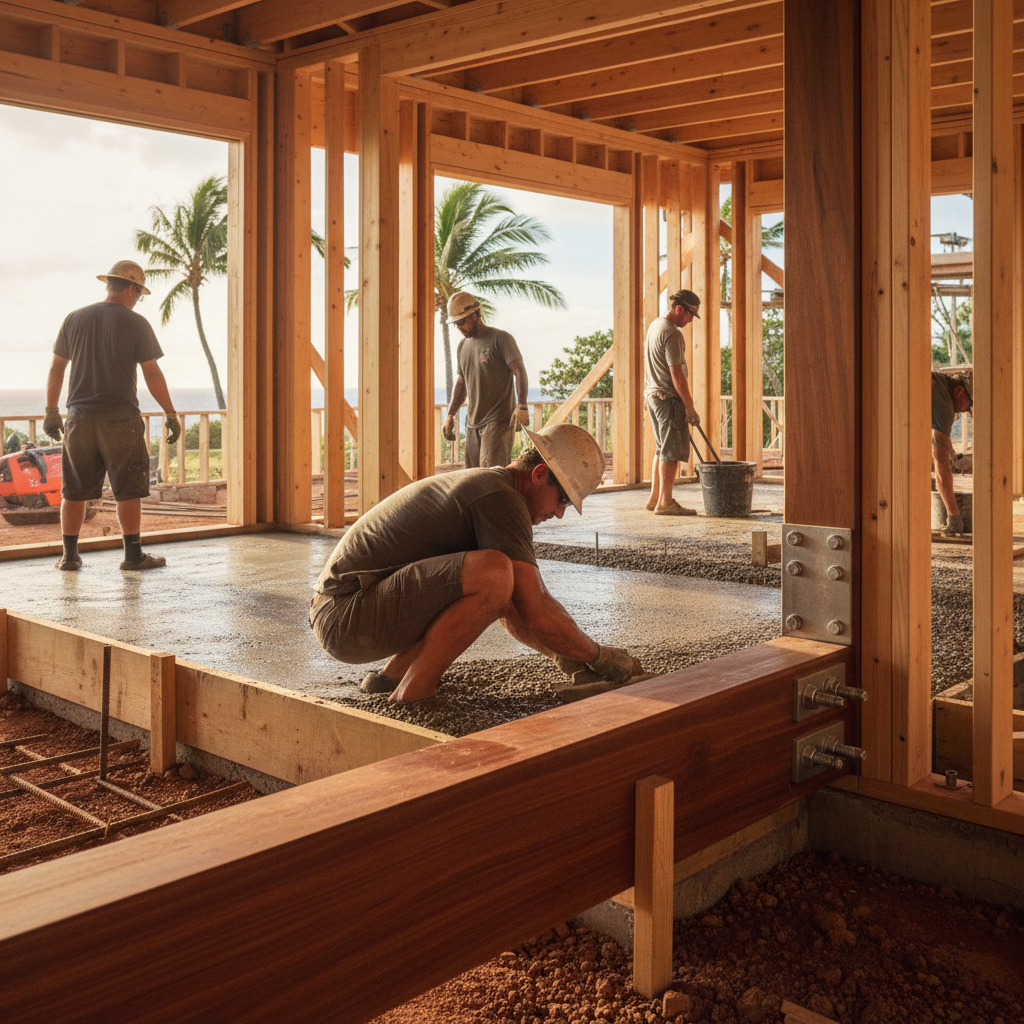
Once we have an approved permit in hand, the on-site work can begin. Here are some typical project timelines from the start of work to the final pour:
\n
- \n
- Standard Driveway (500 sq ft): The physical work is relatively quick. Site prep, forming, and placing rebar takes about 2-4 days. The pour and finishing itself is a single day. The total hands-on time is usually under a week.
- Custom Home Foundation (2,000 sq ft): This is a more involved process. The timeline breaks down like this:\n
- \n
- Excavation, Grading & Compaction: 1 to 2 weeks, depending on soil conditions and how much material needs to be moved.
- Under-Slab Plumbing & Electrical Rough-in: 3 to 5 days. This has to be inspected before we can proceed.
- Forming & Rebar Installation: 1 to 2 weeks. This is meticulous work that requires another inspection.
- Pour & Finish: 1 to 2 days, depending on the size and complexity.
\n
\n
\n
\n
\n So, the total active construction time for the foundation is typically 3 to 5 weeks.
\n
\n
\n\n
The final phase is curing. Concrete doesn’t \”dry\”; it undergoes a chemical reaction called hydration. It reaches about 70% of its final strength in the first 7 days, which is usually when we can begin framing on top of it. However, it takes a full 28 days to reach its specified design strength (e.g., 3000 PSI). For a driveway, this means you can walk on it after about 24-48 hours, but you shouldn’t drive a vehicle on it for at least 7-10 days, and ideally, you wait the full 28 days for heavy trucks. Weather plays a big role here. A hot, sunny Lahaina day can cause the surface to cure too quickly and crack, so we have to take measures like using curing compounds or keeping it wet.
\n\n
What Permits Do You Need for Concrete Contractor in Lahaina?
\n\n
Navigating the permitting process with the Maui County Department of Planning and Permitting is one of the most crucial steps for any concrete project. The simple rule of thumb is: if the concrete is structural, you need a permit. There are very few exceptions.
\n\n
You absolutely need a building permit for:
\n
- \n
- New Foundations: Every new home, ADU (Ohana unit), or garage requires a fully permitted foundation. This is non-negotiable.
- Foundation Repairs or Alterations: If you are changing the footprint of your home or doing significant structural repairs to your existing foundation, a permit is required.
- Retaining Walls: Any retaining wall that is over 4 feet tall, measured from the bottom of the footing to the top of the wall, requires an engineered design and a building permit. Even shorter walls might need a grading permit if you’re moving a lot of soil.
- Structural Slabs: Any slab designed to support a structure, including lanais that are tied into the house foundation or a detached workshop, will need a permit.
- Driveways with Major Grading: While a simple, flat driveway replacement might not need a building permit, creating a new driveway that involves significant cutting or filling of your land will likely trigger the need for a grading permit.
\n
\n
\n
\n
\n
\n\n
The permitting process in Maui County, much like the one managed by the Honolulu DPP[2], involves a series of departmental reviews. When we submit your plans, they are checked for compliance with zoning codes, building codes (including hurricane and seismic requirements), fire codes, and sometimes shoreline management rules if your property is near the coast. This is not a process you want to attempt on your own. It requires professional architectural or engineering drawings that meet all current state and county codes.
\n\n
As your general contractor, Warrior Construction manages this entire process. Our preconstruction services include coordinating with the architect and engineer to ensure the plans are complete and accurate before submission. We handle the paperwork, track the application through the county’s system, and respond to any comments or requests for information from the plan reviewers. This professional management is key to preventing unnecessary delays. Trying to save money by using an unlicensed contractor who skips the permitting process is a massive risk. It can lead to stop-work orders, fines, having to tear out the work, and major problems when you try to sell your property in the future.
\n\n

Lahaina-Specific Considerations: Climate, Materials, Regulations
\n\n
Building in Lahaina means facing a unique set of environmental and regulatory challenges that don’t exist on the mainland. A successful concrete project depends on a contractor’s ability to address these head-on.
\n\n
1. Aggressive Salt-Air Corrosion: The beautiful West Maui coastline comes with a hidden threat: a highly corrosive marine environment. The salt in the air is relentless. It attacks the steel rebar inside concrete, causing it to rust. As the rebar rusts, it expands, cracking the concrete from within—a process called spalling. To combat this, we have a multi-layered defense:\n
- \n
- Increased Concrete Cover: Code may only require 1.5 inches of concrete cover over rebar, but in coastal Lahaina, we specify a minimum of 3 inches, especially on the side facing the ocean. This puts more protective concrete between the steel and the salt.
- Corrosion-Inhibiting Admixtures: We often specify a calcium nitrite-based admixture in the concrete mix. This chemical additive forms a passive, protective layer around the rebar, chemically defending it from chloride (salt) ions.
- Epoxy-Coated Rebar: For critical structural elements, we use rebar coated with a fusion-bonded epoxy. This green coating acts as a physical barrier, preventing salt and moisture from ever reaching the steel. It’s a significant upgrade that pays for itself in longevity.
\n
\n
\n
\n
\n\n
2. Expansive Volcanic Soil: Lahaina’s soil composition can vary dramatically from one lot to the next. Much of the area sits on volcanic soils that can have a high clay content. These soils are \”expansive,\” meaning they swell up when they get wet and shrink when they dry out. This constant movement puts immense stress on a rigid concrete foundation, leading to cracks and uneven settling. Before we design a foundation, we always recommend a geotechnical report. The engineer’s findings might require us to over-excavate the native soil and replace it with a thick layer of compacted, engineered fill to create a stable base for the slab.
\n\n
3. Strict Hurricane Code Requirements: Hawaii’s building codes were significantly strengthened after Hurricane Iniki in 1992. The foundation is the critical starting point for the entire \”continuous load path\” that holds a house together during high winds. This means the connection between the foundation and the walls is paramount. We embed heavy-duty steel hurricane straps directly into the wet concrete of the foundation. These straps are then nailed to the wall framing, literally tying the house down to its concrete base. The specific size, type, and spacing of these tie-downs are specified by a structural engineer and are meticulously inspected before we’re allowed to pour.
\n\n
4. Evolving Rebuilding Regulations: The regulatory landscape in Lahaina is more dynamic than ever. Maui County has implemented specific ordinances and guidelines for rebuilding that address fire-resistance, material choices, and sometimes updated zoning or height restrictions. A contractor working in Lahaina today must be deeply familiar with these new rules. It impacts everything from the type of foundation venting required to the materials we can use in close proximity to property lines. Our team stays in constant contact with the Department of Planning to ensure our projects comply with the very latest requirements, preventing costly delays or rework orders from inspectors.
\n\n
How to Choose the Right Concrete Contractor Contractor in Lahaina
\n\n
Choosing the right contractor is the single most important decision you’ll make for your concrete project. A good contractor prevents problems; a bad one creates them. Here are the six money-saving tactics that are really about due diligence and smart hiring.
\n\n
Tactic 1: Verify Their License and Insurance. No Exceptions.\nThis is the absolute baseline. Any legitimate contractor will have a Hawaii State contractor’s license. Ours is BC-34373. You can and should verify any contractor’s license on the state’s PVL website[1]. Also, ask for their certificates of insurance for both General Liability and Worker’s Compensation. If a worker gets hurt on your property and the contractor isn’t insured, you could be held liable. Skipping this step is a gamble you can’t afford to take.
\n\n
Tactic 2: Insist on a Detailed, Itemized Proposal.\nA quote scribbled on a piece of paper that just says \”Driveway – $15,000\” is a giant red flag. A professional proposal should be several pages long and break down the costs. It should clearly state the square footage, concrete thickness (e.g., 4 inches), concrete strength (e.g., 3000 PSI), type of reinforcement (e.g., #3 rebar at 18\” on center), site prep details, and finishing method. This protects you from surprise charges later and allows you to compare bids on an apples-to-apples basis.
\n\n
Tactic 3: Check Their Maui-Specific Experience.\nA contractor based on Oahu might do great work there, but Maui is a different world. Ask for addresses of projects they’ve completed *in Lahaina or West Maui*. Go take a look. Ask them about their relationships with local suppliers and inspectors. A contractor with a strong local network can solve problems and navigate logistics far more effectively than someone who just flies in for the job.
\n\n
Tactic 4: Discuss the Plan for Unforeseen Conditions.\nWhat happens if they start digging for a foundation and hit a massive blue rock boulder? What if they discover an old, undocumented cesspool? These things happen. A good contractor will have a clause in their contract explaining how unforeseen conditions are handled, usually with a change order process. Discuss this upfront. Their answer will tell you a lot about their experience and professionalism.
\n\n
Tactic 5: Understand the Payment Schedule.\nBe wary of any contractor who demands a huge upfront deposit. Hawaii law has specific rules about how much a contractor can ask for upfront. A typical payment schedule is tied to project milestones: a small deposit to start, another payment after the forms and rebar pass inspection, and the final payment upon completion. This ensures the contractor is motivated to keep the project moving forward.
\n\n
Tactic 6: Gauge Their Communication Style.\nDuring the bidding process, how responsive are they? Do they answer your questions clearly and patiently? Construction is complex, and good communication is the glue that holds a project together. You’ll be working with this person for weeks or months. Make sure it’s someone you can talk to and who treats your project with the seriousness it deserves.
\n\n
Real Lahaina Concrete Contractor Project Example
\n\n
To put all these concepts together, let’s walk through a typical project we recently completed for a family rebuilding in Lahaina.
\n\n
The Project: A new 2,400 sq. ft. custom home foundation, a 700 sq. ft. driveway, and a critical 6-foot high, 90-foot long retaining wall to create a usable backyard on a sloped lot. The property was located about a half-mile from the ocean, putting it squarely in the salt-air corrosion zone.
\n\n
The Challenges:\n
- \n
- The sloped lot required significant excavation and a robust, engineered retaining wall to ensure stability.
- The soil report confirmed expansive volcanic clay, requiring special sub-base preparation for the concrete foundation Lahaina home.
- The proximity to the coast demanded an upgraded materials specification to ensure a 50+ year lifespan.
- The clients were navigating the complex Maui County rebuilding permit process and needed a contractor to guide them.
\n
\n
\n
\n
\n
\n\n
Warrior Construction’s Solution & Process:\nFirst, we worked with the client’s structural engineer to refine the plans. For the retaining wall Lahaina soils demanded, we specified a deeper and wider footing than standard and included a comprehensive French drain system behind the wall to alleviate hydrostatic pressure.
\n\n
For the foundation, we over-excavated the native clay soil by 18 inches and brought in 12 inches of compacted, engineered fill, creating a stable platform that wouldn’t shift. For all concrete, we specified a 4000 PSI mix with a corrosion inhibitor. All rebar used in the foundation, wall, and the driveway concrete Lahaina conditions required was epoxy-coated for maximum protection. We embedded heavy-gauge hurricane tie-downs every 48 inches along the perimeter of the foundation, directly tying the future structure to its base.
\n\n
Our team managed the entire permit submittal, addressing reviewer comments quickly to keep the project moving. Once on-site, our crew executed the plan, passing all inspections—footing, rebar, and under-slab plumbing—on the first attempt, which saved valuable time.
\n\n
The Outcome and Costs:\n
- \n
- Foundation (2,400 sq ft @ $35/sf): $84,000 (included upgrades for fill and materials)
- Driveway (700 sq ft @ $30/sf): $21,000 (included epoxy rebar)
- Retaining Wall (540 sq face ft @ $125/sff): $67,500 (included extensive drainage and engineering)
- Total Concrete Package: Approximately $172,500
\n
\n
\n
\n
\n
\n
The entire on-site concrete phase was completed in 7 weeks, from first excavation to the final cure. The clients had a solid, corrosion-resistant, and properly engineered base, ready for framing, knowing that the most critical part of their new home was built to last for generations.
\n\n
What this means for Hawaii homeowners
\n\n
For any homeowner in Lahaina looking at a concrete project in 2026, the path to success is paved with due diligence and a focus on long-term value over short-term savings. The unique combination of our marine environment, volcanic geology, and specific regulatory hurdles means that cutting corners on concrete is one of the most expensive mistakes you can make. The foundation of your home is not the place to look for the cheapest bid.
\n
Here is your actionable checklist:
\n
- \n
- Budget for Reality: Use the cost breakdowns in this guide ($28-$37/sf for foundations, $95-$135/sff for retaining walls) as a starting point. Be prepared for these figures, and be skeptical of any bid that comes in significantly lower. It likely means they are omitting critical steps or materials.
- Plan for the Permit Timeline: The single biggest factor in your project’s start date is the Maui County permit. Assume a 4-8 month waiting period before any significant work can begin. Start the design and permitting process long before you hope to break ground.
- Prioritize Resiliency Over Cost: Always opt for the upgrades that matter in our climate. Insist on corrosion-inhibiting admixtures and epoxy-coated rebar, especially if you are within a mile of the coast. The small upfront cost is dwarfed by the cost of future spalling repairs.
- Hire a Licensed and Local Professional: There is no substitute for a licensed General Contractor with years of experience specifically on Maui. They will have the local knowledge, supplier relationships, and permitting expertise to navigate your project smoothly. Verify their license and insurance without fail.
- Get Everything in Writing: Demand a detailed, itemized contract that specifies materials, timelines, and payment schedules. This document is your primary protection and ensures both you and your contractor are aligned on the scope and expectations of the project.
\n
\n
\n
\n
\n
\n
Ultimately, a successful concrete project in Lahaina is about building for the future. It’s about creating a solid, stable, and durable foundation that will withstand the tests of time and our beautiful but demanding island environment.
\n\n
Frequently Asked Questions About Concrete Contractor in Lahaina
\n
How much does a simple concrete patio cost in Lahaina?
\n
For a basic, flat-ground concrete patio in Lahaina, you can expect costs in 2026 to be around $22 to $30 per square foot. A typical 15×20 foot (300 sq ft) patio would therefore cost between $6,600 and $9,000. This assumes easy access for a wheelbarrow or small mixer and a standard broom finish.
\n
\n
Can you pour concrete in the rain on Maui?
\n
While a light, misty rain might be acceptable during a pour, a heavy downpour is a major problem. Excessive water can change the water-to-cement ratio, weakening the final product and ruining the surface finish. Professional contractors watch the weather forecast obsessively and will reschedule a pour if significant rain is expected. We never take that risk with a client’s project.
\n
\n
What is the difference between 3000 PSI and 4000 PSI concrete?
\n
PSI stands for \”Pounds per Square Inch\” and measures the concrete’s compressive strength. 3000 PSI is a standard mix suitable for many residential applications like driveways and patios. 4000 PSI is a stronger, denser mix. We recommend 4000 PSI for all structural foundations in Lahaina, especially near the coast, because its lower permeability offers better protection against salt and moisture intrusion.
\n
\n
Do I need an engineer for my Lahaina retaining wall?
\n
Yes, if the wall is over 4 feet high (measured from the bottom of the footing). Maui County code requires any retaining wall of that height or greater to be designed by a licensed structural engineer. The engineer will calculate the forces acting on the wall and specify the required footing size, rebar schedule, and drainage to ensure it is safe and stable.
\n
\n
How long does it take to get a permit for a foundation in Maui County in 2026?
\n
As of 2026, the timeline for getting a foundation permit from Maui County is typically between 4 and 8 months. While there are initiatives to speed up permits for rebuilding, the volume of applications remains high. The complexity of your project and the completeness of your submitted plans are the biggest factors influencing your specific wait time.
\n
\n
What are the signs of a bad concrete job?
\n
Key red flags include excessive cracking (especially wide, structural cracks), spalling (chipping or flaking of the surface), uneven or inconsistent color, and poor drainage (puddles on your new slab). These issues often stem from a poor sub-base, an incorrect water-to-cement ratio, or improper finishing and curing techniques.
\n
\n
Why is concrete work more expensive on Maui than on the mainland?
\n
Several factors contribute to the higher cost. First, nearly all manufactured goods, including cement, admixtures, and steel rebar, must be shipped across the Pacific, adding significant transportation costs. Second, land and labor costs are higher in Hawaii. Finally, our stringent building codes for hurricanes and seismic activity, along with the necessary upgrades for our corrosive marine environment, require more robust and therefore more expensive materials and techniques.
\n
\n
\n\n
Ready to Build Your Foundation in Lahaina?
\n
At Warrior Construction, we understand that building in Lahaina is about more than just a house—it’s about restoring a community and creating a legacy. Our team combines decades of Hawaii construction experience with a deep respect for the unique challenges and responsibilities of building on Maui. We provide transparent, detailed bids and expert project management from start to finish. If you’re ready to start your project on the right footing, let’s talk.
\n
We invite you to schedule a free, detailed estimate for your Lahaina concrete project. Let us show you how our commitment to quality, durability, and open communication can make all the difference.
\n\n
References
\n