“
When you’re looking for a concrete contractor Wailuku homeowners can trust, you’re not just buying a slab of gray stuff. You’re investing in the literal foundation of your home, the driveway you’ll park on for decades, or the retaining wall holding back tons of Maui’s red earth. Here on the islands, concrete isn’t a simple commodity; it’s a science that has to account for salt air, volcanic soil, and hurricane-force winds. Getting it wrong means cracks, spalling, and catastrophic failures down the road. Getting it right means a lifetime of structural integrity.
\n\n
At Warrior Construction, we’ve been pouring concrete across Hawaii for over 20 years. We’ve seen firsthand what happens when mainland techniques are applied to our unique island conditions—and it’s never pretty. From a poorly compacted pad on expansive clay soil in Wailuku Heights to rebar rusting out from salt spray in Waiehu, the mistakes are costly and completely avoidable.
\n\n
This isn’t just another blog post. This is a distillation of decades of on-the-job experience, specifically for you, the Wailuku homeowner. We’re going to pull back the curtain on costs, timelines, permitting, and the specific challenges of working with concrete on Maui. You’ll learn how to spot a professional, what questions to ask, and how to ensure your project is built to last a generation. Let’s get into it.
\n\n
Why Wailuku Homeowners Trust Warrior Construction for Concrete Contractor
\n
Hiring a contractor for any job is an act of trust. When that job is the foundation of your house or a critical retaining wall, that trust is paramount. For years, our team at Warrior Construction has earned that trust from Wailuku homeowners by focusing on what truly matters: island-specific expertise, transparent processes, and an unwavering commitment to quality. We’re not just a company with a license; we are a team of career builders who live and work right here on Maui.
\n\n
Our approach starts with understanding the ground you’re building on. Wailuku isn’t Honolulu or Phoenix. Much of the area has expansive clay soil, which can swell and shrink with moisture, putting immense pressure on any structure built on top of it. A mainland contractor might not understand the critical importance of over-excavation and bringing in engineered fill, compacting it layer by layer to 95% proficiency. We do. On a recent project for a custom home in Kehalani, our geotechnical assessment showed significant soil instability. Instead of just pouring a standard slab, we engineered a post-tensioned foundation, a solution that provides superior strength and crack resistance on volatile soils. It’s that level of localized expertise that prevents disaster.
\n\n
Furthermore, we understand the chemistry of concrete for our climate. The mix we use for a foundation in cool, misty Iao Valley is different from the mix we’d specify for a driveway baking in the Kahului sun. We factor in humidity, salt content in the air, and the specific structural load to create a custom batch design. This might involve using a water reducer for better workability, air-entrainment admixtures for durability, or a higher-strength mix (e.g., 4000 PSI vs. the standard 2500 PSI) for critical structural elements. It’s a level of detail that many contractors overlook, but for us, it’s standard practice for any concrete foundation wailuku project we undertake.
\n\n
Finally, homeowners trust us because we are a fully licensed and insured General Contractor (BC-34373). This means we manage the entire process, from initial designs and navigating the labyrinth of Maui County permitting to coordinating inspections and guaranteeing the final product. You have one point of contact, one team accountable for the entire job. That peace of mind is priceless.
\n\n\n
What Does Concrete Contractor Cost in Wailuku?
\n
Let’s talk numbers, because that’s often the first question a homeowner has. In 2026, concrete work on Maui is more expensive than on the mainland, and there’s no getting around it. Every bag of cement, every piece of rebar, and every gallon of fuel for the concrete truck is shipped here, adding a significant cost. But understanding the breakdown helps you budget effectively.
\n\n
Here’s a realistic look at what you can expect to pay for professional concrete work in the Wailuku area. These are all-in numbers, including labor, materials, prep, and basic finishing.
\n
- \n
- Standard 4-Inch Slab (Patios, Walkways): For basic flatwork, you’re looking at approximately $28 to $38 per square foot. For a typical 10’x20′ (200 sq ft) patio, this comes out to $5,600 – $7,600.
- Driveway Concrete Wailuku (5-6 Inches Thick): A driveway needs to support thousands of pounds, so it requires a thicker slab and more reinforcement. Expect to pay $35 to $45 per square foot. A 20’x40′ (800 sq ft) driveway would run from $28,000 to $36,000.
- Structural Concrete Foundation Wailuku: This is the most complex and expensive work. A monolithic slab with integrated footings, proper vapor barriers, and heavy rebar grids will cost between $50 and $75 per square foot. For a 2,000 sq ft home, the foundation alone could be $100,000 to $150,000.
- Retaining Wall Wailuku (Engineered): Costs for retaining walls are usually measured by the face of the wall. For a properly engineered concrete block or poured-in-place wall with drainage and waterproofing, the cost is typically $90 to $150 per square foot of wall face. A 4-foot-high, 50-foot-long wall (200 sq ft face) would be $18,000 to $30,000.
\n
\n
\n
\n
\n\n
What Drives These Costs?
\n
Several key factors influence that final price tag:
\n
- \n
- Site Access & Preparation: Is your property flat and easily accessible for a concrete truck? Or is it on a steep slope in Wailuku Heights requiring a concrete pump and extensive excavation? Site prep, grading, and compaction are a huge part of the labor cost.
- Material Specifications: The price of concrete itself can vary. A standard 2500 PSI mix is cheaper than a high-strength 4000 or 5000 PSI mix required by an engineer. Epoxy-coated rebar, necessary for projects near the ocean to prevent corrosion, can cost nearly double what standard rebar does.
- Complexity of Formwork: A simple square patio is easy to form up. A foundation with multiple corners, steps, and curves requires significantly more labor and materials for the formwork, directly impacting the cost.
- Finishing: A standard broom finish is included in the base price. But if you want a stamped pattern, exposed aggregate, or a polished surface, these specialized finishes require more time and skilled labor, adding anywhere from $5 to $20+ per square foot to the cost.
\n
\n
\n
\n
\n
When you get a quote, make sure it clearly itemizes these elements so you know exactly what you’re paying for. A lowball bid often means corners are being cut on site prep or material quality—a mistake that will cost you far more in the long run.
\n\n
How Long Does a Concrete Contractor Take in Wailuku?
\n
Time is a critical factor in any construction project, and concrete work has its own unique schedule governed by preparation, weather, and the laws of chemistry. A common misconception is that the job is done once the concrete is poured. In reality, that’s just one step in a multi-stage process. Here are some typical timelines for projects in Wailuku, keeping in mind that the permitting phase can add months before any dirt is moved.
\n\n
Estimated Timelines (Post-Permit):
\n
- \n
- Small Patio (e.g., 200 sq ft): This is a relatively quick project. Expect it to take 3 to 5 working days. Day 1 is excavation and grading. Day 2 is building the forms and placing the rebar or wire mesh. Day 3 is the pour and initial finishing. The following days are for curing and form removal.
- Standard Driveway (e.g., 800 sq ft): A larger project like a driveway involves more extensive prep work. This can take anywhere from 1 to 2 weeks. The extra time accounts for deeper excavation, placing and compacting a base course of gravel, and more complex formwork, especially for the apron connecting to the street.
- Full Home Foundation (e.g., 2,000 sq ft): A structural foundation is a major undertaking. From the day we break ground to the day the slab is fully cured and ready for framing, you should budget 3 to 5 weeks. This includes excavation for footings, trenching for plumbing and electrical conduits, multiple inspections by the county, and a much longer, carefully managed curing process.
\n
\n
\n
\n\n
The Five Phases of a Concrete Project:
\n
To understand the timeline, it helps to see the distinct stages our team moves through:
\n
- \n
- Phase 1: Planning & Permitting (2-8 Months): This is the variable that catches most homeowners by surprise. For any structural concrete, we first need engineered plans. Those plans then go to the Maui County Department of Planning for review, which in 2026 can take several months. This happens long before we schedule the first day of work.
- Phase 2: Site Preparation (1-7 Days): This is the earth-moving stage. We excavate to the required depth, grade the site for proper drainage, and compact the soil or imported fill material to create a stable base. This is arguably the most important step for long-term stability.
- Phase 3: Forming & Reinforcement (1-5 Days): Here, we build the wooden or metal forms that will contain the wet concrete. Inside these forms, we place a grid of steel rebar or wire mesh, using plastic chairs to hold it at the correct height within the slab. The county inspector must approve this setup before we can order the concrete.
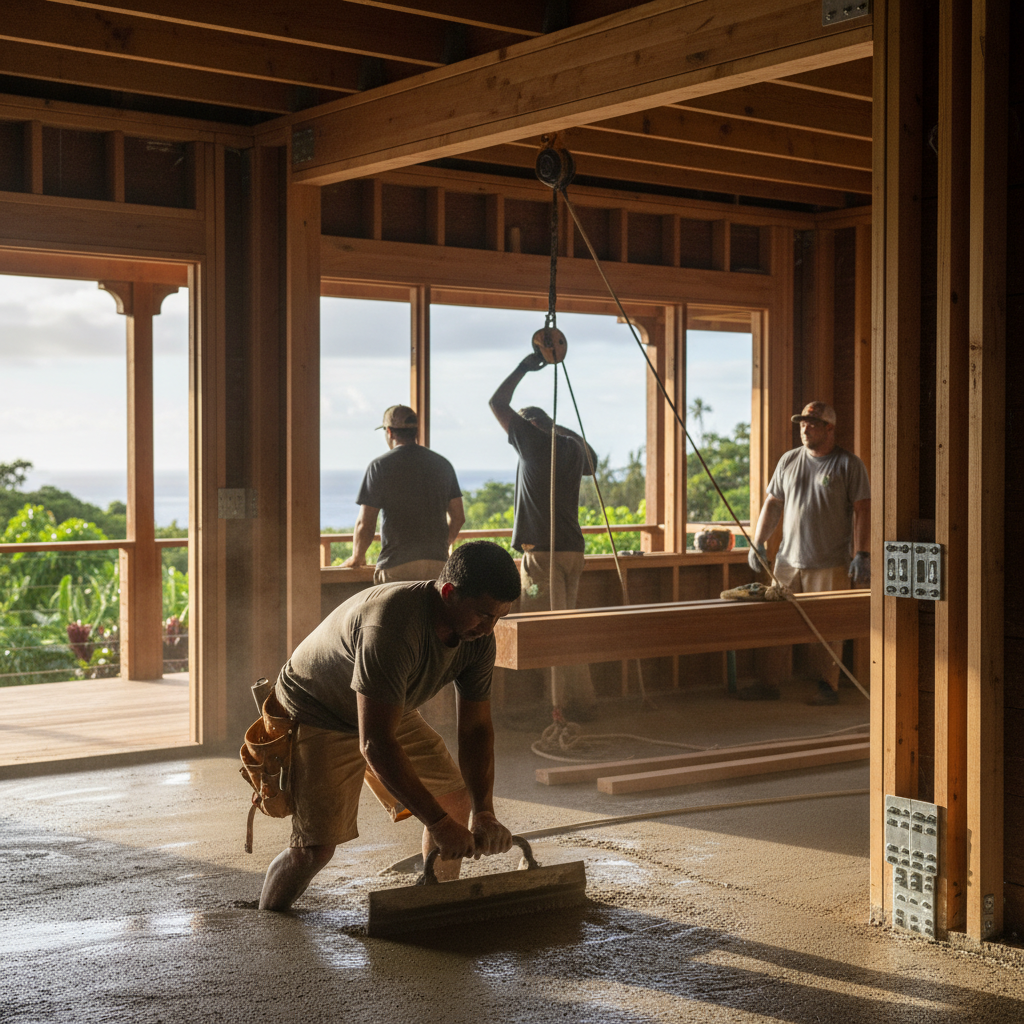
- Phase 4: The Pour & Finishing (1 Day): The concrete truck arrives, and the pour happens quickly. Our crew works to spread the concrete, screed it level, and then, as it begins to set, finish the surface with trowels and brooms. The weather on this day is critical; a sudden Wailuku downpour can ruin a fresh slab.
- Phase 5: Curing & Protection (7-28 Days): This is the final, crucial phase. Concrete doesn’t \”dry\”; it cures through a chemical reaction called hydration. It reaches about 70% of its strength in the first 7 days, and full design strength in 28 days. During this time, we protect the slab from drying too quickly and advise clients to stay off it. You can typically walk on it after 2-3 days, but you shouldn’t park a car on a new driveway for at least 7-10 days, and ideally a full month.
\n
\n
\n
\n
\n
\n\n
Rushing any of these steps, especially preparation and curing, is the fastest way to guarantee cracks and a failed project. Patience is a key ingredient in good concrete work.
\n\n
What Permits Do You Need for Concrete Contractor in Wailuku?
\n
Navigating the permitting process with Maui County can be one of the most frustrating parts of any construction project for a homeowner. The rules can seem confusing, and the timelines are often long. As your general contractor, a huge part of our job is to manage this process for you, ensuring everything is filed correctly and all inspections are passed. Knowing what to expect is the first step.
\n\n
The guiding principle is this: any work that is structural or could impact public infrastructure or safety requires a permit from the County of Maui Department of Public Works. Here’s how it generally breaks down for concrete projects:
\n\n
- \n
- Permit Usually NOT Required: Simple, non-structural flatwork is often exempt. This includes things like a small patio slab or walkway that is poured “on-grade” (not raised) and is not part of the home’s required exit path. If it’s under a certain size and doesn’t involve any grading, you may be in the clear. However, it’s always best to check.
- Permit ALMOST ALWAYS Required: The moment the concrete becomes structural or interacts with the public right-of-way, you need a permit. This list includes:\n
- \n
- New Home Foundations: This is a non-negotiable. It requires a full building permit, with engineered drawings stamped by a Hawaii-licensed structural engineer.
- Foundations for Additions: Same as a new home, a permit is absolutely required.
- Driveways: While the driveway slab itself might seem simple, the “apron” or curb cut where it meets the street requires a permit from Public Works to ensure it doesn’t disrupt drainage or sidewalks.
- Retaining Walls: Any retaining wall holding back a slope over 4 feet in height (measured from the bottom of the footing to the top of the wall) requires an engineered design and a building permit. Even walls under 4 feet may need a permit if they are supporting a driveway or structure.
- Structural Slabs: A concrete slab for a carport, a raised lanai, or any structure with a roof requires a permit.
\n
\n
\n
\n
\n
\n
\n
\n
\n\n
The Permitting Process on Maui
\n
For a project that requires a permit, like a new `concrete foundation wailuku`, the process looks like this:
\n
- \n
- Plan Creation: An architect or engineer drafts the plans, ensuring they comply with all current building codes, including hurricane and seismic requirements.
- Application Submission: We submit the plans and application package to the appropriate Maui County department. In Honolulu, homeowners are familiar with the DPP[1] and its complex electronic system; Maui has its own version, and knowing how to navigate it is key.
- Plan Review: Multiple departments (Planning, Building, Public Works) will review the plans. This is often the longest part of the process, taking anywhere from 4 to 9 months in 2026, depending on the complexity and their backlog.
- Permit Issuance: Once all departments approve, the permit is issued, and we can begin work.
- Inspections: During construction, a county inspector must visit the site at critical stages. For a foundation, this includes an inspection of the excavation and footings before concrete is placed, and another to check the rebar placement. A final inspection is required upon completion.
\n
\n
\n
\n
\n
\n
Trying to do unpermitted structural work is one of the biggest mistakes a homeowner can make. It can result in stop-work orders, heavy fines, and the requirement to tear out the unpermitted work. Even worse, it can create major problems when you try to sell your home. Part of our job is to protect you from these risks by doing everything by the book.
\n\n\n

Wailuku-Specific Considerations: Climate, Materials, Regulations
\n
Pouring concrete in Wailuku is not the same as pouring it in Las Vegas or Seattle. Our unique island environment presents a specific set of challenges that a professional concrete contractor must know how to handle. Ignoring these local factors is a recipe for premature failure. At Warrior Construction, we build our projects to withstand the specific pressures of the Maui environment.
\n\n
Climate and Weather
\n
Wailuku sits in a unique spot, catching both the hot, dry leeward sun and the moisture-laden tradewinds coming through the central valley. This creates a challenging microclimate for concrete work.
\n
- \n
- Humidity and Curing: High humidity can slow the evaporation of water from the surface of a new slab. This can make finishing difficult and extend the time before the concrete is hard enough to work. On the flip side, the intense sun and wind can dry the surface too quickly, causing it to shrink and crack before the concrete below has cured. We manage this by timing our pours for the early morning, using evaporation retardants, and employing proper wet-curing methods (like covering the slab with burlap and keeping it moist) for at least seven days.
- Rainfall: Wailuku gets its share of sudden downpours. A heavy rain on a freshly poured and finished slab can wash away the surface layer of cement paste, exposing the aggregate and ruining the finish. Our crews are constantly watching the weather radar. We always have plastic sheeting on-site, ready to cover the work at a moment’s notice if a shower pops up.
\n
\n
\n\n
Materials and Corrosion
\n
Even though Wailuku isn’t right on the beach, the air is still filled with salt blown in from the coastlines. This is a relentless enemy of steel.
\n
- \n
- Salt-Air Corrosion: The chlorides in salt air can penetrate porous concrete over time. Once they reach the steel rebar, they trigger a chemical reaction—rust. As rebar rusts, it expands with incredible force, cracking the concrete from within. This is known as spalling. To combat this, building codes require a minimum “concrete cover” over the steel. For foundations, we ensure there are at least 3 inches of solid concrete between the rebar and the outside soil. For projects in highly corrosive zones, we recommend using more expensive but far more durable epoxy-coated or galvanized rebar.
- Aggregate Quality: The rock and sand (aggregate) used in concrete are critical to its strength. Not all rock is created equal. We ensure that our suppliers are providing high-quality, clean, and properly graded basalt aggregate, free from organic materials or excessive dust that could weaken the final product.
\n
\n
\n\n
Soil and Regulations
\n
The ground beneath your home is just as important as the foundation itself.
\n
- \n
- Expansive Volcanic Soil: As mentioned before, the red clay-like soil common in Wailuku can be tricky. It expands when wet and shrinks when dry. A foundation poured on improperly prepared soil will heave and settle, leading to massive cracks in your slab and walls. The solution is proper geotechnical engineering: removing the unstable topsoil and replacing it with a thick, compacted base of engineered fill. This creates a stable platform that isolates the foundation from soil movement.
- Hurricane Code and Seismic Requirements: Since Hurricane Iniki devastated Kauai in 1992, Hawaii has adopted some of the strictest building codes in the nation. For concrete work, this means specific requirements for how the foundation is tied to the walls of the house. We use embedded hurricane straps (like Simpson Strong-Ties) and anchor bolts cast directly into the concrete to create a continuous load path that holds the roof to the foundation, designed to resist uplift from hurricane-force winds. The code also dictates rebar sizing and spacing to provide ductility in the event of an earthquake.
\n
\n
\n
An experienced Wailuku contractor doesn’t see these as obstacles; they are simply the known parameters of building a durable structure on Maui. We incorporate these solutions into every project we design and build.
\n\n
How to Choose the Right Concrete Contractor Contractor in Wailuku
\n
Finding a great concrete contractor on Maui involves more than just picking the first name that pops up in a search. You’re looking for a partner with proven local experience, proper credentials, and a professional process. A little due diligence upfront can save you from a world of headaches, financial loss, and shoddy workmanship. Here is our team’s checklist—the same standards we hold our own subcontractors to.
\n\n
1. Verify Their License and Insurance
\n
This is the absolute, non-negotiable first step. Anyone performing construction work in Hawaii valued at over $1,000 must have a contractor’s license. You can and should verify any contractor’s license status on the Hawaii Department of Commerce and Consumer Affairs (DCCA) Professional & Vocational Licensing (PVL) website[2]. Our license, for example, is Warrior Construction, BC-34373. A valid license means they have met minimum experience requirements and passed exams on law and trade practices.
\n
Equally important is insurance. Ask for proof of:
\n
- \n
- General Liability Insurance: This protects your property from damage caused by the contractor’s operations. A minimum of $1 million per occurrence is standard.
- Workers’ Compensation Insurance: This covers their employees if they get injured on your property. If they don’t have it, you could be held liable.
\n
\n
\n
Never hire anyone who can’t promptly provide you with certificates for both.
\n\n
2. Demand Maui-Specific Experience
\n
The challenges we’ve discussed—salt air, expansive soil, county permitting—are unique to our islands. Ask potential contractors for a list of recent projects they’ve completed in Wailuku or Central Maui. A good contractor will be proud to show you their work. Go take a look. Does the driveway have cracks? Is the finish even? Better yet, ask for references from past clients and call them. Ask about their experience with communication, scheduling, and budget.
\n\n
3. Get a Detailed, Written Contract
\n
A handshake deal is not a contract. A professional contractor will provide a comprehensive written agreement that details:
\n
- \n
- A Clear Scope of Work: Exactly what will be done, including demolition, excavation, formwork, rebar specs, concrete PSI, and finish type.
- Material Specifications: The type and strength of concrete, the size and grade of rebar, the thickness of the gravel base, etc.
- A Payment Schedule: This should be tied to project milestones (e.g., contract signing, completion of prep, after the pour). Be wary of anyone asking for a huge upfront deposit.
- A Timeline: A projected start and completion date, with acknowledgments for potential delays due to weather or inspections.
- Change Order Process: How changes to the original plan will be handled and priced.
\n
\n
\n
\n
\n
\n\n
4. Understand the Role of a General Contractor
\n
For a simple patio or driveway, hiring a specialty concrete contractor (a C-31 license) might be fine. But for a project like a new foundation, a `retaining wall wailuku` project, or an addition, you should hire a General Contractor (a B license) like Warrior Construction. Why? Because the concrete is just one piece of a larger puzzle. We are responsible for managing the entire job—from the architect and engineer to the plumbers who run pipes under the slab, the electricians who place conduit, and the county inspectors. We coordinate all the trades to ensure the project runs smoothly, on time, and on budget, taking the entire burden of management off your shoulders.
\n\n\n
Real Wailuku Concrete Contractor Project Example
\n
To bring all these concepts together, let’s walk through a recent, typical project our team completed in Wailuku. This example shows how we navigate the specific challenges and deliver a product built for the long haul.
\n\n
The Client: The Akana family, building their dream home in the Wailuku Country Estates.
\n\n
The Project: A 2,200 square foot monolithic foundation slab for their new single-story home, an 800 square foot driveway with a decorative broom finish, and a 4-foot high, 75-foot long CMU retaining wall to level a portion of their backyard for a garden.
\n\n
The Challenge: The lot had a gentle slope and the soil test confirmed what we suspected: highly expansive volcanic clay soil. The plans also called for a large, covered lanai, which meant the foundation would have complex corners and thickened edges to support the roof posts. Access was good, but the site’s slope required careful planning for drainage around the foundation.
\n\n
Our Solution & Process:
\n
- \n
- Pre-Construction: We worked with the Akana’s architect and a structural engineer we trust. The engineer specified that we needed to over-excavate the entire building pad by 24 inches, removing the unstable clay. We then brought in 18 inches of imported structural fill, compacting it in 6-inch lifts and testing each layer for 95% compaction. This created an unshakable base.
- Foundation: For the foundation itself, the engineer designed a monolithic slab with thickened edges and interior footings. We formed it up, laid a vapor barrier, and then installed a grid of #4 rebar at 16 inches on center. Before the pour, we coordinated with the plumber to install all the under-slab sewer and water lines. The Maui County inspector came out and signed off on our rebar and plumbing layout. We then poured 85 cubic yards of 3500 PSI concrete, ensuring all anchor bolts and hurricane hold-downs were perfectly placed.
- Driveway & Retaining Wall: For the `driveway concrete wailuku` portion, we used a 5.5-inch thick slab with wire mesh reinforcement. The retaining wall was built with fully grouted concrete masonry units (CMU) and vertical rebar tied into a solid concrete footing. Crucially, we installed a proper drainage system behind the wall with gravel and a perforated pipe to relieve hydrostatic pressure—the number one cause of retaining wall failure.
\n
\n
\n
\n\n
The Outcome:
\n
- \n
- Timeline: From breaking ground to the foundation being ready for framers took about 4.5 weeks. The driveway and retaining wall were completed concurrently.
- Cost: The engineered foundation came in at approximately $143,000 (about $65/sq ft). The driveway was $32,000 (about $40/sq ft), and the retaining wall cost roughly $28,500 (about $95/sq ft face).
- Result: The Akana family now has a rock-solid foundation that will resist soil movement and a driveway and wall built to last for decades. They avoided the common pitfalls because the job was engineered and executed correctly from the ground up.
\n
\n
\n
\n\n
What this means for Hawaii homeowners
\n
Pouring concrete on Maui is a serious investment in your property’s value and safety. It’s not the place to cut corners or hire the cheapest guy with a pickup truck. The unique combination of our volcanic soil, salt-laden air, and severe weather means that what works on the mainland often fails here. Understanding this is the key to making a smart decision for your Wailuku home.
\n
Here are the essential takeaways:
\n
- \n
- Expertise is Local: Your contractor must have direct, hands-on experience dealing with Wailuku’s specific conditions. Ask them about expansive soil mitigation and salt-air corrosion protection. Their answers will tell you everything you need to know.
- Budget for Quality: The numbers we’ve provided are realistic for 2026. Be wary of any bid that comes in significantly lower. It likely means they are skimping on crucial steps like soil preparation, proper reinforcement, or using a substandard concrete mix. A cheap job now will lead to expensive repairs later.
- Permitting is Not Optional: For any structural work, a permit is your protection. It ensures the work is designed to code and inspected by a third party. A contractor who suggests skipping the permit process is putting you, your family, and your financial investment at enormous risk.
- Hire a Professional Team: For anything beyond a simple patio, consider hiring a licensed General Contractor like Warrior Construction. We manage all the moving parts, from engineering and permitting to coordinating with other trades, ensuring a seamless process and a superior result. Your peace of mind is worth it.
\n
\n
\n
\n
\n
Ultimately, the concrete work at your home is the invisible hero. When done right, you’ll never have to think about it again. When done wrong, it will be a constant source of problems. Choose a partner who has the experience and integrity to do it right the first time.
\n
\n\n
Frequently Asked Questions About Concrete Contractor in Wailuku
\n
How much does a new concrete driveway cost in Wailuku in 2026?
\n
In 2026, you can expect a new concrete driveway in Wailuku to cost between $35 and $45 per square foot. This price includes excavation, a proper gravel base, reinforcement like rebar or wire mesh, a 5-6 inch slab of 3000 PSI concrete, and a standard broom finish. For an 800 square foot driveway, the total cost would be roughly $28,000 to $36,000.
\n
\n
Do I need a permit for a concrete patio on Maui?
\n
Generally, a simple, ground-level (on-grade) patio that is not part of a required exit path from the house does not require a permit from Maui County. However, if the patio is raised, covered by a roof, or requires significant grading or a retaining wall, you will almost certainly need a permit. It’s always safest to consult with a licensed contractor or the county planning department before starting work.
\n
\n
What is the best concrete mix for Maui’s climate?
\n
There isn’t one single \”best\” mix; it depends on the application. For most exterior flatwork exposed to the elements, we recommend a minimum of 3000 PSI concrete with air-entrainment. The air-entrainment creates microscopic air pockets that help the concrete resist cracking from thermal expansion and moisture. For structural foundations, an engineer will specify the required strength, often 3500 or 4000 PSI.
\n
\n
How long do I have to wait before I can park on my new driveway?
\n
Patience is key. While you can typically walk on new concrete after 24-48 hours, you should wait at least 7 full days before parking a passenger car on it. For heavier vehicles like an SUV or truck, we strongly recommend waiting 14-28 days. The concrete needs that time to cure and reach sufficient strength to handle the weight without cracking.
\n
\n
Why is concrete work so much more expensive on Maui?
\n
The higher cost comes down to island logistics. The primary ingredient, cement, is manufactured on Oahu or imported from the mainland, then barged to Maui. The same goes for all steel rebar, specialized tools, and even the trucks themselves. These shipping costs, combined with higher labor wages and land costs in Hawaii, all get factored into the final price per square foot.
\n
\n
What is spalling and how do you prevent it in a place like Wailuku?
\n
Spalling is when the surface of the concrete flakes or peels off, often exposing the rebar underneath. In coastal areas like Maui, the primary cause is salt-air corrosion of the steel rebar. To prevent it, we ensure there is adequate concrete cover (at least 3 inches for foundations) over all steel, use a less permeable, high-strength concrete mix, and in some cases, use corrosion-resistant rebar like epoxy-coated or galvanized steel.
\n
\n
What’s the difference between hiring a concrete contractor and a general contractor?
\n
A specialty concrete contractor (C-31 license) focuses solely on concrete work. A General Contractor (B license), like Warrior Construction, is licensed to manage an entire building project. For a standalone driveway, a concrete sub might be sufficient. But for a new foundation or an addition where concrete is just one component, a GC is essential to coordinate all the trades (plumbing, electrical, framing, etc.) and manage the overall permit and inspection process.
\n
\n
\n\n
Ready to Build with Confidence?
\n
Your home’s foundation is the most critical part of its structure. Don’t leave it to chance. If you’re planning a concrete project in Wailuku—whether it’s a new custom home foundation, a driveway, or an engineered retaining wall—you need a team with proven, local expertise.
\n
At Warrior Construction (BC-34373), we combine decades of Hawaii-specific experience with a commitment to quality and transparency. We handle everything from engineering and permitting to the final pour, ensuring your project is built right, built to code, and built to last. Let’s talk about your project and how we can provide the solid groundwork your vision deserves.
\n
Get a professional estimate for your Wailuku concrete project today.\n
\n\n
References
\n