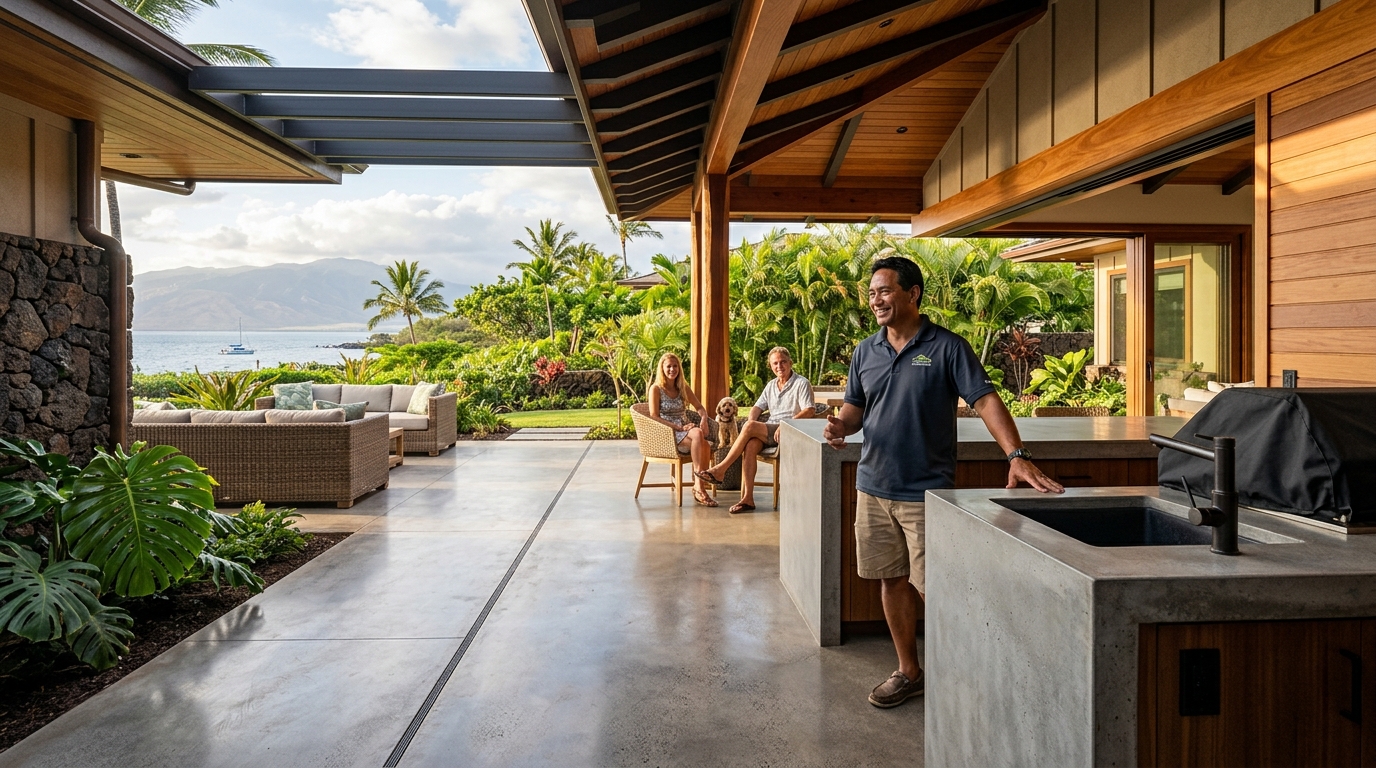
When you need a concrete contractor in Kihei, you’re not just pouring a slab; you’re building a foundation that has to withstand intense sun, corrosive salt air, and Maui’s unique soil conditions. For any significant concrete project in 2026—from a simple driveway to a complex engineered foundation—the typical all-in cost for quality work will range from $25 to $45 per square foot, depending on thickness, reinforcement, and site access. We see it all the time: homeowners get a lowball quote that doesn’t account for proper sub-grade preparation or the right concrete mix for our coastal environment, leading to cracks and spalling within just a few years.
As a general contractor with over two decades of experience across the islands, our team at Warrior Construction (License BC-34373) has managed countless concrete projects on Maui. We understand the specific challenges of building in South Maui, from the logistics of getting materials to the job site to navigating the Maui County permitting process. This isn’t like the mainland where you can just call a truck and have it there in an hour. Here, everything from the rebar to the specific admixtures needs to be planned weeks in advance.
This article will break down everything you actually need to know before you hire a concrete contractor kihei. We’ll cover the real costs you can expect in 2026, realistic timelines for projects, the essential permits required by Maui County, and the critical, Kihei-specific factors that can make or break your project. We’ll also give you a checklist for vetting contractors so you can be confident you’re hiring a team that will do the job right the first time.
Why Kihei Homeowners Trust Warrior Construction for Concrete Contractor
Choosing a concrete contractor on Maui goes beyond just finding someone who can mix and pour. It’s about finding a team that understands the local environment and has a proven track record of building structures that last. At Warrior Construction, we’re not just a concrete company; we’re a fully licensed general contractor. This means we manage the entire process, from initial design and engineering to permitting and the final pour, ensuring every piece of the puzzle fits together perfectly. A simple concrete guy might pour a great slab, but they don’t always see the bigger picture of how that slab integrates with drainage, landscaping, and the main structure.
For example, on a recent project in Wailea, just up the road from Kihei, we were brought in to build a new patio and retaining wall. The original plan from another company didn’t properly account for the red dirt slope and the potential for water runoff during a heavy Kona storm. Our team re-engineered the footings for the retaining wall Kihei soil required and integrated a French drain system behind it. It’s that kind of holistic, forward-thinking approach that prevents expensive problems down the line. We don’t just see a concrete pour; we see the entire system and how it needs to perform for the next 50 years.
Here’s what sets our approach apart for Kihei homeowners:
- General Contracting Oversight: We are licensed (BC-34373) general contractors, not just concrete subcontractors. This means we manage the project with a comprehensive view, coordinating engineers, surveyors, and our own skilled crews. You have a single point of responsibility and accountability.
- Maui-Specific Expertise: We know the difference between pouring in the dry heat of Kihei versus the wet conditions of Haiku. We specify the correct concrete mix (often a higher PSI with corrosion inhibitors), the right type of reinforcement (epoxy-coated rebar in coastal areas), and the proper curing techniques to handle the intense Maui sun.
- Transparent Project Management: Our process is built on clear communication. From the initial estimate to the final walkthrough, you’ll have a direct line to your project manager and receive regular updates. We believe an informed client is a happy client.
- Logistical Mastery: Getting materials and equipment to a Maui job site requires careful planning. We have long-standing relationships with local suppliers like Hawaiian Cement and Ameron, and we manage the inter-island shipping logistics for any specialty items, so your project stays on schedule. We factor these potential delays into our timeline from day one.
Ultimately, homeowners trust us because we build things the right way, with no shortcuts. We understand that a solid foundation—whether it’s for your home, your driveway, or your new lanai—is the most critical part of any construction project in Hawaii. Our commitment is to deliver a finished product that not only looks great but is engineered to withstand the unique challenges of our island environment for decades to come.
What Does Concrete Contractor Cost in Kihei?
Let’s get straight to the numbers. In 2026, the cost for professional concrete work in Kihei is higher than on the mainland, and even slightly higher than on Oahu, due to inter-island shipping costs for materials and equipment. A simple, flat pour on a well-prepared site will be on the lower end, while a complex foundation with extensive grading and reinforcement will be on the higher end.
Here’s a realistic breakdown of what you can expect to pay a licensed and insured concrete contractor kihei for different types of projects:
- Standard 4-inch Driveway or Patio Slab: For a basic broom-finish slab, expect to pay between $24 and $32 per square foot. For a 600-square-foot driveway, this comes out to approximately $14,400 to $19,200. This price includes site prep, forming, a vapor barrier, wire mesh reinforcement, the concrete itself (typically 3000 PSI), and the labor for pouring and finishing.
- Engineered Concrete Foundation Slab: For a proper concrete foundation Kihei homes require, which is typically 6-8 inches thick with integrated footings and extensive rebar, the cost is significantly higher. You should budget for $38 to $50 per square foot. A 1,500-square-foot foundation could therefore cost between $57,000 and $75,000. This includes the engineering plans, excavation, grading, termite treatment, plumbing block-outs, and a much more complex rebar grid.
- Concrete Retaining Walls: These are priced differently, usually by the square foot of the wall’s face. For an engineered CMU block wall with concrete grout fill and rebar, which is common for dealing with Maui’s sloped lots, the cost is typically $90 to $125 per square foot of wall face. A wall that is 4 feet high and 50 feet long (200 sq ft face) would be in the range of $18,000 to $25,000.
- Stamped or Decorative Concrete: If you want a more decorative finish for a patio or walkway, such as a stamped or colored concrete, add $5 to $10 per square foot to the standard slab cost.
Key Factors That Influence Your Final Price
Several variables can push your costs toward the higher end of these ranges:
- Site Access: Is your property on a steep hill in Maui Meadows? Is there limited space for a concrete truck and pump? Difficult access requires more labor and specialized equipment like a line pump, which can add $1,500 to $3,000 to the project cost.
- Excavation & Grading: Kihei’s soil can be tricky. If your lot has a lot of rock or requires extensive grading to create a level base, this will increase your costs. A simple scrape and level might be included, but significant earthmoving will be an extra line item.
- Demolition: Do you need an old, cracked driveway or patio removed? Demolition, breaking, and hauling away old concrete can add $4 to $7 per square foot to the total job cost.
- Reinforcement Requirements: Building codes in hurricane-prone areas and specific engineering requirements might call for thicker rebar, tighter spacing, or epoxy-coated steel to resist salt-air corrosion. These necessary upgrades add to the material cost.
- Drainage: Proper drainage is critical in Hawaii. The cost may need to include installing French drains, channel drains, or grading the surrounding landscape to ensure water flows away from your foundation or slab, preventing erosion and water damage.
When you get a quote, make sure it’s itemized. It should clearly state the cost of demolition, site prep, materials (including concrete PSI and reinforcement type), labor, and finishing. A vague, one-line estimate is a red flag. We believe in providing detailed proposals so you know exactly where your money is going.
How Long Does a Concrete Contractor Take in Kihei?
One of the first questions every homeowner asks is, “How long will my yard be a construction zone?” The timeline for a concrete project in Kihei depends heavily on three things: project complexity, permitting, and the weather. Here on Maui, we can’t just assume the sun will shine every day, and a sudden downpour can delay a pour by a day or two.
First, let’s be clear: the pre-construction phase often takes longer than the actual physical work. This includes getting engineering plans drawn up (if required), submitting for permits with Maui County, and waiting for approval. As of 2026, this administrative part alone can take anywhere from 4 to 12 weeks, especially for more complex projects like a new foundation or a large retaining wall.
Once we have the permit in hand and boots on the ground, here are some typical timelines for the construction phase:
- Standard Driveway (approx. 600 sq ft): From the start of demolition to the final cure, this is typically a 2 to 3-week process.
- Week 1: Demolition of the old driveway, excavation, grading, and setting up the forms.
- Week 2: Laying down the base rock, compacting it, installing the rebar or wire mesh, and scheduling the inspection and the concrete pour. The pour itself only takes a few hours.
- Week 3: Curing. While you can often walk on the concrete after 48-72 hours, we recommend keeping vehicles off a new driveway concrete Kihei project for at least 7-10 days to allow it to reach sufficient strength. Full cure takes 28 days.
- House Foundation (approx. 1,500 sq ft): This is a much more involved project and usually takes 4 to 6 weeks for the concrete portion of the build.
- Weeks 1-2: Major excavation, grading, and digging the footings according to the engineered plans.
- Week 3: Installing underground plumbing and electrical conduits, termite pre-treatment, and laying the vapor barrier.
- Week 4: Building the complex rebar grid for the footings and slab. This is meticulous work that requires inspection by a structural engineer and the county inspector.
- Week 5: The pour. This is a major event, often requiring multiple trucks and a concrete pump. This is followed by the initial finishing work.
- Week 6: Curing time and form removal.
The “Maui Time” Factor: What Can Cause Delays?
While we build our schedules with buffers, some things are unique to working on a neighbor island like Maui:
- Material Availability: While standard concrete is mixed locally, specialty items like specific rebar sizes, admixtures, or decorative stamps might need to be shipped from Oahu or the mainland. A delay at the port in Honolulu can have a domino effect.
- Inspections: We are at the mercy of the Maui County inspector’s schedule. Sometimes we can get an inspection the next day; other times, we might have to wait a few days, holding up the next phase of work.
- Weather: You can’t pour concrete in the rain. A week of unexpected Kona weather can push a project back. We also have to be careful about pouring in the intense midday Kihei sun, as it can cause the surface to cure too quickly and crack. Early morning pours are standard practice here.
A professional contractor will communicate these potential delays proactively. At Warrior Construction, we create a detailed project schedule using construction management software and share it with our clients. If a delay occurs, you’ll be the first to know why and how we plan to adjust to get the project back on track.
What Permits Do You Need for Concrete Contractor in Kihei?
Navigating the permitting process is one of the most important jobs of a qualified general contractor. In Maui County, you can’t just start tearing up your yard and pouring concrete without the proper approvals. Attempting to do so can result in hefty fines, stop-work orders, and being forced to tear out the unpermitted work. It’s a costly mistake we’ve seen homeowners make when they hire an unlicensed handyman.
The agency you’ll be dealing with is the Maui County Department of Public Works. While the specific forms and personnel are different, the principles are similar to other counties in Hawaii, such as the Honolulu Department of Planning and Permitting (DPP)[1]. The goal is the same: to ensure that any construction is done safely and to current building codes.
Here’s a breakdown of the permits typically required for concrete projects in Kihei:
- Grubbing & Grading Permit: Before any significant earth is moved, you often need this permit. If your project involves excavating more than a certain volume of soil or is on a steep slope, this is a mandatory first step.
- Building Permit: This is the main permit for most concrete work. You will almost certainly need a building permit for:
- Any new concrete foundation Kihei for a house, ADU, or garage.
- Retaining walls over 4 feet in height (measured from the bottom of the footing).
- Any concrete slab that is part of a roofed structure, like a covered lanai or carport.
- Sometimes, even large driveways or patios may require a permit, depending on their size and location on the property.
When You Might *Not* Need a Permit
There are a few exceptions. For minor, flatwork-only projects, you may not need a full-blown building permit. According to Maui County rules, you generally do *not* need a permit for:
- Pouring a simple, on-grade patio or walkway that isn’t part of a structure.
- Replacing a small section of an existing driveway with the same footprint.
- Building a small retaining wall that is less than 4 feet high.
However, and this is critical: Always check with the county or a licensed contractor before assuming your project is exempt. The rules can be nuanced. Furthermore, if you live in a community with a homeowners association (HOA) in areas like Wailea or Maui Lani, you will need their approval in addition to any county permits.
The Permitting Process and Why It Takes Time
Getting a permit isn’t just filling out a form. It’s a multi-step process.
- Plans and Engineering: For any structural concrete work (foundations, large retaining walls), you need architectural and structural engineering plans. These must be stamped by a Hawaii-licensed engineer. This alone can take 2-4 weeks.
- Application Submission: Your contractor submits the complete application package, including plans, forms, and fees, to the Maui County offices.
- Plan Review: A county plan reviewer checks your documents to ensure they comply with all building codes, zoning regulations, and shoreline setbacks (if applicable). This is often the longest part of the wait. The reviewer may come back with questions or required revisions (often called ‘redlines’).
- Permit Issuance: Once all revisions are made and approved, the permit is issued, and work can legally begin.
At Warrior Construction, we handle this entire process for our clients. We have dedicated staff who know the ins and outs of the Maui County system, which helps to streamline the process and avoid common mistakes that can cause long delays. It’s a core part of our service as a general contractor.

Kihei-Specific Considerations: Climate, Materials, Regulations
Building on Maui, and specifically in Kihei, is unlike anywhere else. You’re dealing with a unique combination of intense sun, corrosive marine air, volcanic soil, and specific local regulations. A mainland contractor’s standard practices simply won’t cut it here. A concrete job done incorrectly in this environment can fail in a fraction of the time it would elsewhere.
Climate: Sun, Salt, and Vog
The environment in Kihei is harsh on building materials, especially concrete. Here’s what we have to engineer against:
- Intense Solar Radiation: The sun in South Maui is relentless. Pouring concrete in the middle of the day can cause the surface water to evaporate too quickly. This leads to a weak surface and can cause plastic shrinkage cracking—those spiderweb-like cracks you see on poorly finished slabs. That’s why professional crews in Kihei start their pours at dawn, to give the concrete time to set before the peak heat of the day. We also use curing compounds or cover the slab with wet burlap to control the moisture loss.
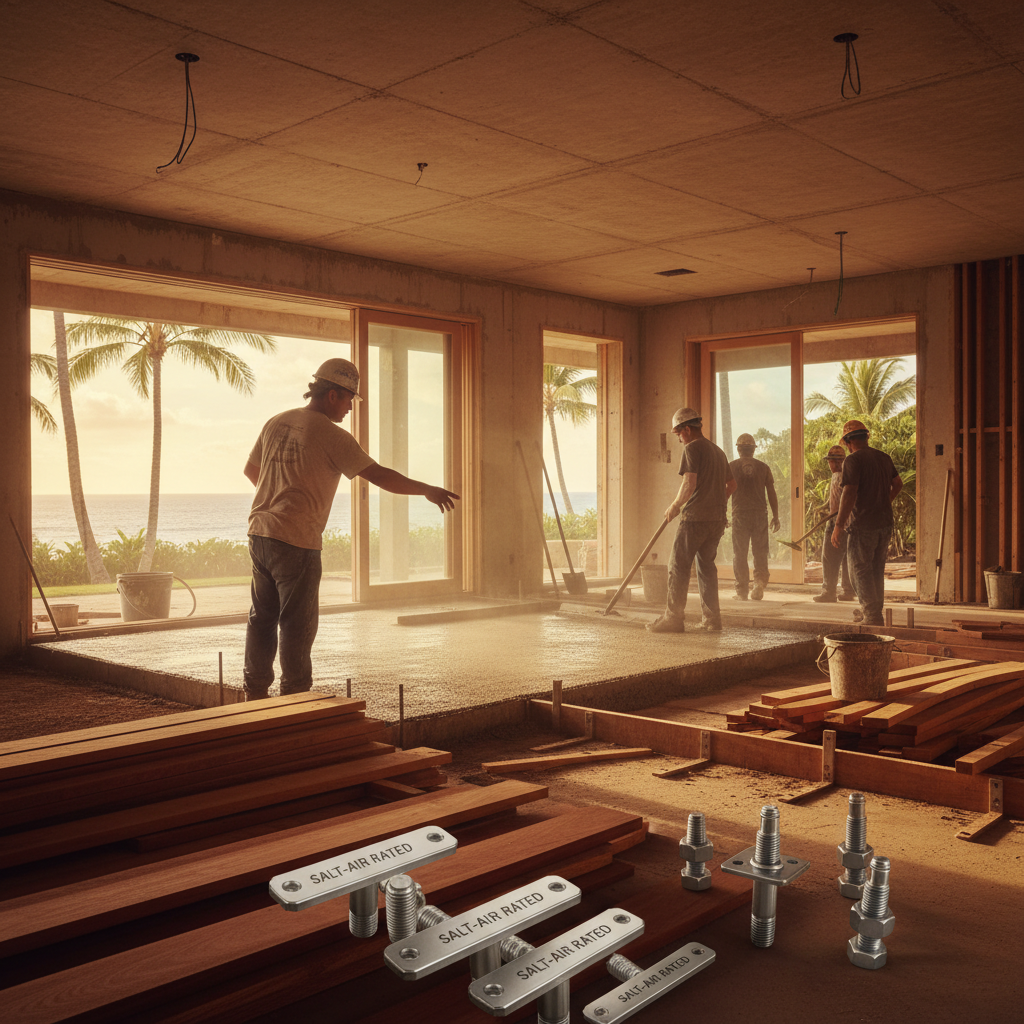
- Salt-Air Corrosion: This is the number one enemy of concrete in coastal Hawaii. The chloride ions from the salt spray permeate the porous concrete and attack the steel rebar inside. As the rebar rusts, it expands, cracking the concrete from within—a phenomenon called spalling. To combat this, for any home within a mile of the coast, we specify:
- Higher PSI Concrete: A denser, 4000 PSI mix is less permeable than a standard 3000 PSI mix.
- Corrosion-Inhibiting Admixtures: We add special chemicals to the concrete mix that protect the steel.
- Epoxy-Coated or Galvanized Rebar: For critical structural elements, using protected rebar creates a physical barrier against the salt. This adds cost but is essential for longevity.
- Increased Concrete Cover: We ensure the rebar is placed deeper within the concrete—at least 3 inches from the surface—to give it more protection.
- Vog (Volcanic Smog): While more of a factor when the trades die down, the sulfur dioxide in vog can contribute to acid rain, which can slowly etch and degrade the surface of concrete over many years. Using a high-quality sealer on finished concrete can provide a protective layer against this.
Materials and Logistics on Maui
You can’t just run to Home Depot for a truckload of structural rebar on Maui. Every piece of your project needs to be planned.
- Concrete Supply: The concrete itself is batched locally at plants on Maui. However, the raw materials—cement, sand, and aggregate—are often barged in. Any disruption to the shipping schedule can impact availability.
- Reinforcement and Forms: All the steel rebar, wire mesh, and forming materials are shipped from off-island, mostly from Oahu. We have to order materials weeks in advance and coordinate trucking from the harbor in Kahului to the job site in Kihei. This is a major reason for the higher costs compared to Oahu.
Local Regulations and Codes
Beyond the standard building code, there are Kihei-specific rules to follow:
- Hurricane Code Compliance: Ever since Hurricane Iniki devastated Kauai in 1992, Hawaii’s building codes have been significantly strengthened. For foundations, this means specific requirements for tie-downs, anchor bolts, and strapping to connect the house frame securely to the concrete foundation. Your contractor must be fluent in these hurricane-resistant construction techniques.
- Special Management Area (SMA): A large portion of Kihei lies within the SMA, which is the land closest to the shoreline. Any construction in this zone requires an additional layer of permits and review to protect the coastal environment. If your property is near the water, your contractor needs experience with the SMA permitting process, which can add months to your project timeline.
- Bill 7 (ADU Regulations): While Bill 7 is an Oahu-specific ordinance for ADUs, Maui County has its own set of rules for building ohana units. The foundation for these units must meet all current codes, and the contractor needs to be aware of the specific setback and footprint requirements for these secondary dwellings.
Hiring a contractor who understands these interwoven challenges is non-negotiable. It’s the only way to ensure your investment is built to last in our beautiful but demanding island home.
How to Choose the Right Concrete Contractor Contractor in Kihei
Finding a reliable contractor is the most critical step in your project. A bad hire can lead to a world of problems, from shoddy work that fails prematurely to budget overruns and even legal issues. Here’s a practical checklist our team at Warrior Construction recommends to any homeowner looking to hire for a concrete project on Maui.
1. Verify Their License and Insurance – No Exceptions
This is the absolute first thing you must do. In Hawaii, any construction job valued at over $1,000 (including labor and materials) legally requires a licensed contractor. Don’t just take their word for it; verify it yourself.
- Check the License: Go to the Hawaii Department of Commerce and Consumer Affairs (DCCA) Professional & Vocational Licensing (PVL) website[2]. You can search by company name or license number. Our license, for example, is BC-34373. Make sure the license is “Active” and that there are no disciplinary actions against them.
- Ask for Insurance Certificates: The contractor must provide you with a current Certificate of Insurance (COI) for both General Liability and Worker’s Compensation. General Liability protects your property from damage, and Worker’s Comp protects you from being sued if one of their employees gets injured on your job site. If a contractor can’t provide these, walk away immediately.
2. Look for Relevant, Local Experience
A contractor who does great work in Kula might not have the same experience with the coastal conditions in Kihei. You want a team that has a portfolio of completed projects specifically in South Maui.
- Ask for a Portfolio: Request to see photos of projects similar to yours. Look at their online portfolio. Pay attention to the quality of the finish and the complexity of the jobs.
- Request Local References: Ask for the names and numbers of 2-3 recent clients in the Kihei or Wailea area. Call them and ask about their experience. Were they happy with the communication? Did the project stay on budget and on schedule? Was the job site kept clean?
3. Get a Detailed, Itemized Written Contract
A handshake deal or a one-page quote is a recipe for disaster. A professional contractor will provide a comprehensive contract that clearly outlines every detail of the project. It should include:
- A Detailed Scope of Work: Exactly what is and is not included. It should specify demolition, site prep, concrete thickness, PSI strength, type of reinforcement, finish type, and cleanup.
- A Clear Payment Schedule: The schedule should be tied to project milestones (e.g., deposit, upon completion of forming, upon passing inspection, final payment upon completion). Be wary of anyone demanding a huge upfront deposit.
- A Project Timeline: A realistic start date and estimated completion date, with an acknowledgment of potential delays due to weather or inspections.
- Change Order Process: How will changes or unforeseen issues be handled? There should be a written process for approving any additional costs.
4. Don’t Let Price Be the Only Factor
It’s tempting to go with the lowest bid, but in construction, you almost always get what you pay for. An unusually low bid is often a sign that the contractor is cutting corners—using a cheaper concrete mix, inadequate reinforcement, non-licensed labor, or is uninsured. These shortcuts will inevitably lead to failure. It’s much more expensive to tear out and replace bad concrete than it is to do it right the first time. Get at least three detailed bids and compare them based on the scope of work, materials specified, and the contractor’s qualifications, not just the bottom-line number.
Taking the time to properly vet your contractor is the best investment you can make in your project’s success. It’s the difference between a beautiful, long-lasting addition to your home and a cracked, crumbling mess in a few years.
Real Kihei Concrete Contractor Project Example
To make all this information more concrete, let’s walk through a typical project we recently completed for a homeowner in Kihei, near Kamaole Beach Park III.
The Client’s Problem: The homeowner had an old, badly cracked asphalt driveway that was a trip hazard and created drainage problems, sending water toward their foundation during heavy rains. They also wanted to replace a crumbling rock wall with a modern, engineered retaining wall to create a more usable, level garden area on their sloped lot.
The Scope of Work:
- Demolish and haul away the existing 700 sq ft asphalt driveway.
- Excavate and re-grade the driveway area for proper slope and drainage.
- Form and pour a new 4-inch thick, 700 sq ft concrete driveway with wire mesh reinforcement and a standard broom finish.
- Demolish the old 60-foot long, 3-foot high rock wall.
- Excavate footings for a new, engineered retaining wall.
- Construct a new 60-foot long, 4-foot high retaining wall using CMU blocks, rebar, and concrete grout fill, including a proper drainage system behind the wall.
The Process and Timeline:
- Weeks 1-6 (Pre-Construction): We worked with a structural engineer to draw up plans for the new retaining wall, as it was over the 4-foot height threshold requiring a permit. We submitted the plans and permit application to Maui County. The review process took about five weeks.
- Week 7 (Construction Start): Permit in hand, our crew began demolition. The old asphalt and rock were broken up and hauled away.
- Week 8: The site was excavated and graded. Footings for the retaining wall were dug, and the driveway sub-base was prepared and compacted. We passed our footing inspection.
- Week 9: The retaining wall was built, block by block, with rebar and concrete fill. The French drain and waterproofing were installed behind the wall. Driveway forms were set.
- Week 10: We passed the retaining wall inspection. The rebar for the driveway was placed, and we scheduled the concrete pour for early the next morning. Both the wall’s core and the driveway were poured on the same day to maximize efficiency.
- Week 11: The concrete cured. Forms were stripped, the site was cleaned up, and we backfilled against the new retaining wall.
- Week 12 (Final Walkthrough): We did a final walkthrough with the homeowner, who was thrilled with the result. They now had a safe, beautiful driveway and a new, functional garden space.
The Final Cost:
- Driveway (700 sq ft @ ~$28/sq ft): $19,600
- Retaining Wall (240 sq ft face @ ~$110/sq ft): $26,400
- Engineering & Permitting Fees: $3,500
- Total Project Cost: $49,500
This project is a perfect example of how a seemingly simple job involves careful planning, engineering, permitting, and skilled execution to ensure it’s done right in the Kihei environment.
What this means for Hawaii homeowners
Pouring concrete in Kihei is a serious investment that needs to be done right to withstand our unique coastal conditions. Simply hiring the cheapest guy with a truck is a surefire way to get a cracked, spalling slab in a few years. The combination of intense sun, corrosive salt air, and specific Maui County building codes means that both the materials used and the techniques employed are critically important.
Here are the key takeaways you need to focus on for a successful project:
- Budget Realistically: Understand that professional, licensed, and insured work on Maui costs more. For a standard driveway in 2026, budget for $24-$32 per square foot. For an engineered foundation, it’s closer to $38-$50 per square foot. Anything significantly lower is a major red flag.
- Prioritize a Licensed General Contractor: A GC, like our team at Warrior Construction, manages the entire process—from engineering and permitting to coordinating the pour and finishing. This holistic approach prevents mistakes and ensures your concrete work integrates properly with your home’s drainage and structural systems.
- Insist on the Right Materials: Don’t be afraid to ask your contractor what specifications they are using. For Kihei, this should include a minimum of 3000 PSI concrete (4000 PSI is better near the coast), proper reinforcement, and corrosion inhibitors if you’re close to the ocean.
- Factor in the Timeline: Remember that the permitting and planning phase often takes longer than the construction itself. Be patient and build this time into your expectations. A good contractor won’t rush the prep work.
- Verify Everything: Before signing a contract, personally verify the contractor’s license on the state’s PVL website[2] and ask for their current insurance certificates. This simple step can save you from enormous financial and legal headaches.
Taking these steps will help you protect your investment and ensure you get a high-quality concrete project that adds value and durability to your Maui home.
Frequently Asked Questions About Concrete Contractor in Kihei
Do I really need a permit for a new driveway in Kihei?
It depends on the scope. For a simple replacement of an existing driveway with the same footprint, you often don’t. However, if you are creating a new, larger driveway, changing the access point to the road, or if the work involves significant grading, a permit is typically required by Maui County. It’s always best to have your contractor confirm with the Department of Public Works before starting any work.
Why is concrete work so much more expensive on Maui than the mainland?
There are two primary reasons. First, logistics. Nearly all raw materials—cement, aggregate, and especially the steel rebar—have to be shipped to Hawaii, then barged from Honolulu to Maui. These shipping costs are passed on to the consumer. Second, labor costs are higher here due to the high cost of living. A skilled concrete finisher is a valuable trade professional, and wages reflect that.
How long do I have to wait before I can drive on my new concrete driveway?
We advise all our Kihei clients to wait a minimum of 7 full days before driving a standard passenger car on a new driveway. You can typically walk on it after 48-72 hours. While concrete feels hard quickly, it takes 28 days to reach its full design strength, and putting heavy loads on it too early can cause stress fractures that compromise its long-term durability.
What is ‘spalling’ and how can I prevent it on my concrete in Kihei?
Spalling is when the surface of the concrete flakes or peels off, often exposing the rebar underneath. In Kihei, the primary cause is salt-air corrosion of the internal steel rebar. To prevent it, you need to hire a contractor who uses a multi-layered defense: a dense, high-PSI concrete mix, corrosion-inhibiting admixtures, ensuring adequate concrete cover over the rebar (at least 3 inches), and potentially using epoxy-coated rebar in highly corrosive areas.
Can you pour colored or stamped concrete in Kihei?
Absolutely. Stamped and colored concrete is a popular option for patios, walkways, and pool decks. The process involves adding a color pigment to the concrete mix or applying it to the surface, and then pressing molds into the wet concrete to create patterns like stone or tile. It adds about $5 to $10 per square foot to the cost but can create a beautiful, high-end finish.
My lot is sloped. What’s the best solution for creating a level area?
For sloped lots in places like Maui Meadows or parts of Wailea, the best solution is often a combination of grading and an engineered retaining wall. A retaining wall allows you to create a solid, level terrace for a patio, lawn, or even a foundation. Any wall over 4 feet tall in Maui County requires a building permit and plans from a licensed structural engineer to ensure it can safely hold back the weight of the soil.
What’s the difference between a concrete contractor and a general contractor?
A concrete contractor specializes specifically in concrete work. A general contractor, like Warrior Construction, manages the entire construction project, which may include concrete work as one component. For a simple slab pour, a concrete specialist might be fine. But for any project that involves multiple trades, engineering, or permitting—like a foundation, a large retaining wall, or a new lanai—a general contractor is essential to coordinate all the moving parts and ensure the project is built to code.
Building in Hawaii presents unique challenges, but with the right team and proper planning, you can get a finished concrete project that will stand the test of time. It all starts with a solid foundation.
If you’re ready to discuss your concrete project in Kihei, whether it’s a new foundation, driveway, or retaining wall, our team at Warrior Construction is here to help. We bring decades of Hawaii-specific experience to every job site. Reach out to us for a straightforward, comprehensive estimate.
Ready to build a solid foundation for your Kihei home? Learn more about our Concrete & Foundation services and request your free, detailed estimate today.