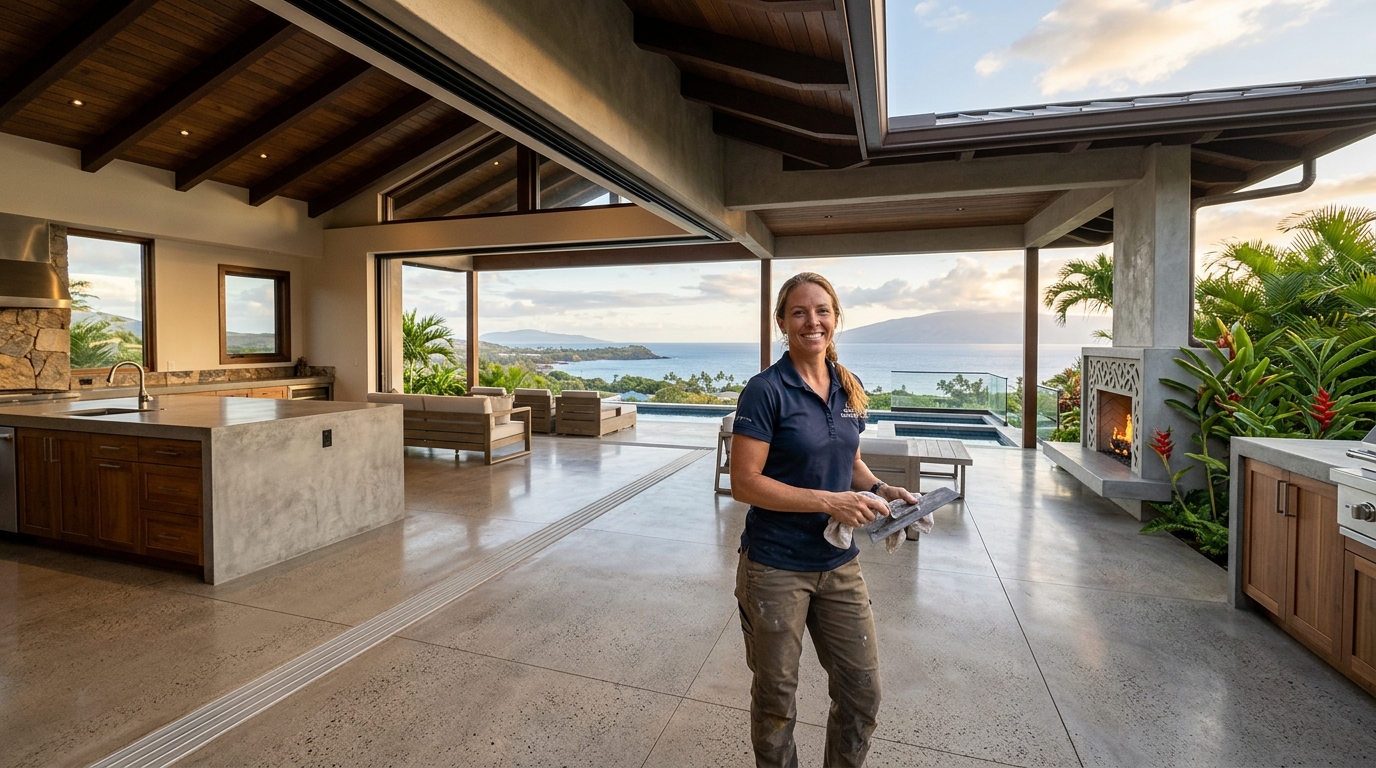
When you need a concrete contractor in Kapalua, you’re not just pouring a slab; you’re laying the groundwork for a home that needs to withstand some of Hawaii’s most demanding conditions. Here in West Maui, concrete work involves much more than just mixing cement, sand, and aggregate. It requires a deep understanding of corrosive salt air, tricky volcanic soil compositions, and strict hurricane-resistant building codes. At Warrior Construction, we’ve spent over two decades mastering these challenges on Maui, ensuring the foundations, driveways, and structural elements we build are engineered to last for generations.
Pouring concrete in a place like Kapalua is a science. One misstep—the wrong mix design, improper rebar placement, or poor curing in the hot Maui sun—can lead to spalling, cracking, and catastrophic failure down the road. This is especially true for hillside properties requiring complex retaining walls or coastal homes where chloride-ion attack is a constant threat to reinforcing steel. As a licensed general contractor (BC-34373) with teams on Maui, we bring the technical expertise and logistical know-how to get the job done right the first time. We’ve seen firsthand what happens when mainland techniques are applied without modification for our island environment, and it’s a costly mistake we help homeowners avoid.
This guide breaks down the essential solutions and considerations for any concrete project in Kapalua for 2026. We’ll cover real-world costs per square foot, what to expect for project timelines including permitting, and the specific environmental factors unique to this part of Maui. Furthermore, we’ll walk you through how to vet a contractor properly and provide a concrete example of a project we recently completed in the area, giving you a clear roadmap for success.
Why Kapalua Homeowners Trust Warrior Construction for Concrete Contractor
Kapalua isn’t just another spot on the map; it’s a world-class destination with some of the most beautiful—and challenging—terrain for construction in Hawaii. Homeowners here expect a level of precision, durability, and aesthetic quality that goes far beyond a standard build. They trust our team at Warrior Construction because we’ve built our reputation on delivering exactly that, specifically tailored for the unique demands of West Maui.
First and foremost, our experience is hyper-local. We’re not just a company with a Hawaii license; we are a team that lives and works here, navigating the specific logistical and environmental hurdles of Maui every single day. For example, we understand the nuances of sourcing high-quality aggregate and the scheduling of concrete trucks from the Central Maui plants to ensure a hot load doesn’t compromise a pour on a remote Kapalua site. We have long-standing relationships with local suppliers and trucking companies, which is critical when a barge delay on Oahu could otherwise halt a project for weeks. This on-the-ground knowledge is something you can’t learn from a textbook; it’s earned over hundreds of projects from Lahaina to Napili to Kapalua itself.
Additionally, we specialize in the high-performance concrete required for coastal and hillside construction. A standard 3000 PSI concrete mix that might be acceptable inland is simply not sufficient for a Kapalua oceanfront home. Our standard protocol for these projects includes:
- Higher Strength Mixes: We often specify 4000 or 5000 PSI concrete to create a denser, less permeable surface that resists salt water intrusion.
- Corrosion Inhibitors: We incorporate admixtures like calcium nitrite directly into the concrete mix, which chemically protects the steel rebar from rust and corrosion caused by chloride ions from the salt spray.
- Epoxy-Coated or Stainless Steel Rebar: For critical structural elements, we recommend and install upgraded reinforcing steel that provides a physical barrier against corrosive elements, significantly extending the life of the foundation.
- Proper Curing Techniques: In the intense Kapalua sun, improper curing can ruin a pour. We employ wet curing methods, applying curing compounds to control moisture evaporation, preventing surface cracking and ensuring the concrete reaches its full design strength.
Finally, as a full-service general contractor (License BC-34373), we manage the entire process. This means we handle the structural engineering, the complex Maui County permitting, and the coordination of all site work. A homeowner in Kapalua doesn’t have to juggle a separate engineer, an architect, an excavator, and a concrete crew. We are the single point of accountability from initial soil tests to the final finish. This integrated approach saves time, reduces miscommunication, and ultimately delivers a superior result. We recently handled a project in Pineapple Hill where the initial plans didn’t account for a lava rock shelf three feet below the surface. A simple concrete subcontractor would have had to stop work and issue a change order, causing massive delays. Because we were managing the entire build, our team was able to immediately consult our engineer, adjust the footing design, and keep the project moving forward with minimal disruption.
What Does Concrete Contractor Cost in Kapalua?
In 2026, the cost for a concrete contractor in Kapalua is higher than on the mainland or even in Honolulu, driven by neighbor island logistics, material transport, and the higher specifications required for the environment. Providing a vague range isn’t helpful, so let’s break down real, tangible numbers you can expect for different types of projects on Maui.
The biggest factors influencing your final cost are the type of work, site accessibility, required structural engineering, and the finish you choose. Getting a concrete truck and a pump truck up a steep, narrow driveway in the West Maui mountains is a different logistical and financial beast than pouring a simple slab in a flat, accessible area of Kihei. At Warrior Construction, we provide detailed, line-item estimates so you know exactly where your money is going.
Here’s a breakdown of typical 2026 costs for concrete work in the Kapalua area:
Typical Kapalua Concrete Project Costs (2026)
| Project Type | Typical Cost Per Square Foot | Notes & Cost Drivers |
|---|---|---|
| Standard Driveway (4″ slab) | $28 – $38 | Broom finish. Price increases with slope, extensive grading, or decorative finishes. A basic 800 sq. ft. driveway concrete Kapalua project would be around $22,400 – $30,400. |
| Structural Foundation Slab (6″ slab) | $45 – $65 | Includes thickened edges, footings, and standard rebar grid. Volcanic soil often requires more extensive site prep and thicker vapor barriers. |
| Stamped / Decorative Concrete | $35 – $55 | For patios or walkways. Price depends on pattern complexity (e.g., flagstone vs. simple tile) and coloring methods (integral color vs. surface stains). |
| Engineered Retaining Wall | $110 – $180 per face sq. ft. | This is not per ground square foot. A 5-foot-high, 50-foot-long wall (250 face sq. ft.) could cost $27,500 – $45,000. Price is heavily dependent on soil reports, height, and engineering requirements. |
| Concrete Spall Repair | $150 – $250 per sq. ft. | Labor-intensive work involving chipping out bad concrete, treating rebar, and patching. Common in older coastal condos. |
What’s Included in These Prices?
These numbers typically cover:
- Materials: Concrete from the plant (e.g., HC&D), reinforcing steel (rebar), formwork materials, vapor barriers, and admixtures.
- Labor: The skilled crew for site prep, forming, tying rebar, pouring, and finishing.
- Equipment: Concrete pump truck rental, excavation equipment, and finishing tools.
- General Contractor Overhead: Project management, insurance, and a reasonable profit margin.
What’s NOT Included?
- Engineering & Plans: For any structural concrete foundation in Kapalua or a retaining wall over 4 feet, you’ll need a licensed structural engineer. This can cost between $5,000 and $15,000.
- Permit Fees: Maui County permit fees are calculated based on project valuation. Expect to pay 1-2% of the project cost.
- Major Excavation/Grading: If your site has a significant slope or requires extensive earth moving, this will be a separate, major line item.
- Geotechnical Report: For complex foundations or retaining walls, a soil report is often required by the engineer, costing $3,000 – $7,000.
A recent client in Kapalua wanted a new, expanded driveway and a matching walkway. The total area was about 1,200 square feet. The site was sloped, requiring extra grading and a thickened edge slab design. The final cost for this driveway concrete Kapalua project, with a standard broom finish, came in at around $34 per square foot, for a total project cost of approximately $40,800. This is a realistic example of how site conditions can move the price from the low end to the higher end of the range.
How Long Does a Concrete Contractor Take in Kapalua?
Project timelines for concrete work in Kapalua are often longer than homeowners anticipate, largely due to factors outside of the physical construction itself. The actual pour might only take a day, but the lead-up and follow-up work are where the majority of the time is spent. As your general contractor, our job at Warrior Construction is to manage this entire schedule transparently and proactively.
Here is a realistic timeline for a significant concrete project in Kapalua in 2026, such as a new home foundation or a large, engineered retaining wall. Simple flatwork like a small patio will be much faster.
Phase 1: Pre-Construction (4 to 9 Months)
- Design & Engineering (4-8 weeks): A structural engineer needs to create detailed plans based on architectural drawings and a soil report. This back-and-forth process to get the design just right takes time.
- Permitting with Maui County (3-8 months): This is the biggest variable and often the longest phase. A simple permit might move through the Department of Public Works faster, but a project in a Special Management Area (SMA) or one requiring zoning variances can easily stretch to 8 months or more. The County of Maui’s Department of Planning and Permitting is thorough, and there are no shortcuts. We manage this entire submission and review process, responding to county comments and keeping the application moving.
- Material Procurement & Scheduling (2-4 weeks): Once the permit is close to being issued, we order materials. Special-order items like specific rebar coatings or architectural finishes have to be barged from Oahu or the mainland, which adds lead time. We also have to get on the schedule for the concrete plant and pump trucks, which can be booked out for weeks during busy seasons.
Phase 2: Construction (3 to 6 Weeks for a Foundation)
- Site Prep & Excavation (3-7 days): Clearing the site, grading the building pad to the correct elevation, and compacting the soil. If we hit unexpected hard rock, this can take longer.
- Formwork & Rebar Installation (5-10 days): Our crew builds the wooden or metal forms that will contain the concrete. They then meticulously place and tie the grid of reinforcing steel according to the engineered plans. This is a critical stage that requires a county inspection before any concrete can be poured.
- Pre-Pour Inspection (1-3 days): The Maui County building inspector must visit the site to verify that the formwork, rebar placement, and ground prep all meet code. You cannot pour without this sign-off.
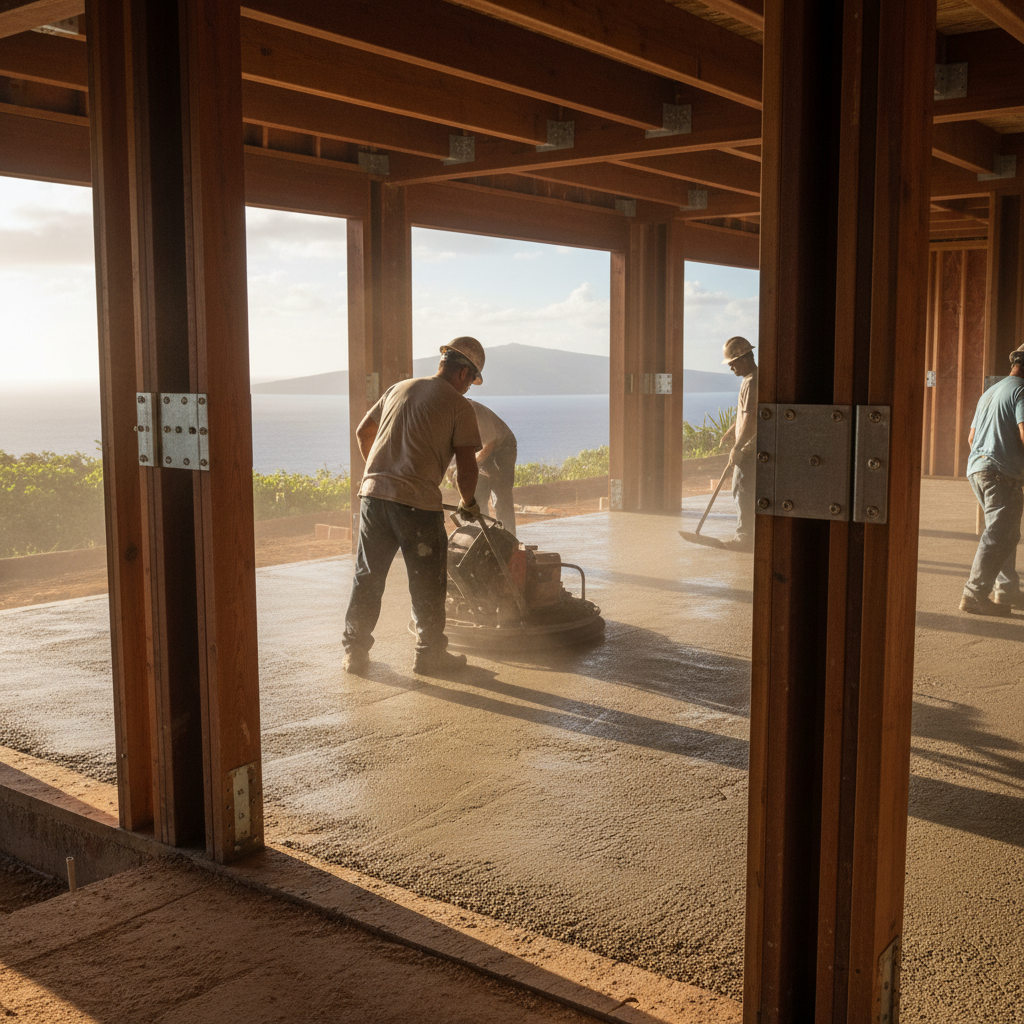
- The Pour (1 day): This is the main event. A team of finishers, the concrete trucks, and a pump truck all arrive in a coordinated effort to place, spread, and begin finishing the concrete.
- Curing & Finishing (7-28 days): The concrete doesn’t just “dry.” It undergoes a chemical reaction called hydration, which gives it strength. The initial set happens in hours, but it needs to be kept moist (cured) for at least 7 days to reach a good portion of its design strength. It won’t reach its full 28-day design strength for about a month. Light foot traffic is usually okay after 2-3 days, but you shouldn’t drive a car on a new driveway for at least 7-10 days.
For a straightforward 2,000 sq. ft. concrete foundation in Kapalua, a homeowner should budget a minimum of 5-6 months from the day they hire an engineer to the day the foundation is ready for framing. The actual on-site work is only a fraction of that time. The key is understanding that the permitting process in Hawaii is a marathon, not a sprint. We set this expectation with our clients from day one.
What Permits Do You Need for Concrete Contractor in Kapalua?
Navigating the permitting process with the County of Maui Department of Public Works is one of the most critical services a qualified general contractor provides. It’s a complex, document-heavy process that can easily stall a project if not handled correctly. Attempting to do concrete work without the proper permits is a recipe for disaster, potentially leading to stop-work orders, fines, and even being forced to tear out the completed work.
Here’s the rule of thumb: if the concrete is structural or related to life safety, you need a building permit. If it’s purely cosmetic and flat, you might not. But the lines can be blurry, and it’s always best to have a professional confirm.
Projects That Absolutely Require a Building Permit in Kapalua:
- New Home Foundations: Every new concrete foundation in Kapalua, without exception, requires a full building permit with engineered plans.
- Retaining Walls: Any retaining wall kapalua residents build that is over 4 feet in height (measured from the bottom of the footing to the top of the wall) requires a permit and an engineer’s stamp. Even walls under 4 feet may need one if they are supporting a surcharge, like a driveway or a building.
- Additions or Structural Slabs: Pouring a new slab for a home addition, a new garage, or even a covered lanai that will have a roof structure attached to it.
- Second-Story Decks or Balconies: Any elevated concrete structure requires full permitting.
- Major Structural Repairs: Significant spalling repair on condo lanais or structural beams requires a permit, as the integrity of the building is at stake.
Projects That May Not Require a Permit (Always Verify):
- Driveways: A simple, at-grade driveway concrete Kapalua replacement often does not require a building permit, *unless* you are changing the curb cut, altering drainage patterns, or the driveway is part of a larger new construction project.
- Patios and Walkways: At-grade (on the ground) concrete patios and walkways that are not structurally supporting a roof are generally exempt from permitting.
The Permitting Process with Maui County:
While every project is unique, the general workflow we manage for our clients looks like this:
- Plan Submittal: We submit the complete set of engineered drawings and supporting documents to the Maui County DPP. This is all done electronically now.
- Departmental Reviews: The plans are routed to various departments for review. This can include Zoning, Planning, Building, and sometimes Public Works or the Department of Health depending on the project scope. Each department reviews the plans for compliance with their specific codes. The process is similar in principle to what Honolulu’s DPP handles[1], but with Maui’s own specific regulations and staff.
- Review Comments & Revisions: It is very common for a department to return plans with comments or requests for clarification (RFCs). Our team works with the engineer to address these comments and resubmit the revised plans. This back-and-forth can happen several times and is a major reason for the long permit timelines.
- Permit Issuance: Once all departments have approved the plans, the permit is issued, and we can pay the fees and begin work.
For Kapalua properties, there can be an extra layer of complexity. If the property is near the shoreline, it may fall within the Special Management Area (SMA), which requires an additional, more intensive permit review process focused on environmental and coastal impacts. Also, many Kapalua communities have their own Design Review Committees that must approve plans *before* they are even submitted to the county. We are experienced in preparing submittal packages for these committees, ensuring compliance with community-specific aesthetic and material guidelines.
Kapalua-Specific Considerations: Climate, Materials, Regulations
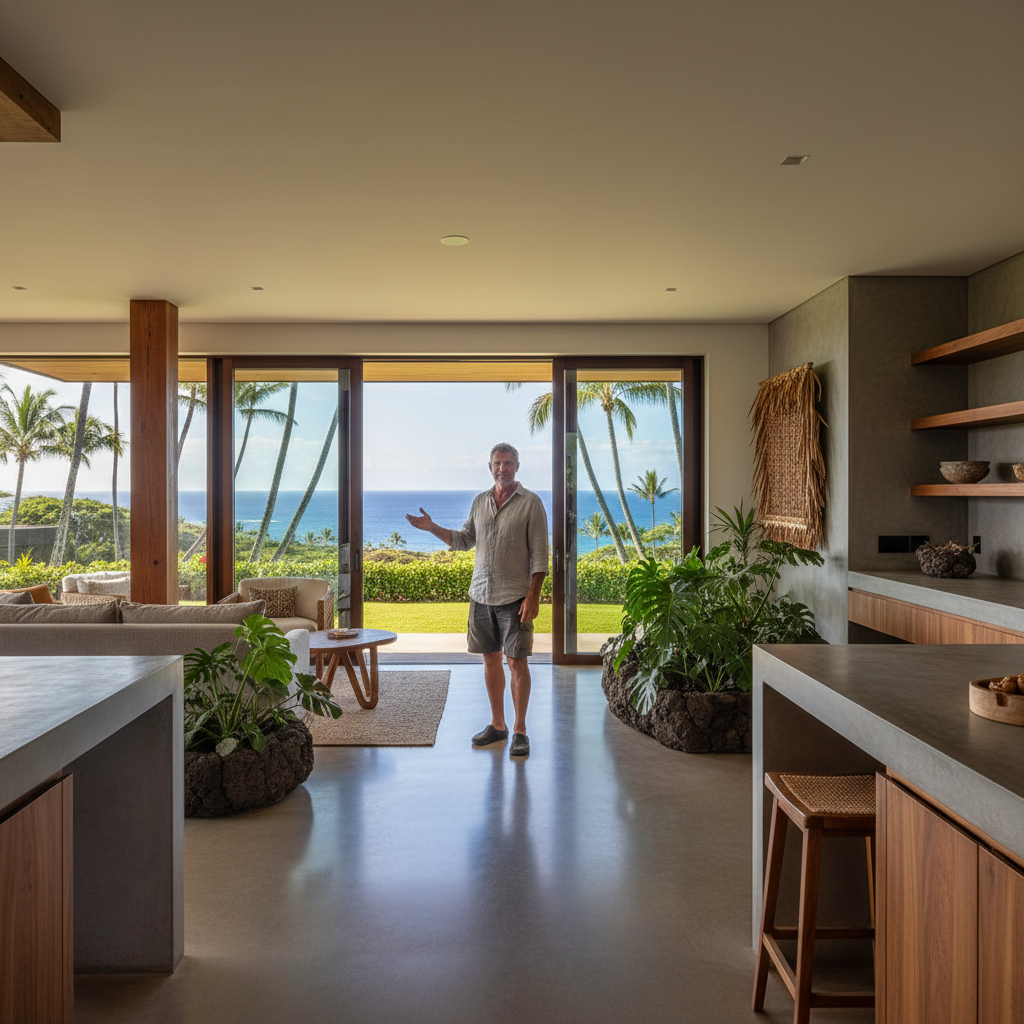
Building in Kapalua is not like building anywhere else. The combination of its stunning coastal location, unique microclimate, and high-end community standards creates a set of challenges that every concrete contractor must be prepared to handle. At Warrior Construction, we engineer our solutions specifically for these Kapalua realities.
Climate: Salt Air and Intense Sun
The number one enemy of concrete in Kapalua is the relentless salt-air corrosion. The moist, salt-laden air drifts inland and settles on everything. When it penetrates porous concrete, it reaches the steel rebar inside and starts a corrosive process that is devastating. The rebar rusts, expands, and exerts immense pressure on the surrounding concrete, causing it to crack and break away in a process called spalling. We see this all the time on older buildings that weren’t built to modern standards.
Our mitigation strategies are non-negotiable:
- Increased Concrete Cover: Code might require 1.5 inches of concrete cover over rebar, but for a Kapalua project, we push for 2 to 3 inches, especially on surfaces facing the ocean. This extra thickness provides a much more robust barrier against chloride intrusion.
- Waterproofing and Sealants: We recommend applying high-quality silane/siloxane sealants to finished concrete surfaces. These penetrate the pores and create a hydrophobic barrier that repels water and salt without changing the look of the concrete. For below-grade retaining walls, we use robust waterproofing membranes.
- Strategic Pour Scheduling: The intense Maui sun can be brutal on fresh concrete, causing it to lose moisture too quickly and weaken. We schedule our pours for the very early morning to avoid the peak heat of the day. This gives the concrete time to set properly before being baked by the sun.
Materials and Logistics
Every single bag of cement, ton of aggregate, and stick of rebar used in Kapalua has to be barged to Maui and then trucked to the west side. This supply chain has major implications.
- Lead Times: We can’t just run down to a big box store for specialty materials. Epoxy-coated rebar, specific architectural form liners, or high-performance admixtures often have a 6-8 week lead time from the mainland. Planning and ordering well in advance is essential to keeping a project on schedule.
- Concrete Batch Plant Location: The primary concrete batch plants are in Central Maui. This means a concrete truck has about a 45-60 minute travel time to get to a Kapalua job site. In Hawaii’s heat, the clock is ticking on that truck’s load. The concrete mix has to be designed with retarders to slow the setting process, and the logistics must be flawlessly coordinated. A traffic jam in Lahaina can jeopardize an entire pour.
- Material Quality: The volcanic rock aggregate available on Maui has different properties than continental aggregates. Our mix designs are specifically calibrated for the materials we have available locally to ensure we meet or exceed engineering specifications.
Regulations: Beyond the Building Code
In addition to the County of Maui building codes, which incorporate hurricane-resistant standards for things like foundation tie-downs, Kapalua has its own set of rules. Most of the residential communities, like Pineapple Hill or the Kapalua Plantation Estates, have strict covenants, conditions, and restrictions (CC&Rs) and a Design Review Committee (DRC).
These rules can govern things like:
- Driveway Finishes: Many communities prohibit a standard grey, broom-finished driveway. They may require an exposed aggregate finish, staining, or the use of pavers, all of which impact the concrete scope and cost.
- Retaining Wall Appearance: A standard concrete retaining wall may be forbidden. The DRC might require it to be faced with lava rock or another approved stone veneer, which becomes a major part of the project.
- Construction Hours and Site Management: There are strict limits on when work can be performed (e.g., no weekends) and rules about dust control, noise, and parking for construction vehicles.
Our team is adept at working within these frameworks. We prepare detailed submittals for the DRC and maintain clean, respectful job sites that meet the high standards of the Kapalua community. This understanding of the ‘unwritten rules’ is just as important as our technical expertise.
How to Choose the Right Concrete Contractor Contractor in Kapalua
Choosing the right contractor for your Kapalua project is the single most important decision you’ll make. A great contractor will protect your investment and deliver a lasting product; a bad one can lead to years of problems and financial loss. The stakes are too high in this environment to simply go with the lowest bidder. You need a partner with proven, local expertise.
Here is the checklist our team at Warrior Construction recommends every Kapalua homeowner use when vetting a potential concrete contractor:
1. Verify Their License and Insurance – No Exceptions.
- License: The contractor must have a valid Hawaii Contractor’s License. For any project involving multiple trades, like a foundation, they should have a General Contractor (B) license. Our license is BC-34373. You can and should verify any contractor’s license status on the Hawaii Department of Commerce and Consumer Affairs (DCCA) Professional & Vocational Licensing (PVL) website[2]. An unlicensed contractor has no business working on your property.
- Insurance: Ask for certificates of General Liability and Workers’ Compensation insurance. General Liability protects your property from damage, while Workers’ Comp protects you from being sued if one of their employees is injured on your job site. A minimum of $1 million in liability coverage is standard.
2. Insist on Maui-Specific, Kapalua-Relevant Experience.
- Portfolio Review: Don’t just look at pretty pictures. Ask to see examples of projects similar to yours *in the Kapalua or West Maui area*. Ask them to explain the challenges of that specific project. What kind of concrete mix did they use for that oceanfront foundation? How did they handle the hillside grading for that retaining wall?
- Local References: Ask for the names and numbers of 2-3 recent clients on Maui, preferably in Kapalua. Call them and ask about their experience. Were they on budget? Was the communication clear? Were there any surprises? How was the job site kept?
3. Evaluate Their Technical Knowledge of Coastal Concrete.
This is where you can separate the pros from the rest. Ask them direct questions about building in Kapalua:
- “What PSI concrete do you recommend for my project and why?”
- “How do you protect the rebar from salt-air corrosion?”
- “What is your process for curing concrete in the hot sun here?”
- “How do you manage the logistics of getting a concrete delivery to my property without issues?”
Their answers should be confident, detailed, and specific. If they give vague answers or seem unsure, it’s a major red flag.
4. Get a Detailed, Itemized Bid.
Never accept a one-page, lump-sum bid. A professional bid from a company like Warrior Construction will be several pages long and break down the costs for:
- Permitting
- Engineering (if applicable)
- Site prep and excavation
- Materials (with quantities and unit prices)
- Labor
- Equipment rental
- Contingency
This level of detail shows that they have thoroughly thought through your project. It also allows you to compare bids on an apples-to-apples basis. Be very wary of a bid that is significantly lower than others; it almost always means they’ve missed something or are cutting corners on materials or insurance.
Choosing a contractor is about building a relationship based on trust and expertise. Our process begins with listening to your goals and then providing a clear, transparent plan to achieve them, backed by decades of Hawaii-specific experience.
Real Kapalua Concrete Contractor Project Example
To make this all more tangible, let’s walk through a recent, typical project our Warrior Construction team completed. This provides a clear picture of how we tackle the unique challenges of concrete work in Kapalua.
The Project: A Hillside Concrete Foundation in Kapalua
The Client: A family building a new 3,500 sq. ft. custom home on a sloped lot in one of Kapalua’s established residential communities.
The Challenge: The lot had a significant grade change of about 15 feet from the street down to the back of the property. The soil was a mix of volcanic clay and rock shelves. The design called for a multi-level foundation with a walk-out basement level, requiring substantial retaining walls to be integrated directly into the home’s foundation. Furthermore, the property offered stunning ocean views, meaning it was fully exposed to the prevailing, salt-laden trade winds.
Our Solution & Process:
- Pre-Construction (6 months): The first step was coordinating with the client’s architect and our trusted structural engineer. A geotechnical engineer was brought in to perform soil borings, which confirmed the presence of the rock shelves. This report was crucial for the engineer to properly design the footings. Some footings were standard spread footings, while others had to be pinned directly to the bedrock. We then prepared and submitted the extensive plan package to both the community’s Design Review Committee and the County of Maui. The back-and-forth with the county took about five months to resolve all comments.
- The Concrete Specification: Given the hillside location and coastal exposure, we specified a high-performance concrete mix. The final specification was a 4500 PSI mix with a corrosion-inhibiting admixture. All reinforcing steel for the retaining walls and ocean-facing elements was epoxy-coated rebar to provide maximum protection against salt-air corrosion. This was a critical upgrade for the long-term durability of the concrete foundation in Kapalua.
- Construction (7 weeks):
- Excavation (2 weeks): This was a major phase. We used heavy equipment to cut into the hillside and create the building pad and stepped-down levels. We had to use a hydraulic hammer to break through the unexpected rock shelves.
- Forming & Rebar (3 weeks): Our crew built a complex web of formwork for the stepped footings, foundation walls, and integrated retaining walls. Thousands of pieces of epoxy-coated rebar were meticulously placed and tied by hand. This phase concluded with a successful pre-pour inspection from the county.
- The Pours (4 separate days): Due to the complexity, the foundation was poured in four separate stages: footings first, then the lower retaining walls, then the upper walls, and finally the main slab-on-grade. Each pour was scheduled for 6:00 AM to ensure the concrete was placed before the heat of the day.
The Numbers:
- Total Concrete Poured: 180 cubic yards
- Total Reinforcing Steel: 12 tons
- Total Project Cost (Foundation only): Approx. $265,000
- Total Timeline (start of engineering to finished slab): 8 months
The Outcome: The result was a rock-solid, precisely engineered foundation built to last a century, perfectly integrated into the hillside and ready for the framing crew to begin their work. The client had a single point of contact throughout the entire complex process, and the project proceeded smoothly despite the challenging site conditions.
What this means for Hawaii homeowners
For any homeowner in Kapalua planning a project that involves concrete, from a simple driveway to a complex new home foundation, the key takeaway is this: local expertise is not a luxury, it’s a necessity. The unique combination of Hawaii’s climate, geology, and regulatory environment means that what works on the mainland often fails here. Your investment is too significant to leave to chance.
Here’s how you can translate the information in this guide into actionable steps for your 2026 project:
- Budget Realistically for Quality: Understand that the costs for concrete work in Kapalua—around $45-$65 per square foot for a structural slab or $110-$180 per face square foot for a retaining wall—reflect the higher-grade materials and specialized labor required. Trying to cut corners here will inevitably lead to much more expensive repairs later on. Budget for corrosion protection like epoxy rebar from the start.
- Plan for the Permitting Timeline: The most common point of frustration for homeowners is the project timeline. Internalize the fact that permitting with Maui County will likely take 4-8 months before any dirt is moved. Start the process of engaging a contractor and engineer far earlier than you think you need to. A good general contractor will manage this process for you, but they can’t make it go faster than the county’s review queue allows.
- Hire a Licensed, Insured, and Experienced General Contractor: Don’t try to piecemeal the job by hiring a separate excavator, form-setter, and finisher. Hire a single, accountable General Contractor like Warrior Construction (BC-34373) who understands the entire process, from engineering and permitting to the final cure. Verify their license and insurance without fail.
- Ask the Right Questions: Use the knowledge you’ve gained here to interview potential contractors. Ask them specifically about salt-air mitigation, their experience with Kapalua’s Design Review Committees, and their logistical plan for your specific site. Their answers will quickly reveal their level of local expertise.
Ultimately, a successful concrete project in Kapalua is about proactive planning and partnering with a team that has a proven track record in this demanding environment. By doing so, you ensure the very foundation of your home is built not just to code, but to last a lifetime in paradise.
Frequently Asked Questions About Concrete Contractor in Kapalua
How much thicker does a driveway need to be in Hawaii to handle heavy vehicles?
For a standard passenger car driveway in Kapalua, a 4-inch thick slab with wire mesh or light rebar is usually sufficient. However, if you have heavy vehicles like large delivery trucks, a boat trailer, or construction equipment, we strongly recommend increasing the thickness to 6 inches and using a more robust grid of #3 or #4 rebar. This will increase the cost by about 25-35%, but it’s essential for preventing cracking and failure under heavy loads.
What is the cost difference between a standard concrete finish and a decorative finish in Kapalua?
In 2026, a standard broom-finished driveway concrete in Kapalua costs between $28-$38 per square foot. For a decorative stamped concrete finish with one color, you can expect to pay around $35-$45 per square foot. For more complex, multi-color patterns or an exposed aggregate finish, the cost can rise to $45-$55 per square foot. The increase is due to the additional labor, specialized tools, and more expensive materials (stains, sealers, and release agents) required.
Can you pour concrete in the rain on Maui?
It’s highly inadvisable. A light, passing shower might be manageable if the concrete has already begun to set, but heavy rain can ruin a fresh pour. Rainwater increases the water-to-cement ratio on the surface, which severely weakens the top layer, leading to a soft, dusty, or flaky finish. At Warrior Construction, we monitor the weather radar obsessively. If there’s a significant chance of rain, we will always postpone a pour to protect the quality of the final product.
Do I need a geotechnical report for my Kapalua concrete project?
For simple flatwork like a patio, no. But for any new concrete foundation in Kapalua or an engineered retaining wall, the structural engineer will almost certainly require a geotechnical (or soils) report. This report, which typically costs $3,000-$7,000, tells the engineer about the soil’s bearing capacity, composition (e.g., expansive clay, rock), and stability. It’s a critical piece of data needed to design a foundation that won’t shift, sink, or fail.
What is ‘spalling’ and why is it common in Kapalua?
Spalling is when the surface of concrete cracks, pits, and breaks away. In Kapalua, the primary cause is corrosion of the internal steel rebar due to salt-air exposure. As the rebar rusts, it expands, pushing the concrete cover off from the inside. It’s common in older buildings constructed before modern corrosion-resistant techniques were standard practice. Preventing it requires using high-quality concrete, adequate concrete cover over the rebar, and protective measures like admixtures or coated rebar.
How long do I really have to wait before driving on my new driveway?
We advise all our clients to wait a minimum of 7 full days before driving a standard passenger car on a new concrete driveway. For heavier vehicles like an SUV or truck, waiting 10-14 days is even better. While the concrete may feel hard to the touch after a day, it’s still gaining a significant amount of its strength during that first week. Driving on it too soon can create hairline cracks that will worsen over time.
Is a post-tension slab a good idea for Kapalua’s soil?
A post-tension slab, which uses steel cables tensioned after the concrete cures, can be an excellent solution for areas with expansive or problematic soils. It creates a stronger, more crack-resistant foundation. While more expensive upfront than a standard slab-on-grade (typically by 15-20%), it can be a wise long-term investment for certain Kapalua properties, especially those on lots with challenging soil reports. This is a decision that should be made in consultation with your structural engineer.
The foundation of your home is no place to compromise. When you’re ready to discuss your concrete project, you need a team that understands the unique demands of building in Kapalua. At Warrior Construction, we combine decades of on-the-ground Hawaii experience with a commitment to quality and transparency.
Whether you’re planning a new driveway, a critical retaining wall, or the foundation for your dream home, our team has the expertise to deliver a product built to withstand the test of time against the Maui elements. If you’re looking for a concrete contractor in Kapalua who gets it right the first time, we’re here to help.
Ready to lay a solid foundation for your Kapalua project? Explore our concrete and foundation services or contact our team today for a comprehensive estimate.