“
When you need a concrete contractor in Hanalei, you’re not just pouring a simple slab. You’re building a foundation that has to withstand some of the most beautiful but demanding conditions on earth: constant salt air, heavy rainfall, and specific building codes designed for hurricane zones. The right concrete solution here is the difference between a home that lasts generations and one that shows spalling and cracks in a few short years. At Warrior Construction, we’ve spent over two decades mastering the specifics of Kaua‘i concrete work, from hillside foundations to oceanfront driveways.
\n\n
This isn’t about guesswork; it’s about engineering for the environment. Our team understands that the concrete mix specified for a dry Kapolei subdivision is entirely wrong for a property near Hanalei Bay. You need the right admixtures for moisture, the correct rebar grade and placement to fight corrosion, and a deep understanding of Kaua‘i’s unique soil and water tables. For homeowners on the North Shore, this means focusing on long-term resilience over short-term savings. We’ve seen too many jobs by mainland-minded contractors fail because they didn’t account for the relentless humidity and corrosive environment.
\n\n
In this guide, we’ll break down the five essential concrete solutions every Hanalei homeowner needs to consider for 2026. We’ll cover realistic costs, permitting timelines on Kaua‘i, and the critical climate factors that should dictate every decision you make. This is the insider knowledge our team brings to every project, ensuring your investment stands strong for decades to come.
\n\n
Why Hanalei Homeowners Trust Warrior Construction for Concrete Contractor
\n\n
Hanalei homeowners trust our team at Warrior Construction because we’re a licensed general contractor (BC-34373) with a deep, practical understanding of Kaua‘i’s unique building challenges. We’re not just a concrete crew; we are builders who see the foundation as the most critical component of the entire structure. Our approach is holistic, considering how the concrete work integrates with drainage, landscaping, and the home’s overall resilience to the North Shore’s specific climate. We’ve been on the ground here for over 20 years, learning lessons you can only get from real-world projects, not from a textbook.
\n\n
One of the biggest differentiators is our logistical expertise. Getting materials and equipment to a place like Hanalei isn’t as simple as calling a supplier on O‘ahu. We have established relationships with Kaua‘i suppliers and barging companies. This means we can accurately forecast costs and timelines, accounting for potential shipping delays that can derail a project. For instance, on a recent project near Wainiha, a specific corrosion-inhibiting admixture for the concrete mix had a six-week lead time. Because we anticipated this, we ordered it during the architectural planning phase, preventing any downtime on site. A less experienced contractor might have waited until the forms were built, causing a costly month-and-a-half delay.
\n\n
Furthermore, our experience extends beyond just the pour. We understand the local soil conditions—from the rich, water-retaining soils in the valleys to the sandier compositions closer to the bay. This dictates our approach to site preparation, compaction, and foundation design. We know precisely how to engineer a concrete foundation in Hanalei that won’t shift or crack as the ground saturates during the rainy season. It’s this granular, on-the-ground knowledge that sets a true local expert apart. Our clients know that when we build a foundation or pour a driveway, it’s engineered specifically for their piece of paradise, not as a one-size-fits-all solution.
\n\n
What Does Concrete Contractor Cost in Hanalei?
\n\n
In 2026, the cost for a professional concrete contractor in Hanalei typically ranges from $28 to $45 per square foot for basic flatwork like a driveway or standard foundation slab. However, this is just a baseline. For more complex projects involving significant grading, hillside work, or specialized finishes, the costs can be higher. We always provide detailed, line-item estimates because a simple square-foot price doesn’t tell the whole story, especially on Kaua‘i.
\n\n
Let’s break down the real costs for a typical 4-inch thick, 3,500 PSI driveway pour in Hanalei:
\n
- \n
- Materials: Concrete itself runs about $250-$280 per cubic yard delivered to the North Shore. For a 1,000 sq. ft. driveway, you’ll need around 13 cubic yards. Add to that the cost of welded wire mesh or rebar, which can be $1.50 – $2.50 per square foot installed.
- Labor & Site Prep: This is a significant factor. It includes excavation, grading, building the forms, and placing the rebar. For a standard site, this can add $10 – $15 per square foot. If your property is on a slope or requires extensive soil compaction, this cost will increase.
- Finishing: A standard broom finish is the most cost-effective. If you want a stamped pattern (like lava rock or wood plank) or an exposed aggregate finish for better traction, expect to add another $5 – $12 per square foot.
- Pumping & Logistics: If the pour site is inaccessible for a concrete truck, you’ll need a pump truck. On Kaua‘i, this can add a flat fee of $1,500 to $2,500 for the day, plus a per-yard pumping fee. This is a common requirement for hillside properties in Hanalei.
\n
\n
\n
\n
\n\n
Here’s a sample cost comparison for a 600-square-foot project, like a patio or a small driveway extension:
\n\n
| Concrete Service in Hanalei | Average Cost per Sq. Ft. (2026) | Estimated Total for 600 sq. ft. | Key Considerations |
|---|---|---|---|
| Standard Broom-Finish Driveway | $32 | $19,200 | Assumes stable, level ground. |
| Stamped Concrete Patio | $40 | $24,000 | Includes color hardener and sealer. |
| Engineered Retaining Wall (4 ft. tall) | $95 per face sq. ft. | Varies by length | Requires structural engineering and deeper footings. |
| Basic Concrete Foundation Slab | $35 | $21,000 | For a small cottage or garage; includes footings. |
\n\n
Remember, the price of materials includes the cost of barging them to Kaua‘i and trucking them to the North Shore, which adds about 15-20% compared to O‘ahu prices. When you get a quote, make sure it clearly outlines these costs. Our team at Warrior Construction ensures every proposal is transparent, so you see exactly where your money is going, from the cost of rebar to the fee for the final sealer application.
\n\n\n\n
How Long Does a Concrete Contractor Take in Hanalei?
\n\n
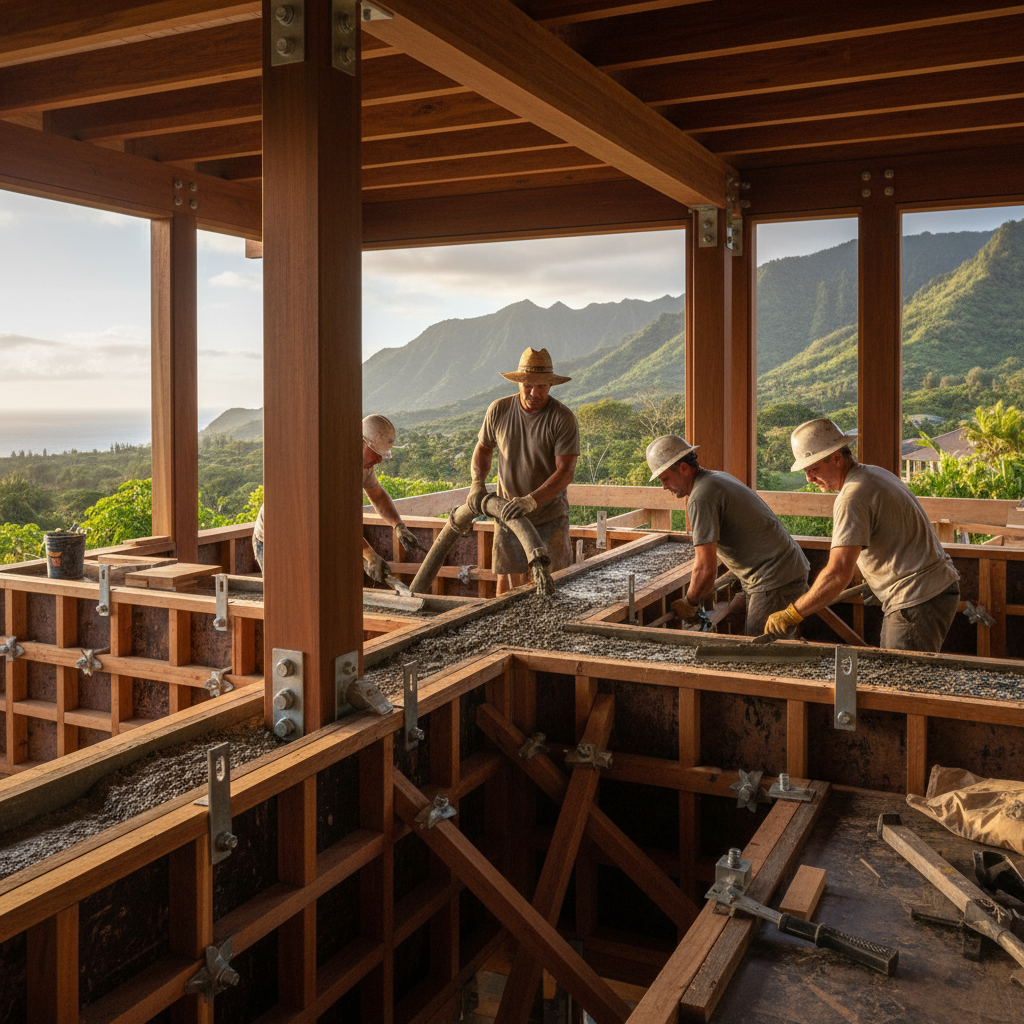
A typical concrete project in Hanalei, like a standard driveway or a simple foundation, can take anywhere from 2 to 5 weeks from the day we sign the contract to the final cure. This timeline is heavily influenced by three Kaua‘i-specific factors: weather, permitting, and material availability. It’s not like the mainland where you can have a crew on site the next day. Here, careful planning is everything.
\n\n
Let’s walk through a realistic timeline for a 1,200 sq. ft. driveway concrete Hanalei project:
\n\n
- \n
- Week 1: Planning & Permitting. Even if a permit isn’t required for a simple driveway replacement, we still need to clear plans with the county for anything involving grading or new structures. This first week involves site survey, finalizing the plan, and submitting any necessary paperwork to the Kaua‘i County Planning Department. This is also when we schedule material deliveries, which can be a week or two out.
- Week 2: Site Preparation. This is where the physical work begins. Our crew will excavate the area, removing old concrete or soil. We then lay down and compact the base rock (like CRB) to create a stable sub-base. Forms are built to outline the pour, and all rebar or wire mesh is meticulously placed and tied according to engineering specs. Weather is a huge factor here; a few days of heavy Hanalei rain can easily push this phase into week 3.
- Week 3: The Pour & Initial Curing. This is pour day. The concrete truck arrives, and we place the concrete, screed it level, and apply the initial finish (like a broom finish). This is a critical day that requires a full, experienced crew. For the next 7 days, the concrete undergoes its most critical curing phase. We often advise clients to keep it moist during this time, especially if it’s hot and sunny, to ensure maximum strength. No vehicles can go on it during this time.
- Week 4-5: Final Curing & Site Cleanup. The forms are stripped away, and we’ll do any necessary backfilling and site cleanup. The concrete can typically handle foot traffic after a few days, but we recommend waiting a full 28 days for it to reach its designed compressive strength before parking heavy vehicles on it. We’ll perform a final walkthrough with you to ensure every detail is perfect.
\n
\n
\n
\n
\n\n
For larger projects like a new home’s concrete foundation in Hanalei, the timeline expands significantly. The permitting process alone can take several months. The foundation work itself, involving footings, stem walls, and slab pour, can take 6-10 weeks, depending on complexity and inspections. The key takeaway for any project on the North Shore is patience and partnership with your contractor. We build realistic schedules that account for the inevitable “island time” factors, ensuring you’re not met with unexpected and frustrating delays.
\n\n
What Permits Do You Need for Concrete Contractor in Hanalei?
\n\n
Navigating the permitting process with the Kauaʻi County Department of Public Works and Planning Department is one of the most critical services a qualified concrete contractor provides. You can’t just start digging. For most concrete work beyond simple, at-grade patio slabs, you will need a permit. This is especially true for anything structural, like foundations, retaining walls, or significant new driveways that alter drainage.
\n\n
Here’s a breakdown of common concrete projects and their likely permitting requirements in Hanalei:
\n
- \n
- New Home Foundation: A building permit is absolutely mandatory. This is a complex application that requires a full set of architectural and structural plans stamped by a Hawaiʻi-licensed engineer. The plans must detail footing depths, rebar schedules, concrete PSI strength, and adherence to hurricane code. This is the most intensive review process.
- Retaining Walls: For a retaining wall in Hanalei, if it is over 4 feet in height (measured from the bottom of the footing to the top of the wall), you will need a building permit and engineered plans. Walls under 4 feet may not require a permit, but they still must be built to code, and it’s always wise to check with the county first.
- Driveways: A simple repair or replacement of an existing driveway often does not require a permit. However, if you are creating a new, larger driveway, changing its location, or if the work involves significant grading or a new curb cut, a grading permit and/or a building permit will be required. The county is particularly focused on how new impervious surfaces affect water runoff.
- ADUs & Ohana Units: The foundation for any accessory dwelling unit requires a full building permit, just like a new home. These are reviewed carefully to ensure compliance with all zoning and building codes.
\n
\n
\n
\n
\n\n
The process on Kauaʻi is similar to that on Oʻahu with the Honolulu DPP[1], but with its own unique timelines and staff. Expect the permit review for a new foundation or major structural work to take anywhere from 3 to 9 months in 2026. Smaller permits, like for a retaining wall, might be faster, perhaps 2-4 months. Delays often happen when plans are incomplete or don’t adequately address local conditions like flood zones or soil stability.
\n\n
Our role at Warrior Construction is to manage this entire process for you. We work with trusted local architects and engineers to create plans that anticipate the reviewers’ questions. We handle the submission, respond to any comments from the plan checkers, and manage all required inspections (footing, rebar, slab, etc.). This hands-on management is crucial to keeping a project on track. Trying to navigate this bureaucracy as a homeowner can be incredibly frustrating and lead to long, costly delays.
\n\n

Hanalei-Specific Considerations: Climate, Materials, Regulations
\n\n
Building with concrete in Hanalei is fundamentally different than anywhere else in Hawaiʻi. The combination of intense rainfall, high humidity, corrosive salt air, and unique geological conditions demands a specialized approach. A contractor who doesn’t understand these nuances can inadvertently create a structure that fails prematurely. Our team’s local experience is built on adapting our methods to these five key Hanalei-specific factors.
\n\n
1. Extreme Rainfall and Drainage: Hanalei is one of the wettest places on earth. This constant saturation affects everything. For foundations, it means we often need to incorporate robust French drain systems and waterproof membranes to prevent moisture intrusion. For driveways and flatwork, the slope is critical. We design every surface with a precise grade (at least 1/4 inch per foot) to ensure water sheets off and away from the home, preventing pooling and infiltration under the slab.
\n\n
2. Salt-Air Corrosion: Proximity to Hanalei Bay means a constant barrage of salt-laden air. Salt attacks steel rebar within concrete, causing it to rust and expand, which cracks the concrete from the inside out—a process called spalling. To combat this, we use several strategies:
\n
- \n
- Increased Concrete Cover: We ensure there’s a thicker layer of concrete (often 3 inches) over the rebar, especially on surfaces facing the ocean.
- Epoxy-Coated or Galvanized Rebar: For critical structural elements, we specify coated rebar that provides a physical barrier against chlorides.
- Corrosion-Inhibiting Admixtures: We often recommend special chemicals mixed into the concrete that protect the steel rebar at a molecular level. This adds to the cost but can double the life of the structure.
\n
\n
\n
\n\n
3. Volcanic and Alluvial Soils: The soil composition around Hanalei can vary dramatically. Some areas have expansive clay soils that shrink and swell with moisture, while others have looser, alluvial soils deposited by the Hanalei River. Before any major foundation work, a geotechnical report is often necessary. This tells us the load-bearing capacity of the soil and guides our engineers in designing the right type of foundation—whether it’s a monolithic slab, a post-and-pier system, or a more complex solution with grade beams.
\n\n
4. Hurricane Code Compliance: Ever since Hurricane ʻIniki devastated Kauaʻi, building codes have been significantly strengthened. For concrete work, this means specific requirements for how the foundation is tied to the rest of the house. We use heavy-duty anchor bolts and hurricane straps embedded directly into the concrete foundation, ensuring a continuous load path that can resist the powerful uplift forces of hurricane-force winds. This isn’t optional; it’s a critical life-safety requirement.
\n\n
5. Logistical Realities of the North Shore: Getting a fully loaded 10-yard concrete truck across the Hanalei Bridge and onto a tight residential street requires planning. We have to schedule pours during non-peak traffic hours and sometimes use smaller trucks to navigate difficult access. Material deliveries, from rebar to base rock, must be carefully coordinated with barge schedules into Nāwiliwili Harbor. Our project managers are experts in this North Shore supply chain, which is essential for keeping a project on budget and on schedule.
\n\n
How to Choose the Right Concrete Contractor Contractor in Hanalei
\n\n
Choosing the right concrete contractor in a specialized market like Hanalei is the single most important decision you’ll make for your project. A bad concrete job is incredibly difficult and expensive to fix. It’s not just about getting the lowest bid; it’s about finding a true partner with the right qualifications, experience, and local knowledge. Here’s the checklist our team recommends every homeowner use.
\n\n
1. Verify Their License and Insurance. This is non-negotiable. Any contractor performing work over $1,000 in Hawaiʻi must have a valid contractor’s license. You can and should verify any contractor’s license status on the state’s Professional & Vocational Licensing (PVL) website[2]. For example, our license is BC-34373. Ask for a copy of their general liability insurance and worker’s compensation insurance certificates. If an uninsured worker gets hurt on your property, you could be held liable. A professional contractor will provide these documents without hesitation.
\n\n
2. Demand Local, Relevant Experience. Ask for a portfolio of projects specifically on Kauaʻi’s North Shore. A contractor who primarily works in the dry, flat areas of West Oʻahu may not have the experience to handle Hanalei’s rain, slopes, and salt air. Ask them specific questions:
\n
- \n
- \”How do you adjust your concrete mix for the salt air in Hanalei?\”
- \”What is your procedure for handling a sudden downpour on the day of a pour?\”
- \”Can you show me a retaining wall you built in the Hanalei or Princeville area?\”
\n
\n
\n
\n
Their answers will quickly reveal their level of local expertise.
\n\n
3. Get a Detailed, Written Contract. A professional proposal isn’t a one-page estimate. It should be a detailed contract that clearly specifies the scope of work, a breakdown of costs (materials, labor, equipment), the payment schedule, the project timeline, and the exact materials to be used (e.g., \”4,000 PSI concrete with fiber mesh reinforcement\”). This document protects both you and the contractor and prevents misunderstandings down the road.
\n\n
4. Check Their References. Don’t just rely on online reviews. Ask the contractor for the names and numbers of their last three clients. Call them and ask about their experience. Was the project completed on time and on budget? Was the crew professional and the communication clear? How did they handle unexpected issues? A confident contractor with a history of satisfied clients will be happy to provide references.
\n\n
5. Assess Their Communication and Professionalism. From the first phone call, gauge their responsiveness and professionalism. Do they return your calls promptly? Do they listen to your concerns and answer questions clearly? Construction is a long process with many moving parts. You need a contractor who is a good communicator and who you feel comfortable working with for several weeks or months.
\n\n
Real Hanalei Concrete Contractor Project Example
\n\n
To make this tangible, let’s look at a recent project we completed for a homeowner in Hanalei, which highlights many of the challenges and solutions we’ve discussed. The client was building a new 800-square-foot ʻohana unit on their property, which had a moderate slope and was located about a quarter-mile from the bay.
\n\n
The Challenge: The initial plan from a mainland architect called for a standard monolithic slab-on-grade foundation. However, our site assessment and a geotechnical report we commissioned revealed two major issues. First, the soil had a high clay content, making it unstable during the rainy season. Second, the slope required a significant amount of cut-and-fill, which could lead to future settling issues if not handled properly. A standard slab would likely crack within a few years.
\n\n
Our Solution: A Step-Footing Foundation with Integrated Retaining Wall. Instead of a simple slab, our team, in collaboration with a local structural engineer, designed a more robust solution. We proposed a step-footing foundation that followed the natural contour of the land. This minimized the amount of grading needed. On the downhill side, the foundation stem wall was engineered to also act as a structural retaining wall in Hanalei, creating a level building pad and preventing soil erosion.
\n\n
Key specifications of our approach included:
\n
- \n
- Deeper Footings: We excavated footings down to a stable soil layer, well below the expansive clay.
- Heavy Rebar Schedule: We used #5 rebar (thicker than standard) and tied it more closely together within the footings and stem walls. All rebar was specified as epoxy-coated due to the proximity to the coast.
- Waterproofing and Drainage: The entire retaining wall portion of the foundation was treated with a heavy-duty waterproof membrane and a French drain system was installed at its base to channel hydrostatic pressure away from the structure.
- High-Strength, Low-Permeability Concrete: We specified a 4,500 PSI concrete mix with a corrosion-inhibiting admixture to ensure maximum durability against salt and moisture.
\n
\n
\n
\n
\n\n
The Outcome: While our proposed foundation was about 20% more expensive than the original, inadequate design (total foundation cost was approximately $42,000), it provided a stable, permanent solution engineered specifically for the site. The project was completed in 7 weeks, including two weather delay days. The homeowner now has peace of mind knowing their investment is built on a solid, resilient foundation that will last for generations, rather than a cheaper alternative that would have led to costly structural repairs down the road.
\n\n
What this means for Hawaii homeowners
\n
For homeowners in Hanalei, understanding the nuances of concrete work is not just an academic exercise—it’s about protecting your most valuable asset. The key takeaway is that concrete is not a commodity here. The specific mix, reinforcement, and design must be tailored to the unique environmental pressures of the North Shore. Simply hiring the cheapest crew to pour a slab is a recipe for disaster that often leads to spalling, cracking, and water intrusion issues within a decade.
\n
Here are the actionable steps you should take:
\n
- \n
- Budget for Resilience, Not Just Size. Allocate a portion of your budget for upgrades like corrosion-inhibiting admixtures or epoxy-coated rebar, especially if your property is close to the water. An extra $3,000 – $5,000 on a foundation for these upgrades can prevent a $50,000 repair bill later.
- Invest in Upfront Engineering. For any project involving slopes or questionable soil, insist on a geotechnical report. The $2,500 – $4,000 cost for the report provides the essential data for an engineer to design a foundation that won’t fail. It’s the cheapest insurance you can buy.
- Question Every Bid. When you receive a bid from a concrete contractor, look past the final number. Does it specify the PSI of the concrete? The type and spacing of the rebar? The method of water-proofing? If these details are missing, the contractor is likely cutting corners.
- Think About Water Management First. Before you even think about the concrete pour, think about where the water will go. Your concrete driveway, patio, and foundation are all part of a larger system. Discuss drainage, grading, and gutter tie-ins with your contractor from day one.
\n
\n
\n
\n
\n
Ultimately, your role as a homeowner is to be an informed partner in the process. By understanding these Hanalei-specific challenges, you can ask the right questions and choose a contractor who provides genuine, long-term solutions, not just a quick and easy pour.
\n\n
Frequently Asked Questions About Concrete Contractor in Hanalei
\n
What is the best type of concrete finish for Hanalei’s wet climate?
\n
For outdoor flatwork like walkways and driveways in Hanalei, a broom finish is the most practical and safest choice. The textured surface provides excellent traction, which is critical during frequent rain showers. While stamped or smooth finishes can look beautiful, they can become extremely slippery when wet. An exposed aggregate finish is another great option that offers both durability and high traction.
\n
\n
How much more does concrete work cost on Kauaʻi compared to Oʻahu?
\n
You can generally expect concrete work on Kauaʻi to cost 15-25% more than on Oʻahu in 2026. This price difference is almost entirely due to logistics. All cement, aggregate, and steel rebar must be barged to Nāwiliwili Harbor and then trucked to the job site. These inter-island shipping costs, along with potentially higher labor rates, are factored into the final price.
\n
\n
Can you pour concrete in the rain in Hanalei?
\n
It is highly inadvisable to pour concrete during heavy rain. Rainwater can increase the water-to-cement ratio in the surface layer of the concrete, weakening it significantly and leading to a poor, dusty finish. Our team constantly monitors the weather forecast. If a sudden shower pops up during a pour, we have plastic sheeting ready to cover the fresh slab immediately to protect its integrity.
\n
\n
How long do I have to wait to drive on my new concrete driveway?
\n
We recommend waiting a minimum of 7 full days before driving a passenger car on a new concrete driveway. For heavier vehicles like a large truck or SUV, it’s best to wait 14-28 days. While the concrete will be hard to the touch within 24 hours, it takes about 28 days to reach its full design strength, and putting heavy loads on it too early can cause hairline cracks.
\n
\n
Do I need a structural engineer for my concrete foundation in Hanalei?
\n
Yes, for any new home, addition, or ADU foundation, a Hawaiʻi-licensed structural engineer is required to design and stamp the plans. This is a mandatory part of the building permit process with Kauaʻi County. The engineer will specify the footing sizes, rebar schedule, and concrete strength based on the architectural plans and soil conditions to ensure the structure is safe and up to code.
\n
\n
What is a ‘monolithic slab’ and is it good for Hanalei?
\n
A monolithic slab is a type of foundation where the footings and the floor slab are poured as one single piece. It can be faster and more cost-effective for flat, stable sites. However, for the sloped terrain and variable soils common in Hanalei, it’s often not the best choice. A stem wall foundation with separate footings provides more stability and is better suited to hillside construction.
\n
\n
How do you deal with the red dirt staining the new concrete?
\n
Kauaʻi’s red dirt is notorious for staining. During site preparation, we are meticulous about managing the soil and using base rock to create a clean barrier. After the pour, we apply a high-quality penetrating sealer (silane or siloxane based) to the cured concrete. This sealer fills the pores of the concrete, making it much more resistant to staining from red dirt, organic materials, and oil.
\n
\n
\n\n
Your Foundation for a Lasting Hanalei Home
\n
Your home in Hanalei is more than just a structure; it’s a legacy. Ensuring it’s built on a solid, correctly engineered foundation is the most important investment you can make in its future. At Warrior Construction, we bring decades of hands-on, Kauaʻi-specific experience to every pour, from a simple driveway to a complex hillside foundation. We understand the challenges of the North Shore climate and know how to build for it.
\n
If you’re ready to discuss your project with a team that values quality and durability, we’re here to help. Let’s talk about building something strong enough to stand the test of time. Learn more about our concrete and foundation services or reach out today for a detailed consultation.
\n\n
References
\n