“
Concrete Contractor Hilo: 7 Mistakes to Avoid for 2026
\n
Choosing the right concrete contractor Hilo homeowners can rely on is about more than just getting a good price; it’s about ensuring your foundation, driveway, or retaining wall can withstand Hilo’s unique environment for decades. The biggest mistake we see homeowners make is underestimating our specific island challenges—from the constant rain affecting the concrete cure to the corrosive volcanic soil that can eat away at improperly prepared foundations. This isn’t like pouring a slab in Arizona. Here on the Big Island, the wrong concrete mix or inadequate site prep can lead to catastrophic failure in just a few years.
\n
For over 20 years, our team at Warrior Construction has been pouring concrete across Hawaii. We’ve seen it all, from foundations shifting in Puna’s lava zones to retaining walls failing under the pressure of waterlogged soil in Waiakea. This isn’t just a job for us; it’s about building structures that last for our community. We want to pull back the curtain and show you what goes into a professional concrete job in Hilo, so you can avoid the costly shortcuts that less experienced contractors might take. We’ll break down the real costs you can expect in 2026, the permitting process in Hawai’i County, and the critical Hilo-specific techniques that separate a lasting project from a future problem.
\n\n
Why Hilo Homeowners Trust Warrior Construction for Concrete Contractor
\n
When you’re building in Hilo, you need a team that understands the ground beneath your feet. It’s that simple. We’re not a mainland company trying to apply one-size-fits-all solutions to our unique island conditions. At Warrior Construction, we are a licensed Hawaii General Contractor (BC-34373), and our roots are firmly planted in local soil. This deep experience means we anticipate problems before they happen. For example, we know that the soil in many parts of Hilo has a high acidic content from volcanic minerals. Consequently, we don’t just pour a standard concrete mix; we specify mixes with a higher Portland cement content and sometimes recommend admixtures that resist sulfate attack, protecting your foundation from premature degradation.
\n
Our reputation is built on transparency and meticulous planning. Before a single bag of cement is ordered, we conduct thorough site evaluations. We analyze drainage patterns—a critical factor in a town that gets over 120 inches of rain a year. We look at soil compaction and determine the exact sub-base requirements, which often involves bringing in and compacting specific types of fill like 3/4\” crushed drain rock to ensure a stable, well-draining base. This prevents the kind of slab heaving and cracking we often get called to repair on projects done by others. It’s this level of detail that makes a difference. We manage the entire process, from engineering and permitting to the final cure and cleanup, ensuring a seamless experience for our clients.
\n
Furthermore, our clients value our communication. You’re not just a project number to us. You’ll have a direct line to our project managers who can explain every step of the process. Whether we’re working on a complex `concrete foundation hilo` for a new custom home or a simple `driveway concrete hilo` replacement, we provide regular updates. This commitment to service, combined with our technical expertise and deep understanding of Big Island construction, is why homeowners across East Hawai’i choose our team. Our extensive portfolio of projects speaks for itself, showcasing the quality and durability we build into every job.
\n\n
What Does Concrete Contractor Cost in Hilo?
\n
Let’s get straight to the numbers, because that’s what every homeowner wants to know. In 2026, the cost for professional concrete work in Hilo is higher than on the mainland, and for good reason. Everything—from the cement itself to the rebar and even the specialized equipment—has to be shipped to the Big Island, adding a significant cost. Here’s a realistic breakdown of what you should budget for:
\n
- \n
- Standard Concrete Driveway or Patio Slab (4-inch thick): For a basic broom-finish slab, you should expect to pay between $18 and $26 per square foot. For a typical 600-square-foot two-car driveway, this puts the total cost in the range of $10,800 to $15,600. This price includes proper site prep, forming, a compacted gravel base, wire mesh reinforcement, the concrete itself (typically 3000 PSI), labor, and finishing.
- Concrete Foundation Slab (6-inch thick with footings): A structural slab for a home is a more complex job. For a `concrete foundation hilo` project, costs run from $28 to $40 per square foot. A 1,500-square-foot foundation will therefore land between $42,000 and $60,000. This includes excavation, extensive sub-base prep, vapor barriers, perimeter and interior footings, #4 rebar reinforcement tied 18 inches on-center, and anchor bolts set for framing. The higher cost reflects the increased material (thicker concrete, more steel) and the precision required.
- Retaining Wall Hilo (CMU Block or Poured-in-Place): Retaining walls are priced differently, often by the square foot of the wall’s face. For an engineered block `retaining wall hilo` homeowners need for slope control, costs in 2026 are between $85 and $130 per face square foot. A wall that is 4 feet high and 50 feet long (200 sq ft) would cost between $17,000 and $26,000. This includes the deep footing, vertical rebar, block-laying, filling the cells with grout, and waterproofing. Poured-in-place concrete walls are often 15-20% more expensive due to the extensive formwork required.
\n
\n
\n
\n
What drives these costs? First, materials are a huge factor. A yard of concrete delivered in Hilo can cost over $250. Rebar prices fluctuate with the steel market, plus the added shipping from Oahu or the mainland. Second is labor. Skilled concrete finishers are in high demand, and their expertise is not cheap. Third, site access and preparation can add thousands. If your property is on a steep slope in Kaumana or has difficult access, we might need special equipment like a concrete pump truck, which adds $1,500-$2,500 per day to the project cost. When you get a quote, make sure it clearly itemizes these elements so you know exactly what you’re paying for.
\n\n
How Long Does a Concrete Contractor Take in Hilo?
\n
Patience is key in Hawaii construction, and concrete work is no exception. The timeline is often longer than people expect, largely due to factors outside of the actual pour day. Here’s a typical project flow and duration for a mid-sized concrete project, like a new driveway or a small foundation, in Hilo for 2026.
\n
Phase 1: Planning & Permitting (3 – 8 weeks)
This is the most variable part of the timeline. For any structural concrete work like a foundation or a `retaining wall hilo` over four feet high, you’ll need a building permit from the Hawai’i County Department of Public Works. Even a driveway might require a permit if it involves a new curb cut. Our team handles the entire submittal process, which includes drafting plans, getting any necessary engineering stamps, and navigating the county review. In 2026, we’re seeing permit review times for simple projects hover around 4-6 weeks, but more complex plans can easily take 8 weeks or more. This is before any work can begin.
\n
Phase 2: Site Preparation & Forming (3 – 7 days)
Once we have the permit in hand, our crew gets to work. This phase involves:
\n
- \n
- Excavation and Grading: Clearing the area and ensuring the ground is sloped correctly for drainage. (1-2 days)
- Sub-base Installation: Bringing in and compacting several inches of gravel or crushed rock. This is a critical step for stability, especially in Hilo’s often soft soil. (1-2 days)
- Formwork and Reinforcement: Building the wooden forms that will hold the wet concrete, and precisely placing and tying all the steel rebar and/or wire mesh. (1-3 days)
\n
\n
\n
\n
Phase 3: The Pour & Finishing (1 day)
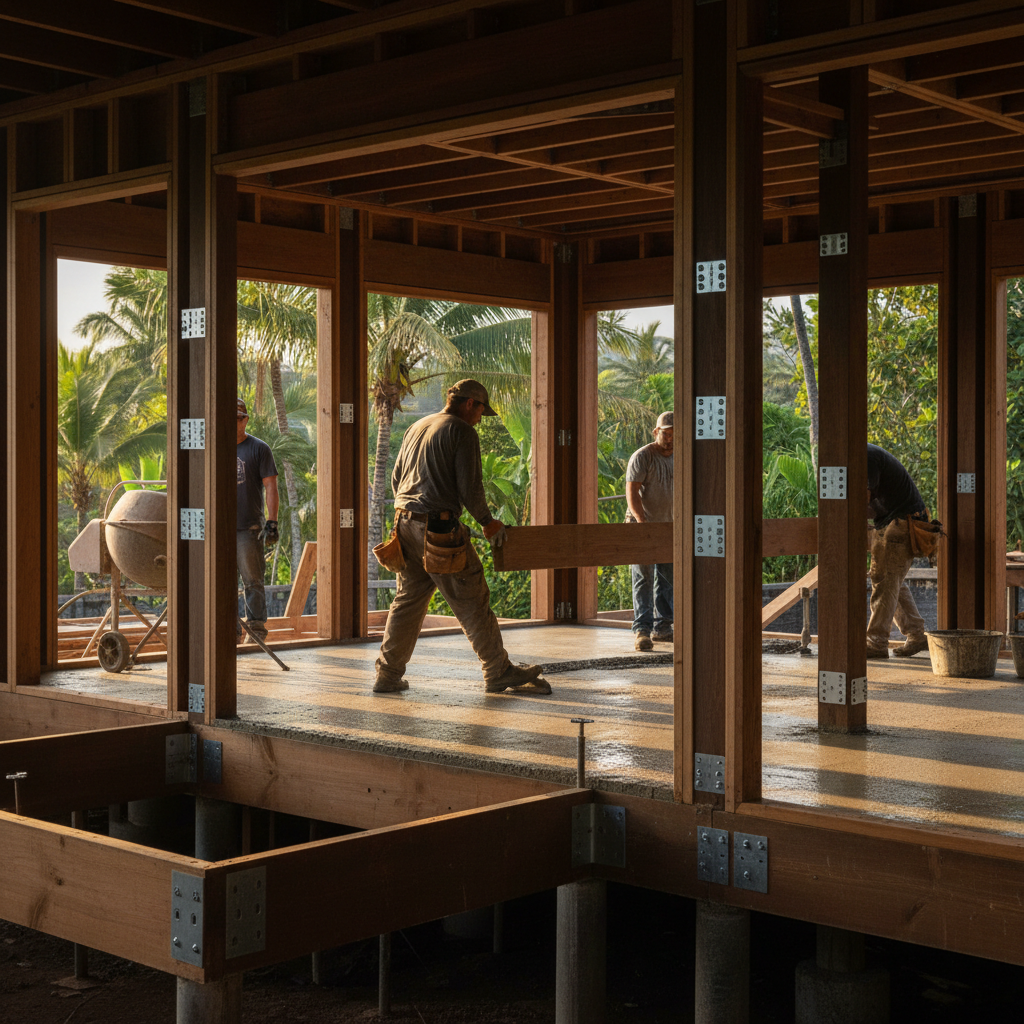
The actual pour day is intense but relatively short. The concrete truck arrives, and our team works quickly to pour, spread, and level the concrete before it begins to set. This is followed by the finishing process—screeding, floating, and applying the final surface texture, like a broom finish for grip or a smooth trowel finish for an interior floor. For a standard driveway, this is all done in a single day.
\n
Phase 4: Curing and Final Steps (1 – 4 weeks)
This is where homeowners get antsy, but it’s arguably the most important phase for long-term durability. Concrete doesn’t ‘dry’; it cures through a chemical reaction called hydration. It needs to remain moist to gain its full strength.
\n
- \n
- Initial Cure (7 days): The concrete should not be walked on for at least 24-48 hours. After 7 days, it has reached about 70% of its final strength and can typically handle light foot traffic.
- Full Cure (28 days): It takes a full 28 days for concrete to reach its designed compressive strength (e.g., 3000 PSI). You should not drive a vehicle on a new driveway for at least 7-10 days, and ideally wait closer to 28 days for heavy trucks. We often apply a curing compound or cover the slab to control moisture loss, which is especially important in the Hilo sun. After the cure, we return to strip the forms and do a final site cleanup.
\n
\n
\n
So, from signing a contract to being able to fully use your new concrete, a straightforward driveway project can take 5 to 10 weeks, with most of that time spent in permitting and curing.
\n\n
What Permits Do You Need for Concrete Contractor in Hilo?
\n
Navigating the permitting process with the Hawai’i County Department of Public Works (DPW) can be a major headache for homeowners. It’s one of the biggest areas where an experienced local `concrete contractor hilo` provides immense value. You can’t just start digging and pouring. Here’s a look at the permit requirements for common concrete jobs in Hilo for 2026.
\n
A building permit is generally required for any work that is structural in nature or affects public safety and property lines. The rules are designed to ensure everything is built to Hawaii’s stringent building codes, which account for hurricanes and seismic activity.
\n
Here’s when you will almost certainly need a permit:
\n
- \n
- New Home Foundations: This is a non-negotiable. A `concrete foundation hilo` requires a full building permit, which involves architectural plans, structural engineering calculations, and multiple reviews by the county.
- Retaining Walls: Any `retaining wall hilo` that is over four feet in height (measured from the bottom of the footing to the top of the wall) requires a permit and must be designed by a licensed structural engineer. Walls under four feet that are supporting a surcharge (like a driveway or structure) also require a permit. Don’t let a contractor tell you otherwise; a failing retaining wall can cause a landslide.
- Slabs for Habitable Structures: Pouring a slab for a new home addition, an ADU (Ohana unit), or even an enclosed lanai requires a permit as it’s part of a livable space.
- Driveways with New Curb Cuts: If you are simply replacing an existing `driveway concrete hilo` in the same footprint, you often don’t need a building permit. However, if you are creating a new access point to a county road (a “curb cut”) or widening the existing one, you will need a separate permit from the DPW’s Highway Division.
\n
\n
\n
\n
\n
The process involves submitting detailed plans for review. For anything structural, these plans must be stamped by a Hawaii-licensed engineer. The county reviewers check for compliance with everything from property setbacks to drainage requirements and hurricane code tie-ins. The complexity of Hawaii’s system, while sometimes frustrating, is what keeps buildings standing during a major storm. Just look at the permit system on Oahu through their Department of Planning and Permitting (DPP)[1]; it’s a model of the detail required statewide. At Warrior Construction, we handle this entire bureaucratic process for our clients. We know the submission requirements, we have relationships with local engineers and surveyors, and we know how to answer the county’s questions to keep the project moving forward.
\n\n

Hilo-Specific Considerations: Climate, Materials, Regulations
\n
Pouring concrete in Hilo is a completely different beast than anywhere else in the United States. You’re dealing with a unique combination of intense rain, acidic volcanic soil, and a corrosive salt-air environment. Ignoring these factors is the fast track to a failing slab. Our team’s local knowledge is critical here.
\n
1. The Rain Factor: Hilo is one of the wettest cities in the nation. A sudden downpour in the middle of a pour can ruin the entire slab by increasing the water-to-cement ratio on the surface, which severely weakens it. An experienced Hilo contractor is an amateur meteorologist. We watch the forecast obsessively and always have a large inventory of plastic sheeting on hand to cover a fresh pour instantly. Furthermore, we adjust our curing methods. In a dry climate, you focus on adding water to cure. In Hilo, we often focus on protecting the slab from excess rain while still controlling evaporation to ensure proper hydration. This might involve using liquid membrane-forming curing compounds that seal the surface.
\n
2. Volcanic Soil: The soil composition around Hilo is often acidic and poorly draining. This creates two major problems. First, acidic soil can chemically attack concrete over time, leading to spalling and degradation. We mitigate this by ensuring a thick, well-compacted sub-base of clean crushed rock, which separates the slab from the native soil. We also might specify a concrete mix with fly ash or slag cement, which increases its resistance to sulfate and acid attack. Second, the soil can become saturated and lose its load-bearing capacity. Proper site grading to divert water away from the foundation and installing sub-slab drainage systems are not optional extras here—they are essential for long-term stability.
\n
3. Salt-Air Corrosion: Even on the Hilo side, we’re on an island. The air carries salt, which is the mortal enemy of the steel rebar inside concrete. When moisture and salt penetrate the concrete, they cause the rebar to rust. Rusting steel expands with incredible force, cracking the concrete from within—a process called spalling. To combat this, Hawaii building codes require specific “concrete cover,” meaning the rebar must be embedded deeper within the concrete than in other regions. For a foundation, this is typically a minimum of 3 inches of cover on any side exposed to the earth. We use plastic or concrete “chairs” to ensure the rebar is held precisely in the center of the slab during the pour, guaranteeing this protective cover is maintained.
\n
4. Hurricane Code and Seismic Activity: As a general contractor, we’re building everything to withstand hurricane-force winds and seismic events. For concrete foundations, this translates into specific requirements for anchor bolts (J-bolts) that connect the wood framing of the house to the foundation. They must be of a certain size, spacing, and embedment depth. Footings also need to be designed to handle both uplift forces from wind and lateral forces from earthquakes. These are not suggestions; they are code requirements that we strictly adhere to, ensuring your home is securely fastened to its `concrete foundation hilo`.
\n\n
How to Choose the Right Concrete Contractor Contractor in Hilo
\n
Hiring the wrong contractor can turn your project into a nightmare of delays, budget overruns, and shoddy work that needs to be redone. Vetting your contractor is the single most important step you will take. Here is our team’s checklist for choosing a reliable `concrete contractor hilo` residents can trust.
\n
1. Verify Their License and Insurance – No Exceptions.
This is the absolute first step. Any legitimate contractor in Hawaii must have a state-issued license. You can and should verify any contractor’s license number (ours is BC-34373) on the Hawaii Department of Commerce and Consumer Affairs (DCCA) Professional & Vocational Licensing (PVL) database[2]. A valid license means they have met the state’s requirements for experience and financial stability. Also, ask for proof of general liability insurance and workers’ compensation insurance. If an uninsured worker gets hurt on your property, you could be held liable. Do not skip this step.
\n
2. Look for Deep Local, Big Island Experience.
Ask potential contractors to show you their portfolio of completed projects *in East Hawai’i*. A company based on Oahu might not fully grasp the logistical challenges and specific ground conditions in Hilo. Ask them questions from the section above: “How do you handle a sudden rainstorm during a pour?” or “What kind of sub-base do you recommend for the volcanic soil in my area?” Their answers will quickly reveal their level of local expertise.
\n
3. Get a Detailed, Itemized Written Proposal.
A price scribbled on the back of a business card is a giant red flag. A professional proposal should be several pages long and clearly detail the scope of work. It should specify:
\n
- \n
- The exact dimensions and thickness of the slab.
- The compressive strength of the concrete mix (e.g., 3000 PSI).
- The type and spacing of reinforcement (e.g., #4 rebar at 18\” on center).
- The thickness and type of the gravel sub-base.
- A clear statement about who is responsible for permitting.
- A payment schedule.
- An estimated start and completion date.
\n
\n
\n
\n
\n
\n
\n
\n
Comparing detailed bids like this is the only way to ensure you’re comparing apples to apples.
\n
4. Check Their References.
Don’t just ask for a list of references—actually call them. Ask past clients about their experience. Was the project completed on time and on budget? How was the communication with the project manager? Was the job site kept clean and safe? Were there any issues after the project was completed, and if so, how did the contractor respond?
\n
5. Don’t Let Price Be the Only Factor.
The lowest bid is often the lowest for a reason. It might mean they’re using a cheaper, weaker concrete mix, skimping on the steel reinforcement, using an inexperienced crew, or are uninsured. A concrete failure is one of the most expensive things to fix in a home. It’s far better to pay 10-15% more for a quality job done right the first time than to have to tear everything out and start over in five years. Quality work from a reputable company like Warrior Construction is an investment in your property’s future.
\n\n
Real Hilo Concrete Contractor Project Example
\n
To make this tangible, let’s walk through a recent project we completed in Waiākea Uka. A homeowner needed a structural `concrete foundation hilo` for a new 1,200-square-foot ADU they were building for their parents.
\n
The Challenge: The property was on a slight slope with classic Hilo soil: soft, waterlogged, and rich in organic material. The initial soil report indicated poor load-bearing capacity, and a simple slab-on-grade would be at high risk of shifting and cracking. Proper water management was also a major concern for the client.
\n
Our Solution: Our team, in collaboration with a local structural engineer, designed a monolithic slab foundation with thickened footings. Here’s what that involved:
\n
- \n
- Site Preparation: We began by over-excavating the building pad by 18 inches, removing the poor-quality topsoil. We then laid a perimeter drain system (a French drain) at the uphill side of the pad to intercept groundwater and divert it safely away from the foundation area.
- Structural Fill: We brought in 12 inches of engineered structural fill, laid in 4-inch lifts. Each lift was meticulously compacted and tested to ensure it met the 95% compaction rating required by the engineer. On top of this, we added a 4-inch layer of clean, compacted drain rock.
- Formwork and Reinforcement: We formed the 6-inch slab with 18-inch deep by 16-inch wide perimeter footings. The reinforcement was robust: a grid of #4 rebar tied 16 inches on-center throughout the slab, with additional #5 bars in the footings to handle the structural loads. We also installed a 15-mil vapor barrier to prevent moisture from wicking up from the ground into the slab.
- The Pour: We used a 4000 PSI concrete mix with a water-reducing admixture to increase strength and workability. The pour was scheduled for a clear morning and completed in about four hours. Our finishing crew then worked the surface to a smooth, hard-trowel finish ready for the interior flooring.
\n
\n
\n
\n
\n
The Outcome:
Timeline: From permit approval to the end of the 28-day cure, the concrete phase took just under 6 weeks.
Cost: The total cost for the 1,200 sq ft foundation, including the extensive site prep and drainage, was approximately $45,600 (about $38 per sq ft).
\n
The client now has a rock-solid, stable foundation that will keep their new ADU dry and secure for generations, perfectly engineered for Hilo’s challenging ground conditions. This is the level of detail and problem-solving that defines a professional concrete project.
\n\n
What this means for Hawaii homeowners
\n
When you’re ready to start a concrete project in Hilo, understanding these local nuances is your best defense against costly mistakes. It’s not just about mixing sand, rock, and cement. It’s about building a structure that becomes a permanent, reliable part of your home, capable of withstanding everything the Big Island environment throws at it. Don’t be tempted by a contractor who offers a surprisingly low price without a detailed explanation of how they’ll tackle Hilo’s specific challenges.
\n
Here is your action plan:
\n
- \n
- Budget Realistically: Use the 2026 cost figures provided here ($18-$26/sf for driveways, $28-$40/sf for foundations) as a starting point. Be wary of any bid that comes in significantly lower.
- Insist on a Site Visit: Never accept a bid over the phone. A true professional will need to see the site to assess soil, access, and drainage before giving you an accurate price.
- Ask Pointed Questions: Use the information in this guide. Ask about their plan for rain, their specific rebar cover for salt-air protection, and their soil compaction methods.
- Verify Everything: Always check their license on the DCCA PVL website. Call their insurance provider to confirm their policy is active. Call their references. A little due diligence upfront can save you a world of hurt later.
- Get It All in Writing: Your contract is your protection. Ensure it details the scope, materials, timeline, and payment schedule.
\n
\n
\n
\n
\n
\n
Your concrete work is the literal foundation of your property’s value and safety. Taking the time to hire a qualified, experienced, and licensed local contractor is the most important decision you’ll make in the entire process. Ready to discuss your project? Get a no-obligation estimate from our team.
\n\n
Frequently Asked Questions About Concrete Contractor in Hilo
\n
Do I need rebar in my Hilo driveway?
\n
Yes, absolutely. While some contractors in dry, stable climates might use only wire mesh, it’s not enough for Hilo’s conditions. The frequent rain saturates the soil, causing it to expand and contract. Rebar provides the essential tensile strength to hold the slab together and prevent major cracking and separation. We recommend a grid of #3 or #4 rebar for any `driveway concrete hilo` project as a minimum standard.
\n
\n
What is the best concrete mix (PSI) for residential use in Hilo?
\n
For most residential applications like patios, walkways, and driveways, a 3000 PSI (pounds per square inch) mix is sufficient. For a structural `concrete foundation hilo` or a slab that will support heavy vehicles or a workshop, we upgrade to a 4000 PSI mix. The small additional cost per yard for the higher-strength mix is cheap insurance for long-term durability.
\n
\n
How much does a permit for a retaining wall cost in Hawai’i County?
\n
The permit fee itself is calculated based on the project valuation, but that’s only part of the cost. For 2026, you should budget between $2,500 and $5,000 for the engineering plans and structural calculations required for a permitted `retaining wall hilo` project. The county’s permit fee will then typically add another $300 to $800 on top of that. This pre-construction cost is essential for ensuring the wall is safe and legal.
\n
\n
Can you pour concrete in the rain in Hilo?
\n
No, you cannot pour concrete during active rainfall. A reputable contractor will postpone the pour. Rainwater hitting the surface will increase the water-to-cement ratio, which drastically weakens the top layer and can lead to a soft, dusty, or flaking surface. We always build flexibility into our schedule to wait for a clear window and have protective coverings ready in case of a surprise shower.
\n
\n
What is a vapor barrier and is it necessary for a Hilo foundation?
\n
A vapor barrier is a heavy-duty plastic sheet (typically 10-15 mil thick) laid on the ground before the concrete is poured. Its job is to block moisture from the soil from wicking up through the concrete slab into your home, which can cause mold, mildew, and flooring failures. Given Hilo’s damp ground, a vapor barrier is not optional; it’s a building code requirement and an absolute necessity for any interior slab.
\n
\n
How long before I can park my F-150 on my new driveway?
\n
We advise clients to wait a minimum of 10 days before parking passenger cars on a new driveway. For a heavy vehicle like a Ford F-150 or a commercial van, you should wait at least 14 days, and ideally the full 28-day cure period if possible. Parking a heavy truck on the slab too early can cause permanent tire depressions or even crack the immature concrete.
\n
\n
Why is my contractor recommending a concrete pump truck?
\n
A concrete pump truck is used when the pour site is inaccessible to the large, heavy concrete mixer truck. This is common for backyard patios, foundations on steep lots, or any site where the truck can’t get within 15-20 feet of the forms. While it adds cost (typically $1,500-$2,500 for a day), it’s often the only way to get the concrete placed efficiently and safely without compromising its quality by trying to move it too far with wheelbarrows.
\n
\n
\n\n
Build a Foundation That Lasts with Warrior Construction
\n
Your home’s foundation and concrete flatwork are the bedrock of your investment. In Hilo’s demanding environment, taking shortcuts isn’t just risky; it’s a guarantee of future problems. Our team at Warrior Construction combines decades of on-the-ground Hawaii experience with a commitment to using the right materials and techniques for every single job. We build things the right way, the first time.
\n
If you’re planning a project that involves concrete, from a new custom home foundation to a durable driveway that can handle the rain, we’re here to help. Let’s talk about your vision and how we can build a solid foundation for it. We invite you to learn more about our concrete and foundation services or reach out directly to our team to schedule a consultation and receive a detailed, transparent estimate for your project.
\n\n
References
\n