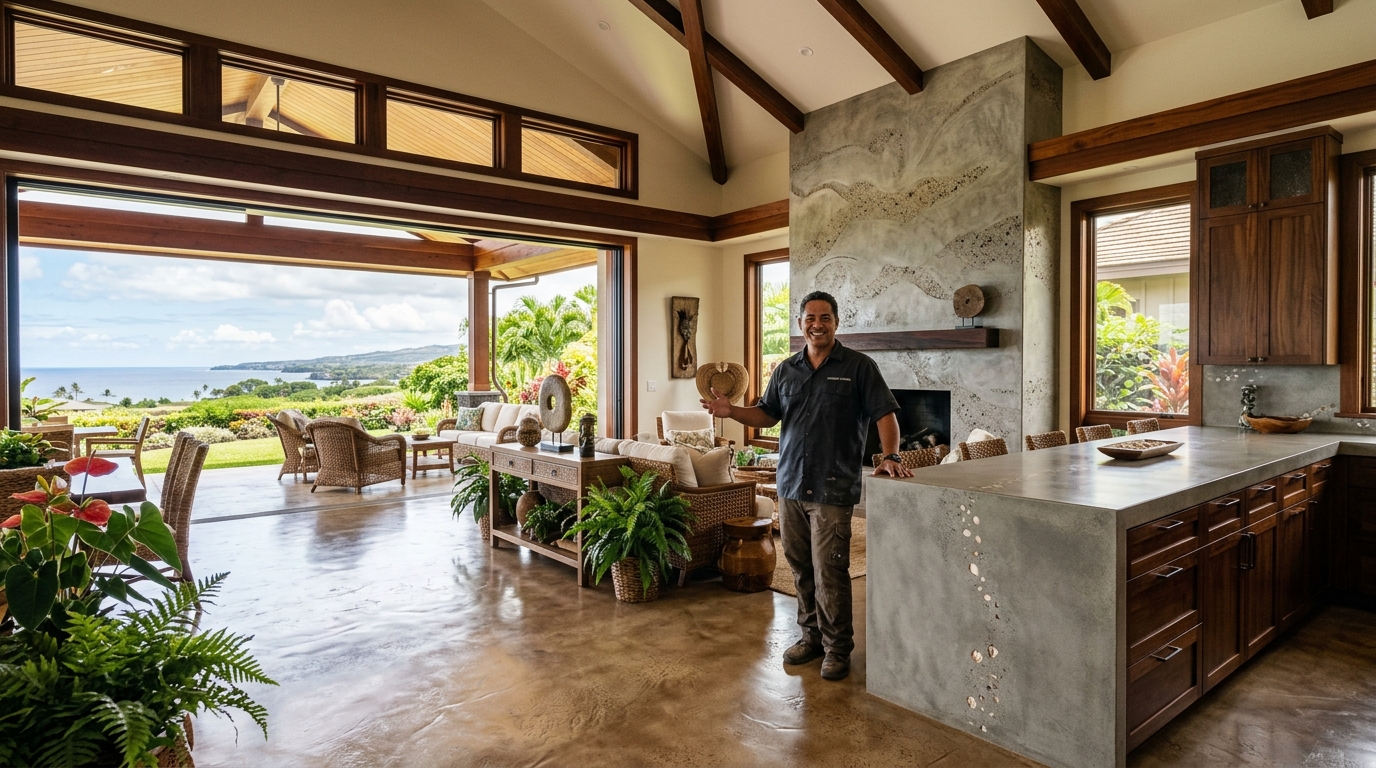
When you’re looking for a concrete contractor Kailua-Kona homeowners can rely on, the decision goes far beyond the price per yard. Here on the Big Island, concrete isn’t just a building material; it’s the anchor of your home, battling corrosive salt air, unpredictable volcanic soil, and intense UV exposure. Getting it right the first time is the single most important investment you can make, potentially saving you tens of thousands in future structural repairs. At Warrior Construction, we’ve spent over two decades pouring foundations, driveways, and retaining walls across West Hawai’i, and we’ve seen firsthand how a little bit of local knowledge at the start prevents major headaches down the road.
The truth is, pouring concrete in Kona is a different beast than on the mainland or even on Oahu. Material logistics, unique soil mechanics, and the sheer power of our coastal environment demand a level of expertise that can’t be learned from a book. This guide isn’t about generic advice; it’s about sharing six practical, money-saving tactics that our team uses on projects from Keauhou to Kohala. We’ll break down the real costs you can expect in 2026, navigate the County of Hawai’i’s permitting maze, and explain why spending a little extra on the right rebar now can save your foundation later. We’re pulling back the curtain on what it really takes to build lasting concrete structures in our unique island paradise.
Why Kailua-Kona Homeowners Trust Warrior Construction for Concrete Contractor
Homeowners and developers on the Big Island trust our team because we operate as a licensed general contractor (BC-34373), not just a concrete subcontractor. This distinction is critical. A subcontractor’s job is to pour the concrete as specified. Our job is to ensure the entire system—from the initial excavation and soil compaction to drainage and integration with the rest of the structure—is engineered for long-term success. We manage the whole picture, which prevents the costly blame game that can happen when multiple subs are involved.
For example, on a recent custom home build in Holualoa, we encountered a large pocket of unstable, deep soil where the foundation for the main lanai was planned. A typical concrete-only outfit might have just formed it up and poured, leaving the homeowners with a sinking, cracked lanai in a few years. Because we’re the GC, our process included a geotechnical review. We identified the issue, excavated the poor soil, and replaced it with two feet of engineered fill, compacted in 6-inch lifts. It added a day to the schedule and about $3,500 to the site prep budget, but it prevented a future repair that would have easily cost $40,000 and immense frustration. That’s the difference we bring to the table.
Furthermore, our decades of experience on Hawai’i Island mean we have deep-rooted relationships with local suppliers like West Hawai’i Concrete. We know who has the best aggregate, which batch plant is most reliable, and how to schedule a pump truck to avoid rush hour traffic on Queen Ka’ahumanu Highway. We understand the specific concrete mix designs needed to withstand the corrosive salt spray along Ali’i Drive versus the requirements for a foundation up in the cooler, wetter climate of Waimea. This granular, on-the-ground knowledge is something you only get from being part of this community for years. We don’t just work here; we live here, and we build every project as if it were for our own family.
What Does Concrete Contractor Cost in Kailua-Kona?
Let’s get straight to the numbers for 2026. For a standard 4-inch concrete slab in Kailua-Kona, you can expect to pay between $28 to $35 per square foot for the complete installation. This includes ground prep, formwork, rebar or mesh, the concrete itself, and a basic finish. However, that’s just a starting point. Complex projects with difficult site access, significant excavation, or high-end finishes can easily reach $45 per square foot or more, especially for structural foundations.
Here’s a more detailed cost breakdown for common concrete projects on the Big Island:
- Standard Driveway (4-inch slab, broom finish): $28 – $32 per sq. ft. A typical 20×24 foot (480 sq. ft.) driveway would run about $13,440 to $15,360.
- Patio or Lanai (4-inch slab, stamped or colored): $35 – $45 per sq. ft. The added cost comes from the decorative stamps, color hardeners, and the extra labor for the finishing crew. A 15×20 foot (300 sq. ft.) stamped patio might cost around $12,000.
- Concrete Foundation Kailua-Kona (6-inch slab-on-grade): $32 – $40 per sq. ft. This includes thicker concrete, more robust rebar grids, and thickened footings around the perimeter. For a 1,500 sq. ft. home, the foundation slab could cost $48,000 to $60,000.
- Retaining Wall Kailua-Kona (CMU block with concrete footing): $85 – $110 per face square foot. This is a very different calculation. A wall that is 4 feet high and 50 feet long (200 face sq. ft.) would cost between $17,000 and $22,000, including excavation, the continuous footing, rebar, block, and waterproofing.
Several key factors drive these costs in West Hawai’i:
- Material & Logistics: A cubic yard of concrete delivered in Kona runs about $230 – $260 in 2026. Any special admixtures for salt resistance or rapid curing have to be barged over from Oahu, which can add 20% to their cost.
- Site Preparation: This is the biggest variable on the Big Island. Hitting solid blue rock during excavation is common and requires heavy equipment and extra time. We budget for this possibility on every job.
- Labor: Good concrete finishers are artists, and they are in high demand. Labor accounts for nearly 50% of the total cost of any concrete project.
- Pumping: If the truck can’t get right next to the pour site, you’ll need a concrete pump truck, which adds another $1,200 to $2,000 to the day’s cost.
How Long Does a Concrete Contractor Take in Kailua-Kona?
The most common misconception we encounter is about the project timeline. While the actual on-site work for a driveway concrete Kailua-Kona project might only take a week, the total timeline from signing a contract to driving your car on it is realistically closer to 6 to 10 weeks. The bottleneck, almost without exception, is the permitting process.
Here’s a typical timeline for a project that requires a permit, like a new foundation or a large retaining wall:
- Week 1-2: Planning and Engineering. First, we finalize the plans. For anything structural, a licensed Hawaii engineer needs to review and stamp the drawings. This is non-negotiable for foundations and retaining walls.
- Week 3-8: Permitting with the County of Hawai’i. This is the big wait. We submit the engineered plans to the County of Hawai’i Planning Department. In 2026, review times for simple projects are running about 4-6 weeks, but complex builds can take longer. We have a dedicated team member who stays on top of the submittal, but the pace is set by the county reviewers.
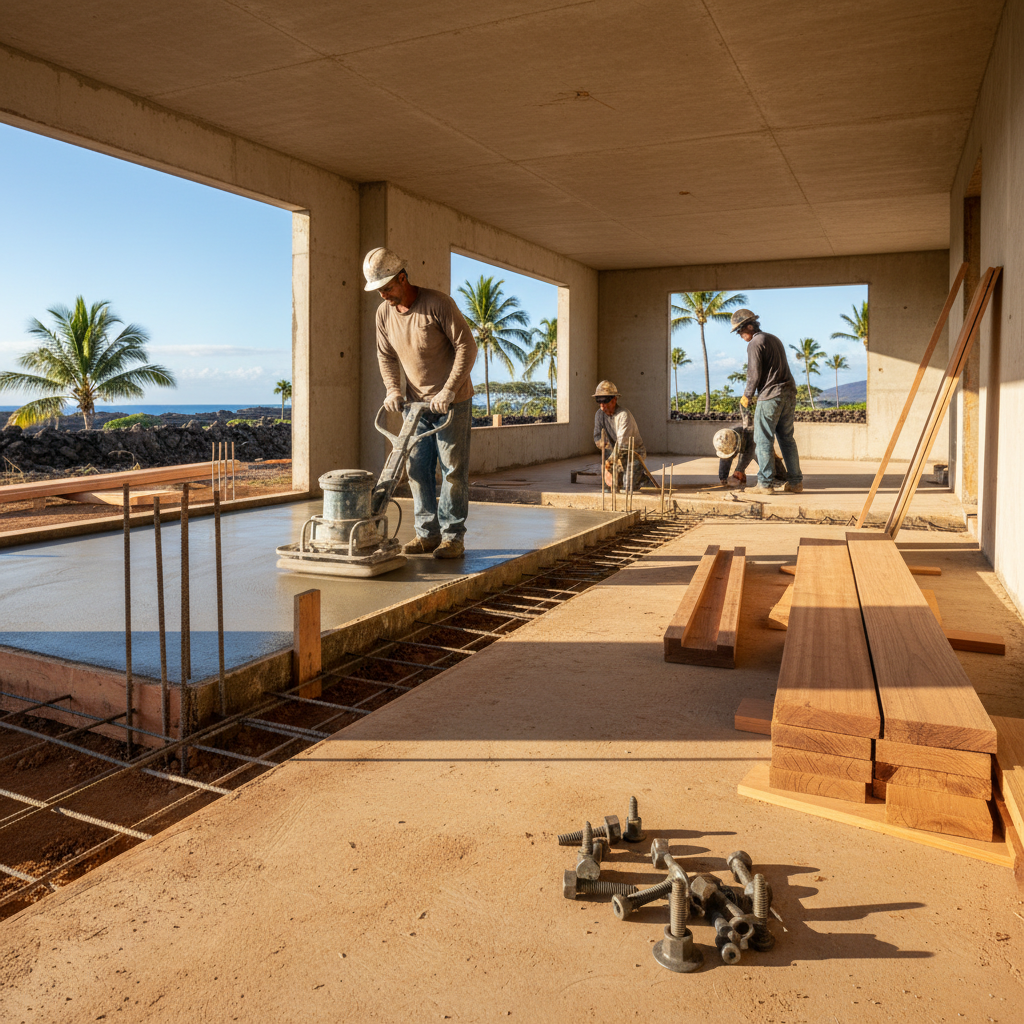
- Week 9: Site Preparation. Once the permit is in hand, things move quickly. Our crew will be on-site within a few days to excavate, grade the area, build the formwork, and meticulously place the rebar according to the engineering plans. This typically takes 3-5 days.
- Week 9 (End of Week): The Pour. This is the main event. The concrete trucks arrive, and the crew pours, screeds, and finishes the concrete. This is a single, intense day of work. After the pour, the crew will return to make control cuts to guide cracking.
- Week 10-13: Curing. This is the final and most crucial phase. Concrete doesn’t ‘dry’; it cures through a chemical reaction called hydration. You can typically walk on a new slab within 24-48 hours, but it needs 28 days to reach its full design strength. We advise clients to keep vehicles off a new driveway for at least 7-10 days.
For projects that don’t require a permit, like a simple patio replacement, you can skip the 4-6 week permitting delay. But even then, from contract to completion, you should still plan for a 2-3 week process to get on the schedule and complete the work properly.
What Permits Do You Need for Concrete Contractor in Kailua-Kona?
Navigating the permitting process with the County of Hawai’i can be frustrating for homeowners, but it’s a critical step that protects your investment and ensures safety. For concrete work in Kailua-Kona, any structural element requires a building permit. This absolutely includes new home foundations, footings for home additions, and any retaining wall Kailua-Kona residents build that is over four feet in height (measured from the bottom of the footing to the top of the wall).
On the other hand, a lot of flatwork is often exempt. Replacing an existing driveway or patio of the same size, or pouring a small slab for a shed (under 200 sq. ft. in most cases), typically does not require a permit. However, the rules can be nuanced. For example, if your new driveway alters the property’s drainage or creates a new access point to a county road, a permit might be triggered. The golden rule is to always verify with the County of Hawai’i Planning Department before starting any work. As your general contractor, we handle this entire process for you.
The permitting system, similar to other counties like Honolulu’s Department of Planning and Permitting (DPP)[1], requires a detailed application package. For a foundation, this includes:
- Completed Building Permit Application
- Multiple sets of stamped architectural and structural plans
- Geotechnical or soils report (often required in Kona due to the varied volcanic conditions)
- Drainage plan showing how stormwater will be managed
Once the permit is issued, inspections are mandatory. Before we pour a single yard of concrete, a county inspector must visit the site to approve our formwork, rebar placement, and ground preparation. This is called a “pre-pour” or “footing” inspection. If anything is not exactly to plan, the inspector will fail the inspection, and we can’t pour until it’s corrected and re-inspected. This can cause a delay of several days and is a major reason to hire an experienced contractor who gets it right the first time. Our team at Warrior Construction has a near-perfect first-pass rate on pre-pour inspections because we know what the Big Island inspectors are looking for.
Kailua-Kona-Specific Considerations: Climate, Materials, Regulations
Pouring concrete in Kailua-Kona is nothing like working in, say, Arizona or California. Our island environment presents a unique set of challenges that must be engineered into every single project. Ignoring these local factors is the fastest way to premature failure.
Climate and Environment
The Kona coast is defined by two major climate factors: intense, year-round sun and corrosive, salt-laden air. The heat and low humidity mean that a fresh concrete pour can lose its surface moisture too quickly. This can stop the chemical curing process and result in a weak, dusty surface with lots of shrinkage cracks. Our crews often schedule major pours for the very early morning to avoid the heat of the day. We also use curing compounds or cover the slab with wet burlap to ensure it cures evenly and reaches its full strength.
More importantly, the salt air is relentless. It penetrates porous concrete and aggressively attacks the steel rebar inside, causing it to rust. As rebar rusts, it expands, cracking the concrete from within—a process called spalling. For any project within a mile of the shoreline, we strongly recommend specific protective measures.
Materials and Mix Designs
- Corrosion-Resistant Rebar: For coastal projects, upgrading from standard black steel rebar to either epoxy-coated (the green stuff) or galvanized rebar is one of the smartest investments you can make. It might add 15-20% to the material cost of the rebar, but it can add decades to the life of your concrete.
- Concrete Mix: We don’t use a one-size-fits-all mix. For coastal zones, we specify a mix with a lower water-to-cement ratio, which creates a denser, less permeable concrete. We may also add a corrosion-inhibiting admixture directly into the concrete at the batch plant for an extra layer of protection.
- Aggregate: The aggregate (crushed rock) used in Big Island concrete comes from local volcanic rock. It’s strong and works well, but it has different absorption and thermal properties than the limestone or granite aggregates used on the mainland. A good local contractor understands how to work with it.
Local Regulations and Ground Conditions
The Big Island is geologically active. All of Hawai’i Island is in a high seismic zone, which means foundations and retaining walls must be engineered with extra steel and specific footing designs to withstand ground shaking. Additionally, the ground itself is unpredictable. You can be digging in soft soil and ten feet away hit a massive, solid lava rock boulder. Or worse, you might find a lava tube (puka). This is why site preparation is so vital and why we always budget a small contingency for unforeseen ground conditions. It’s simply the reality of building on a volcano.
How to Choose the Right Concrete Contractor Contractor in Kailua-Kona
Choosing the right team for your concrete project is the most critical decision you’ll make. A bad concrete job is incredibly expensive and disruptive to fix. The first step is always to verify their contractor’s license with the Hawai’i Department of Commerce and Consumer Affairs (DCCA) Professional and Vocational Licensing (PVL) division[2]. Ensure their license (our is BC-34373) is active, in good standing, and that they carry both general liability and workers’ compensation insurance. Never hire anyone who can’t promptly provide you with a certificate of insurance.
Beyond the basics, here are the six critical tactics we promised to help you save money and ensure a quality result:
- Hire a General Contractor, Not Just a Concrete Sub. This might seem self-serving, but it’s true. A GC manages the entire process—permits, excavation, drainage, rebar, concrete, and even coordinating with plumbers for underslab rough-ins. This integrated approach prevents mistakes. We’ve been called in to fix driveways that were poured before the plumber ran the sewer line, which is an absolutely heartbreaking and expensive mistake.
- Plan for Drainage From Day One. Water is the enemy of foundations. Before you pour a slab, you need a plan for where the water will go. It’s far cheaper to install a French drain or grade the site properly from the start than to deal with a flooded crawlspace or a water-damaged foundation later. This is a common corner-cutting tactic that costs homeowners dearly.
- Upgrade Your Rebar if You’re Near the Coast. This is the single best money-saving tip for coastal Kona homes. Spending an extra $1,000-$2,000 on epoxy-coated or galvanized rebar for your foundation or lanai slab today will prevent a $50,000 spalling repair bill in 15-20 years. We consider it essential for any home in Keauhou, along Ali’i Drive, or in the Kohala coastal resorts.
- Batch Your Concrete Projects Together. If you know you want to replace your driveway and also add a new patio in the back, do them at the same time. You’ll save thousands. Concrete trucks have a minimum delivery charge (often 6-8 cubic yards), so a small pour is very inefficient. Combining jobs means one mobilization cost for the crew, one pump truck rental, and a more efficient concrete order.
- Consider Permeable Options for Large Hardscapes. For very large driveways or parking areas, using permeable pavers or sections of pervious concrete can be a smart move. They allow rainwater to soak back into the ground, which can reduce the need for complex and expensive engineered drainage systems that the county might otherwise require.
- Demand a Detailed, Itemized Bid. A bid that just says “Pour driveway: $15,000” is a massive red flag. A professional bid from a company like ours will break down the costs: demolition, excavation and grading, base course material, formwork, rebar/mesh, concrete (in cubic yards), pumping, and finishing labor. This transparency protects you from surprise change orders and shows you exactly what you’re paying for.
Real Kailua-Kona Concrete Contractor Project Example
To put all this into perspective, let’s walk through a real-world project our team completed last year: a complex foundation for a custom 2,200-square-foot home in the mauka section of Keauhou.
The Challenge: The clients had bought a beautiful lot with a stunning ocean view, but it was on a significant slope and littered with large lava rock outcroppings. The initial soil report also indicated variable compaction, a common issue in Kona where old lava flows have weathered unevenly. A simple flat slab-on-grade was out of the question; it would require either a massive, expensive retaining wall or an unstable foundation prone to cracking.
Our Solution: As the general contractor, we managed the project from the very beginning. Instead of fighting the slope, we designed a stepped foundation that followed the natural topography of the land. This created distinct levels within the home and dramatically reduced the amount of costly excavation and fill. Our process involved:
- Surgical Excavation: We used an excavator with a hydraulic hammer to break up and remove only the necessary lava rock, preserving the natural landscape where possible.
- Engineered Fill: In the areas with poor soil, we over-excavated by three feet and brought in engineered structural fill, which we compacted and tested every 8 inches to ensure a solid base.
- Stepped Footings: The foundation was formed in three main levels, with reinforced concrete retaining walls integrated directly into the foundation itself. This created a monolithic structure far stronger than building separate walls and slabs.
- Coastal Protection: Even though the home was mauka, we still specified epoxy-coated rebar in the footings and slab as a long-term insurance policy against the corrosive air.
The Numbers: The total foundation cost was approximately $88,000, which came out to $40 per square foot. This was about 15% higher than a simple flat slab, but our design saved the client an estimated $60,000 they would have otherwise spent on separate, massive retaining walls. The entire foundation phase, from breaking ground to passing the final pre-pour inspection, took 7 weeks, with the permitting process having taken 6 weeks prior to that. The pour itself was completed in a single 6-hour period using a 42-meter boom pump to reach all corners of the complex formwork. The result was a rock-solid foundation, perfectly integrated with the landscape, that passed every inspection the first time and kept the entire home build on schedule.
What this means for Hawaii homeowners
Building with concrete in Kailua-Kona is a significant investment, and understanding the local nuances is key to protecting it. The biggest takeaway is that cutting corners on your foundation or structural concrete work is the most expensive mistake you can make as a homeowner in Hawai’i. The initial savings from a low-ball bid will be erased many times over by the cost of future repairs for spalling, cracking, or water intrusion.
Here is your action plan for a successful concrete project on the Big Island:
- Embrace “Hawaii Time” for Permits. Start the planning and contractor selection process at least 3-4 months before you hope to break ground. The County of Hawai’i permit process is the longest part of the journey; accept it and plan for it.
- Budget for the Unseen. Always hold a 10-15% contingency in your budget specifically for ground conditions. Hitting unexpected lava rock or a lava tube is a real possibility, and it’s better to be prepared.
- Prioritize a Contractor’s Experience Over Price. Ask potential contractors for addresses of projects they completed 5 or 10 years ago, specifically here on the Big Island. Go look at them. Do you see cracks? Is there staining? A track record of durability is more valuable than the cheapest price.
- Don’t Argue About Corrosion Protection. If your contractor recommends upgrading to epoxy-coated rebar or adding a corrosion inhibitor because you’re near the ocean, listen to them. It’s the cheapest long-term insurance you can buy for your home’s structural integrity.
Your foundation isn’t just a line item; it’s the bedrock of your family’s home for generations to come. Making the right choices now, with an experienced local team, ensures it will stand strong against everything our beautiful but challenging island environment throws at it.
Frequently Asked Questions About Concrete Contractor in Kailua-Kona
How thick should my driveway concrete be in Kailua-Kona?
For a standard passenger car driveway in Kailua-Kona, a 4-inch thick slab with wire mesh or fiber mesh reinforcement is the minimum industry standard. However, if you have heavy vehicles like a large work truck, an RV, or plan to have construction vehicles on it, we strongly recommend increasing the thickness to 5 inches and using a grid of #3 or #4 rebar for added strength and crack resistance.
Can you pour new concrete directly over old lava rock on my property?
Absolutely not. This is a critical mistake we sometimes see. Pouring concrete on unprepared ground or loose rock will lead to catastrophic failure. All organic material, loose soil, and lava rock must be excavated to reach stable subsoil. Then, a base course of compacted crushed rock (like 3/4″ gravel) must be installed to create a solid, level, and well-draining platform for the new concrete.
What’s the cost difference between a monolithic slab and a post-and-pier foundation on the Big Island?
A monolithic slab (where the footing and slab are poured as one piece) is generally faster and less expensive, running $32-$40 per square foot in 2026. A post-and-pier foundation, common for sloped lots, involves separate concrete piers and a framed floor system. While the concrete portion is less, the overall cost is higher (often 20-30% more) once you factor in the lumber, labor, and insulation for the raised floor system.
How long does it take for the County of Hawai’i to issue a concrete-related permit in 2026?
As of early 2026, you should budget a minimum of 4 to 6 weeks for the County of Hawai’i Planning Department to review and approve a permit for a standard foundation or retaining wall. For more complex projects, or if the plans require corrections and resubmission, this timeline can stretch to 8-12 weeks. An experienced contractor who submits a complete and correct package is your best bet for staying on the shorter end of that range.
Is stamped or colored concrete a good idea in the strong Kona sun?
Yes, but with caveats. Stamped and colored concrete can be beautiful, but the intense UV radiation in Kona can cause darker colors to fade over time. We recommend using lighter, earth-toned colors which show less fading. It’s also critical to have it sealed with a high-quality, UV-resistant sealer immediately after curing, and then re-sealed every 2-3 years to protect the color and surface.
Why does my concrete quote include a ‘pump truck’ fee?
A pump truck is required when the concrete mixer truck cannot get close enough to the pour location to discharge the concrete directly via its chutes. This is common on hillside properties, for backyard patios, or on tight job sites. The pump truck fee, typically $1,200-$2,000 for a day, covers the specialized equipment and certified operator needed to safely pump the concrete through hoses to exactly where it’s needed.
What PSI concrete should be used for a foundation in Kailua-Kona?
For residential foundations on the Big Island, we specify a minimum of 3,000 PSI (pounds per square inch) concrete after 28 days of curing. However, for homes near the coast or for foundations supporting two-story structures, we often increase the specification to 3,500 or even 4,000 PSI. The stronger mix provides better durability and lower permeability, which helps resist salt-air corrosion and adds a greater margin of safety.
From a simple driveway replacement to a complex, engineered foundation on the slopes of Hualālai, every concrete project deserves the highest level of expertise. At Warrior Construction, we combine decades of on-the-ground Big Island experience with a commitment to building structures that last. If you’re ready to discuss your project, our team is here to provide a clear, detailed plan to bring it to life.
Ready to build a foundation that will stand the test of time in Kailua-Kona? Let’s talk about your concrete foundation project and get you a detailed, no-obligation estimate.