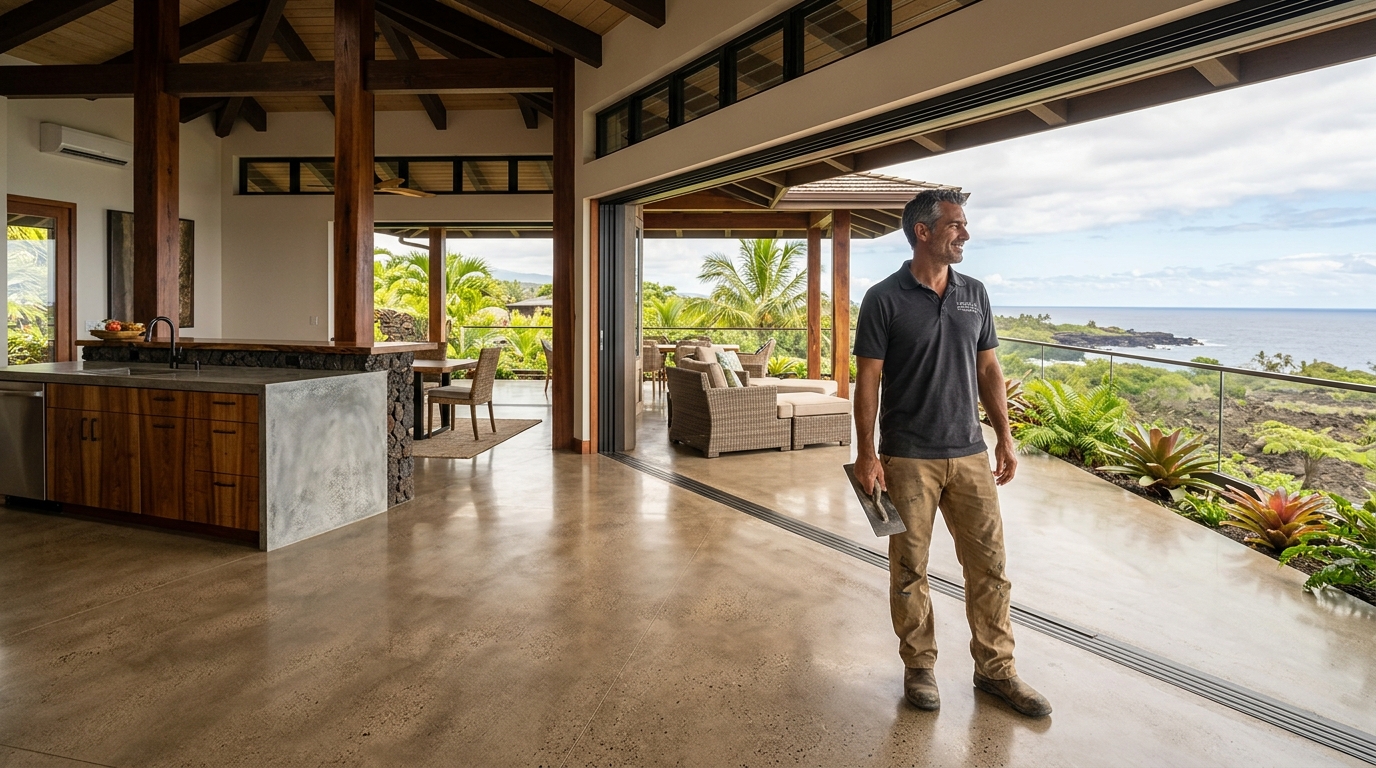
When you’re looking for a concrete contractor pahoa, you need more than just someone who can mix mud and pour a slab. You need a team that understands Puna’s unique challenges, from the volcanic soil under your feet to the 130 inches of rain that can fall from the sky. The best Pahoa contractor combines deep expertise in Big Island building codes, logistical mastery for getting materials to East Hawai’i, and a true understanding of how to build foundations that last on lava rock. This isn’t like pouring a patio in California; here, the ground itself dictates the entire process.
Over our 20+ years as a general contractor in Hawaii (BC-34373), our team at Warrior Construction has seen firsthand what separates a successful concrete project in Pahoa from a costly failure. It often comes down to the details that mainland contractors would never even consider. For example, the chemical composition of the volcanic soil can require a special concrete mix to prevent degradation over time. Furthermore, the constant moisture means drainage and site prep are ten times more critical here than in a dry climate. Getting it wrong can lead to cracking, settling, and major structural issues down the road.
This guide cuts through the noise. We’re going to share the real numbers, timelines, and Puna-specific challenges you’ll face. You’ll learn why a simple driveway pour costs more here, the number one permit mistake we see homeowners make with the county, and how to choose a concrete contractor who is truly equipped to build on the Big Island. We’ll cover everything from site prep on ‘a’a flow to the specific rebar needed to fight salt-air corrosion.
Why Pahoa Homeowners Trust Warrior Construction for Concrete Contractor
Building in Pahoa isn’t just a job; it’s a science that requires local knowledge. Homeowners trust our team at Warrior Construction because we’re not just an Oahu-based company with a neighbor island phone number. We have boots on the ground and years of experience navigating the specific geological and logistical hurdles of Puna. Our state license, BC-34373, is a mark of our commitment to professional standards, but our real value comes from the lessons learned on Big Island job sites.
One of the biggest factors in Puna is the ground itself. Much of the area sits in Lava Zones 1 and 2. This means we’re often not just digging in dirt; we’re dealing with solid volcanic rock. We understand the difference between prepping a site on older, weathered pahoehoe versus trying to grade a field of sharp ‘a’a. This affects everything from the cost of excavation to the design of the foundation itself. For instance, on a recent project for a new custom home in Hawaiian Paradise Park (HPP), our excavation crew uncovered a significant lava tube just a few feet below the surface of the proposed house pad. A less experienced contractor might just fill it and pour. Instead, we paused work, brought in a local geotechnical engineer to assess the tube’s stability, and redesigned the concrete foundation pahoa with a reinforced, bridged footing over that section to ensure long-term structural integrity. This is the kind of proactive problem-solving that prevents catastrophic failures years later.
Logistics are another major reason clients choose us. Getting a steady supply of quality materials to a job site in Pahoa is a constant challenge. You can’t just call up a supplier and expect a truck in an hour. We’ve spent years building solid relationships with Hilo-based aggregate quarries and concrete batch plants. Consequently, we can better manage schedules and ensure the specific mix designs we need are available. We meticulously plan our pours around barge schedules for specialty admixtures and the trucking capacity from Hilo, minimizing the costly delays that can plague Big Island projects. Our clients know that when we give them a schedule, it’s based on the realities of the supply chain in East Hawai’i, not just wishful thinking.
What Does Concrete Contractor Cost in Pahoa?
Let’s get straight to the numbers for 2026. For a basic 4-inch slab on grade, like a patio or a simple driveway, you should budget between $28 to $35 per square foot in Pahoa. The raw material, the concrete itself, will run about $195 to $240 per cubic yard delivered to your site in Puna. A full structural foundation for a house is a more complex calculation, but these figures give you a solid baseline. These costs are often 15-25% higher than on Oahu and significantly more than mainland prices due to Big Island specifics.
Here’s a breakdown of where that money goes:
- Materials: This isn’t just the concrete. It includes the #3 or #4 rebar for reinforcement, the lumber and fasteners for formwork, a vapor barrier, and the crushed rock or gravel for the sub-base. Everything has an inter-island shipping cost baked into its price before it even gets trucked from the port in Hilo out to your property.
- Labor: A skilled and insured concrete crew is a significant investment. For a standard four-person finishing crew, you can expect to pay between $2,800 and $3,500 per day. This covers their wages, insurance, and expertise in working with the variable Puna weather.
- Site Preparation: This is the biggest variable in Pahoa. If your lot is relatively flat with deep soil, site prep might only be $5,000 to $8,000 for clearing, grading, and compaction. However, if your lot is solid blue rock, you could be looking at $25,000 or more just for excavation and rock-breaking before any forms are even set.
- Equipment: Costs include renting an excavator or bobcat for site work, a plate compactor, and often a concrete pump truck. A pump truck is essential for foundations or hard-to-reach areas and can add $1,800 to $2,500 to the cost of a single pour.
To make it more concrete, here are some typical all-in project cost estimates for 2026 in the Pahoa area:
| Project Type | Typical Size | Estimated All-In Cost Range (Pahoa, 2026) |
|---|---|---|
| Standard driveway concrete pahoa | 600 sq. ft. (20′ x 30′) | $18,000 – $23,000 |
| Slab-on-Grade concrete foundation pahoa | 1,500 sq. ft. | $65,000 – $80,000 |
| Engineered retaining wall pahoa | 50 ft. long x 4 ft. high | $22,000 – $30,000 |
| Concrete Water Catchment Tank Pad | 225 sq. ft. (15′ x 15′) | $8,500 – $11,000 |
Factors like complex angles, thickened edges for load-bearing walls, special finishes like stamping or staining, and significant sloping on your property will increase these costs. Always get a detailed quote that breaks down these line items so you know exactly what you’re paying for.
How Long Does a Concrete Contractor Take in Pahoa?
For a typical project, the on-site work moves fairly quickly, but the overall timeline is heavily influenced by planning and Puna’s unpredictable weather. A standard 600-square-foot driveway in Pahoa, from the day we break ground to the day you can park on it, will take about 1 to 2 weeks. A more complex 1,500-square-foot house foundation will take closer to 3 to 5 weeks of on-site work. Importantly, these timelines do not include the weeks or months needed for planning and permitting beforehand.
Here’s a realistic step-by-step timeline for a new home foundation project:
- Planning & Permitting (4-8 weeks, sometimes longer): This involves finalizing your architectural and structural plans, submitting them to the Hawai’i County Department of Public Works (DPW), and waiting for their review and approval. This is often the longest part of the entire process.
- Site Prep & Excavation (3-7 days): Once we have the permit in hand, our crew gets to work. This includes clearing vegetation, excavating for the footings, grading the pad, and dealing with any rock we encounter.
- Formwork & Rebar (2-5 days): We build the wooden forms that will contain the wet concrete and carefully place and tie the steel rebar grid according to the engineer’s specifications. This stage must be inspected by the county inspector before we can pour.
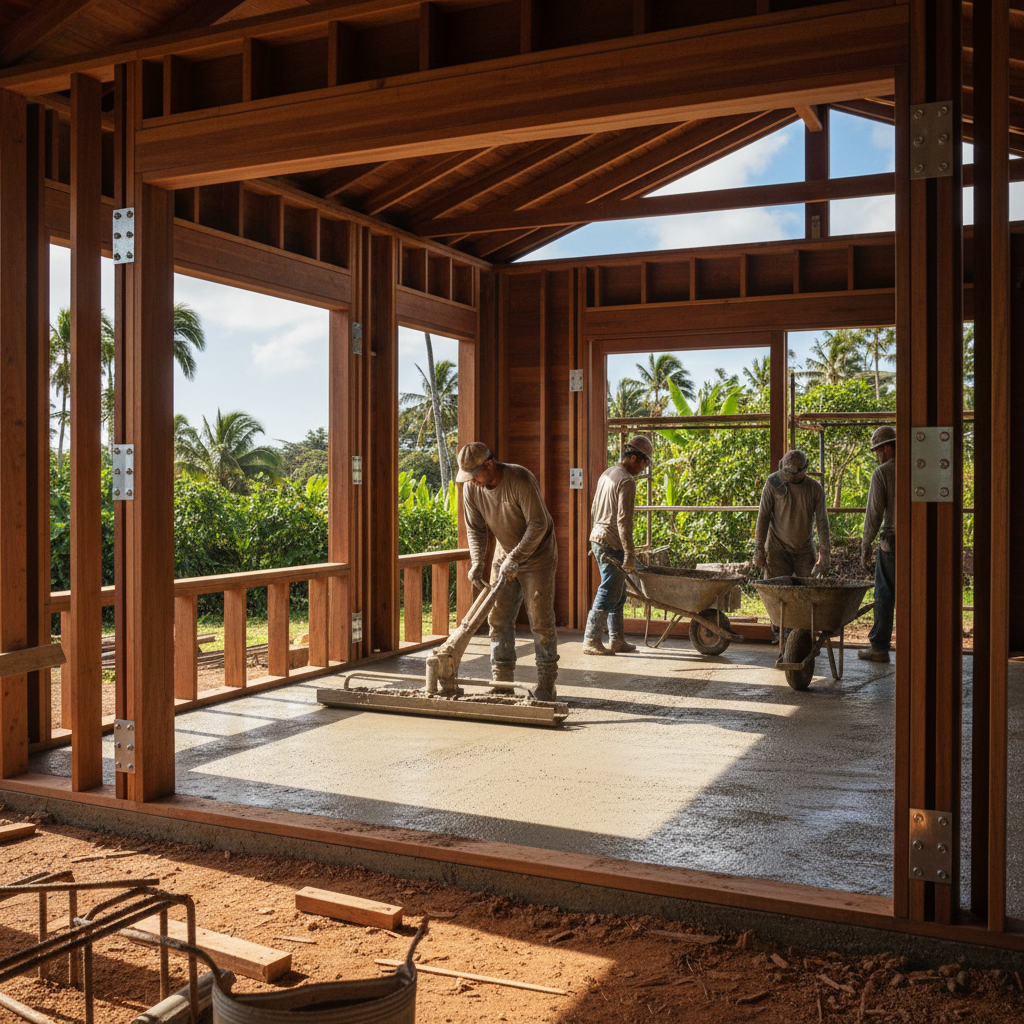
- The Pour (1 day): This is the main event. The concrete trucks arrive, and we pour, spread, and screed the concrete to the correct level. This is a critical day that is highly dependent on good weather.
- Finishing (1-2 days): As the concrete begins to set, our finishers get to work with trowels to create a smooth, durable surface. The following day, we typically saw-cut control joints into the slab to manage cracking.
- Curing (7-28 days): This is the most misunderstood part of the process. The concrete needs to cure, which is a chemical hardening process, not just drying. It gains most of its strength in the first 7 days, at which point framing can usually begin. However, you shouldn’t drive a heavy vehicle on a new driveway for the full 28 days it takes to reach its designed compressive strength.
In Pahoa, the biggest wild card is always the weather. A sudden torrential downpour can postpone a scheduled pour at the last minute, as pouring concrete in heavy rain compromises its strength and finish. We watch the Hilo forecast like hawks and always have a backup plan. Additionally, scheduling the necessary county inspections for footings and rebar can add a day or two of waiting time at critical junctures. A professional contractor builds these potential delays into the schedule they provide you.
What Permits Do You Need for Concrete Contractor in Pahoa?
The short answer is this: almost any concrete work beyond a very small, non-structural patio slab requires a building permit from the Hawaiʻi County Department of Public Works (DPW). Trying to avoid this process is one of the most expensive mistakes a homeowner can make. The County is very serious about enforcement, and a stop-work order can derail your project for months and lead to significant fines.
Here are the general thresholds for when a permit is required for a concrete contractor pahoa:
- Permit Definitely Required:
- All new home foundations or foundations for additions.
- Any structural slab that supports walls or a roof.
- Retaining walls that are over 4 feet tall (this is measured from the bottom of the footing to the top of the wall).
- Any retaining wall, regardless of height, that supports a surcharge load like a driveway, a building, or a steep slope.
- Driveways that involve a new curb cut or connection to a county road.
- Large patios or lanais attached to the house.
- Permit Maybe Not Required (Always Verify!):
- Small, detached concrete pads (think a pad for your AC unit or a small shed) under 200 square feet and not part of a primary structure.
- Minor flatwork repairs.
The permitting process on the Big Island involves several steps that we manage for our clients:
1. Plan Submission: For any structural work like a foundation or engineered retaining wall, you’ll need plans stamped by a Hawaii-licensed architect or structural engineer. We submit these plans to the DPW.
2. Plan Review: The county’s plan checkers review the submission for compliance with the building code, zoning, and other regulations. In 2026, this review process is taking anywhere from 6 to 12 weeks, and sometimes longer for complex projects.
3. Addressing Comments: It’s common for the DPW to return the plans with comments or questions. We work with your architect/engineer to address these promptly and resubmit.
4. Permit Issuance: Once approved, the permit is issued. We post it visibly on the job site before any work begins.
5. Inspections: During construction, a county inspector must visit the site and sign off on key milestones. For concrete, this typically includes the footing/excavation inspection and the pre-pour inspection (to check rebar and formwork). Failing an inspection means stopping work until the issue is corrected, which is why we are meticulous about following the approved plans.
We once took over a project in Leilani Estates where the previous homeowner had hired an unlicensed individual to build a large retaining wall pahoa without a permit. A neighbor reported it, and the county issued a stop-work order. The homeowner ended up having to pay double: once to the original worker, and then again for us to come in, hire an engineer to create expensive as-built drawings of the unpermitted work, submit them for a retroactive permit, and fix several code violations. The ordeal delayed their landscaping by four months and cost them nearly $15,000 in extra engineering and fines. It’s a powerful lesson in doing things by the book from the start.

Pahoa-Specific Considerations: Climate, Materials, Regulations
Building in Pahoa requires a playbook completely different from anywhere else in Hawaii, let alone the mainland. The unique combination of extreme weather, volcanic geology, and local regulations demands specialized knowledge. As your concrete contractor pahoa, we have to account for these factors in every single project.
Climate Challenges
- Extreme Rainfall: Pahoa and the surrounding Puna district can receive over 120-150 inches of rain annually. This has a massive impact on concrete work. We can’t pour during a downpour as it will ruin the surface finish and, more importantly, alter the water-to-cement ratio, weakening the final product. We build weather contingency days into every schedule and use weather-resistant admixtures in our concrete mix to help control set times when there’s a chance of showers. Proper site drainage during construction is also critical to prevent a muddy mess.
- Salt-Air Corrosion: Even though Pahoa isn’t directly on the coast like Kapoho once was, the prevailing trade winds carry a significant amount of salt inland. Over time, this salt penetrates porous concrete and corrodes the steel rebar inside, causing it to expand and crack the concrete from within (a condition called spalling). For any lanais, exposed foundations, or homes within a couple of miles of the coast, we strongly recommend and often specify upgraded epoxy-coated or galvanized rebar. This can add 15-20% to the material cost for steel but can easily double or triple the lifespan of the structure.
Material and Geological Realities
- Volcanic Soil and Rock: The ground in Puna is a mix of fast-draining volcanic soil, cinder, and hard lava rock. The soil’s high acidity can be corrosive to standard concrete over decades. For foundations, we often specify a Type II or Type V cement in our mix, which offers higher sulfate resistance. The biggest challenge is excavation. Hitting a field of blue rock where you planned to dig footings can add thousands of dollars and several days to a project for rock-breaking. This is why thorough site investigation is so important.
- Aggregate Quality: The strength of concrete is heavily dependent on the quality of the aggregate (the crushed rock) used in the mix. Not all aggregate on the Big Island is created equal. We source our materials exclusively from reputable quarries that wash and properly grade their rock to meet ASTM (American Society for Testing and Materials) standards. Using poor-quality, dirty aggregate is a corner some cut to save money, but it results in weaker concrete prone to failure.
Local Regulations and Codes
- Lava Flow Hazard Zones: Most of Puna lies in Lava Hazard Zones 1 or 2, the areas with the highest risk of being impacted by future eruptions. While this doesn’t typically add specific structural requirements to the concrete code itself, it has major implications for homeowner’s insurance and financing. Building a sound, well-engineered foundation is even more critical when the land itself is so dynamic.
- Hurricane-Resistant Construction: Since Hurricane Iniki in 1992, Hawaii has had robust building codes for wind resistance. For concrete work, this primarily involves the connection between the house framing and the foundation. We are meticulous about installing heavy-duty hurricane straps and anchor bolts, like Simpson Strong-Tie HDU hold-downs, embedding them directly into the wet concrete of the foundation. This creates a continuous load path that anchors the entire house to the ground, providing maximum resistance to uplift forces during a hurricane.
How to Choose the Right Concrete Contractor Contractor in Pahoa
Choosing the right contractor is the single most important decision you’ll make for your project. In a place with as many challenges as Pahoa, a cheap bid from the wrong person can lead to disastrously expensive problems. Here’s a checklist our team at Warrior Construction recommends every homeowner use.
1. Verify Their License and Insurance.
This is non-negotiable. Any legitimate concrete contractor will have a State of Hawaii C-5 (Concrete) or B (General Building Contractor) license. You can and should verify this yourself on the Department of Commerce and Consumer Affairs (DCCA) Professional & Vocational Licensing (PVL) website[1]. Ask for copies of their general liability and worker’s compensation insurance certificates. Make sure their coverage is active and specifically for work on Hawai’i Island.
2. Demand Big Island-Specific References.
A contractor might have a great portfolio of projects in Honolulu, but that doesn’t mean they know how to handle Puna’s rain and rock. Ask for the names and numbers of at least three recent clients whose projects were in Pahoa, HPP, Orchidland, or another nearby Puna subdivision. Call those references and ask about their experience: Did the contractor communicate well? Did they stay on schedule and on budget? How did they handle unexpected problems?
3. Scrutinize the Written Contract.
Never work on a handshake deal. A professional contractor will provide a detailed written contract that clearly outlines the full scope of work, the specific materials to be used (e.g., concrete PSI strength, rebar size and grade), a clear payment schedule, and an estimated start and completion date. If the contract is vague, that’s a major red flag.
4. Ask About Their Crew and Equipment.
Find out if they have their own experienced crew on the Big Island or if they plan to fly workers over from another island. A local crew has invaluable knowledge of the conditions and suppliers. Ask what equipment they own versus what they need to rent. A contractor with their own equipment, like a bobcat or excavator, may have more control over the schedule.
5. Gauge Their Knowledge of Site Prep and Drainage.
During your initial conversation, pay attention to the questions they ask you. A great contractor will be more concerned with your property’s drainage, soil type, and slope than with the color you want to stain the patio. They should talk extensively about the importance of a properly compacted sub-base and how they plan to manage water runoff. The concrete itself is important, but the foundation it sits on is what guarantees its longevity.
6. Discuss How They Handle Weather Delays.
Ask them directly: “What is your policy when a concrete pour gets rained out?” Their answer will reveal a lot about their professionalism. A prepared contractor will explain how they protect the sub-base from getting saturated, how they reschedule with the batch plant and their crew, and how they communicate those delays to you. This foresight is crucial for a smooth project in one of Hawaii’s rainiest districts.
Real Pahoa Concrete Contractor Project Example
To illustrate how these principles work in the real world, let’s walk through a recent project we completed. It perfectly showcases the unique challenges of concrete work in Puna.
- Client: The Kamaka family.
- Location: A 1-acre lot in Hawaiian Shores Recreational Estates.
- Project: A new 1,800 sq. ft. monolithic slab foundation for their custom home, plus a 450 sq. ft. attached garage slab and a separate 600 sq. ft. driveway concrete pahoa.
- The Challenge: The property appeared to be soil-covered, but just 18 inches below the surface, we discovered it was solid, old ‘a’a lava flow. This rock was extremely difficult to break and excavate. Furthermore, soil tests confirmed the topsoil was highly acidic, posing a long-term risk to standard concrete.
Our Step-by-Step Solution:
1. Assessment and Re-Planning: Upon hitting solid rock, we immediately paused excavation. We brought in a geotechnical engineer to analyze the rock’s composition and stability. This confirmed that while the rock was solid, it required mechanical breaking. This added an unforeseen cost, which we transparently communicated to the Kamakas with a formal change order. The additional cost for a week of rock-breaking with a hydraulic hammer attachment on our excavator came to $8,500.
2. Specialized Materials: Based on the soil test results, we worked with our supplier in Hilo to order a custom concrete mix. We specified a 3,500 PSI mix using Type V cement for its high sulfate resistance, protecting the foundation from the acidic soil. We also specified epoxy-coated #4 rebar for the entire project due to the lot’s proximity to the ocean cliffs, providing superior protection against salt-air corrosion.
3. Meticulous Site Prep: After breaking the rock to the required depth for the footings, we imported and compacted 6 inches of 3/4″ crushed gravel to create a stable, level sub-base. This base course provides a capillary break to stop moisture from wicking up from the ground into the slab.
4. Engineering for Resilience: The foundation was engineered as a monolithic slab, meaning the footings and floor are poured as one single piece. This creates a very strong, rigid foundation. We precisely placed the rebar grid at 18 inches on center and embedded Simpson HDU hold-down anchor bolts directly into the concrete at all specified shear wall locations to meet and exceed hurricane code requirements.
- Final Timeline: 4.5 weeks from the start of excavation to the foundation being fully cured and ready for the framing crew.
- Final Cost: The foundation and garage slab package cost approximately $115,000, and the driveway cost $19,000. The total for all concrete work was $134,000, including the change order for rock-breaking.
The Outcome: The Kamaka family now has a rock-solid concrete foundation pahoa, engineered specifically for the tough conditions of their Puna lot. By addressing the challenges of rock and soil head-on, we built a foundation designed to last for generations.
What this means for Hawaii homeowners
Navigating a concrete project in a unique environment like Pahoa requires careful planning and a realistic perspective. The key is to understand the local challenges and partner with a professional who is equipped to handle them. Here are the most critical takeaways for any homeowner planning concrete work on the Big Island.
- Your Budget Must Reflect Pahoa’s Reality. Do not use mainland cost estimators or even numbers from Honolulu. Material logistics, difficult site prep on lava rock, and the need for specialized labor mean projects here simply cost more. Budgeting an extra 15-20% for unforeseen site conditions, like hitting rock, is a wise strategy.
- A General Contractor License is the Bare Minimum. The most important step you can take is to hire a properly licensed and insured contractor. Verify their B-General or C-5 Concrete license on the state’s PVL website[1]. An unlicensed worker offers no protection if something goes wrong, and their work almost never meets code.
- Plan for Mother Nature. Rain is a certainty in Puna. A good contractor will already have contingency days built into the schedule. Be patient and understand that a delay to wait for a clear day to pour is far better than a rushed job with a compromised, weakened slab.
- Invest in Geotechnical Engineering for Foundations. For any new home foundation, spending $3,000-$5,000 on a geotechnical report is one of the best investments you can make. It will identify what’s under the surface—be it lava tubes, expansive clay, or solid rock—allowing your foundation to be engineered correctly from the start.
- Embrace the Permitting Process. View the Hawai’i County DPW[2] (note: link is to Honolulu DPP as a representative example of a permitting agency) not as a hurdle, but as a form of quality control. The plans review and on-site inspections ensure your contractor is building to the safety standards required by law. Your contractor should handle this entire process for you.
Ultimately, the success of your project comes down to the foundation. By understanding these Pahoa-specific factors, you can make informed decisions and ensure the work is done right the first time.
Frequently Asked Questions About Concrete Contractor in Pahoa
How thick should my driveway concrete be in Pahoa?
For a standard passenger car driveway, a 4-inch thick slab is the minimum code requirement. However, given the potential for unstable volcanic soil in Puna, our team at Warrior Construction almost always recommends a 5-inch thick slab reinforced with a grid of #3 rebar. This provides significantly more strength and crack resistance for a marginal increase in cost.
Can you pour concrete directly on lava rock?
No, never. Pouring directly onto uneven lava rock creates voids and stress points that will cause the slab to crack and fail. The proper method is to excavate and break up the surface rock to create a level area, then import and mechanically compact at least 4-6 inches of gravel to create a stable, uniform sub-base for the concrete.
What is the average cost per square foot for a stamped concrete lanai in Pahoa in 2026?
For a decorative stamped and colored concrete lanai or patio, you should expect to pay between $35 and $45 per square foot in Pahoa. The price varies based on the complexity of the stamp pattern (e.g., flagstone vs. wood plank) and whether you choose single-color or multi-color application. This is an all-in cost that includes site prep, materials, and labor.
Why is my concrete quote for Pahoa so much higher than my friend’s recent project on Oahu?
There are two main reasons. First, logistics: all cement and special materials must be shipped by barge to Hilo, then trucked to your Puna job site, adding significant cost. Second, site conditions: excavation in Puna frequently involves expensive rock-breaking, which is far less common in the developed areas of Oahu. These unique Big Island factors directly impact the bottom line.
Do I need a permit for a concrete retaining wall pahoa?
Yes, a permit from the Hawaiʻi County DPW is required if the wall is over 4 feet high, measured from the bottom of the footing to the top of the wall. A permit is also required for any retaining wall, regardless of height, that supports a surcharge, such as a driveway, slope, or another structure. Any permitted retaining wall will also require an engineered design.
How long before I can park on my new driveway concrete pahoa?
You can typically walk on new concrete after 24-48 hours. However, you should wait a minimum of 7 full days before parking a regular passenger car on it. For heavier vehicles like a large truck or an RV, it is critical to wait the full 28 days for the concrete to reach its designed compressive strength and prevent damage.
What kind of maintenance does a concrete foundation need in Hawaii’s climate?
Concrete foundations are very low-maintenance, but not zero-maintenance. We recommend an annual walk-around inspection to check for any new cracks. Most importantly, ensure the ground around the foundation is graded to slope away from the house and that rain gutters are clean and discharging water well away from the slab to prevent soil erosion and water intrusion.
Building in Pahoa is a unique challenge that demands a deep understanding of the ‘aina. From the bedrock to the building codes, every step requires local expertise and a commitment to quality. If you’re planning a project that needs a rock-solid start—whether it’s a new home foundation, a durable driveway, or an engineered retaining wall—our team at Warrior Construction has the Big Island experience to get it done right. We build foundations that are made to last in one of the most dynamic landscapes on Earth.
Ready to discuss your project? Explore our concrete and foundation services or request a free estimate today.