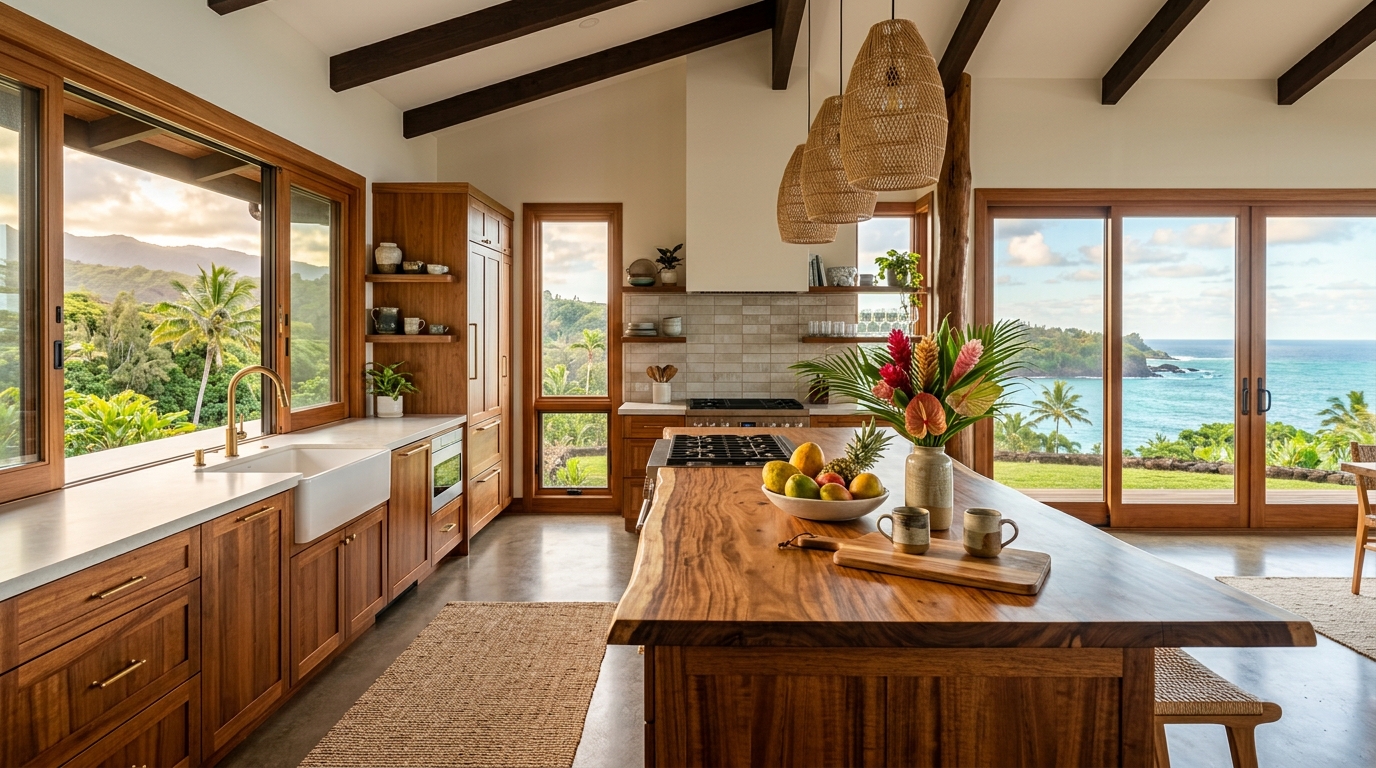
A kitchen remodel in Hana is unlike any other project in Hawaii. In 2026, a successful renovation here requires a deep understanding of hyper-local logistics, a relentless focus on material durability against the jungle humidity and salt air, and a realistic budget that accounts for the “Hana premium”—typically between $75,000 for a basic refresh and upwards of $175,000 for a comprehensive gut renovation. The biggest factors aren’t just finishes and fixtures; they’re the barge schedules from Honolulu, the winding road for deliveries, and the specialized labor needed to execute flawlessly in one of Maui’s most remote communities.
Over our 20+ years as a licensed Hawaii general contractor (BC-34373), our team at Warrior Construction has managed complex projects from Oahu to the neighbor islands. Remodeling in a place as unique as Hana isn’t just about building—it’s about meticulous planning. From sourcing marine-grade hardware that won’t rust in a year to coordinating material consolidation in Kahului to minimize trucking costs, every step has to be thought through. This article breaks down our nine core strategies for a successful Hana kitchen remodel, covering everything from real-world costs and timelines to permitting with Maui County and choosing materials that will actually last.
Why Hana Homeowners Trust Warrior Construction for Kitchen Remodel
When you’re investing in a significant project like a kitchen renovation in Hana, you need a partner who understands the difference between building in Kapolei and building on the East Maui coast. They are worlds apart. Homeowners in Hana choose our team because we bring over two decades of specific, hard-won experience in neighbor island construction. Our license, BC-34373, is more than just a number; it represents a long history of successfully navigating the very challenges that make Hana projects so unique. We’re not just a Honolulu contractor who takes the occasional neighbor island job; we have dedicated processes and relationships built to handle these logistical puzzles.
First, our approach is built on logistics. The single biggest point of failure for a Hana project is poor material management. We’ve seen it happen: a contractor orders cabinets, appliances, and tile from ten different vendors, and they all arrive in Kahului at different times. This results in multiple, expensive truck runs down the Hana Highway, storage fees, and a disjointed construction schedule. Our process is different. We have a logistics manager who coordinates a single point of consolidation, usually a warehouse in Kahului. All materials—from lumber and drywall to the specific faucet you picked out—are gathered there. Once everything is accounted for, we charter a dedicated truck to make one or two comprehensive deliveries to your job site. This saves thousands in shipping and prevents weeks of delays. For example, on a recent project near Waiʻānapanapa, this consolidation strategy saved the homeowner nearly $8,000 in piecemeal delivery fees and shaved three weeks off the timeline.
Second, we understand the environment. The materials and methods that work in a dry, newer development like Ewa Beach will fail quickly in Hana’s humid, salty air. Our material selection process is rigorous. We guide homeowners toward solutions designed for this climate:
* **Cabinetry:** We recommend solid wood like teak or sapele, or high-end marine-grade polymers. We strongly advise against MDF or particle board, which will swell and delaminate within a few years.
* **Hardware:** All hinges, pulls, and screws must be 316-grade stainless steel or high-quality brass to resist corrosion. Standard zinc-plated hardware from a big box store will show rust spots within months.
* **Ventilation:** A powerful, properly vented range hood isn’t a luxury in Hana; it’s a necessity to combat moisture and prevent mold growth. We calculate the required CFM (cubic feet per minute) based on your kitchen’s volume and cooktop type to ensure it’s effective.
Finally, communication is paramount, especially when homeowners may be off-island. Our clients receive access to a dedicated project portal with daily photo updates, schedule tracking, and a direct messaging system. You’ll see the progress as it happens, not just get a weekly email. This transparency and our proven expertise in managing the unique demands of a kitchen remodel in Hana are why people put their trust in Warrior Construction.
What Does Kitchen Remodel Cost in Hana?
A kitchen remodel cost in Hana for 2026 carries a significant premium over a similar project on Oahu, primarily due to logistics. We tell our clients to budget approximately 20-30% more for the exact same scope of work. This covers inter-island barge freight, ground transportation from Kahului, and often includes travel and accommodation costs for specialized tradespeople. A realistic cost breakdown requires looking at different tiers of renovation.
Here’s a look at what you can expect:
* **The Basic Refresh (Pull-and-Replace): $65,000 – $90,000**
This level of renovation keeps the existing layout of your kitchen. It involves removing old components and installing new ones in the same place. Typically, this includes stock or semi-custom cabinets from a supplier like Home Depot or Lowe’s, durable laminate or solid surface countertops, a new sink and faucet, standard-grade appliances, and a fresh coat of paint. Even at this level, the Hana premium is evident. A $50,000 kitchen refresh in Honolulu easily becomes a $65,000+ project in Hana once you factor in getting every single one of those items to the job site.
* **The Mid-Range Gut Renovation: $90,000 – $150,000**
This is the most common type of kitchen renovation we undertake. It involves gutting the kitchen down to the studs and starting fresh. This allows for layout changes, such as moving the sink or refrigerator, adding an island, or removing a non-load-bearing wall to create an open-concept space. Key features include:
* Semi-custom or custom cabinetry built with moisture-resistant materials.
* Quartz or natural stone (granite) countertops.
* An undermount sink with an upgraded faucet.
* A full suite of mid-to-high-end appliances.
* New lighting, including recessed cans and pendant lights.
* New flooring, often a luxury vinyl plank (LVP) that holds up well in humid conditions.
The `kitchen remodel cost hana` in this range is heavily influenced by the complexity of plumbing and electrical work and the grade of materials selected.
* **The High-End Luxury Remodel: $150,000 – $250,000+**
For a luxury kitchen, the budget can expand significantly. These projects involve high-end architectural design, significant structural changes (like removing load-bearing walls and installing large beams), and premium materials. Think custom-milled koa or mango wood cabinetry from a local artisan, quartzite or marble countertops with waterfall edges, professional-grade appliances from brands like Sub-Zero or Wolf, integrated smart home technology, and custom lighting design. The labor costs are also higher due to the level of precision required. A project like this in Kahala on Oahu might cost $120,000; in Hana, the same project starts at $150,000-$160,000 and goes up from there.
Where does the extra money go? Consider a pallet of custom cabinets. Shipping from the mainland to Honolulu costs a certain amount. Then it has to be moved to Young Brothers for barge transport to Kahului. From there, it’s loaded onto a smaller truck capable of navigating the Hana Highway. Each step adds cost and a potential point of delay. It’s not just one shipping fee; it’s a chain of them. This is the reality of building in paradise, and we build these costs into our initial estimates so there are no surprises.
How Long Does a Kitchen Remodel Take in Hana?
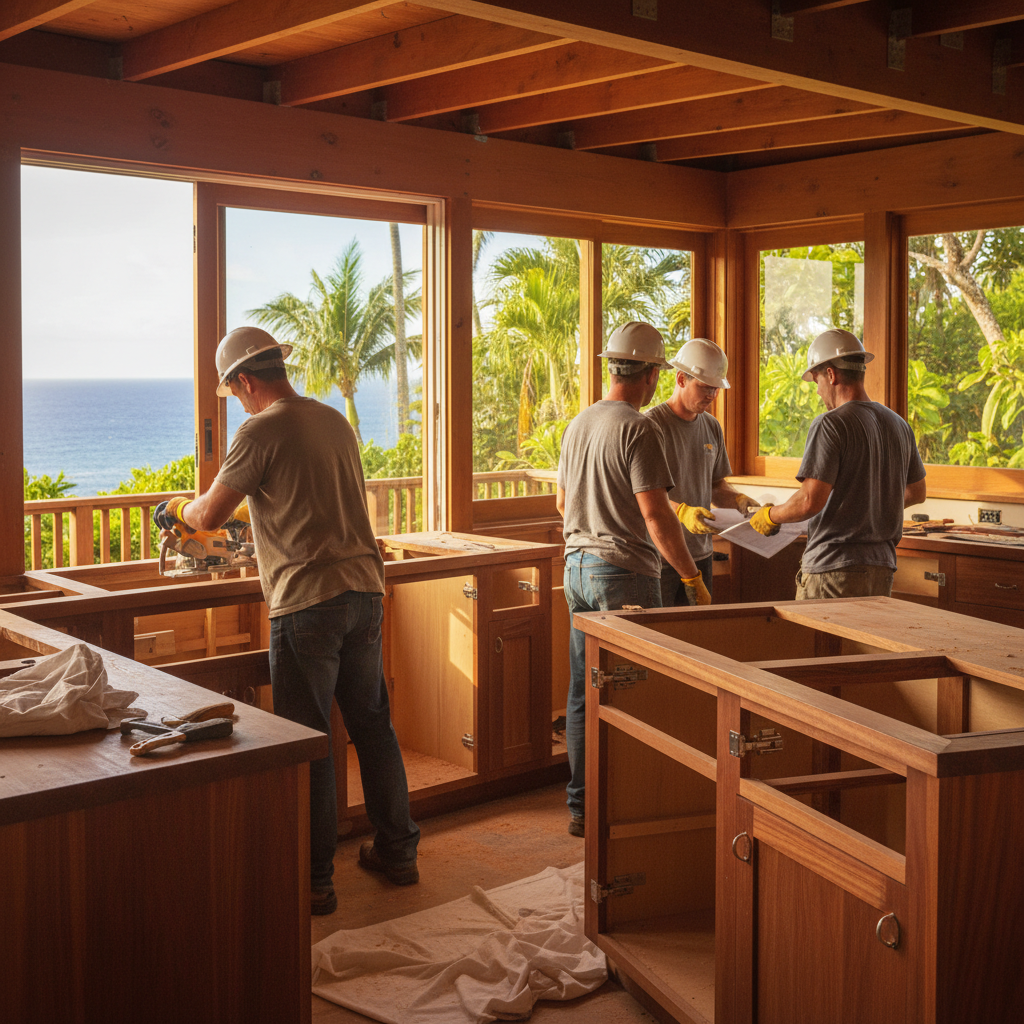
The timeline for a Hana kitchen remodel is another area where planning for delays is crucial. While the actual hands-on construction might take a similar amount of time as an Oahu project, the pre-construction phase is significantly longer. Patience isn’t just a virtue here; it’s a project requirement. We advise clients to start the planning process a full 9 to 12 months before they hope to begin demolition.
Here is a realistic timeline breakdown for a mid-range kitchen renovation in Hana in 2026:
* **Phase 1: Design and Planning (3-6 months)**
* **Initial Consultation & Design (4-6 weeks):** This is where we meet, discuss your vision, and develop initial concepts and layouts. Because of the location, we often do this through a combination of on-site visits and detailed video calls.
* **Material Selection (4-8 weeks):** This phase can be prolonged. While some selections can be made from online catalogs, for key items like countertops and cabinetry finishes, clients often fly to Kahului or Honolulu to see samples in person. We then have to order those samples for final approval on-site.
* **Architectural Plans & Engineering (4-6 weeks):** If any walls are being moved, we need a licensed architect and structural engineer to draw up the plans required for permitting.
* **Permit Submission & Review (2-4 months):** This is a major bottleneck. Once we submit the plans to the Maui County Department of Public Works, the review process can take anywhere from 8 weeks to 4 months, or sometimes longer, depending on their backlog and the complexity of the project.
* **Phase 2: Procurement & Logistics (2-4 months)**
This phase runs concurrently with the permit review. The moment you approve the cabinet design and appliance models, we place the orders. This is the most critical logistical step.
* **Cabinet Fabrication Lead Time: 8-16 weeks.** Custom or even semi-custom cabinets are made to order. This is often the longest lead-time item.
* **Appliance & Fixture Lead Time: 4-12 weeks.** High-end or specific models can have long backorders.
* **Shipping & Consolidation: 3-4 weeks.** Once items arrive in Honolulu or on the West Coast, they must be booked for barge transport to Kahului. We then hold them at our consolidation point until every last piece has arrived. Rushing this step is a recipe for disaster. Starting demo before the new sink has even left California is a classic mistake we see other contractors make.
* **Phase 3: Construction (8-16 weeks)**
Only after the permit is in hand and all materials are confirmed to be on Maui do we begin the physical work.
* **Demolition & Rough-in (1-2 weeks):** Tearing out the old kitchen and running new plumbing and electrical lines.
* **Inspections (1 week):** The county inspector must sign off on the rough-in work before we can close up the walls.
* **Drywall, Flooring, & Painting (2-3 weeks):** Getting the “box” ready for the new components.
* **Cabinet & Countertop Installation (2-4 weeks):** This is a meticulous process. Countertop templating happens after the base cabinets are set, adding about 2-3 weeks for fabrication and installation.
* **Appliance, Plumbing, & Electrical Finals (1-2 weeks):** Setting appliances, connecting the sink and dishwasher, and installing light fixtures and outlets.
* **Backsplash & Finishing Touches (1-2 weeks):** Tiling, trim work, and final paint touch-ups.
* **Final Inspections & Punch List (1 week):** The final walkthrough with you and the county inspector.
As you can see, a total timeline of 10-12 months from the first phone call to the final meal cooked is realistic for a major kitchen remodel in Hana. The key is managing the frontend logistics properly so the construction phase can proceed smoothly and efficiently.
What Permits Do You Need for Kitchen Remodel in Hana?
Navigating the permitting process for a kitchen remodel in Hana means working with the Maui County Department of Public Works. It’s a common misconception that you only need a permit for a major addition. The reality is that most substantial kitchen renovations require one. Understanding when a permit is triggered is the first step to a smooth and legal construction process.
Generally, you do not need a permit for cosmetic upgrades. This includes:
* Painting cabinets or walls
* Replacing countertops (if the sink location doesn’t change)
* Installing a new faucet in the existing location
* Replacing flooring
* Swapping out an appliance with a new one of the same type and in the same location
You will absolutely need a building permit if your kitchen renovation involves any of the following:
1. **Changing the layout:** Moving, adding, or removing any walls, even if they aren’t load-bearing. The county needs to ensure the new layout meets egress and ventilation codes.
2. **Altering Plumbing:** Relocating a sink or dishwasher, or adding a new prep sink or pot filler, requires a plumbing permit (which is part of the overall building permit).
3. **Altering Electrical:** Moving outlets, adding new circuits for powerful appliances (like a new induction range), or installing new lighting requires an electrical permit.
4. **Changing Windows or Doors:** If you plan to enlarge a window or replace a door with a larger one, this is considered a structural alteration and requires a permit. This also ensures the new units meet current hurricane code requirements for wind resistance.
As your general contractor, Warrior Construction handles the entire permitting process. Our process involves hiring a licensed architect or draftsperson to create detailed plans that meet all relevant building codes. These plans are then submitted to Maui County for review. While Honolulu’s Department of Planning and Permitting (DPP) has a more digitized system[1], the principles are the same across the islands: detailed plans, adherence to code, and patience during the review period. The reviewers in Maui will check for structural integrity, electrical safety, plumbing compliance, and energy efficiency standards.
It’s tempting to try and avoid the permit process to save time and money. This is a huge mistake. First, unpermitted work can result in a stop-work order from the county, along with significant fines. Second, it creates major problems when you decide to sell your home. Unpermitted work is a red flag for buyers and lenders and can devalue your property. Finally, and most importantly, it’s a safety issue. Permits and the required inspections ensure that the electrical and plumbing work was done correctly and won’t cause a fire or a flood down the road. We always build to code and by the book—it’s the only way to protect your investment and your family.
Hana-Specific Considerations: Climate, Materials, Regulations
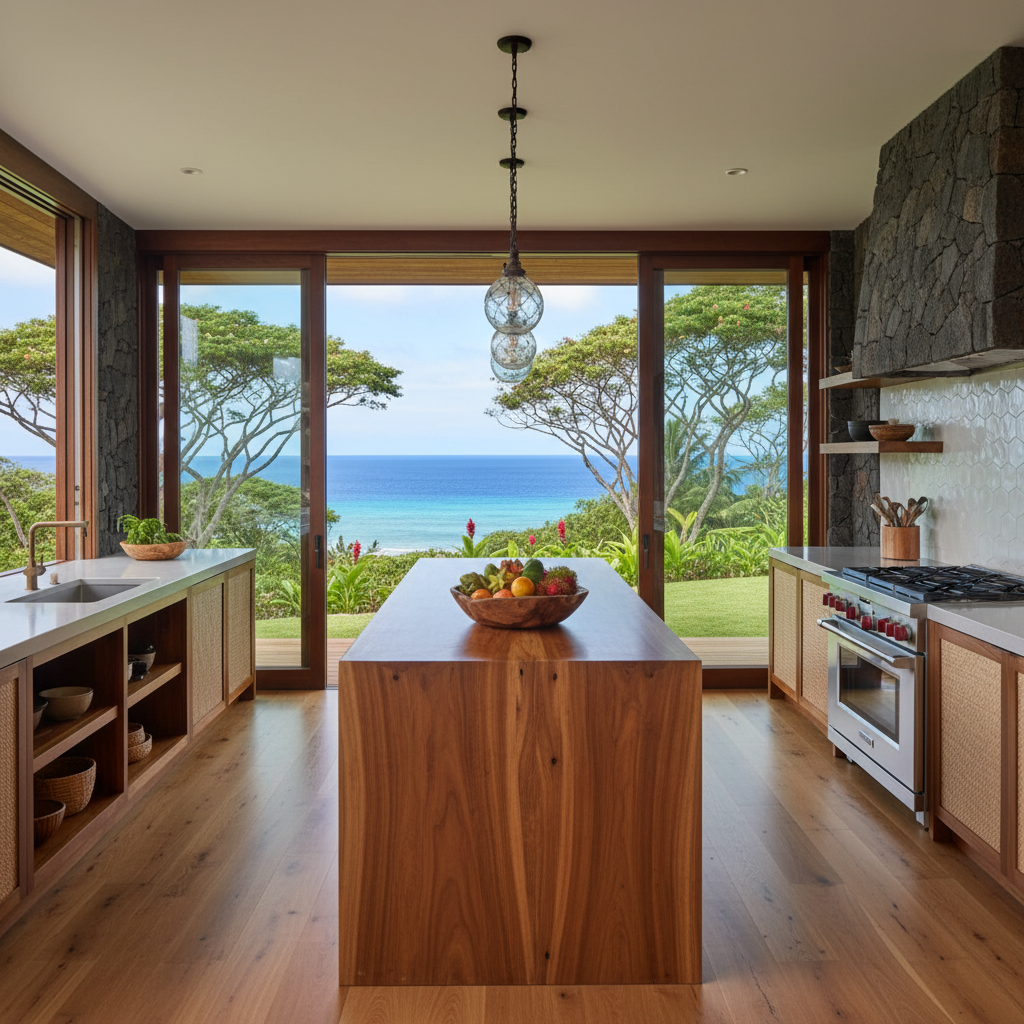
Remodeling a kitchen in Hana is a battle against the elements. The combination of high humidity, salty air, and intense sun creates an environment that can quickly degrade standard building materials. A successful project hinges on making smart choices that are tailored specifically for these conditions. Beyond materials, the logistics of getting anything and everything to a remote site on Maui dictates a unique set of rules.
### Climate and Material Selection
The air in Hana is constantly moist and laden with salt, a corrosive combination for any home. Here’s how we combat it in the kitchen:
* **Cabinetry is Key:** We’ve already mentioned avoiding MDF, but it bears repeating. It acts like a sponge in Hana’s humidity. Solid woods like teak, sapele, or even locally sourced mango (if properly sealed) are excellent choices. Another fantastic, though more modern, option is high-density polymer or acrylic cabinetry, which is completely impervious to moisture.
* **Hardware and Fixtures:** The grade of your metal matters immensely. Look for 316L stainless steel, often called “marine grade,” for appliances, sinks, and outdoor kitchen components. For cabinet pulls and hinges, solid brass is another great option that develops a patina but won’t rust and fail. Anything less will corrode.
* **Countertops:** Non-porous materials are your friend. Quartz is an excellent choice as it’s stain-resistant and doesn’t need sealing. Some types of well-sealed granite can also work, but we generally steer clients away from porous stones like marble or travertine, which can be susceptible to moisture issues if not meticulously maintained.
* **Flooring:** Luxury Vinyl Plank (LVP) is a champion in this environment. It looks like wood but is 100% waterproof and won’t warp or swell. Tile is another great option, but we recommend using an epoxy-based grout which is more resistant to mold and staining than traditional cementitious grout.
### Logistics of the Hana Highway
Every single nail, screw, and 2×4 has to travel down one of the most famous—and challenging—roads in the world. This is not a trivial detail; it’s a central planning constraint.
* **Delivery Size:** We can’t send a 40-foot container truck down the Hana Highway. It simply won’t make the turns. All materials must be planned for delivery on smaller, straight-body trucks. This often means de-palletizing goods in Kahului and reloading them for the final leg of the journey.
* **Scheduling:** We schedule deliveries for early mornings on weekdays to avoid the crush of tourist traffic. A truck stuck behind a line of rental cars can lose half a day, which directly impacts the project timeline and budget.
* **Weather Delays:** Heavy rains can cause landslides or flooding that closes the road for hours or even days. We build buffer days into our schedule to account for these potential delays, especially during the rainy season (November-March).
### Local Regulations and Community
Hana is a tight-knit community with a strong sense of place. Building here requires respect and understanding.
* **Noise and Work Hours:** We are strict about adhering to considerate work hours, typically starting no earlier than 8:00 AM and finishing by 4:30 PM, to minimize disruption to neighbors.
* **Environmental Sensitivity:** Runoff and waste management are critical. We implement thorough site protection to ensure no construction debris or sediment pollutes the delicate local ecosystem. All waste is properly contained and hauled back to the central landfill.
* **Water Catchment:** Many homes in Hana rely on water catchment systems. During a remodel, we take extra precautions to protect the roof and gutters to ensure the water supply remains clean and uncontaminated.
Building in Hana is a privilege, and we approach every project with that in mind. It’s about more than just construction; it’s about creating a beautiful, durable space that respects its incredible surroundings.
How to Choose the Right Kitchen Remodel Contractor in Hana
Selecting the right `kitchen contractor in Hana` is the single most important decision you will make for your project. The stakes are higher here than in urban Honolulu. A mistake in hiring can lead to catastrophic delays, budget overruns, and shoddy workmanship that won’t stand up to the climate. You need a general contractor who is not just skilled, but also a master of logistics and a specialist in coastal construction.
Here’s what to look for when vetting potential contractors:
1. **Verify Their License and Insurance.** This is non-negotiable. The first step is to verify that the contractor holds a current B-General Building Contractor license in the State of Hawaii. You can do this instantly online using the Department of Commerce and Consumer Affairs (DCCA) Professional & Vocational Licensing (PVL) search tool[2]. Our license at Warrior Construction is BC-34373. Additionally, ask for proof of General Liability and Worker’s Compensation insurance. Without this, you could be held liable for any accidents on your property.
2. **Demand Neighbor Island Experience, Specifically Maui.** Don’t be shy about this. Ask them directly: “Show me three projects you’ve completed on Maui in the last five years. Can I speak to the homeowners?” A contractor whose portfolio is 99% Oahu projects will be learning on your dime. They won’t have the established relationships with Maui-based subcontractors, they won’t understand the quirks of the Maui County inspection process, and they won’t have their shipping and delivery logistics dialed in. We pride ourselves on our neighbor island portfolio for this very reason.
3. **Scrutinize Their Communication and Project Management.** For a Hana project, where you may be managing it from off-island, communication is everything. Ask them to walk you through their process. How often will you get updates? How are change orders handled? Do they use project management software? At Warrior Construction, we provide clients with access to a portal showing daily logs, photos, and real-time budget tracking. Vague answers about “sending an email once a week” are a major red flag.
4. **Get a Detailed, Itemized Proposal.** A one-page quote with a single number is not acceptable. A professional proposal should be several pages long and break down the costs for each phase of the project: demolition, framing, electrical, plumbing, cabinetry, countertops, etc. It should also clearly state what is included and, just as importantly, what is excluded (these are called allowances). This level of detail shows that the contractor has thoroughly thought through your project and protects you from unexpected costs later on.
5. **Talk to Their References.** Don’t just get a list of names; actually call them. Ask specific questions:
* Did the project stay on budget and on schedule? If not, why?
* How did the contractor handle unexpected problems?
* Was the communication clear and consistent?
* Was the job site kept clean and safe?
* Would you hire them again?
A reputable kitchen contractor who is confident in their work will be happy to provide you with recent, relevant references. Choosing your builder is about finding a long-term partner for a complex process. Take the time to do your homework—it will pay dividends for the life of your kitchen.
Real Hana Kitchen Remodel Project Example
To make these strategies concrete, let’s walk through a project we recently completed for a family with a 1980s home near Hamoa Beach. Their situation was classic Hana: a kitchen that was not only dated but actively failing due to the climate.
**The Problem:** The kitchen was dark, cramped by a poorly placed peninsula, and suffering from years of exposure to the humid, salt-laden air. The original particle board cabinets were swelling and the doors no longer closed properly. The drawer glides were so corroded with rust they were nearly impossible to open. Furthermore, there was visible evidence of termite damage in the cabinet boxes under the sink, a common issue in older Hawaii homes.
**The Client’s Vision:** They wanted a bright, open, and incredibly durable kitchen that would become the heart of their home. A key goal was to better connect the space to their beautiful lanai and the lush tropical garden outside. They loved to cook and entertain, so they needed a functional layout with plenty of counter space and modern appliances that could handle frequent use.
**Warrior Construction’s Solution & Strategy:** Our plan was two-fold: first, completely re-engineer the space for better flow and light; second, build it back with materials that could withstand Hana’s environment for decades.
1. **Structural and Layout Changes:** We began by getting engineering plans to remove the non-load-bearing peninsula and a small section of the wall separating the kitchen from the living area. We also replaced a small, jalousie window with a large pass-through awning window that opened directly onto the lanai, creating a seamless indoor-outdoor bar and serving area.
2. **Material Selection for Durability:**
* **Cabinetry:** We worked with a custom cabinet maker on Oahu to fabricate boxes and doors from Sapele, an African hardwood known for its beauty, stability, and high resistance to moisture and insects. All hardware was 316L stainless steel.
* **Countertops:** They chose a light-colored quartz countertop for its durability and low maintenance.
* **Appliances:** We sourced a full suite of marine-grade stainless steel appliances designed for coastal applications.
* **Flooring:** We installed luxury vinyl plank flooring that ran continuously from the kitchen into the living area, unifying the space.
3. **Logistics Management:** This was the critical behind-the-scenes work. All materials—the custom cabinets from Oahu, the quartz slabs from a supplier in Seattle, the appliances from the mainland, and all the plumbing and electrical fixtures—were shipped to and consolidated in a warehouse in Kahului. Only when every single item was accounted for did we schedule a single, large truck for the careful journey to the Hana job site. This prevented the common scenario of having a half-finished kitchen waiting for weeks on a missing faucet.
**The Results:**
The transformation was remarkable. The new kitchen is bright, airy, and highly functional. The large island provides ample prep space, and the connection to the lanai has completely changed how the family lives in their home. Most importantly, every component was chosen for longevity.
* **Final Budget:** $185,000
* **Project Timeline:** 5.5 months from demolition to final inspection. (Note: The planning and permitting phase took an additional 4 months prior to starting).
This project showcases how a successful `kitchen renovation in Hana` is a product of thoughtful design, climate-appropriate materials, and, above all, military-grade logistical planning.
What this means for Hawaii homeowners
Remodeling your kitchen in a unique location like Hana, Maui requires a shift in mindset from a standard home improvement project to a complex logistical operation. The key takeaway is that planning and material selection are far more important than in any other part of Hawaii. Success is defined months before the first hammer swings.
For homeowners considering a kitchen remodel in Hana, here are the most critical, actionable steps to take:
* **Embrace a Longer Timeline:** Start your planning process at least 9-12 months before you want the project to be completed. A significant portion of this time will be dedicated to design, permitting with Maui County, and—most crucially—the long lead times for ordering and shipping every single material to the island. Rushing this process is the number one cause of budget overruns and frustration.
* **Budget for the “Hana Premium”:** A realistic budget must include a 20-30% contingency specifically for logistics. This covers barge fees from Oahu, ground transport from Kahului, potential travel costs for specialized labor, and buffer for unforeseen shipping delays. A contractor who doesn’t discuss this premium upfront is not being transparent about the true `kitchen remodel cost hana`.
* **Prioritize Durability Over Fleeting Trends:** The beauty of your kitchen will be short-lived if the materials can’t withstand the humidity and salt air. Invest in the right things: solid wood or polymer cabinets, marine-grade (316L) stainless steel hardware and appliances, non-porous countertops like quartz, and powerful ventilation. These choices will pay for themselves by avoiding premature replacement and repair.
* **Hire a True Neighbor Island Specialist:** Your contractor’s experience with off-Oahu projects is paramount. Vet them specifically on their logistics process. Ask how they consolidate materials, how they schedule deliveries on the Hana Highway, and for references from other Maui homeowners. Choosing a licensed, insured contractor with a proven track record in challenging locations like Hana is the best way to protect your investment.
Ultimately, a well-executed Hana kitchen is an incredible asset, blending modern function with the unparalleled beauty of East Maui. Approaching it with the right knowledge and the right professional partner makes all the difference.
Frequently Asked Questions About Kitchen Remodel in Hana
How much does a high-end kitchen remodel in Hana cost per square foot?
For a high-end kitchen remodel in Hana in 2026, you should budget between $350 to $500 per square foot. This accounts for custom cabinetry, professional-grade appliances, natural stone countertops, and the significant logistical costs of shipping and labor. A 200-square-foot luxury kitchen could therefore easily range from $70,000 to $100,000 or more, before considering major structural changes.
Do I need an architect for my Hana kitchen renovation?
You’ll need a licensed architect or a qualified draftsperson if your renovation involves any structural changes. This includes moving or removing walls (especially load-bearing ones), enlarging windows or exterior doors, or altering the roofline. For a simpler, “pull-and-replace” remodel that keeps the existing layout, you typically do not need an architect, as your general contractor can handle the permitting for basic electrical and plumbing updates.
What are the best cabinet materials for Hana’s high-humidity climate?
The best materials are those impervious to moisture. We strongly recommend solid hardwoods like teak or sapele, which have natural oils that resist rot and insects. High-density marine-grade polymers or acrylics are also excellent, modern choices. You must avoid MDF and particle board, as they will absorb moisture from the humid air, swell, and delaminate over time, regardless of the finish.
Can I live in my house during a kitchen remodel in Hana?
We strongly advise against it. A kitchen remodel is disruptive anywhere, but in a remote location like Hana, it’s amplified. You’ll be without water, cooking facilities, and a central part of your home for 2-4 months. Given the lack of nearby restaurants or long-term stay hotels, it’s best to arrange for alternative accommodation before the project begins to avoid extreme inconvenience and stress.
How long do permits for a kitchen remodel take in Maui County?
As of 2026, the permit review process with the Maui County Department of Public Works for a kitchen remodel typically takes between 2 to 4 months. This timeline begins after the architectural plans are finalized and submitted. The duration can vary based on the complexity of your project and the county’s current backlog, so it’s essential to factor this waiting period into your overall project schedule.
What’s the biggest mistake homeowners make in a Hana kitchen remodel?
The most common and costly mistake is underestimating logistics. Homeowners often focus on the design and finishes but fail to grasp the timeline and cost implications of getting every single component to a remote job site. This leads to starting demolition before materials have arrived on Maui, resulting in long, frustrating delays with a non-functional kitchen. A good contractor will have all materials consolidated on-island before Day 1 of construction.
Are there specific hurricane code requirements for a Hana kitchen?
Yes, particularly if you are changing windows or doors. Any new exterior windows or glass doors installed as part of your kitchen remodel must be impact-rated and meet the current wind-load requirements specified in the Hawaii building code. As your general contractor, we ensure all new openings are properly flashed, sealed, and anchored to the home’s structure with approved hurricane straps and connectors to protect your home during a major storm.
How does Warrior Construction handle logistics for a project in Hana?
We have a dedicated logistics process refined over many neighbor island projects. We establish a single consolidation point, usually a warehouse in Kahului, where all project materials—from cabinets and appliances to tile and fixtures—are received and inventoried. Once 100% of the materials are on-island and confirmed, we schedule phased deliveries to the Hana job site using trucks appropriate for the road. This prevents costly piecemeal shipping and ensures the construction phase proceeds without material-related delays.
Ready to build a Hana kitchen that lasts?
A kitchen remodel in Hana is a significant investment, but when done right, it creates a lasting, beautiful space that honors its incredible setting. It requires a team with the experience to navigate the challenges of building in one of Hawaii’s most remote and beautiful places. At Warrior Construction, we bring the logistical expertise, climate-specific material knowledge, and transparent communication needed to make your project a success.
If you’re ready to discuss your vision, our team is here to help. Learn more about our detailed approach to Hawaii kitchen remodeling or contact us today to schedule a consultation and receive a comprehensive estimate for your Hana home.