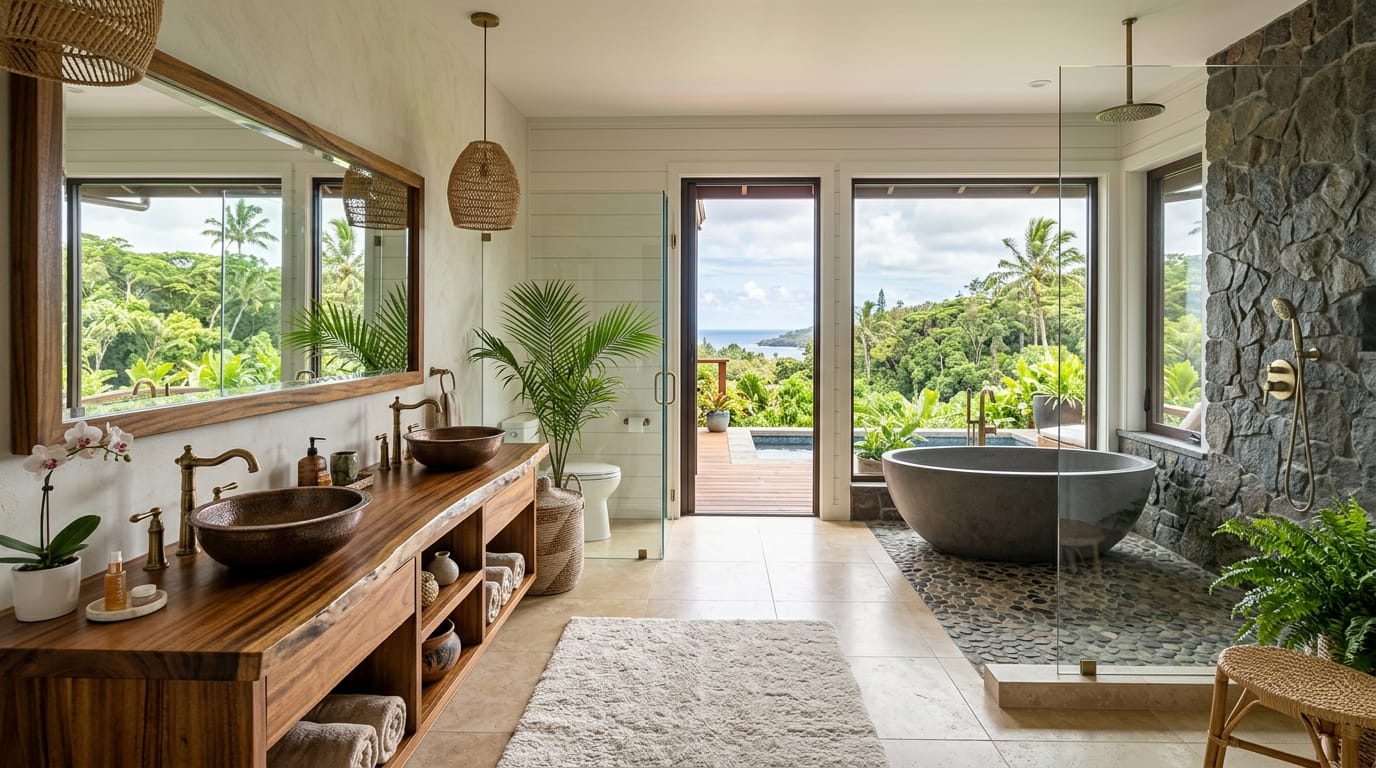
A bathroom remodel hana project is one of the best investments you can make in your home, but it’s a completely different animal than remodeling a bathroom in Honolulu or on the mainland. The biggest mistakes we see homeowners make are underestimating Hana’s unique logistical challenges, ignoring the high-humidity and salt-air climate, choosing the wrong materials for Maui, failing to plan for Maui County permitting, hiring an unlicensed or off-island contractor, not designing for proper ventilation, forgetting about water catchment and septic systems, skimping on waterproofing, and not budgeting for the real costs of inter-island freight. Tackling a bathroom renovation in Hana requires a deep understanding of local conditions, a robust supply chain, and a team that knows how to build for the tropics. After more than 20 years in Hawaii construction, our team at Warrior Construction has seen it all, and we’ve built the systems to deliver high-quality bathrooms that stand the test of time, even in one of Maui’s most demanding environments.
Why Hana Homeowners Trust Warrior Construction for Bathroom Remodel
Homeowners in a remote community like Hana trust Warrior Construction because we are a fully licensed and insured Hawaii general contractor (BC-34373) with a proven track record on Maui. We don’t just build; we solve the complex logistical puzzles that come with every Hana project. Our experience isn’t theoretical; it’s earned on job sites from Haiku to Kaupo, dealing with barge schedules, material sourcing from Kahului, and the specific nuances of the Maui County building code. An off-island contractor might give you a great-looking bid, but they often don’t grasp the reality of getting a specialized plumber or a specific vanity to a job site past the winding turns of Hana Highway. That lack of local knowledge leads to costly delays and frustration.
Our license, BC-34373, isn’t just a number. It’s a commitment to professionalism and accountability, verifiable through the state’s Department of Commerce and Consumer Affairs Professional & Vocational Licensing Division[1]. This means we carry the necessary insurance, understand Hawaii’s lien laws, and are held to a higher standard of practice. For a Hana homeowner, this provides crucial protection and peace of mind. We’ve seen situations where an unlicensed handyman botched a shower pan installation, leading to thousands in water damage that the homeowner had to pay for out-of-pocket because the worker had no insurance. With our team, you’re partnering with established professionals who live and work here.
Furthermore, our approach is built on transparent communication. We know that you can’t just run to the store if something is missing. Our pre-construction planning is meticulous. We map out every single material, from the tile grout to the toilet flange, and ensure it’s ordered and staged in Kahului before we even begin demolition. On a recent project in Nahiku, the homeowner wanted a specific type of freestanding tub that was only stocked in Honolulu. We coordinated the purchase, the crating, the Young Brothers barge shipment, and the final careful delivery to the site. Another contractor might have told the client to pick something else. We just see it as part of the job. That dedication to overcoming Hana’s unique hurdles is why people choose us for their bathroom remodel.
What Does Bathroom Remodel Cost in Hana?
In 2026, a complete, mid-range bathroom remodel in Hana will cost between $375 and $500 per square foot. For a standard 5-foot by 8-foot bathroom (40 square feet), this puts the typical project cost in the $20,000 to $30,000 range for a full gut renovation. For a larger, high-end master bathroom with custom cabinetry, stone countertops, and premium fixtures, the cost can easily climb to $75,000 or more. The single biggest factor driving costs up in Hana compared to Wailuku or Kihei is logistics. We factor in what we call a “Hana Logistics Premium” of 15-25% on top of baseline material and labor costs to account for freight, fuel, and travel time for our skilled tradespeople.
A common mistake is looking at national cost averages or even Honolulu prices and assuming they apply. They don’t. Here’s a realistic cost breakdown for a hypothetical $28,000 Hana bathroom renovation:
- Labor (50%): $14,000. This includes our skilled carpenters, licensed plumbers, licensed electricians, tile setters, and painters. The rate is higher in Hana to account for the travel time from central Maui.
- Materials & Fixtures (30%): $8,400. This covers everything from the new vanity and toilet to the tile, grout, paint, and lumber. We prioritize durable, moisture-resistant materials suitable for the climate.
- Inter-Island & Local Freight (10%): $2,800. This is the cost that surprises many homeowners. It includes barge fees from Oahu for special-order items, plus the cost of our trucks making multiple trips from our Kahului staging area to your home in Hana.
- Permits & Fees (3%): $800. This covers the Maui County permit application and plan review fees.
- Contingency (7%): $2,000. We always build in a contingency for the unexpected. In Hana, this could be discovering extensive termite or rot damage once we open up the walls, or needing to upgrade a portion of the home’s septic system to accommodate the new layout.
We once had a client who fell in love with a specific line of volcanic rock tile from a boutique supplier on the Big Island. The tile itself was reasonably priced. But the cost to professionally crate it, ship it to Maui, and then transport it carefully to their remote Hana property added nearly 40% to the material cost. We laid out these costs upfront so there were no surprises. A transparent bathroom contractor will always break down these logistical costs for you. If a bid for a bathroom remodel in Hana looks too good to be true, it’s likely because they haven’t properly accounted for the real cost of getting materials and skilled labor to your door.

How Long Does a Bathroom Remodel Take in Hana?
For a standard bathroom remodel in Hana, you should plan for a total project duration of 8 to 12 weeks. This timeline breaks down into two main phases: 2 to 4 weeks for the pre-construction phase (design, material selection, and permitting) and 6 to 8 weeks for the active construction phase (from demolition to final cleaning). This is typically 25-40% longer than a similar project would take in a more central location like Kahului, and the primary reasons for the extended schedule are material lead times and the logistics of scheduling inspections.
Here’s a step-by-step look at a realistic timeline for a shower remodel hana project:
- Phase 1: Pre-Construction (Weeks 1-4)
- Week 1: Initial consultation, design finalization, and signing the contract.
- Week 2: Material selection is finalized. This is critical. We immediately place orders for long-lead-time items like the vanity, custom tile, or special-order fixtures, as these can take 4-8 weeks to arrive on Maui.
- Weeks 3-4: We prepare and submit the permit application to the Maui County Department of Public Works. Depending on their workload, the review process can take a couple of weeks.
- Phase 2: Active Construction (Weeks 5-12)
- Week 5: Demolition and site prep. We contain the dust and debris and tear out the old bathroom down to the studs.
- Week 6: Plumbing and electrical rough-in. This is where we move pipes and wires for the new layout. This must be done by licensed professionals.
- Week 7: Rough-in inspections. We have to coordinate with the Maui County inspector to come out to the site. This can sometimes cause a day or two of delay depending on their schedule in East Maui.
- Week 8: Insulation, drywall, and waterproofing. This is a critical stage, especially applying waterproofing membranes like Schluter-KERDI in the shower area.
- Week 9-10: Tiling. This is a meticulous process that takes time. The floor, shower walls, and any backsplash are installed.
- Week 11: Installation of vanity, countertops, toilet, and fixtures. The bathroom starts to look finished.
- Week 12: Painting, installation of lighting, mirror, and accessories. This is followed by a final plumbing and electrical inspection, and a thorough site cleaning.
The most common cause of delay is waiting for materials. On a recent bathroom renovation hana, the client chose a specific vanity that had to be shipped from a manufacturer in California. Due to port congestion in Long Beach, the vanity’s arrival was delayed by three weeks. Because we had anticipated this possibility, we were able to adjust our schedule and work on other aspects of the project, but it highlights why building extra time into a Hana project schedule is not just a good idea—it’s essential.
What Permits Do You Need for Bathroom Remodel in Hana?
For any bathroom remodel in Hana that involves altering the structure, plumbing, or electrical systems, a building permit from the Maui County Department of Public Works is required. If you’re just doing cosmetic upgrades—like painting the walls, replacing a faucet in the same location, or laying down new flooring over the old one—you typically don’t need a permit. However, the moment you move a wall, relocate a toilet, change the size of a shower, or run a new electrical line for a lighted mirror, you’ve crossed the line into permit territory.
Navigating the permitting process can be one of the most confusing parts for homeowners. It’s a different system than the one used by the Honolulu Department of Planning and Permitting (DPP)[2], with its own forms, review timelines, and specific requirements. As your general contractor, Warrior Construction handles this entire process. We prepare the architectural drawings, fill out all the necessary paperwork, and communicate directly with the county plan reviewers and inspectors. This service is a core part of what a professional bathroom contractor hana provides, saving you from headaches and ensuring your project is legal and safe.
Here’s a simple breakdown of what does and doesn’t require a permit:
Work Requiring a Permit
- Moving or removing walls
- Changing the size or location of windows or doors
- Relocating plumbing fixtures (toilet, sink, shower)
- Adding or altering electrical circuits (e.g., for a new fan or outlet)
- Converting a tub to a shower
Work Not Typically Requiring a Permit
- Painting and trim work
- Replacing a toilet or vanity in the exact same location
- Installing new flooring over the existing subfloor
- Replacing a light fixture or faucet with a similar model
- Regrouting tile
Attempting to do work without a required permit is a costly mistake. We were once called in to fix a project in Haiku where the homeowner hired a handyman to build a new bathroom addition. They never pulled permits. When the homeowner tried to sell the property years later, the unpermitted addition was flagged by the buyer’s inspector. The sale fell through, and they had to hire us to retroactively permit the work. This involved tearing open walls for the inspector to see the plumbing and framing, which cost nearly double what it would have to do it right the first time. It’s simply not worth the risk.

Hana-Specific Considerations: Climate, Materials, Regulations
A successful bathroom remodel in Hana hinges on respecting the unique local environment. The constant high humidity, salty air, and intense tropical sun, combined with the logistical realities of a remote town, dictate every choice we make, from the type of fan we install to the finish on the cabinet handles. Ignoring these factors is the fast track to a beautiful new bathroom that starts to fail within a few years.
Managing Humidity and Preventing Mold
Hana’s air is naturally humid. Inside a bathroom, that humidity skyrockets. Without aggressive ventilation, mold and mildew are inevitable. A cheap, low-power fan from a big box store won’t cut it. We insist on installing high-capacity exhaust fans (rated at 100 CFM or higher) that are properly vented all the way to the exterior of the house. We also use mold-resistant drywall (often called “green board” or “purple board”) in all our bathroom projects. Most importantly, we apply a robust waterproofing membrane, like the Schluter-KERDI system, behind all tile in showers and tub surrounds. This creates a completely sealed, waterproof barrier that prevents moisture from ever reaching the wall studs, which is the primary cause of rot and structural damage we see in older bathrooms.
Fighting Salt-Air Corrosion
Anything made of metal will be under constant attack from the salt in the air. That shiny chrome faucet or towel bar that looks great in a catalog can become a pitted, rusty mess in a Hana bathroom in less than two years. We guide our clients toward materials designed for marine environments.
- Fixtures: Look for fixtures with a PVD (Physical Vapor Deposition) finish. It’s far more durable and corrosion-resistant than standard chrome plating. Brushed nickel and matte black are often good choices.
- Hardware: For cabinet pulls, hinges, and screws, we use 316-grade stainless steel whenever possible. It has a higher resistance to corrosion than the more common 304 grade.
- Lighting: Light fixtures should be rated for damp or wet locations and made from materials like brass, bronze, or high-grade polymers that won’t rust.
Water Catchment and Septic Systems
Many homes in and around Hana rely on water catchment for their water supply and septic systems for waste. A bathroom remodel must take this into account. We always recommend installing low-flow toilets (1.28 gallons per flush or less) and WaterSense-rated showerheads and faucets. This not only conserves your precious water supply but also reduces the load on your septic system’s leach field. If you’re adding a bathroom or significantly increasing the number of fixtures, we may need to consult with a civil engineer to ensure your existing septic system can handle the increased capacity. An upgrade can be a significant expense, and it’s something that must be identified and budgeted for during the planning phase, not after demolition has started.
How to Choose the Right Bathroom Remodel Contractor in Hana
Choosing the right contractor is the single most important decision you’ll make for your Hana bathroom remodel. The right choice means a smooth process and a durable, beautiful result. The wrong choice can lead to endless delays, budget overruns, and shoddy workmanship that fails in Hana’s tough climate. The key is to find a contractor who is not only skilled but who also has specific, verifiable experience working in East Maui.
Here is the checklist we recommend every Hana homeowner use when vetting a potential bathroom contractor:
- Verify Their Hawaii Contractor’s License. This is non-negotiable. Ask for their license number (ours is BC-34373) and verify it on the Hawaii DCCA PVL website[1]. A valid license ensures they are registered, insured, and accountable to the state. Never hire an unlicensed handyman for a project of this scope.
- Ask for Hana-Specific References. Don’t settle for references from Kihei or Lahaina. Ask to speak with at least two recent clients whose projects were in Hana, Nahiku, or Kipahulu. Ask them specifically about communication, how delays were handled, and the quality of the finished work.
- Review Their Portfolio of Local Work. A picture is worth a thousand words. Ask to see photos of completed bathroom projects on Maui. You can see examples of our work across the islands in our online portfolio. Look for quality craftsmanship and designs that are appropriate for a tropical environment.
- Demand a Detailed, Itemized Contract. A vague, one-page bid is a major red flag. A professional contract will be many pages long and will itemize the entire scope of work, including specific brand names and model numbers for all fixtures and materials. It should also clearly state the payment schedule, the process for handling change orders, and the project timeline.
- Confirm They Manage All Permitting. The general contractor should take full responsibility for the permitting process from start to finish. If a contractor asks you, the homeowner, to pull the permit, it’s often a sign that they are not properly licensed or insured.
- Discuss Their Logistics and Supply Chain Strategy. Ask them directly: “How do you get materials and specialized subcontractors to my home in Hana?” A prepared contractor will have a clear answer involving their staging warehouse, trusted freight partners, and a schedule that accounts for delivery times. If they hesitate or seem unsure, they likely don’t have the experience to manage a remote project effectively.
- Check Their Insurance Coverage. Ask for a copy of their general liability insurance and workers’ compensation insurance certificates. This protects you from any liability in case of an accident on your property.
- Get a Feel for Their Communication Style. You’ll be working closely with this team for several months. Choose a contractor who is responsive, professional, and easy to talk to. At Warrior Construction, we assign a dedicated project manager to every job to ensure you always have a single point of contact.
- Don’t Let Price Be the Only Factor. While budget is important, the cheapest bid is often the most expensive in the long run. It can be a sign of an inexperienced contractor who has underestimated the costs, uses subpar materials, or is cutting corners on critical steps like waterproofing.
- Trust Your Gut. After you’ve done all your research, trust your intuition. Choose the team that you feel most confident can deliver on their promises and that you’ll be comfortable having in your home.
Real Hana Bathroom Remodel Project Example
To make this tangible, let’s walk through a recent project our team completed. It was a master bathroom renovation in a 25-year-old home located just outside Hana town, with beautiful ocean views but a bathroom that was showing its age.
- The Client’s Goal: The homeowners wanted to transform their dark, cramped 90-square-foot master bathroom into a bright, open, spa-like retreat. Their main goals were to replace a bulky, unused bathtub with a large walk-in shower, improve the terrible ventilation, and use materials that would stand up to the humid, salty air.
- The Challenges: When we opened up the walls, we discovered what we often find in older bathrooms: significant water damage and rot in the subfloor around the old tub due to a slow, long-term leak. The single small window and an underpowered fan were not providing nearly enough ventilation, leading to mildew issues. The client also wanted a custom-built vanity made from monkeypod wood, which required careful sourcing and sealing.
- The Warrior Construction Solution: Our team started by completely gutting the space. We removed and replaced the rotted sections of the subfloor and wall framing. We then re-configured the plumbing to accommodate a spacious, curbless walk-in shower. Our plan included:
- Waterproofing: We installed a full Schluter-KERDI waterproofing system on the shower walls and floor, creating a completely sealed envelope.
- Ventilation: We installed a powerful but quiet 150-CFM Panasonic exhaust fan, venting it directly through the roof. We also worked with a window supplier in Kahului to install a larger vinyl window with a frosted-glass finish for privacy.
- Materials: We used large-format porcelain tile for the shower walls and floor, which minimizes grout lines and is easy to clean. All fixtures had a PVD brushed nickel finish, and the lighting was marine-grade stainless steel. For the custom vanity, we worked with a Maui woodworker, ensuring the monkeypod slab was properly kiln-dried and sealed with multiple coats of marine-grade varnish to prevent warping.
- The Results:
- Timeline: The project was completed in 11 weeks, from demolition to the final walkthrough. This included a one-week delay waiting for the custom vanity to be finished.
- Budget: The final project cost came in at $42,500, which was right on the original budget. This equates to about $472 per square foot.
- Outcome: The homeowners were thrilled with their new bathroom. It was bright, functional, and, most importantly, built with the right techniques and materials to last for decades in the demanding Hana climate.
What this means for Hawaii homeowners
Embarking on a bathroom remodel in a place as special and remote as Hana requires a different mindset than a typical home improvement project. It’s less about just picking out pretty tile and more about strategic planning, robust engineering, and smart material science. For homeowners here, success comes down to embracing the realities of the environment and planning accordingly.
Here are the key takeaways you should focus on:
- Budget for Reality: Plan for your project to cost 15-30% more than a similar project in Honolulu. This isn’t because contractors are marking things up; it’s the real, tangible cost of freight, transportation, and labor in a remote area. Build a healthy contingency fund (10-15%) into your budget from day one.
- Time is a Resource: Start planning your remodel at least six months before you want the work to begin. This allows ample time for design, material selection, ordering, shipping, and permitting. Rushing the process is the fastest way to make expensive mistakes.
- Prioritize Durability Over Trends: In Hana’s climate, function must come before fashion. Invest your budget in the things you can’t see: top-tier ventilation, a bulletproof waterproofing system, and corrosion-resistant fixtures. A trendy vanity can be replaced in five years; a rotted subfloor is a catastrophic failure.
- Hire a Local, Licensed Pro: The risks of hiring an unlicensed individual or an off-island contractor are magnified in Hana. A licensed, Maui-based general contractor like Warrior Construction already has the local relationships, supply chains, and climate-specific knowledge to execute your project correctly and legally. The peace of mind and quality assurance are worth the investment.
- Get Everything in Writing: A detailed, professional contract is your best friend. It protects both you and the contractor by setting clear expectations for the scope of work, timeline, and cost. Don’t move forward on a handshake deal.
Ultimately, a well-executed bathroom remodel in Hana is more than an upgrade—it’s an investment in your home’s longevity and your quality of life. By planning carefully and partnering with the right team, you can create a space that is not only beautiful but also a durable sanctuary built to thrive in the heart of paradise.
Helpful resources: City & County of Honolulu DPP · Hawaii DCCA Licensing
Frequently Asked Questions About Bathroom Remodel in Hana
How much value does a bathroom remodel add to a Hana home?
A mid-range bathroom remodel in Hawaii typically recoups about 60-70% of its cost at resale. However, in a place like Hana, the value is often higher. Because buyers are acutely aware of the challenges of renovating in a remote area, a home with a modern, well-built, and properly waterproofed bathroom is significantly more attractive than a fixer-upper. It removes a major headache for a potential buyer, making the home move-in ready and adding intangible value beyond just the cost recoup.
Can I live in my house during the remodel?
If you have a second bathroom, it is usually possible to live in your home during the renovation. Our team at Warrior Construction takes great care to isolate the work area with plastic barriers and minimize dust and disruption. However, you should expect some noise, dust, and daily activity from our crew. If the bathroom being remodeled is your only one, you will need to make alternative arrangements for the 6-8 week construction phase.
What’s the biggest mistake people make with a bathroom remodel hana?
The single biggest mistake is underestimating the impact of humidity and skimping on ventilation and waterproofing. People get excited about the visible finishes like tile and fixtures but neglect the critical systems behind the walls. A bathroom in Hana without a powerful, properly vented exhaust fan and a professional waterproofing membrane system is destined to have problems with mold, mildew, and rot within just a few years.
Is a tub or a walk-in shower better for a Hana home?
This often comes down to personal preference, but we are seeing a strong trend towards large, walk-in showers. They feel more open, are easier to clean, and are more accessible. For many people living the indoor-outdoor lifestyle in Hana, a quick rinse in a spacious shower is more practical than a bath. As long as you have at least one bathtub in the house for potential resale value (for families with young children), converting a master bath to a shower-only space is an excellent choice.
How do you deal with termite damage found during demolition?
Finding termite damage is common in older Hawaii homes. As a licensed general contractor, we are prepared for this. When we uncover damage, we first assess the extent and determine which structural members (studs, joists, subfloor) need to be replaced. We then bring in a licensed pest control company to treat the area before we rebuild with new, pressure-treated lumber to prevent future infestations. This is what the contingency fund in your budget is for.
What are the best flooring materials for a humid Hana bathroom?
Porcelain tile is our top recommendation for bathroom flooring in Hana. It’s virtually waterproof, incredibly durable, and comes in a huge variety of styles, including realistic wood-look planks. We also recommend using a high-quality epoxy grout, which is stain-proof and resists mold and mildew far better than traditional cement-based grout. We generally advise against using natural stone like travertine or marble, as it can be porous and require frequent sealing to prevent moisture issues.
Does Warrior Construction work on projects of all sizes in Hana?
Yes, we handle a wide range of projects. While we are known for full-scale renovations and custom homes, we are happy to discuss smaller projects like a straightforward shower remodel hana or a simple bathroom facelift. The key for us is being able to apply our quality standards and systematic approach to the project. The best way to find out if we’re a good fit is to reach out and discuss your specific needs with our team.
How much should I budget for contingency on a Hana remodel?
For a bathroom remodel in an older home in Hana, we strongly recommend a contingency fund of 10-15% of the total project cost. In a newer home, 5-10% might be sufficient. This fund covers unforeseen issues that can’t be identified until demolition, such as hidden water damage, termite infestations, or outdated electrical wiring that needs to be brought up to current hurricane code. It’s better to have it and not need it than to need it and not have it.
A bathroom renovation in Hana is a significant undertaking, but it doesn’t have to be overwhelming. With the right planning and an experienced, local construction partner, you can create a beautiful and durable space that adds value and enjoyment to your home for years to come. At Warrior Construction, we have the expertise and the local knowledge to guide you through every step of the process.
Build with confidence. Build with Warrior.
If you’re ready to transform your Hana bathroom, our team is here to help. Contact us today to discuss your project and schedule a free estimate.