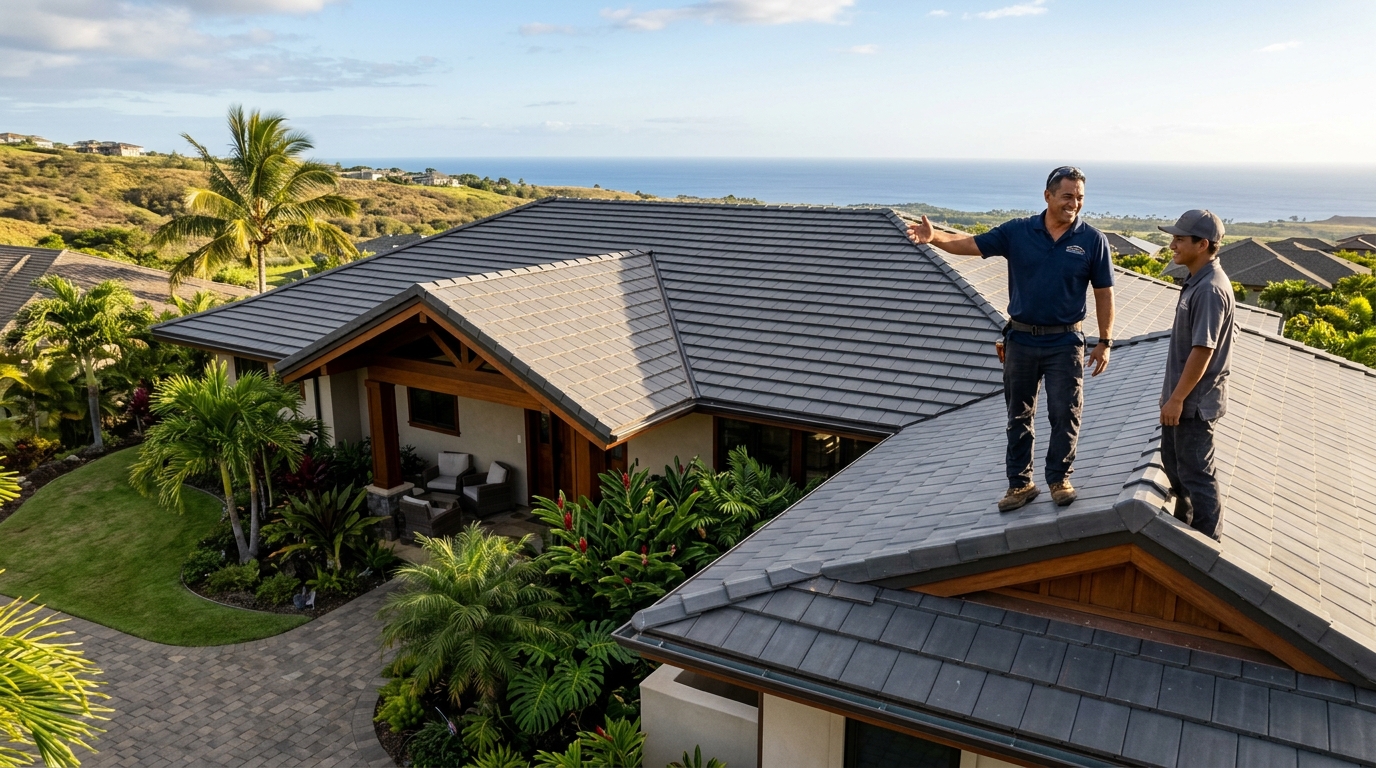
Choosing the right roofing contractor in Kapolei is about more than just keeping the rain out; it’s about hiring a team that truly understands West O‘ahu’s unique climate. From the relentless sun on the Ewa Plain to the specific wind-driven rain we get during Kona storms, your roof is your home’s most critical line of defense. At Warrior Construction, we’ve spent over two decades seeing firsthand what works and, more importantly, what fails under these demanding conditions. A roof isn’t just a commodity; it’s a complex system that needs to be engineered for Hawaii.
Many homeowners think roofing is a straightforward job, but the details make all the difference. The wrong fastener can rust out in our salt air in just a few years. The wrong underlayment can bake and crack under the intense UV, creating leaks that go undetected until you see stains on your ceiling. This is why a deep understanding of local conditions is non-negotiable. As a licensed general contractor (BC-34373) based here on O’ahu, our team doesn’t just install roofs; we build integrated, long-lasting roofing systems designed to withstand hurricanes, reduce your cooling costs, and protect your investment for decades. In this guide, we’ll walk you through the essential tips every Kapolei homeowner needs before starting a roofing project, from accurate 2026 costs and timelines to navigating the Honolulu permitting process and selecting materials that make sense for our island lifestyle.
Why Kapolei Homeowners Trust Warrior Construction for Roofing Contractor
Finding a reliable roofing contractor Kapolei homeowners can depend on involves more than a quick search. You need a partner who understands the local landscape, from the red dirt of Makakilo to the specific HOA guidelines in master-planned communities like Ho’opili or Ko Olina. Our team at Warrior Construction brings a general contractor’s perspective to every roofing project. This means we’re not just looking at the shingles; we’re assessing the entire structure underneath.
Here’s the thing: a simple roofer might not be licensed or equipped to handle what they find once the old roof comes off. We’ve seen it dozens of times. On a recent project in Kapolei, we tore off a 25-year-old asphalt roof and discovered that a slow, hidden leak had led to significant termite damage and dry rot in three of the main roof trusses. A company that only does roofing would have had to stop work, forcing the homeowner to find a separate structural contractor, leading to major delays and unexpected costs. Because we are a full-service general contractor, our crew was able to frame out and replace the damaged trusses the next day, keeping the project on schedule and the home watertight. This comprehensive capability is a crucial difference.
Our approach is built on a few key principles:
- Holistic Assessment: We inspect the decking, fascia, trusses, and ventilation. A roof is a system. If one part fails, the whole thing is compromised. We ensure every component is sound before a single new shingle is installed.
- Local Code Mastery: The City and County of Honolulu’s building codes, especially regarding hurricane-resistant construction, are complex. We live and breathe these regulations, ensuring every roof we build meets or exceeds the latest standards for wind uplift and water intrusion.
- Transparent Communication: You’ll have a dedicated project manager and direct access to our team. We provide daily updates and are always available to answer questions. We believe an informed client is a happy client.
- Long-Term Value: We guide you toward materials that offer the best performance and longevity for the Kapolei climate, focusing on energy efficiency and durability rather than just the lowest upfront cost. A cheap roof that fails in 10 years is the most expensive roof you can buy. Our goal is to install a roof that provides peace of mind for decades to come.
Choosing Warrior Construction means choosing a team that sees the bigger picture. We handle the permits, the structural repairs, the material logistics, and the final installation, providing a seamless experience from start to finish. That’s the value of hiring a true general contractor for your roofing needs.
What Does Roofing Contractor Cost in Kapolei?
Let’s get straight to the numbers for 2026. In Kapolei, the cost for a full roof replacement depends heavily on the material you choose, the complexity of your roof’s design, and its size. For a typical 2,000-square-foot, single-story home, you can expect the total project cost to fall into these ranges. These are not vague estimates; these are the all-in numbers we’re seeing on our projects right now.
Here’s a breakdown of the most common roofing materials and their installed costs per square foot in Kapolei:
- Architectural Asphalt Shingles: This is the most common residential roofing material. For a quality product like CertainTeed Landmark PRO with an algae-resistant coating (a must-have in Hawaii), expect to pay between $12 to $18 per square foot. For our 2,000 sq ft example home, the total would be roughly $24,000 to $36,000. This includes tear-off of the old roof, new synthetic underlayment, all materials, labor, and disposal fees.
- Standing Seam Metal Roofing: This is a premium choice, and for good reason. It’s incredibly durable, reflective (which lowers cooling costs), and ideal for mounting solar panels. For a 24-gauge Galvalume steel standing seam system, the cost runs from $22 to $30 per square foot. That same 2,000 sq ft home would cost between $44,000 and $60,000. While the initial investment is higher, a metal roof can easily last 50+ years, twice as long as asphalt shingles.
- Concrete or Clay Tile: Tile offers a classic look popular in many Kapolei neighborhoods. It’s very durable but also very heavy, sometimes requiring structural reinforcement. The cost is typically $18 to $25 per square foot, putting our example home in the $36,000 to $50,000 range. We always perform a structural check to ensure the existing framing can handle the weight before recommending tile.
Potential Additional Costs to Budget For:
The price of the roofing material is only part of the story. You need to be aware of potential issues that can add to the final invoice. A trustworthy contractor will outline these possibilities in their bid.
- Plywood Decking Replacement: If the plywood under your old shingles is soft, delaminated, or water-damaged, it must be replaced. We budget approximately $120 – $160 per 4×8 sheet, installed.
- Structural & Fascia Board Repairs: Termite damage or dry rot is common in older homes. Repairing fascia boards or rafters is billed on a time and materials basis, typically $100 – $150 per hour per carpenter plus the cost of lumber.
- Upgraded Ventilation: Proper ventilation is critical in Kapolei’s heat. Installing new ridge vents or a solar-powered attic fan can add $800 – $2,000 to the project but pays for itself in energy savings.
- New Gutters: It often makes sense to replace old gutters during a reroof. Expect to pay $15 to $25 per linear foot for seamless aluminum gutters.
A detailed proposal from our team will clearly separate these costs, so you know exactly what you’re paying for. We believe in providing a complete, transparent budget to avoid surprises during the project.
How Long Does a Roofing Contractor Take in Kapolei?
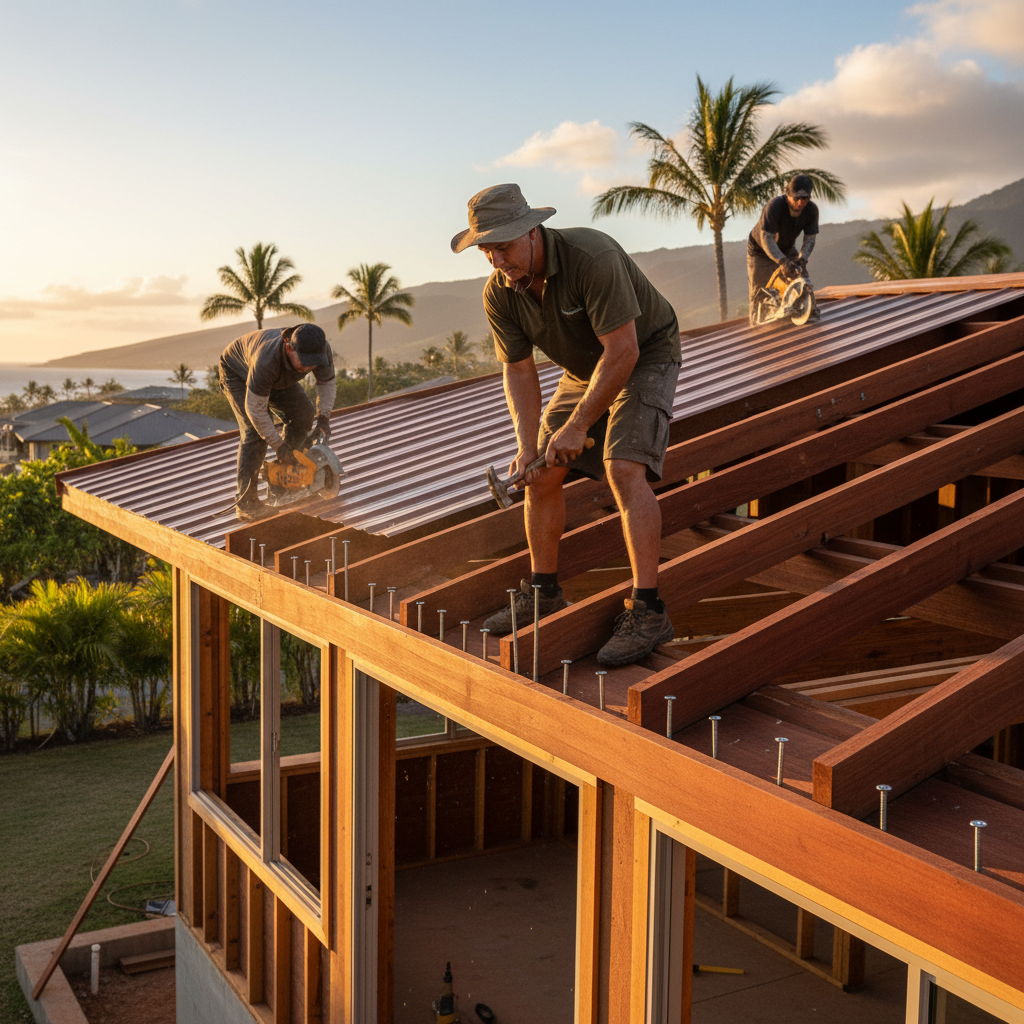
One of the most common questions we get from Kapolei homeowners is, “How long will my house be a construction zone?” The on-site work is actually the shortest part of the process. The total timeline for a full `roof replacement Kapolei` project, from signing the contract to final inspection, is driven by two main factors unique to Hawaii: permitting and material logistics.
Here’s a realistic project timeline for 2026:
- Planning and Permitting (4-8 Weeks): This is the phase that surprises most people. After you sign the contract, we prepare the necessary drawings and submit the building permit application to the Honolulu Department of Planning and Permitting (DPP). As of 2026, even with their improved digital systems, the review process for a straightforward roofing permit can take over a month. If any structural work is involved, it will require engineered plans, which can add to this timeline. We manage this entire process, but the DPP’s schedule is outside of anyone’s control. We advise clients to start this process well in advance.
- Material Ordering and Shipping (3-6 Weeks): We don’t live on the mainland. Nearly all roofing materials, especially specific colors of metal roofing or special-order shingles, have to be shipped in by container. We order materials as soon as the permit is approved, but island logistics are a real factor. We’ve had containers get bumped or delayed at the port in Long Beach, adding a week or two to the timeline. A good contractor plans for this. We build this buffer into our schedule and communicate any delays immediately. For a recent project, a client wanted a specific Kynar-coated metal panel in a custom color; that added five weeks to the pre-construction phase, a fact we made clear upfront.
-
On-Site Work (5-10 Business Days): Once the permit is in hand and materials are on-site, our crew works quickly and efficiently. For an average-sized home (1,500-2,500 sq ft), the physical process looks like this:
- Day 1: Site prep (protecting landscaping, etc.) and tear-off of the old roof.
- Day 2: Inspect decking, make any necessary repairs to plywood or framing.
- Day 3-4: Install new underlayment and flashing. This is a critical step for waterproofing.
- Day 5-8: Install the new roofing material (shingles, metal panels, or tile).
- Day 9-10: Install ridge caps, vents, and complete final details. Thorough site cleanup.
- Final Inspections (1-2 Weeks): After our work is complete, we schedule the final inspection with the DPP building inspector. Once that’s passed, the permit is closed, and the project is officially complete.
All told, a homeowner in Kapolei should plan for a 2 to 4-month process from the day they sign a contract to the final sign-off. The actual disruption to your home is minimal—just a week or two of work. But the administrative and logistical steps that ensure a high-quality, fully permitted job take time here in Hawaii.
What Permits Do You Need for Roofing Contractor in Kapolei?
Navigating the permitting process with the City and County of Honolulu’s Department of Planning and Permitting (DPP) is a critical part of any legitimate roofing project. In Hawaii, you can’t just start tearing off a roof. Any `roof replacement Kapolei` project that involves removing and replacing the existing roofing material requires a building permit. A simple `roof repair Kapolei` for a few blown-off shingles might not, but if you’re replacing more than one “square” (a 10×10 foot area), you officially need a permit.
Here’s what every Kapolei homeowner needs to understand about the permitting process:
- Why a Permit is Required: A permit is not just bureaucracy. It’s your assurance that the job is done to code, particularly the stringent hurricane codes Hawaii adopted after Hurricane Iniki. The permit triggers inspections by a city official who verifies that the contractor has used the correct nailing patterns, installed hurricane straps properly, and used the right flashing techniques. Without a passed inspection and a closed permit, you could have issues with your homeowner’s insurance or when you try to sell your home.
- The Contractor MUST Pull the Permit: A licensed contractor should always be the one to pull the permit. We use our license (Warrior Construction, BC-34373) to file the application. If a contractor asks you, the homeowner, to pull the permit as an “owner-builder,” it’s a massive red flag. That means they are likely unlicensed or trying to evade liability. When an owner pulls the permit, they assume all legal responsibility for the work, the safety of the workers, and compliance with building codes.[1]
- The Submission Process: We handle the entire submission package for our clients. This includes filling out the application, providing plans (if necessary), and detailing the materials and installation methods to be used. For a standard re-roof, this is a fairly straightforward architectural submission. If we discover that framing repairs are needed, we may have to submit structural drawings signed and sealed by a licensed Hawaii engineer.
- Required Inspections: The DPP typically requires at least two inspections for a roofing project. The first is an “in-progress” or sheathing inspection after the old roof is off and any new plywood is down, to check the nailing pattern. The second is the final inspection after the new roof is installed to verify it’s complete and the site is clean. We coordinate with the inspectors and are on-site to walk them through the job.
The permit fee itself is a small part of the overall budget, usually just a few hundred dollars. But its value in protecting you, the homeowner, is immense. It ensures the job is done right and holds the contractor accountable. At Warrior Construction, we consider professional permit management a core part of our service, not an optional extra.
Kapolei-Specific Considerations: Climate, Materials, Regulations
Kapolei isn’t Kailua, and it’s certainly not Manoa. The weather, regulations, and even the sun’s intensity are different on the Ewa Plain, and your roofing strategy needs to reflect that. A contractor who uses the same approach everywhere on O’ahu isn’t doing you any favors. We tailor our recommendations specifically for the conditions your home will face.
Climate: Intense Sun and Dry Heat
The defining feature of Kapolei’s climate is the sun. It’s one of the hottest, driest parts of the island. This has huge implications for your roof:
- Heat & UV Degradation: The relentless UV radiation breaks down materials over time. Dark-colored asphalt shingles absorb a tremendous amount of heat, which not only accelerates their own aging process (causing them to become brittle and crack) but also transfers that heat directly into your attic and living space. This drives up your air conditioning bill significantly.
- Cool Roofing is Key: We strongly recommend “cool roof” solutions for Kapolei homes. This can be a specially formulated reflective shingle, but the best option is often a light-colored standing seam metal roof. These roofs can reflect a significant portion of the sun’s solar energy, keeping your attic up to 50-60 degrees cooler and reducing your home cooling costs by 10-25%. This is the essence of effective `tropical roofing Kapolei`.
- Ventilation is Non-Negotiable: A hot roof needs to breathe. We always evaluate a home’s attic ventilation system. Many older Kapolei homes are under-ventilated. Adding a continuous ridge vent system paired with sufficient soffit vents creates a natural airflow that pulls hot air out of the attic, further reducing the load on your AC.
Materials: Durability over Price
Material selection should be laser-focused on withstanding Kapolei’s environment.
- Metal’s Advantage: Standing seam metal is arguably the superior choice for West O’ahu. It’s impervious to UV degradation, highly reflective, and can be engineered to withstand hurricane-force winds. We always specify stainless steel clips and fasteners to prevent any corrosion, even in the relatively dry Kapolei air.
- High-Quality Asphalt: If you choose asphalt shingles for budget reasons, it’s critical to select a high-quality architectural shingle, not a basic 3-tab. Look for products with Scotchgard protector to prevent the dark algae streaks you see on many older roofs.
- Underlayment Matters: The black felt paper of the past is not the right choice for a roof that gets as hot as it does in Kapolei. We exclusively use high-temperature synthetic underlayment, which is far more durable, tear-resistant, and acts as a superior secondary water barrier.
Regulations: The HOA Factor
Kapolei and the surrounding Ewa area are dominated by planned communities, and that means one thing: Homeowners Associations (HOAs). The HOA is often the first approval you need, even before we go to the DPP. They have strict covenants on:
- Material Type: Some HOAs may require a specific material, like concrete tile, to maintain a uniform look in the neighborhood.
- Color Palette: Your color choices are almost always restricted to a pre-approved list. A bright blue metal roof, for example, is unlikely to be approved.
- Profile and Style: Even the profile of the roofing material might be specified (e.g., S-tile vs. flat tile).
We have extensive experience working with the major HOAs in Kapolei, Makakilo, and Ewa Beach. Part of our service is helping you prepare and submit your application package to the HOA design committee to ensure a smooth approval process.
How to Choose the Right Roofing Contractor in Kapolei
Choosing your contractor is the single most important decision you’ll make in your roofing project. A great contractor with good materials will give you a 30-year roof; a bad contractor with the best materials will give you leaks in three years. Here is the checklist our team recommends every Kapolei homeowner use.
- Verify Their License and Insurance. This is non-negotiable. Anyone you consider must have a valid Hawaii Contractor’s License. You can and should verify it online using the state’s Professional & Vocational Licensing (PVL) search.[2] Our license is Warrior Construction, BC-34373. They must also provide you with current certificates of General Liability insurance and Worker’s Compensation insurance. If a worker gets hurt on your property and the contractor isn’t insured, you could be held liable.
- Confirm They are a Local Company. Ask for their physical office address here on O’ahu. After big storms, we sometimes see out-of-state or “fly-by-night” crews show up looking for quick work. You need a contractor with a permanent presence who will be here to stand by their warranty years from now.
- Get a Detailed, Itemized Proposal. A legitimate bid will be several pages long. It should clearly break down the scope of work, material types and brands, tear-off and disposal costs, labor costs, permit fees, and potential contingencies (like the cost per sheet for replacing bad plywood). A one-page quote with a single bottom-line number is a red flag. It leaves too much room for unexpected charges later.
- Ask About Their Crew. Does the contractor use their own employees or do they subcontract the labor? A company that uses its own dedicated crew, like we do at Warrior Construction, has much better control over quality, training, and scheduling. Our foremen have been with us for years; they know our standards and how to work efficiently and safely.
- Check Their Experience with Your Specific Roof Type. If you want a standing seam metal roof, ask to see examples of their metal roofing projects in West O’ahu. If you have a complex roof with multiple valleys and dormers, ask how they handle complex flashing details. Flashing is where most roof leaks occur, and it takes experience to get it right.
- Discuss the Warranty in Detail. There are two types of warranties: the manufacturer’s warranty on the material itself, and the contractor’s warranty on their workmanship. The workmanship warranty is arguably more important, as most roof failures are due to installation error, not material defects. We provide a clear, written workmanship warranty on all our projects.
Taking the time to vet your contractor thoroughly is the best investment you can make in the long-term health of your home. Check out our portfolio of past projects to see the quality we deliver.
Real Kapolei Roofing Contractor Project Example
To make this all concrete, let’s walk through a typical project we recently completed in the Makakilo neighborhood of Kapolei.
The Homeowner & The Problem: The clients were a family living in a 2,400-square-foot home built in the late 1990s. Their original asphalt shingle roof was well past its prime. The granules had worn off, the shingles were curling at the edges, and they had a persistent leak around a plumbing vent stack that stained the ceiling in their upstairs bathroom. Furthermore, their summer electricity bills were getting out of control, a sure sign the attic was superheating and their AC was working overtime.
Our Proposed Solution: After a thorough inspection, we identified the source of the leak—failed flashing—and confirmed the shingles were at the end of their life. Given their concerns about energy bills and the intense Makakilo sun, we proposed a full `roof replacement Kapolei` solution. We recommended removing the old asphalt and installing a 24-gauge standing seam metal roof in a light, reflective beige color. We also included adding a continuous ridge vent to improve attic ventilation dramatically.
The Process & Timeline:
- Weeks 1-6: We handled the HOA approval with their Makakilo association and submitted the building permit application to the Honolulu DPP. The permit was issued in just under six weeks.
- Weeks 7-10: We ordered the custom-rolled metal panels from our mainland supplier. They arrived on island and were delivered to the job site at the end of week 10.
- Weeks 11 (On-Site Work – 9 Days): Our crew began work. During the tear-off, we discovered about 10% of the plywood decking around the eaves had water damage and was too soft to nail into. As planned for in our contingency budget, we replaced four sheets of plywood. The rest of the installation, including the new synthetic underlayment, metal panels, and ridge vent, proceeded smoothly. The project was completed in 9 working days.
The Outcome & Cost: The final project passed the DPP inspection on the first try. The family now has a beautiful, watertight roof that is rated to withstand hurricane-force winds and will last for 50 years or more. They reported an immediate and noticeable difference in the temperature of their upstairs rooms and saw a nearly 20% reduction in their HECO bill the following summer. The total project cost, including the permit, materials, labor, and the replacement of the four sheets of plywood, was $58,500.
Frequently Asked Questions About Roofing Contractor in Kapolei
How often should I have my roof inspected in Kapolei?
We recommend a professional inspection every 2-3 years, and always after a major storm event with high winds. The intense sun in Kapolei can wear down seals around vents and pipes faster than in other areas. A quick inspection can catch small issues like a cracked sealant or a loose shingle before they turn into a major leak and cause interior damage.
Can I just install a new roof over my old shingles to save money?
This is called a “layover,” and we strongly advise against it. The Honolulu building code generally requires a full tear-off to allow for inspection of the underlying roof deck. Covering old problems is never a good solution. It also adds significant weight to your roof structure and can void the manufacturer’s warranty on the new shingles.
What is the best roofing material for solar panel installation?
Without question, a standing seam metal roof is the ideal platform for solar panels. The solar mounts can clamp directly to the raised seams without creating any penetrations in the roof deck. This eliminates a major potential point for future leaks. On an asphalt shingle roof, every solar mount requires a penetration that must be heavily flashed and sealed.
How much does a simple roof repair in Kapolei cost?
For a minor `roof repair Kapolei` job, such as replacing a handful of blown-off asphalt shingles or re-sealing the flashing around a vent pipe, you can expect to pay between $500 and $1,500 in 2026. The cost depends on the steepness of your roof, the accessibility of the damaged area, and the type of material. Most reputable contractors will have a minimum service charge for sending out a crew.
What are the basic hurricane code requirements for O’ahu roofs?
Current codes are much stricter since Hurricane Iniki. Key requirements include specific nailing patterns for sheathing and shingles (typically 6 nails per shingle in high-wind zones), rated underlayment, and ensuring the roof sheathing is properly connected to the wall framing with hurricane straps or clips. A permitted job ensures all these critical connections are inspected and approved.
Does my homeowner’s insurance cover a roof replacement?
Insurance typically covers roof replacement only if it’s damaged by a specific, covered peril like a hurricane, a fire, or a fallen tree. It does not cover replacement due to old age or lack of maintenance. If you have storm damage, we can work with you to provide your insurance adjuster with the detailed documentation and estimate they need to process your claim.
What’s the difference between your warranty and the material warranty?
The material manufacturer (e.g., CertainTeed or Boral) provides a warranty against defects in their product, which can last for 30 years or even a lifetime. We, as the installer, provide a separate workmanship warranty, typically for 5 to 10 years. This covers any issues arising from the installation itself, which is where most problems originate. We stand behind our work completely.
Choosing the right roofing contractor is a major decision, but it doesn’t have to be overwhelming. By focusing on licensed, local professionals who understand Kapolei’s specific challenges, you can ensure your home is protected by a high-quality roofing system built to last.
Ready to Protect Your Home with a High-Performance Roof?
Your roof is the most important component of your home’s exterior envelope, especially here in Hawaii where we face everything from intense sun to hurricane-force winds. Investing in a quality roof installed by an experienced, licensed general contractor is one of the smartest decisions you can make. At Warrior Construction, we don’t just build roofs; we build resilient, energy-efficient systems designed for our island climate. Our expertise in hurricane-resistant construction ensures your new roof meets the highest standards of safety and durability.
If you’re considering a roof replacement or repair in Kapolei or anywhere on O’ahu, contact our team. We’ll provide a comprehensive, no-obligation consultation and a detailed estimate for your project. Let’s build something that lasts.
Get Your Free Roofing Estimate Today