“
Building an Accessory Dwelling Unit (ADU) in Kaunakakai isn’t like building on Oahu. The biggest mistake homeowners make is underestimating the unique logistical and regulatory challenges of Moloka’i. From the added cost and time of barging materials to navigating Maui County permits at a neighbor island pace, what works in Honolulu can lead to disaster here. As a licensed adu builder kaunakakai families have trusted for years, we’ve seen homeowners get stuck with contractors who don’t understand these realities, leading to blown budgets and stalled projects. The key mistakes to avoid in 2026 are: ignoring the true cost of shipping, using the wrong materials for the salt-heavy air, misunderstanding local wastewater requirements, and hiring a contractor without proven Moloka’i experience.
\n\n
This guide lays out the realities of building an ohana unit on Moloka’i. We’ll cover the true costs you can expect in 2026, realistic timelines from design to completion, the specific permits you’ll need from Maui County, and how to select materials that will last. Building on Moloka’i is a privilege, and doing it right means respecting the island’s pace, people, and environment. Our team at Warrior Construction (License BC-34373) has managed projects across the islands, and we know what it takes to get it done right on the Friendly Isle. Let’s walk through the process, so you can avoid the common pitfalls and build a valuable asset for your family.
\n\n
Why Kaunakakai Homeowners Trust Warrior Construction for ADU Builder
\n\n
Choosing an ADU builder in Kaunakakai is fundamentally about trust in logistics. It’s not just about building a structure; it’s about managing a complex supply chain to a neighbor island. Homeowners on Moloka’i trust our team because we have a long track record of successfully navigating these challenges, something a contractor based solely on Oahu might not grasp. We understand the Young Brothers barge schedule isn’t just a suggestion—it’s the lifeline of the project. Missing a shipment because materials weren’t consolidated properly can delay a project by weeks, not days, and cause a cascade of scheduling problems with local subcontractors.
\n\n
Here’s a common scenario we help clients avoid. A homeowner hires a contractor who gives them a great-looking bid based on Oahu pricing. But they haven’t factored in the 20% cost premium for shipping everything from lumber and trusses to drywall and appliances. They haven’t budgeted for the inter-island travel and lodging for specialized crews if local talent isn’t available for a specific task. Suddenly, the project is tens of thousands of dollars over budget before the foundation is even poured. At Warrior Construction, we build these real-world costs into our initial estimates. Our preconstruction planning is meticulous because it has to be. We map out every shipment and coordinate with on-island suppliers and crews far in advance.
\n\n
Furthermore, experience on Moloka’i means understanding the local culture and process. You can’t just show up and start giving orders. Building here requires relationships. We’ve spent years building trust with local tradespeople, suppliers, and the Maui County planning officials on Moloka’i. This rapport is invaluable when it comes to scheduling inspections or sourcing materials locally when possible. An off-island contractor without these connections will constantly be fighting an uphill battle. Our clients know that when they hire us as their ADU contractor Kaunakakai, they’re not just getting a builder; they’re getting a team that knows how to operate effectively and respectfully on Moloka’i.
\n\n
The eight mistakes we see most often are:
\n
- \n
- Underestimating Freight Costs: Not budgeting at least 15-25% extra for barging materials and equipment.
- Ignoring Site-Specifics: Failing to properly assess soil, drainage, and especially wastewater options (septic vs. cesspool).
- Using Mainland Materials: Choosing untreated wood or standard metal fixtures that will corrode in Kaunakakai’s salt air within years.
- Miscalculating Timelines: Expecting an Oahu-speed permit process and construction schedule. Double it.
- Hiring an Off-Island Crew: Using a team unfamiliar with local conditions, supply houses, and the community.
- Incomplete Plans: Submitting plans to Maui County that don’t account for Moloka’i-specific requirements, causing long delays.
- Forgetting Insurance & Bonding: Not verifying that your contractor carries the right insurance for a remote neighbor island project.
- Lack of Communication Plan: Not having a clear system for updates when you and your contractor are on different islands.
\n
\n
\n
\n
\n
\n
\n
\n
\n
Our goal is to eliminate these risks from the start. We provide transparent, all-inclusive bidding that accounts for the true cost of building on Moloka’i, ensuring there are no surprises down the line.
\n\n
What Does ADU Builder Cost in Kaunakakai?
\n\n
In 2026, the straightforward answer for a turnkey ADU in Kaunakakai is to budget between $475 and $600 per square foot. So, for a standard 800-square-foot, 2-bedroom ohana unit, you should plan for a total project cost of $380,000 to $480,000. This figure is all-inclusive, covering everything from architectural plans and permits to foundation, construction, basic finishes, and utility connections. Anyone quoting you significantly less is likely leaving out critical costs that will surprise you later.
\n\n
Let’s break down why the cost is what it is. Building on Moloka’i carries a “neighbor island premium” of roughly 20-30% over a similar build in Kapolei. This isn’t contractor markup; it’s the hard cost of logistics.
\n\n
Here’s a sample cost breakdown for a hypothetical 800 sq. ft. ADU in Kaunakakai:
\n
- \n
- Soft Costs (Plans & Permits): $30,000 – $45,000. This includes architectural or drafting fees ($15k-$25k), structural engineering ($5k-$8k), and Maui County permit fees and review costs which can be slow and meticulous ($10k-$12k).
- Site Work & Foundation: $50,000 – $75,000. This is highly variable. Does your lot need significant grading? Are you on lava rock? Most critically, you’ll likely need a new septic system, which can cost $25,000 to $40,000 alone. A simple slab-on-grade foundation is on the lower end, while a post-and-pier foundation on a sloped lot is higher.
- Materials & Freight: $150,000 – $180,000. This is the lumber package, roofing, windows, doors, insulation, and all fixtures. We budget about $30,000-$40,000 of this total specifically for freight costs via Young Brothers barge, including crating, trucking to and from the port, and insurance.
- Labor & Construction: $150,000 – $180,000. This covers all the trades—framers, plumbers, electricians, roofers, finishers. If we have to bring a specialized subcontractor over from Maui or Oahu for a few days, this line item includes their travel and lodging.
\n
\n
\n
\n
\n\n
One of the biggest mistakes we see is homeowners trying to piecemeal the project to save money. For example, they might try to manage the material purchasing themselves. On a recent project consultation for a family near Kaunakakai, they had ordered beautiful but incorrectly sized windows. The supplier on Oahu charged a 25% restocking fee, and the new custom windows had a 12-week lead time. The entire project was stalled, with framing exposed to the elements, all to save a few hundred dollars. As an experienced ADU contractor Kaunakakai, our team consolidates all material orders into carefully planned container shipments. This not only saves on total freight costs but ensures everything arrives together and is correct, preventing costly delays.
\n\n
To keep costs in check, focus on design efficiency. A simple rectangular footprint is far more economical to build than a complex design with multiple corners and rooflines. Standard window sizes are cheaper than custom orders. And selecting durable, low-maintenance finishes might cost a bit more upfront but will save you thousands over the life of the building in Moloka’i’s harsh environment.
\n\n
How Long Does a ADU Builder Take in Kaunakakai?
\n\n
Building an ADU in Kaunakakai takes, on average, 18 to 24 months from the day you hire a builder to the day you get your keys. Homeowners coming from the mainland or even Oahu are often shocked by this timeline. The key is to understand that the process moves at a “Moloka’i pace,” which is dictated by permitting backlogs and shipping schedules, not a lack of effort. Rushing the process is the fastest way to make expensive mistakes.
\n\n
Let’s break down a realistic 2026 timeline:
\n
- \n
- Phase 1: Design and Planning (3-5 months): This is where we work with you and an architect or draftsperson to create the construction drawings. We conduct site surveys, confirm zoning setbacks, and finalize the design. This phase also includes material selections. Making all your decisions here—from flooring to faucet fixtures—is crucial to prevent delays later. Changing your mind after materials have been ordered for barge shipment is a costly, time-consuming error.
- Phase 2: Permitting (8-12 months): This is the longest and most unpredictable phase. All plans for Kaunakakai must be submitted to the Maui County Department of Public Works and Planning. While they have an office on Moloka’i, final reviews often happen on Maui. The backlog is significant. A simple plan with no complexities might get through in 6 months if you’re lucky. A more complex project or one requiring zoning variances can easily take a year or more. We’ve seen plans get stuck for months over minor issues like wastewater calculations or shoreline setback questions. Our team’s job is to submit a perfect, complete package and follow up persistently and professionally.
- Phase 3: Pre-Construction & Logistics (1-2 months): Once the permit is issued, we don’t just start digging the next day. This is when we place all the material orders. We line up the container, schedule the barge, and coordinate with our on-island crew. This is a critical logistical step that many builders overlook.
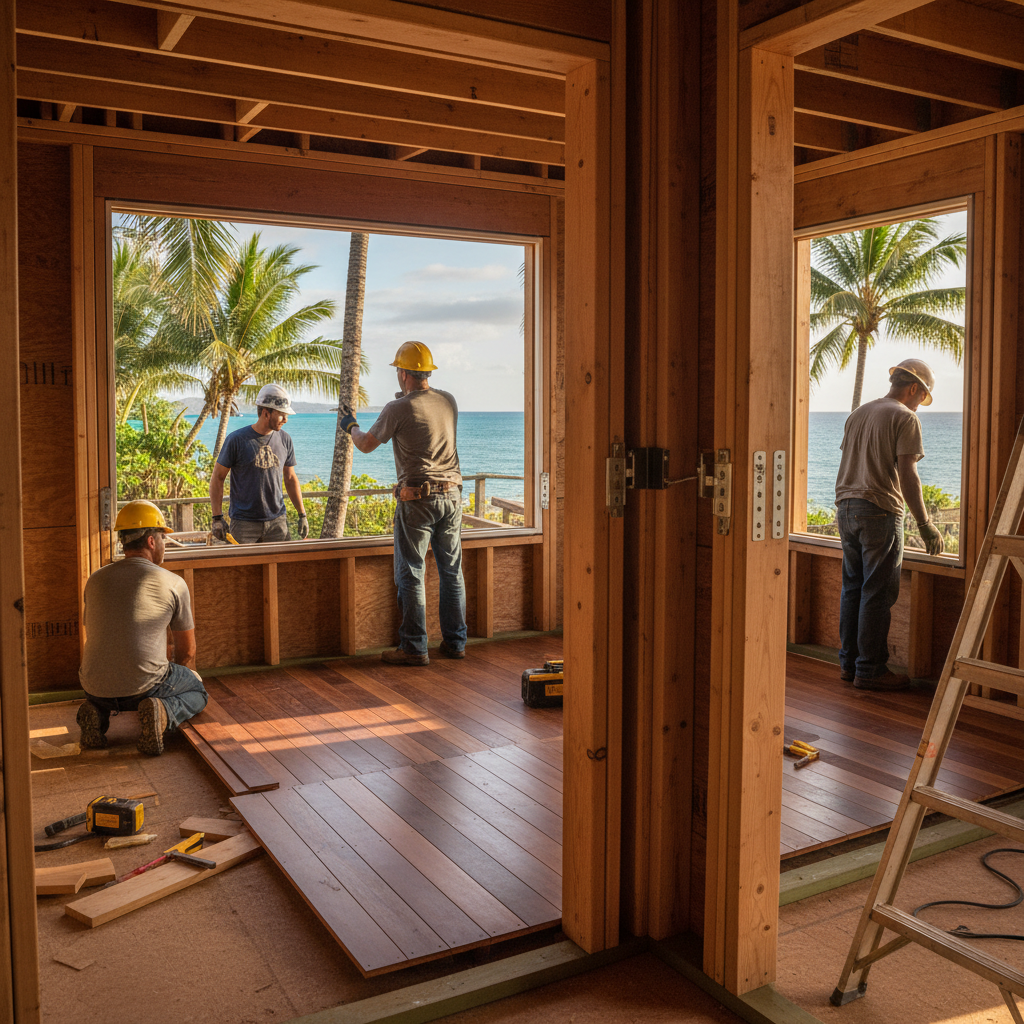
- Phase 4: Construction (6-9 months): This is the actual building phase. The timeline here is dependent on three main factors: material availability (everything must arrive on schedule), subcontractor availability, and weather. A delay in one trade, like the plumber, can halt progress for everyone else. Unlike Oahu where you can call another plumbing company, on Moloka’i, your options are limited. Building a good schedule buffer is essential.
\n
\n
\n
\n
\n\n
A classic Moloka’i story: On one build, the custom trusses were scheduled to arrive on a Tuesday barge. That barge was delayed due to high surf. The framing crew, who we had scheduled for Wednesday, had to be rescheduled for the following week. This pushed back the roofer, which then pushed back the window installer. A one-day weather delay for the barge ended up causing a two-week delay in the overall project schedule. An experienced adu builder kaunakakai anticipates these issues and builds slack into the schedule. A novice will be caught off guard every time.
\n\n
What Permits Do You Need for ADU Builder in Kaunakakai?
\n\n
Securing the right permits for an ADU in Kaunakakai is a process that requires patience and meticulous preparation. It’s not just one permit; it’s a bundle of approvals from Maui County’s Department of Planning and Department of Public Works. The process for Moloka’i is administered by Maui County, and while there’s a local office, the core review process can be centralized, adding layers of time and complexity.[1] Although this link is for Honolulu’s DPP, the general types of permits and review processes are conceptually similar across Hawaii counties, all aiming to ensure compliance with building codes and zoning.
\n\n
First and foremost, you will need a Building Permit. This is the master permit that covers the construction of the ADU itself. To get this, you must submit a complete set of construction drawings stamped by a Hawaii-licensed architect or engineer. These plans must be incredibly detailed, showing everything from the foundation design and structural frame to the electrical layout and plumbing schematics.
\n\n
Here’s a checklist of what typically goes into the permit application package for an ohana unit builder Kaunakakai:
\n
- \n
- Completed Building Permit Application Form for Maui County.
- Full Sets of Stamped Architectural and Engineering Plans: Usually 4-6 sets are required.
- Site Plan: A detailed map of your property showing the location of the existing house, the proposed ADU, property lines, setbacks, and any easements.
- Wastewater System Approval: This is a massive hurdle on Moloka’i. You must show how the ADU’s wastewater will be handled. If you are connecting to an existing septic system, you’ll need calculations proving it can handle the additional load. More often, you will need a permit for a new, independent septic system, which is a separate and complex approval process with the Department of Health.
- Grading and Grubbing Permits: If your project involves moving more than 100 cubic yards of soil or clearing a significant area, you will need separate permits for this work before you can even start on the foundation.
- State Land Use Boundary Review: Your property’s location relative to conservation districts or other state-level zoning might trigger additional reviews.
\n
\n
\n
\n
\n
\n
\n\n
Many homeowners think they can just use pre-approved or stock ADU plans to speed this up. This is a common misconception. While a stock plan is a good starting point for design, it must still be reviewed and stamped by a local engineer to certify that it meets all current hurricane codes and local soil conditions. The site plan and wastewater plan must be created specifically for your unique property. There’s no real shortcut to the permitting process. Misinformation about the new statewide ADU rules or Bill 7 ADU kaunakakai (which is an Oahu-specific ordinance) often confuses homeowners. While the state encourages ADUs, you must follow Maui County’s specific submission and review process, which remains rigorous.
\n\n
Our role as your general contractor is to manage this entire process. We work with the architect and engineers to ensure the submission package is flawless. A single missing document or incorrect calculation can send your application to the back of the line, adding months of delay. We handle the communication with the county reviewers, answer their questions, and shepherd the application through the system. For a homeowner, trying to navigate this bureaucratic maze alone is often a recipe for frustration and failure.
\n\n
Kaunakakai-Specific Considerations: Climate, Materials, Regulations
\n\n
Building an ADU in Kaunakakai that will last requires a deep understanding of the local environment. What works in a dry part of Honolulu will fail quickly here. The combination of intense sun, salt-laden air, and the potential for heavy rains and high winds dictates every choice we make, from the foundation up.
\n\n
Climate and Materials: Fighting Salt-Air Corrosion
\n
The number one enemy of any structure on Moloka’i is salt-air corrosion. The air in Kaunakakai is constantly carrying microscopic salt particles that eat away at metal and degrade wood finishes. This is not a minor issue; it’s the primary factor in a building’s longevity.
\n
- \n
- Fasteners are Critical: Every single nail, screw, and structural connector must be, at a minimum, hot-dip galvanized steel. For homes right on the coast, we insist on 316-grade stainless steel. Using cheaper electro-galvanized hardware is one of the costliest mistakes a builder can make. It might save $2,000 on an entire house, but the connectors will rust out in 5-7 years, compromising the structural integrity of the entire ADU.
- Window and Door Frames: We recommend vinyl or fiberglass frames over aluminum. While anodized aluminum is better than standard, any scratch in the coating becomes an entry point for corrosion. Vinyl frames are essentially immune to salt and require very little maintenance.
- Roofing: Standing-seam metal roofing with a Kynar 500 paint finish is the gold standard for coastal Hawaii. It provides excellent protection against both corrosion and high winds. Cheaper metal roofing systems will show rust spots within a decade.
- Siding and Paint: Fiber cement siding (like James Hardie products) is an excellent choice as it’s impervious to moisture, termites, and won’t rot. We pair this with high-quality elastomeric paint, which creates a waterproof, flexible barrier that can handle the intense UV radiation without cracking and peeling.
\n
\n
\n
\n
\n\n
Regulations and Community
\n
While the technical building code is set by Maui County, building on Moloka’i also involves unwritten rules. This is a small, tight-knit community. You can’t just bring in a huge crew from off-island and expect a warm welcome. A good ADU contractor kaunakakai works with the community, not against it. This means hiring local labor whenever possible, respecting the land (aina), and keeping a clean and quiet job site.
\n\n
Another key regulation is water. Water availability is a major concern on Moloka’i. Your ADU plan must show efficient water use, and you may face restrictions or higher costs for your water meter. Similarly, as mentioned, wastewater is not a given. Most of Kaunakakai is not on a sewer system. This means your ADU will require its own septic system, designed and approved by the Department of Health. This process alone can add $30,000 and 6 months to your project. Ignoring this reality from day one is a critical error. We bring in a wastewater engineer at the very beginning of the design process to ensure the plan is viable before we ever draw a single line of the ADU itself.
\n\n
How to Choose the Right ADU Builder Contractor in Kaunakakai
\n\n
Choosing the right contractor is the single most important decision you’ll make for your Kaunakakai ADU project. The right partner will navigate the island’s unique challenges smoothly, while the wrong one can turn your dream into a nightmare of delays and cost overruns. Here’s a practical checklist to vet any potential builder.
\n\n
- \n
- \n Verify Their License and Insurance. This is non-negotiable. Any contractor you consider must have a valid Hawaii General Contractor license (ours is BC-34373). You can and should verify this on the state’s Professional & Vocational Licensing (PVL) website.[2] Ask for certificates of general liability and worker’s compensation insurance. If a worker gets hurt on your property and the contractor isn’t insured, you could be held liable. For Moloka’i, ensure their policy doesn’t have exclusions for neighbor island work.\n
- \n Demand Specific Moloka’i Experience. Don’t just ask, \”Have you worked on the neighbor islands?\” Ask, \”How many projects have you completed on Moloka’i in the last five years?\” Ask them to describe their process for shipping materials. What happens if a barge is delayed? How do they handle lodging and transport for their crew? Who are their go-to local subcontractors for plumbing or electrical? If they can’t answer these questions with specific, confident details, they lack the experience you need.\n
- \n Request a Detailed, Itemized Bid. Never accept a one-page bid with a single lump-sum number. A professional bid should be several pages long, breaking down the costs by category: permits, site work, foundation, framing, roofing, electrical, plumbing, finishes, etc. It should also clearly state allowances for items you’ll select, like appliances and tile. This transparency protects you and shows that the contractor has done their homework. A vague bid is a red flag that they haven’t truly priced out the complexities of a Moloka’i build.\n
- \n Interview Their References. Don’t just ask for a list of past clients. Ask for references from projects similar to yours (i.e., another ADU) and specifically from a project they completed on Moloka’i. When you call the reference, ask about communication, budget adherence, problem-solving, and the quality of the final product. Ask, \”What was the biggest unexpected challenge, and how did the contractor handle it?\” Their answer will tell you everything you need to know.\n
- \n Assess Their Communication Style. You will be in a close working relationship with this person for over a year. You need a contractor who communicates clearly, professionally, and proactively. Especially when you might be on another island, you need a system for regular updates, photos, and decisions. Do they use project management software? Do they schedule weekly calls? A builder who is hard to get a hold of during the bidding process will be impossible to reach once the project starts.\n
\n
\n
\n
\n
\n
\n\n
Choosing a builder isn’t about finding the lowest price. It’s about finding the best value and the lowest risk. The cheapest bid often becomes the most expensive project after accounting for mistakes, delays, and change orders. Our team at Warrior Construction focuses on providing a comprehensive, risk-managed process from start to finish. Check out some of our past projects to see the quality we deliver.
\n\n
Real Kaunakakai ADU Builder Project Example
\n\n
To make this tangible, let’s walk through a typical ADU project our team recently completed on the west end of Moloka’i, just outside Kaunakakai.
\n
The Client: A local family whose adult children had moved back home. They needed an independent space for their kupuna (elders) to live comfortably on the same property, allowing them to age in place.
\n
The Project: A 780-square-foot, single-story, 2-bedroom, 1-bathroom ohana unit designed for accessibility. This included a zero-threshold shower, wider doorways, and a ramp instead of stairs leading to the entrance.
\n
The Initial Challenge – Wastewater: The property’s existing cesspool was old and undersized. Maui County regulations in 2026 strictly forbid connecting a new dwelling to an existing cesspool. The first major hurdle, identified during our preconstruction phase, was the need for a brand new, engineered septic system. This added $35,000 to the budget and required a separate, time-consuming permit from the Department of Health. The client was initially discouraged, but we explained this was a non-negotiable for any legal ADU on the island.
\n
Logistical Solution: We structured the project in two logistical phases. Phase one involved all the site work that could be done with local labor and equipment: clearing the site, digging and installing the new septic system, and trenching for utilities. While this was happening, our Oahu-based team was finalizing the material takeoffs and procuring every single item needed for the vertical build. We consolidated everything—from the foundation rebar and hurricane straps to the last box of tile—into two 40-foot containers. This meticulous pre-planning meant we only had two major barge shipments, drastically reducing freight costs compared to multiple smaller shipments.
\n
Construction Execution: Once the containers arrived in Kaunakakai, our core crew came over to lead the build. We hired local Moloka’i laborers for the framing and drywall, integrating our team with the local workforce. This combination proved highly efficient. The critical path was managed by our experienced site superintendent, ensuring quality control met our standards, while leveraging local knowledge and manpower. The biggest near-miss was a delay on the custom-ordered windows due to a mainland factory shutdown. Because we had ordered them 5 months in advance, the 3-week delay was absorbed into the schedule without holding up framing or roofing.
\n
The Outcome:
\n
- \n
- Timeline: From breaking ground to final inspection, the construction took 8.5 months. The total project time, including design and permitting, was 22 months.
- Budget: The final all-in cost was approximately $450,000, which translated to about $577 per square foot. This was within 3% of our original budget, with the only change order being an upgrade to the kitchen countertops requested by the homeowner.
\n
\n
\n
The family now has a safe, beautiful, and fully compliant home for their kupuna, increasing both their property value and quality of life.
\n\n
What this means for Hawaii homeowners
\n
For any homeowner in Kaunakakai considering an ADU in 2026, this all boils down to a few key takeaways. Building an ohana unit is one of the smartest investments you can make in your property, but on Moloka’i, the margin for error is zero. You must approach the project with a clear understanding of the local realities.
\n
Here is your action plan:
\n
- \n
- Budget for Reality, Not Hope: Start with a baseline budget of at least $475 per square foot. This figure includes the inescapable costs of inter-island logistics. If a contractor quotes you significantly less, demand to see a detailed line-item breakdown of their freight and labor transport costs. It’s likely missing.
- Start the Process Yesterday: The moment you decide to build, engage a contractor and designer. The 8-12 month (or longer) permitting process with Maui County is your biggest time hurdle. The sooner your plans are in the queue, the better. Don’t wait until you have the full funding saved up to start the design and permit process.
- Prioritize Durability Over Aesthetics: When making material selections, your first question should be, \”How will this hold up to salt air?\” Opt for stainless steel fasteners, vinyl windows, fiber cement siding, and high-quality paint. Spending 10% more on a durable exterior will save you 50% in maintenance and repair costs within the first decade.
- Hire a Logistics Manager Who Also Builds: Your contractor’s primary role in a Moloka’i build is logistics management. Vet them on their process for ordering, consolidating, shipping, and receiving materials. Their construction skills are important, but their ability to manage the supply chain is what will make or break your project’s budget and timeline.
\n
\n
\n
\n
\n
Building an ADU in Kaunakakai is a marathon, not a sprint. By partnering with an experienced team that understands the course, you can avoid the hurdles and achieve a successful outcome that serves your ohana for generations.
\n
\n\n
Frequently Asked Questions About ADU Builder in Kaunakakai
\n
How much does an 800 sq. ft. ADU cost in Kaunakakai in 2026?
\n
A realistic all-in budget for an 800 sq. ft. ADU in Kaunakakai is between $380,000 and $480,000. This works out to approximately $475 to $600 per square foot. This price reflects the added 20-30% cost for barging materials, equipment, and sometimes specialized labor to Moloka’i compared to an Oahu build.
\n
\n
Is it hard to get an ADU permit on Moloka’i?
\n
It is not necessarily harder, but it is significantly slower than on Oahu. All permits are processed by Maui County, and the backlog is substantial. You should expect the permit review process alone to take between 8 to 12 months. A complete and flawless application package prepared by an experienced professional is critical to avoid even longer delays.
\n
\n
Can I build an ADU myself to save money?
\n
While it might seem tempting, acting as your own general contractor (owner-builder) on Moloka’i is incredibly risky unless you have extensive construction and logistics experience. Managing the barge schedule, coordinating the limited number of local subcontractors, and passing inspections requires professional expertise. Mistakes in logistics or scheduling can easily cost more than you would save.
\n
\n
What is the biggest hidden cost when building an ADU on Moloka’i?
\n
The biggest hidden cost is almost always wastewater management. Most properties require a new, engineered septic system, which can cost $25,000 to $40,000 and has its own separate permitting process. Many initial quotes from less experienced builders fail to adequately budget for this essential and expensive requirement.
\n
\n
Does Oahu’s Bill 7 for ADUs apply to Kaunakakai?
\n
No, it does not. Bill 7 is an ordinance specific to the City and County of Honolulu (Oahu). Moloka’i falls under Maui County jurisdiction, which has its own distinct zoning codes, setback requirements, and rules for Accessory Dwelling Units. It’s crucial to work with a contractor who is an expert in Maui County’s regulations, not Oahu’s.
\n
\n
What materials are best for a Kaunakakai ohana unit?
\n
Prioritize materials that resist salt-air corrosion and high UV exposure. We strongly recommend standing-seam metal roofing with a Kynar finish, fiber cement siding, vinyl or fiberglass windows, and 316-grade stainless steel for all exterior fasteners and hardware. These choices cost more upfront but prevent costly repairs and maintenance down the road.
\n
\n
How can I find a reliable ohana unit builder for Kaunakakai?
\n
Look for a licensed general contractor with a portfolio of completed projects specifically on Moloka’i. Verify their license (BC-34373 for Warrior Construction) on the Hawaii PVL website. Ask for local references and inquire deeply about their logistics process for shipping and their relationships with on-island tradespeople. A builder’s neighbor island experience is more important than their Oahu resume.
\n
\n
\n\n
Start Your Kaunakakai ADU Project the Right Way
\n
Building an ADU on Moloka’i is a major undertaking, but with the right partner, it can be a smooth and rewarding process. Our team at Warrior Construction has the neighbor island experience and logistical expertise to manage your project from concept to completion, ensuring it’s built to last in our unique island environment.
\n
If you’re ready to discuss your ohana unit, let’s talk. We provide realistic, transparent estimates that account for the true costs of building in Kaunakakai. Learn more about our ADU & Ohana Unit building services or request your free estimate today.
\n
\n\n
References
\n