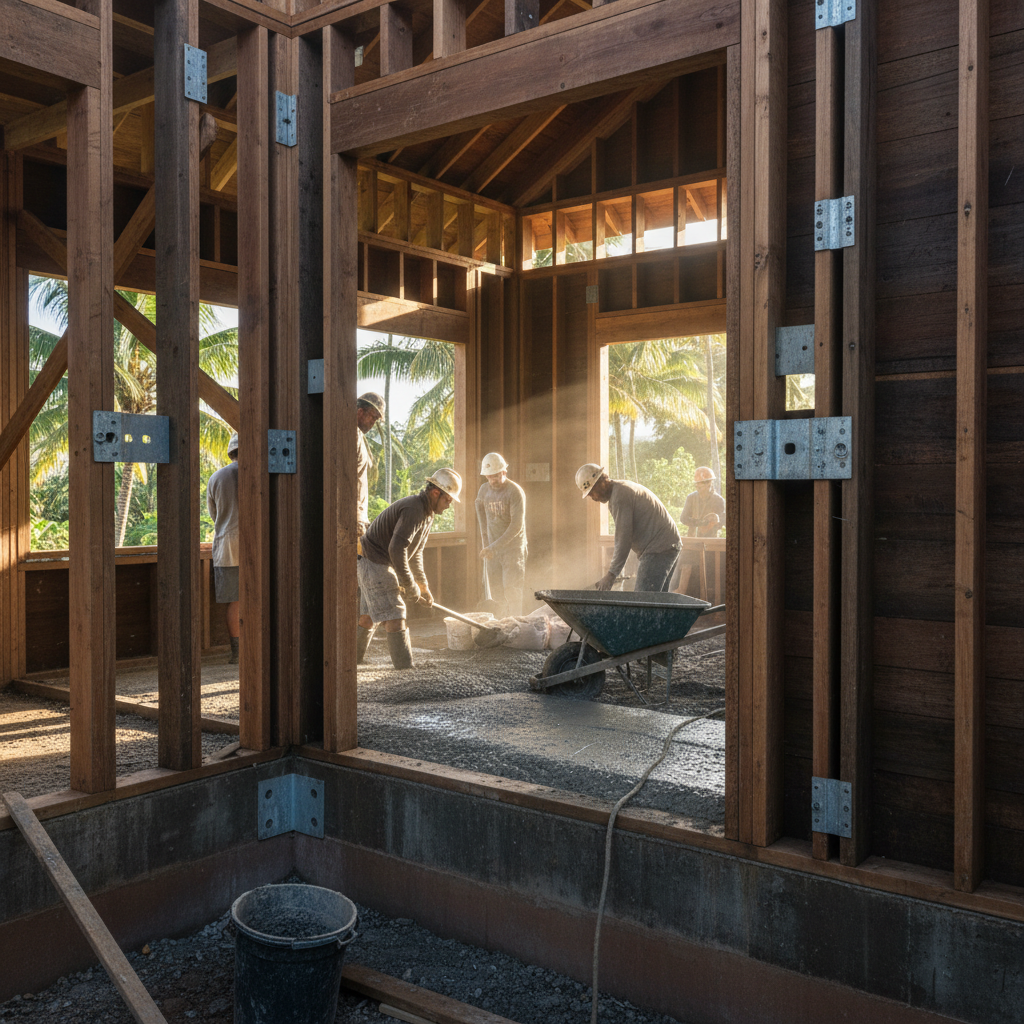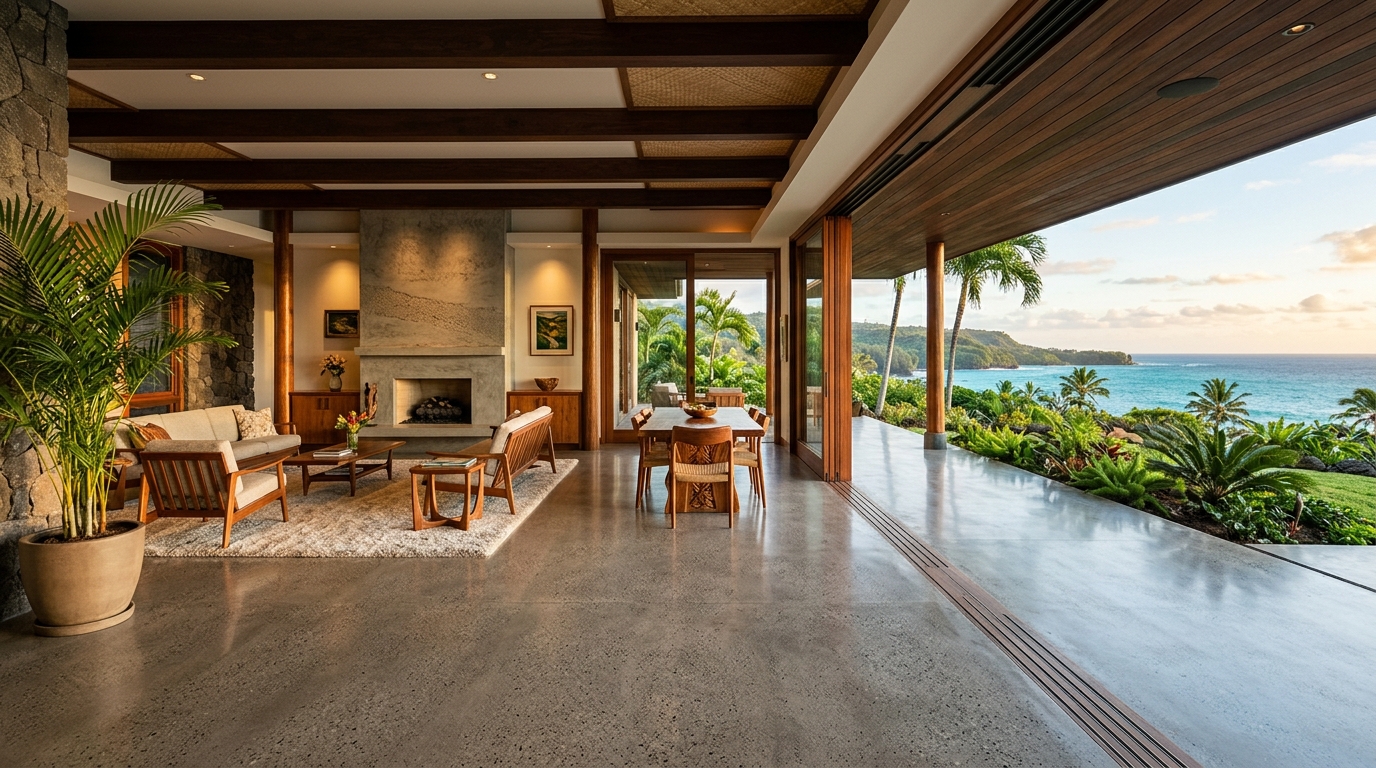
Building in Hana isn’t like building anywhere else in Hawaii, let alone the mainland. As a concrete contractor Hana homeowners rely on, we know that a successful project out here depends more on logistics and material science than almost anything else. For 2026, a standard 1,500 square foot concrete foundation in Hana will cost approximately $48,000, including the significant mobilization fees required to get crews and materials past Paia. This price reflects the unique challenges and advanced solutions needed to build something that lasts in one of the wettest, most corrosive environments on earth.
Over our 20+ years, our team at Warrior Construction has seen what works and what fails spectacularly in East Maui’s demanding climate. It’s not just about pouring a slab; it’s about engineering a foundation that can handle torrential rain, shifting volcanic soil, and relentless salt spray. Homeowners often underestimate the sheer planning involved. It’s a full-time job just coordinating concrete trucks to navigate the Hana Highway, ensuring they arrive with a hot load ready to pour without getting stuck behind a tour bus or a minor landslide.
This guide breaks down the nine essential concrete upgrades we recommend for any Hana project in 2026. These aren’t just nice-to-haves; they are critical investments for durability and longevity. We’ll cover everything from advanced materials that fight salt-air corrosion to the real-world costs and timelines you should expect. Think of this as the conversation we’d have over coffee before breaking ground, giving you the insider knowledge to build it right, once.
The 9 essential upgrades for any Hana concrete project in 2026 are:
1. **High-Strength Concrete Mix (4000+ PSI):** For superior durability against moisture.
2. **Corrosion-Resistant Rebar:** Using fiberglass or epoxy-coated steel to prevent rust.
3. **Integral Crystalline Waterproofing:** An admixture that makes the concrete itself the waterproof barrier.
4. **Enhanced Vapor Barrier System:** A thicker, more robust membrane under the slab.
5. **Engineered Fill for Volcanic Soil:** Replacing unstable soil with compacted, stable material.
6. **Robust Hurricane Tie-Down Systems:** Embedding stainless steel straps directly into the foundation.
7. **Custom-Formed Concrete Water Catchment Tanks:** A sustainable solution for properties off the grid.
8. **Decorative Stamped & Colored Concrete:** For lanais and driveways that blend with the natural landscape.
9. **Permeable Concrete Driveways:** To manage heavy rainfall and reduce runoff.
We’ll explore each of these in detail, giving you the practical information you need to plan your project with confidence.
## Why Hana Homeowners Trust Warrior Construction for Concrete Contractor
Trust isn’t built overnight, especially in a small community like Hana. It comes from showing up, doing what you said you would do, and understanding the specific local challenges that don’t appear on a blueprint. For our team at Warrior Construction (License BC-34373), working as a concrete contractor in Hana means being a master logistician as much as a master builder. We’ve spent years building on Maui and other neighbor islands, and we’ve learned the hard lessons so our clients don’t have to. The biggest difference between us and an off-island contractor is our deep understanding of the Hana premium—the extra time, cost, and planning required to execute flawlessly in a remote location.
For example, on a recent project near Nahiku, the plan called for a 22-cubic-yard monolithic pour for a custom home foundation. That’s about three full concrete trucks. In Kahului, that’s a simple morning’s work. In Hana, it’s a military-style operation. We had to coordinate the trucks to leave the plant in central Maui with precise timing, accounting for traffic on the Hana Highway. We had a spotter at the halfway point to report on road conditions. We also had a backup plan with extra admixtures on site to manage the concrete’s temperature and slump if a truck was delayed. The pour went off without a hitch, but that level of proactive planning is what separates a successful project from a very expensive, hardened mistake in the back of a truck. That’s the experience we bring to the table.
Furthermore, our approach is rooted in building for the specific environment. We don’t use the same concrete mix or rebar in dry Kihei that we use in rainy Hana. We push for upgrades like fiberglass rebar, which is immune to rust, and integral waterproofing admixtures that protect the slab from the inside out. These aren’t upsells; they are our standard recommendations for building in a coastal rainforest. Our commitment is to building structures that will stand for generations, not just until the warranty expires. We live here, our reputation is here, and we take pride in building things that last for our neighbors.
When you work with us, you’re not just hiring a crew. You’re partnering with a team that has a proven track record across the islands and understands the nuances of Maui County building codes and inspectors. We handle the complex logistics, the material sourcing, and the skilled labor mobilization, so you can focus on the vision for your home. That peace of mind is the real foundation we build on every project.
## What Does a Concrete Contractor Cost in Hana?
The first question any homeowner asks is about cost, and in Hana, the answer is always, “more than in town.” For 2026, you must budget for a significant “Hana premium” of 25-40% on top of standard Maui construction costs. This premium covers three main things: logistics, labor, and materials. A simple 600-square-foot `driveway concrete hana` project that might cost $10,800 ($18/sq ft) in Kahului can easily run $15,000 ($25/sq ft) or more in Hana.
Let’s break down the real numbers for a typical project. A standard 1,500-square-foot `concrete foundation hana` is a good baseline. In Central Maui, the 2026 cost would be around $22 per square foot, or $33,000. In Hana, our team budgets closer to $32 per square foot, bringing the total to $48,000.
Here’s a look at where that extra $15,000 goes:
* **Concrete Delivery Surcharge:** The batch plants are in Kahului. They charge a hefty travel fee per truck, which can be $500-$800 extra *per truck*. A 1,500 sq ft slab needs 4-5 trucks. That’s already $2,500-$4,000 in just delivery fees.
* **Labor Mobilization & Travel:** Our skilled crew needs to get to the site. We pay for their travel time, which is 1.5-2 hours each way. For a 4-person crew over a two-week project, that’s 160 hours of paid travel time, adding nearly $10,000 to the labor bill.
* **Material & Equipment Transport:** Everything from lumber for forms, rebar, excavators, and pumps has to be trucked out. We often dedicate a flatbed truck just for material runs, adding thousands in transport costs.
* **Contingency for Delays:** A sudden downpour or a road closure on the highway can derail a pour schedule. We build a small contingency into the price to account for the higher risk of weather and access delays.
Here is a sample cost breakdown for common Hana concrete projects in 2026:
| Project Type | Typical Size | Cost in Kahului (2026) | Estimated Cost in Hana (2026) | Key Cost Drivers |
| ——————————- | ——————— | ———————- | —————————– | —————————————————— |
| **Slab-on-Grade Foundation** | 1,500 sq ft | ~$33,000 | ~$48,000 | Concrete delivery fees, labor travel, equipment mobilization |
| **Concrete Driveway** | 600 sq ft (2-car) | ~$10,800 | ~$15,000 | Smaller load delivery fees, site prep in wet soil |
| **Retaining Wall Hana** | 50 ft long, 4 ft high | ~$15,000 | ~$21,000 | Formwork complexity, engineering requirements, drainage |
| **Custom Water Catchment Tank** | 10,000 Gallon | N/A (less common) | ~$25,000 | Specialized formwork, waterproofing, plumbing integration |
These numbers reflect standard finishes. Opting for upgrades like fiberglass rebar can add 15-20% to the material cost but saves a fortune in future spalling repairs. Similarly, a stamped and colored concrete lanai might cost $30-$35 per square foot, but it creates a lasting, high-end finish that withstands the Hana weather. When we prepare an estimate, we break down these costs transparently so you can see exactly where your money is going and make informed decisions about quality and durability.
## How Long Does a Concrete Contractor Take in Hana?
In Hana, the project timeline is dictated by weather and logistics, not just the work itself. While the physical process of forming, pouring, and finishing a foundation might only take 2-3 weeks, the total duration from signing a contract to a fully cured slab is often 10-14 weeks in 2026. This is significantly longer than a similar project in a more accessible area like Kapolei on Oahu, where we might wrap up in 6-8 weeks.
The single biggest variable is rain. Hana gets over 300 inches of rain a year in some spots. You cannot pour concrete in a downpour, and you can’t do site prep when the ground is a muddy swamp. We have to watch the forecast like hawks and build buffer days into every phase of the schedule. We recently had a retaining wall project delayed for nine straight days because of a persistent weather system. There’s nothing you can do but wait for a window, which requires patience from everyone involved.
Here’s a realistic timeline for a 1,500 sq ft `concrete foundation hana` project:
* **Weeks 1-4: Permitting & Planning:** Even with a great architect, Maui County plan review for a new foundation can take a month or more. During this time, our team is deep in logistics—scheduling the excavator, ordering the rebar and forms, and getting commitments from the concrete batch plant. This phase is all about preparation.
* **Week 5: Site Prep & Excavation:** This involves clearing the site, grading the building pad, and digging the footings. In Hana’s often-soggy, volcanic soil, this can take longer than expected. We might need to bring in engineered fill to create a stable base. This phase is heavily weather-dependent and can take 3 to 7 days.
* **Week 6: Formwork & Rebar Installation:** Our crew builds the wooden forms that will hold the concrete and meticulously lays the grid of steel or fiberglass rebar. This is precise work. This stage also includes installing underslab plumbing and electrical conduits.
* **Week 7: Inspections & Pour Day:** Before we pour, a Maui County inspector must visit the site to approve the footing dimensions and rebar placement. Getting an inspector to drive out to Hana can sometimes take a few days to schedule. Once we get the green light, we schedule the trucks for the pour. Pour day itself is an intense, all-hands-on-deck effort that takes 4-6 hours.
* **Weeks 8-10: Curing & Finishing:** The concrete needs to cure, a chemical process that gives it strength. We typically wet-cure the slab for the first 7 days, keeping it moist to prevent cracking. The slab can usually be walked on after 48 hours and is strong enough to begin framing on after about 1-2 weeks. However, concrete doesn’t reach its full design strength for 28 days. During this time, we’ll strip the forms and do any final finishing work.
For a `driveway concrete hana` or a `retaining wall hana`, the timeline is shorter but follows the same principles. A driveway might take 3-4 weeks from start to finish, while a retaining wall could take 4-6 weeks, depending on its complexity and engineering requirements. The key takeaway is to be realistic. Building in paradise requires a patient, flexible mindset. We build schedules with built-in buffers because, in Hana, nature always has the final say.
## What Permits Do You Need for Concrete Contractor in Hana?
Navigating the permitting process is one of the most crucial roles a general contractor plays, and in Maui County, you want someone who knows the system and the people. Unlike Honolulu, which has its own Department of Planning and Permitting (DPP)[1], Hana projects fall under the jurisdiction of the Maui County Department of Public Works. While the principles are similar, the specific procedures and timelines can differ. For any significant concrete work in 2026, you will absolutely need a building permit.
So, what triggers a permit? It’s not just for new houses. Here are the most common concrete projects in Hana that require a permit:
1. **New Foundations:** Every new `concrete foundation hana`, whether for a home, garage, or ohana unit, requires a full building permit with engineered plans.
2. **Retaining Walls:** Any `retaining wall hana` that is over four feet in height (measured from the bottom of the footing to the top of the wall) requires a permit and stamped engineering drawings. This is a critical safety rule to prevent wall failures, especially on sloped lots.
3. **Driveways:** A standard `driveway concrete hana` might not need a separate permit if it’s part of a new home construction package. However, if you are adding a new driveway that involves a new curb cut or impacts county drainage, a permit and review will be required.
4. **Structural Slabs:** Any concrete slab designed to support a structure, like a carport, a large lanai attached to the house, or a heavy-duty workshop floor, will need to be included in a building permit.
5. **Large Patios or Flatwork:** While a small, detached patio slab might not need a permit, large-scale flatwork (typically over 200 sq ft) that alters property drainage often requires review.
The permitting process in Maui County generally follows these steps:
* **Plan Submission:** Your architect or engineer submits detailed drawings to the county. For concrete, this includes the foundation plan, footing details, rebar schedule, and concrete strength specifications.
* **Plan Review:** Multiple county departments (planning, building, public works) will review the plans to ensure they comply with building codes, zoning regulations, and shoreline rules if applicable.
* **Revisions & Comments:** The county will almost always come back with comments or required revisions. This is a normal part of the process. Our job is to work with the designer to address these comments quickly and resubmit the plans.
* **Permit Issuance:** Once all departments sign off, the permit is issued, and you can pay the fees. Permit fees for a new home foundation in Hana can range from $2,000 to $5,000, depending on the project’s total valuation.
Having an experienced, licensed contractor (like Warrior Construction, BC-34373) is essential. We can anticipate what plan reviewers look for, helping to streamline the process. We know the specific requirements for building in high-wind zones and areas with sensitive environmental concerns. Trying to do unpermitted work in a place like Hana is a terrible idea. It can lead to stop-work orders, hefty fines, and the potential for having to tear out the work you just paid for. It’s always better, cheaper, and faster in the long run to do it the right way from the start.
## Hana-Specific Considerations: Climate, Materials, Regulations
Building in Hana is a constant battle against the elements. The very things that make it a lush paradise—the daily rain, the humid salt-laced air, the rich volcanic soil—are actively trying to break down a building from the moment it’s constructed. As a concrete contractor in Hana, our job is to use material science and smart building practices to win that battle. Here are the critical Hana-specific factors we plan for on every project.
### Climate: Rain and Salt
The air in Hana is not just wet; it’s corrosive. The constant salt spray from the ocean, combined with high humidity, creates the perfect environment for rust. For concrete, this is a major problem because standard steel rebar inside the slab can corrode. As it rusts, it expands, cracking the concrete from within—a phenomenon called spalling. To combat this, we have two primary upgrades:
1. **Corrosion-Resistant Rebar:** We often specify epoxy-coated steel rebar or, even better, fiberglass rebar. Fiberglass is more expensive upfront, but it is 100% rust-proof, making it a wise long-term investment for a home just a few hundred yards from the ocean.
2. **High-Strength, Low-Permeability Concrete:** We design a mix with a higher Portland cement content and lower water-to-cement ratio (a 4000 PSI mix is our standard). This creates a denser, less porous concrete that makes it harder for salt and moisture to penetrate and reach the rebar.
### Materials: Logistics is Everything
There are no lumberyards, hardware stores, or concrete batch plants in Hana. Every single nail, 2×4, and bag of cement has to be trucked in from Kahului. This has massive implications. Material orders must be perfectly planned and consolidated to minimize expensive truck runs. Forgetting a specific type of anchor bolt can mean a half-day delay and hundreds of dollars in labor and transport to go get it. For a concrete pour, the logistics are even more critical. The concrete mix is perishable; it has about a 90-minute window from the time it leaves the plant until it must be discharged from the truck. The two-hour drive to Hana pushes this limit, requiring special admixtures to retard the set time and careful coordination to avoid any delays on the road. This is a high-stakes delivery that we manage with extreme care.
### Regulations: Hurricane Codes and Volcanic Soil
Since Hurricane Iniki in 1992, Hawaii has had some of the strictest building codes in the nation, and they are rigorously enforced on Maui. For concrete foundations, this means specific requirements for how the house is anchored to the slab.
* **Hurricane Tie-Downs:** We embed heavy-duty, stainless steel hurricane straps and anchor bolts directly into the wet concrete of the footings and slab edge. These straps are later connected to the wall framing and roof trusses, creating a continuous load path that holds the house down in high winds. Using stainless steel is critical in Hana’s corrosive environment to ensure these connections don’t rust away.
* **Geotechnical Considerations:** Hana’s soil is a mix of clay, rock, and volcanic ash. It can be unstable and prone to shifting, especially when saturated with water. For many projects, a soil engineering report is required. Based on the report, we may need to over-excavate the site, remove the unstable native soil, and bring in layers of compacted, engineered fill to create a stable building pad. This adds cost and time but is absolutely essential for a stable foundation that won’t crack or settle over time. We also design robust drainage systems around the foundation to carry Hana’s heavy rainfall away from the structure.
## How to Choose the Right Concrete Contractor Contractor in Hana
Choosing the right concrete contractor in Hana is less about finding the lowest bidder and more about finding a true partner with proven logistical expertise and a deep understanding of the local environment. A cheap bid from a contractor who has never worked past Twin Falls can quickly turn into an expensive disaster. Your foundation is the single most important part of your home; this is not the place to cut corners.
Here is a practical checklist to use when vetting potential contractors for your Hana project:
1. **Verify Their License and Insurance.** This is non-negotiable. Any legitimate contractor in Hawaii will have a license number. Ours is BC-34373. You can verify any contractor’s license status and complaint history on the Hawaii Department of Commerce and Consumer Affairs (DCCA) Professional & Vocational Licensing website[2]. Also, ask for a certificate of insurance showing they have both general liability and worker’s compensation coverage. Without this, you could be liable for any accidents on your property.
2. **Ask for Hana-Specific References.** Don’t just ask for Maui references; ask for references from projects they have completed *in Hana or the surrounding East Maui area*. Call those references and ask specific questions: How did they handle scheduling and communication? Did they anticipate and solve logistical problems? How did they manage their crew and materials on a remote site? Were there any unexpected cost overruns?
3. **Inquire About Their Logistical Plan.** This is the question that separates the pros from the amateurs. Ask them to walk you through their plan for your specific project. How do they schedule concrete deliveries? What is their contingency plan if the Hana Highway closes? How do they handle material staging and waste removal? A seasoned Hana contractor will have detailed, confident answers because they have done it dozens oftimes before.
4. **Review Their Proposed Materials.** Look closely at the material specifications in their proposal. Are they recommending standard steel rebar or a corrosion-resistant option like epoxy-coated or fiberglass? What strength (PSI) of concrete are they specifying? Are they including an integral waterproofing admixture? A good contractor will recommend materials suited for Hana’s harsh environment, not just the cheapest option to win the bid.
5. **Get a Detailed, Itemized Bid.** A one-page bid with a single number is a red flag. A professional proposal from a company like Warrior Construction will be several pages long, breaking down the costs for labor, materials, equipment, delivery surcharges, and permits. This transparency allows you to compare apples to apples and shows that the contractor has thoroughly thought through every aspect of your project.
Ultimately, you are looking for a contractor who communicates clearly, plans proactively, and has the experience to prove they can deliver a high-quality product in one of Hawaii’s most challenging building environments. Your home deserves nothing less.
## Real Hana Concrete Contractor Project Example
To make this real, let’s walk through a project we recently completed for a homeowner building a 1,200-square-foot custom home in Hamoa.
**The Project:** A monolithic `concrete foundation hana` with thickened edges for a single-story residence, plus an attached 400-square-foot carport slab and a small `retaining wall hana` to manage a slope in the backyard.
**The Challenge:** The lot was on a narrow, unpaved road with limited access for heavy equipment. The soil was saturated from recent rains, and the homeowner wanted to incorporate a 12,000-gallon concrete water catchment tank below the carport slab, a common feature for homes in the area.
**Our Solution & Process:**
1. **Pre-Construction & Logistics (4 weeks):** After the permit was secured, our first step was all about planning. We walked the site with our excavator operator to map out the safest access route and determine the smallest machine we could use effectively. We pre-ordered all materials—the fiberglass rebar for the house foundation, forms, drainage pipes, and the specialized formwork for the cistern—and had them barged to Maui and trucked to a staging area near Hana town. This minimized individual trips.
2. **Site Work & Formwork (2 weeks):** The soil was indeed too wet. We had to over-excavate by two feet, lay down a geotextile fabric, and import 15 truckloads of engineered fill, compacting it in 6-inch lifts to create a solid base. This added a week to the schedule but was critical for long-term stability. Concurrently, our crew formed the cistern walls and the foundation itself, meticulously placing the rust-proof fiberglass rebar.
3. **The Pour (2 days):** This was the most complex phase. The total project required 45 cubic yards of concrete. We couldn’t get full-sized concrete trucks down the access road. Our solution was to use smaller-capacity trucks, which meant coordinating a fleet of eight trucks from the Kahului plant in a staggered procession. We had two-way radios to communicate through the spotty cell service. The first pour was for the cistern walls. The next day, after inspector approval, we did the main foundation and carport slab in one continuous, monolithic pour to ensure a solid, cold-joint-free structure.
**The Outcome:**
* **Final Cost:** The project came in at approximately $78,000. This was about 5% over the initial budget due to the extra earthwork required, a possibility we had discussed with the homeowner upfront.
* **Timeline:** Total time from breaking ground to the final concrete cure was 9 weeks, which was right on our revised schedule after accounting for the soil remediation.
* **Result:** The homeowner has a rock-solid, rust-proof foundation and an integrated water system built to last a lifetime. They understood that the extra investment in planning and materials was essential for a successful build in Hana’s challenging environment.
## What this means for Hawaii homeowners
For anyone looking to build or renovate in Hana, understanding the unique realities of local construction is paramount. Your project’s success and budget depend on acknowledging these factors from day one. Simply put, you cannot apply mainland or even Honolulu construction assumptions to a project in East Maui. The logistics, climate, and costs are in a category of their own.
Here are the key takeaways and actionable advice for your project:
* **Budget for the Hana Premium:** Expect your concrete work to cost 25-40% more than it would in a central location. This isn’t price gouging; it’s the real cost of transport, labor mobilization, and logistical coordination. Build this premium into your budget from the very beginning to avoid surprises.
* **Prioritize a Contractor’s Experience Over Price:** The cheapest bid is almost never the best value in Hana. Vet contractors based on their specific, verifiable experience working in remote areas of Maui. A contractor who already has relationships with suppliers, inspectors, and has a proven system for Hana logistics is worth their weight in gold.
* **Invest in Better Materials:** The upfront cost of upgrades like fiberglass rebar, stainless steel connectors, and high-performance concrete mixes is a fraction of what it will cost to repair a foundation damaged by salt-air corrosion in 10-15 years. In Hana’s climate, these are not luxuries; they are essential for durability.
* **Be Patient and Flexible with the Timeline:** Your project schedule will be influenced by weather and the realities of the Hana Highway. Delays are not a matter of ‘if’ but ‘when’. Work with a contractor who communicates proactively and builds realistic buffer days into the schedule. A rigid timeline is a recipe for frustration.
Ultimately, building in Hana requires a partnership between you and your contractor. By choosing a team with the right local expertise and investing in the right materials, you can ensure that the foundation of your dream home is as strong and enduring as the landscape around it.
Frequently Asked Questions About Concrete Contractor in Hana
How much more does concrete work cost in Hana compared to Kahului in 2026?
You should budget for a 25% to 40% cost increase, which we call the “Hana premium.” A standard concrete foundation that costs around $22/sq ft in Kahului will be closer to $32/sq ft in Hana. This extra cost covers concrete delivery surcharges (up to $800 per truck), labor travel time, equipment mobilization, and logistical contingencies for the remote location.
What is the best type of concrete rebar to use in Hana’s salty air?
For the best long-term durability, we strongly recommend fiberglass rebar. It is 100% rust-proof and impervious to salt-air corrosion. While it can add 15-20% to the material cost compared to standard black steel, it prevents spalling and cracking down the line. Epoxy-coated steel rebar is a good second choice, offering more protection than standard rebar at a lower cost than fiberglass.
Can I get a stamped or colored concrete driveway in Hana?
Yes, absolutely. Decorative concrete finishes like stamping and integral color are available for projects in Hana. However, the costs will be higher due to the logistics of getting the specific color pigments, stamping tools, and skilled finishers to the job site. Expect to pay in the range of $30-$35 per square foot for a high-quality stamped and colored `driveway concrete hana`.
How long should I wait before building on a new concrete foundation in Hana?
While concrete feels hard after 48 hours, it’s still curing. We recommend waiting at least 7 to 10 days before starting to load the slab with heavy materials like lumber packs or beginning wall framing. This allows the concrete to reach about 70% of its design strength. The concrete will continue to strengthen for months, reaching its full specified strength at 28 days.
Do I need a soil report for my concrete foundation in Hana?
It is highly recommended and often required by Maui County, especially on sloped lots or in areas with known soil instability. Hana’s volcanic soils can vary greatly. A geotechnical engineer will analyze the soil and provide recommendations for foundation design and site preparation, such as requiring engineered fill. This upfront investment of a few thousand dollars can prevent catastrophic foundation failure later.
What PSI concrete is best for Hana’s wet climate?
Our standard for any structural slab in Hana is a minimum of 4000 PSI (pounds per square inch). A higher PSI mix has a lower water-to-cement ratio, which creates a denser, less permeable concrete. This makes it much more difficult for moisture and salt to penetrate the slab, protecting the rebar within and increasing the overall longevity of the foundation.
Is it possible to build a concrete water catchment tank in Hana?
Yes, building concrete cisterns is a very common and practical solution for water storage in Hana. We specialize in custom-formed, reinforced concrete tanks that can be built underground (e.g., beneath a garage slab) or as standalone structures. These tanks are incredibly durable and can be designed to any size, often starting from 10,000 gallons, providing a reliable water source for properties not on county water.
Ready to Build a Foundation That Lasts in Hana?
Navigating a concrete project in Hana requires local expertise and meticulous planning. At Warrior Construction, we have the experience and logistical mastery to deliver a superior foundation, driveway, or retaining wall, no matter how remote the location. Our team is ready to help you build it right, from the ground up.
If you’re ready to discuss your project, we invite you to schedule a consultation for your concrete and foundation needs. Let’s build something that will stand strong for generations.
References