“
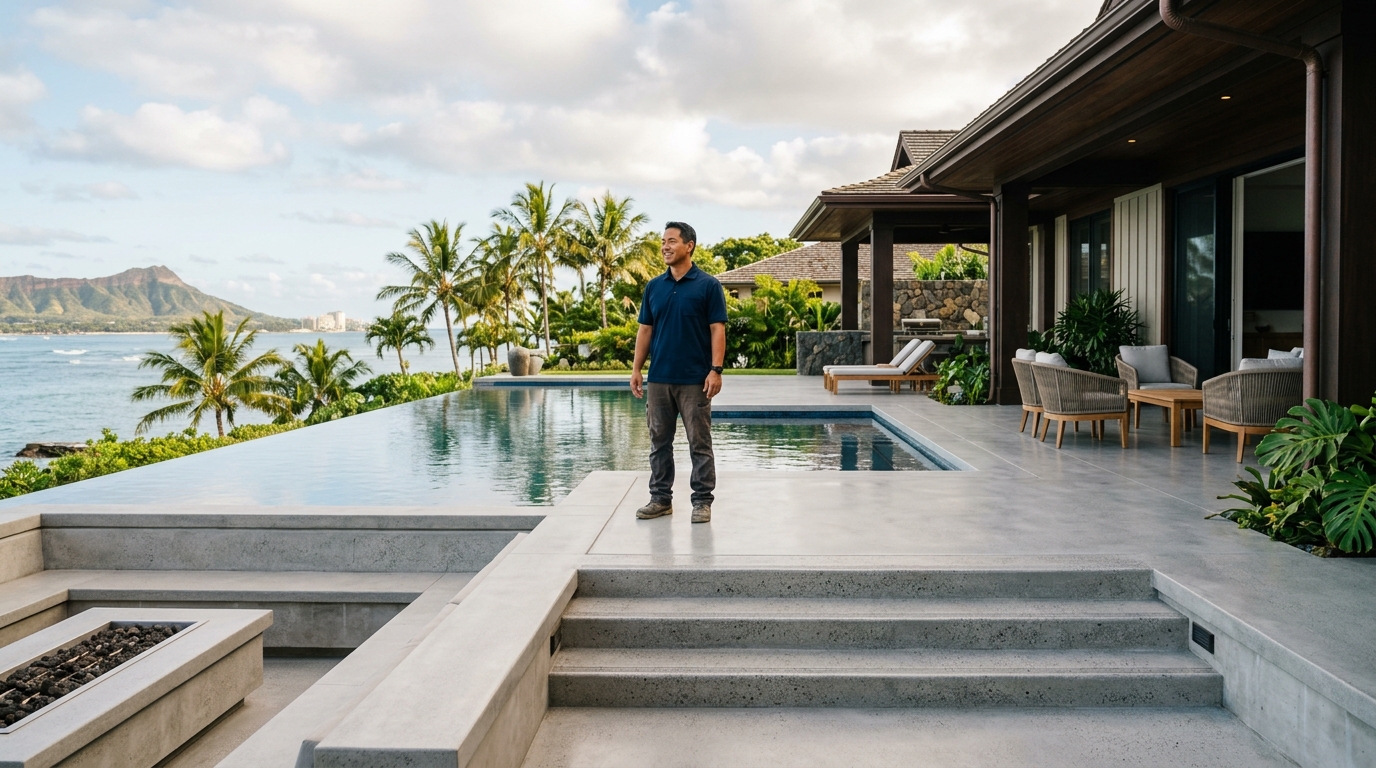
Hiring the right concrete contractor Honolulu homeowners can trust is the single most important decision for the longevity of your home. It’s not about finding someone to just pour gray mud; it’s about partnering with a licensed, local expert who understands that in Hawaii, concrete is constantly at war with salt, moisture, and shifting volcanic soil. An improperly poured foundation or driveway here doesn’t just crack—it can spall, corrode from the inside out, and compromise the entire structure it supports. This is the bedrock of your investment, and getting it wrong has consequences that last for decades.
For over 20 years, our team at Warrior Construction (License BC-34373) has been pouring foundations, driveways, and retaining walls across O’ahu, from the salt-sprayed coasts of Kailua to the expansive soils of Ewa Beach. We’ve seen firsthand what happens when mainland techniques are applied without an understanding of our unique island environment. The truth is, the knowledge required to properly execute concrete work in Honolulu isn’t found in a textbook; it’s earned over thousands of hours on local job sites, navigating the Honolulu Department of Planning and Permitting (DPP), and working with island-based material suppliers.
This guide breaks down the nine essential reasons why a local, experienced contractor is non-negotiable for your project. We’ll cover real 2026 costs you can expect on O’ahu, typical project timelines, the frustrating but necessary permitting process, and the specific material choices that protect your home from our corrosive climate. Think of this as the conversation we’d have over coffee before we even look at your plans—straight talk from a contractor who’s built his reputation on doing things the right way, right here at home.
\n\n
Why Honolulu Homeowners Trust Warrior Construction for Concrete Work
\n
Choosing a concrete contractor goes far beyond a simple quote. It’s about trust and local expertise. Homeowners across Honolulu trust Warrior Construction because we’re not just building on O’ahu; we are part of the community, and our reputation is built on every foundation, driveway, and retaining wall we complete. Our license, BC-34373, isn’t just a number—it’s a promise of accountability and quality backed by years of experience navigating the specific challenges of building in Hawaii.
One of the biggest differentiators is our deep understanding of microclimates across the island. For instance, a concrete mix design for a home in dry, hot Kapolei is fundamentally different from what we’d specify for a beachfront property in Waimanalo getting blasted by salt spray. For a recent project on the Windward side, we specified a higher-strength 4500 PSI mix with a corrosion-inhibiting admixture and required an extra inch of concrete cover over the rebar. A mainland contractor might not think to do that, but we know from experience that this step adds decades to the life of the structure by preventing the rebar from rusting and causing spalling. It’s this granular, location-specific knowledge that protects our clients’ investments.
Furthermore, our relationships with local entities are invaluable. We have a long-standing history with O’ahu’s material suppliers like Hawaiian Cement and Grace Pacific, which helps us manage logistics and secure reliable material deliveries in a supply chain that can be unpredictable. We also know the inspectors at the Honolulu DPP. We understand what they look for during foundation, footing, and rebar inspections, which helps streamline the process and avoid costly delays. A contractor from out of state simply doesn’t have this on-the-ground network, which can lead to miscommunication, project slowdowns, and failed inspections. Our clients aren’t just hiring a construction company; they’re hiring a team with deep local roots and a proven track record of getting the job done right on O’ahu.
\n\n
What Does a Concrete Contractor Cost in Honolulu in 2026?
\n
Let’s get straight to the point on cost, because “it depends” doesn’t help you budget. In 2026, concrete work in Honolulu is expensive due to island logistics, labor costs, and specialized material requirements. Here’s a realistic breakdown of what our team at Warrior Construction is seeing for typical residential projects on O’ahu.
\n
For a standard concrete foundation Honolulu homeowners need for a new build or a large addition, you should budget between $28 to $35 per square foot. For a 2,000-square-foot home, that’s a foundation cost of $56,000 to $70,000. This price includes:
\n
- \n
- Site excavation and grading
- Termite treatment (a must in Hawaii)
- Forming the slab and footings
- Placing and tying all necessary rebar per engineering specs
- The concrete itself (typically a 3000-4000 PSI mix)
- Finishing the slab
\n
\n
\n
\n
\n
\n
\n
What pushes the cost to the higher end of that range? A few key factors. Sloped lots, like many in Manoa or on Tantalus, require much more extensive excavation, formwork, and sometimes even stepped foundations, which significantly increases labor. Poor soil conditions might require deeper footings or more extensive compaction, adding material and machine time. And complex designs with lots of corners and interior footings are more labor-intensive than a simple rectangle.
\n
For a driveway concrete Honolulu project, the costs are slightly lower but still substantial. Expect to pay $22 to $30 per square foot for a standard replacement. This assumes we’re tearing out an old, cracked driveway and pouring a new 4-inch slab with wire mesh or rebar reinforcement. For a typical 500-square-foot driveway, you’re looking at $11,000 to $15,000. If you want a decorative finish, like stamped or colored concrete, the price can easily jump to $35+ per square foot.
\n
A structural retaining wall Honolulu residents often need for hillside properties is priced differently. We typically price these per square foot of the wall’s face. For a standard CMU (concrete masonry unit) block wall, engineered and fully grouted with rebar, the cost is between $85 and $110 per linear foot for a 4-foot-high wall. If the wall is taller and requires more significant engineering and deeper footings, that price can climb. A 50-foot-long, 4-foot-high wall could cost between $21,250 and $27,500 (50 ft x 4 ft = 200 sq ft face * $106.25-$137.5). The biggest cost drivers here are the engineering requirements and the amount of excavation needed to place the footings correctly.
\n\n
How Long Does a Concrete Project Take in Honolulu?
\n
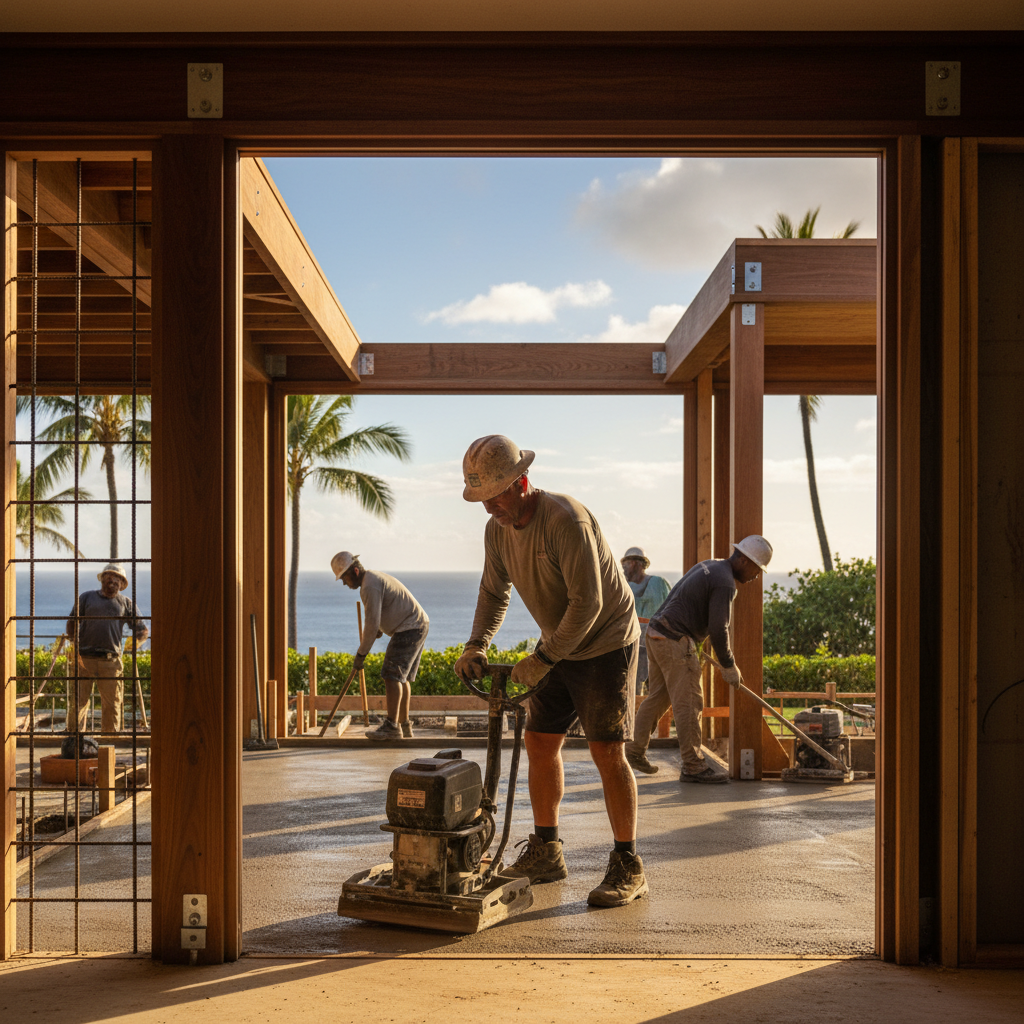
Time is a critical factor for any construction project, and in Honolulu, the timeline is often dictated by more than just the physical work. Permitting, inspections, weather, and material logistics all play a significant role. Here’s what you can realistically expect for a concrete project timeline in 2026.
\n
A straightforward project like a new driveway concrete Honolulu homeowners want can take between 2 to 3 weeks from start to finish. This might sound long for a simple slab, but here’s the breakdown:
\n
- \n
- Week 1: Demolition of the old driveway, excavation, grading, and setting the forms. We also place the rebar or wire mesh during this time. At the end of the week, we call the city for our pre-pour inspection.
- Week 2: The city inspector comes out (this can take 1-3 days depending on their schedule). Once we pass, we schedule the concrete pour. The pour itself only takes a few hours. The rest of the week is for initial curing.
- Week 3: Curing continues. While you can often walk on it after 48-72 hours, we strongly advise clients to wait at least 7-10 days before driving a vehicle on it. Full curing to maximum strength actually takes 28 days.
\n
\n
\n
\n
For a full concrete foundation Honolulu project, the timeline is much longer, typically ranging from 4 to 6 weeks. The complexity of the foundation is the biggest variable. We recently completed a 2,500 sq. ft. foundation for a custom home in Kailua that took nearly 7 weeks. The lot was sloped and required extensive stepped footings, plus we had a week of delays due to heavy rain—you can’t pour concrete in a downpour as it ruins the water-to-cement ratio.
\n
A large, engineered retaining wall Honolulu properties sometimes require can also take 4 to 7 weeks. The process involves getting engineering plans approved, excavating for massive footings, complex rebar cages, and multiple concrete or grout pours. Each step—footing, block laying, grouting—requires a separate inspection from the DPP, and each inspection call can add days to the schedule. It’s a methodical process that simply cannot be rushed.
\n
The biggest wildcard in any Honolulu construction timeline is the Department of Planning and Permitting (DPP). Getting the initial permit can take months, and scheduling the necessary inspections during construction can add days or even weeks to the total project duration. A good local contractor knows how to anticipate these delays and manage the schedule accordingly.
\n\n
What Permits Do You Need for Concrete Work in Honolulu?
\n
Navigating the Honolulu Department of Planning and Permitting (DPP) is one of the biggest hurdles for any construction project on O’ahu, and concrete work is no exception.[1] As a general rule, if the work is structural or involves new construction, you absolutely need a permit. Trying to bypass this process can result in stop-work orders, hefty fines, and the potential for having to tear out the unpermitted work.
\n
Here’s a breakdown of common concrete projects and their permit requirements in 2026:
\n
- \n
- New Driveway: Yes, a permit is required. You are creating a new impervious surface and altering the grading of your property. The DPP will review the plans to ensure proper drainage and setbacks from property lines.
- Driveway Repair/Replacement: It depends. If you are just resurfacing or patching existing concrete, you likely don’t need a permit. However, if you are tearing out the entire driveway and replacing it, even in the same footprint, the DPP considers this new construction and requires a building permit.
- Concrete Foundation: Absolutely, 100% of the time. This is the structural base of your home, and the permit process is extensive. It requires a full set of architectural and structural engineering plans to be submitted and reviewed by multiple DPP departments. This is not a quick process; expect the permit review for a new foundation to take anywhere from 6 to 12 months in the current 2026 backlog.
- Retaining Wall: A permit is required for any retaining wall that is over 4 feet in height (measured from the bottom of the footing to the top of the wall). Any wall over this height must be designed by a licensed structural engineer in Hawaii. Even for walls under 4 feet, if they are supporting a surcharge (like a driveway or structure), a permit and engineering are often required.
\n
\n
\n
\n
\n
The value of hiring an experienced local concrete contractor Honolulu-based like Warrior Construction is our ability to manage this frustrating process. We prepare and submit the permit applications, we know what the plan reviewers are looking for, and we can respond to their comments and corrections efficiently. For a homeowner, trying to navigate the DPP’s online portal and complex requirements can be a full-time job. We recently helped a client in Aina Haina whose initial retaining wall permit application had been stuck in review for 8 months. We were able to identify the missing engineering calculations, work with our structural engineer to revise the plans, and get the permit issued within 60 days of taking over the project. That’s the kind of local knowledge that saves both time and money.
\n\n
Honolulu-Specific Considerations: Climate, Materials, Regulations
\n
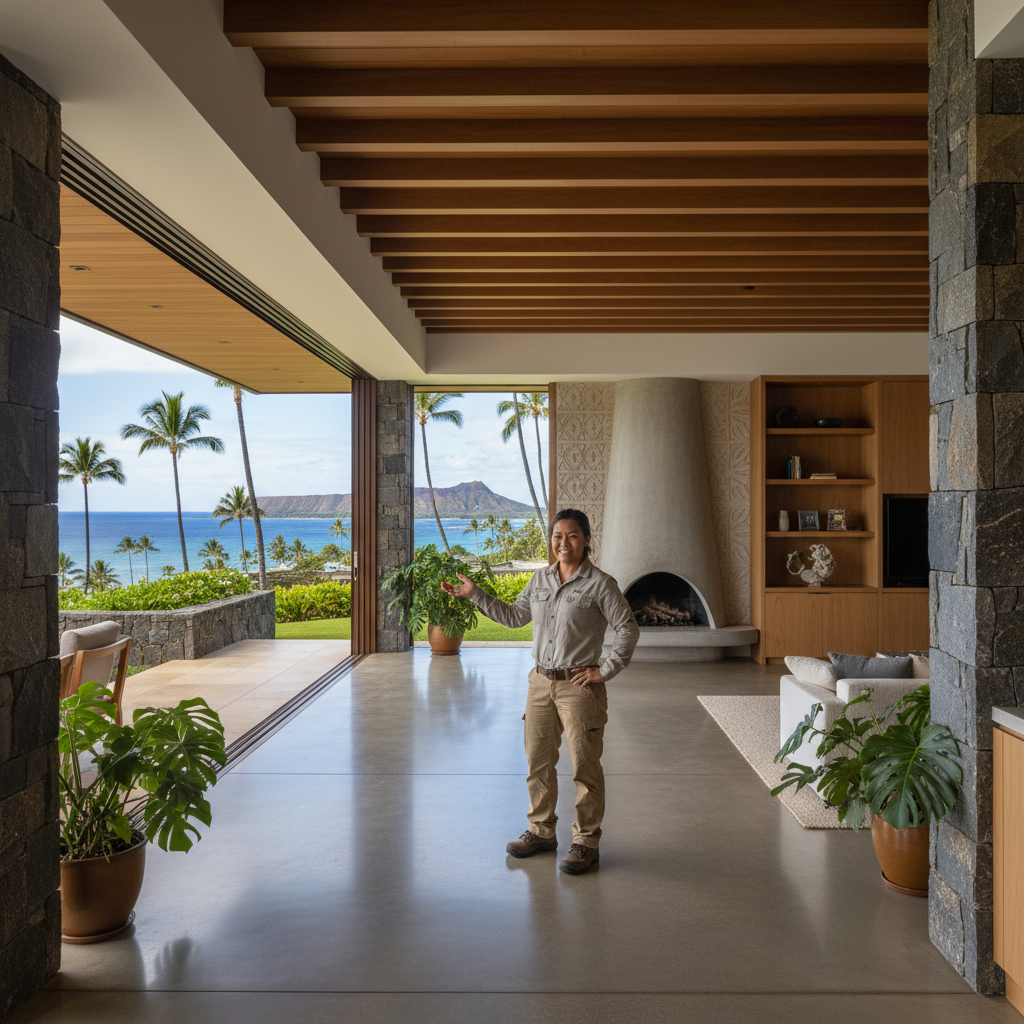
Building on an island in the middle of the Pacific presents a unique set of challenges that you simply don’t encounter on the mainland. Concrete work here is a specialized field, and ignoring these local factors is a recipe for premature failure. As a seasoned concrete contractor Honolulu depends on, we engineer every project to withstand our specific environment.
\n
1. Salt-Air Corrosion
\n
This is the number one enemy of concrete in Hawaii, especially for homes anywhere near the coast—from the Windward side (Kailua, Kaneohe) to the South Shore (Diamond Head, Hawaii Kai). The salty, moist air penetrates porous concrete and attacks the steel rebar inside. As the rebar rusts, it expands with incredible force, cracking the concrete from within. This is called spalling. To combat this, we take several critical steps:
\n
- \n
- Higher-Strength Concrete: We often specify a minimum of 4000 PSI concrete for coastal projects, which is less porous than the standard 2500-3000 PSI.
- Corrosion Inhibitors: We can add chemical admixtures to the concrete mix that create a protective layer around the rebar, actively resisting corrosion.
- Increased Rebar Cover: Building code might require 1.5 inches of concrete cover over rebar, but in high-corrosion zones, we insist on 2 to 3 inches. That extra inch of dense concrete can add decades of life to a foundation or lanai.
- Epoxy-Coated or Galvanized Rebar: For the most critical applications, using coated rebar provides an excellent barrier against salt intrusion, though it does add to the project cost.
\n
\n
\n
\n
\n
2. Volcanic Soil
\n
Much of O’ahu is built on volcanic soil, which can have highly variable properties. Some areas have expansive clay soils that shrink and swell with moisture content, while others are comprised of porous lava rock. Understanding the specific soil composition on your lot is critical for foundation design. A standard slab-on-grade that works in California might fail spectacularly in the expansive soils of Ewa. We always work with a geotechnical engineer on new home foundations to analyze the soil and design a footing and slab system that can handle the local conditions. This might involve over-excavating and bringing in engineered fill or designing a post-tension slab to resist soil movement.
\n
3. Hurricane Code and Seismic Activity
\n
Since Hurricane Iniki in 1992, Hawaii has adopted some of the most stringent building codes in the nation regarding wind resistance. For concrete work, this translates to very specific requirements for how the foundation connects to the rest of the house. We use heavy-duty hurricane straps and hold-downs that must be embedded directly into the concrete foundation at precise locations. These straps are what literally hold the walls and roof onto the foundation during a hurricane-force wind event. The DPP inspectors are extremely meticulous about checking the placement and embedment of these connectors before any walls go up. This is a critical life-safety issue, and we build to exceed these code minimums on every project.
\n
4. Material Logistics
\n
Everything is shipped to Hawaii, and that includes the raw materials for concrete (cement) and the steel for rebar. This has two major impacts: cost and availability. Our material costs are inherently higher than on the mainland. Furthermore, supply chain disruptions can and do happen. A good contractor has strong relationships with local suppliers and plans projects with enough buffer to account for potential shipping delays. This is especially true for specialty items that aren’t stocked locally. Forgetting to order a specific type of anchor bolt can delay a project for 6 weeks while you wait for it to arrive from the West Coast.
\n\n
How to Choose the Right Concrete Contractor in Honolulu
\n
Finding a qualified and reliable contractor is crucial for the success of your project. The consequences of hiring the wrong team, especially for foundational work, can be disastrous and expensive. Here is a practical checklist to help you vet and select the best concrete contractor Honolulu has to offer for your specific needs.
\n
1. Verify Their License and Insurance
\n
This is the absolute first step. Never consider hiring anyone who is not a licensed contractor in the State of Hawaii. You can and should verify any contractor’s license status on the Department of Commerce and Consumer Affairs (DCCA) Professional & Vocational Licensing (PVL) website.[2] Our license at Warrior Construction is BC-34373. A valid license means the contractor has met the state’s requirements for experience and testing. Equally important, ask for proof of current General Liability and Workers’ Compensation insurance. If an uninsured worker gets hurt on your property, you could be held financially liable. Don’t just take their word for it; ask to see the insurance certificates.
\n
2. Look for Relevant, Local Experience
\n
Hawaii is not the mainland. Ask potential contractors to show you a portfolio of projects similar to yours that they have completed here on O’ahu. If you need a hillside retaining wall, you want to see examples of hillside retaining walls they’ve built in places like St. Louis Heights or Manoa, not just flatwork in Kapolei. This demonstrates they understand the unique challenges of your type of project in our specific environment. Our portfolio showcases a wide range of projects, from complex foundations to detailed flatwork across the island.
\n
3. Check Local References
\n
A good contractor will be happy to provide you with a list of recent clients you can speak with. When you call these references, don’t just ask if they were happy. Ask specific questions:
\n
- \n
- Did the project stay on budget? If not, why?
- Was the project completed on time?
- How was the communication with the project manager?
- Was the job site kept clean and safe?
- Have there been any issues with the work since it was completed?
\n
\n
\n
\n
\n
\n
4. Get a Detailed, Itemized Bid
\n
Beware of contractors who give you a single, lump-sum price on a napkin. A professional bid should be a detailed document that breaks down the costs for materials, labor, equipment rental, permits, and overhead/profit. This transparency allows you to compare apples to apples between different bids and understand exactly what you are paying for. A detailed scope of work also prevents misunderstandings down the line. It should clearly state the concrete PSI, the rebar schedule, the slab thickness, and the type of finish.
\n
5. Trust Your Gut
\n
Finally, this is a person or team you will be working with closely for weeks or months. You need to feel comfortable with their communication style and professionalism. Are they responsive to your calls and emails? Do they take the time to answer your questions thoroughly? If you feel like you’re getting the runaround during the bidding process, it’s a major red flag for how things will be once the project starts.
\n\n
Real Honolulu Concrete Project Example: Hawaii Kai Foundation & Lanai
\n
To make all this information tangible, let’s walk through a recent, typical project our team at Warrior Construction completed in 2026. This case study illustrates the real-world costs, timelines, and challenges involved in a residential concrete project in Honolulu.
\n
The Project: A new 2,200 square foot concrete foundation Honolulu home in Hawaii Kai, plus an attached 600 square foot lanai. The clients were building a custom single-story home and wanted a solid, durable base that could withstand the coastal environment.
\n
The Challenge: The property was located within a quarter-mile of the marina, exposing it to significant salt air. A geotechnical report also revealed the lot had about two feet of poor, uncompacted fill over coral substrate. This meant a standard slab-on-grade was not sufficient; the foundation needed to be designed to handle both potential soil settlement and aggressive corrosion.
\n
Our Solution:
\n
- \n
- Engineering & Permitting: We worked with a local structural engineer to design a monolithic slab foundation with deepened footings that extended through the poor fill to the solid coral base. We specified a 4000 PSI concrete mix with a corrosion-inhibiting admixture and called for epoxy-coated rebar for the entire foundation and lanai. The permitting process with the DPP took approximately 7 months to get through all the reviews.
- Site Prep: Once we had the permit, our crew spent the first week and a half on site. This involved over-excavating the poor soil, hauling it away, and bringing in 24 truckloads of engineered fill, which was then compacted in 8-inch lifts and tested for proper density.
- Forming & Pour: The next two weeks were dedicated to forming the complex footprint of the home, placing all the underslab plumbing, and meticulously tying the grid of epoxy-coated rebar. This phase required two separate DPP inspections: one for the plumbing and one for the rebar and formwork. After passing inspection, we scheduled the pour, which required two concrete trucks and a boom pump to place 35 cubic yards of concrete.
- Finishing & Curing: The crew expertly finished the slab and applied a curing compound to ensure proper hydration. The lanai portion received a light \”broom finish\” for a non-slip surface. We enforced a strict 10-day period before any other trades were allowed to begin framing on the slab.
\n
\n
\n
\n
\n
The Numbers:
\n
- \n
- Total Concrete Square Footage: 2,800 sq. ft. (2,200 house + 600 lanai)
- Total Project Duration: 5.5 weeks from breaking ground to completion.
- Final Cost: Approximately $92,400. This breaks down to about $33 per square foot, which was on the higher end due to the extensive site prep, engineered fill, and the premium for epoxy-coated rebar and admixtures.
\n
\n
\n
\n
This project is a perfect example of why local expertise is critical. An out-of-state contractor might have missed the soil issues or underestimated the corrosion threat, leading to catastrophic foundation failure within 10-15 years. By investing in the right design and materials up front, these homeowners now have a foundation that will last a lifetime.
\n\n
What this means for Hawaii homeowners
\n
Understanding the complexities of concrete work in Honolulu is the first step toward making a smart investment in your property. The key takeaway is that the foundation, driveway, or retaining wall you install is not a commodity; it’s a custom-engineered system designed to perform in one of the most demanding environments on earth. Cutting corners on concrete is one of the most expensive mistakes a homeowner can make.
\n
Here’s your action plan for approaching your next concrete project:
\n
- \n
- Budget Realistically: Use the 2026 cost figures provided in this guide ($28-$35/sq. ft. for foundations, $22-$30/sq. ft. for driveways) as a starting point. Be wary of any bid that comes in significantly lower; it likely means they are cutting corners on materials, labor, or insurance.
- Prioritize Local Experience Over Price: When vetting a concrete contractor Honolulu has many to choose from, but always ask pointed questions about their experience with salt-air corrosion, volcanic soils, and navigating the Honolulu DPP. A contractor who can speak intelligently about these issues is worth a small premium over one who can’t.
- Plan for the Timeline: Remember that Honolulu construction timelines are longer than on the mainland. Factor in months for permitting before any work can even begin, and understand that on-site work can be delayed by weather and inspections. A good contractor will communicate these potential delays proactively.
- Insist on a Detailed Contract: Your contract should specify everything: the exact PSI of the concrete, the grade and spacing of the rebar, the thickness of the slab, the type of finish, and the payment schedule. This document protects both you and the contractor and ensures there are no surprises.
\n
\n
\n
\n
\n
Ultimately, your goal is to hire a partner, not just a laborer. You need a licensed, insured, and experienced local professional who will build your project to last. Taking the time to do your due diligence upfront will save you from a world of headaches and financial loss down the road.
\n\n
Frequently Asked Questions About Concrete Contractor in Honolulu
\n
How much does a new concrete driveway cost in Honolulu in 2026?
\n
In 2026, you can expect to pay between $22 and $30 per square foot for a standard new or replacement concrete driveway on O’ahu. For a typical 500-square-foot driveway, this translates to a total cost of $11,000 to $15,000. Costs can be higher for heavily sloped driveways or if you choose decorative options like stamped or colored concrete.
\n
\n
Do I need a permit for a retaining wall in Honolulu?
\n
Yes, a building permit from the Honolulu DPP is required for any retaining wall over four feet tall, measured from the bottom of the footing. Walls of this height must also be designed and stamped by a Hawaii-licensed structural engineer. Even for walls under four feet, a permit may be required if they support a load, such as a driveway, patio, or part of a building’s foundation.
\n
\n
What is spalling and how can it be prevented in Hawaii’s climate?
\n
Spalling is when the surface of concrete cracks and breaks off, often exposing the rebar underneath. In Hawaii, it’s almost always caused by salt air corroding the internal steel rebar, which then expands and blows the concrete apart. Prevention is key: using a higher PSI concrete mix, adding corrosion-inhibiting admixtures, and ensuring at least 2-3 inches of concrete cover over the rebar are the best ways to prevent spalling.
\n
\n
How long should I wait before driving on my new concrete driveway?
\n
While you can typically walk on new concrete within 24-48 hours, you should wait at least 7 full days before driving a passenger car on it. For heavier vehicles like an SUV or truck, we recommend waiting 10-14 days. Concrete technically takes 28 days to reach its full design strength, so being patient in the first two weeks is critical to prevent cracks and damage.
\n
\n
Why is concrete work so much more expensive on O’ahu than the mainland?
\n
There are three main reasons. First, nearly all materials, from the cement powder to the steel rebar, have to be shipped to the island, adding significant freight costs. Second, Hawaii has a higher cost of living, which translates to higher labor wages. Finally, our stringent building codes for hurricanes and the specialized techniques required for our corrosive environment demand higher-quality materials and more skilled labor, both of which add to the overall project cost.
\n
\n
Can you pour concrete in the rain in Hawaii?
\n
No, we avoid pouring concrete during active rain. Rainwater adds excess water to the surface of the concrete mix, which disrupts the critical water-to-cement ratio. This can severely weaken the top layer of the slab, leading to a soft, dusty, or easily damaged surface. If a sudden shower pops up after a pour has started, we will quickly cover the fresh concrete with plastic sheeting to protect it.
\n
\n
Is a post-tension slab foundation a good choice for Honolulu homes?
\n
Post-tension slabs can be an excellent solution, particularly in areas with expansive soils like parts of Ewa or Central O’ahu. These engineered foundations have steel cables running through them that are tensioned after the concrete cures, creating a stronger, crack-resistant slab. While more expensive upfront than a standard slab-on-grade, they provide superior performance against soil movement, which can save a homeowner from costly structural repairs in the long run.
\n
\n
\n\n
The foundation of your home is the most critical part of its structure. It’s not the place to cut corners or hire an unqualified contractor. At Warrior Construction, we bring over two decades of dedicated Hawaii experience to every project, ensuring your concrete work is built to last a lifetime against our island’s unique challenges. Our team treats every foundation as if it were for our own family’s home.
\n
If you’re planning a project and need a concrete contractor who understands the intricacies of building on O’ahu, we’re here to help. Contact Warrior Construction today to discuss your concrete and foundation needs and receive a comprehensive, transparent estimate for your project.
\n\n
References
\n