“
Hiring a concrete contractor in Kailua isn’t just about pouring a slab; it’s about building a foundation that can withstand the unique pressures of our Windward Oʻahu environment. The right contractor understands how to combat relentless salt-air corrosion, manage drainage during flash floods, and engineer for our specific volcanic soil conditions. Getting it wrong means spalling, cracking, and structural failure down the road—costly mistakes we see homeowners dealing with all the time. At Warrior Construction, with over two decades of experience on Oʻahu, we believe an informed homeowner is our best partner. That’s why we’ve put together this guide based on real-world projects right here in Kailua.
\n\n
The most critical factors you need to consider are verifying your contractor’s Hawaii license (ours is BC-34373), understanding the true costs beyond the per-foot price, navigating the Honolulu Department of Planning and Permitting (DPP), and insisting on materials and techniques specifically designed for our coastal climate. This isn’t mainland construction. Here, the mix design of your concrete, the type of rebar used, and how it’s all placed matters immensely. We’ll walk you through the real numbers, timelines, and pitfalls we encounter on Kailua job sites every week, from Lanikai to Enchanted Lake. This guide will equip you with the knowledge to ask the right questions and choose a team that will get the job done right the first time, ensuring your investment lasts for decades.
\n\n
Why Kailua Homeowners Trust Warrior Construction for Concrete Contractor
\n
When you’re looking for a concrete contractor, you’re not just buying a product; you’re investing in decades of stability for your home. In Kailua, that investment is constantly under assault from the elements. That’s where local experience becomes non-negotiable. Our team at Warrior Construction isn’t just based in Hawaii; we’ve built our careers here, understanding the nuances that can make or break a concrete project on the Windward side. We know that the concrete mix needed for a foundation in dry Kapolei is fundamentally different from what’s required for a driveway a block from Kailua Beach.
\n\n
First and foremost, we are a fully licensed and insured Hawaii general contractor (BC-34373). This is the baseline for any legitimate operation. It means we’re held to the state’s standards for safety, quality, and financial stability. But our expertise goes much deeper. We’ve spent years developing relationships with local suppliers like Hawaiian Cement and Grace Pacific. This allows us to specify and source the exact concrete mix designs needed for Kailua’s high-salinity environment. For example, on a recent project near Kalama Beach Park, we specified a 4500 PSI mix with a corrosion-inhibiting admixture and insisted on epoxy-coated rebar for a new retaining wall. A less experienced contractor might have used a standard mix, which would have started showing signs of spalling and rust bleed-through within a decade. We build for the long haul.
\n\n
Furthermore, our experience extends to navigating the often-complex bureaucracy of the Honolulu DPP. We have an in-house permit coordinator who understands the specific requirements for Kailua, from shoreline setback rules to drainage plan requirements. This integrated approach saves our clients months of potential delays and headaches. We handle the drawings, the submissions, and the inspections as part of our comprehensive service. Homeowners trust us because we provide a seamless process, not just a concrete pour. We manage the entire project, ensuring that every detail, from the soil compaction beneath the slab to the final curing process, is handled with the precision that our local conditions demand. It’s this deep, on-the-ground knowledge of Kailua that gives our clients peace of mind.
\n\n
What Does Concrete Contractor Cost in Kailua?
\n
Let’s get straight to the numbers for 2026. Vague estimates don’t help you budget, so here’s a breakdown of what you can realistically expect to pay for professional concrete work in Kailua. These figures include labor, materials, basic site prep, and standard finishes.
\n\n
For a standard driveway concrete Kailua project, you’re looking at a cost of approximately $24 to $32 per square foot. This assumes a 4-inch thick slab with a broom finish and a standard rebar grid. So, for a typical 600-square-foot two-car driveway, the budget would be around $14,400 to $19,200. This price can increase if your site has significant slope, requires extensive excavation, or if you opt for decorative finishes like stamping or staining, which can add another $5 to $15 per square foot.
\n\n
When it comes to a concrete foundation Kailua, the complexity and cost go up. For a monolithic slab-on-grade foundation for a new home or addition, the cost typically ranges from $38 to $60 per square foot of the home’s footprint. A 1,500-square-foot foundation could therefore cost between $57,000 and $90,000. This price includes:
\n
- \n
- Excavation and grading
- Engineered fill and compaction
- Vapor barrier installation
- Termite treatment (like a Sentricon or Termidor pre-treat)
- Formwork for footings and the slab edge
- A robust rebar grid with proper clearances
- Anchor bolts and hold-downs required by hurricane code
- The concrete pour and finish itself
\n
\n
\n
\n
\n
\n
\n
\n
\n\n
For a retaining wall Kailua, pricing is usually calculated per square foot of the wall’s face. For a standard CMU (concrete masonry unit) block wall on a concrete footing, expect to pay $160 to $275 per square foot of wall face. A wall that is 4 feet high and 50 feet long (200 sq. ft. of face) would cost between $32,000 and $55,000. This cost is heavily influenced by factors like the height of the wall (taller walls require more engineering and steel), soil conditions, and the need for waterproofing and a drainage system behind the wall, which is critical in rainy Kailua.
\n\n
Several key factors can influence these prices on Oʻahu. Site access is a big one; if we can’t get a full-size concrete truck close to the pour site on a narrow Lanikai lane, we may need to use a pump truck, which adds $1,500 to $2,500 to the day’s cost. Additionally, demolition and hauling away of an old, broken slab can add $4 to $7 per square foot. Always make sure your quote clearly itemizes these potential additions.
\n\n
How Long Does a Concrete Contractor Take in Kailua?
\n
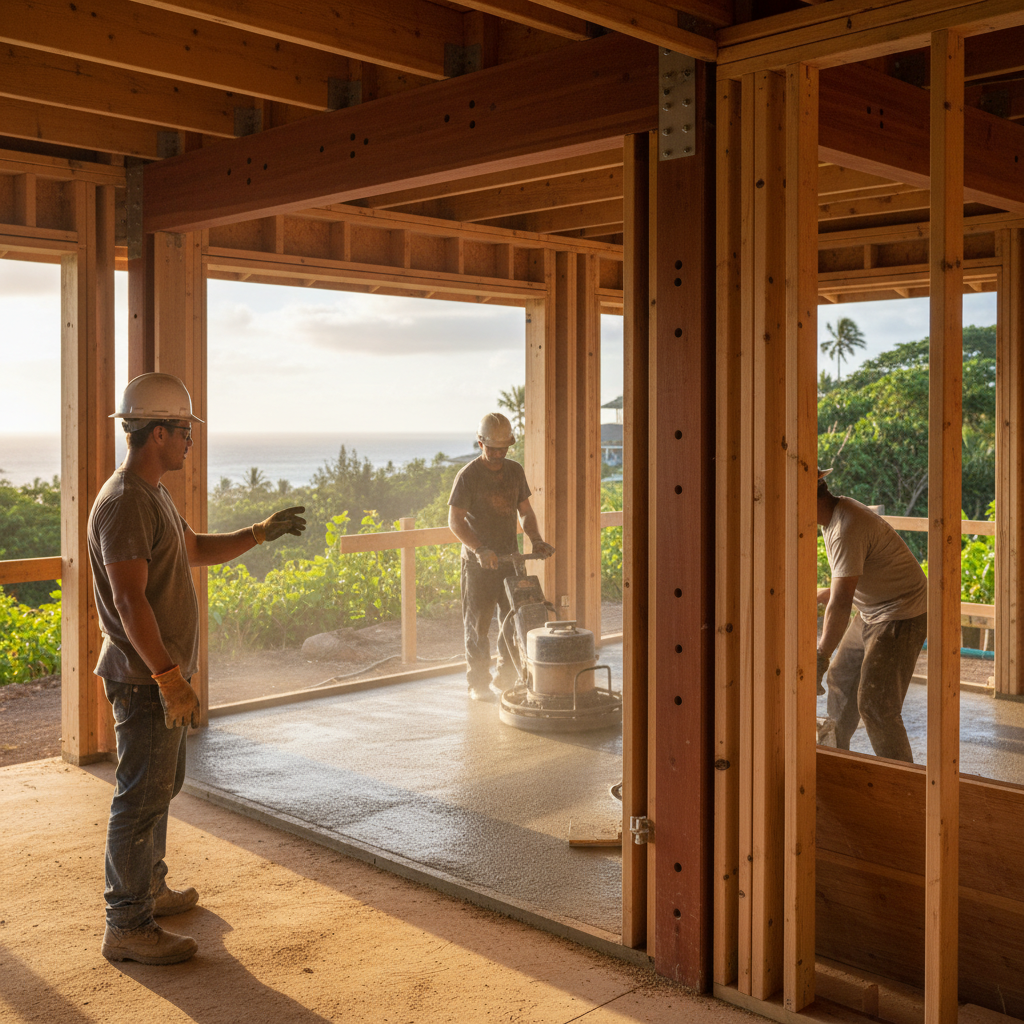
Time is a major factor in any construction project, and concrete work has its own specific schedule driven by permitting, preparation, and the laws of chemistry. A common misconception is that the job is done once the concrete is poured. The reality is that the timeline starts long before and ends long after that single day.
\n\n
Here’s a realistic timeline for a typical concrete project in Kailua in 2026:
\n
- \n
- Planning and Permitting (The Longest Phase): 2 to 8 months. If your project is purely cosmetic, like replacing a small patio with the exact same footprint, you might not need a permit. However, for anything structural—a new foundation, a retaining wall over four feet tall, or a new driveway that alters drainage—you will be dealing with the Honolulu DPP. As of 2026, even with their online systems, a straightforward permit review can take a few months. For complex projects requiring structural engineering, plan for six to eight months. We handle this entire process for our clients, but the timeline is largely set by the city’s workload.
- Site Preparation and Formwork: 1 to 3 weeks. Once the permit is in hand, our crew gets to work. This phase involves demolishing and removing any old concrete, excavating to the proper depth, grading the area for drainage, and laying down and compacting the base material (like #3 crushed rock). After that, we build the wooden forms that will define the shape of the slab, driveway, or footings. We also place the rebar grid and any necessary plumbing or electrical conduits that will be embedded in the concrete. For a simple driveway, this might take a week. For a complex house foundation, it could be three weeks.
- The Pour: 1 day. This is the main event. A team of skilled finishers works quickly to pour, spread, level, and finish the concrete before it begins to set. The timing is critical, especially on a hot Kailua day.
- Curing and Finishing: 1 to 28 days. This is the most misunderstood part of the timeline. The concrete will be hard enough to walk on within 24-48 hours. However, it only reaches about 70% of its final strength in the first week. We recommend keeping vehicles off a new driveway for at least 7-10 days. The concrete doesn’t achieve its full specified design strength for 28 days. During the first week, proper curing is essential, which might involve keeping the surface moist to prevent it from drying too quickly and cracking.
\n
\n
\n
\n
\n\n
Kailua’s weather can also play a role. A week of heavy Windward showers can delay excavation and site prep. We also have to be careful about pouring concrete if a major downpour is expected, as it can ruin the surface finish. We constantly watch the forecast and build contingency days into our schedules to account for Kailua’s unpredictable microclimate.
\n\n
What Permits Do You Need for Concrete Contractor in Kailua?
\n
Navigating the permitting process with the City and County of Honolulu’s Department of Planning and Permitting (DPP) is one of the most significant hurdles for any construction project on Oʻahu.[1] Many homeowners are surprised to learn what requires a permit and what doesn’t. Getting this wrong can lead to stop-work orders, fines, and having to tear out completed work.
\n\n
As a general rule, you need a building permit for any concrete work that is structural or affects your property’s lot coverage and drainage. Here’s a more specific breakdown:
\n
- \n
- New Foundations: Absolutely, 100% of the time. This is the structural base of your home and requires detailed architectural and engineering plans to be submitted and approved by the DPP.
- Retaining Walls: A permit is required for any retaining wall that is over four feet in height (measured from the bottom of the footing to the top of the wall). Any wall holding back a significant slope, regardless of height, will also likely require an engineered plan and a permit.
- Driveways and Patios: This is a gray area for many. If you are repairing or resurfacing an existing driveway, you generally do not need a permit. However, if you are pouring a *new* driveway, expanding an existing one, or adding a large new patio, a permit is typically required. The DPP is concerned with how this new non-permeable surface affects water runoff and your property’s maximum lot coverage calculations, which are stricter under recent ordinances like Bill 7.
- Major Repairs: If you are doing extensive spalling repair that involves chipping out concrete and replacing rebar in structural elements like beams or columns, a permit is often necessary.
\n
\n
\n
\n
\n\n
What typically *doesn’t* require a permit is minor, non-structural flatwork. This includes things like pouring a small 10×10 foot slab for a shed in your backyard (as long as the shed itself is exempt), replacing a few sidewalk squares, or pouring a pad for your air conditioning condenser. However, it’s always best to check.
\n\n
The permit process itself involves submitting a full set of plans to the DPP for review. They check for compliance with building codes, zoning regulations, and shoreline management rules (especially relevant in Kailua). The plans for any structural concrete must be stamped by a Hawaii-licensed structural engineer. Once the permit is issued, there will be a series of inspections:
\n
- \n
- Footing/Slab-on-Grade Inspection: The inspector verifies the excavation depth, formwork, and rebar placement *before* you are allowed to pour any concrete.
- Final Inspection: After the work is complete, a final inspection closes out the permit.
- Higher-Strength Concrete: We often specify a mix of 4000 PSI or higher. Denser, less permeable concrete makes it harder for saltwater to penetrate.
- Corrosion-Inhibiting Admixtures: These are special chemicals added to the concrete mix that form a protective layer around the rebar, chemically inhibiting rust.
- Proper Rebar Cover: Building code dictates a minimum distance between the rebar and the outer surface of the concrete. In the harsh Kailua environment, we often exceed this minimum to provide extra protection.
- Coated Rebar: For critical applications, we use epoxy-coated or galvanized rebar, which provides a physical barrier against salt and moisture.
- The full scope of work, including demolition, site prep, formwork, and finishing.
- The specific materials to be used (e.g., \”4000 PSI concrete with a corrosion inhibitor\”).
- The thickness of the slab and the size/spacing of the rebar.
- A clear breakdown of costs for labor, materials, equipment, and permit fees.
- The payment schedule.
- An estimated start date and project duration.
- Proof of license and insurance.
- Permitting and Engineering: Because the retaining wall was four feet high, a building permit and engineered drawings were required. We engaged a local structural engineer to design the wall’s footing and reinforcement schedule based on the soil conditions. We submitted the full package to the Honolulu DPP, which took about five months for approval.
- Materials for a Coastal Environment: For both the driveway and the retaining wall, we specified a 4000 PSI concrete mix. Crucially, we included a calcium nitrite corrosion-inhibiting admixture to protect the rebar from the Kailua salt air. For the driveway, we used standard #4 rebar, but for the critical retaining wall structure, we upgraded to galvanized rebar for maximum longevity.
- Execution: The project began with the demolition of the old driveway, which we hauled away for recycling. Our crew then excavated for the retaining wall footing and the new driveway subgrade. We carefully installed the formwork and steel reinforcement, ensuring proper concrete cover over all the rebar. A DPP inspector came to the site to approve our footing and rebar placement before we were allowed to pour. We installed a proper drainage system behind the retaining wall with gravel and a perforated pipe to relieve hydrostatic pressure—a step that is essential in rainy Kailua. The pours were scheduled on clear days, and our expert finishers gave the driveway a non-slip broom finish.
- Timeline: 5 months for permitting, 3 weeks for on-site construction.
- Cost: The total project cost, including engineering, permits, labor, and materials, was approximately $58,000 in 2026.
- Result: The homeowner now has a safe, beautiful, and durable driveway and a stable backyard. The new concrete structures were built not just to code, but to a higher standard designed specifically to withstand the harsh Kailua environment for many decades to come.
- Don’t Underestimate the Environment: Kailua’s salt and rain are relentless. Your concrete project must be designed from the ground up to resist corrosion and manage water. Always ask a potential contractor how they plan to address these specific issues. If they don’t have a clear answer about admixtures or drainage, they aren’t the right choice.
- Factor in Permitting Time: The Honolulu DPP sets the pace for any structural project. Build this timeline into your plans from the very beginning. A good contractor will manage this process for you, but they can’t make it go faster. Be realistic and start the planning process at least 6-8 months before you want to break ground.
- Budget for Quality: The lowest bid is rarely the best value. Cutting corners on concrete means using a cheaper mix, less rebar, or rushing the site prep. These shortcuts will lead to cracks and spalling within a few years, costing you far more in the long run. Pay for the expertise and materials that will ensure your project lasts 30 years or more.
- Hire a Licensed Professional: Use the DCCA PVL website to verify every contractor’s license and check their history. This simple step is your first and best line of defense against unqualified or unscrupulous operators. A true professional, like our team at Warrior Construction (BC-34373), will be proud to share their license and insurance information.
\n
\endol>\n\n
At Warrior Construction, we manage this entire process. We know what the DPP plan reviewers in Honolulu are looking for and how to prepare the documents correctly to minimize delays. Trying to do this as a homeowner can be an incredibly frustrating and time-consuming process. It’s a key part of the value a professional, licensed general contractor brings to your project.
\n\n

Kailua-Specific Considerations: Climate, Materials, Regulations
\n
Kailua is not like the rest of the island, and it’s certainly not like the mainland. The combination of salt, wind, rain, and unique soil creates a challenging environment for any building material, especially concrete. A successful project here requires a deep understanding of these local factors.
\n\n
Salt-Air Corrosion
\n
This is the number one enemy of concrete on the Windward side. The constant tradewinds carry a fine mist of salt that settles on every surface. Concrete is porous, and over time, this salt-laden moisture penetrates the surface and reaches the steel rebar inside. Once the chloride ions reach the steel, a chemical reaction starts—rust. The problem is that rust expands, exerting immense pressure on the surrounding concrete. This pressure causes the concrete to crack and break off in chunks, a process called spalling. We see it everywhere in Kailua: on retaining walls, lanais, and driveways.
\n
To combat this, we take specific measures:
\n
- \n
\n
\n
\n
\n
\n\n
Rainfall and Drainage
\n
Kailua is known for its frequent showers and occasional torrential downpours. All that water has to go somewhere. Any new concrete flatwork, like a driveway or patio, must be graded with a precise slope (typically a minimum of 2%, or ¼ inch per foot) to direct water away from your house’s foundation and into a safe area like a drain or a landscaped bed. Improperly sloped concrete can lead to water ponding against your home, which can cause moisture intrusion, foundation issues, and create a breeding ground for mosquitos. We use laser levels to ensure every slab we pour has positive drainage built-in.
\n\n
Volcanic Soil and Compaction
\n
The ground beneath your home isn’t just dirt; it’s a mix of volcanic soil, sand, and clay that behaves differently depending on its composition and moisture content. Before we pour any concrete, a critical step is preparing the subgrade. This involves removing any organic material, laying down a base course of crushed rock, and then compacting it thoroughly with a mechanical tamper. If this step is skipped or done poorly, the soil underneath can settle over time, causing the concrete slab above to sink and crack. On some Kailua lots, especially those with expansive clay soils, we may need a geotechnical engineer to provide a soil report and recommend a specific foundation design.
\n\n
How to Choose the Right Concrete Contractor Contractor in Kailua
\n
Choosing the right team for your concrete project is the most important decision you’ll make. A good contractor will deliver a product that lasts a lifetime; a bad one can leave you with a cracking, spalling mess and a hole in your wallet. Here are the key steps to vetting and selecting a qualified concrete contractor in Kailua.
\n\n
Step 1: Verify Their License and Insurance
\n
This is non-negotiable. Anyone performing construction work in Hawaii valued at over $1,000 must have a contractor’s license from the Department of Commerce and Consumer Affairs (DCCA). You can and absolutely should verify any contractor’s license on the DCCA Professional & Vocational Licensing (PVL) website.[2] Our license is BC-34373. The PVL search will tell you if the license is active, if there are any complaints against the contractor, and if they hold the correct classification for the work. A concrete contractor should have a C-5 (Concrete) or, ideally, a B (General Building) license like ours, which allows us to manage the entire project, including any related trades.
\n
Equally important is insurance. Ask for a certificate of insurance showing they carry both General Liability and Worker’s Compensation. General Liability protects your property from damage, while Worker’s Comp protects you from being sued if one of their employees gets injured on your job site. If a contractor can’t provide these, walk away.
\n\n
Step 2: Insist on Local, Kailua-Specific Experience
\n
As we’ve discussed, Kailua is a unique environment. A contractor who primarily works in Ewa Beach or Mililani may not have the same firsthand experience dealing with the constant salt spray and high humidity of the Windward side. Ask potential contractors for addresses of projects they’ve completed in Kailua that are at least five years old. Go take a look. See how their work is holding up. Are there cracks? Is there spalling? Also, ask for references from recent Kailua clients and call them. Ask about their experience with communication, scheduling, and cleanliness.
\n\n
Step 3: Get a Detailed, Itemized Proposal
\n
Never accept a one-line estimate or a verbal agreement. A professional proposal should be a detailed document that clearly outlines:
\n
- \n
\n
\n
\n
\n
\n
\n
\n
\n\n
Comparing detailed proposals is the only way to ensure you’re comparing apples to apples. A low bid is often a red flag that a contractor is cutting corners on materials, subgrade preparation, or doesn’t carry proper insurance.
\n\n
Real Kailua Concrete Contractor Project Example
\n
To bring all these points together, let’s walk through a typical project we recently completed for a homeowner in the Keolu Hills neighborhood of Kailua.
\n
The Problem: The client’s original driveway, poured in the 1980s, was a mess. It was heavily cracked, and large sections were spalling, exposing rusted rebar. It was not only an eyesore but a tripping hazard. Additionally, a sloped section of their backyard was eroding, threatening the home’s foundation during heavy rains.
\n\n
The Scope: Our task was twofold. First, to demolish and replace the 800-square-foot driveway concrete Kailua. Second, to design and build a 60-foot-long, 4-foot-high engineered retaining wall Kailua to solve the erosion problem.
\n\n
Our Approach and Solution:
\n
- \n
\n
\n
\n
\n\n
The Outcome:
\n
- \n
\n
\n
\n
\n\n
What this means for Hawaii homeowners
\n
When you’re ready to start a concrete project in Kailua, it’s easy to get focused on the final look or the initial price tag. But the real value lies in the unseen details: the quality of the subgrade, the specific mix of the concrete, the type of rebar, and the expertise of the team doing the work. Investing in a knowledgeable, licensed contractor who understands Kailua’s specific challenges isn’t an expense; it’s insurance against future failure.
\n
Here are the key takeaways for your project:
\n
- \n
\n
\n
\n
\n
\n
Ultimately, your concrete driveway, foundation, or retaining wall is a critical component of your home’s structure and value. Treat the hiring process with the seriousness it deserves.
\n\n
Frequently Asked Questions About Concrete Contractor in Kailua
\n
How much does a simple concrete foundation cost in Kailua in 2026?
\n
For a standard monolithic slab-on-grade concrete foundation Kailua, homeowners can expect to pay between $38 and $60 per square foot. This includes the engineering, site prep, formwork, rebar, vapor barrier, and the pour itself. So for a 1,000-square-foot home addition, the foundation cost would likely fall between $38,000 and $60,000.
\n
\n
Do I need a permit to just repair my spalling concrete lanai?
\n
It depends on the extent of the damage. For minor, cosmetic patching, a permit is not required. However, if the spalling is extensive and requires chipping out significant amounts of concrete and replacing structural rebar, the Honolulu DPP will consider it a structural repair and require a building permit. It’s always best to consult with a licensed contractor to assess the damage.
\n
\n
What is the best type of concrete to use for a driveway near Kailua Beach?
\n
For any concrete work within a few blocks of the ocean, we strongly recommend a high-performance mix. This means a minimum strength of 4000 PSI to reduce permeability, and the inclusion of a corrosion-inhibiting admixture like calcium nitrite. We also ensure the rebar has at least 3 inches of concrete cover to protect it from salt intrusion.
\n
\n
How long do I really have to wait before parking my car on a new driveway?
\n
While the concrete may feel hard after a day, it’s still curing. We advise all our clients to keep vehicles off a new driveway for a minimum of 7 full days. This allows the concrete to reach about 70% of its design strength, which is sufficient to handle the weight of a standard car without risking surface damage or cracking.
\n
\n
Why is my 10-year-old retaining wall cracking and showing rust stains?
\n
This is a classic sign of rebar corrosion caused by salt-air moisture. The original contractor likely used standard materials and didn’t provide enough concrete cover over the steel reinforcement. The rust expands, cracking the concrete from within (spalling). Repairing this often involves chipping away the damaged concrete, cleaning or replacing the rusted rebar, treating it, and then patching with a specialized repair mortar.
\n
\n
Can you pour concrete during a typical rainy Kailua week?
\n
It’s challenging but possible with proper planning. We avoid pouring during heavy, driving rain as it can wash out the cement paste on the surface and ruin the finish. However, for a light, passing shower, we can protect the fresh slab with plastic sheeting. For critical pours that cannot be delayed, we can even erect temporary tents over the work area.
\n
\n
What’s the difference between hiring a general contractor versus just a concrete subcontractor?
\n
A concrete subcontractor typically only handles the concrete pour itself. A licensed General Contractor (GC) like Warrior Construction manages the entire project from start to finish. This includes obtaining the permits, coordinating engineers, handling all excavation and site prep, managing inspections, and ensuring the project meets all building codes. For any project more complex than a simple slab, a GC provides comprehensive management and a single point of responsibility.
\n
\n
\n\n
Choosing the right concrete contractor in Kailua is about ensuring the longevity and safety of your biggest investment—your home. The unique challenges of our Windward Oʻahu environment demand more than just standard practices; they require specialized knowledge, materials, and techniques.
\n
At Warrior Construction, we bring over 20 years of on-the-ground Hawaii experience to every foundation, driveway, and retaining wall we build. We understand the specific threats posed by salt air and heavy rain, and we know how to build structures that last. If you’re ready to discuss your project with a team that puts quality and durability first, we’re here to help.
\n
Ready to build a concrete foundation that lasts? Learn more about our expert Concrete & Foundations services and how we protect your home from Kailua’s toughest elements.
\n\n
References
\n