Finding a reliable concrete contractor in Kaunakakai involves more than just a search for someone who can pour a slab. Here on Moloka’i, it’s about navigating unique logistical challenges, understanding our specific climate, and building structures that will last for generations. The key to saving money isn’t cutting corners; it’s smart planning, efficient material management, and hiring a team that knows the island. At Warrior Construction, we’ve been tackling neighbor island projects for over 20 years, and we understand that a concrete foundation or driveway in Kaunakakai requires a different level of expertise than one in Honolulu.
The biggest cost drivers on Moloka’i are mobilization and materials. Everything, from specialized equipment to the very rebar that reinforces your foundation, has to come over on the barge. Consequently, a contractor without a solid logistics plan can quickly blow your budget. This guide breaks down the real costs, timelines, and critical considerations for any concrete project on the Friendly Isle. We’ll give you seven actionable tips to save money without compromising on quality, covering everything from permit strategies to selecting the right materials for our salt-laden air. Whether you’re planning a new home foundation, a durable driveway, or a sturdy retaining wall, this is the insider knowledge you need to get the job done right.
Why Kaunakakai Homeowners Trust Warrior Construction for Concrete Contractor
Choosing a concrete contractor for a project on Moloka’i isn’t just about price. It’s about trust and experience. Homeowners in Kaunakakai trust our team at Warrior Construction (License BC-34373) because we’ve proven our ability to manage the complexities of neighbor island work. Unlike a purely Oahu-based company that might treat a Moloka’i job as a one-off adventure, we have systems in place specifically for these projects. Our experience means we anticipate challenges before they become costly delays.
First and foremost, we are masters of logistics. We know the Young Brothers barge schedule like the back of our hand. This isn’t just about booking a spot; it’s about consolidating shipments to minimize costs. For example, on a recent project, we coordinated the delivery of formwork, rebar, and specialized anchor bolts to arrive on the same barge, saving the client thousands in separate shipping fees. We also have relationships with on-island suppliers for essentials, allowing us to balance what needs to be shipped versus what can be sourced locally. This logistical fluency is a massive advantage and a significant cost-saver for our clients.
Furthermore, our technical expertise is tailored to Hawaii’s unique environment. Pouring concrete in Kaunakakai is not the same as in, say, Arizona. Our team understands the critical importance of the right concrete mix design to combat salt-air corrosion. We specify mixes with lower water-to-cement ratios and often recommend using corrosion-inhibiting admixtures, especially for homes near the coast. We also ensure the steel reinforcement has adequate concrete cover—a minimum of 3 inches in corrosive environments—a small detail that adds decades to the life of a foundation.
Finally, we bring the professionalism and accountability of a seasoned general contractor to every job. Our project managers provide clear communication, transparent billing, and a predictable schedule. We handle the entire process, from initial geotechnical assessments to navigating the Maui County permitting system and coordinating all necessary inspections. Homeowners in Kaunakakai know that when they hire Warrior Construction, they’re not just getting a crew to pour concrete; they’re getting a dedicated partner committed to building a lasting, high-quality project on their island.
What Does Concrete Contractor Cost in Kaunakakai?
In 2026, the all-in cost for a standard 4-inch concrete slab from a professional concrete contractor in Kaunakakai is approximately $30 to $38 per square foot. This price is typically 25-35% higher than on Oahu, and the difference comes down to three key factors: material shipping, labor mobilization, and equipment logistics. Understanding this breakdown is the first step to creating a realistic budget.
Here’s a look at what goes into that square-foot price:
- Materials (~$12-$15/sq ft): This includes the ready-mix concrete, which may be batched on-island or require special considerations. It also covers steel rebar, formwork lumber, vapor barriers, and any necessary base course material like compacted gravel. The cost of barging rebar and other non-local materials from Honolulu is a significant component of this price.
- Labor (~$10-$14/sq ft): This covers the skilled team for site preparation, grading, form-setting, rebar tying, pouring, finishing, and stripping forms. If a crew needs to be brought over from another island, inter-island travel and lodging costs are factored in.
- Equipment & Mobilization (~$8-$9/sq ft): For a small job, this might be minimal. But for a larger project like a home foundation, it can include the cost of shipping a skid steer, a concrete pump truck, or other heavy machinery to Moloka’i. Most contractors also charge a flat mobilization fee, ranging from $5,000 to $15,000, to cover the setup costs for a neighbor island project.
Let’s look at some real-world project estimates for 2026:
- Standard Driveway (600 sq ft): For a basic 4-inch thick `driveway concrete kaunakakai`, you can expect a total cost of around $19,800. This assumes straightforward access and minimal site prep.
- New Home Foundation (1,500 sq ft): A monolithic slab `concrete foundation kaunakakai` of this size would cost approximately $52,500. This includes thickened edges, interior footings, and all required structural rebar.
- Engineered Retaining Wall (50 ft long, 4 ft high): A structural `retaining wall kaunakakai` is more complex and labor-intensive. Including the footing, rebar, and block or poured concrete wall, the cost would be around $25,000 – $30,000, or $500-$600 per linear foot.
Cost-Saving Tip #1: Bundle your concrete work. If you’re planning a new foundation, see if you can pour the driveway, walkways, and a patio at the same time. The mobilization cost is a huge factor, so maximizing the amount of work done in a single trip provides a much better value per square foot.
How Long Does a Concrete Contractor Take in Kaunakakai?
A common misconception is that the timeline for a concrete project is just the pour and curing time. In reality, for a project in Kaunakakai, the upfront planning and logistics phase often takes longer than the physical construction. A typical 600-square-foot driveway might take 1 to 2 weeks for the actual site work, but the total project timeline from signing a contract to final completion can easily stretch to 6 to 10 weeks.
Here’s a more realistic breakdown of the timeline for a concrete project on Moloka’i:
- Phase 1: Planning, Engineering & Permitting (3-6 weeks): This is the most variable part of the timeline. Simple flatwork might not require a permit, but a new foundation or a tall retaining wall will require engineered plans submitted to the Maui County Department of Public Works. Getting plans drawn, reviewed, and approved can take over a month, especially if revisions are needed.
- Phase 2: Material Ordering & Logistics (2-4 weeks): This phase runs parallel to permitting. Once the plan is set, we order all the necessary materials. Rebar, form ties, anchor bolts, and other specialty items need to be purchased on Oahu and booked for shipment on the Young Brothers barge. This lead time is non-negotiable and must be factored into the schedule. Missing a barge can delay a project by a full week or more.
- Phase 3: Site Preparation & Forming (3-5 days): Once permits are in hand and materials are on-site, our crew can get to work. This involves excavation, grading the soil, installing a gravel base, and setting up the wooden or metal forms that will contain the wet concrete. For a foundation, this is also when underslab plumbing and electrical conduits are installed.
- Phase 4: Rebar & Pre-Pour Inspection (1-2 days): The steel reinforcement grid is carefully placed and tied according to the engineering plans. A county inspector must then visit the site to approve the formwork and rebar placement before any concrete can be poured. This is a critical milestone.
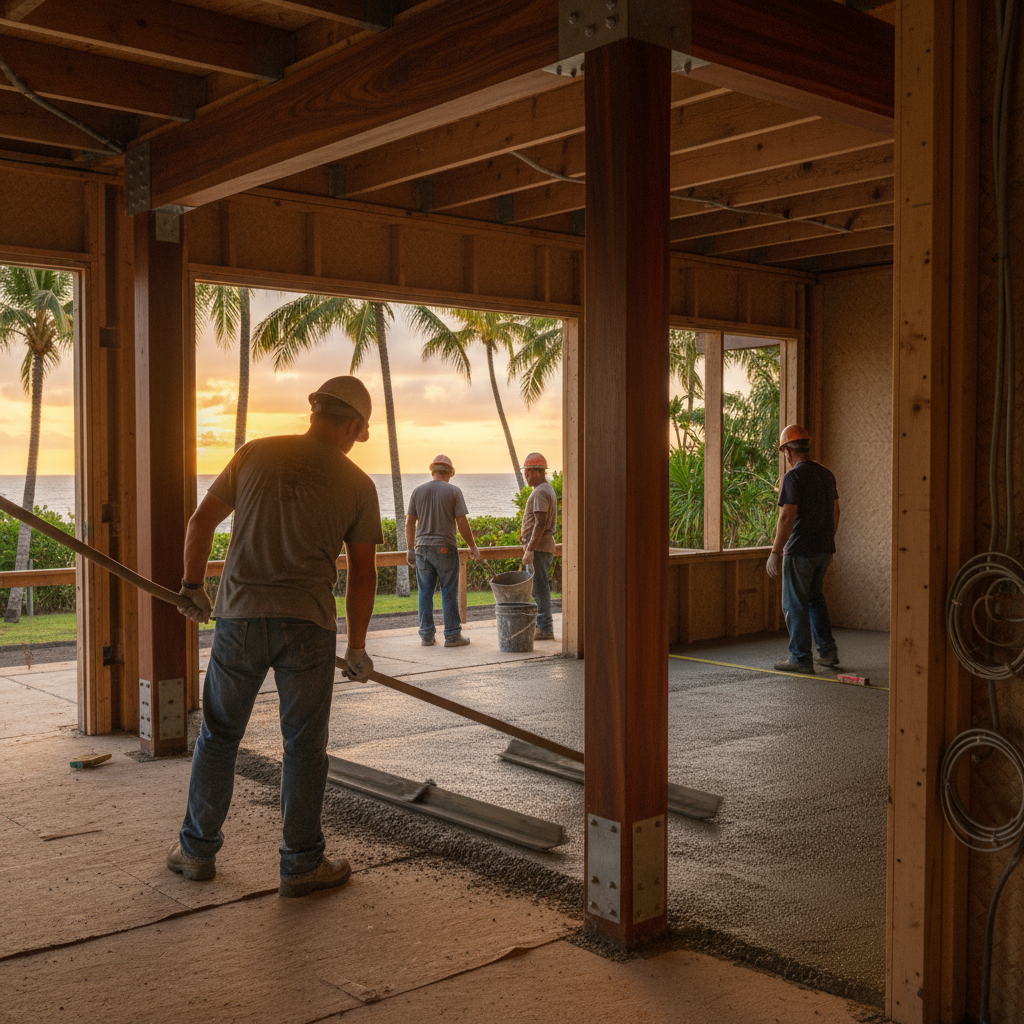
- Phase 5: The Pour & Finishing (1 day): Pour day is the main event. A concrete truck arrives, and the crew places, levels, and finishes the concrete. The finishing process is crucial for a durable and attractive surface.
- Phase 6: Curing & Form Stripping (1-28 days): The concrete needs to cure properly to reach its designed strength. We typically strip the forms after a day or two. You can usually walk on a new slab within 24-48 hours, but it needs to cure for at least 7 days before you can drive a car on it. It takes a full 28 days for concrete to reach its full design strength.
Cost-Saving Tip #2: Have your plans and engineering finalized *before* you engage a contractor for a final bid. Having a permit-ready set of drawings allows us to give you a fixed price and order materials immediately, which can shorten the overall project timeline by several weeks.
What Permits Do You Need for Concrete Contractor in Kaunakakai?
Navigating the permitting process is one of the most important services a qualified contractor provides. For any work done in Kaunakakai, you’re dealing with the County of Maui Department of Public Works. While their offices are on Maui, they handle all permitting for Moloka’i. Assuming you can get everything done online is a common mistake; neighbor island projects often require a more hands-on approach.
Here’s a general guide to when you do and don’t need a permit for concrete work in 2026:
When You Almost Certainly Need a Permit:
- New Concrete Foundations: Any structural foundation for a new home, ADU (Ohana Unit), or addition absolutely requires a building permit. This involves submitting full architectural and structural engineering plans.
- Retaining Walls: Any `retaining wall kaunakakai` that is over 4 feet tall (measured from the bottom of the footing to the top of the wall) requires a permit and engineered drawings. Walls supporting a surcharge (like a driveway or structure above it) may require a permit even if they are shorter.
- Structural Slabs: A concrete slab that is part of the structural support for a building, such as a second-floor slab or a raised foundation, will need a permit.
- Large Driveways or Patios: If the work is part of a larger new construction or renovation project that already requires a permit, the flatwork will be included in that permit scope. Extensive site work that alters drainage may also trigger the need for a grading permit.
When You Might Not Need a Permit:
- Finishes and Repairs: Resurfacing an existing patio or repairing minor cracks does not require a permit.
- Small, On-Grade Slabs: A simple, non-structural concrete pad for a shed (under 200 sq ft in most cases), an A/C unit, or a small walkway is typically exempt from permitting.
- Short, Non-Structural Walls: A small landscape wall under 4 feet that is not holding back a critical slope or structure is usually exempt.
The permit process itself involves several steps that we manage for our clients: plan submission, review by various county agencies (planning, building, etc.), responding to any comments or requests for more information, and paying the associated fees. The Honolulu Department of Planning and Permitting (DPP)[1] is known for its complexity, and while Maui County’s process is different, it still requires detailed knowledge to navigate efficiently. For Kaunakakai projects, we often have to coordinate virtual meetings or send a representative to Wailuku to resolve issues in person.
Cost-Saving Tip #3: Hire a licensed `general contractor` like Warrior Construction to handle your entire project. Trying to act as an owner-builder to save money on permitting often backfires. We can identify what work is exempt, and for work that isn’t, our experience ensures the application is complete and accurate, minimizing review cycles and delays which ultimately saves money.
Kaunakakai-Specific Considerations: Climate, Materials, Regulations
Building on Moloka’i is a unique challenge that demands local knowledge. What works for a project in Kapolei or Mililani won’t necessarily be the best approach in Kaunakakai. Our two decades of experience across the islands have taught us to pay close attention to the specific environmental and logistical factors of each location.
Climate: The Salt-Air Battle
The number one enemy of concrete in coastal Hawaii is `salt-air corrosion`. Chloride ions from the sea spray permeate porous concrete and attack the steel rebar inside, causing it to rust. As the rebar rusts, it expands, cracking the concrete from within in a process called spalling. To combat this, we take specific measures:
- Proper Mix Design: We specify a concrete mix with a low water-to-cement ratio (0.40 to 0.45) to create a denser, less permeable final product. We may also add a corrosion-inhibiting admixture to the mix for critical projects.
- Increased Concrete Cover: Building code might require 1.5 inches of concrete cover over rebar, but for a home in Kaunakakai, we insist on a minimum of 3 inches for any concrete exposed to the elements. This extra layer of protection can add 50 years to the life of a foundation.
- Corrosion-Resistant Rebar: For high-exposure areas, using galvanized or epoxy-coated rebar provides an excellent defense against corrosion, though it does add to the upfront material cost.
Materials & Logistics: The Barge is Everything
You can’t just call up a supplier and expect a delivery tomorrow in Kaunakakai. Every single piece of material that isn’t already on the island must be planned for weeks in advance. A concrete pour is a carefully orchestrated event. We must confirm the availability of concrete from the local batch plant and ensure our crew, formwork, rebar, and any special equipment (like a concrete pump) are all ready on the same day. If one piece of the puzzle is delayed on the barge, the entire project can grind to a halt.
Cost-Saving Tip #4: Plan for material substitutions. Sometimes a specific type of form tie or anchor bolt isn’t available to ship in time. A good contractor will have the expertise to identify an approved, available alternative to keep the project on track.
Regulations: Building Beyond Code
All construction in Hawaii must adhere to stringent `hurricane code` requirements, a legacy of Hurricane Iniki. For concrete work, this primarily concerns the foundation’s connection to the rest of the house. We are meticulous about the placement and installation of anchor bolts and hurricane straps (like Simpson Strong-Ties) that are embedded in the concrete foundation. These metal connectors create a continuous load path that literally ties the roof to the foundation, helping the structure resist uplift forces from hurricane-force winds. We don’t just build to meet the code; we build to exceed it, because we know what these homes might have to endure. While Oahu’s recent focus has been on regulations like Bill 7 for ADUs, the core principles of resilient, hurricane-ready construction apply everywhere.
How to Choose the Right Concrete Contractor Contractor in Kaunakakai
Hiring the right team is the single most important decision you’ll make for your project. A great contractor saves you money, stress, and time, while a bad one can be a nightmare. On an island like Moloka’i, where your options are more limited, it’s even more critical to do your homework.
Here’s our 7-point checklist for vetting any contractor:
- Verify Their License. Never hire an unlicensed contractor. Period. You can and should verify any contractor’s license on the Hawaii Department of Commerce and Consumer Affairs (DCCA) Professional & Vocational Licensing (PVL) website[2]. Look up their name or license number (ours is BC-34373) to ensure it’s active and in good standing.
- Confirm Their Insurance. A legitimate contractor must carry both General Liability insurance and Worker’s Compensation insurance. Ask for a Certificate of Insurance (COI). If a worker gets hurt on your property and the contractor isn’t insured, you could be held liable.
- Ask About Moloka’i-Specific Experience. This is a key differentiator. Ask them: “Tell me about the last project you completed on Moloka’i. What were the biggest logistical challenges and how did you solve them?” Their answer will tell you everything you need to know about their experience level.
- Get a Detailed, Itemized Bid. A one-page bid with a single number is a red flag. A professional proposal should break down the costs for materials, labor, equipment, and mobilization. This allows you to compare bids accurately and understand exactly what you’re paying for.
- Check References. Don’t just ask for a list of names. Ask for references from their last 2-3 projects, preferably ones similar to yours. Call those references and ask about communication, budget adherence, and overall quality.
- Assess Their Communication. During the bidding process, how responsive are they? Do they answer your questions clearly? A contractor who is a poor communicator before they have your money will not get better once the job starts.
- Trust Your Gut. At the end of the day, you’ll be working closely with this team for weeks or months. You need to feel comfortable with them and trust that they have your best interests at heart.
Cost-Saving Tip #5: Be wary of a bid that is significantly lower than all the others. It’s a major red flag that the contractor may have missed something, is using substandard materials, or is uninsured. That low bid can quickly become the most expensive one when you have to pay to fix their mistakes.
Real Kaunakakai Concrete Contractor Project Example
To illustrate how these principles come together, let’s walk through a recent project we completed for a family building their dream home just east of Kaunakakai.
The Project: A new 1,800-square-foot `concrete foundation kaunakakai` for a custom single-story home. The design was a monolithic slab-on-grade foundation with integrated footings.
The Challenge: The property was located in a high-velocity wind zone as designated by the building code, and a geotechnical report revealed the soil had poor compaction. Furthermore, the client wanted to incorporate a large, covered lanai that required a perfectly level, finished concrete surface integrated with the main foundation pour.
The Warrior Construction Solution: Our approach started with the soil. Instead of just scraping the lot level, we followed the geotech engineer’s recommendation to over-excavate by 24 inches and bring in 18 inches of compacted, engineered fill. This created a stable base that will prevent the foundation from shifting or cracking over time.
For the foundation itself, we worked with the structural engineer to design a slab that went beyond the bare minimum code requirements. We specified a thicker slab (5 inches instead of 4), used #4 rebar instead of #3, and placed the rebar grid at 16 inches on-center instead of the standard 18 inches. Most importantly, we carefully placed and mapped every single Simpson hurricane tie-down bolt, ensuring perfect alignment for the framing crew that would follow us.
Logistics & Execution: The biggest hurdle was logistics. We coordinated a single, large barge shipment from Oahu that included all the rebar, anchor bolts, forming materials, and a vapor barrier. The engineered fill was sourced from a local supplier on Moloka’i. Our on-site supervisor managed the entire process, from coordinating the delivery of the fill to scheduling the pre-pour inspection with the Maui County inspector. The pour itself involved two concrete trucks from the local plant, perfectly timed to ensure there were no ‘cold joints’ in the slab. Our expert finishers then went to work, creating a beautiful, smooth trowel finish for the interior and a non-slip broom finish for the exterior lanai.
The Outcome: The result was a rock-solid, perfectly level foundation that passed every inspection with flying colors. The project was completed within the 6-week timeline we projected. The total cost for the 1,800 sq ft foundation, including the extensive site prep and engineered fill, was approximately $68,400 (or $38/sq ft).
What this means for Hawaii homeowners
For homeowners in Kaunakakai, undertaking a concrete project requires a shift in mindset from typical mainland or even Oahu-based construction. Success hinges on acknowledging and planning for the island’s unique realities. You can’t fight the logistics or the environment, but you can certainly prepare for them.
Here are the key takeaways for your project:
- Budget for Logistics: Your budget must include a realistic line item for mobilization and inter-island shipping. This can be 15-25% of the total project cost. Trying to skimp here will only lead to problems.
- Embrace a Longer Timeline: Patience is essential. Permitting, barge schedules, and weather are all factors outside your direct control. Build buffer time into your schedule from the very beginning.
- Prioritize Durability Over Initial Cost: Given the corrosive salt-air environment, spending a little extra on a better concrete mix, more concrete cover for rebar, or galvanized hardware is one of the smartest investments you can make. It will save you tens of thousands in spalling repairs down the road.
- Hire Proven Neighbor Island Experience: Your single most effective cost-saving strategy is to hire a contractor who has a proven system for working on Moloka’i. Their expertise in logistics, sourcing, and scheduling will prevent costly mistakes and delays.
Cost-Saving Tip #6: Be decisive during the planning phase. Once materials are ordered and on the barge, making changes becomes extremely expensive. Finalize your design, layout, and finish choices before the contractor starts ordering materials to avoid change orders and wasted shipping costs.
Cost-Saving Tip #7: Perform as much site clearing as you can yourself, if you are able. If your project site needs to be cleared of green waste, rocks, or old debris, handling this yourself before the contractor mobilizes their heavy equipment can save you hundreds or even thousands in labor and disposal fees.
Frequently Asked Questions About Concrete Contractor in Kaunakakai
How much more does concrete work cost on Moloka’i vs. Oahu?
As of 2026, you should expect concrete work on Moloka’i to cost approximately 25% to 35% more than a comparable project in Honolulu. This premium covers the unavoidable costs of shipping all materials and sometimes equipment via barge, mobilization fees for the crew, and the general higher cost of doing business on a neighbor island.
Can I do a small concrete pour myself in Kaunakakai?
For a very small project like a footing for a mailbox post or a small A/C pad, a DIY approach using bags of concrete mix is feasible. However, for anything larger than about 20 square feet, the labor and consistency required make a professional contractor a much better choice. Proper finishing is a skill that takes years to master, and a poorly finished slab can be a permanent eyesore.
What is the best type of concrete for a driveway concrete kaunakakai?
For a driveway in our climate, we recommend a minimum of 3,000 PSI (pounds per square inch) compressive strength concrete. We also specify an ‘air-entrained’ mix, which contains microscopic air bubbles. This helps the concrete resist cracking from surface expansion and contraction and improves its overall durability and resistance to weathering.
How tall can a retaining wall kaunakakai be before I need an engineer?
Under Maui County regulations, any retaining wall that measures 4 feet or taller from the bottom of the footing to the top of the wall requires a building permit and plans stamped by a licensed structural engineer in the State of Hawaii. This is a critical safety rule, as a failing retaining wall can be catastrophic.
Does Warrior Construction work on Moloka’i?
Yes, absolutely. Warrior Construction has extensive experience managing and executing projects on Moloka’i and other neighbor islands. We have a dedicated process for logistics, material handling, and project management to ensure our neighbor island projects run as smoothly as our Oahu-based ones. We handle everything from mobilization to final inspection.
How do you prevent cracks in a new concrete slab?
While some hairline cracking is inevitable, we minimize significant cracks in three ways. First, we use the proper low-water concrete mix and ensure the subgrade is perfectly compacted. Second, we cut control joints into the slab within 24 hours of pouring to give the concrete a designated place to crack as it shrinks. Finally, we ensure the slab is cured properly, keeping it moist for several days to allow it to gain strength slowly.
Is a monolithic slab or a stem wall foundation better for Kaunakakai?
It depends on the specific site. A monolithic slab (where the footing and slab are poured as one piece) is often faster and more cost-effective for flat lots. A stem wall foundation (where footings are poured first, then a short wall is built, and the slab is poured inside) is better for sloped lots or in areas requiring more elevation to protect against flooding. We assess each site’s topography and soil to recommend the best and most cost-effective solution.
Planning a concrete project in Kaunakakai requires a contractor who is not just a builder, but also a logistician and a local expert. At Warrior Construction, our team has the hands-on experience and proven processes to deliver high-quality, long-lasting concrete work on Moloka’i. We understand the challenges and know how to manage them effectively.
If you’re ready to build a foundation, driveway, or retaining wall that will stand the test of time, our team is here to help. Explore our concrete and foundation services or contact us today for a comprehensive, no-obligation estimate for your Kaunakakai project.