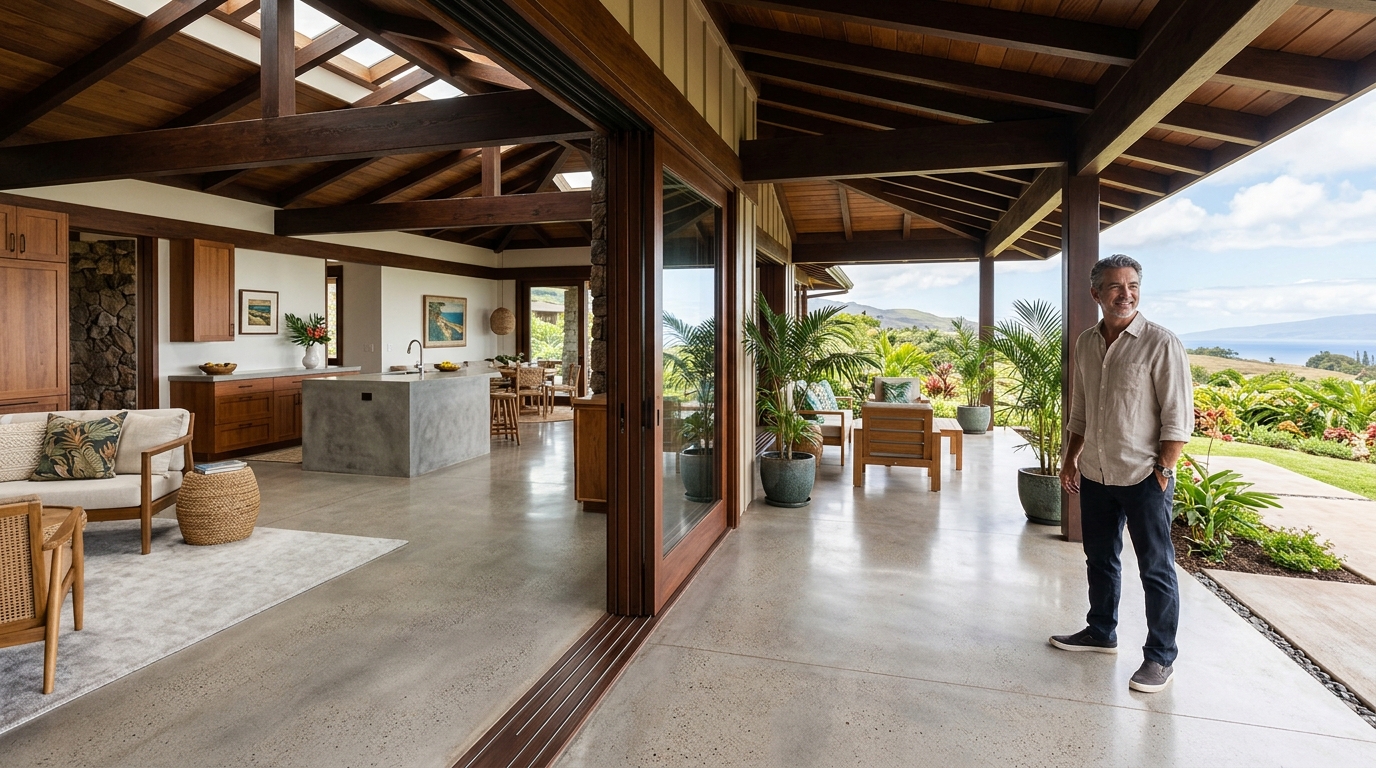
“Building on Lana’i isn’t like building anywhere else in Hawaii, let alone the mainland. As a concrete contractor in Lanai City for over two decades, our team at Warrior Construction knows that every yard of concrete, every piece of rebar, comes with a story of logistics and careful planning. The most common concrete projects we handle are foundations for new homes and ohana units, durable driveways that can handle the red dirt, and critical retaining walls for sloped properties. Due to the realities of barging every single material to the island, homeowners should expect costs to be roughly 25-40% higher than a similar project on Oahu.\n\nBut the extra cost and planning are worth it for a final product that stands up to the unique conditions on the Pineapple Isle. Getting the concrete right is the literal foundation of your home’s longevity. This means using the right mix design to combat the dry, windy climate, specifying corrosion-resistant materials to fight the constant salt air, and working with a general contractor who understands the nuances of the Maui County permitting process and the Young Brothers barge schedule. We’ve seen too many projects get delayed for weeks because a contractor new to Lana’i didn’t order materials far enough in advance.\n\nIn this guide, our team will walk you through the specifics of concrete work on Lana’i. We’ll break down the real costs, realistic timelines, and the critical factors that separate a bulletproof foundation from one that will cause headaches down the road. We’ll also share the eight most important upgrades we recommend to every Lanai City homeowner to ensure their investment lasts a lifetime.\n\n \n\n
\n\n
Why Lanai City Homeowners Trust Warrior Construction for Concrete Contractor
\n\nChoosing a concrete contractor on Lana’i requires a different level of scrutiny. You’re not just hiring a crew to pour a slab; you’re hiring a logistics manager, a materials expert, and a partner who understands the island’s unique rhythm. At Warrior Construction (License BC-34373), we’ve built our reputation on successfully navigating these challenges for projects across the neighbor islands. Our experience isn’t just about knowing how to form and pour concrete—it’s about knowing how to get the job done right, on time, and on budget in a remote location.\n\nFirst and foremost, our team has a deep understanding of neighbor island logistics. Every bag of cement, every stick of rebar, every form board has to be ordered weeks in advance and shipped from Oahu via barge. We have the process down to a science. We manage the ordering, trucking to the port in Honolulu, coordinating with Young Brothers, and arranging for pickup and delivery to your job site in Lanai City. This integrated approach prevents the costly delays that happen when a contractor miscalculates material needs or misses a barge cut-off. For a recent foundation project, we had to coordinate three separate concrete trucks to meet our pumper at the Manele Harbor barge landing at 6 AM sharp to ensure we could complete a 40-yard pour before the midday heat set in. That level of coordination is standard practice for us.\n\nFurthermore, we specialize in building for Hawaii’s specific environmental challenges. On Lana’i, the combination of persistent salt-laden trade winds and dry conditions requires a specialized approach. We don’t just use a standard concrete mix. We work with our suppliers to specify a mix with a lower water-to-cement ratio for increased density and often include additives like corrosion inhibitors to protect the rebar from the inside out. This is a critical detail that prevents spalling and degradation down the line, a common issue we see in older concrete work on the island.\n\nHere are the eight time-tested upgrades we build into our Lanai City concrete projects:\n\n
- \n
- Epoxy-Coated or Galvanized Rebar: A non-negotiable upgrade to combat salt-air corrosion and prevent concrete spalling.
- Corrosion-Inhibiting Admixtures: A chemical added to the concrete mix itself that creates a protective layer around the steel rebar.
- Higher PSI Concrete Mix: We typically specify a 4000 PSI mix instead of the standard 2500-3000 PSI for added durability and lower permeability.
- Vapor Barriers Under Slabs: A heavy-duty plastic sheeting placed under the foundation slab to block moisture from the ground, which is crucial for Lana’i’s volcanic soil.
- Proper Curing Techniques: We insist on extended wet curing or the use of high-quality spray-on curing compounds to prevent the surface from drying too quickly in the Lana’i wind, which causes cracking.
- Integrated Hurricane Straps: Embedding Simpson Strong-Tie straps directly into the foundation pour to create a continuous load path from the foundation to the roof, as required by modern hurricane code.
- Thicker Driveway Slabs: For any `driveway concrete lanai city` project, we recommend a 5-inch thick slab with rebar reinforcement, not just the minimum 4-inch wire mesh, to handle heavier vehicles and resist cracking.
- Engineered Footings: We always work from an engineered plan that specifies footing depth and width based on a soil analysis, ensuring the foundation is perfectly matched to the ground conditions on your specific lot.
\n
\n
\n
\n
\n
\n
\n
\n
\n\nOur commitment as a licensed general contractor is to build structures that last. That means doing it right from the ground up, starting with a foundation that is engineered and constructed specifically for Lana’i.\n\n
What Does Concrete Contractor Cost in Lanai City?
\n\nCalculating the cost for a concrete contractor in Lanai City involves more than just square footage. The final price tag is heavily influenced by logistics, material enhancements, and labor mobilization. As a baseline in 2026, homeowners can expect to pay between $35 to $55 per square foot for a standard 4-inch concrete slab on Lana’i. This is a significant jump from the $25-$40 per square foot we might see for a similar project in Kapolei or Ewa Beach.\n\nLet’s break down why.\n\n
- \n
- Material Costs & Shipping: A cubic yard of ready-mix concrete that costs $225 on Oahu can easily reach $350-$400 by the time it’s delivered to a job site in Lanai City. This price includes the cost of barging the raw materials (cement, sand, aggregate) to the island and the operational costs of the local batch plant. Rebar, form lumber, and accessories all carry a similar premium of 30-50% to cover shipping.
- Labor & Mobilization: While we hire local labor whenever possible, specialized crews like concrete finishers or pump truck operators often need to be brought over from Maui or Oahu. This involves costs for flights, accommodation, and per diem, which are factored into the overall labor rate.
- Equipment Rental and Transport: Heavy equipment like excavators, concrete pumps, and concrete trucks are expensive to operate and maintain on a neighbor island. If a specific piece of equipment isn’t available on Lana’i, it must be barged over, adding thousands to the project cost.
\n
\n
\n
\n\nHere are some realistic 2026 cost estimates for common Lanai City concrete projects:\n\n
| Project Type | Typical Size | Estimated Cost Range (Lana’i) | Key Cost Factors |
|---|---|---|---|
| Standard Driveway | 600 sq. ft. (24′ x 25′) | $21,000 – $30,000 | 5-inch thickness, rebar grid, broom finish, minor grading. |
| House Foundation Slab | 1,500 sq. ft. | $60,000 – $82,500 | Engineered footings, vapor barrier, plumbing block-outs, termite treatment. |
| Retaining Wall | 100 linear feet, 4′ high | $35,000 – $50,000+ | Requires extensive engineering, deep footings, significant rebar, and drainage systems. Cost for a `retaining wall lanai city` can vary dramatically with height and soil conditions. |
| Patio or Walkway | 300 sq. ft. | $9,000 – $15,000 | Includes forming, basic finish, and minimal site prep. Stamped or stained finishes add 20-30%. |
\n\nFor a `concrete foundation lanai city` project, the cost per square foot is higher than a simple flat slab because it includes much more labor and material for digging and forming the footings, which are the thickened edges of the foundation that bear the weight of the walls. These footings can be 24 inches deep and 16 inches wide, requiring a substantial amount of extra concrete and rebar. The complexity of the home’s footprint also plays a big role; a simple rectangle is far more affordable than a design with many corners and jogs.\n\nWhen you receive a quote from our team, it will be a comprehensive breakdown of all these costs. We believe in transparency, so you’ll see exactly where your money is going—from the barge fees to the specific grade of rebar we’re using. You can start the process by requesting a free estimate from our website.\n\n
How Long Does a Concrete Contractor Take in Lanai City?
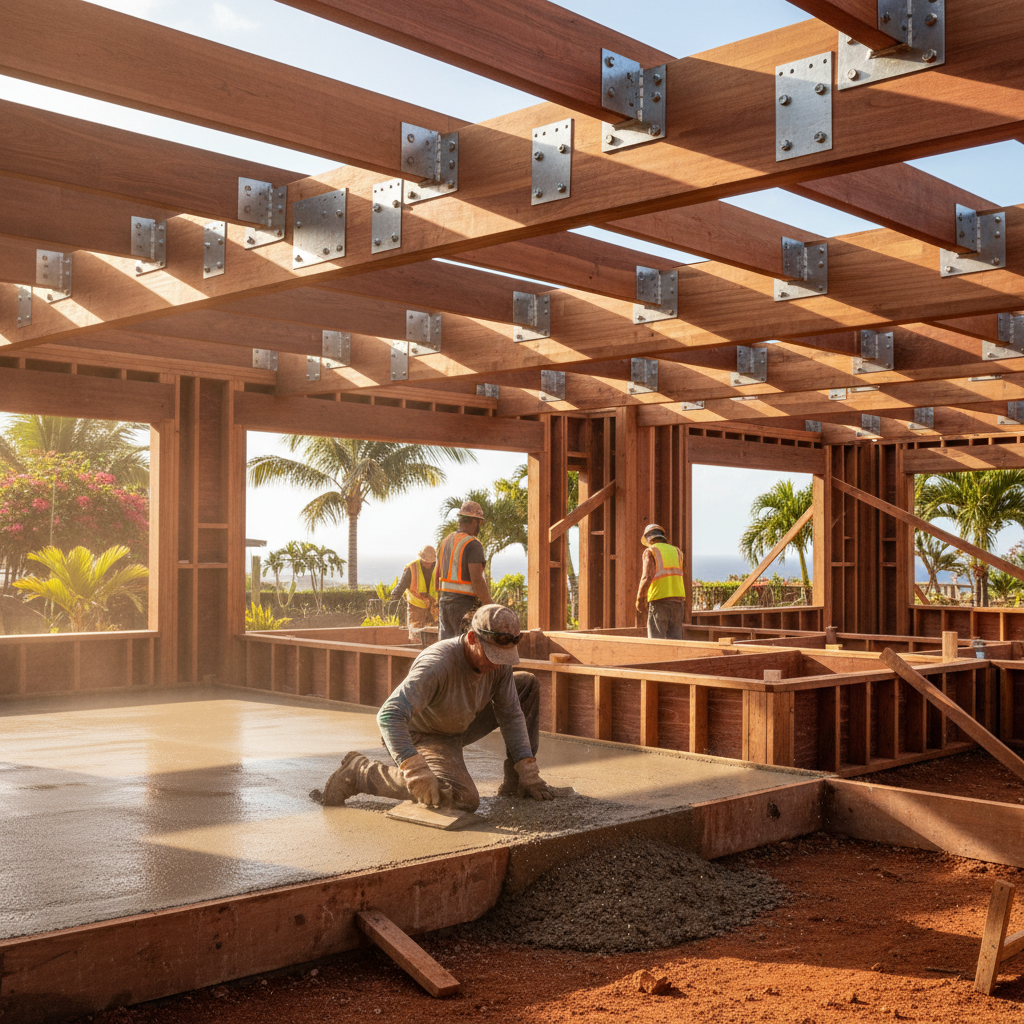
\n\nThe timeline for a concrete project in Lanai City is dictated as much by the barge schedule as it is by the construction work itself. Homeowners need to factor in additional time for logistics that simply don’t exist on Oahu. A foundation that might take 4-5 weeks from start to finish in Honolulu could easily stretch to 7-9 weeks on Lana’i.\n\nHere’s a step-by-step breakdown of a typical timeline for a 1,500 sq. ft. home foundation on Lana’i in 2026:\n\n
- \n
- Week 1-3: Permitting and Material Ordering. Before any dirt is moved, we need an approved building permit from Maui County. The review process can take several weeks. Concurrently, as soon as the plans are finalized, we place all material orders. This includes rebar, form lumber, anchor bolts, hurricane straps, and vapor barrier. These materials must be consolidated on Oahu and booked for a spot on the Young Brothers barge. This lead time is non-negotiable.
- Week 4: Site Prep and Excavation. Once the permit is in hand and we have confirmation the materials have landed on Lana’i, our crew mobilizes. This week is dedicated to clearing the site, staking out the foundation footprint, and excavating the trenches for the footings. Depending on the soil—Lana’i’s red dirt can be hard and rocky—this might take a few extra days.
- Week 5: Forming and Rebar. The crew builds the wooden forms that will shape the concrete. It’s meticulous work that has to be perfectly level and square. Inside these forms, they place the steel rebar cage for the footings and the rebar grid for the main slab, tying every intersection by hand. This is also when underslab plumbing and electrical conduits are installed.
- Week 6: Inspections and Pre-Pour Prep. This is a critical pause point. We must schedule an inspection with a Maui County building inspector, who often has to fly over. They will meticulously check the footing depth, rebar placement and spacing, and all underslab installations. If anything fails, it has to be corrected and re-inspected, which can add a week or more to the schedule. Once the inspection passes, we do a final prep, installing the vapor barrier and ensuring the site is ready for the pour.
- Week 7: The Pour Day. This is the most coordinated day of the entire project. We schedule the concrete delivery from the local batch plant for an early morning start. The concrete pump truck gets into position, and the pour begins. A team of skilled finishers works quickly to spread, level, and smooth the concrete before it starts to set. For a 1,500 sq. ft. foundation, this is an all-day affair involving 40-50 cubic yards of concrete.
- Week 8-9: Curing and Stripping Forms. The concrete isn’t finished when it’s hard. It needs to cure properly to reach its full design strength. We cover the slab and keep it moist for at least 7 days. Rushing this step, especially in Lana’i’s dry, windy weather, is the #1 cause of surface cracking. After the initial curing period, we strip the wooden forms and begin backfilling around the foundation. The slab should not have heavy loads placed on it for at least 28 days.
\n
\n
\n
\n
\n
\n
\n\nAs you can see, almost half the timeline is dedicated to planning, logistics, and inspections. A contractor who doesn’t account for these neighbor island realities from the start is setting a project up for failure and frustrating delays. Our project managers build these buffers into every Lanai City schedule to provide a realistic and achievable timeline from day one.\n\n
What Permits Do You Need for Concrete Contractor in Lanai City?
\n\nNavigating the permitting process is one of the most crucial roles a general contractor plays, and on Lana’i, it comes with its own set of rules. Lana’i is part of Maui County, so all permits are issued by the Maui County Department of Public Works, not the Honolulu Department of Planning and Permitting (DPP)[1]. While the underlying building codes are similar statewide, the submission process, review timelines, and specific requirements are unique to Maui County.\n\nFor most concrete work, you will need a Building Permit. This is required for any structural project, including:\n\n
- \n
- New home foundations or slabs
- Foundations for additions or ohana units
- Retaining walls over four feet in height (or any height if they are supporting a surcharge, like a driveway)
- Raised concrete lanais or decks
\n
\n
\n
\n
\n\nSimple flatwork, like a `driveway concrete lanai city` replacement or a small patio at ground level, may not require a full building permit, but it’s always best to verify with the county. Sometimes a simpler “Grading and Grubbing Permit” might be needed if you are moving a significant amount of soil to prepare the site.\n\nTo obtain a building permit for a new foundation, our team prepares and submits a comprehensive package through Maui County’s online portal, MAPPS (Maui Application and Planning Permitting System). This package typically includes:\n\n
- \n
- Completed Application Forms: Official documents detailing the scope of work, property owner, and licensed contractor (that’s us, Warrior Construction, BC-34373).
- Engineered Structural Plans: Detailed blueprints stamped by a Hawaii-licensed structural engineer. These plans show the foundation’s dimensions, footing sizes, rebar schedule, and connection details. This is not optional.
- Site Plan: A drawing showing the location of the proposed work on your property, including setbacks from property lines.
- Soil Report: For new homes, a geotechnical report may be required to analyze the soil conditions and inform the foundation design.
\n
\n
\n
\n
\n\nOnce submitted, the plans go through a review process with various Maui County agencies. A plans examiner will check for compliance with the building code, zoning code, and other local ordinances. On average, you can expect this review process to take anywhere from 4 to 12 weeks for a standard residential project in 2026. Because there are fewer reviewers covering a large geographic area (Maui, Molokai, and Lana’i), the timeline can sometimes be less predictable than on Oahu.\n\nOur role as your general contractor is to manage this entire process. We work with the architects and engineers to ensure the plans are complete and accurate before submission, and we act as the point of contact with the county, responding to any questions or requests for clarification from the plan reviewers. This hands-on management prevents unnecessary delays and keeps your project moving forward.\n\n
Lanai City-Specific Considerations: Climate, Materials, Regulations
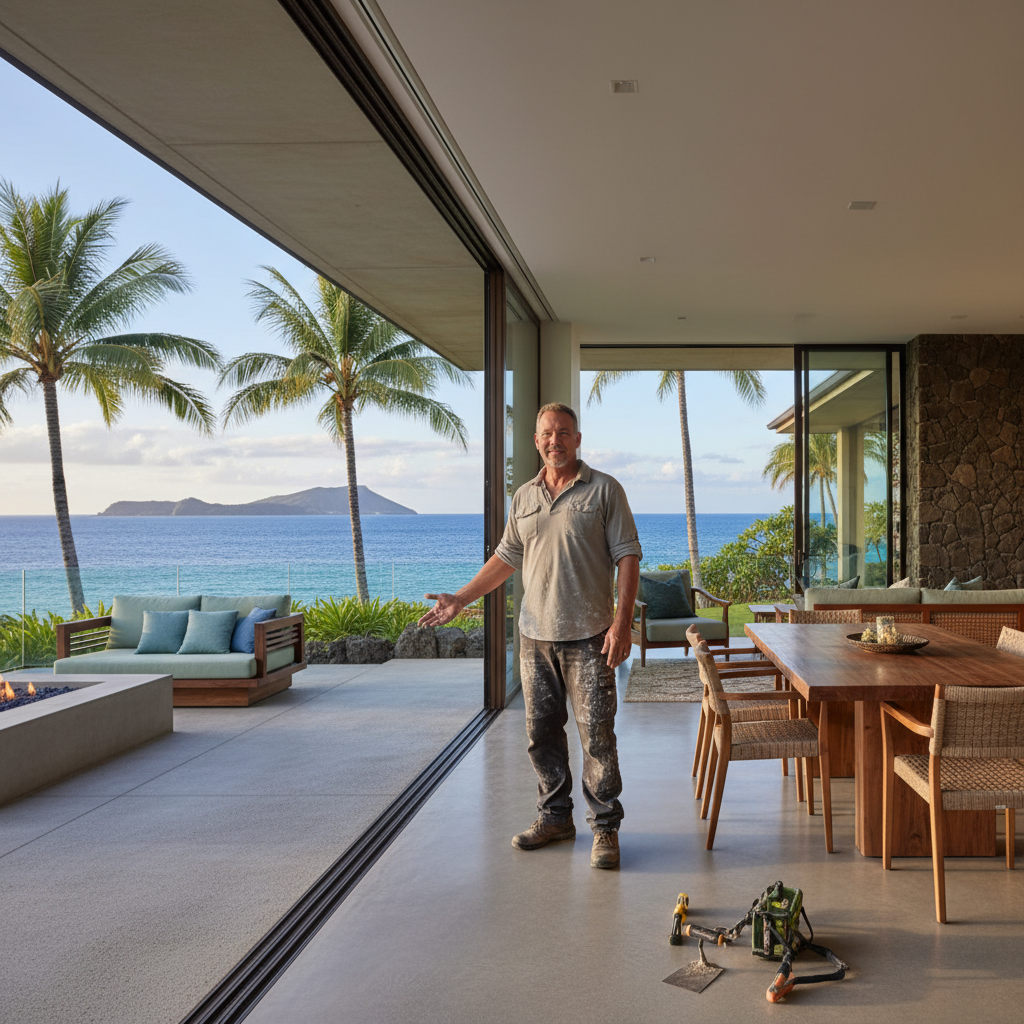
\n\nBuilding on Lana’i presents a unique convergence of logistical, environmental, and regulatory challenges that every concrete project must address. Success hinges on anticipating these factors, not reacting to them.\n\n### Climate and Curing\nLana’i’s climate is generally drier and windier than much of Oahu. While this makes for beautiful weather, it’s problematic for fresh concrete. The wind and low humidity can cause the surface water in a new slab to evaporate too quickly. This rapid drying leads to plastic shrinkage cracking—a web of fine cracks that can compromise the surface integrity and appearance of the slab. To combat this, our finishing crews are experts in hot-weather concreting techniques. We often use evaporation reducers (a chemical film sprayed on the surface during finishing) and insist on a rigorous curing process. This involves either covering the slab with plastic and keeping it continuously wet for 7 days (wet curing) or applying a high-solids, membrane-forming curing compound immediately after finishing to lock in moisture.\n\n### Material Sourcing and Logistics\nThis is the single biggest factor affecting cost and schedule. There is no large-scale quarry or building supply superstore on Lana’i. Virtually everything is barged in. A typical `concrete foundation lanai city` project requires:\n
- \n
- Cement, Sand, Aggregate: These raw materials are shipped to the local ready-mix plant on Lana’i to be batched into concrete. The capacity of this plant and the barge schedule for resupply dictate when large pours can happen.
- Steel Rebar: Ordered from a supplier on Oahu, cut and bent to specification, then bundled and shipped in a container or on a flat rack. We always order at least 10% extra to account for any waste or last-minute changes, as getting a few extra sticks of rebar can take weeks.
- Formwork & Accessories: Plywood, lumber for bracing, form ties, anchor bolts, and hurricane straps are all consolidated at our Oahu warehouse before being shipped over.
\n
\n
\n
\nWe build our project schedules around the Young Brothers sailing schedule. Missing a Tuesday cutoff for the weekly barge can mean a full week’s delay on site. This is a lesson many off-island contractors learn the hard way.\n\n### Regulations and Hurricane Code\nAs part of Maui County, Lanai City adheres to the International Building Code with Hawaii-specific amendments. A critical part of this is the hurricane code, which became much more stringent after Hurricane Iniki in 1992. For foundations, this means creating a continuous load path to resist uplift forces from high winds. We do this by embedding heavy-gauge steel straps, like Simpson HDU hold-downs, directly into the wet concrete of the footings. These straps are then nailed to the wall framing, which connects to the roof trusses. This system ensures the entire house is securely anchored to the foundation. Maui County inspectors are extremely strict about the placement and quantity of these connections, and we have them pre-inspected before every pour.\n\n
How to Choose the Right Concrete Contractor Contractor in Lanai City
\n\nSelecting the right contractor is the most important decision you’ll make for your project. On Lana’i, where the margin for error is slim and the cost of mistakes is high, this choice is even more critical. A low bid from a contractor without neighbor island experience can quickly turn into a costly nightmare of delays and change orders.\n\nHere is a checklist of what to look for and the questions you should ask:\n\n
- \n
- Verify Their License and Insurance. This is non-negotiable. Any contractor performing work over $1,000 must have a valid Hawaii contractor’s license. You can verify our license, BC-34373, and any other contractor’s status on the state’s Professional & Vocational Licensing (PVL) website[2]. Also, ask for a certificate of insurance showing they carry both general liability and worker’s compensation. Without it, you could be held liable for accidents on your property.
- Ask About Their Neighbor Island Experience. Be specific. Don’t just ask, \”Do you work on Lana’i?\” Ask: \”Describe your process for material logistics to Lana’i. How do you handle crew travel and housing? Tell me about a time a barge was delayed and how you managed the project schedule.\” A seasoned contractor will have detailed, immediate answers. They should be able to talk about coordinating with the harbor master at Kaumalapau or Manele and the local trucking companies.
- Review Their Portfolio of Similar Work. Ask to see photos and project details of foundations, driveways, or retaining walls they have completed in Hawaii, preferably on a neighbor island. A picture of a finished project shows they can get the job done. Our portfolio showcases a range of projects from complex custom homes to detailed renovations.
- Inquire About Their On-Island Presence. Do they have a reliable on-island supervisor? Or will they be trying to manage the job from Oahu with infrequent site visits? For a project to run smoothly, you need consistent, daily oversight. Our team establishes a command center for every neighbor island project, with a dedicated project manager who is on-site or in constant communication with the site foreman.
- Get a Detailed, Written Contract. The contract should clearly specify the scope of work, a detailed materials list (including concrete PSI and rebar type), a payment schedule, a projected timeline, and a process for handling change orders. Vague contracts lead to misunderstandings and disputes. We provide exhaustive contracts that protect both the homeowner and our company.
- Check Their References. Talk to their past clients, especially those on Lana’i or Molokai. Ask about their communication, professionalism, ability to stick to the budget, and the quality of the final product. A reputable contractor will be happy to provide you with a list of references.
\n
\n
\n
\n
\n
\n
\n\nChoosing a contractor based solely on the lowest price is the biggest mistake a homeowner can make, especially on Lana’i. The cheapest bid often leaves out crucial elements like corrosion protection, proper curing, or sufficient logistical planning, which will end up costing you far more in the long run through delays or premature failure.\n\n
Real Lanai City Concrete Contractor Project Example
\n\nTo illustrate how these principles work in the real world, let’s look at a recent project we completed for a family building an ohana unit in the highlands above Lanai City.\n\n**The Project:** A new 950 sq. ft. `concrete foundation lanai city` for a two-bedroom accessory dwelling unit (ADU). The lot had a moderate slope, requiring a stepped foundation and a small, engineered `retaining wall lanai city` to create a level yard space.\n\n**The Challenge:** The primary challenge was the rocky volcanic soil and the logistical puzzle of a complex pour on a sloped site. The initial excavation revealed large boulders that had to be hammered and removed, adding two days to the site prep schedule. Furthermore, the design required two different concrete pours: one for the deep footings of the 5-foot-high retaining wall, and a second, larger pour for the main house slab.\n\n**Our Solution and Process:**\n
- \n
- Logistics First: Three weeks before starting, we booked space on two separate barges. The first carried all the rebar, form lumber, and drainage materials for the retaining wall. The second, a week later, carried the materials for the house slab, including the vapor barrier and all the embedded hurricane straps. This staggered approach ensured materials weren’t sitting on site for too long but were there exactly when needed.
- Engineering and Inspection Coordination: We worked closely with the structural engineer to adjust the footing design in the field to accommodate the unexpected rock formations. We then coordinated with the Maui County inspector to fly in for two separate key inspections: one for the retaining wall steel before its pour, and a second for the main foundation’s rebar and underslab plumbing. Bundling inspections is key to keeping neighbor island projects moving.
- The Pour Plan: The sloped site made a standard concrete truck chute impossible. We barged over a small line pump from Maui. For the first pour (15 yards for the retaining wall), we used the pump to place the concrete precisely into the tall forms. For the main slab pour (35 yards), the pump allowed us to reach every corner of the foundation from a single setup location, minimizing disturbance to the site and speeding up the process.
- Quality Control: Our site supervisor was on hand for both pours, checking the consistency of each truckload of concrete. We used a 4000 PSI mix with an integral corrosion inhibitor. Immediately after the finishers completed their work, the slab was coated with a liquid curing compound to protect it from the hot, windy conditions.
\n
\n
\n
\n
\n\n**The Result:** The project was completed within one week of the original 8-week schedule, even with the excavation delay. The final cost was $78,500, which was within 5% of our initial budget, with the increase directly attributable to the extra rock-breaking work. The client had a rock-solid, perfectly engineered foundation, ready for the framing crew to start on schedule. This is the kind of predictable, professional outcome that deep logistical planning and experience provides.\n\n
What this means for Hawaii homeowners
\n
For any homeowner planning a project involving concrete on Lana’i, the key takeaway is that planning and logistics are just as important as the physical construction itself. You’re not just building on an island; you’re building on an island supplied by another island. This reality must inform your budget, your timeline, and most importantly, your choice of contractor. Here are the actionable steps to take:
\n
- \n
- Budget for the \”Lana’i Premium\”: When you get cost estimates, assume a 25-40% premium over Oahu prices for any concrete work. If a quote seems too good to be true, it likely is and is missing key logistical costs that will appear later as change orders.
- Add a Time Buffer: Plan for your project to take at least 3-4 weeks longer than a similar one on Oahu. This accounts for barge schedules, inspector availability, and potential weather delays. Patience is a virtue in neighbor island construction.
- Prioritize Durability Over Cost: Insist on upgrades like epoxy-coated rebar and corrosion-inhibiting admixtures. The small upfront investment (typically adding 5-8% to the foundation cost) will save you tens ofthousands of dollars in spalling repairs 15-20 years down the road.
- Hire a Proven Logistics Manager: Your general contractor’s primary role in the early stages of a Lana’i project is managing the supply chain. Choose a company like Warrior Construction that can demonstrate a clear, proven process for getting materials and skilled labor to your job site predictably and efficiently.
\n
\n
\n
\n
\n
\n\n
Frequently Asked Questions About Concrete Contractor in Lanai City
\n
How thick should my driveway be in Lanai City?
\n
For a standard residential `driveway concrete lanai city` project, we strongly recommend a minimum thickness of 5 inches. While some contractors may quote a 4-inch slab to save money, the extra inch of concrete, combined with a grid of #3 rebar, provides significantly more strength to resist cracking from heavy vehicles like SUVs and pickup trucks, or even the occasional delivery truck. It’s a small upfront cost that drastically improves the driveway’s lifespan.
\n
\n
What is the best concrete mix for Lana’i’s climate?
\n
We specify a minimum of 4000 PSI (pounds per square inch) compressive strength for most structural applications on Lana’i, including foundations and driveways. This higher-strength mix is denser and less permeable than standard 3000 PSI concrete, offering better protection against moisture and salt intrusion. We also often recommend adding a corrosion-inhibiting admixture directly into the mix for maximum rebar protection.
\n
\n
Do I need an engineer for a simple retaining wall?
\n
Yes, absolutely. In Hawaii, any retaining wall over 4 feet tall requires a building permit and stamped engineering plans. Even for walls under 4 feet, we advise getting an engineer involved if it’s supporting a critical load like a driveway, a hillside, or the foundation of your home. The soil pressure on a retaining wall is immense, and improper design is a recipe for failure.
\n
\n
Can I get stamped or colored concrete on Lana’i?
\n
Yes, decorative concrete finishes like stamping and integral color are available on Lana’i, but they come at a premium due to logistics. The coloring agents and stamping tools must be barged in. Furthermore, it requires highly skilled finishers who often must travel to the island. You can expect decorative finishes to add $8 to $15 per square foot to your total project cost.
\n
\n
How much more does a concrete project really cost on Lana’i versus Honolulu?
\n
In 2026, a safe estimate is to budget for a 25-40% cost increase. For example, a $50,000 foundation on Oahu would likely cost between $62,500 and $70,000 on Lana’i. This increase covers all logistical aspects: barging every material, inter-island travel and housing for specialized crews, and the higher operational costs of equipment on a remote island.
\n
\n
How do you handle concrete waste and washout on Lana’i?
\n
This is a critical environmental consideration. We use a designated, plastic-lined washout area on site where chutes and tools can be cleaned. The hardened concrete waste is then broken up and properly disposed of. We never allow concrete washout to enter the ground or storm drains, following all Maui County and State environmental regulations to protect Lana’i’s natural resources.
\n
\n
What causes cracks in new concrete, and can they be prevented?
\n
The most common cause of cracking in new concrete on Lana’i is rapid drying from the wind and sun, known as plastic shrinkage. While it’s impossible to prevent all microscopic cracking, major cracks are preventable through proper techniques. This includes using the correct water-to-cement ratio, avoiding adding water on site, using evaporation reducers, and most importantly, proper curing for at least seven days. We also cut control joints into the slab within 24 hours of pouring to encourage the concrete to crack in a straight, clean line where we want it to.
\n
\n
\n\n
Start Your Lanai City Project on a Solid Foundation
\n
Building on Lana’i requires a partner who understands the unique challenges and has a proven track record of delivering results. From meticulous logistical planning to expert execution, the Warrior Construction team ensures your concrete work is built to last. Whether you’re planning a new custom home, an ohana unit, or a durable new driveway, let’s build it right from the ground up.
\n
If you’re ready to discuss your project, explore our Concrete & Foundations services and contact us for a comprehensive, no-obligation estimate.
\n
\n\n
References
\n