“
Hiring a concrete contractor in Lihue means looking beyond a simple price per square foot. Here on Kaua’i, you’re dealing with unique challenges that mainland contractors never see: corrosive salt air whipping in from Nawiliwili, expansive red dirt that can crack a poorly prepped slab, and a permitting process with its own island rhythm. For a standard 4-inch broom-finished driveway in Lihue in 2026, you should budget around $30 to $45 per square foot, and for a proper engineered foundation, that number can climb to $65 per square foot. The difference between a slab that lasts five years and one that lasts fifty comes down to a contractor’s deep, on-the-ground knowledge of these local conditions.
\n\n
For over 20 years, our team at Warrior Construction has been pouring concrete across Hawaii, and we’ve seen firsthand what happens when shortcuts are taken on the Garden Isle. A foundation without the right vapor barrier and termite treatment becomes a costly nightmare. A retaining wall without proper drainage engineering can fail under the pressure of our heavy seasonal rains. This guide isn’t just about concrete; it’s about making a smart, long-term investment in your Kaua’i property. We’ll walk you through understanding real 2026 costs, navigating the Kaua’i County permitting office, and asking the right questions to ensure you hire a truly qualified professional who understands how to build for our island.
\n\n
Why Lihue Homeowners Trust Warrior Construction for Concrete Contractor
\n\n
When you’re looking for a concrete contractor in Lihue, you’re not just hiring someone to pour and finish a slab. You’re bringing on a partner who needs to understand the very ground your home sits on. At Warrior Construction, our reputation on Kaua’i is built on a foundation of local knowledge, earned project by project. We’re a fully licensed Hawaii General Contractor (BC-34373), and that license represents decades of experience navigating the specific building science of our islands, from the shores of Poipu to the lush valleys of Hanalei.
\n\n
Just last year, we were working on a project in the Puhi area, just outside Lihue. The plan was a simple patio extension. But when we started excavating, we found the soil was far more expansive clay than anticipated. A less experienced crew might have just laid down some gravel and poured. Our team knew better. We stopped, brought in a soil engineer for a quick consult, and ended up over-excavating an additional 12 inches to install a properly engineered, multi-layered compacted base. It added a day to the schedule and a little to the budget, but it meant the homeowner’s new lanai won’t heave and crack after the first few rainy seasons. That’s the difference local experience makes.
\n\n
Here’s what sets our approach apart for Lihue homeowners:
\n
- \n
- Deep Kaua’i Knowledge: We don’t use a one-size-fits-all approach. We understand the high-salinity environment near the coast requires different concrete mix designs (higher PSI, sometimes epoxy-coated rebar) than a project up in Kapa’a. We know how to manage drainage around the island’s unique topography.
- Transparent Bidding: Our proposals aren’t just a single number on a piece of paper. We provide a detailed breakdown covering demolition, site prep, base material, rebar specification, concrete yardage and PSI, finishing labor, and cleanup. You’ll see exactly where every dollar goes.
- Logistical Mastery: Getting materials to Kaua’i is a constant dance with barge schedules and supplier inventory. We have long-standing relationships with local suppliers and manage the entire supply chain, ensuring your project isn’t held up waiting for a rebar shipment from Oahu.
- Unwavering Commitment to Code: Hurricane Iniki forever changed how we build on Kaua’i. Our work doesn’t just meet the code; it exceeds it. We ensure every foundation has the correct tie-ins and that every structural element is designed to withstand hurricane-force winds. Our extensive portfolio of projects stands as a testament to this commitment.
\n
\n
\n
\n
\n\n
Ultimately, homeowners trust us because we build it right the first time. We live here, our families are here, and our reputation is on every job site. We treat your home’s foundation with the same care and precision as we would our own.
\n\n
What Does Concrete Contractor Cost in Lihue?
\n\n
Let’s get straight to the numbers, because that’s what every homeowner wants to know. In 2026, concrete work in Lihue is more expensive than on the mainland, and even slightly higher than in Honolulu. This isn’t about price gouging; it’s the simple reality of island logistics. Every bag of cement, every piece of rebar, every yard of aggregate has to get here on a barge, and that shipping cost is baked into the final price. A smart homeowner budgets for these Kaua’i-specific realities.
\n\n
Here’s a detailed breakdown of what you can expect to pay for common concrete projects in the Lihue area:
\n\n
| Project Type | 2026 Estimated Cost per Square Foot (Lihue) | Key Details & Inclusions |
|---|---|---|
| Standard 4\” Driveway / Patio | $30 – $45 | Includes basic site prep, 4\” compacted gravel base, wire mesh or light rebar, 3000 PSI concrete, and a standard broom finish. Price varies with site access. |
| Concrete Foundation Lihue (Slab-on-Grade) | $45 – $65 | For a new home or addition. Includes engineered footings, #4 rebar grid, vapor barrier, perimeter insulation, termite treatment, and a smooth trowel finish. |
| Retaining Wall Lihue (CMU Block) | $80 – $120 (per wall face sq. ft.) | Includes footing, vertical and horizontal rebar, solid grouting. Walls over 4 feet require engineering and permitting, which adds to the cost. |
| Stamped or Stained Concrete | Add $10 – $20 to base cost | This is an upgrade. The cost covers the stamps, integral color or stains, release agents, and sealing labor. More complex patterns cost more. |
| Demolition & Haul-Away | $5 – $10 per sq. ft. | Cost to break up and remove an existing concrete slab. This is a separate line item from the new pour. |
\n
\n\n
Factors That Influence Your Final Cost
\n
The table above gives you a solid starting point, but several factors can move the price up or down. As your concrete contractor, we assess these during our initial site visit:
\n
- \n
- Site Access: Can a full-size concrete truck get right up to the pour site? If we have to use a pump truck or wheelbarrows to move the concrete from the street, it adds significant labor costs. A recent project in a tight Kapa’a neighborhood required a concrete pump for the entire foundation, adding about $2,500 to the total job cost.
- Level of Site Prep: Is the area flat and clear, or do we need to do extensive excavation, grading, and soil compaction? Dealing with Kaua’i’s heavy clay soil or volcanic rock can increase preparation time and costs.
- Reinforcement Requirements: A simple patio might only need wire mesh. An engineered foundation or a driveway for a heavy vehicle will require a thicker grid of #4 or #5 rebar, which increases both material and labor costs. For coastal areas, we strongly recommend epoxy-coated rebar to fight salt-air corrosion, which adds about 15-20% to the steel cost but decades to the lifespan of the slab.
- Finish Complexity: A standard broom finish is the most cost-effective. A smooth, power-troweled finish for a garage is more labor-intensive. Stamped, colored, or exposed aggregate finishes are at the top end of the price range due to the extra materials and skilled labor required.
\n
\n
\n
\n
\n\n
When you get a bid, make sure it clearly specifies the concrete PSI (pounds per square inch). For most exterior flatwork in Lihue, we won’t use anything less than 3,000 PSI. For driveways and foundations, we often spec 3,500 or 4,000 PSI for added durability against our humid, rainy climate. Getting a detailed bid is the first step toward a successful project without any surprise costs.
\n\n
How Long Does a Concrete Contractor Take in Lihue?
\n\n
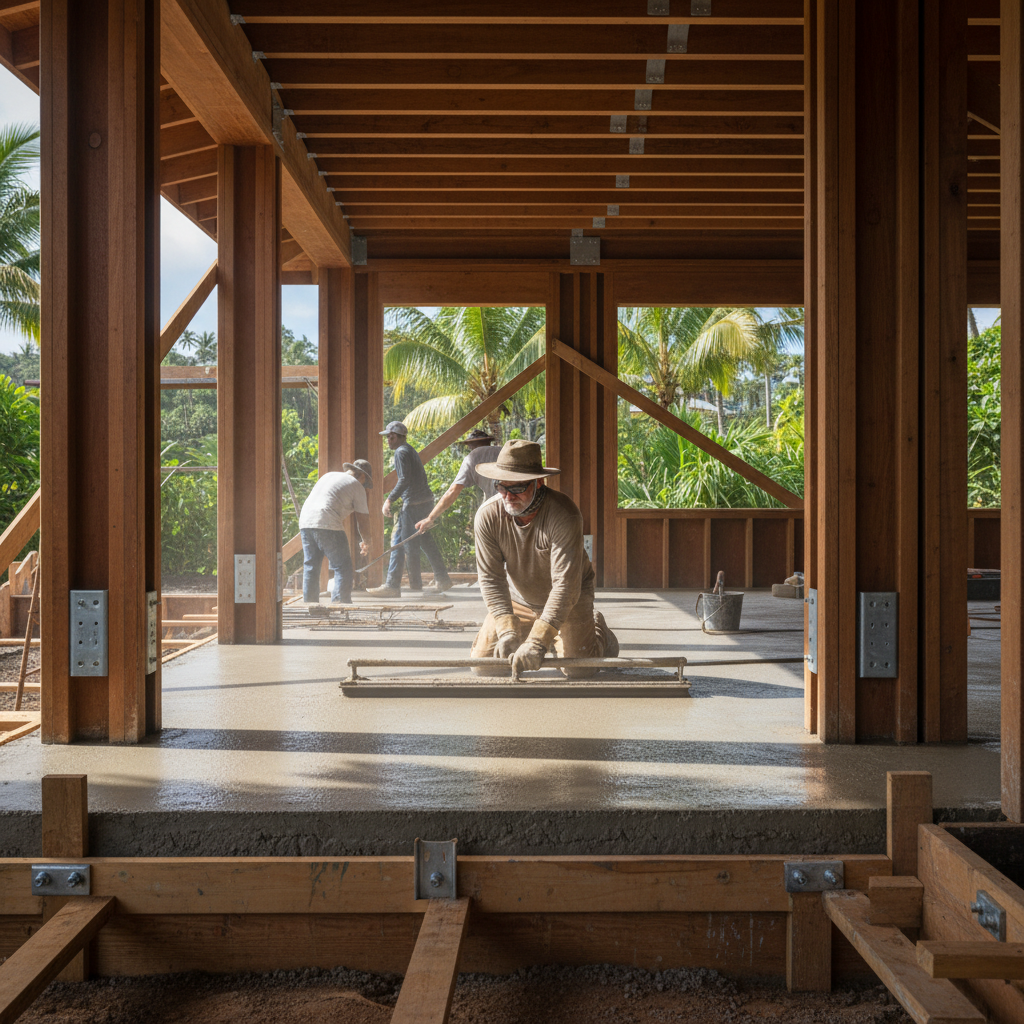
Time is a critical factor in any construction project, and concrete work on Kaua’i has its own unique calendar. The process isn’t just about the day of the pour; it’s a multi-stage operation that starts weeks, sometimes months, in advance. A common mistake homeowners make is underestimating the pre-construction phase, especially the time it takes to get permits from the Kaua’i County Planning Department.
\n\n
Let’s map out a realistic timeline for a typical 1,200 square foot driveway replacement project in Lihue, from the first call to driving your car on the new surface.
\n\n
Sample Timeline: 1,200 sq. ft. Driveway Replacement in Lihue (2026)
\n
- \n
- Phase 1: Planning & Permitting (4 to 10 weeks)\n
- \n
- Initial Consultation & Proposal (1 week): Our team meets you on-site, discusses your goals, takes measurements, and assesses any challenges like drainage or access. We then prepare a detailed proposal.
- Plan Drafting & Engineering (1-2 weeks): For a simple driveway, we can often create the necessary site plans. For more complex jobs like a large retaining wall or a new foundation, an architect or structural engineer will need to draw official plans.
- Permit Submission & Review (3-7 weeks): This is the biggest variable. We submit the plans to the Kaua’i County Planning Department. The review time can fluctuate based on their workload. We handle this entire process, including responding to any questions from the plan reviewers.
\n
\n
\n
\n
- Phase 2: Site Work & Pouring (1 to 2 weeks)\n
- \n
- Material Ordering & Scheduling (Contingent on Permit): As soon as the permit is approved, we place orders for rebar, form lumber, and schedule the concrete batch plant. This requires coordinating with inter-island shipping schedules.
- Demolition & Excavation (2-3 days): Our crew breaks up and hauls away the old driveway. Then, we excavate to the required depth and grade the area for proper drainage.
- Forming & Rebar Installation (2-3 days): We build the wooden forms that will contain the concrete and carefully place and tie the steel rebar grid according to the engineered plan. This is a critical step for strength.
- The Pour Day (1 day): The concrete truck arrives, and our team pours, spreads, and finishes the concrete. This is an intense, all-hands-on-deck day.
\n
\n
\n
\n
\n
- Phase 3: Curing & Completion (1 to 4 weeks)\n
- \n
- Initial Curing (7 days): The concrete needs to be left completely undisturbed. You can typically walk on it after 2-3 days, but no vehicles. We often recommend keeping it moist during this period to ensure a stronger cure.
- Full Cure & Project Cleanup (28 days total): Concrete doesn’t reach its full design strength for about 28 days. While you can usually park a regular car on it after 7-10 days, we advise waiting the full period for heavy trucks. During this time, we’ll return to strip the forms, clean up the site, and do any necessary backfilling or landscaping repair.
\n
\n
\n
\n
\n
\n
\n\n
Total Estimated Time: Roughly 6 to 15 weeks from signing the contract to full use.
\n\n
The key takeaway is that patience is essential. Weather is another major factor here. A week of heavy rain during the rainy season can halt all site work, pushing the schedule back. A good contractor will communicate proactively about these potential delays. We build buffer days into our schedules because we know that on Kaua’i, you have to work with the elements, not against them.
\n\n
What Permits Do You Need for Concrete Contractor in Lihue?
\n\n
Navigating the permitting process is often the most intimidating part of a construction project for homeowners. The rules can seem complicated, but they exist for a crucial reason: to ensure that all work is done safely and to a standard that can withstand everything our island environment throws at it. In Lihue, all building permits are handled by the Kaua’i County Department of Public Works, Building Division. While some general principles apply across the state, like those seen in Honolulu’s Department of Planning and Permitting (DPP)[1], Kaua’i has its own specific procedures and review timelines.
\n\n
As your general contractor, a huge part of our job is managing this entire process for you. We know the people at the building department, we speak their language, and we know how to prepare a permit application package that gets reviewed efficiently.
\n\n
When is a Permit Required for Concrete Work on Kaua’i?
\n
You’ll almost certainly need a permit if your project involves any of the following:
\n
- \n
- New Structures: Any new concrete foundation for a home, ADU (Ohana unit), or garage. This is the most stringent review process and requires full architectural and engineering plans.
- Home Additions: Pouring a new slab for a room addition requires a permit, as it changes the building’s footprint and structural load.
- Retaining Walls: Any wall that is over four feet in height (measured from the bottom of the footing to the top of the wall) requires a building permit and an engineered design. This is a major safety issue, as a failed retaining wall can be catastrophic.
- Driveways: If you are creating a new driveway cut or altering the entrance where your driveway meets a county road (the \”apron\”), you will likely need a permit or at least a review from Public Works.
- Large Patios or Slabs: While specific rules vary, large, detached concrete slabs (e.g., over 200 square feet) may require a simple plot plan review to ensure they don’t violate property line setbacks or create drainage issues for your neighbors.
\n
\n
\n
\n
\n
\n\n
When Might a Permit NOT Be Required?
\n
For minor work, you can often proceed without a full building permit. These situations typically include:
\n
- \n
- Replacing an existing patio or walkway with one of the same size and location (like-for-like replacement).
- Pouring a small concrete pad for an AC unit or trash cans.
- Minor concrete patching and repairs.
\n
\n
\n
\n
However, the golden rule is: when in doubt, ask. It is far better for us to make a quick call to the Building Division to confirm than for you to get a stop-work order midway through your project. A stop-work order can result in fines and significant delays.
\n\n
The permit is your assurance that the project has been designed to meet current building codes for structural integrity, hurricane resistance, and land use. It protects your investment, your safety, and the value of your home. A contractor who suggests skipping a required permit is not saving you money; they are exposing you to immense risk. Always insist on a properly permitted job.
\n\n

Lihue-Specific Considerations: Climate, Materials, Regulations
\n\n
Building on Kaua’i is unlike anywhere else. You can’t just apply mainland construction techniques and expect them to hold up. A good concrete contractor in Lihue understands that our island’s specific environment dictates every choice we make, from the concrete mix design to the type of rebar we use. Overlooking these local factors is the fastest way to a failing project and wasted money.
\n\n
Battling Salt-Air Corrosion
\n
Lihue sits on the windward side of the island, constantly bathed in a salt-laden mist from the ocean. This salt is incredibly corrosive to steel, the very material that gives concrete its tensile strength. We’ve been called to repair lanais in the Nawiliwili area, less than 10 years old, where the rebar inside the concrete had rusted, expanded, and caused the concrete to crack and spall (break off in chunks). This is a structural failure caused by ignoring the environment.
\n
Our mitigation strategy includes:
\n
- \n
- Increased Concrete Cover: We ensure there’s a minimum of 3 inches of concrete covering any steel rebar, which is more than the standard code for inland areas. This provides a thicker protective barrier.
- Higher PSI Concrete: We often specify a 3500 or 4000 PSI mix. Denser concrete is less porous, making it harder for salt and moisture to penetrate and reach the rebar.
- Epoxy-Coated or Galvanized Rebar: For critical structural elements or properties right on the coast, we recommend using coated rebar. It’s a more expensive material, but it’s the ultimate defense against corrosion and can add decades to the life of the concrete structure.
\n
\n
\n
\n\n
Working With Kaua’i’s Red Dirt
\n
Our famous red dirt is volcanic clay soil. It’s beautiful to look at but can be a nightmare for foundations if not handled correctly. This type of soil expands significantly when it gets wet and shrinks when it dries. This constant movement can exert tremendous pressure on a concrete slab, leading to heaving, cracking, and failure.
\n
The solution is all in the prep work:
\n
- \n
- Proper Sub-Base: We never, ever pour concrete directly on red dirt. We always excavate and install a thick, compacted sub-base of gravel (usually 4-6 inches for a driveway). This creates a stable, well-draining layer that decouples the slab from the movement of the underlying soil.
- Drainage Planning: We grade the site carefully to ensure water flows away from the foundation and concrete slabs. On some sites, this might involve installing French drains or other drainage systems to manage the heavy rainfall Kaua’i is known for.
\n
\n
\n\n
Post-Iniki Hurricane Code Requirements
\n
Hurricane Iniki in 1992 was a defining moment for Kaua’i, and its legacy is written into our building codes. The codes are tougher here for a reason. For concrete work, this means a heavy focus on creating a continuous load path—a system that securely connects the roof to the walls, and the walls to the foundation, so the whole house acts as a single unit against high winds.
\n
This affects concrete work in several ways:
\n
- \n
- Foundation Straps and Tie-Downs: We embed specific hurricane straps and anchor bolts into the concrete foundation precisely where the wall framing will sit. These aren’t optional; they are critical structural connectors.
- Engineered Footings: The size and depth of the concrete footings, as well as the amount of steel reinforcement within them, are calculated by an engineer to resist the uplift forces generated by hurricane-force winds.
\n
\n
\n\n
Choosing a contractor who not only understands these regulations but embraces them is non-negotiable. It’s about ensuring your home is a safe refuge during a storm, not a liability.
\n\n
How to Choose the Right Concrete Contractor Contractor in Lihue
\n\n
Choosing your contractor is the single most important decision you’ll make for your project. A great contractor ensures a smooth process and a lasting result, while a bad one can lead to budget overruns, endless delays, and shoddy work that needs to be redone. On an island as small as Kaua’i, reputation is everything. Here are the essential steps we recommend every homeowner take before signing a contract.
\n\n
Step 1: Verify Their License and Insurance
\n
This is the absolute first step and it’s non-negotiable. Any legitimate contractor doing significant work in Hawaii must have a state-issued contractor’s license. You can and should verify this yourself using the Hawaii Professional & Vocational Licensing (PVL) search website.[2] Our license at Warrior Construction is BC-34373. A valid license means the contractor has met the state’s requirements for experience, passed exams, and is accountable. Beware of anyone working out of a truck with just a cell phone number and no license—you have zero recourse if something goes wrong.
\n
Equally important is insurance. Ask for certificates of:
\n
- \n
- General Liability Insurance: This protects your property from damage caused by the contractor’s work. A minimum of $1 million in coverage is standard.
- Worker’s Compensation Insurance: This covers the contractor’s employees if they are injured on your property. Without it, you could be held liable for their medical bills.
\n
\n
\n\n
Step 2: Ask for Local, Relevant References
\n
Don’t just ask if they have references; ask for references for projects similar to yours, here on Kaua’i. A contractor who primarily builds on Oahu may not understand the logistical and environmental nuances of working in Lihue. Ask for the names and numbers of 2-3 past clients. Call them and ask:
\n
- \n
- Was the project completed on time and on budget?
- How was the communication throughout the process?
- Were you happy with the quality of the work and the professionalism of the crew?
- Have there been any issues with the concrete since the project was completed?
\n
\n
\n
\n
\n\n
Step 3: Get a Detailed, Itemized Bid
\n
A legitimate contractor will provide a professional, detailed proposal, not a one-line quote on a handshake. The bid should clearly break down the costs for:
\n
- \n
- Permits and fees
- Demolition and site preparation
- Materials (specifying quantity, type, and PSI of concrete)
- Labor
- Equipment rental (like a concrete pump, if needed)
- Finishing details
- Cleanup and haul-away
\n
\n
\n
\n
\n
\n
\n
\n
Comparing detailed bids is the only way to do an apples-to-apples comparison. The lowest bid is often not the best value; it may be a sign that the contractor is cutting corners on materials, prep work, or insurance.
\n\n
Step 4: Trust Your Gut
\n
Finally, this is a relationship. You’ll be working with this contractor and their crew for weeks or months. Do they communicate clearly and promptly? Do they listen to your concerns and answer your questions patiently? Do they seem professional and organized? If you feel pressured or get a bad vibe, it’s best to walk away. The peace of mind that comes from working with a contractor you trust is invaluable.
\n\n
Real Lihue Concrete Contractor Project Example
\n\n
Sometimes the best way to understand the process is to walk through a real-world example. Let’s look at a recent project our team completed for a homeowner in the Hanamaulu area, just north of Lihue. This case study illustrates how we handle common Kaua’i challenges from start to finish.
\n\n
The Client & The Problem:
\n
A family with a home built in the 1980s was facing two major issues. First, their original driveway was a mess of cracks and uneven sections, a classic sign of being poured on poorly compacted soil. It was a tripping hazard and created drainage problems during heavy rains. Second, they wanted to create a more functional outdoor living space by adding a large, covered lanai off the back of their home where there was only grass.
\n\n
Our Proposed Solution:
\n
Our project plan addressed both needs comprehensively. We proposed a full demolition and replacement of the 900 sq. ft. driveway and the construction of a new 500 sq. ft. concrete slab for the future lanai. The key was ensuring both new slabs were engineered to last in Kaua’i’s climate.
\n\n
The Process & The Numbers:
\n
- \n
- Permitting (6 weeks): Because we were adding a new slab for a future covered structure, a permit was required. We submitted site plans to the Kaua’i County Building Division, which were approved after a minor revision regarding setbacks.
- Demolition & Site Prep (1 week): Our crew used a breaker to demolish the old 900 sq. ft. driveway and hauled away the debris. We then excavated both the driveway and the new lanai area to a depth of 10 inches. We brought in and machine-compacted 6 inches of crushed gravel to create a solid, stable base. This step was critical to prevent the failures of the original driveway.
- Forming & Pour (1 week): We formed both areas, laid down a vapor barrier and termite treatment for the lanai slab, and installed a #4 rebar grid, 18 inches on-center, throughout both slabs. The new lanai slab was tied into the existing house foundation with doweled rebar for stability. We then poured 1,400 sq. ft. of 3,500 PSI concrete.
- Finishing & Curing (4 weeks): The driveway received a standard broom finish for traction. The lanai slab received a smooth trowel finish, ready for tile later on. The crew returned after a week to strip the forms and clean the site. We advised the homeowner to stay off the driveway with vehicles for 10 days.
\n
\n
\n
\n
\n\n
Project Breakdown:
\n
- \n
- Total Concrete Poured: 1,400 sq. ft.
- Total Project Cost: Approximately $60,200 (This breaks down to an average of $43/sq. ft., which includes the higher cost of demolition and the more intensive prep for the lanai slab).
- Total Timeline: About 12 weeks from contract signing to project completion.
\n
\n
\n
\n\n
The Outcome:
\n
The family now has a safe, durable driveway that properly channels rainwater away from their home. They also have the solid foundation for the outdoor living space they’ve always wanted. By investing in proper site preparation and engineering, they have a concrete installation that will add value to their home and serve their family for decades to come, free from the issues that plagued their old driveway.
\n\n
What this means for Hawaii homeowners
\n\n
For a homeowner in Lihue, undertaking a concrete project is a significant investment that goes right to the core of your property’s value and safety. The key takeaway from all this information is that success hinges on acknowledging and planning for Kaua’i’s unique building environment. You cannot afford to cut corners here; the combination of salt air, expansive soil, and hurricane risk will expose any weakness in the work.
\n\n
Here’s your action plan for a successful concrete project:
\n
- \n
- Budget for Reality: Use the 2026 cost figures we’ve provided ($30-$65 per sq. ft. depending on the job) as a realistic starting point. Be wary of any bid that comes in dramatically lower; it’s a red flag that they are likely skimping on crucial elements like site prep, concrete quality, or proper reinforcement.
- Prioritize a Licensed Local Pro: Your contractor must have deep, specific experience on Kaua’i. They need to have relationships with local suppliers, know the permitting staff at the county building, and have a portfolio of projects that have stood up to our weather. Always verify their license (our is BC-34373) on the state’s PVL website.
- Insist on Proper Prep Work: The quality of what’s underneath the concrete is more important than the finish on top. Ask your potential contractor to detail their plan for the sub-base, drainage, and soil compaction. If they don’t have a detailed answer, they aren’t the right contractor for the job.
- Embrace the Permitting Process: View the permit not as a hassle, but as a form of quality control. It ensures an independent expert from the county has reviewed the plans to confirm they meet the safety and durability standards required for our island. A contractor willing to skip this step is putting your entire property at risk.
\n
\n
\n
\n
\n\n
By taking a methodical, informed approach, you can ensure your construction project results in a high-quality, long-lasting addition to your home that will withstand the test of time on the Garden Isle.
\n\n
Frequently Asked Questions About Concrete Contractor in Lihue
\n
How much does a concrete foundation cost in Lihue?
\n
For a new home or addition in Lihue in 2026, you should budget between $45 and $65 per square foot for a slab-on-grade concrete foundation. This price includes the necessary engineered footings, a grid of #4 or #5 rebar, a vapor barrier to control moisture, and mandatory termite treatment. The cost is higher than a simple driveway because of the increased structural requirements and engineering involved.
\n
\n
Do I need an engineer for a retaining wall on Kaua’i?
\n
Yes, if the retaining wall is over four feet high (measured from the bottom of the footing). The Kaua’i County building code requires any retaining wall exceeding this height to be designed by a licensed structural engineer. This ensures the wall can safely handle the immense pressure from the soil and water behind it, preventing a dangerous collapse.
\n
\n
What is the best concrete finish for a wet area like a pool deck?
\n
The best finish for a pool deck or other frequently wet area is a \”broom finish\” or a textured, stamped finish. A broom finish is created by dragging a specialized broom across the surface before it fully cures, creating fine lines that provide excellent traction. Avoid smooth, hard-troweled finishes around pools, as they become extremely slippery when wet.
\n
\n
Why is concrete more expensive on Kaua’i than on Oahu?
\n
The price difference is due to logistics. Kaua’i has fewer local quarries and material suppliers, so a significant portion of the raw materials—cement, specific aggregates, and all steel rebar—must be shipped from Oahu or the mainland via barge. These inter-island shipping costs add a premium of roughly 15-20% to the material price, which is reflected in the final project cost.
\n
\n
How long before I can park on my new driveway in Lihue?
\n
We advise clients to wait a minimum of 7-10 days before parking standard passenger cars on a new concrete driveway. For heavier vehicles like work trucks or RVs, you should wait the full 28 days it takes for the concrete to reach its designed compressive strength. Parking on it too soon can cause permanent tire depressions and weaken the slab.
\n
\n
Can you pour concrete in the rain in Lihue?
\n
It is highly inadvisable to pour concrete during heavy rain. Excess water can alter the water-to-cement ratio, significantly weakening the final product and leading to a poor, dusty surface. A light, passing sprinkle might be manageable with protective coverings, but any reputable contractor will reschedule a pour if significant rain is in the forecast to protect the integrity of your investment.
\n
\n
What’s the difference between hiring a general contractor like Warrior and just a concrete subcontractor?
\n
A concrete subcontractor specializes only in concrete work. A General Contractor (GC) like Warrior Construction manages the entire project, including permitting, excavation, coordinating other trades (like plumbers if pipes are in the slab), and ensuring the project integrates correctly with the rest of your home. For anything beyond a simple slab replacement, a GC provides critical oversight and project management.
\n
\n
\n\n
Ready to Build a Foundation That Lasts on Kaua’i?
\n
Pouring concrete in Lihue is more than a construction task; it’s a commitment to building structures that respect and withstand our unique island environment. From the initial soil test to the final cure, every step requires local expertise and an unwavering dedication to quality. If you’re ready to start your project with a team that understands the nuances of building on the Garden Isle, we’re here to help.
\n
At Warrior Construction, we bring over two decades of Hawaii-specific experience to every foundation, driveway, and retaining wall we build. Let our team provide the solid groundwork your Kaua’i home deserves. Reach out today for a straightforward, no-obligation discussion about your project. Get a detailed estimate for your concrete and foundation project.
\n\n
References
\n