Finding a reliable concrete contractor in Makawao can feel like a tough job, especially with the unique challenges we face here on Maui. You’re not just pouring a slab; you’re building a foundation that has to stand up to Upcountry rain, volcanic soil, and Hawaii’s building codes. As a general contractor with over two decades of experience here in the islands, we at Warrior Construction have seen it all. From complex foundations on sloping lots near Olinda to simple driveway pours off Makawao Avenue, the principles are the same: get the prep work right, use the right mix for our climate, and never, ever cut corners. Here’s what you actually need to know in 2026 to get your concrete project done right the first time.
The biggest mistake we see homeowners make is underestimating the prep work. They get a low bid and think they’re saving money, but that contractor skimps on the base course, uses the wrong rebar spacing, or doesn’t account for proper drainage. A few years later, that beautiful new driveway has cracks you can lose a slippah in. Proper concrete work in Hawaii is about longevity. It’s about engineering a solution that accounts for our specific environment. This guide will walk you through the real costs, timelines, and critical considerations for any concrete project in Makawao, from a simple patio to a full structural foundation for a new home.
Why Makawao Homeowners Trust Warrior Construction for Concrete Work
When you’re building in Makawao, you need a team that understands the local landscape—literally. Warrior Construction isn’t just a company with a Hawaii license (BC-34373); we are a team that has spent years working with the specific conditions of Upcountry Maui. This isn’t like pouring concrete in Kapolei or Waikiki. The soil composition, the higher elevation, and the moisture levels are completely different up here, and that changes everything about how we approach a project. Our experience means we know how to properly compact the red volcanic soil to prevent future settling, and we understand the right concrete mix and curing process for the cooler, often wetter, Makawao climate. We’ve poured foundations for custom homes with sweeping views and built retaining walls to tame the steepest lots. This hands-on, local knowledge is something you can’t learn from a textbook.
Furthermore, our approach is built on transparency and communication. We’ve all heard stories about contractors who disappear after the first check is cashed. That’s not how we operate. As your general contractor, we manage the entire process. This means we handle the architects, the engineers, the permitting with Maui County, and the coordination of materials and inspections. You have one point of contact. For example, on a recent project building a concrete foundation in Makawao, we had to coordinate with the structural engineer to adjust rebar placement to accommodate some unexpectedly hard blue rock. Instead of causing a major delay, our on-site supervisor worked directly with the engineer to get a revised plan approved by the inspector within 48 hours. This level of integrated project management is what keeps projects on track and on budget. It’s the difference between a frustrating experience and a smooth one. Our clients in Makawao trust us because we build strong relationships, not just strong foundations.
What Does Concrete Work Cost in Makawao?
Let’s get straight to the numbers for 2026, because that’s what every homeowner wants to know. For a standard 4-inch slab on grade, like for a patio or a simple garage floor, you should budget between $35 to $45 per square foot in Makawao. This price includes labor, standard 3500 PSI concrete, basic site prep on a relatively flat lot, and a simple broom finish. So, a 400-square-foot patio might run you about $16,000.
But that’s just a starting point. Several factors unique to Maui can drive that cost up significantly:
- Site Access: Is your property up a narrow, winding road? Getting a full-size concrete truck to some parts of Makawao can be a challenge. If we have to use a smaller truck or a pump truck, that adds cost. A concrete pump truck can add $1,500 to $3,000 to the daily cost, depending on the reach needed.
- Site Prep & Excavation: Upcountry lots are rarely flat. If we need to do significant excavation, grading, or bring in engineered fill to create a stable base, the cost per square foot can jump to $50 or more. Hitting blue rock, which is common in the area, requires heavy equipment and adds time and money.
- Foundation Work: A structural concrete foundation in Makawao for a new home is a different animal altogether. This involves deep footings, extensive rebar grids to meet hurricane code, and multiple inspections. For a full foundation, you’re looking at a range of $60 to $85 per square foot of the home’s footprint. For a 2,000-square-foot home, the foundation alone could be $120,000 to $170,000.
- Retaining Walls: Building a retaining wall in Makawao is a common necessity. A properly engineered concrete masonry unit (CMU) or poured-in-place concrete wall costs between $90 and $150 per square face foot. The height, soil pressure, and need for drainage systems are the biggest variables. A 4-foot high, 50-foot long wall could easily cost $25,000 or more.
- Driveways: A basic driveway concrete in Makawao project, assuming minimal grading, will be in that $35-$45 per square foot range. However, if you want a decorative finish like stamped or colored concrete, or if your driveway has a steep slope requiring thicker concrete and more rebar, the price can climb to $55+ per square foot.
Remember, these costs also factor in the price of materials on Maui. We don’t have the same supply chain as the mainland. Cement, aggregate, and rebar all have inter-island shipping costs baked in. This is why getting a detailed, line-item quote from a licensed contractor is so critical. Our estimates at Warrior Construction break everything down so you know exactly where your money is going.
How Long Does a Concrete Project Take in Makawao?
The timeline for a concrete project is often longer than homeowners expect, primarily due to factors outside of the actual pour: planning and permitting. Here in 2026, the Maui County permitting process is the biggest variable. A simple project might move quickly, while a complex one can take months. Let’s break down a typical timeline for a mid-sized project, like a 1,000-square-foot driveway and a small retaining wall.
Phase 1: Planning & Permitting (4 to 12 weeks)
- Initial Consultation & Design (1-2 weeks): This is where we meet you on-site, discuss your goals, and take measurements.
- Engineering & Plans (2-4 weeks): For any structural concrete, like a retaining wall over 4 feet or a new foundation, a licensed structural engineer must create plans. This is a non-negotiable step for safety and code compliance.
- Permit Submission & Review (4-8 weeks, sometimes longer): Once the plans are ready, we submit them to the Maui County Planning Department. The review process can be unpredictable. We’ve seen simple permits get approved in a month, but we’ve also seen more complex ones get held up with requests for more information, stretching the timeline out. We manage this entire process, responding to county comments and keeping things moving.
Phase 2: Site Work & Pour (2 to 4 weeks)
- Excavation & Site Prep (3-5 days): This involves clearing the area, grading the land, and compacting the sub-base. On a tricky Makawao lot, this could take longer if we encounter rock or need to haul in a lot of fill.
- Formwork & Rebar (3-6 days): Our team builds the wooden forms that will hold the wet concrete in shape. We then meticulously place and tie the rebar according to the engineer’s plans. This is followed by a crucial pre-pour inspection by a county inspector. You cannot pour without this sign-off.
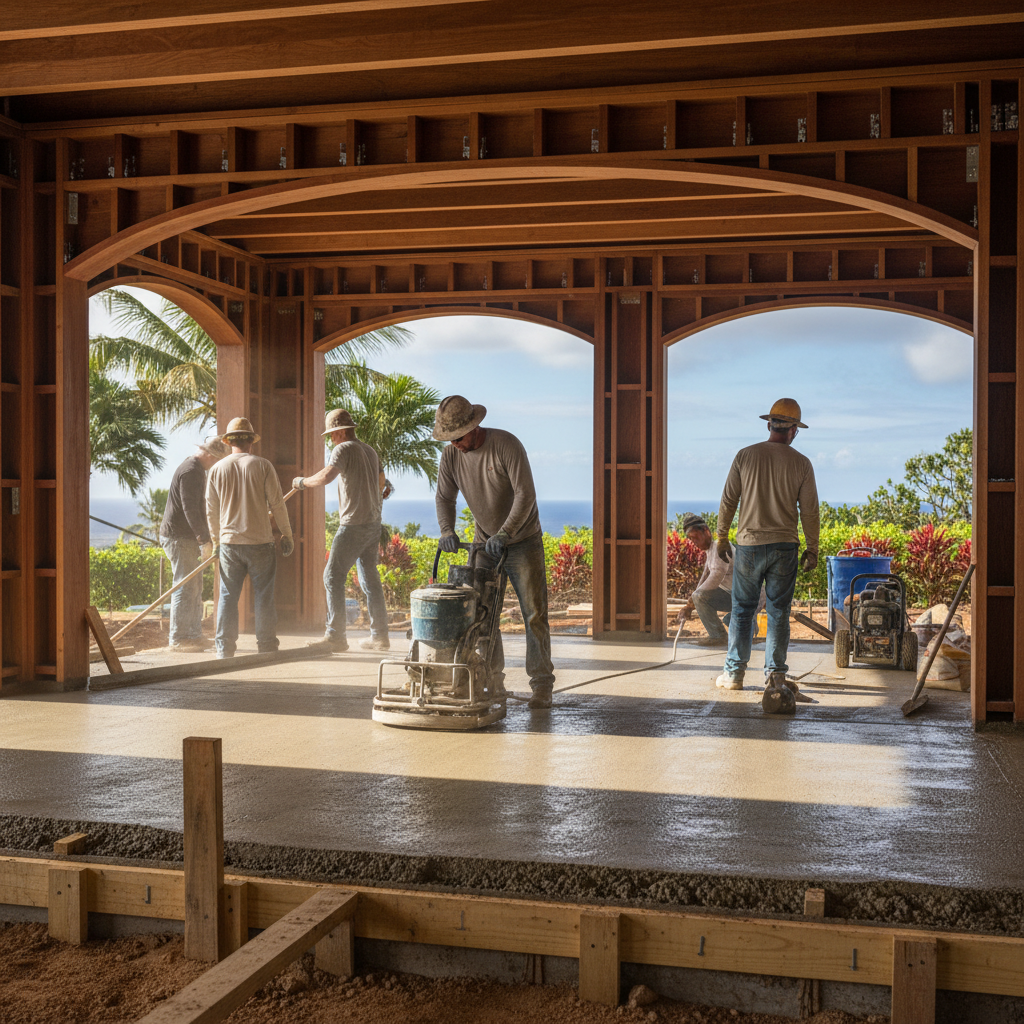
- The Pour (1 day): The concrete truck arrives, and we pour, spread, and screed the concrete. This is a fast-paced, highly coordinated effort.
- Finishing (1-2 days): Depending on the desired finish (broom, trowel, stamped), our finishers will work the surface as it begins to set.
Phase 3: Curing & Cleanup (1 to 4 weeks)
- Curing (7-28 days): This is the most misunderstood part. The concrete is hard enough to walk on in a day or two, but it doesn’t reach its full design strength for about 28 days. During the first week, it’s critical to keep the surface moist to ensure a proper cure, especially on hot, sunny Makawao days. We advise clients to stay off a new driveway with vehicles for at least 7 to 10 days.
- Form Removal & Cleanup (1-2 days): After a few days, we return to strip the forms, clean up the site, and perform any necessary backfilling or final grading.
So, for our example project, the total time from our first meeting to you being able to park on your new driveway is realistically 2.5 to 5 months. The biggest variable is always that permit review window. Patience and proper planning are key.
What Permits Do You Need for Concrete Work in Makawao?
Navigating the permitting process with Maui County can be one of the most daunting parts of any construction project for a homeowner. It’s a common point of confusion, and frankly, it’s where having an experienced general contractor makes a huge difference. As of 2026, the rules are quite clear: most concrete work beyond a simple, non-structural flat-work patch requires a permit.
Here’s a breakdown of when you’ll need to pull a permit for your Makawao project:
- Foundations and Slabs: Any new structural slab or foundation for a home, garage, or ADU absolutely requires a building permit. This is part of the overall construction permit and involves a full plan review by the county, including structural engineering calculations. You can’t even break ground without that stamped set of plans.
- Retaining Walls: This is a big one in hilly Upcountry Maui. According to Maui County code, any retaining wall in Makawao that is over four feet in height (measured from the bottom of the footing to the top of the wall) requires a building permit. This also means it must be designed by a licensed Hawaii engineer. We often see unpermitted, failing retaining walls built by unlicensed contractors—it’s a massive safety hazard and a huge liability for the homeowner.
- Driveways: A simple resurfacing or replacing an existing driveway of the same size might not require a permit. However, if you are building a new driveway, expanding an existing one, or changing the access point to a county road, you will likely need a grading permit and possibly a separate permit for the driveway apron connection. The Department of Public Works is very particular about this to ensure proper drainage and road safety.
- Patios and Walkways: Generally, on-grade patios and walkways that are not part of the home’s structural support system or required egress paths do not need a permit. However, if that patio includes a roof or is elevated, it crosses the line into a structure and will require a permit.
The permit process itself involves submitting detailed plans and applications to the Maui County Planning Department. These plans are then routed to various divisions for review—planning, building, public works, and sometimes health. Each department has its own checklist. For example, the Honolulu Department of Planning and Permitting (DPP)[1] has a notoriously complex system, and while Maui is different, the level of detail required is similar. Our team at Warrior Construction handles this entire submittal and follow-up process. We know the reviewers, we speak their language, and we can anticipate their questions, which helps avoid unnecessary delays. Trying to navigate this as a homeowner is often a recipe for frustration and months of lost time.
Makawao-Specific Considerations: Climate, Materials, Regulations
Doing any kind of construction in Makawao isn’t the same as working down in Kihei or Lahaina. The unique environment of Upcountry Maui presents specific challenges and requires a specialized approach, especially with concrete.
Climate and Curing: Makawao gets significantly more rainfall and has cooler average temperatures than the coastal areas. This directly impacts how concrete cures. On a hot, dry day in South Maui, the surface of a new slab can dry out too quickly, leading to shrinkage cracks and a weaker final product. Up here, the higher humidity and cloud cover can be beneficial, promoting a slower, stronger cure. However, the frequent passing showers mean we have to be ready to cover a fresh pour at a moment’s notice to prevent the surface from getting washed out. We also adjust the concrete mix itself, sometimes using additives to control the set time based on the day’s forecast.
Volcanic Soil: The rich, red soil in Makawao is great for farming but can be tricky for foundations. It’s an expansive soil, meaning it can swell with moisture and shrink when it dries. This movement can put immense pressure on a foundation or slab. Proper site preparation is non-negotiable. This involves over-excavating the native soil and bringing in a thick, compacted base course of crushed rock (like #3/#4 CM-16 aggregate). This creates a stable, non-expansive layer that isolates the concrete from the volatile soil beneath. We see improperly prepped slabs heave and crack within a few years—a costly mistake that’s entirely preventable.
Material Logistics: All concrete materials—cement, sand, aggregate—are produced or shipped to a central point on Maui, typically in the Kahului area. Getting a fully loaded, 10-yard concrete truck from the plant up to a job site on, say, Olinda Road, requires careful planning. We have to account for the travel time, the traffic on roads like Baldwin Ave, and the limited accessibility of some properties. This logistical planning is part of our service. We schedule pours for times with less traffic and ensure the site is prepped for the truck’s arrival to avoid costly standby fees from the concrete supplier.
Hurricane Codes & Rebar: Since Hurricane Iniki, Hawaii’s building codes have become some of the strictest in the nation regarding wind resistance. This directly affects concrete work. Foundations require specific footing sizes and robust rebar grids to anchor the structure against uplift forces. For a concrete foundation in Makawao, this means more steel and more labor than in many mainland locations. We also have to ensure proper placement of anchor bolts and hurricane straps embedded in the concrete. The county inspectors are extremely meticulous about checking rebar spacing and clearance before they will approve a pour. This is a good thing; it ensures your home is built to withstand a serious storm.
How to Choose the Right Concrete Contractor in Makawao
Selecting the right contractor for your concrete project is the single most important decision you’ll make. A great contractor can deliver a lasting product on time and on budget, while a bad one can lead to years of problems and financial stress. Here’s a straightforward checklist for vetting any concrete contractor in Makawao.
1. Verify Their License and Insurance.
This is the absolute first step. Don’t just take their word for it. Every legitimate contractor in Hawaii must have a license. You can and should verify their license status on the state’s Professional & Vocational Licensing (PVL) website[2]. For example, Warrior Construction’s license is BC-34373. A valid license means they have met the state’s requirements for experience and testing. Equally important, ask for a copy of their general liability and worker’s compensation insurance certificates. If an uninsured worker gets hurt on your property, you could be held liable. Do not skip this step.
2. Check for Local, Relevant Experience.
Ask to see a portfolio of their work, specifically projects completed here on Maui, and if possible, in the Makawao area. A contractor who primarily works in Honolulu or even Kihei may not be familiar with the specific soil conditions and weather patterns of Upcountry. Ask them questions like: “Have you worked with expansive volcanic soil before?” or “How do you plan for weather delays during a pour in Makawao?” Their answers will quickly tell you if they have real local experience. We at Warrior are always happy to share photos and addresses of our completed projects around the island.
3. Get a Detailed, Written Contract.
A handshake deal or a one-page quote is a major red flag. A professional contract should clearly detail:
- The full scope of work, including site prep, materials, and finishing.
- A breakdown of costs for labor, materials, and permits.
- The specific materials to be used (e.g., 4000 PSI concrete, #4 rebar at 18″ on center).
- A payment schedule. Never pay for the entire job upfront. A typical schedule is a deposit, then progress payments at key milestones.
- A projected start and completion date.
4. Communication is Key.
During the initial consultation, pay attention to how they communicate. Do they listen to your questions and provide clear, understandable answers? Or do they use a lot of jargon and rush you? Throughout the project, you’ll need a contractor who is responsive and keeps you informed. A simple text update at the end of the day or a quick call to let you know an inspector is scheduled can make all the difference.
Choosing the right partner is about more than just the lowest price. It’s about finding a team with the right experience, professionalism, and commitment to quality. These are the standards we hold ourselves to on every single project.
Real Makawao Concrete Project Example
To make this more concrete (pun intended), let’s walk through a recent project we completed in 2025 just outside Makawao town. The homeowner had a beautiful property with a great view, but their backyard was a sloped, unusable mess of red dirt. They wanted to create a level 600-square-foot patio area for entertaining and a safe walkway connecting it to their driveway.
The Challenge: The slope was significant, dropping about 6 feet over a 20-foot distance. This meant we couldn’t just pour a slab; we needed an engineered solution. The soil was classic expansive volcanic clay, and access for heavy equipment was tight due to mature avocado trees the owner wanted to save.
Our Solution:
- Engineering & Design: We brought in our structural engineer to design a retaining wall and patio slab system. The plan called for a 5-foot-tall, 50-foot-long poured-in-place concrete retaining wall in Makawao with deep footings to anchor it into the stable substrate below the clay. The patio slab itself was designed as a “structural slab,” reinforced with a thick rebar grid to float over the expansive soil, supported by the new wall and the existing house foundation.
- Permitting: Because the wall was over 4 feet tall, a building permit was required from Maui County. We submitted the engineered plans and handled the entire review process, which took about 7 weeks.
- Execution: Our team carefully excavated the hillside using a mini-excavator to protect the trees. We formed and poured the massive retaining wall footing first, passing the rebar inspection without issue. Then, we built the wall forms, poured the wall, and installed a robust drainage system behind it to relieve hydrostatic pressure. After backfilling and compacting the area behind the new wall, we prepped, formed, and poured the 600-square-foot patio slab and the connecting 150-foot walkway. The homeowner chose a light broom finish for a non-slip surface.
The Numbers:
- Total Project Cost: Approximately $78,000
- Breakdown: Engineering and permits were about $6,500. The retaining wall portion was roughly $45,000 ($90 per square face foot). The 600 sq ft patio slab and walkway came in around $26,500 (approx. $35/sf, higher due to structural rebar requirements).
- Timeline: From initial contract signing to final cleanup, the project took just under 4 months. The on-site construction portion was about 5 weeks of that total.
The result was a complete transformation. The homeowner now has a beautiful, safe, and engineered outdoor living space that added significant value to their property. This project is a perfect example of how what looks like a simple patio can become a complex structural job requiring the right expertise.
What this means for Hawaii homeowners
For any homeowner in Makawao considering a concrete project in 2026, the key takeaway is that planning and professional expertise are paramount. The days of getting a quick, cheap job done by an unlicensed handyman are over, and for good reason. The combination of stricter building codes, complex permitting, and our unique island environment means that cutting corners will inevitably lead to costly failures down the road. A cracked foundation or a failing retaining wall isn’t just an eyesore; it’s a serious safety and financial liability.
Here are your actionable steps:
- Budget Realistically: Use the numbers in this guide as a starting point. Understand that in Hawaii, quality construction costs more due to logistics and code requirements. Be wary of any bid that comes in significantly lower than others; they are likely cutting corners on materials, insurance, or labor.
- Hire a Licensed Professional: Make verifying a contractor’s license (like our BC-34373) and insurance your first step. A licensed general contractor like Warrior Construction can manage the entire process, from engineering and permitting to the final pour, saving you immense time and stress. This is one of our core services.
- Embrace the Process: Accept that permitting takes time. A good contractor will set realistic expectations about the timeline from the beginning. Building that waiting period into your project plan will reduce frustration.
- Focus on the Foundation: Whether it’s a literal home foundation or the sub-base for your driveway, the work that happens before the concrete arrives is the most critical part. Ask your contractor detailed questions about their site prep process, especially how they handle Makawao’s volcanic soil.
Ultimately, investing in a well-planned and professionally executed concrete project is an investment in the long-term value and safety of your home. Taking the time to do it right is the smartest financial decision you can make.
Frequently Asked Questions About Concrete Work in Makawao
How thick should my concrete driveway be in Makawao?
For a standard residential driveway in Makawao that will see regular use from cars and pickup trucks, we recommend a minimum thickness of 4 inches. However, if you have heavy vehicles like a large work truck, or if the underlying soil is particularly soft, we often engineer it to be 5 inches thick with a heavier rebar grid for added strength and crack resistance.
Can you pour concrete in the rain in Makawao?
Pouring concrete during a heavy Makawao downpour is a bad idea. Excess water can weaken the surface and ruin the finish. However, a light passing shower isn’t necessarily a dealbreaker. Our professional crews always watch the weather radar closely and have plastic sheeting on-site ready to cover a fresh pour instantly to protect it from rain damage.
What is the difference between 3000 PSI and 4000 PSI concrete?
PSI stands for “pounds per square inch” and measures the concrete’s compressive strength after it fully cures. For most non-structural flatwork like patios and walkways, 3000 PSI is sufficient. For driveways, garage slabs, and structural footings, we almost always use a minimum of 3500 or 4000 PSI mix for its superior durability and strength, which is essential for meeting Hawaii’s building codes.
How much does a permit for a retaining wall cost in Maui County?
The permit fee itself is based on the valuation of the project, but it’s usually a smaller part of the total pre-construction cost. For a typical residential retaining wall in Makawao, you can expect the permit fee from Maui County to be between $500 and $1,500 in 2026. The larger cost is the structural engineering plans required for the submittal, which can range from $2,500 to $5,000.
Does salt air affect concrete in Makawao?
While Makawao is Upcountry and doesn’t face the direct salt spray of a place like Paia or Kihei, the salt-laden air can still travel inland. For projects with exposed rebar or for homes closer to the coast, this can accelerate corrosion (spalling). We mitigate this by ensuring proper concrete cover over all steel reinforcement and by using specific concrete mixes with lower permeability to keep the corrosive salts out.
Why is my existing concrete cracking?
There are several reasons for concrete cracking in Hawaii. The most common are improper site prep leading to settling, an incorrect concrete-to-water ratio in the mix, rapid drying during the curing process, or simply the lack of control joints. Expansive volcanic soil, like we have in Makawao, can also cause heaving and cracking if the sub-base wasn’t prepared correctly.
Can I get colored or stamped concrete for my driveway?
Absolutely. Decorative concrete is a popular option. We can add integral color to the concrete mix for a consistent hue throughout the slab, or apply a color hardener to the surface. Stamping involves pressing molds into the wet concrete to create patterns that mimic stone, brick, or even wood planks. These finishes typically add $10 to $20 per square foot to the total project cost.
Ready to Start Your Makawao Concrete Project?
Whether you’re planning a new home foundation, a durable driveway, or an engineered retaining wall to reclaim your yard, getting it right starts with a solid plan and an experienced team. At Warrior Construction, we have the local Upcountry knowledge and the technical expertise to handle the unique challenges of building in Makawao. We manage every detail, from navigating Maui County permits to ensuring the final pour is flawless.
If you’re ready for a professionally managed project built to last, our team is here to help. Learn more about our approach to concrete and foundation services and let’s build something strong together.
Get Your Free, No-Obligation Estimate Today