
When you need a concrete contractor in Po’ipu, you’re not just pouring a slab; you’re building a foundation against some of the most demanding conditions in Hawaii. The right concrete work stands up to the South Shore’s corrosive salt air, the occasional torrential downpour, and the unique challenges of Kaua’i’s red volcanic soil. The wrong pour can lead to spalling, cracking, and costly repairs within a few years. Here at Warrior Construction, we’ve spent over two decades mastering the specifics of concrete on Kaua’i, ensuring your investment lasts. This isn’t just about mixing sand and cement; it’s about engineering a solution for a specific microclimate. This article breaks down the six most critical upgrades for any Po’ipu concrete project, explains the real costs and timelines you can expect in 2026, and walks you through navigating the permitting process with Kaua’i County.
Many homeowners think all concrete is the same, but that’s a mainland mentality. On an island, especially a stone’s throw from the ocean like Po’ipu, the details make all the difference between a driveway that looks great for 20 years and one that’s a pitted mess after five. We’ll cover everything from specifying the right concrete mix with corrosion inhibitors to using epoxy-coated rebar, which can double the life of your slab. We’ll also dive into proper site preparation for that infamous red dirt, which can cause major issues if not handled correctly. We believe an informed homeowner is our best partner, so we’re laying out the exact same advice we give our clients over a cup of coffee before we even start a project. Understanding these factors upfront not only saves you money in the long run but ensures the final product is something you can be proud of.
Why Po’ipu Homeowners Trust Warrior Construction for Concrete Contractor
Choosing a concrete contractor in Po’ipu goes beyond finding someone who can pour a slab. You need a team that understands the local landscape—from the supply chain logistics to the unique soil composition and the salty air that relentlessly attacks building materials. At Warrior Construction, our license (BC-34373) is just the starting point. Our real value comes from over 20 years of hands-on experience right here on Kaua’i. We’re not flying in a crew from Oahu; our guys live here, they understand the weather patterns, and they know the local inspectors at the Kaua’i County Planning Department.
For example, on a recent project building a concrete foundation in Po’ipu for a custom home near Brennecke’s Beach, the soil report came back showing pockets of expansive clay mixed in with the usual volcanic rock. A less experienced contractor might have just done a standard pour. But our team knew that specific soil type requires a thicker base of compacted aggregate and strategic placement of control joints to prevent the slab from cracking under pressure during heavy rains. It’s this kind of hyper-local knowledge that prevents expensive problems down the road. We don’t guess; we test, verify, and build for the specific conditions of your exact lot.
Furthermore, our relationships with island suppliers are critical. When a barge is delayed or a specific admixture is in short supply on the island, we have the long-standing connections to find solutions and keep a project on track. We’ve seen mainland-based or neighbor island contractors get stalled for weeks because they don’t have those local roots. Our bids are comprehensive and transparent, detailing not just the cost but the specific materials we use, such as:
- Minimum 4000 PSI Concrete: We won’t pour less than this near the coast. It provides the density needed to resist moisture intrusion.
- Corrosion-Inhibiting Admixtures: A non-negotiable for Po’ipu. This chemical additive protects the rebar from the inside out.
- Epoxy-Coated or Galvanized Rebar: This provides a physical barrier against salt and moisture, preventing the rust that leads to spalling.
- Proper Curing Methods: We don’t just pour and leave. We use curing compounds or water curing to ensure the concrete reaches its full design strength, which is especially important in the hot Kaua’i sun.
Trust isn’t just about a good final product. It’s about communication, reliability, and knowing your contractor is fully invested in the local community. We build for our neighbors, and that makes all the difference in the quality and care we bring to every job site.
What Does Concrete Contractor Cost in Po’ipu?
Let’s get straight to the numbers for 2026. Concrete work in Po’ipu carries a premium compared to Honolulu or the mainland, and it’s important to understand why. Everything from the cement powder to the gravel and the specialized rebar has to be barged to Kaua’i, adding a significant logistics cost. Labor is also more expensive. But a clear budget is the first step to a successful project. Here’s what you can realistically expect to pay.
For a standard project like a new driveway concrete in Po’ipu or a simple patio slab, you’re looking at a cost of approximately $28 to $38 per square foot. This price typically includes excavation, a compacted gravel base, forming, standard rebar, a 4-inch pour of 3500 PSI concrete, and a basic broom finish for texture. So, for a 500-square-foot driveway, the budget would be around $14,000 to $19,000.
However, for most projects in Po’ipu, we strongly recommend upgrades to fight salt-air corrosion. Here’s how those 6 money-saving upgrades impact the cost:
- Upgrading to 4000+ PSI Concrete: Adds about $2 per square foot.
- Adding a Corrosion-Inhibiting Admixture: Adds about $1.50 per square foot.
- Using Epoxy-Coated Rebar: Adds about $2.50 per square foot.
- Thicker Slab (5-6 inches): Adds $4-$6 per square foot.
- Vapor Barrier Installation: Adds about $1 per square foot (essential for interior slabs).
- Professional Curing Compound: Adds about $0.50 per square foot.
A fully upgraded, coastal-rated slab with these features will cost closer to $39 to $49 per square foot. While it seems like a lot, spending that extra $10 per square foot now can prevent you from having to do a $50,000 spalling repair project in 15 years. For a structural concrete foundation in Po’ipu, which requires deeper footings, more steel, and engineering oversight, the cost increases to $55 to $75 per square foot. A complex hillside foundation can easily exceed this.
For a CMU (Concrete Masonry Unit) retaining wall in Po’ipu, pricing is usually by the face square foot. Expect costs in the range of $90 to $130 per square foot of wall face. This includes the footing, block, rebar, grout fill, and waterproofing. A wall that is 5 feet high and 50 feet long (250 sq. ft.) would therefore cost between $22,500 and $32,500. The cost is high because these are engineered structures critical for managing Kaua’i’s terrain and rainfall.
How Long Does a Concrete Contractor Take in Po’ipu?
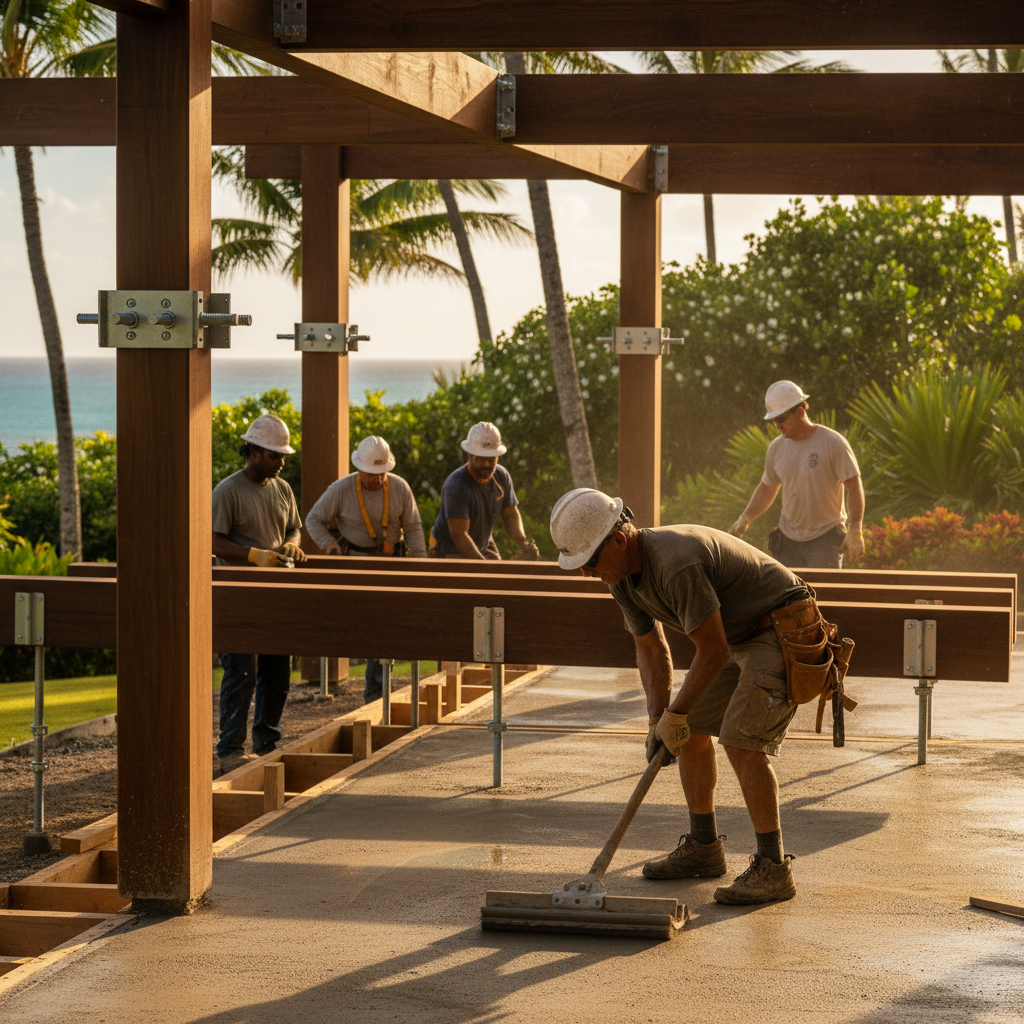
Time is a critical factor, and on Kaua’i, we operate on what’s affectionately known as “island time.” This isn’t about being slow; it’s about realistically planning for logistics, weather, and a thorough permitting process. A simple driveway replacement might be quick, but a new foundation is a multi-month commitment before the first truck even arrives.
Here’s a realistic timeline for a moderately complex concrete project in Po’ipu, like a new lanai and walkway requiring a building permit:
- Planning & Design (2-4 weeks): This involves finalizing the design, getting an engineer to draw up plans if required, and preparing the permit application package.
- Permitting with Kaua’i County (4-8 months): This is often the longest phase. The Kaua’i County Planning Department is thorough, and depending on their backlog and the complexity of your project (especially if it’s near the shoreline or has drainage implications), reviews can take a significant amount of time. There is no speeding this up. We submit the plans and manage the communication, but the timeline is in the county’s hands.
- Site Preparation & Excavation (1-2 weeks): Once the permit is in hand, we can get to work. This involves clearing the area, performing any necessary grading, and compacting the soil and base course. This phase is heavily weather-dependent. A week of heavy Po’ipu rain can bring this to a halt.
- Forming & Rebar Placement (1 week): Our crew builds the wooden forms that will contain the concrete and meticulously places and ties the steel rebar according to the engineering plans. This is also when the pre-pour inspection happens. A county inspector must sign off on the rebar placement before any concrete is ordered.
- The Pour (1 day): The concrete pour itself is a carefully orchestrated event that usually takes a few hours. The finishing crew then works the surface to the desired texture (broom finish, trowel, etc.).
- Curing (7-28 days): This is the most misunderstood part of the process. The concrete needs to cure and gain strength. You can typically walk on it after 24-48 hours, but it shouldn’t see heavy use. We recommend waiting at least 7-10 days before driving a car on a new driveway. The concrete won’t reach its full design strength for 28 days. Rushing this can compromise the entire project.
So, from the day you sign a contract to the day you can use your new concrete surface, a permitted project can easily take 6 to 10 months. A non-permitted project, like a simple slab repair, might only take 2-3 weeks from start to finish. We always build buffer time into our schedules to account for shipping delays on materials or unexpected afternoon downpours that can saturate the ground and delay a pour.
What Permits Do You Need for Concrete Contractor in Po’ipu?
Navigating the permitting process in Hawaii can feel complicated, but it’s a crucial step that protects your property value and ensures everything is built to code. For concrete work in Po’ipu, you’ll be dealing with the Kaua’i County Planning Department. As a licensed general contractor, part of our job is to manage this entire process for you.
Here’s a general breakdown of when you’ll need a permit:
- New Foundations: Absolutely. Any new structural foundation for a house, ADU (Ohana unit), or even a large garage requires a full building permit with engineered plans.
- Retaining Walls: A permit is required for any retaining wall over 4 feet in height (measured from the bottom of the footing to the top of the wall). Any wall that supports a surcharge (like a driveway or structure) also needs a permit, regardless of height.
- Driveways: You generally need a permit if you are creating a new curb cut, altering the public sidewalk, or significantly changing the property’s drainage patterns. A simple replacement of an existing driveway often doesn’t, but it’s always best to verify with the county.
- Patios & Slabs: A permit is usually not required for a simple, on-grade concrete slab (like a patio) that isn’t part of a structure’s foundation. However, if it’s part of a larger project or a covered lanai, it will be included in the main building permit.
The permit process for a project in Po’ipu generally follows these steps:
- Plan Submittal: We submit the architectural and engineering drawings to the Kaua’i County Planning Department. As of 2026, most submissions are done digitally.
- Plan Review: Multiple departments will review the plans, including planning, building, and engineering. They check for compliance with zoning, building codes, hurricane standards, and drainage requirements. This is the longest part of the process. The county may come back with comments or required revisions (RFI’s).
- Permit Issuance: Once all departments have approved the plans, the permit is issued upon payment of fees. Permit fees are calculated based on the project’s valuation and can range from a few hundred to several thousand dollars.
- Inspections: During construction, a county inspector must visit the site at key milestones. For concrete, the most critical is the ‘pre-pour’ inspection to verify footing depth and rebar placement. A final inspection is required upon completion.
A key consideration for Po’ipu is proximity to the coastline. If your property falls within the Special Management Area (SMA), you will need an additional SMA permit, which adds significant time, complexity, and cost to the process. It involves a much deeper review of environmental and public access impacts. We’ve managed many SMA projects and can guide you through that specific maze. Attempting to do concrete work without a required permit is a costly mistake that can lead to fines, stop-work orders, and being forced to tear out the work. It’s never worth the risk.

Po’ipu-Specific Considerations: Climate, Materials, Regulations
Building on Kaua’i is unlike anywhere else, and Po’ipu has its own unique set of challenges that a good concrete contractor in Po’ipu must master. Ignoring these local factors is the fastest way to a failed project.
Climate: The Salt-Air Assault
The biggest enemy of concrete in Po’ipu is the constant, corrosive salt spray carried on the trade winds. This salty moisture penetrates porous concrete, reaching the steel rebar inside. When the rebar rusts, it expands with incredible force, cracking the concrete from within. This is called spalling. We see it all the time on older properties: chunks of concrete popping off railings, lanais, and wall corners.
Our defense strategy is multi-layered:
- Denser Concrete: We use a minimum of 4000 PSI concrete mix. The higher pressure rating corresponds to a denser, less permeable material, making it harder for salt and moisture to get in.
- Chemical Warfare: We insist on adding a calcium nitrate-based corrosion-inhibiting admixture to the concrete mix. This chemical additive forms a protective layer on the rebar, neutralizing the corrosive effects of chlorides (salt).
- Protected Steel: We use epoxy-coated (the green stuff) or galvanized rebar. This creates a physical barrier so that even if moisture reaches the steel, it can’t cause rust. It costs more upfront but is cheap insurance against spalling.
Materials: That Famous Red Dirt
Kaua’i’s red volcanic soil is beautiful but challenging to build on. It’s often expansive, meaning it swells when wet and shrinks when dry. This movement can heave and crack a poorly prepared concrete slab. Proper site preparation is non-negotiable.
The process involves ‘over-excavating’ the native soil and bringing in a structural fill. We lay down a thick (usually 6-12 inches) base course of compacted, crushed rock. This creates a stable, well-draining platform that isolates the concrete slab from the movement of the underlying soil. We use a plate compactor to ensure this base is at least 95% compacted, which we verify with testing. Skipping this step to save a few dollars is a recipe for a cracked driveway or foundation in just a few years.
Regulations: The Legacy of Hurricane Iniki
Hurricane Iniki in 1992 completely changed the building codes on Kaua’i. The island has some of the strictest hurricane-resistant construction requirements in the nation, and it all starts with the foundation. A concrete slab isn’t just a floor; it’s the anchor for the entire house.
Modern codes require robust connections between the foundation and the walls. This involves:
- Anchor Bolts: J-bolts are embedded in the concrete along the perimeter to secure the wall’s bottom plate.
- Hold-Downs (Straps): Heavy-duty steel straps, like Simpson Strong-Ties, are embedded deep into the concrete footing and extend up to be fastened to the wall studs. These are critical for preventing the entire wall from lifting off the foundation in high winds.
The placement, size, and spacing of these connectors are specified by a structural engineer and are meticulously checked by the county inspector before the pour. As your general contractor, we manage all these engineering requirements to ensure your home is not just beautiful, but a fortress built to withstand the next big storm. You can verify any contractor’s license and check for complaints through the Hawaii Department of Commerce and Consumer Affairs Professional & Vocational Licensing (PVL) division[1], a step we encourage every homeowner to take.
How to Choose the Right Concrete Contractor Contractor in Po’ipu
Choosing your contractor is the single most important decision you’ll make for your project. A great contractor can make a complex job feel smooth, while the wrong one can turn it into a nightmare. In a specialized market like Po’ipu, here are the key things our team recommends you look for.
1. Verify Their License and Insurance. First and foremost, never hire an unlicensed contractor. You can and should verify any contractor’s license number on the Hawaii PVL website[1]. Look for a B-General Building license, like our BC-34373, or a C-5 specialty concrete license. Ask for a copy of their general liability and worker’s compensation insurance certificates. If a worker gets hurt on your property and the contractor isn’t insured, you could be held liable. There are no exceptions to this rule.
2. Demand Kaua’i-Specific Experience. A contractor from Honolulu or Maui might do great work there, but they don’t necessarily understand the logistics, suppliers, soil, and permitting on Kaua’i. Ask for addresses of recent projects they completed in or near Po’ipu. Go take a look at their work. Does it look clean? Are the lines crisp? Is there any sign of premature cracking or staining? A portfolio of photos is nice, but seeing the work in person tells the real story.
3. Analyze the Bid, Not Just the Price. A low-ball bid is a massive red flag. A professional bid from a quality contractor will be several pages long and will specify everything in detail:
- The exact PSI of the concrete mix.
- The size, grade, and spacing of the rebar (e.g., “#4 rebar at 18″ on center each way”).
- Mention of any admixtures, like a corrosion inhibitor.
- The thickness of the compacted base course.
- Details on cleanup, demolition of old concrete (if any), and finish type.
A bid that just says “Pour 500 sq ft driveway – $15,000” is from an amateur. You have no idea what you’re actually getting, and it leaves room for them to cut corners everywhere.
4. Communication is Key. During your initial conversations, how do they communicate? Do they return your calls promptly? Do they answer your questions clearly and patiently? Construction is full of unforeseen challenges—weather delays, supply issues, unexpected site conditions. You need a partner who will communicate proactively and work with you to find solutions, not someone who disappears for days at a time. A good contractor should be able to explain complex topics, like the importance of control joints, in a way that makes sense to you. This is a sign they are a true professional and educator, not just a laborer.
Real Po’ipu Concrete Contractor Project Example
To put all this theory into practice, let’s walk through a typical project we completed recently in Po’ipu. It’s a great example of how addressing the specific challenges of the area leads to a superior, long-lasting result.
The Client: A family with a 20-year-old home in the Po’ipu Kai resort community. Their property gets significant salt spray, especially during south swells.
The Problem: Their original driveway was cracking badly, and large, rust-colored stains were appearing, a classic sign of spalling. The concrete was popping up in several places, creating tripping hazards. Their back lanai was also too small and had similar issues. They wanted a complete replacement and expansion of both areas.
Our Assessment: When we jackhammered a small test section, we found exactly what we expected: the original contractor from two decades ago had used standard, uncoated rebar and placed it too close to the surface. Years of salt air exposure had caused the rebar to rust and expand, destroying the concrete from the inside. The original pour was also likely a lower PSI mix without any protective admixtures.
Our Solution & The 6 Upgrades in Action:
- Demolition and Site Prep: We demolished and hauled away the entire 800 sq. ft. driveway and 300 sq. ft. lanai. We then excavated the clay-like soil and brought in 8 inches of compacted CM-19 aggregate base to create a stable, non-expansive platform.
- The Upgraded Pour: For the new 1,100 sq. ft. of flatwork, we specified a 4500 PSI mix (Upgrade 1) from a local Kaua’i batch plant. We included a calcium-nitrite corrosion inhibitor (Upgrade 2) directly in the mix.
- Superior Reinforcement: All reinforcement was #4 epoxy-coated rebar (Upgrade 3), carefully placed on chairs to ensure a minimum of 3 inches of concrete cover, keeping it far from the surface and salt intrusion. We also made the new driveway a full 5 inches thick (Upgrade 4) for added durability under their vehicles.
- Finishing Touches: We installed a heavy-duty vapor barrier (Upgrade 5) under the lanai slab to prevent ground moisture from wicking up. Both surfaces received a slip-resistant broom finish. Finally, after the initial set, we applied a professional, water-based curing compound (Upgrade 6) to control moisture loss and ensure maximum strength gain.
The Numbers: The total project cost was approximately $51,700 (1,100 sq. ft. @ ~$47/sq. ft.). This included demolition, hauling, extensive site prep, and all the premium materials. The project took 4 weeks from demolition to the final cleanup and walk-through.
The Outcome: The family now has a beautiful, durable driveway and lanai that seamlessly connect. More importantly, they have peace of mind knowing the foundation of their outdoor living space is engineered specifically for the Po’ipu environment and will resist spalling and cracking for decades to come. This is the difference between just pouring concrete and making a long-term investment in your property.
What this means for Hawaii homeowners
Living in a place as beautiful as Po’ipu comes with the responsibility of building smart. The environment is demanding, and materials that work fine on the mainland can fail quickly here. For any concrete project, from a simple walkway to a full house foundation, cutting corners is the most expensive mistake you can make. The money you save today on a cheaper mix or standard rebar will be spent ten times over on future repairs.
Here’s your actionable checklist based on everything we’ve covered:
- Budget for Durability: Plan your budget around a higher-spec, coastal-rated concrete pour. Expect to pay between $39 and $49 per square foot for quality flatwork in Po’ipu. If a bid comes in significantly lower, you need to find out exactly what they are cutting out.
- Question Your Contractor: Ask specific questions. What PSI is the mix? Are you adding a corrosion inhibitor? What kind of rebar are you using and what is the concrete cover? If they can’t answer these questions confidently, they are not the right contractor for a job near the ocean.
- Embrace the Timeline: Understand that projects on Kaua’i, especially those requiring permits, take time. A contractor who promises an impossibly fast timeline is likely skipping steps, probably with the county. Patience at the start leads to a better result at the end.
- Focus on the Prep Work: The work done before the concrete truck arrives is just as important as the pour itself. Pay attention to the details of the site prep, especially the thickness and compaction of the gravel base. This is the foundation of your foundation.
- Verify Everything: Don’t take anyone’s word for it. Verify your contractor’s license on the PVL website[1]. Ask to see their insurance. Ask for local references. Due diligence is your best protection. For general information on Hawaii’s permitting process, resources like Honolulu’s Department of Planning and Permitting[2] can provide a good overview, though specifics must be confirmed with Kaua’i County.
Investing in a well-built concrete project is investing in the longevity and value of your home. By choosing the right materials and the right local contractor, you can ensure your piece of paradise is built to last.
Frequently Asked Questions About Concrete Contractor in Po’ipu
What is the best concrete mix for Po’ipu’s salt air?
For any concrete work within a mile of the Po’ipu coastline, we recommend a minimum of 4000 PSI concrete. More importantly, it must include a calcium-nitrite based corrosion-inhibiting admixture. This chemical additive is your best defense against the rebar rusting from salt intrusion, which is the primary cause of concrete spalling in coastal Hawaii.
Do I need a permit for a new concrete driveway in Po’ipu?
Usually, yes. While a simple patch or overlay might not, a full demolition and replacement or a new driveway often requires a permit from the Kaua’i County Planning Department. A permit is almost always required if you are creating a new curb cut, altering the public sidewalk, or if the project will significantly change how rainwater drains off your property.
How much more does stamped or decorative concrete cost on Kaua’i?
Stamped or colored concrete typically adds $10 to $18 per square foot to the base cost of your project in Po’ipu. The final cost depends on the complexity of the pattern and the number of colors used. This premium covers the specialized stamps, color hardeners, release agents, and the highly skilled labor required for a professional finish.
Can you pour concrete in the rain in Hawaii?
No. Any reputable concrete contractor will reschedule a pour if significant rain is in the forecast. Heavy rain can increase the water-to-cement ratio on the surface, weakening the concrete and leading to a poor, dusty finish. A light, passing mist might be manageable, but a typical Po’ipu downpour will ruin the job.
What is concrete spalling and how do I prevent it?
Spalling is when the surface of the concrete pops or flakes off, exposing the aggregate or rebar below. In Hawaii, it’s almost always caused by salt and moisture penetrating the concrete and rusting the internal steel rebar. You prevent it by using a dense, high-PSI mix, adding a corrosion inhibitor, using epoxy-coated rebar, and ensuring the rebar has at least 3 inches of concrete cover.
How long should I wait to park on my new driveway?
We advise clients to stay off a new driveway entirely for at least 7 days. Concrete gains strength over time, and while you can walk on it after 48 hours, the weight of a vehicle can cause damage in the first week. For full strength and to be completely safe, especially with heavy trucks, it’s best to wait 14 days. The concrete technically doesn’t reach its full design strength for 28 days.
Why is my concrete quote higher in Po’ipu than what my friend paid in Honolulu?
There are two main reasons: logistics and labor. All raw materials for concrete—cement powder, aggregate, sand, and additives—must be shipped to Kaua’i on a barge from Oahu or the mainland, which adds significant cost. Additionally, the labor pool is smaller on Kaua’i, leading to higher wages for skilled concrete finishers and form setters compared to Oahu.
Choosing the right concrete contractor in Po’ipu is about finding a partner who understands how to build for the long haul in our unique island environment. At Warrior Construction, we combine decades of local experience with the best materials and techniques to protect your investment. If you’re ready to discuss your concrete foundation, driveway, or retaining wall project, our team is here to help.
Ready to build a concrete project that lasts? Get a detailed estimate from our Po’ipu concrete specialists today.