“
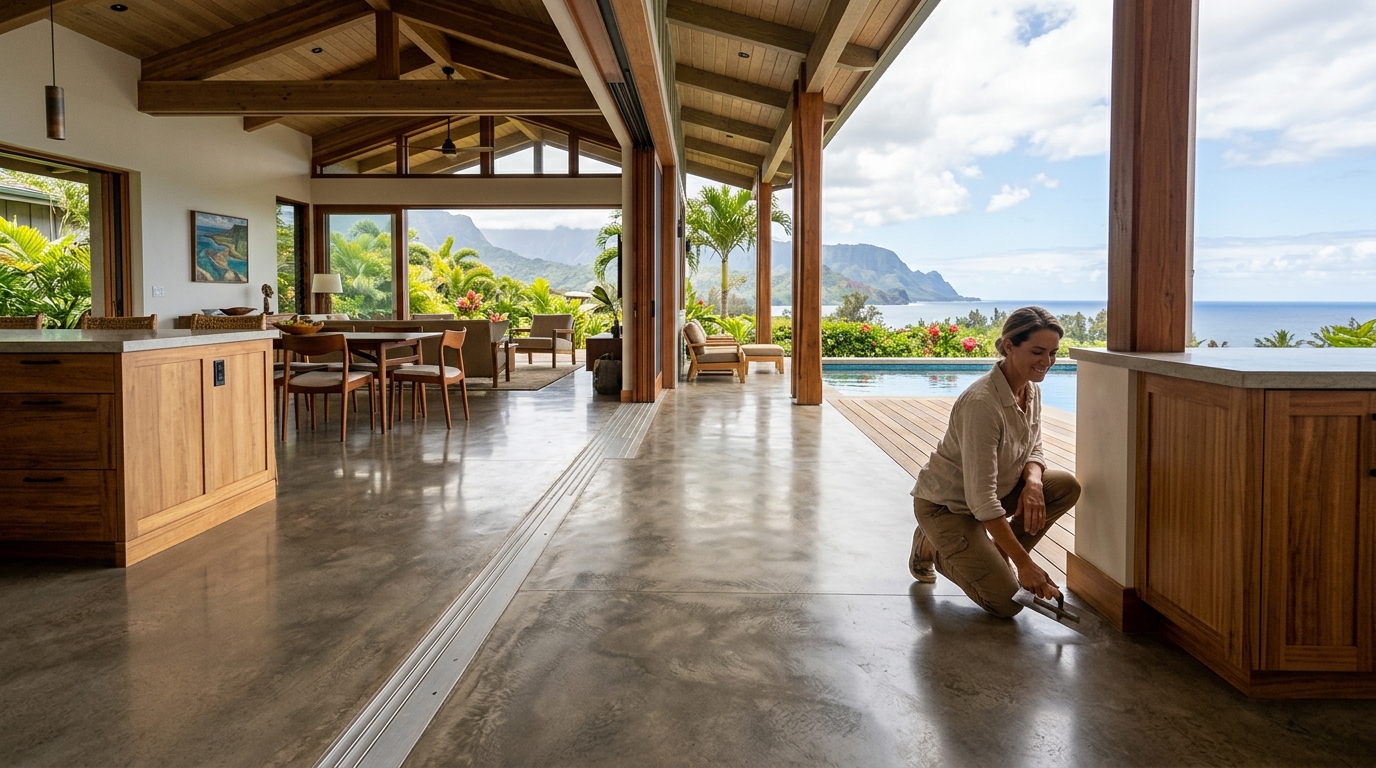
Finding a reliable concrete contractor Princeville homeowners can trust for 2026 involves more than a quick search. You need a licensed team, like ours at Warrior Construction (BC-34373), that intimately understands Kauaʻi’s unique North Shore climate, from the relentless rainy season to the corrosive salt spray coming off the ocean. Pouring concrete here isn’t like on the mainland or even in Honolulu. It’s a specialized craft that has to account for shifting red clay soil, intense hydrostatic pressure, and some of the strictest hurricane building codes in the nation. The wrong concrete mix or improper site prep can lead to catastrophic failure in just a few years.
\n\n
For over two decades, our team has been on the ground across the islands, managing the complexities of Hawaii construction. We’ve seen firsthand what happens when contractors cut corners on foundations or retaining walls, especially in a high-rainfall area like Princeville. The results are cracked slabs, failing walls, and homeowners facing tens of thousands of dollars in repairs. This isn’t just about pouring a driveway; it’s about engineering a durable solution that protects your most significant investment—your home. In this guide, we’ll pull back the curtain and share what you need to know before hiring a concrete contractor on Kauaʻi. We’ll cover the real 2026 costs you can expect, break down realistic timelines, navigate the dual-layered permitting process with the County and the Princeville Community Association, and detail the specific materials required to build something that lasts on the Garden Isle.
\n\n
Why Princeville Homeowners Trust Warrior Construction for Concrete Contractor
\n
Homeowners in Princeville trust our team at Warrior Construction because we blend over 20 years of statewide Hawaii construction expertise with a specific, hard-won understanding of Kauaʻi’s North Shore challenges. Holding a comprehensive General Contractor license (BC-34373) means we manage the entire scope of your project, not just the pour itself. This is a critical distinction. A simple concrete project often involves excavation, grading, drainage, and structural tie-ins—all things a specialized subcontractor can’t legally or logistically handle. We take full responsibility from the ground up.
\n\n
Our experience in Princeville is practical, not theoretical. We know the local batch plants, their mix designs, and their delivery schedules. Furthermore, we understand the immense logistical hurdles of building on Kauaʻi. Getting a concrete pump truck, tons of rebar, and specialized formwork to a job site in Princeville requires careful coordination with barges from Oahu and local trucking companies. There’s no Home Depot down the street with unlimited supply. A contractor unfamiliar with these island logistics can cause weeks of costly delays.
\n\n
On a recent project for a custom home foundation near Queen’s Bath, we had to plan the pour around the notoriously unpredictable North Shore weather. The forecast showed a small window of clear skies. We scheduled the trucks and our finishing crew to be on-site at dawn, but a sudden downpour started just as we were setting up. Instead of risking a compromised slab, we had our crew deploy heavy-duty tarps to tent the entire foundation footprint. This allowed us to control the environment and proceed with the pour, ensuring the water-to-cement ratio wasn’t compromised. That’s the kind of proactive problem-solving that comes from decades of working in these conditions. It’s a level of foresight that protects the integrity of your project and gives you peace of mind.
\n\n
What Does Concrete Contractor Cost in Princeville?
\n
In 2026, homeowners in Princeville should budget between $35 to $55 per square foot for basic concrete flatwork like a driveway or patio. For structural work like a new concrete foundation Princeville requires, the cost jumps significantly to $80 to $120 per square foot. These figures include materials, labor, and standard site preparation, but it’s important to understand what drives these costs on Kauaʻi’s North Shore.
\n\n
The numbers are higher here than on Oahu or the mainland for several reasons. First, every single bag of cement, piece of rebar, and specialized tool arrives on a barge, adding a significant shipping cost. Second, labor rates are higher to account for the cost of living. Finally, the technical requirements for building in this environment add expense. Let’s break it down into common project types:
\n\n
- \n
- Standard Driveway (4-inch slab, broom finish): Expect to pay $35 – $45 per square foot. For a typical 20’x30′ (600 sq ft) driveway, this translates to $21,000 – $27,000. This includes basic excavation, a gravel base for drainage, a rebar grid for strength, and the concrete itself.
- Stamped or Colored Concrete Patio: The cost here is closer to $45 – $60 per square foot. The increase comes from the specialized labor for stamping, the cost of the color hardeners and release agents, and the final sealing process which protects the finish.
- Slab-on-Grade Home Foundation: This is a major structural element, costing $80 – $120 per square foot. For a 1,500 sq ft home, the foundation alone will be in the $120,000 to $180,000 range. This price includes engineering plans, extensive excavation and soil compaction, a vapor barrier, a heavy-duty rebar grid, mandatory termite treatment, and thickened footings around the perimeter and for load-bearing walls.
- Engineered Retaining Wall: A retaining wall Princeville soil and rain demand is a serious piece of engineering. These typically cost $150 to $250 per face square foot. A wall that is 6 feet high and 50 feet long (300 face sq ft) could cost between $45,000 and $75,000. The cost is driven by the deep footings, extensive steel reinforcement, and critical drainage systems required to handle the immense pressure from water-saturated soil.
\n
\n
\n
\n
\n\n
Several factors can push these numbers higher. For example, a property on a narrow road with difficult access might require a concrete pump truck, which adds $2,500 to $5,000 per day to the budget. If your property is on the oceanfront bluffs, we will strongly recommend, and engineers will likely require, using epoxy-coated or stainless steel rebar to prevent corrosion from the salt air. This can increase material costs for reinforcement by 30-50%, but it prevents concrete spalling and catastrophic failure down the road.
\n\n
How Long Does a Concrete Contractor Take in Princeville?
\n
A standard concrete project in Princeville, from the day you sign the contract to the final curing, typically takes 4 to 8 weeks in 2026. The biggest mistake homeowners make is assuming the work starts the day after they sign. In reality, a significant portion of the timeline is dedicated to planning and permitting before a single shovelful of dirt is moved. The pour itself is often just one or two days in a multi-week process.
\n\n
Here’s a realistic timeline for a project like a new driveway or a large patio:
\n\n
- \n
- Permitting, Planning, & Design (2-4 weeks): This is the most variable phase. It involves getting plans drawn if necessary, submitting them to the Princeville Design Committee for approval, and then submitting them to the County of Kauaʻi’s building department. This phase alone can sometimes stretch into months on more complex jobs.
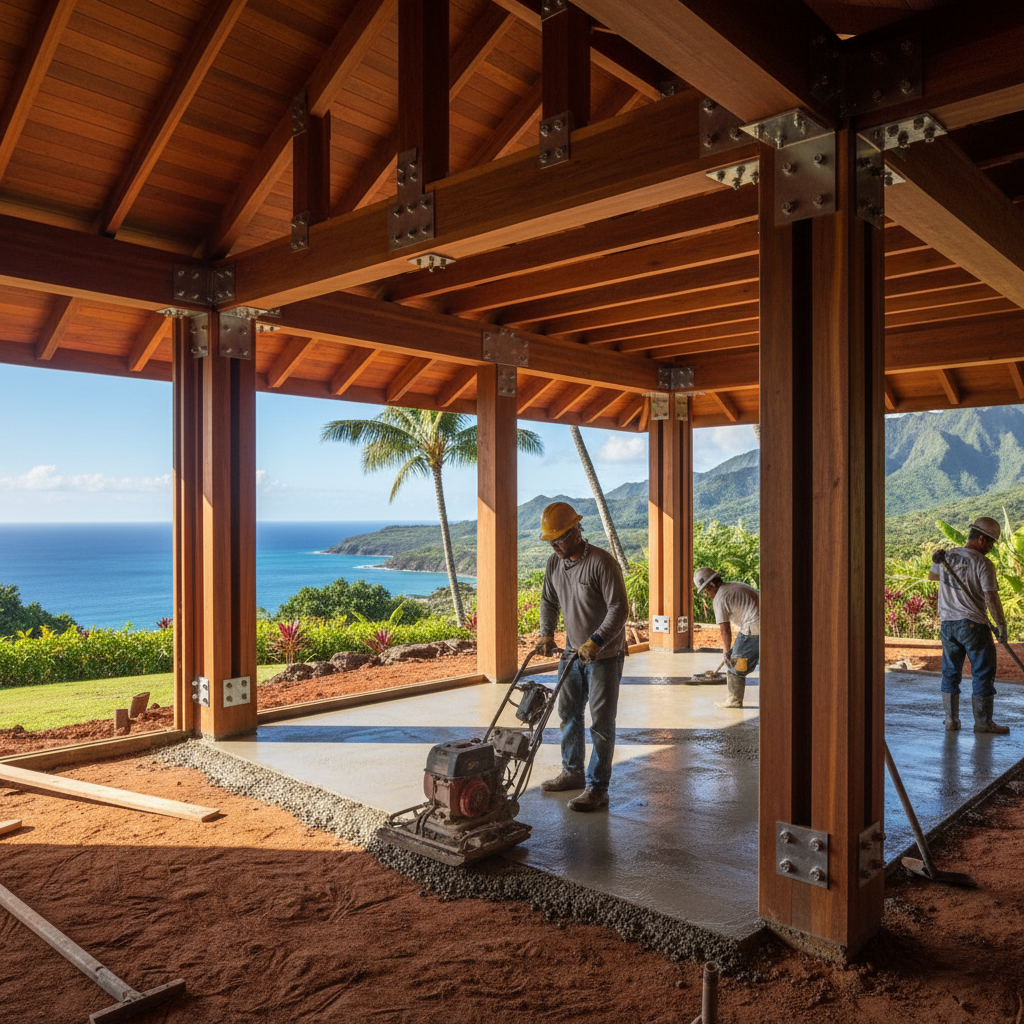
- Demolition, Site Prep, & Formwork (3-7 days): Once we have the permits in hand, our crew gets to work. This includes tearing out any old concrete or asphalt, excavating to the proper depth, grading the site for drainage, compacting the soil, laying down a gravel base, and building the wooden forms that will contain the wet concrete. We also place the steel rebar grid during this stage.
- Pre-Pour Inspection (1-2 days): Before we can order the concrete, a county building inspector must visit the site to approve our formwork, rebar placement, and site preparation. We are on their schedule, and this can sometimes cause a day or two of delay.
- The Pour & Finishing (1 day): This is the main event. The concrete trucks arrive, we pour the slab, and our expert finishers get to work leveling it and applying the desired surface, whether it’s a smooth trowel, a non-slip broom finish, or a decorative stamp.
- Curing & Form Removal (7-28 days): Concrete cures, it doesn’t just dry. It’s a chemical process called hydration. For the first week, the concrete is fragile and needs to be protected, sometimes kept moist, to ensure it cures evenly. We typically remove the forms after a few days. While you can often walk on a new slab after 48-72 hours, it doesn’t reach its full design strength for 28 days. We always tell clients: no heavy trucks on your new driveway for at least three to four weeks.
\n
\n
\n
\n
\n
\n\n
The North Shore’s weather is the ultimate wild card. We simply cannot pour concrete in the rain, as the extra water will weaken the mix and ruin the surface finish. During the winter months, it’s not uncommon for a project to be delayed for a week or more while we wait for a clear window. A good local contractor watches the weather radar obsessively and builds this potential for delay into the schedule they give you.
\n\n
What Permits Do You Need for Concrete Contractor in Princeville?
\n
For almost any significant concrete work in Princeville, you will need a building permit from the County of Kauaʻi Department of Public Works. This isn’t just a suggestion; it’s the law. This applies to new foundations, any structural slab, retaining walls over four feet in height (measured from the bottom of the footing), and even large driveways that alter the property’s drainage. Attempting to do this work without a permit can result in stop-work orders, heavy fines, and being forced to tear out the unpermitted work at your own expense.
\n\n
However, in Princeville, there’s a crucial extra layer of approval. Before you can even submit your plans to the county, you must get approval from the Princeville at Hanalei Community Association (PHCA) Design Committee. They have their own set of rules and aesthetic guidelines that cover everything from the color and finish of your driveway concrete Princeville project to the materials and design of any visible retaining walls. This is a non-negotiable step that adds 2-4 weeks to the pre-construction timeline.
\n\n
The typical permitting process looks like this:
\n
- \n
- Step 1: Hire a Professional. For any structural work like a foundation or engineered retaining wall, you’ll need plans stamped by a Hawaii-licensed architect or structural engineer.
- Step 2: PHCA Design Committee Review. We submit the plans and application to the Princeville Design Committee. They review it for compliance with community guidelines. They may approve it or come back with required changes.
- Step 3: County Permit Application. Once we have the PHCA approval letter, we can formally submit the building permit application to the County of Kauaʻi. While Honolulu’s DPP[2] is a well-known entity, Kauaʻi’s process is distinct and has its own set of reviewers and timelines.
- Step 4: County Plan Review. The county’s plan reviewers will scrutinize the plans for compliance with the building code, zoning laws, and safety regulations. This review process can take anywhere from a few weeks for a simple project to several months for a complex new home.
\n
\n
\n
\n
\n\n
We had a client on Ka Haku Road who learned this the hard way. They wanted to expand their driveway and add a small garden wall. They assumed it was minor work. But because the new driveway changed how rainwater flowed off their property, and the wall was technically a small retaining wall, both the PHCA and the County required a full drainage plan and structural calculations. A project they thought would take two weeks ended up taking three months of planning and permitting before we could start. This is precisely why you need a general contractor who has navigated this dual-approval system many times before.
\n\n
Princeville-Specific Considerations: Climate, Materials, Regulations
\n
Building with concrete in Princeville is fundamentally different than anywhere else. The unique combination of extreme rainfall, corrosive salt air, tricky soil conditions, and hyper-local regulations requires a specialized approach. A mainland contractor using standard methods will see their work fail here, and quickly.
\n\n
Climate: Relentless Rain and Corrosive Salt
\n
Princeville is one of the rainiest places in the United States. This isn’t a drizzle; it’s tropical downpours that can dump inches of water in an hour. This has two major impacts on concrete work:
\n
- \n
- Hydrostatic Pressure: The ground becomes saturated with water, which then pushes against anything below ground with immense force. For a retaining wall Princeville needs, this means we must install a robust drainage system behind the wall—typically a layer of gravel and a perforated pipe—to relieve this pressure. Without it, the wall will bow and eventually fail. For foundations, it means using heavy-duty waterproofing membranes and perimeter drains to keep basements and crawl spaces dry.
- Salt-Air Corrosion: For any property near the ocean bluffs, salt spray is a constant enemy. Salt ions penetrate porous concrete and attack the steel rebar inside. The rebar rusts, expands to many times its original size, and breaks the concrete apart from within. This is called spalling. To combat this, we use several strategies: specifying a denser, less permeable concrete mix (4000 PSI or higher), ensuring adequate concrete cover over the rebar, and using corrosion-resistant reinforcement like epoxy-coated or galvanized steel rebar. It costs more upfront but prevents catastrophic failure.
\n
\n
\n\n
Materials and Soil: Building on Red Clay
\n
Kauaʻi’s iconic red dirt is a type of volcanic clay soil that has poor load-bearing capacity and expands and contracts dramatically as its moisture content changes. You cannot simply pour a foundation on top of it. The site must be properly engineered. This usually involves \”over-excavation\”—digging out several feet of the unstable clay—and replacing it with compacted, engineered fill to create a stable building pad. Skipping this step can lead to a foundation that shifts, cracks, and settles over time.
\n\n
Regulations: The PHCA and Hurricane Codes
\n
Beyond the standard county building permits, all construction in Princeville is governed by two other major forces. First, as we’ve discussed, the Princeville at Hanalei Community Association (PHCA) has strict design guidelines. Their approval is mandatory. Second, ever since Hurricane Iniki devastated Kauaʻi in 1992, the island has had some of the most stringent hurricane-related building codes in the world. For concrete work, this means the foundation is not an isolated element. It must be designed as part of a continuous load path, where the entire house is tied together with steel connectors—from the foundation, through the walls, to the roof—to resist uplift from hurricane-force winds. This involves embedding specific hurricane straps and anchor bolts into the concrete foundation at precise locations, a detail our team is meticulously trained to handle.
\n\n
How to Choose the Right Concrete Contractor Contractor in Princeville
\n
To choose the right concrete contractor in Princeville for your 2026 project, you must verify they have a valid Hawaii general contractor’s license, confirm they carry adequate insurance, check their local Kauaʻi references, and insist on a detailed, itemized quote. A slick website or a low price doesn’t guarantee quality work, especially in this challenging environment. Due diligence is your best defense against a bad outcome.
\n\n
Here is a checklist our team at Warrior Construction recommends every homeowner use:
\n\n
- \n
- Verify Their License: This is non-negotiable. Go to the Hawaii Department of Commerce and Consumer Affairs (DCCA) Professional & Vocational Licensing (PVL) website[1] and search for the contractor’s name or license number. For a project involving more than just a simple slab, you want a General Contractor with a \”B\” license, like our BC-34373. This ensures they are qualified to manage all aspects of the job, including the necessary site work and structural connections. Be wary of anyone with just a specialty license or, worse, no license at all.
- Ask for a COI (Certificate of Insurance): The contractor must provide you with a current COI showing they have both General Liability and Worker’s Compensation insurance. If an uninsured worker gets injured on your property, you could be held financially responsible. General Liability protects your property from damage caused by the contractor’s work.
- Check Local Kauaʻi References: Don’t just ask for references; ask for references for projects they have completed *in Princeville or on the North Shore* within the last two years. A contractor based on Oahu might do great work there, but they may not be prepared for the logistical, regulatory, and climate-related challenges specific to your area. Call the references and ask about communication, timeliness, and how they handled unexpected problems.
- Demand a Detailed, Itemized Quote: A quote that just says \”New Driveway: $25,000\” is a massive red flag. A professional proposal will break down the costs: demolition, excavation and grading, materials (specifying concrete PSI and rebar type), labor, formwork, finishing, and permit fees. This transparency prevents misunderstandings and protects you from surprise charges later.
- Assess Their Communication: In the early stages, pay attention to how they communicate. Do they return your calls promptly? Do they answer your questions clearly and patiently? Construction projects always have hiccups; you want a partner who will communicate proactively when they arise, not one who disappears for days at a time.
\n
\n
\n
\n
\n
\n\n
Real Princeville Concrete Contractor Project Example
\n
A perfect example of the challenges and solutions in Princeville was a project we completed on Queen Emma’s Bluff. The homeowner had an aging timber retaining wall that was leaning precariously, and the connected driveway was severely cracked due to soil settlement.
\n\n
The Challenge: The property was on a steep, unstable slope constantly saturated by rain and exposed to heavy salt spray from the ocean. The failing wooden wall was a safety hazard, and the poor drainage was channeling water directly toward the home’s foundation. The homeowner needed a permanent, engineered solution that was both structurally sound and met the high aesthetic standards of the Princeville community.
\n\n
Our Warrior Construction Solution:
\n
- \n
- Engineering & Design: We immediately engaged a local structural engineer who understood Kauaʻi soil. Together, we designed a new 8-foot-tall, steel-reinforced concrete retaining wall Princeville conditions demand. The design included a deep cantilevered footing for stability and a comprehensive drainage system with perforated pipes and clean gravel backfill to eliminate hydrostatic pressure.
- Permitting & Approvals: Our team handled the entire complex permitting process. We first created detailed plans and material specifications to submit to the Princeville Design Committee. After securing their approval for the wall design and the proposed stamped concrete finish for the new driveway, we submitted the full package to the County of Kauaʻi for the building permit.
- Material Selection: Given the home’s proximity to the ocean, we specified a high-performance 4000 PSI concrete mix with a corrosion-inhibiting admixture. Crucially, all steel reinforcement used in both the retaining wall and the new driveway was epoxy-coated rebar, providing maximum protection against rust and spalling.
- Execution: The new driveway concrete Princeville project was poured with an integral color and a stone-stamped pattern that complemented the home’s architecture. We also incorporated a new channel drain system at the top of the driveway to capture runoff and pipe it away from the foundation, solving the original drainage problem.
\n
\n
\n
\n
\n\n
The Results:
\n
- \n
- Total Project Cost: Approximately $125,000
- Project Timeline: 10 weeks from start to finish (4 weeks for permitting and approvals, 6 weeks for construction).
- Outcome: The homeowner received a beautiful, structurally robust solution that permanently secured their property, solved critical drainage issues, and will withstand the harsh North Shore environment for decades to come. It was an investment that added significant safety, functionality, and value to their home.
\n
\n
\n
\n\n
What this means for Hawaii homeowners
\n
Navigating a concrete project in a place as unique as Princeville requires a shift in mindset. You’re not just buying a product; you’re investing in a long-term solution engineered for a demanding environment. The success of your project hinges on planning for the realities of building on Kauaʻi’s North Shore.
\n
Here is our direct advice for homeowners considering a concrete project in Princeville:
\n
- \n
- Budget for Reality, Not Hope: Understand that costs on Kauaʻi are inherently higher due to logistics and technical requirements. Get multiple detailed bids from licensed, insured contractors and compare them line-by-line. Be wary of any bid that is significantly lower than the others; it likely means corners are being cut. We strongly advise including a 15-20% contingency fund in your budget to cover unforeseen issues, like discovering exceptionally poor soil that requires more extensive excavation.
- Embrace \”Island Time\” for Permitting: The dual-layered permitting process (PHCA and County of Kauaʻi) takes time. Build this into your expectations. A contractor who promises to start next week without permits is breaking the law and putting you at risk. A realistic timeline begins with at least a month of pre-construction planning and paperwork.
- Prioritize Local Experience Above All: Do not underestimate the value of a contractor who has a proven track record *in Princeville*. They will know the county inspectors, understand the nuances of the PHCA’s expectations, have relationships with the local material suppliers, and know how to build for the weather. This local knowledge is worth paying a premium for, as it will save you money and headaches in the long run.
- Invest in Durability: In this environment, the “pay me now or pay me later” principle is absolute. Spending an extra 10-15% on upgrades like epoxy-coated rebar, a higher-strength concrete mix, or a more robust waterproofing and drainage system might seem expensive upfront. However, it’s a fraction of the cost of repairing a spalling, cracked, and failing concrete structure five to ten years down the road. Make the smart, long-term investment.
\n
\n
\n
\n
\n
\n\n
Frequently Asked Questions About Concrete Contractor in Princeville
\n
Do I need an engineer for a simple concrete driveway in Princeville?
\n
For a straightforward replacement of an existing driveway with the same footprint and grade, you typically do not need an engineer. However, if you are creating a new driveway, significantly changing its size or slope, or if your property is on a steep grade, the County of Kauaʻi will almost certainly require plans from a licensed civil engineer to ensure proper drainage and stability.
\n
\n
What is the best concrete finish for Princeville’s rainy climate?
\n
The most practical and safest finish for outdoor flatwork in a high-rainfall area like Princeville is a classic broom finish. The fine, brushed lines create excellent traction and help prevent slips and falls when the surface is wet. While stamped or smooth-troweled concrete can be beautiful, they can become very slippery unless a special non-slip additive is mixed into the final sealer coat.
\n
\n
How much does a concrete foundation cost for a 2,000 sq ft house in Princeville in 2026?
\n
For a 2,000 square foot home in Princeville, you should budget between $160,000 and $240,000 for a standard slab-on-grade concrete foundation in 2026. The final cost will depend on the complexity of the home’s footprint, the recommendations from the geotechnical soil report, and the specific engineering requirements for hurricane resistance and structural loads.
\n
\n
Can you pour concrete in the rain on Kauaʻi?
\n
Absolutely not. A professional contractor will never pour structural concrete during active rainfall. Rainwater landing on the fresh concrete surface will increase the water-to-cement ratio, which severely weakens the final product and can cause dusting, scaling, and a poor finish. Our team constantly monitors weather radar and will reschedule a pour if there is a significant chance of rain.
\n
\n
Why is my quote for a retaining wall in Princeville so high?
\n
Retaining walls over four feet tall are not garden features; they are serious engineered structures designed to hold back immense pressure from thousands of pounds of water-saturated soil. The high cost reflects the deep, steel-reinforced footings, the large quantity of steel rebar required in the wall itself, and the critical, code-mandated drainage system that must be installed behind it to prevent failure. The labor and materials are substantial.
\n
\n
What’s the difference between a GC and a specialty concrete contractor?
\n
A specialty concrete contractor (C-5 license) is licensed only to perform concrete work. A General Contractor (\”B\” license) like Warrior Construction is licensed to oversee and manage the entire project. For a foundation, driveway, or retaining wall, this often includes necessary excavation, grading, drainage, and coordinating with other trades. For anything beyond a simple slab, hiring a GC provides a single point of responsibility and ensures the entire project is managed correctly.
\n
\n
How long does the Princeville Design Committee approval take?
\n
Typically, you should plan for 2 to 4 weeks for the Princeville Design Committee to review and approve your plans. This timeline can be longer if they have questions or request revisions to your design to better comply with community aesthetic guidelines. It is a critical first step that must be completed before you can apply for any permits with the County of Kauaʻi.
\n
\n
\n\n
Building in Princeville requires more than just concrete; it requires deep local knowledge and a commitment to building practices that can withstand the unique challenges of the North Shore. If you’re ready to start your project—whether it’s a resilient new foundation for your dream home, a durable driveway, or an engineered retaining wall to secure your property—our team at Warrior Construction has the proven Kauaʻi experience to do it right, the first time. We handle the complexities so you don’t have to.
\n
Ready to discuss your Princeville concrete project? Get a straightforward, no-obligation estimate from our team today.
\n\n
References
\n