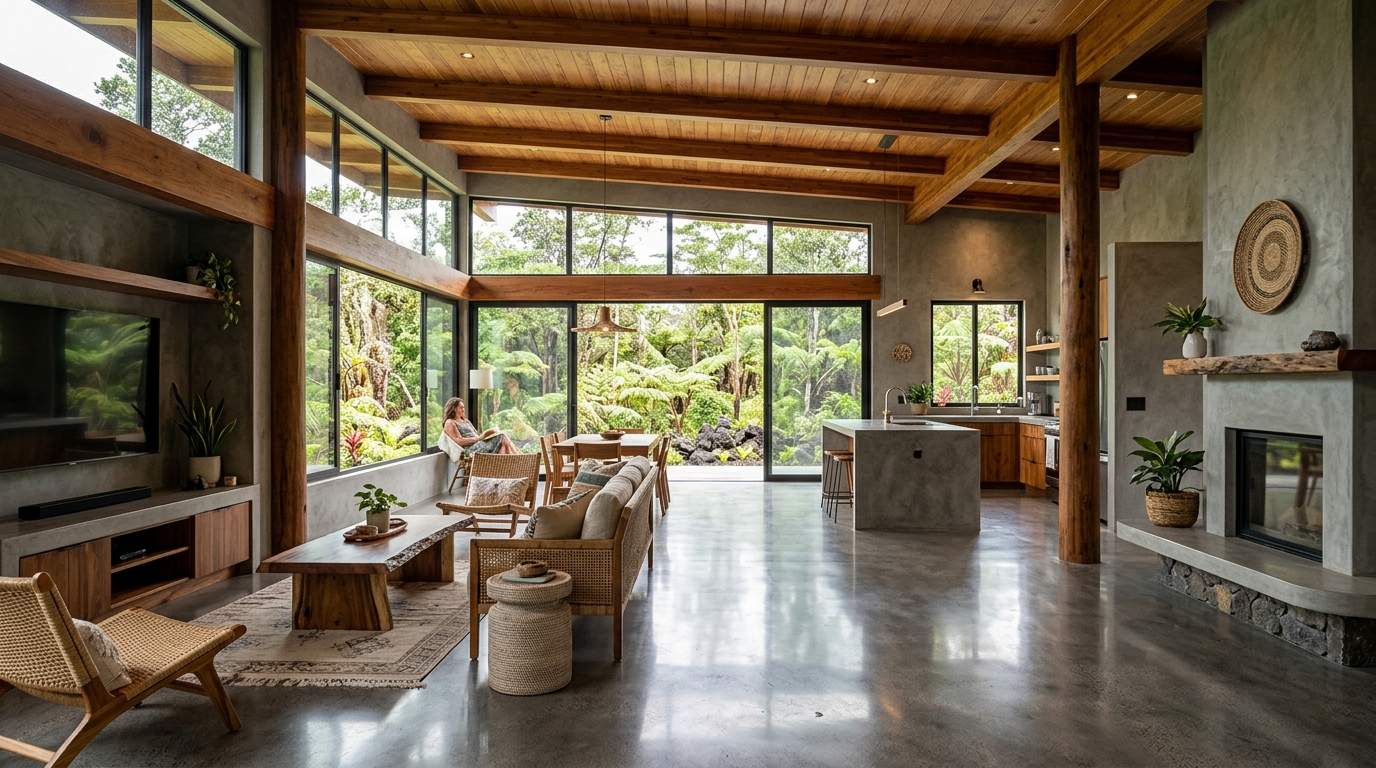
Working as a concrete contractor in Volcano is unlike anywhere else in Hawaii, let alone the mainland. The unique combination of high altitude, constant moisture, acidic volcanic soil, and challenging logistics requires a level of expertise that can only be earned through years of hands-on experience on the Big Island. A simple driveway pour or foundation slab that’s straightforward in Kapolei becomes a complex operation at 4,000 feet elevation next to a rainforest. At Warrior Construction, we’ve managed these challenging projects for over two decades, and we understand that the success of your Volcano home starts from the ground up—with solid, correctly formulated, and properly poured concrete.
The biggest mistake we see homeowners make is underestimating the environment. They might get a quote from a less experienced contractor who treats a Volcano project like one in dry, flat Ewa Beach. The result? A foundation that cracks under hydrostatic pressure or rebar that corrodes prematurely due to acidic soil. This article shares our team’s hard-won knowledge. We’ll break down the real costs you can expect in 2026, navigate the Hawaiʻi County permitting process, and explain the specific techniques required for durable concrete work in this special part of our islands. Getting the concrete right is the most critical investment you’ll make in your home’s longevity.
Why Volcano Homeowners Trust Warrior Construction for Concrete Contractor
When you’re building in a place as demanding as Volcano, you need a team that has already solved the problems you haven’t even thought of yet. That’s where our experience at Warrior Construction (License BC-34373) makes all the difference. We’re not just a general contractor; we are specialists in Hawaii’s unique microclimates and geological conditions. Our long history working across the islands, including numerous projects on the Big Island, gives us an operational advantage that directly benefits our clients in Volcano.
First and foremost, we understand Big Island logistics. Unlike Oahu, where materials and concrete plants are relatively close, Volcano is a haul. The nearest batch plants are in Hilo or Kona. That means concrete can spend over an hour in the truck, a critical timeframe that affects its temperature, slump, and workability. We work directly with the plant technicians to formulate a specific mix design for each Volcano project. This often includes retarders to slow the set time and water reducers to maintain strength without adding excess water, ensuring the concrete that arrives at your remote job site is still at its peak quality for the pour. A contractor without this foresight might end up with a “hot load” that’s impossible to work and finish properly.
Furthermore, our team has deep experience with the specific site work required for a successful concrete foundation volcano. On a recent project in Volcano Farm Lots, the site was a mix of pāhoehoe lava sheets and deep, mucky soil pockets. A standard approach would have failed. We brought in an excavator to break up the surface rock, then over-excavated the soil pockets and backfilled with 2-3 feet of compacted structural fill. This created a stable, uniform base for the foundation, preventing the kind of differential settlement that leads to major structural cracks down the road. It’s this kind of proactive, site-specific problem-solving that sets a seasoned Hawaii contractor apart.
Our commitment extends beyond technical skill. We build relationships. We have established connections with surveyors, engineers, and suppliers on the Big Island, which helps streamline the pre-construction process. We know who has the right equipment, who stocks the specified epoxy-coated rebar, and which trucking companies are reliable. For a homeowner, trying to coordinate these moving parts from off-island or even from another part of the Big Island can be a nightmare. When you partner with us, you’re not just hiring a concrete crew; you’re engaging a fully integrated team that manages the entire process, from design and permitting to the final cure.
What Does Concrete Contractor Cost in Volcano?
Let’s get straight to the numbers, because that’s what every homeowner wants to know. In 2026, the cost for a professional concrete contractor in Volcano is significantly higher than on Oahu due to logistics, materials, and labor. You have to account for barging costs for specialized materials, longer travel times for crews and equipment, and the extra site preparation that the terrain demands. Anyone quoting you Honolulu prices for a Volcano job is either cutting corners or setting you up for a change order down the line.
Here’s a realistic breakdown of what our team is seeing for costs in the Volcano area as of 2026:
- Standard Slab-on-Grade Foundation: For a typical residential home, you should budget between $38 and $45 per square foot. This includes excavation for footings, a 4-inch compacted gravel base, a vapor barrier, termite treatment, rebar reinforcement grid, and a 4-inch thick, 3000 PSI concrete slab with a trowel finish. For a 1,500 sq. ft. home, this puts the foundation cost between $57,000 and $67,500.
- Driveway Concrete Volcano: A new concrete driveway typically costs $28 to $35 per square foot. This price includes light excavation, the gravel base, wire mesh or rebar reinforcement, and a 4-inch slab with a broom finish for traction. A standard 20×30 foot (600 sq. ft.) driveway would therefore run from $16,800 to $21,000. Costs increase for colored concrete, stamped finishes, or thicker slabs designed for heavy vehicles.
- Retaining Wall Volcano: Building a retaining wall is more complex and priced differently. For a standard CMU (concrete masonry unit) block wall, filled solid with concrete and rebar, the cost is typically $90 to $120 per square foot of wall face. For example, a wall that is 4 feet high and 50 feet long (200 sq. ft. of face) would cost between $18,000 and $24,000. This is for a non-engineered wall; walls over 4 feet high require an engineer’s stamp, which adds significantly to the cost.
What drives these costs? Several Volcano-specific factors come into play:
- Material Transport: Most building materials, including specialized rebar and formwork supplies, are shipped to Hilo from Oahu or the mainland. That inter-island freight cost gets passed on. The concrete itself has a surcharge for the long delivery drive from the plant up the mountain.
- Site Preparation: The ground in Volcano is rarely flat or stable. We often have to bring in multiple truckloads of cinder or gravel for the base course, far more than on a typical Oahu lot. If we hit hard lava rock, we need heavy equipment with hydraulic breakers, which adds machine and operator time.
- Labor and Logistics: Mobilizing a skilled crew to a remote Volcano job site involves travel time and logistical planning. Our team is efficient, but the reality of working on a neighbor island, especially in an area with limited resources, adds a premium to the labor cost.
Thinking that you can save money by hiring a cheaper, less-experienced contractor is a recipe for disaster. We’ve been called in to fix failing foundations where the previous contractor didn’t install a proper vapor barrier, leading to constant moisture wicking up through the slab—a huge problem in Volcano’s damp climate that can lead to mold and flooring failure.
How Long Does a Concrete Contractor Take in Volcano?
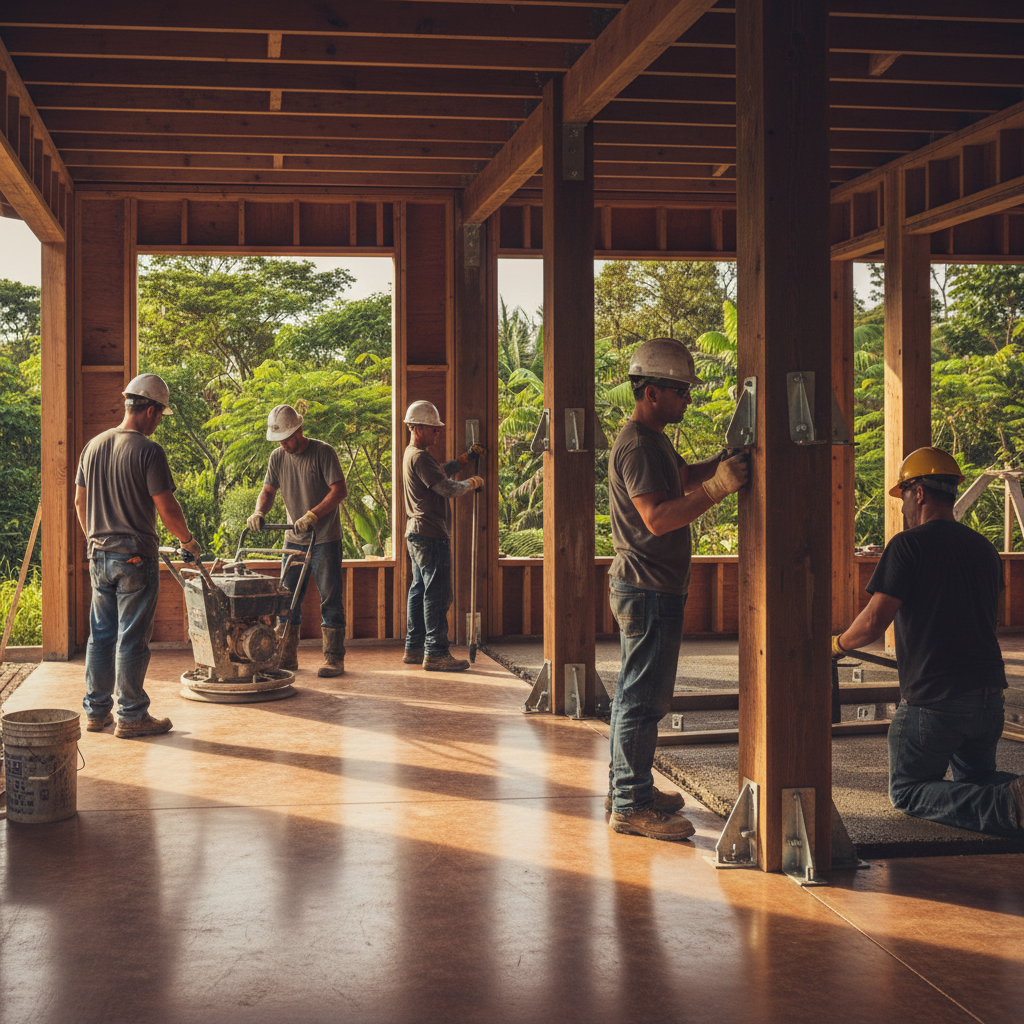
Patience is a virtue in Hawaii construction, and this is especially true for concrete work in Volcano. The timeline is dictated by three main factors: permitting, weather, and the physical process of preparation and curing. Homeowners often focus only on the pour itself, but that’s just one day in a multi-month process. A realistic timeline is crucial for planning the rest of your build.
Here is a sample timeline for a 1,500 square foot concrete foundation project in Volcano, from start to finish in 2026:
- Phase 1: Planning & Permitting (3-5 Months)
- Survey & Engineering (3-4 weeks): Your property needs to be staked by a licensed surveyor. Then, a structural engineer must design the foundation based on a soil analysis and home plans. This is non-negotiable for getting a permit.
- Permit Submission & Review (10-16 weeks): We submit the complete package—architectural plans, structural drawings, and all necessary forms—to the Hawaiʻi County Planning Department. The review process is thorough and can involve back-and-forth with plan reviewers. This is often the longest part of the waiting game.
- Phase 2: Site Work & Preparation (2-3 Weeks)
- Excavation & Grading (3-5 days): Clearing the site, digging the footings, and leveling the building pad. This can take longer if we encounter unexpected lava tubes or large boulders.
- Base Course & Underground Plumbing (2-4 days): Laying and compacting the gravel base, installing underslab plumbing rough-ins, and laying down the vapor barrier and termite treatment.
- Formwork & Rebar (4-6 days): Building the wooden forms that will contain the concrete and meticulously placing and tying the steel reinforcement grid according to the engineer’s plan. This step is critical for the foundation’s strength.
- Phase 3: The Pour & Curing (4 Weeks)
- The Pour (1 Day): This is the main event. A team of concrete finishers, pump operators, and laborers work quickly to place, level, and finish the concrete before it sets. This day is entirely dependent on a clear weather window.
- Initial Curing (7 Days): The concrete needs to be kept moist to cure properly and reach its initial design strength. We often use curing compounds or wet blankets. After about 7-10 days, it’s typically strong enough to begin framing on.
- Full Cure (28 Days): Concrete doesn’t reach its full specified compressive strength (e.g., 3000 PSI) for 28 days. While work can proceed, the foundation is still technically hardening during this time.
The biggest variable in Volcano is the weather. A week of solid rain can halt all site work, pushing the entire schedule back. We had a project near the National Park where we were ready to pour, but an unexpected storm system sat over the area for four straight days. We couldn’t risk pouring, as heavy rain can ruin the surface finish and weaken the crucial water-to-cement ratio. As your contractor, we watch the forecast like hawks and build contingency days into our schedule, but it’s a reality every Volcano homeowner must be prepared for.
What Permits Do You Need for Concrete Contractor in Volcano?
Navigating the permitting process for any construction in Hawaii can be challenging, and Hawaiʻi County is no exception. For any structural concrete work in Volcano, you absolutely need a building permit. Attempting to pour a foundation, a large driveway, or a tall retaining wall without one will result in a stop-work order, fines, and potentially having to tear out the work you just paid for. It’s a risk that is never, ever worth taking.
As your general contractor, Warrior Construction manages the entire permitting process. We work with your architect and engineer to prepare and submit the required documents to the Hawaiʻi County Planning Department. While the specific requirements can vary, here are the essential permits and documents needed for most concrete projects in Volcano:
- Building Permit: This is the primary permit required for any new structure, including the foundation it sits on. It’s also required for a retaining wall volcano project if the wall is over four feet in height (measured from the bottom of the footing) or is supporting a surcharge (like a driveway or part of a house).
- Stamped Engineering Plans: The county will not approve a permit for a foundation or significant structural concrete without plans stamped by a Hawaii-licensed structural engineer. The engineer’s calculations prove that the design meets building codes for seismic activity (critical on the Big Island), wind loads, and soil conditions.
- Site Plan & Grading Plan: You’ll need a detailed site plan showing the location of the proposed work on your property, including setbacks from property lines. If you are moving a significant amount of dirt (typically more than 50 cubic yards), a separate grading permit may be required.
- Plumbing & Electrical Permits: If any plumbing or electrical conduits are being placed within or under the concrete slab, those trades must pull their respective permits, which are tied to the main building permit.
The process generally involves submitting the full plan set to the county’s electronic processing system. A plan reviewer from each relevant department (Building, Planning, Fire, Public Works) will check the plans for compliance. They might issue comments or corrections that your architect or engineer must address before approval is granted. This back-and-forth is normal and is a key reason why the permitting timeline can take several months. The county’s main goal is public safety, and they are meticulous about ensuring all construction adheres to the latest building codes.[1] While this link refers to Honolulu’s DPP, the principles of plan review and code compliance are consistent across all counties.
A few years ago, we took over a project in Mauna Loa Estates where the previous homeowner had hired an unlicensed individual to pour a slab for an “agricultural building” without a permit. When the owner later tried to convert it into a legal dwelling, the county discovered the illegal work. They required expensive core sampling of the concrete, after-the-fact engineering analysis, and ultimately, significant and costly repairs to bring the foundation up to code before any further work could be permitted. It delayed their project by over a year and cost them nearly double what it would have cost to do it right the first time.
Volcano-Specific Considerations: Climate, Materials, Regulations
Success as a concrete contractor in Volcano hinges on mastering the unique environmental and regulatory challenges of the area. Mainland techniques simply don’t apply here. Our team’s approach is built on decades of adapting to these specific conditions to ensure every foundation, driveway, and wall we build is designed for longevity.
Climate: Rain, Humidity, and Temperature
Volcano’s climate is dominated by moisture. With annual rainfall often exceeding 150 inches, water is a constant factor. This impacts concrete work in several ways:
- Pour Scheduling: We absolutely cannot pour concrete during heavy rain. The water will increase the water-to-cement ratio on the surface, severely weakening it and leading to a dusty, low-strength finish called “laitance.” We rely on detailed weather forecasting and try to schedule pours for clear windows, which can be challenging.
- Curing Process: The high humidity is actually beneficial during the curing phase, as it naturally helps the concrete stay hydrated, which is essential for it to gain strength. However, the cool mountain temperatures (often in the 50s or 60s) can slow down the chemical reaction of hydration. This means concrete in Volcano gains strength more slowly than it would in hot, sunny Kapolei. We account for this in our project schedules, allowing for longer cure times before loading the slab with framing materials.
- Mix Design: We often specify an air-entraining admixture for Volcano concrete. This creates microscopic air bubbles in the mix, which helps the concrete resist the stresses of temperature cycles and moisture, making it more durable over the long term.
Soil and Geology: Acid and Lava
The ground itself presents major challenges. Volcanic soils are typically acidic, with a low pH. This acidity aggressively attacks steel. If standard black steel rebar is used and isn’t protected by sufficient concrete cover, it can corrode and expand, cracking the concrete from within—a condition known as spalling. To combat this, we often specify:
- Epoxy-Coated or Galvanized Rebar: This adds a protective layer to the steel, preventing contact with moisture and acidic elements in the soil. It’s a more expensive material, but it’s essential for a foundation that will last a lifetime.
- Increased Concrete Cover: Building codes dictate a minimum distance between the rebar and the edge of the concrete. In corrosive environments like Volcano, we often increase this cover to provide extra protection.
Additionally, the subsurface can be unpredictable. You might be digging in soft ash and then hit a dense lava rock shelf just a few feet away. This requires having the right equipment on-site and the expertise to create a uniform, compacted base so the foundation settles evenly. Proper drainage around the foundation is also critical to prevent water from pooling against the concrete, which can exert immense hydrostatic pressure.
Materials and Logistics
You can’t just run down to the local hardware store for materials in Volcano. Sourcing is a planned, logistical operation. As mentioned, the distance from concrete plants in Hilo or Kona is a major factor. But it also affects everything else. Quality, clean aggregate (the gravel and sand in concrete) is paramount. If the aggregate is contaminated with organic material—common in the lush Volcano environment—it can compromise the strength of the entire mix. We work with reputable suppliers who wash and screen their aggregate to meet strict ASTM standards. This attention to material quality is a hallmark of a professional contractor.
How to Choose the Right Concrete Contractor Contractor in Volcano
Choosing the right contractor for your concrete work in Volcano is arguably the most important decision you’ll make for your entire building project. The foundation is the literal base for everything else; if it’s done wrong, nothing else can be right. Here’s a checklist our team at Warrior Construction recommends you use when vetting potential contractors.
1. Verify Their License and Insurance.
This is the absolute first step. Any legitimate contractor doing this scale of work in Hawaii must have a General Contractor (B) license or a specialty concrete (C-31) license. You can and should verify their license status on the Hawaii Department of Commerce and Consumer Affairs (DCCA) Professional & Vocational Licensing (PVL) website.[2] Our license is BC-34373. Ask for a certificate of insurance showing they carry both General Liability and Worker’s Compensation. If a worker gets hurt on your property and the contractor isn’t insured, you could be held liable.
2. Demand Big Island, and Specifically Volcano, Experience.
A contractor who has only worked on Oahu doesn’t understand the unique challenges. Ask them pointed questions:
- “How do you adjust your concrete mix for the long transit time and cool temperatures in Volcano?”
- “What is your protocol for pouring concrete with Volcano’s unpredictable rain showers?”
- “What type of rebar do you recommend for the acidic soil here, and why?”
- “Can you provide me with addresses of three projects you’ve completed in the Puna or Kaʻū districts in the last two years?”
Their answers will tell you everything. A knowledgeable contractor will give you detailed, confident answers. A contractor who hesitates or gives vague responses is a red flag.
3. Get a Detailed, Itemized Bid.
Don’t accept a one-line quote that just says “Concrete Foundation: $75,000.” A professional bid will break down the costs. It should specify the concrete strength (PSI), the thickness of the slab and footings, the type and spacing of rebar, the thickness of the gravel base, and allowances for site work. This not only shows you exactly what you’re paying for but also allows you to compare bids on an apples-to-apples basis. Be wary of a bid that is significantly lower than the others. They are likely cutting corners on materials, insurance, or labor.
4. Understand Their Project Management and Communication.
Who will be your point of contact? How often will you receive updates? This is especially important if you are managing the project from off-island. At Warrior Construction, we assign a dedicated project manager to each job. We provide regular updates with photos and are always available to answer questions. Clear communication prevents misunderstandings and ensures the project runs smoothly.
Ultimately, you’re looking for a partner, not just a crew to pour mud. You want a team that anticipates problems, communicates clearly, and has the proven expertise to deliver a product that will stand strong for generations.
Real Volcano Concrete Contractor Project Example
To make this all tangible, let’s walk through a recent project our team completed in the Royal Hawaiian Estates subdivision of Volcano. It’s a perfect example of how local knowledge and meticulous planning come together to overcome the area’s challenges.
The Project: A new 1,800-square-foot custom home requiring a monolithic slab-on-grade foundation, along with an 800-square-foot driveway concrete volcano pour and a small, 3-foot-high retaining wall to create a level garden area.
The Challenge: The lot was on a gentle slope, but it was covered in ʻōhiʻa trees and a thick layer of organic topsoil over uneven, broken pāhoehoe lava. The homeowner also wanted a colored, stamped concrete patio area integrated into the main foundation pour. Access was via a narrow, unpaved road, making large truck access tricky. And, of course, the ever-present threat of rain loomed over the schedule.
Our Solution:
- Site Preparation: We carefully cleared only the building envelope to preserve the natural landscape. The big challenge was the subsurface. We used an excavator to remove the topsoil and break up the loose surface lava, then brought in 15 truckloads of compacted structural fill to create a stable, level building pad. This was a critical investment to prevent future cracking.
- Formwork and Reinforcement: We designed the foundation as a monolithic pour, meaning the footings and the slab are formed and poured as one single piece. This creates a stronger, more rigid foundation. For the steel reinforcement, we used #4 epoxy-coated rebar throughout the entire grid to protect against corrosion from the acidic soil.
- The Pour Plan: The project required about 70 cubic yards of concrete. We coordinated with the Hilo batch plant to dispatch trucks in a staggered sequence to ensure a continuous pour. The mix was a 3,500 PSI design with a water reducer and a retarder to give us an extra 45 minutes of workability due to the long drive up the mountain. We had a concrete pump truck on-site to place the concrete precisely, especially for the integrated patio.
- Execution: We identified a three-day clear weather window. Day one was the pour. Our 7-man crew started at dawn and worked tirelessly to place, screed, float, and finish the entire slab. The colored hardener and stamping for the patio section were done in the final stages. For the next seven days, we had a laborer visit the site twice daily to wet-cure the slab, keeping it continuously moist for a stronger cure.
The Outcome: The result was a flawless, rock-solid foundation that passed all county inspections with flying colors. The homeowner was thrilled with the stamped patio, and the framers were able to start work exactly on schedule 10 days after the pour. The total cost for the complete concrete scope (foundation, driveway, wall) was approximately $125,000, and the on-site work took just under four weeks from excavation to being ready for framing. This project highlights how a professional concrete contractor in Volcano doesn’t just pour concrete; we manage geology, climate, and logistics to build a lasting foundation.
What this means for Hawaii homeowners
Building a home in Volcano is a dream for many, but turning that dream into a durable, lasting reality starts with the concrete. Understanding the unique challenges and costs associated with this environment is the first step to a successful project. Cutting corners on your foundation is the most expensive mistake you can make, often leading to repairs that cost far more than doing it right the first time.
Here are the key takeaways for anyone planning a concrete project in Volcano:
- Budget Realistically: Expect to pay a premium for concrete work in Volcano compared to other parts of Hawaii. In 2026, foundation costs of $38-$45 per square foot are the norm. This premium covers the complex logistics, specialized materials, and intensive site work required.
- Hire a True Local Expert: Your contractor must have verifiable, specific experience working on the Big Island, preferably in the high-rainfall, volcanic soil environments of East Hawaiʻi. Don’t be afraid to ask tough, detailed questions about how they handle the local climate and geology.
- Trust the Process: The long permitting timelines and potential weather delays can be frustrating, but they are part of the process of building responsibly in a sensitive environment. A good contractor will manage these expectations and communicate clearly throughout.
- Invest in Better Materials: Insist on the right materials for the job, even if they cost more upfront. Using epoxy-coated rebar and a properly engineered concrete mix is not an upgrade; it’s a necessity for ensuring the longevity of your investment against Volcano’s corrosive soil and damp climate.
Your home’s foundation isn’t just a line item on a budget; it’s the anchor for your family’s safety and your property’s value. Choosing a qualified, experienced concrete contractor is the most critical decision you will make in that process.
Frequently Asked Questions About Concrete Contractor in Volcano
Do I need a special concrete mix for Volcano’s climate?
Yes, absolutely. We never use a standard, off-the-shelf mix for Volcano projects. We typically specify a mix with a lower water-to-cement ratio for higher strength, a retarding admixture to counteract the long truck travel time from Hilo or Kona, and often an air-entraining agent to improve durability in the damp, cool climate. Using the wrong mix can lead to a weak, porous slab that’s susceptible to cracking and moisture issues.
How much does a simple concrete driveway cost in Volcano in 2026?
For a standard broom-finished concrete driveway in Volcano, you should budget between $28 and $35 per square foot in 2026. This includes excavation, a proper gravel base, and steel reinforcement. A typical 20×30 foot (600 sq. ft.) driveway would therefore cost between $16,800 and $21,000. Costs can increase for steep slopes, extensive site work, or decorative finishes like stamping or coloring.
Can I pour concrete in the rain in Volcano?
No, you should never pour concrete during active rainfall. Rainwater getting into the fresh concrete mix will increase the water content on the surface, which dramatically reduces its strength and durability. A professional contractor will watch the weather forecast very closely and will postpone a pour if rain is likely. We would rather delay a project by a day or two than risk the structural integrity of your foundation.
Is a concrete foundation better than post-and-pier in lava zones?
Both foundation types are viable in Volcano, but they serve different purposes. A slab-on-grade or stem wall concrete foundation provides a more stable, solid base and is better for creating a sealed building envelope, which is great for insulation and preventing pests. Post-and-pier (or a post-and-beam) foundation is excellent for steep slopes as it minimizes earthwork. The best choice depends on your specific lot, budget, and house design, and should be determined with your architect and structural engineer.
How do you deal with the acidic soil in Volcano?
The acidic volcanic soil is a major concern because it can corrode standard steel rebar over time, compromising the foundation. Our standard protocol at Warrior Construction is to use either epoxy-coated rebar or galvanized rebar. This creates a protective barrier around the steel. We also ensure the rebar has adequate concrete cover—meaning it’s placed deep enough within the concrete—to further shield it from moisture and soil contact.
What’s the biggest mistake homeowners make with concrete projects on the Big Island?
The biggest mistake is hiring an unlicensed or inexperienced contractor to save money. We’ve seen the disastrous results: cracked slabs from improper site prep, spalling concrete from using the wrong rebar, and major water intrusion issues. Always verify a contractor’s license (ours is BC-34373) and check their references, specifically for projects they’ve done in your area. The short-term savings are never worth the long-term cost of repairs.
How long does it take to get a concrete permit from Hawaiʻi County?
As of 2026, you should plan for a permit review time of 10 to 16 weeks for a new home foundation in Hawaiʻi County. This is the time from when we submit the complete, engineered plans to when the permit is approved and ready to issue. The timeline can be shorter for simpler projects like a driveway, or longer if the plans are complex or require corrections from the plan reviewers. We advise clients to start this process as early as possible.
Building in Volcano presents a unique set of challenges, but with the right team and the right approach, you can build a beautiful, enduring home. The foundation is where it all begins. At Warrior Construction, we have the local expertise and the commitment to quality to ensure your project starts on solid ground.
If you’re ready to discuss your project, our team is here to provide a detailed, transparent estimate based on the real-world conditions of your Volcano property. We’ll help you navigate the process from start to finish. Learn more about our concrete and foundation services or contact us today to get started.