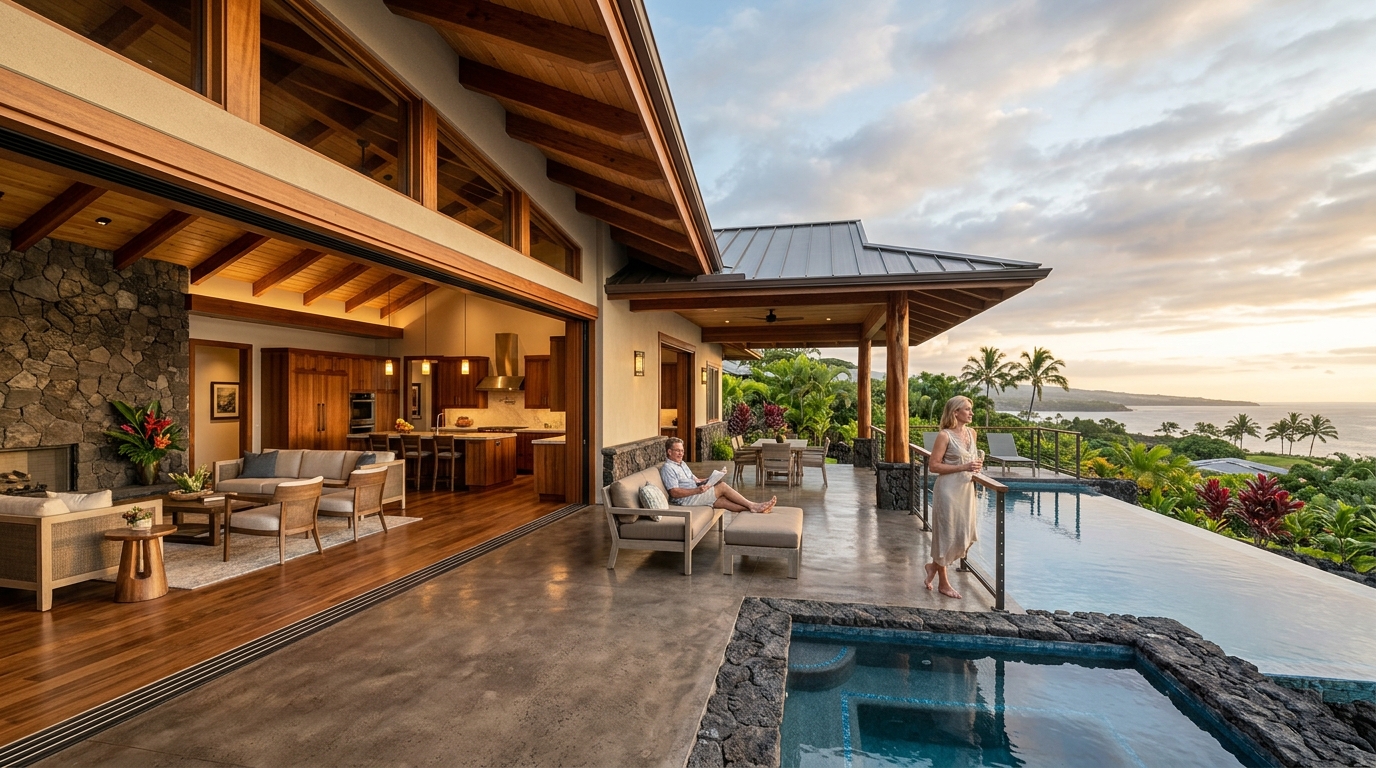
As a custom home builder in Pahoa, the first thing we tell clients is that building here is unlike anywhere else in Hawaii, let alone the mainland. A successful project requires a deep understanding of lava zones, vog, torrential rain, and Big Island logistics. The key to success isn’t just a good set of plans; it’s a contractor who has boots-on-the-ground experience in the Puna district. We’ve seen too many homeowners get burned by mainland-style assumptions that simply don’t apply here.
\n\n\n\nAt Warrior Construction, we’ve spent over 20 years navigating these unique challenges across the islands. Building a custom home in Pahoa demands more than just construction skill—it requires foresight into material durability against volcanic gases, expertise in designing robust water catchment systems, and patience for the Hilo permitting office. This guide breaks down the five critical solutions every prospective homeowner needs: understanding the true costs for 2026, realistic timelines, permit navigation, Pahoa-specific building science, and how to select a genuinely qualified general contractor. Getting these five things right is the difference between a dream home and a costly ordeal.
\n\n\n\nWhy Pahoa Homeowners Trust Warrior Construction for Custom Home Builder
\n\n\n\nTrust isn’t built with a fancy website; it’s earned over decades in the trenches, solving real problems for local families. For us, being a trusted custom home builder in Pahoa comes down to a few core principles. First and foremost is our local knowledge. We’re not just a company with a Hawaii address; our team has managed projects from the rainy side of Hilo to the lava fields of Puna. We understand that a foundation that works in Waimea won’t necessarily work on a recently cleared lot in Leilani Estates. Our team knows how to account for the specific grading needed to handle Puna’s rain, and we know which materials will hold up to the vog and which will be a corroded mess in five years. This isn’t theoretical knowledge from a book; it’s practical wisdom gained from experience.
\n\n\n\nFurthermore, transparency is everything in this business. When we quote a project, we provide a detailed, line-item budget. We explain the real-world costs of shipping materials to Hilo, the price of concrete on the Big Island versus Oahu, and the labor market realities. We had a client in Hawaiian Paradise Park who was shocked by our initial site prep estimate. A mainland contractor had given them a number that was 40% lower. The difference? The other guy hadn’t accounted for the cost of hammering and clearing dense lava rock or the proper soil importation needed for a stable foundation and septic system. We walked the client through every line item, explaining the necessity of each step. That’s the level of detail we bring to every project. Our license, BC-34373, is more than a number—it’s a promise of professionalism and accountability.[1] Our reputation across the islands is our most valuable asset, and we protect it by doing the job right, every single time.
\n\n\n\nWhat Does Custom Home Builder Cost in Pahoa?
\n\n\n\nLet’s get straight to the point, because vague answers don’t help you budget. For a solid, well-built custom home in Pahoa in 2026, you should plan for a starting cost of around $425 to $550 per square foot for the construction itself. For a 2,000-square-foot home, that’s a construction budget of $850,000 to $1,100,000. For a true luxury home builder pahoa experience with high-end finishes, complex architecture, and premium materials, that figure can climb to $600-$800+ per square foot. These numbers often surprise people who see affordable land prices in Puna, but they reflect the hard realities of building in a remote, challenging environment.
\n\n\n\nSo, where does that money go? The costs are driven by several Pahoa-specific factors that don’t exist in places like Honolulu or even Kona. Here’s a typical breakdown of what drives the budget:
\n\n\n\n- \n
- Material Logistics: Almost everything—from engineered lumber to windows to appliances—has to be shipped to Hilo from Oahu or the mainland. That adds a significant percentage to material costs. We recently calculated that the logistical cost for a full home package adds about 15-20% compared to an identical build on Oahu. \n\n\n\n
- Site Preparation: Puna land is not flat, graded dirt. You’re often dealing with dense jungle, albizia trees, and lava rock. Clearing, hammering, grading, and bringing in cinder or soil for a proper house pad can cost anywhere from $25,000 to over $100,000, depending on the acreage and terrain. This is a major variable. \n\n\n\n
- Utilities & Infrastructure: Many lots in Pahoa are off-grid. This means you are responsible for:\n
- \n
- Water Catchment System: A quality system with a food-grade liner, pump, and UV filtration runs $15,000 to $30,000. \n
- Septic System: Engineering and installation for a standard septic system will be in the $20,000 to $35,000 range. \n
- Power: If you’re far from a HELCO pole, the cost to run electricity can be astronomical. This is why many opt for robust solar and battery systems, which can be a $40,000 to $80,000+ investment upfront. \n
\n\n\n\n - Durable Materials: Because of the vog, high humidity, and intense sun, you can’t cut corners. We specify stainless steel hardware (316 grade), high-performance paint, fiberglass or vinyl windows, and termite-resistant framing (like steel framing or borate-treated lumber). These materials cost more upfront but save you from catastrophic failures down the road. \n\n
These are not soft costs; they are hard requirements for a lasting new home construction pahoa project. A builder who gives you a significantly lower per-square-foot cost is likely cutting corners on one of these critical items.
\n\n\n\n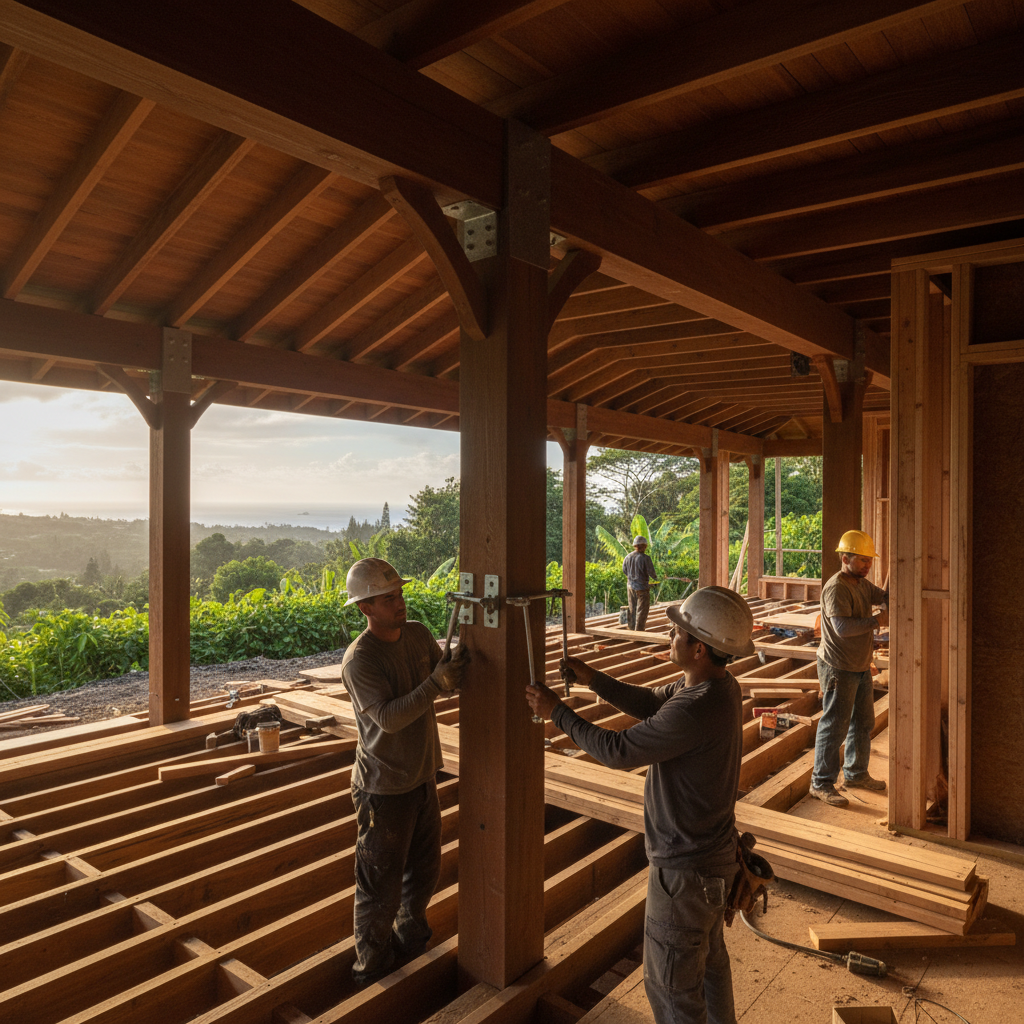
How Long Does a Custom Home Builder Take in Pahoa?
\n\n\n\nPatience is a required building material in Hawaii, and this is especially true in Pahoa. From the day you sign a contract with an architect to the day you get your keys, a realistic timeline for a custom home is 16 to 24 months in 2026. Anyone promising a 9-month build is either inexperienced or not being truthful about the realities of the permitting and inspection process on the Big Island. The construction itself might only take 9-12 months, but the pre-construction phase is what extends the timeline significantly.
\n\n\n\nHere is a phase-by-phase breakdown of a typical Pahoa custom home project timeline:
\n\n\n\n- \n
- Design & Engineering (3-5 months): This is where you work with an architect to translate your vision into construction documents. It involves initial concepts, revisions, and detailed blueprints. Once the architectural plans are set, they go to a structural engineer who designs the foundation and framing to meet Hawaii’s stringent hurricane code requirements. \n\n\n\n
- Permitting (6-10 months): This is the biggest bottleneck. Submitting plans to the Hawai’i County Department of Public Works in Hilo starts a long review process. They check for compliance with zoning, building codes, shoreline setbacks (if applicable), and more. In our experience, there are almost always comments or revisions required, which adds time. It’s a slow, methodical process, and there is very little you can do to speed it up. For comparison, while Honolulu’s DPP has its own challenges, the process on the Big Island is uniquely thorough and can often take longer.[2] \n\n\n\n
- Site Prep & Foundation (1-2 months): Once the permit is in hand, physical work can begin. This includes clearing the lot, grading the house pad, and pouring the concrete foundation or setting the posts for a post-and-pier foundation. \n\n\n\n
- Framing & Dry-In (2-3 months): The skeleton of the house goes up. This includes walls, roof trusses, and sheathing. Once the roofing and windows are installed, the house is considered \”dried-in,\” meaning it’s protected from the elements. \n\n\n\n
- Interior & Exterior Finishes (4-6 months): This is the longest construction phase. It includes running electrical and plumbing, installing insulation and drywall, painting, laying floors, setting cabinets and countertops, and installing fixtures. On the exterior, siding and any lanai work are completed. Material shipping delays can easily add weeks or months to this phase. \n\n\n\n
- Final Inspections & Punchlist (1 month): After construction is complete, a series of final inspections (framing, electrical, plumbing, final) must be passed. After that, we do a final walkthrough with you to create a “punchlist” of any minor items that need to be addressed before we hand over the keys. \n\n
As you can see, the bulk of the time is spent before the framing even goes up. A good home builder pahoa contractor manages this entire timeline proactively, ordering long-lead-time items like windows and trusses months in advance to mitigate delays.
\n\n\n\nWhat Permits Do You Need for Custom Home Builder in Pahoa?
\n\n\n\nNavigating the permitting process for new home construction in Pahoa is a job in itself, and it’s one of the most crucial services a general contractor provides. You can’t just start clearing land with a tractor. A comprehensive building permit from the County of Hawai’i is required, which is actually a bundle of several different approvals and plans. Getting this permit is a multi-step process that requires meticulous documentation and professional plans. There is no shortcut.
\n\n\n\nYour permit application package, typically assembled by your architect and our team, will generally include the following components:
\n\n\n\n- \n
- Stamped Architectural Plans: Complete blueprints detailing floor plans, elevations, sections, and construction details. They must be stamped by a Hawaii-licensed architect. \n\n\n\n
- Structural Engineering Calculations: A separate set of documents from a licensed structural engineer that shows the home is designed to withstand Hawaii’s specific wind loads (hurricane code) and seismic activity. This is non-negotiable. \n\n\n\n
- Site Plan: A drawing showing the location of the proposed house on the property, including setbacks from property lines, the location of the driveway, septic system, and any other structures. \n\n\n\n
- Wastewater System Approval: Since most of Puna is not on a sewer system, you need a plan for an individual wastewater system (IWS), usually a septic system. This plan must be designed by a licensed engineer and approved by the Department of Health. \n\n\n\n
- Grading & Drainage Plans: Depending on the slope of your lot and the scale of the project, the county may require a grading and grubbing permit to ensure your site work doesn’t negatively impact drainage in the surrounding area. \n\n\n\n
- Energy Code Compliance: All new homes must meet state energy efficiency standards. Your plans must show compliance through proper insulation, window specifications, and other measures. \n\n
Our team manages the entire submission and review process. We submit the package to the Hawai’i County Department of Public Works and act as the primary point of contact. We respond to reviewer comments, provide any requested clarifications, and track the application through the various departments. This is a critical role. A simple mistake on the application or a slow response to a query can delay a project by months. We’ve seen DIY applicants get stuck in review cycles for over a year, which is why having an experienced professional handle it is worth every penny.
\n\n\n\n
Pahoa-Specific Considerations: Climate, Materials, Regulations
\n\n\n\nBuilding a home that will last in Pahoa means designing and constructing it specifically for the Puna environment. A house designed for sunny Kapolei would fail quickly here. At Warrior Construction, we call this ‘building for place.’ It means making specific choices about design, materials, and systems to handle the unique local challenges. These aren’t suggestions; they are requirements for a durable, comfortable, and safe home.
\n\n\n\nSolution 1: Understanding and Building for Your Lava Zone
\n\n\n\nThe most important factor for any Pahoa property is its lava-flow hazard zone. Puna is divided into zones 1, 2, and 3, with Zone 1 being the highest risk. This designation affects your ability to get insurance and a mortgage, and it should influence your construction choices. While building codes are the same across zones, building in Zone 1 or 2 requires a higher tolerance for risk and a focus on resilience. We often recommend post-and-pier foundations in higher-risk zones as they can sometimes handle minor ground shifts better than a monolithic slab. Most importantly, it’s critical to secure homeowner’s insurance *before* breaking ground, as it has become increasingly difficult and expensive in these areas.
\n\n\n\nSolution 2: Designing for Rain, Humidity, and Vog
\n\n\n\nPahoa gets a lot of rain—often over 120 inches a year. This, combined with the humidity and volcanic sulfur dioxide (vog), creates a highly corrosive environment. Our design and material choices directly combat this:
\n\n\n\n- \n
- Water Management: A well-designed, oversized water catchment system is essential. We design systems with dual filtration and UV purification for safe, reliable drinking water. We also engineer the roof and gutters to handle torrential downpours and ensure the site is graded so that water flows away from the foundation. \n\n\n\n
- Ventilation: To combat humidity and potential mold, we design homes with excellent cross-ventilation. Large, operable windows, lanais, and high ceilings help keep air moving. We also recommend installing whole-house dehumidifier systems. \n\n\n\n
- Material Selection: Every metal component must be chosen to resist corrosion. This means using 316 stainless steel for all screws, fasteners, and flashing. We recommend fiberglass window frames over aluminum, which pits and corrodes in the vog. For roofing, standing-seam metal with a high-quality Kynar finish is the gold standard for longevity. \n\n
Solution 3: Adhering to Hurricane Code and Beyond
\n\n\n\nAll of Hawaii is in a hurricane zone, and our building codes reflect that. Since Hurricane Iniki, the codes have become much more stringent. For a custom home, this means the structural engineer must design a continuous load path, using specific metal connectors (hurricane straps and ties) to fasten the roof to the walls and the walls to the foundation. This ensures the house can resist uplift forces from high winds. We also strongly advise clients to invest in impact-rated windows and doors, which can withstand flying debris without shattering. It’s a significant upfront cost but provides invaluable protection and peace of mind.
\n\n\n\nHow to Choose the Right Custom Home Builder Contractor in Pahoa
\n\n\n\nChoosing your contractor is the single most important decision you’ll make in the entire process. The right partner will guide you through every challenge, while the wrong one can turn your dream into a nightmare. In Pahoa, local experience is not just a bonus; it’s a prerequisite. Here are the five key steps we recommend every homeowner take when vetting a potential builder.
\n\n\n\nSolution 4: Vet Their License, Insurance, and Reputation
\n\n\n\nFirst, verify their contractor’s license with the Hawaii Department of Commerce and Consumer Affairs (DCCA) Professional & Vocational Licensing (PVL) division.[1] You can look up any contractor by name or license number (ours is BC-34373). Ensure the license is active, in good standing, and is the correct type for your project (a Type B General Building Contractor license). Next, ask for proof of general liability insurance and worker’s compensation insurance. Do not work with anyone who cannot provide this. Finally, check their reputation. Look for online reviews, but more importantly, ask for references from recent projects *in the Puna area*. Call those references and ask about their experience with communication, budget management, and problem-solving.
\n\n\n\nSolution 5: Insist on Puna-Specific Experience
\n\n\n\nA contractor from Honolulu or Maui might be excellent, but if they haven’t built in Puna, they will have a steep learning curve at your expense. Ask specific questions:
\n\n\n\n- \n
- \”Tell me about a project you completed in Lava Zone 1 or 2. What were the challenges?\” \n\n\n\n
- \”How do you source your materials for a Big Island build? Which suppliers do you use in Hilo?\” \n\n\n\n
- \”Who are your go-to subcontractors for excavation and septic systems in the Pahoa area?\” \n\n\n\n
- \”Describe your process for navigating the Hilo permitting office.\” \n\n
Their answers will quickly reveal their level of local expertise. They should be able to answer confidently and with specific examples. If they are vague, it’s a major red flag. At Warrior Construction, we are happy to share details from our portfolio of projects that showcase our experience with these exact challenges.
\n\n\n\nReal Pahoa Custom Home Builder Project Example
\n\n\n\nTo make this tangible, let’s walk through a recent project that encapsulates the challenges and solutions of building in Pahoa. We’ll call it the \”Kapoho Kai Dream Build.\”\n
\n\n\n\n- \n
- Client Goal: A couple from California wanted to build a 2,200-square-foot, 3-bedroom, 2.5-bathroom retirement home on a 1-acre lot they purchased in a subdivision near Pahoa. They wanted an open-concept living space, a large covered lanai for indoor-outdoor living, and a design that was both modern and resilient to the climate. Their budget was around $1.2 million for construction. \n\n\n\n
- The Challenges: The property was located in Lava Zone 2. It was undeveloped, covered in thick ohia and invasive albizia, and had no access to county water or sewer. The clients were also concerned about vog affecting their respiratory health and wanted a home designed for superior air quality. \n\n\n\n
- Warrior Construction’s Solution: Our preconstruction planning started with a thorough site analysis. We determined a post-and-pier foundation would be the most cost-effective and resilient choice for the specific terrain. We designed the home with a large hip roof to maximize water catchment and oriented the windows to capture the trade winds for natural ventilation. Key specifications included:\n
- \n
- A 30,000-gallon water catchment tank with a triple-filtration system (sediment, carbon, UV). \n
- An engineered septic system designed for the area’s soil percolation rate. \n
- A high-efficiency HVAC system with MERV-13 filtration to scrub vog and pollen from the air. \n
- All exterior materials were specified for corrosion resistance: standing-seam metal roof, fiberglass windows, and stainless steel fasteners throughout. \n
- We worked with a trusted local crew for the challenging site clearing and grading. \n
\n\n\n\n - The Outcome: The permitting process took 8 months, and construction took 11 months. The total project duration was 19 months. The final construction cost came in at approximately $1.15 million (about $522/sq ft), right on budget. The clients now have a beautiful, durable home that is perfectly tailored to the Pahoa environment. They have a reliable source of clean water, fresh air inside, and the peace of mind that comes from knowing their home was built correctly for its unique location. \n\n
What this means for Hawaii homeowners
\n\n\n\nBuilding a custom home in Pahoa is an achievable dream, but it requires a shift in mindset from typical construction projects. It’s less about speed and more about diligence, resilience, and working with nature. Your success hinges on acknowledging the unique environmental and logistical realities of the Puna district from day one. You cannot fight the rain, the vog, or the lava rock; you must build in harmony with them.
\n\n\n\nHere is your action plan if you’re considering this journey in 2026 or 2027:
\n\n\n\n- \n
- Budget Realistically: Do not base your budget on mainland costs or even Honolulu costs. Use a starting figure of $425 per square foot for construction and add a healthy contingency (15-20%) for site work and infrastructure unknowns. \n\n\n\n
- Start Early: Because of the long design and permitting timelines, you should begin talking to architects and builders 18-24 months before you hope to move in. The sooner you start, the smoother the process will be. \n\n\n\n
- Prioritize Local Expertise: When selecting your team—your architect, engineer, and especially your general contractor—make Puna-specific experience your number one criterion. This local knowledge is more valuable than any other credential. \n\n\n\n
- Invest in Resilience: Do not cut corners on the things that protect your home from the environment. Pay for the stainless steel fasteners, the impact-rated windows, and the best water filtration system you can afford. These are not upgrades; they are essentials for living in Pahoa. \n\n
By taking a measured, informed, and realistic approach, you can navigate the complexities of a Pahoa build and create a stunning home that will serve your family for generations.
\n\n\n\nFrequently Asked Questions About Custom Home Builder in Pahoa
\n\n\n\nIs it possible to get a mortgage to build a home in Lava Zone 1 or 2?
\nIt is extremely challenging, but not impossible. In 2026, most traditional lenders will not finance new construction in Lava Zone 1 and are very hesitant in Zone 2. Your best bet is to work with local credit unions on the Big Island who have a higher tolerance for this risk or to seek out specialized lenders. The biggest hurdle is securing a homeowner’s insurance policy, which is a prerequisite for any loan. Be prepared to pay cash or have a significant down payment (50% or more).
\nHow much does a building permit for a new house cost in Hawai’i County?
\nThe permit fees are calculated based on the valuation of the project, but you can expect the total cost to be several thousand dollars. For a typical 2,000 sq. ft. home with a construction value of $900,000, the plan review and building permit fees from the County of Hawai’i would likely be in the range of $8,000 to $12,000 in 2026. This does not include the cost of the architect, engineer, or any third-party reviews that may be required.
\nWhat is the biggest hidden cost when building in Pahoa?
\nSite preparation is almost always the biggest and most unpredictable cost. Many people buy land without fully understanding the expense of clearing dense vegetation and hammering through lava rock to create a stable house pad. What looks like a small line item can easily balloon by tens of thousands of dollars. We always recommend getting a firm quote from an experienced local excavation contractor as part of your due diligence before you even finalize a house plan.
\nCan I act as my own general contractor to save money?
\nWhile Hawaii law allows for an owner-builder exemption, we strongly advise against it unless you have significant construction management experience *in Hawaii*. The process is far more complex than just hiring subcontractors. You would be responsible for navigating the permit process, scheduling a complex web of trades, ensuring code compliance, managing inspections, and handling logistics. Any mistakes will lead to costly delays that quickly erase any potential savings.
\nHow long does it take to get materials shipped to the Big Island?
\nFrom the U.S. West Coast to Hilo, standard ocean freight takes about 2-3 weeks. However, you need to factor in manufacturing lead times. Custom windows can take 12-16 weeks to be built, cabinets can take 8-10 weeks, and specialized items like trusses can be longer. A good contractor plans for this by ordering these long-lead-time items the moment the permit is approved to avoid delays during construction.
\nIs a post-and-pier foundation better than a concrete slab in Pahoa?
\nIt depends on the specific lot, but post-and-pier foundations are very popular in Puna for good reason. They are often better for sloping lots, as they minimize the need for extensive, costly grading. They also elevate the home, which improves airflow and protects the structure from ground moisture and pests. In some cases, a well-engineered slab-on-grade can be a good choice, but post-and-pier offers more flexibility for the typical Pahoa terrain.
\nDo I need an architect, or can a draftsman draw my plans?
\nFor a new custom home in Hawaii, you absolutely need a licensed architect. The county requires that plans be stamped by a Hawaii-licensed architect and structural engineer. A draftsman can help with initial sketches, but they cannot legally submit plans for a permit. The architect’s role is crucial for designing a home that is not only beautiful but also safe, functional, and compliant with all of Hawaii’s complex building codes.
\nBuilding a custom home in Pahoa is a significant undertaking, but it’s one of the most rewarding projects you can do. It’s a chance to create a sanctuary perfectly suited to this unique and beautiful corner of the world. The key is to partner with a team that has the local knowledge and experience to guide you through the process smoothly.
\n\n\n\nIf you’re ready to explore the possibilities for your new home construction in Pahoa, our team at Warrior Construction is here to help. We can provide a clear, honest assessment of your property and help you develop a realistic budget and timeline. Reach out today for a no-obligation consultation and let’s start planning your Puna dream home.
\n\n\n\nReady to build your custom home in Pahoa? Learn more about our custom home building services or request your free, detailed estimate today.
\n\n\n\n