When homeowners on Oahu ask me about the cost of a kitchen remodel in 2026, I give them the straight answer right away. For a full, down-to-the-studs renovation, you should budget between $325 to $600 per square foot. That means for a typical 200-square-foot kitchen, the real oahu kitchen remodel cost is landing anywhere from $65,000 to over $120,000. That number can be a shock if you’re looking at mainland pricing guides, but here in Hawaii, it’s our reality. This isn’t just a number we pull out of thin air; it’s the result of island logistics, a tight labor market, and the unique demands of building in our tropical environment.
For over two decades, our team at Warrior Construction has been navigating these challenges for homeowners across the island. We’ve seen it all, from high-end builds in Portlock to family-friendly renovations in Mililani. The sticker shock is real, but understanding *why* the costs are what they are is the first step in planning a successful project that adds real value to your home. In this guide, we’ll break down the numbers you need to know for 2026, from per-square-foot costs in different neighborhoods to the real timeline you can expect from permit application to final walkthrough. Let’s get into the details.
How Much Does a Kitchen Remodel Cost Per Square Foot on Oahu in 2026?
The single biggest factor driving your kitchen remodel cost, after its size, is your zip code. The price difference between a project in Hawaii Kai and one in Kapolei isn’t just about finishes; it’s about logistics, property values, and homeowner expectations. At Warrior Construction, we base our initial estimates on realistic per-square-foot data, which gives our clients a solid starting point for their budget.
Why East Oahu Kitchens (Kailua, Hawaii Kai) Cost More
On the Windward side and in East Honolulu neighborhoods like Kailua and Hawaii Kai, we are consistently seeing high-end kitchen remodels price out between $450 and $600 per square foot. Why so high? First, the homes themselves are often older and require more extensive work. On a recent project in Lanikai, what started as a straightforward kitchen gut turned into a major structural repair when we discovered decades of termite damage in the load-bearing walls. That’s a common issue in older wood-frame homes.
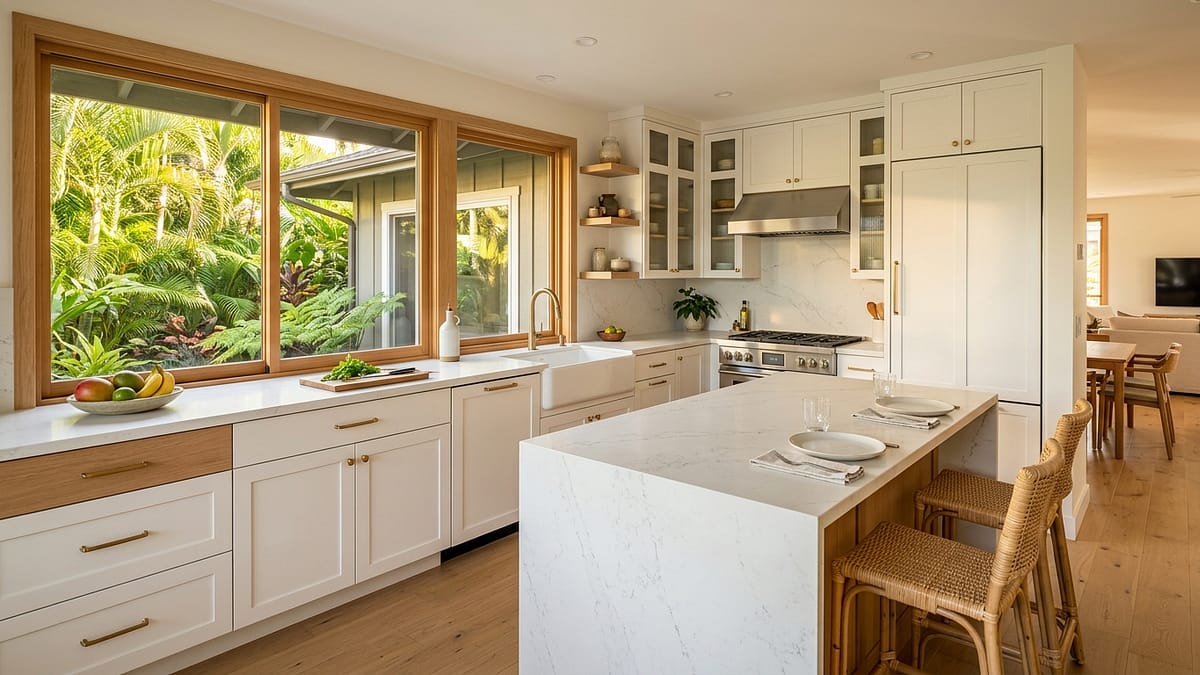
Furthermore, homes in these areas command higher property values, so homeowners are more likely to invest in premium materials to match. Think Sub-Zero and Wolf appliances, custom-milled Sapele cabinets, and full quartzite slabs for the island and backsplash. According to the Hawaii Contractors Association’s 2026 cost survey, the price for these high-end materials, combined with the island’s highest labor rates for top-tier carpenters, is what pushes these projects into a premium bracket.[1] Logistics also play a role; getting a dumpster and material deliveries into tight hillside lots in Hawaii Loa Ridge is simply more challenging and costly than a flat lot in Ewa Beach.
Standard Remodel Costs in West Oahu & Central (Kapolei, Mililani)
In growing communities like Kapolei, Ewa Beach, and Mililani, the cost per square foot for a kitchen remodel is more moderate, typically landing in the $325 to $425 per square foot range. These projects often involve newer homes, built in the last 10-30 years, which generally have better bones. This means less risk of running into major electrical or plumbing surprises that need a complete overhaul to bring up to code.
Homeowners here tend to focus on smart, durable, and family-friendly upgrades rather than pure luxury. We install a lot of high-quality semi-custom cabinets, engineered quartz countertops that are tough as nails, and reliable appliance packages from brands like Bosch or KitchenAid. These choices deliver a fantastic look and excellent function without the steep price tag of the ultra-premium brands. The infrastructure is also newer and more accessible, making the entire construction process smoother and more cost-effective.
What’s the Average Total Cost for a Kitchen Renovation in Honolulu?
While the per-square-foot cost is a great tool for initial planning, most people want to know the all-in number. For a mid-range, 200-square-foot kitchen remodel on Oahu in 2026, the average total cost is running between $80,000 and $125,000. This range typically covers a full gut renovation: new cabinets, countertops, appliances, plumbing fixtures, lighting, flooring, and paint. It also accounts for professional design, project management, permitting, and labor from licensed, insured tradespeople.

Sample Budget Breakdown for a $100,000 Oahu Kitchen
To make that number more tangible, here’s how a typical $100,000 Honolulu kitchen renovation cost might break down. Keep in mind these are percentages and can shift based on your specific material choices.
- Cabinetry & Installation: 30% ($30,000) – This is the biggest line item. A recent report noted that a standard set of semi-custom shaker cabinets has jumped to over $22,000, before installation.[2]
- Labor & Project Management: 25% ($25,000) – This covers demolition, framing, plumbing, electrical, drywall, painting, and daily oversight from your general contractor.
- Appliances: 15% ($15,000) – A solid mid-range package including a refrigerator, range, dishwasher, and microwave/hood vent.
- Countertops: 10% ($10,000) – For a standard-sized kitchen, this gets you quality engineered quartz or a mid-grade granite slab, including fabrication and installation.
- Permitting, Design & Contingency: 10% ($10,000) – Never skip the contingency fund. On Oahu, we recommend 10-15% to cover unforeseen issues.
- Fixtures, Flooring & Lighting: 10% ($10,000) – This includes your sink, faucet, garbage disposal, new flooring like LVP, and all your new light fixtures.
The ROI Sweet Spot: Why $80k-$125k Delivers the Best Return
The best part about investing in a quality kitchen remodel is that you get a lot of it back when you sell. The Honolulu Board of REALTORS’ latest report on renovation ROI shows that kitchen projects in that $80,000 to $125,000 range recoup about 85% of their cost at resale.[3] This is the sweet spot. It’s a significant upgrade that modernizes the home and appeals to buyers without over-improving for the neighborhood.
The same report cautions that once you push a kitchen remodel past $200,000, the return on investment drops sharply to below 60%. This happens when you install a professional-grade kitchen in a home that doesn’t support that level of luxury, creating an imbalance that buyers won’t pay a premium for. Smart, strategic spending is key.
Why Are Kitchen Remodel Costs So High in Hawaii?
Every time we sit down with a new client, this question comes up. You see a kitchen remodel on a mainland TV show for $40,000 and wonder why it costs double or triple here. The answer lies in three core realities of living and building on an island in the middle of the Pacific.
The Matson Factor: Mainland Shipping & Surcharges
Virtually everything for your kitchen—from the cabinets made in Oregon to the faucet from Wisconsin and the quartz slab from Spain—has to get here on a boat. That means Matson shipping costs, container fees, and fuel surcharges get baked into the price of every single material. Once it arrives at Sand Island, it has to be warehoused and then delivered to your job site. This multi-step logistics chain adds a significant premium, something we call the “island tax.” A pallet of tile that costs $2,000 in California can easily cost $3,000 or more by the time it lands in our warehouse.
Oahu’s Skilled Labor Shortage: How It Affects Your Budget
The demand for skilled construction labor on Oahu far outstrips the supply. As UHERO’s 2026 forecast points out, there’s a critical shortage of licensed electricians, plumbers, and finish carpenters.[4] The big commercial projects in Kaka’ako and the ongoing military construction can pull the best talent, leaving a smaller pool for residential jobs. This drives up labor rates. To get reliable, high-quality tradespeople on our projects, we have to pay competitive wages, and that cost is a necessary part of your project budget. It’s the price for quality and for keeping your project on track.
Material Lead Times: The 4-6 Month Wait for Appliances
Because everything is shipped, we can’t just run down to a local warehouse and pick up what we need. Planning and ordering have to happen months in advance. For high-end appliances from brands like Sub-Zero, Thermador, or Miele, we are currently seeing lead times of 4 to 6 months from the day we order to the day they arrive on island.[2] This long waiting period has a ripple effect on the project schedule and requires careful management and storage of materials, which adds to the overall cost.
How Long Does a Kitchen Remodel Take on Oahu?
The second biggest shock for many homeowners, after the cost, is the timeline. A kitchen remodel on Oahu is a marathon, not a sprint. A realistic timeline from the day you hire a contractor to the day you’re cooking in your new kitchen is easily 14 to 20 months. Yes, you read that right. It breaks down into three distinct phases, with most of the time spent waiting before any construction begins.
Phase 1: The 8-10 Month Wait for a Honolulu Permit
If your kitchen remodel involves moving walls, relocating plumbing, or changing the electrical layout, you will need a building permit from the Honolulu Department of Planning and Permitting (DPP). This is non-negotiable. Based on the DPP’s own data from early 2026, the initial review for a
residential permit is taking an average of 8 to 10 months.[5] That’s just the first pass; if the examiner has questions or requires corrections, it can take even longer. We advise clients to think of the design and permitting phase as a year-long process.
Phase 2: Ordering & Staging Materials (4-6 Months)
Once the permit is approved, we start the procurement phase. Our policy at Warrior Construction, which aligns with best practices from the Hawaii Contractors Association, is to have every single item for your project on-island and in our possession before we start demolition.[6] This includes cabinets, appliances, countertops, tile, fixtures—everything. Given the 4-6 month lead times for many items, this phase is critical. It prevents the nightmare scenario where your kitchen is torn apart and the project grinds to a halt for weeks because the sink is stuck on a container ship off the coast of Long Beach.
Phase 3: Active Construction (12-14 Weeks)
This is the phase everyone thinks about: the actual construction. While a mainland project might take 6-8 weeks, on Oahu, a more realistic timeline for the physical work is 12 to 14 weeks. The primary reason for this extended schedule is the labor shortage. We might finish drywall and be ready for the electricians, but our trusted electrical sub-contractor might be tied up on another job for two weeks. These scheduling gaps are an unavoidable part of building in Hawaii right now, and we build them into our schedule to give our clients a realistic completion date.
What Kitchen Design Trends Are Popular in Hawaii for 2026?
Hawaii kitchen design in 2026 is all about reflecting our unique sense of place while using materials that can stand up to our climate. The all-white kitchen is fading in favor of warmer, more natural, and highly functional spaces.
Materials That Fight Salt Air and Humidity
On the Windward side or near the ocean, salt air is relentless. We’re seeing a huge demand for materials that fight corrosion and humidity. This includes specifying marine-grade 316L stainless steel for all exterior hardware, drawer pulls, and even appliance panels. For cabinetry, polymer-based or marine-grade plywood boxes are a smart upgrade from standard particle board, as they won’t swell and delaminate in our humid air. We’re also using more durable finishes that are easy to clean and maintain.
Seamless Indoor-Outdoor Flow for Lanai Living
The line between the kitchen and the lanai is disappearing. The winning designs at the recent BIA-Hawaii awards all featured large-format pocketing or bi-fold doors that create one massive entertaining space. We’re designing kitchens with this flow in mind, often running the same durable porcelain flooring from inside to out and building outdoor BBQ stations with countertops made from the same material as the kitchen island. It’s about embracing the indoor-outdoor lifestyle that makes living in Hawaii so special.
Natural Textures: Moving Beyond the All-White Kitchen
Homeowners are asking for textures and colors that feel connected to the islands. We’re incorporating locally sourced woods like monkeypod or mango for open shelving and island accents. Countertops are moving toward honed or leathered finishes in darker tones like basaltina stone, which echoes the lava rock landscape. Backsplashes are a great place to add a touch of color, with subtle green or deep blue glass tiles that reflect the ocean. It’s a sophisticated, natural aesthetic that feels both modern and deeply rooted in Hawaii.[7]
What this means for Hawaii homeowners
Navigating an Oahu kitchen remodel in 2026 requires a shift in mindset from what you might see on the mainland. The costs are higher and the timelines are longer, but with the right approach, you can achieve an incredible result that enhances your lifestyle and adds significant value to your home. Here’s our best advice:
- Plan for the Long Haul: Embrace the 14-20 month timeline from the very beginning. Understand that the majority of this time is spent in planning, permitting, and procurement before a single hammer swings. Patience is your most valuable asset.
- Budget Realistically and Include a Contingency: Use the per-square-foot numbers in this guide ($325-$600) to set a realistic budget. Most importantly, set aside a 10-15% contingency fund. On any remodel, but especially in Hawaii’s older homes, surprises are inevitable. Having that fund ready turns a potential crisis into a manageable problem.
- Hire an Integrated Design-Build Team: Managing an architect, an engineer, an interior designer, and a general contractor separately is incredibly challenging here. A design-build firm like Warrior Construction brings all those experts under one roof. This streamlines communication, simplifies accountability, and is the most effective way to navigate the lengthy DPP permitting and complex logistics.
- Focus on Durable, Island-Appropriate Materials: Don’t just pick materials that look good on Instagram. Talk to your contractor about what will last. Investing in marine-grade hardware, humidity-resistant cabinet boxes, and durable countertops will pay dividends for years to come, saving you from premature repairs and replacements. A great local resource for ideas on these materials can be found in a recent guide on termite-resistant building materials in Hawaii.
Frequently Asked Questions
Do I really need a permit for my Oahu kitchen remodel?
Yes, almost certainly. If you are moving or adding any walls, altering any plumbing (like moving a sink), or changing the electrical layout (like adding new outlets or dedicated circuits), a permit from the Honolulu DPP is required by law. A simple cosmetic update with new paint and countertops might not, but any substantive work will. Attempting to do this work without a permit can lead to fines, stop-work orders, and major problems when you try to sell your home.
Can I save money by buying my own appliances and materials?
While it seems like a way to save, it often creates more problems and costs. Contractors get trade pricing that is usually better than retail. More importantly, we manage the incredibly complex logistics of ordering, shipping, receiving, inspecting for damage, warehousing, and delivering items to the job site at the right time. If your homeowner-supplied fridge arrives damaged or is the wrong size, the project delays can cost you far more than any initial savings.
How much value does a kitchen remodel add to my Honolulu home?
According to 2026 data from the Honolulu Board of REALTORS, a mid-range kitchen remodel in the $80,000 to $125,000 range has one of the best ROIs of any home improvement project, recouping approximately 85% of its cost at resale.[3] It’s a strong investment that also significantly improves your quality of life while you’re in the home.
What is the biggest unexpected cost in an Oahu kitchen remodel?
The most common surprises we find in older Hawaii homes are related to what’s behind the walls. This often includes termite damage, outdated electrical wiring that isn’t up to code (like old knob-and-tube or ungrounded circuits), and corroded cast-iron plumbing that needs to be replaced. This is why a 10-15% contingency fund is not just a suggestion; it’s a necessity for any project on Oahu.
Is it more expensive to remodel a kitchen in a condo than a single-family home?
Yes, it is often more expensive on a per-square-foot basis. Condo remodels involve AOAO (Association of Apartment Owners) approvals, strict rules on working hours, protecting common areas like hallways and elevators, and challenging logistics for moving materials and debris in and out of the building. These constraints add significant time and labor costs to the project.
Planning a kitchen remodel on Oahu is a major undertaking, but it doesn’t have to be overwhelming. With a realistic budget, a patient mindset, and the right team on your side, you can create the kitchen you’ve always wanted. Our team has the local experience to guide you through every step, from initial design to final inspection.
If you’re ready to start the conversation about your own kitchen project, our team at Warrior Construction is here to help. Learn more about our kitchen remodeling services or contact us to schedule a consultation.
References
- Hawaii Contractors Association 2026 Residential Cost Survey
- Pacific Business News: Oahu Renovation Costs Climb
- Honolulu Board of REALTORS Q1 2026 Renovation ROI Report
- UHERO Hawaii Construction Forecast Spring 2026
- Honolulu DPP Q1 2026 Processing Times Report
- Hawaii Contractors Association Guide to Managing Renovation Timelines
- Hawaii Home + Remodeling: Kitchen Materials for Island Living