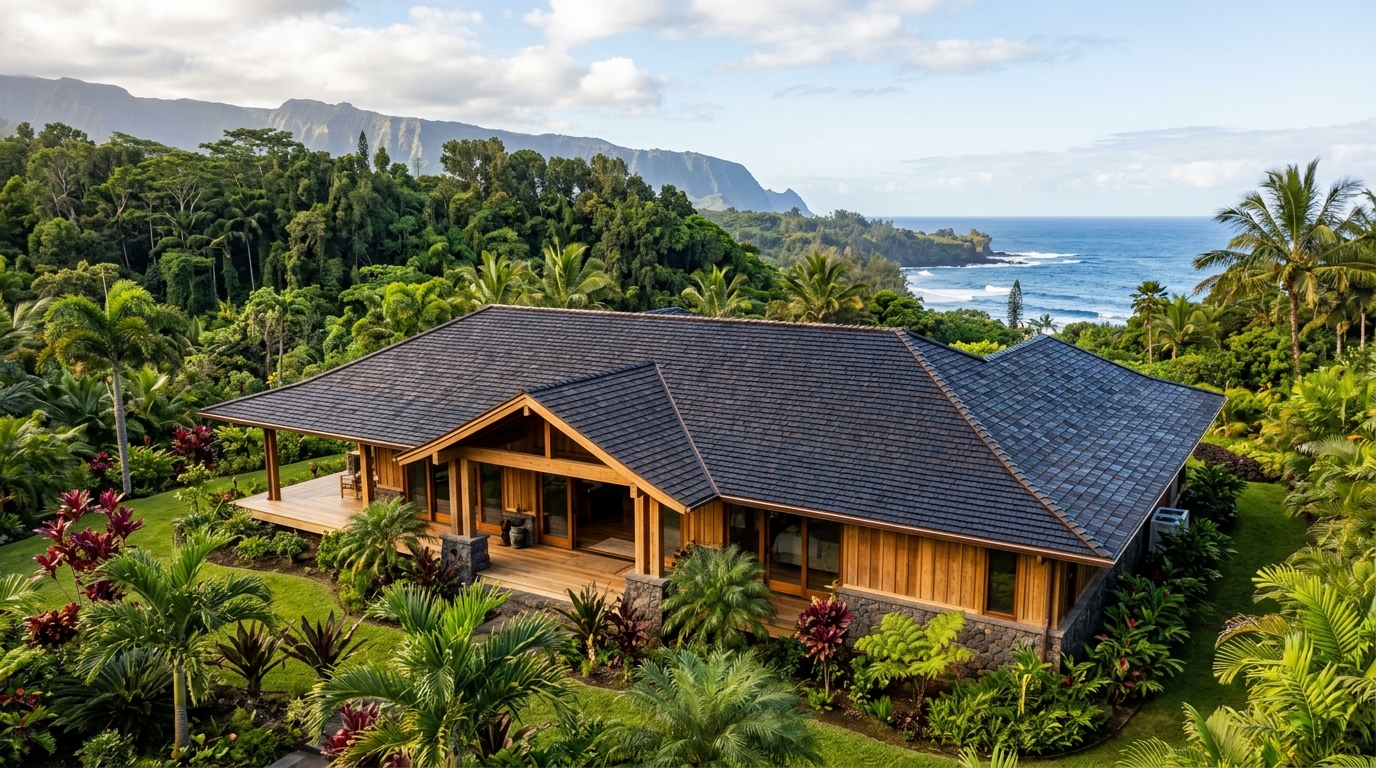
Finding the right roofing contractor Hana homeowners can trust for 2026 means partnering with a team that gets the realities of building in one of Hawaii’s most beautiful, yet challenging, environments. The constant rain, intense sun, and salt-laden air require more than just a standard roof; they demand a system engineered specifically for this climate. At Warrior Construction, we bring over two decades of on-the-ground Hawaii experience to every project, especially on neighbor islands where logistics and material choices are critical. We understand that a roof in Hana isn’t just about keeping water out—it’s about long-term performance against corrosion, high winds, and UV degradation. This means focusing on robust materials like Kynar 500-coated standing seam metal, stainless steel fasteners, and high-performance underlayments that can handle the moisture. Furthermore, navigating the Maui County permitting process and managing the logistics of getting materials and a skilled crew to a remote job site is half the battle, and it’s a part of the process our team has mastered. In this guide, we’ll break down the real costs, timelines, material choices, and critical factors you need to consider for a successful roof replacement or repair in Hana.
Why Hana Homeowners Trust Warrior Construction for Roofing Contractor
Homeowners in a place as unique as Hana need a general contractor, not just a roofer. The reason is simple: a roof is an integrated system that affects your entire home’s structure, from the foundation to the trusses. Our General Contractor license (BC-34373) means we see the whole picture. We’re not just looking at the shingles or metal panels; we’re assessing the sheathing underneath, the integrity of the trusses, the ventilation of the attic space, and how the roofline manages the incredible amount of rainfall Hana receives. This holistic approach prevents future problems. For example, on a recent project near the Seven Sacred Pools, we found that the previous roofer had installed a new roof over partially rotted sheathing. A simple roofer might have missed that or ignored it. As a GC, it’s our responsibility to identify and fix the underlying structural issue, ensuring the new roof has a solid foundation to last for decades.
Furthermore, experience with neighbor island logistics is non-negotiable for Hana projects. Everything—from the roofing panels and screws to the underlayment and the crew themselves—has to be planned meticulously. We have established relationships with Hawaii’s shipping and freight companies, allowing us to accurately schedule material delivery via barge to Kahului and then by truck out to Hana. This prevents costly delays. We’ve seen other contractors underestimate the time and cost involved, leaving homeowners with a torn-off roof and materials stuck on Oahu for weeks. Our project management process accounts for these realities from day one. We build buffer time into our schedules for weather delays (a given in Hana) and ensure our crews are properly equipped and housed to work efficiently in a remote location. This level of planning is what separates a professional operation from a crew that’s simply not prepared for the complexities of working on Maui’s east side. Our commitment is to a seamless process and a final product that stands up to the elements, providing peace of mind for years to come.
What Does Roofing Contractor Cost in Hana?
In 2026, the cost for a professional roofing contractor in Hana is higher than in Honolulu or even Central Maui, primarily due to logistics. A good rule of thumb is to budget for a 15-25% premium on top of typical Maui prices to account for material shipping, crew travel, and lodging. For a standard 2,000-square-foot roof, a full replacement in Hana will likely range from $44,000 to $70,000, depending heavily on the material chosen and the condition of the underlying structure.
Here’s a breakdown of typical per-square-foot costs, installed in Hana:
- Standing Seam Metal (24-gauge with Kynar 500 finish): This is the best choice for Hana’s climate. Expect to pay between $28 and $35 per square foot. For our 2,000 sq. ft. example home, this comes to $56,000 – $70,000. The cost reflects the superior corrosion resistance, wind uplift rating, and longevity. We almost exclusively use stainless steel fasteners and clips here to prevent galvanic corrosion, which is a must in this salt-heavy environment.
- Asphalt Shingles (Architectural/Laminate): While more affordable upfront at $18 to $25 per square foot ($36,000 – $50,000), we rarely recommend them for Hana. The high moisture and humidity lead to issues with algae and moss growth, and the shingles degrade much faster under the intense UV radiation. They simply don’t offer the long-term value required.
- Composite/Synthetic Roofing (e.g., DaVinci Roofscapes): These products offer excellent durability and aesthetics, mimicking slate or wood shake. They run from $22 to $30 per square foot ($44,000 – $60,000). They are a great option but the cost can be similar to metal, which generally offers better performance in high-wind events.
For a smaller project like a `roof repair hana`, costs can vary widely. A simple repair to replace a few blown-off shingles might be $800 – $1,500, factoring in the travel time for a crew. However, if the repair involves fixing a leak that has caused damage to the plywood sheathing underneath, the cost can easily climb to $3,000 – $5,000 once you factor in replacing structural components. It’s critical to get a thorough inspection. Often, what seems like a small leak is a symptom of a much larger issue with the underlayment or flashing, especially around chimneys or vents.
How Long Does a Roofing Contractor Take in Hana?
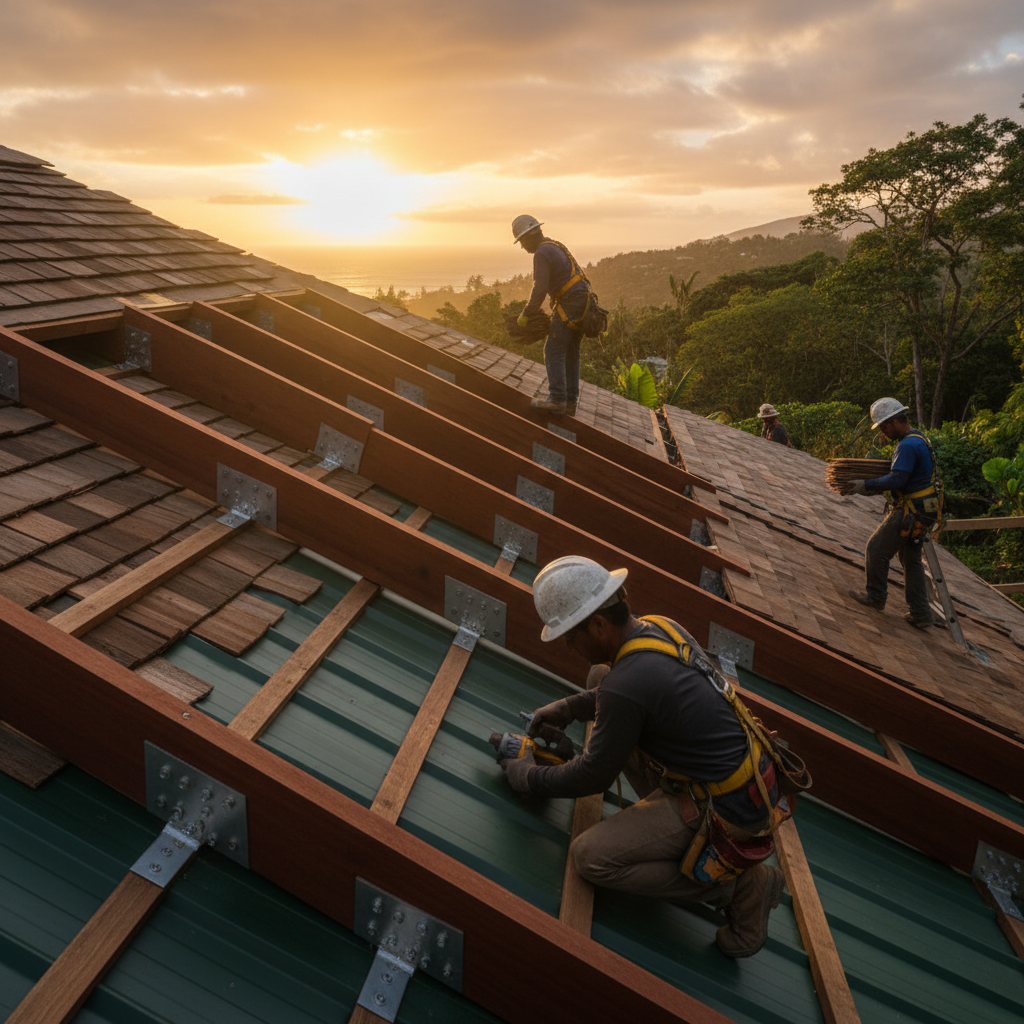
A full roof replacement in Hana is a multi-stage process where the on-site work is often the shortest part. From signing a contract to final inspection, a typical project in 2026 takes between 12 and 20 weeks. Homeowners need to have realistic expectations, as the timeline is heavily influenced by factors outside the contractor’s direct control, especially in such a remote area.
Here’s a realistic timeline for a 2,500-square-foot `roof replacement hana`:
- Planning, Engineering, and Permitting (4 – 8 weeks): Once we have a signed contract, our team finalizes the material selections and, if necessary, works with an engineer to ensure the plans meet current hurricane code requirements. We then submit the permit application to the Maui County Department of Public Works. This is not a fast process, and any complexities with the property can add weeks to the timeline.
- Material Procurement and Shipping (6 – 10 weeks): This phase often runs parallel to permitting. Custom-colored standing seam metal panels need to be manufactured on the mainland, shipped to Honolulu, then barged to Kahului. This is the longest lead time in the entire project. We order materials as soon as the plans are finalized to get them in the queue. Trying to save a week here can result in months of delay later.
- Site Mobilization and Tear-Off (2 – 3 days): Once the permit is in hand and materials have arrived on Maui, our crew mobilizes to the Hana site. We arrange for a dumpster and begin the tear-off of the old roofing material. This is when we do a final, thorough inspection of the roof deck.
- Deck Repairs and Underlayment (2 – 4 days): Any rotted or damaged plywood sheathing is replaced. This is a critical step. We then install a high-performance synthetic underlayment and, in key areas like valleys and eaves, an ice and water shield for an extra layer of protection.
- Roof Installation and Flashing (5 – 8 days): The new roofing material is installed. For standing seam metal, this is a precise process of cutting and fitting each panel. All flashing around vents, skylights, and chimneys is meticulously installed to prevent leaks.
- Cleanup and Final Inspection (2 – 3 days): The site is thoroughly cleaned, and we schedule our final inspection with the Maui County building inspector.
All told, the on-site portion of the work typically takes 2 to 3 weeks. However, Hana’s weather is the ultimate wildcard. A week of solid rain can bring work to a halt, as it’s unsafe and unwise to work on an open roof in those conditions. A good contractor will have contingency days built into the schedule to account for this.
What Permits Do You Need for Roofing Contractor in Hana?
For any significant roofing work in Hana, a building permit from the Maui County Department of Public Works is required. This is a crucial step that protects you, the homeowner. The permit process ensures that the work is designed and executed to meet the latest building codes, particularly those related to hurricane resistance and structural integrity. A complete `roof replacement hana` will always require a permit. This involves submitting plans that detail the type of roofing material, the fastening method, the underlayment to be used, and any structural repairs to the roof deck or trusses. The county reviews these plans to ensure they comply with codes designed to keep your home safe during a high-wind event.
Smaller jobs fall into a gray area. Generally, a `roof repair hana` that involves replacing less than one roofing square (100 square feet) of material with the same type of material may not require a permit. However, if the repair involves any structural elements like replacing the plywood sheathing underneath, a permit is almost certainly necessary. The key is that any work affecting the structural integrity or the building’s weather envelope typically triggers a permit requirement. Our team always verifies with the county before starting any work. Trying to bypass the permit process is a major risk. If you’re caught, the county can issue a stop-work order, levy significant fines, and even require you to tear off the unpermitted work and start over. More importantly, unpermitted work can void your homeowner’s insurance policy and create major problems when you try to sell your home. As your licensed contractor, we handle the entire permitting process on your behalf, from application to final inspection, ensuring everything is done correctly and by the book. It’s an essential part of our service that provides you with long-term protection.
While Honolulu’s Department of Planning and Permitting (DPP)[1] handles this on Oahu, the process on Maui is managed by their own county offices. The principles are the same, but the specific forms, fees, and review timelines are unique to Maui County.

Hana-Specific Considerations: Climate, Materials, Regulations
Building in Hana is unlike anywhere else in Hawaii, and your roof is the first line of defense against its unique climate. Ignoring these local factors is a recipe for premature roof failure. Here’s what our team focuses on for every Hana project.
Climate: Rain, Sun, and Salt
Hana gets an average of 70 to 300 inches of rain per year depending on the specific location. This isn’t just a light drizzle; it’s often a driving, wind-swept rain. This constant moisture saturation means two things for your roof: superior waterproofing and excellent ventilation.
- Waterproofing: We use a two-layer defense. The primary barrier is the roofing material itself (preferably standing seam metal). The critical secondary barrier is the underlayment. We use high-quality synthetic underlayments that won’t break down or absorb moisture like old-school felt paper. In all valleys, eaves, and penetrations, we install a self-adhering ice and water shield for an even higher level of protection.
- Ventilation: With high humidity, attic spaces without proper ventilation become breeding grounds for mold and mildew, which can rot your roof structure from the inside out. We ensure there is a proper system of intake vents (at the soffits) and exhaust vents (at the ridge) to keep air circulating, drying out any incidental moisture.
Materials: Fighting Corrosion and UV
The combination of intense UV radiation and corrosive salt air is brutal on building materials. For `tropical roofing hana`, material selection is everything.
- Metal Roofing: A 24-gauge Galvalume steel panel with a factory-applied Kynar 500 (or Hylar 5000) paint finish is the gold standard. The Galvalume coating provides base-level corrosion resistance, and the Kynar 500 finish is a high-performance resin that excels at resisting UV fading and chalking, keeping your roof looking good for decades.
- Fasteners: This is a detail where many contractors cut corners. Using cheaper galvanized screws with a high-end metal roof is a huge mistake. The screws will rust out in the salt air within 5-10 years, causing leaks and panel failure long before the panels themselves degrade. We insist on using 304 or 316 stainless steel fasteners and clips. They cost more, but they ensure the entire system lasts.
Regulations: Hurricane Code and Water Catchment
Since Hurricane Iniki, Hawaii has had some of the strictest building codes in the nation regarding wind resistance. In Hana, this is especially critical.
- Hurricane Straps and Nailing: The code dictates specific nailing patterns for roof sheathing and requires hurricane straps or clips that create a continuous load path, tying the roof structure all the way down to the foundation. During a reroof, we inspect all existing connections and upgrade them to meet current hurricane code.
- Water Catchment: Many homes in Hana rely on rainwater catchment systems. A roofing project must be planned with this in mind. The choice of roofing material matters (metal is ideal), and the system must be properly disconnected and protected during the work. We also ensure that the new roof installation does not introduce any contaminants into the system and is properly integrated with the gutters and downspouts that feed the tank.
How to Choose the Right Roofing Contractor Contractor in Hana
Choosing your contractor is the most important decision you’ll make for your roofing project. In a remote area like Hana, hiring the wrong team can turn into a logistical and financial nightmare. Here are the key steps to vetting a potential contractor.
First, verify their license and insurance. This is non-negotiable. Any legitimate contractor in Hawaii must have a license issued by the Department of Commerce and Consumer Affairs (DCCA). You can and should verify any contractor’s license number (ours is BC-34373) on the Professional & Vocational Licensing (PVL) website[2]. A valid license means they have met the state’s requirements for experience, examination, and financial standing. Equally important, ask for proof of general liability insurance and worker’s compensation insurance. If an uninsured worker gets hurt on your property, you could be held liable. Our team provides all clients with a certificate of insurance before any work begins.
Second, grill them on their Hana-specific experience. Ask direct questions:
- “How many roofing projects have you completed in Hana or on Maui’s east side in the last few years?”
- “What is your logistical plan for materials and crew? Where do you source your materials? How do you get them to the job site?”
- “How do you handle crew housing and transportation for a multi-week project in Hana?”
- “What specific material suppliers and shipping companies do you work with for neighbor island projects?”
A contractor who gives vague answers or hasn’t thought through these details is not prepared for the realities of working in Hana. You want a team that has a clear, proven process for managing remote projects.
Finally, demand a detailed, itemized proposal. A one-page quote with a single price is a red flag. A professional proposal from a team like ours will be several pages long and will break down the entire scope of work, including:
- Specific materials to be used (e.g., “24-gauge standing seam metal panels in Forest Green with Kynar 500 finish”).
- Scope of tear-off and disposal.
- Details on underlayment and flashing.
- Allowance for potential plywood sheathing replacement (e.g., “Includes replacement of up to 4 sheets of 5/8″ CDX plywood”).
- Payment schedule and project timeline.
- Warranty information, both for materials and workmanship.
This level of detail protects you and ensures there are no surprises down the line. It shows the contractor has thoroughly evaluated your project and is confident in their pricing and process.
Real Hana Roofing Contractor Project Example
To make this all concrete, let’s walk through a typical project we might handle in Hana. Imagine a 2,500-square-foot, single-story home in the Nahiku area, built in the late 1990s. The homeowners called us because their original asphalt shingle roof was failing badly—it was covered in moss, shedding granules into the gutters, and had developed a couple of persistent leaks.
The Problem
Our initial inspection confirmed the roof was at the end of its life. The constant moisture had caused the shingles to curl and break down. Worse, when we walked the roof, we could feel several soft spots, indicating the plywood sheathing underneath had suffered water damage and was likely starting to rot. The existing flashing around their two skylights was also improperly installed and showing signs of corrosion. The home relied on a water catchment system, so the material choice and installation process had to be carefully managed.
Our Solution: A Full Roof Replacement
- Tear-Off and Assessment: We performed a complete tear-off of the old shingles and felt paper. This exposed the plywood deck and confirmed our suspicions: five sheets of plywood, primarily around the skylights and in one valley, were delaminated and needed replacement.
- Structural Repair and Fortification: Our crew replaced the damaged sheathing with new 5/8″ CDX plywood. While the deck was open, we inspected the hurricane clips and added new ones where needed to bring the entire structure up to the current 2026 building code.
- Waterproofing System: We installed a premium synthetic underlayment over the entire roof deck. For extra protection, we applied a self-adhering ice & water shield membrane around the entire perimeter of the roof, in the valleys, and around the skylights.
- New Metal Roof: We installed a 24-gauge standing seam metal roof in a “Patina Green” color with a Kynar 500 finish. This material is ideal for water catchment, is rated for high winds, and the color blends beautifully with the Hana landscape. All clips and fasteners were 316 stainless steel to prevent corrosion from the salt air. We installed new, custom-fabricated flashing around the skylights to ensure a watertight seal.
The Results
- Total Cost: Approximately $81,250. This broke down to about $32.50 per square foot, including the structural repairs and logistics premium for Hana.
- Timeline: From contract signing, it took 7 weeks for permitting and material delivery. The on-site work was completed in 16 working days, spread over three weeks to account for a few days of heavy rain.
- Outcome: The homeowner now has a beautiful, durable roof that is structurally sound, fully compliant with hurricane codes, and will provide clean water for their catchment system for the next 40-50 years with minimal maintenance.
Frequently Asked Questions About Roofing Contractor in Hana
What is the best type of roof for Hana’s rainy climate?
Without a doubt, a standing seam metal roof with a high-quality Kynar 500 paint finish is the superior choice for Hana. The interlocking panels and concealed fasteners create a nearly impenetrable barrier against driving rain. Unlike shingles, metal doesn’t support moss or algae growth, and it’s an excellent, clean surface for rainwater catchment systems.
How much does a simple roof repair cost in Hana?
A minor repair, like replacing a few damaged shingles or sealing a leaking vent flashing, can cost between $800 and $1,500 in Hana. The cost is higher than on Oahu due to the travel time and logistics for getting a skilled crew to the remote location. More extensive repairs involving sheathing replacement will cost significantly more, often starting around $3,000.
Can I do my own roofing work in Hana to save money?
We strongly advise against it. Roofing is dangerous work that requires specialized safety equipment and knowledge. Furthermore, navigating the Maui County permit process and understanding the specific requirements of the Hawaii building code for high-wind zones is complex. A mistake can lead to catastrophic failure, void your insurance, and cost far more to fix than hiring a professional from the start.
How long should a new roof last in Hana?
The lifespan depends entirely on the material. A professionally installed standing seam metal roof with stainless steel fasteners should last 40 to 50 years or more. In contrast, an asphalt shingle roof, even a high-quality one, will likely only last 15 to 20 years in Hana’s harsh climate before it starts to degrade and require replacement.
Does a roof replacement require me to move out of my house?
No, you can typically stay in your home during the entire process. However, you should expect significant noise during the day, particularly during the tear-off and installation phases. We maintain a clean and safe worksite, but there will be disruptions. We communicate our daily schedule clearly so you know what to expect.
What warranty should I expect from a roofing contractor in Hana?
You should receive two warranties. The first is the manufacturer’s warranty on the materials, which can range from 20 years for shingles to 40 years or more for the finish on a metal roof. The second, and arguably more important, is the contractor’s workmanship warranty. A reputable contractor like Warrior Construction will offer a workmanship warranty of at least 5-10 years, guaranteeing the installation against leaks or defects.
How does the salt air in Hana affect my roof choice?
Salt air is extremely corrosive. It will aggressively attack any exposed ferrous metal. This is why material choice is critical. Using galvanized steel screws, fasteners, or flashing is a common and costly mistake. We exclusively use stainless steel or coated aluminum fasteners and components to ensure the entire roofing system, not just the panels, can withstand the salt-laden environment for decades.
Your Hana Home Deserves a Roof Built to Last
A new roof is a major investment in protecting your home, especially in a place as demanding as Hana. It requires a contractor with proven local experience, a deep understanding of tropical building science, and the logistical expertise to manage a remote project flawlessly. At Warrior Construction, we have the team, the process, and the commitment to deliver a roofing system that not only meets but exceeds the requirements for this unique environment.
If you’re ready to discuss a durable, code-compliant, and beautifully installed roof for your Hana property, our team is here to help. We can provide a detailed assessment and a transparent, comprehensive proposal tailored to your home’s specific needs. Learn more about our hurricane-resistant construction practices or contact us today to schedule your free estimate.