
The formula for a profitable oahu house flipping project in 2026 is brutally simple: acquire a single-family home for under $900,000, limit your total renovation budget to a non-negotiable 15% of the purchase price, and design a project scope that qualifies for a 90-day cosmetic permit from the Honolulu Department of Planning and Permitting (DPP). This strategy keeps your final sale price under the jumbo loan threshold, which dramatically increases your buyer pool and ensures a faster, more profitable exit. Stray from this formula, especially by moving a load-bearing wall and triggering an 11-month structural review, and you risk eroding your entire profit margin through holding costs alone.
For over two decades, our team at Warrior Construction has managed countless renovations for real estate investors across the island. We’ve seen firsthand how a disciplined approach separates the successful flips from the ones that barely break even or, worse, lose money. The allure of creating a stunning open-concept masterpiece is strong, but on Oahu, the holding costs associated with long permit delays can turn a dream project into a financial nightmare. Success in this market isn’t about grand architectural changes; it’s about speed, budget discipline, and understanding the nuances of Honolulu’s permitting system. This guide breaks down the numbers, timelines, and strategic choices you need to make to execute a profitable fix-and-flip in Hawaii’s unique and challenging market.
What is the formula for a profitable Oahu house flip?
A profitable Oahu house flip begins with a strict mathematical formula, not a design vision. Before you even think about paint colors or flooring, you must commit to the numbers that make a deal work in our high-cost environment. The entire strategy is built around avoiding the jumbo loan threshold on your final sale, which creates a much larger and more competitive pool of potential buyers who can secure conventional financing. This discipline starts on day one, with the acquisition.
The Sub-$900k Acquisition Sweet Spot
The first rule of a successful flip is buying right. In 2026, the target acquisition price for a viable single-family home flip on Oahu is under $900,000. This is the magic number. It’s challenging, especially with the median home price hovering at $1.15 million, but it’s not impossible.[1] These properties are typically older, single-wall construction homes from the 1960s and 70s, often found in neighborhoods like Kailua, Kaneohe, and parts of Pearl City or Aiea. They have good bones and are located in desirable areas, but they suffer from decades of deferred maintenance: original jalousie windows, dark kitchens with Formica countertops, and tired bathrooms.
As a flipper, this is exactly what you want. You are buying location and potential, not a finished product. Paying over $900k for the initial property puts immense pressure on your renovation budget and pushes your final sale price into a territory where fewer buyers can qualify, leading to longer marketing times and increased holding costs.
The 15% Renovation Rule: Your Maximum All-In Budget
The second, and arguably most important, rule is the 15% renovation budget. Your total renovation cost—including all materials, labor, permits, and a small contingency—should never exceed 15% of your purchase price. For example, if you acquire a property for $880,000, your absolute maximum renovation budget is $132,000. This is not a suggestion; it’s a hard-and-fast rule for maintaining profitability.
This strict budget forces you to make smart, high-impact decisions. It immediately eliminates scope creep and costly changes that don’t provide a dollar-for-dollar return. Every decision, from the type of flooring to the brand of kitchen appliances, must be weighed against this ceiling. This is what we call an “investor-grade” renovation. It’s clean, modern, durable, and appealing to the broadest market, but it is not a high-end custom remodel. We work with our investor clients to value-engineer every aspect of the project to hit this number without sacrificing the quality that today’s buyers expect.
Staying Under the Jumbo Loan Threshold to Maximize Buyers
Here’s why the first two rules are so critical. The goal is to combine your acquisition cost and renovation cost to keep your final all-in investment low enough that you can list the property at a price point that avoids a jumbo loan. As of 2026, the conforming loan limit in Honolulu County is $1,149,825. A jumbo loan is anything above this amount.
Let’s run the numbers on that $880,000 purchase with a $132,000 renovation budget:
- Purchase Price: $880,000
- Renovation Cost: $132,000
- Holding/Closing Costs (approx. 5%): $50,600
- Total Investment: $1,062,600
With a total investment around $1.06M, you can list the home for $1.2M to $1.25M. While this is technically in jumbo territory, it’s close enough to the conforming limit that it attracts a wide range of buyers. A buyer might be able to make a larger down payment to get their loan amount under the limit. If your total investment creeps up to $1.2M, you’d need to sell for $1.4M+ to make a profit, significantly shrinking your buyer pool to only those who can qualify for a more stringent jumbo mortgage. By adhering to the formula, you are engineering the project for a quick sale to a wider audience, which is the key to a successful flip.
How much should a flip renovation actually cost in Hawaii?
For a cosmetic, investor-grade flip on Oahu, you should budget for renovation hard costs between $85 and $110 per square foot. For a typical 1,400-square-foot home in Kaneohe, this translates to a budget of $119,000 to $154,000, which aligns perfectly with the 15% rule for a property acquired in the high $800s. This budget covers the essential, high-impact upgrades that buyers want, executed quickly and efficiently without over-improving for the neighborhood.
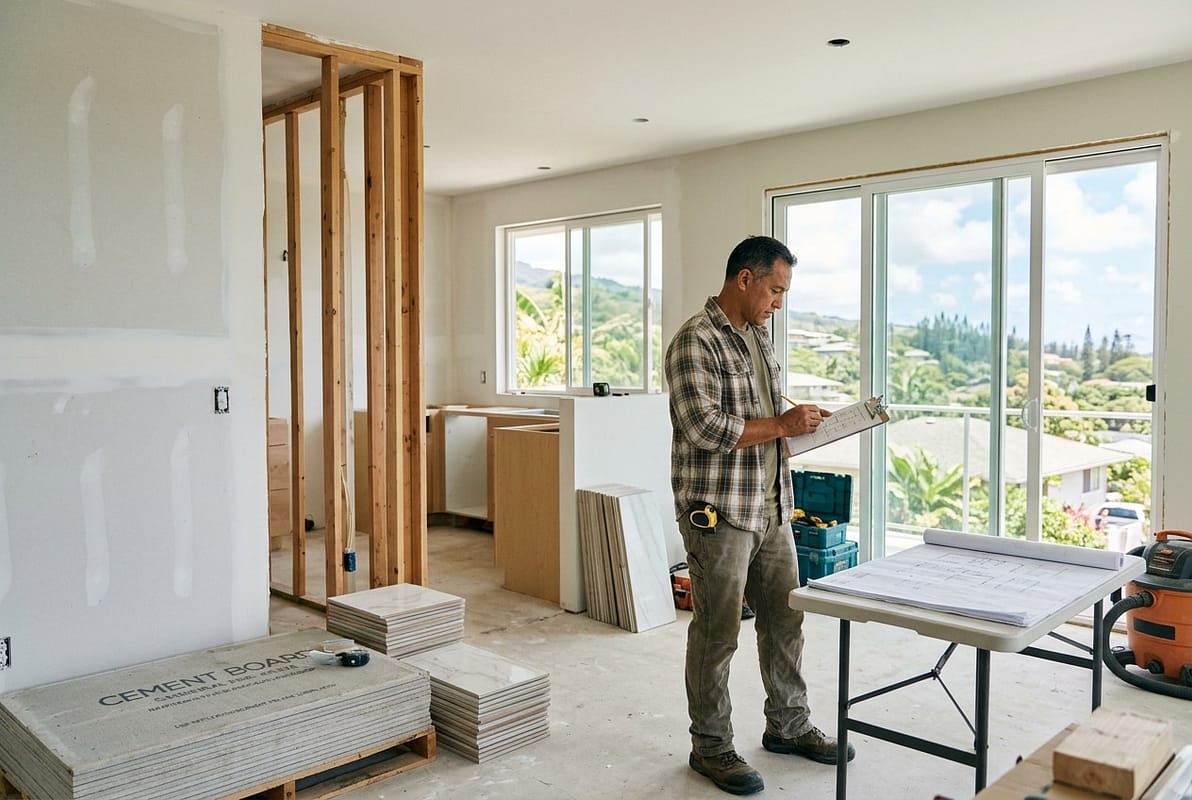
High-ROI Upgrades: Where to Spend Your Money Fast
In an Oahu house flip, speed is profit. You need to focus on materials that are readily available in Hawaii, durable, and appeal to the modern buyer aesthetic. Every dollar must be spent on items that directly increase perceived value and justify your asking price.
- Luxury Vinyl Plank (LVP) Flooring: This is the number one choice for flips. It’s 100% waterproof (perfect for our humid climate), extremely durable, and cost-effective. We can install high-quality LVP throughout a 1,400 sq. ft. home for about $14,000-$17,000. It provides a clean, continuous look that makes older homes feel brand new. Our guide to Hawaii flooring options covers why LVP often wins for ROI.
- Stock Shaker Cabinets: Forget custom cabinetry. We use locally stocked, pre-manufactured shaker-style cabinets in white or a light gray. They are timeless and available immediately from suppliers like Honsador or Golden Cabinets. A full kitchen cabinet package for a standard 10×12 kitchen can be sourced and installed for $10,000-$15,000.
- Durable Quartz Countertops: While granite was once the standard, quartz is now the preferred material for flips. It’s non-porous, stain-resistant, and comes in clean, modern patterns that appeal to today’s buyers. We can typically template, fabricate, and install quartz countertops for an entire kitchen for $7,000-$9,000.
- Fresh Paint (Interior & Exterior): A professional paint job is the single most cost-effective upgrade. We recommend neutral, light colors like Benjamin Moore’s ‘Chantilly Lace’ or Sherwin-Williams’ ‘Agreeable Gray’ for interiors to make spaces feel larger and brighter. A full interior and exterior paint job for a 1,400 sq. ft. home will run about $15,000-$20,000 but can add double that in perceived value.
- Modern Fixtures: Swapping out old, dated ceiling fans, light fixtures, and plumbing hardware is a quick win. Budget around $5,000-$7,000 for all-new, modern-style (matte black or brushed nickel) fixtures throughout the house. It’s a small detail that makes a huge impact.
Budget Killers: Why ‘Open Concept’ Can Destroy Your Profit
The biggest mistake we see new investors make is falling in love with the idea of creating a wide-open living space. On TV, it looks simple: take down a wall and create a beautiful great room. In Hawaii, this is the decision that can single-handedly sink your project. Removing a load-bearing wall, which is common in older home layouts, triggers a full structural review with the Honolulu DPP. As we’ll discuss, this adds nearly a year of waiting time to your project, during which you’re bleeding money on holding costs.
Other common budget killers for an oahu house flipping project include:
- Moving Plumbing: Relocating a toilet or a kitchen sink requires extensive work under the slab or in the walls, easily adding $10,000-$15,000 and significant time to a project. Keep the layout the same.
- Custom Windows and Doors: Standard-sized aluminum or vinyl windows are fine. Ordering custom sizes can have a 16-20 week lead time from the mainland, another timeline killer.
- High-End Appliances: A Sub-Zero refrigerator doesn’t add $20,000 of value to a $1.2M home. A clean, reliable stainless-steel appliance package from GE or Frigidaire for around $6,000 is all you need.
- Ignoring the Exterior: Forgetting to budget for landscaping, exterior paint, and minor wood rot or termite damage repair is a classic rookie mistake. Curb appeal is what gets buyers in the door.
Factoring in the 22% ‘Hawaii Premium’ on Materials & Shipping
Every investor from the mainland needs to understand this reality: everything costs more here. A recent report from UHERO confirms what we deal with every day—a persistent ‘Hawaii premium’ of around 22% on materials due to shipping and logistics.[2] That faucet that costs $200 at a big box store in California will be closer to $250 here after it’s shipped on a barge, unloaded at the port, and trucked to a local supplier. This premium must be baked into your 15% budget from the very beginning. It’s not just the cost, but the time. On a recent Kailua project, we had to wait six extra weeks for a specific backsplash tile that was out of stock locally, a delay that cost our client thousands in holding costs. This is why we push for using locally stocked materials whenever possible; it insulates your timeline and budget from the volatility of trans-Pacific shipping.
How long does it take to get a renovation permit on Oahu?
The time it takes to get a renovation permit on Oahu depends entirely on your project’s scope, and it’s the single most critical factor for a profitable flip. A simple, cosmetic-only interior renovation permit can be secured from the Honolulu DPP in 60 to 90 days. However, if your plans involve moving a single load-bearing wall, you are pushed into the structural review queue, which is currently taking 9 to 11 months for approval.[3] This nine-month difference is where flip profits go to die.
The 90-Day Win: The ‘Cosmetic-Only’ Permit Strategy
The fast track to profitability is the ‘cosmetic-only’ or ‘like-for-like’ replacement permit. This streamlined process is designed for renovations that do not alter the structural integrity or layout of the home. Here’s what you can typically do under this permit:
- Replace all kitchen cabinets and countertops in their existing locations.
- Replace all bathroom vanities, tubs, showers, and toilets in their existing locations.
- Install new flooring, trim, and baseboards.
- Replace all windows and doors with new ones of the same size in the same openings.
- Install new light fixtures and ceiling fans.
- Repair drywall and apply fresh paint.
- Re-roof the home.
By keeping the scope of work strictly within these boundaries, we can get architectural plans drafted, submitted, and approved by the DPP in about three months. Once the permit is in hand, the actual construction for a cosmetic flip of this nature can be completed in another 60-90 days. This means you can go from acquisition to a market-ready home in as little as 5-6 months, minimizing your holding costs and maximizing your ROI. This is the core of a successful hawaii real estate investing strategy for flips.
The 11-Month Nightmare: The Structural Review Queue
Now, consider the alternative. An investor buys a home in Manoa with a classic compartmentalized layout. They decide the wall between the small kitchen and the living room has to go to create the open concept everyone wants. The moment that wall is marked for demolition on the plans, the project is flagged for a full structural review. This involves multiple departments at the DPP, including structural engineers who are notoriously backlogged.
The 9-to-11-month wait is just for the permit to be approved. During this time, the property sits vacant. You are paying the mortgage, property taxes, insurance, and utilities every single day with no progress being made. On an $880,000 loan, that’s easily $5,000-$6,000 per month in holding costs. Over 11 months, you’ve burned over $60,000 before a single hammer is swung. This unforeseen expense can completely wipe out your projected profit. We have seen it happen, and it’s a painful lesson for investors who prioritize a design trend over the hard financial realities of the permitting process in Honolulu.
Our Pro Tip: Design Your Scope Around the Permit Path
This is where working with an experienced local contractor pays dividends. We tell our investor clients to forget about their ideal layout and instead focus on the most profitable layout. We start the design process by asking, “What can we do to make this home feel open and modern *without* touching a load-bearing wall?”
Often, the answer is simpler and just as effective. For example, instead of removing a wall entirely, we can create a large cased opening between the kitchen and living room. This can often be done without requiring a full structural review, yet it still provides the sightlines and flow of an open concept. Other strategies include using consistent flooring throughout, adding recessed lighting to brighten dark corners, and using a light color palette to create an illusion of space. The goal is to design the renovation specifically to fit the 90-day cosmetic permit path. It’s a strategy born from years of navigating the DPP, and it’s essential for any profitable honolulu fix and flip.
Is now a good time to flip houses on Oahu?
Yes, 2026 is a very good time to flip houses on Oahu, but only for disciplined investors who follow a strict formula. The reason is simple: chronic low inventory. The market is starved for move-in-ready homes, and buyers are willing to pay a premium for a property that doesn’t require any work. When executed correctly, a flip provides a valuable product that is in extremely high demand.

Why Low Inventory Makes Flips Viable in 2026
According to the latest data from the Honolulu Board of REALTORS®, Oahu has less than a two-month supply of single-family homes on the market.[1] A healthy, balanced market has a six-month supply. This severe imbalance means that any well-renovated home that is priced correctly will receive multiple offers, often selling above asking price within the first week. The median price is holding strong at $1.15 million, demonstrating the deep, resilient demand from local families and military personnel relocating to the island. Flippers aren’t just speculating; they are servicing a real need in the market by taking older, neglected housing stock and turning it into a safe, modern, and desirable home for a local family. This market dynamic heavily favors the seller and reduces the risk of a property sitting on the market for an extended period.
Targeting Older Housing Stock in Kailua and Kaneohe
The Windward side, particularly Kailua and Kaneohe, is prime territory for flips. These neighborhoods are filled with homes built in the 1960s and 70s that are now in the hands of original owners or their children. These properties are often structurally sound but are cosmetically dated and may have deferred maintenance issues. The layouts are generally good, and the locations are highly sought after for their school districts and lifestyle.
This is the ideal canvas for a cosmetic-only flip. An investor can acquire a property that hasn’t been touched in 40 years, apply the 15% renovation budget to update the kitchen, baths, flooring, and paint, and bring a completely revitalized product to the market. The increase in value from this transformation is substantial. A key part of the assessment involves checking for issues common to this housing vintage, such as single-wall construction nuances, ground termite damage, and old galvanized plumbing. Factoring in the right amount for the kailua home renovation cost is key.
Work With a Contractor Who Understands the Flip Game
It’s crucial to partner with a general contractor who understands the unique demands of an investment flip. This is a different business than building a luxury custom home on the North Shore. A flip requires a team that is obsessed with budget, speed, and sourcing cost-effective, durable materials. Your contractor should be able to look at a potential property with you and immediately identify the red flags that would trigger a structural permit or require costly, unforeseen repairs.
At Warrior Construction, we have specific processes for our investor clients. We help develop the oahu renovation budget, value-engineer the material selections, manage the streamlined permit submittal, and schedule our crews to execute the work with maximum efficiency. We know which quartz supplier has the best price on remnant slabs and which LVP is in stock at the local warehouse. This ground-level knowledge is what keeps a project on time and on budget, ensuring our clients achieve the ROI they need.
What are the Hard Numbers for an Oahu Flip in 2026?
To succeed in Oahu house flipping, you must be a master of your budget. Vague estimates won’t cut it. You need a detailed, line-item understanding of your costs from acquisition to sale. Let’s break down a realistic scenario for a 1,400 sq. ft. home in Kailua to illustrate the financial realities.
Here’s a comparison of a successful cosmetic flip versus a flip that fell into the structural permit trap:
| Cost / Timeline Item | Scenario A: Smart Cosmetic Flip | Scenario B: Structural Permit Nightmare |
|---|---|---|
| Purchase Price | $880,000 | $880,000 |
| Renovation Scope | Kitchen, 2 baths, flooring, paint, fixtures (no moved walls) | Same as A, but removed one load-bearing wall |
| Renovation Budget (15%) | $132,000 | $145,000 (added cost for beam & engineering) |
| Permit Timeline | 3 months (90 days) | 11 months (330 days) |
| Construction Timeline | 3 months (90 days) | 4 months (120 days) |
| Total Project Duration | 6 months | 15 months |
| Holding Costs (@ $5.5k/mo) | $33,000 | $82,500 |
| Total Investment | $1,045,000 | $1,107,500 |
| Sale Price | $1,225,000 | $1,250,000 (slight premium for open concept) |
| Gross Profit (before tax/fees) | $180,000 | $142,500 |
As you can see, the decision to remove one wall cost the investor in Scenario B nearly $40,000 in direct profit and added 9 months of risk and stress to the project. The small premium gained from the open-concept layout did not come close to covering the massive increase in holding costs. This is the math that governs the Oahu flipping market.
Beyond this, you must also factor in:
- General Excise Tax (GET): On Oahu, you pay a 4.5% GET on nearly everything—the final sale price of the home, all your contractor’s labor, and every material purchase. This is a significant cost that must be in your pro forma.
- Financing Costs: Unless you are a cash buyer, you will have loan origination fees, points, and interest payments on your acquisition and construction loans.
- Closing Costs: Expect to pay 1-2% of the purchase price on the way in, and another 1-2% (plus realtor commissions of 5-6%) on the way out.
Successful investors have a detailed spreadsheet that tracks every single one of these expenses. We often help clients build this out during our preconstruction planning phase to ensure their project is financially viable before they even make an offer.
Case Study: A Successful Kailua Cosmetic Flip
To see how these principles work in the real world, let’s look at a recent project we consulted on for an investor client in the Keolu Hills neighborhood of Kailua. The property was a classic example of a prime flip candidate: a 1,450 sq. ft., 3-bedroom, 2-bathroom single-family home built in 1971, owned by the same family for 50 years.
The Acquisition: The investor purchased the property for $895,000. It was cosmetically very dated, with shag carpeting, original dark wood cabinets, and avocado green bathroom tiles, but a pre-purchase inspection showed it was structurally sound with no major termite damage.
The Strategy & Budget: We worked with the investor to establish a firm renovation budget of $134,000 (just under 15%). The entire scope was designed to qualify for a cosmetic-only permit. The key strategic decision was to keep the wall between the kitchen and living room, but create a 6-foot wide cased opening, which provided 90% of the feel of an open concept without triggering a structural review.
The Scope of Work Included:
- Full kitchen gut and remodel with stock white shaker cabinets, quartz countertops, and a new GE appliance package.
- Renovation of both bathrooms with new vanities, tile, and fixtures, keeping the existing plumbing layout.
- Installation of LVP flooring throughout the entire home.
- Replacement of all windows with standard-size vinyl windows.
- New interior and exterior paint.
- Upgraded all lighting to modern LED fixtures and added ceiling fans in all bedrooms.
- Basic landscaping cleanup, including tree trimming and new sod in the front yard.
The Timeline & Outcome:
- Permit Approval: 82 days.
- Construction: 75 days.
- Total Time from Close to Listing: 5.5 months.
- All-In Cost: $895k (purchase) + $134k (reno) + $35k (holding/closing) = $1,064,000.
- The Sale: The home was listed for $1,249,000. After one weekend of open houses, it received three offers and sold for $1,265,000 with a quick close.
The investor walked away with a gross profit of approximately $201,000. This success was not due to luck. It was the direct result of a disciplined strategy: buying right, adhering to the 15% budget, and intelligently designing the scope to avoid the 11-month permit trap. It’s the blueprint for profitable Oahu house flipping.
What does this mean for your Hawaii investment property?
For any aspiring or current real estate investor on Oahu, this information should serve as a clear and direct roadmap. The market is full of opportunity, but it is also littered with financial traps for the unprepared. Success is less about your design taste and more about your discipline and your ability to execute a proven, numbers-driven strategy.
Here are the key takeaways you should apply to your next project:
- Embrace the Formula: Don’t try to reinvent the wheel. The formula of sub-$900k acquisition + 15% renovation budget + cosmetic-only permit is the most reliable path to profit in 2026. Treat it as a non-negotiable rule.
- Become a Permit Expert: Your most valuable asset is understanding the Honolulu DPP. Before you even look at a property, know exactly what work triggers a structural review. Let the permit path dictate your design, not the other way around.
- Prioritize Speed and Availability: Your project’s timeline is just as important as its budget. Choose materials that are in-stock and readily available on-island. A six-week delay waiting for a special-order tile from Italy can erase tens of thousands of dollars in profit.
- Build the Right Team: Partner with a real estate agent who specializes in finding these types of properties and a general contractor who has a proven track record with investment flips. They should understand your need for speed, budget control, and high-ROI finishes. A contractor who primarily builds multi-million dollar custom homes may not have the right mindset or supply chain for a fast-paced flip.
- Know Your Numbers Cold: Create a detailed spreadsheet for every potential deal. Factor in the purchase price, renovation costs, holding costs, financing fees, GET, and closing costs. If the numbers don’t work on paper, walk away. Emotional decisions have no place in a successful flipping business.
Following this advice will position you to capitalize on Oahu’s strong housing market while mitigating the unique risks and costs of renovating in Hawaii.
Frequently Asked Questions
Can I really flip a house on Oahu for a 15% budget?
Yes, absolutely, but it requires strict discipline. A 15% budget on an $880,000 home is $132,000. This is a healthy budget for a cosmetic renovation—new kitchen, two new baths, flooring, and paint—if you use cost-effective, readily available materials like stock shaker cabinets, LVP flooring, and quartz countertops. It leaves no room for moving walls, adding square footage, or choosing high-end custom finishes.
What’s the biggest mistake first-time flippers make in Hawaii?
The most common and costly mistake is underestimating the permit timeline. Many first-time investors, especially from the mainland, create a design that involves moving a load-bearing wall, unknowingly pushing their project into the 9-11 month structural review queue at the Honolulu DPP. The holding costs during this delay can completely destroy their profit margin before construction even begins.
How do I properly budget for the ‘Hawaii Premium’ on materials?
You should add a baseline of 20-25% to mainland material cost estimates to account for shipping, warehousing, and local distribution. A better approach is to work with a local contractor who can provide you with current, on-island pricing for key materials. For a flip, it’s wisest to design your project around materials that are already stocked locally to avoid both the premium and the potential for long shipping delays.
Is it better to flip in Ewa Beach or Kailua?
Both can be profitable, but they target different markets. Kailua has older housing stock with higher acquisition costs but also a higher potential resale value, attracting buyers focused on lifestyle and schools. Ewa Beach and Kapolei have newer homes that may require less work but have a lower price ceiling. The sub-$900k/15% formula works in both areas, but your acquisition search and final buyer profile will be different.
Do I need an architect for a cosmetic flip?
Yes, you will still need plans drawn by a licensed Hawaii architect or draftsman for your DPP permit submittal, even for a cosmetic renovation. The DPP requires professional plans for any work beyond simple repairs. An experienced architect can quickly produce the necessary drawings for a ‘like-for-like’ renovation to ensure a smooth journey through the 60-90 day permit process.
How much are holding costs for a typical Oahu flip?
For a property acquired around $880,000 with a hard money or conventional loan, you should budget between $5,000 and $6,500 per month. This includes the mortgage payment (principal and interest), property taxes, homeowner’s insurance, and basic utilities (electricity, water). Over a 6-month project, that’s $30,000-$39,000 you must account for in your budget.
Can I do any of the renovation work myself to save money?
While it seems like a good way to save money, performing your own work on a flip can be risky and slow you down. Licensed trades like electrical and plumbing must be done by licensed professionals to pass inspection. For other work, the time you spend doing it yourself is time the house isn’t on the market, costing you in holding costs. For a flip, it is almost always more profitable to hire a professional GC who can get the job done quickly and correctly.
Executing a profitable house flip on Oahu is a game of speed, budget, and local knowledge. The demand for renovated, move-in-ready homes is stronger than ever, but so are the risks from long permit delays and high material costs. By following a proven formula and working with a team that understands the nuances of the Honolulu market, you can successfully navigate these challenges.
If you’re an investor looking for a construction partner who understands the numbers and timelines essential for a successful flip, our team at Warrior Construction is ready to help. We specialize in fast-paced, high-ROI renovations designed for the Oahu investment market.
Ready to discuss your next investment project? Contact our team to review your plans and develop a strategic renovation budget.


