
“
How Long Does It Really Take to Build a Restaurant on Oahu?
For a typical full-service restaurant on Oahu, you should expect a 12 to 18-month total project timeline from the day you sign your lease to your grand opening. We tell every potential restaurateur this upfront. The actual construction might only take six to eight months, but the majority of the time is spent in pre-construction planning and, most significantly, navigating the complex, multi-agency permitting process in Honolulu. Understanding the real oahu restaurant build out timeline is the single most important factor in budgeting and planning for success in Hawaii’s competitive food and beverage industry.
This isn’t just about getting a building permit. It’s a marathon involving at least four separate government agencies, each with its own set of rules, review timelines, and inspectors: the Honolulu Department of Planning and Permitting (DPP), the Hawaii Department of Health (DOH), the Board of Water Supply (BWS), and the Honolulu Liquor Commission. These processes run concurrently, and a delay in one can create a domino effect that stalls the entire project. For example, the DOH has final authority on your kitchen layout and can override plans the DPP has already approved, forcing expensive, last-minute changes.[1]
The Three Main Phases: Pre-Construction, Permitting, and Building
To make sense of the 18-month journey, our team at Warrior Construction breaks the oahu restaurant build out timeline into three distinct, yet overlapping, phases:
- Phase 1: Pre-Construction & Design (Months 1-4): This is where the foundation for the entire project is laid. It involves assembling your team, negotiating the lease, defining your concept, and developing architectural and engineering plans.
- Phase 2: Permitting & Agency Reviews (Months 5-10): The longest and most unpredictable phase. We submit plans to the DPP, DOH, BWS, and Liquor Commission. This period is filled with waiting, responding to comments, and making revisions.
- Phase 3: Construction & Closeout (Months 11-18): The physical build-out, from demolition to final inspections. This phase is heavily influenced by Hawaii’s unique supply chain logistics, with long lead times for critical equipment.
Why Your Mainland Timeline Estimate Won’t Work in Hawaii
If you’re coming from the mainland, your first instinct will be to underestimate the timeline. A similar project in Phoenix or Dallas might take 8 months, but Hawaii operates on its own clock. Here’s the thing: everything moves slower and is more complicated. The city’s own data shows that the initial review for a commercial permit at the Honolulu DPP now averages 14 weeks before you even see the first round of comments.[2] That’s nearly four months just to get in the queue.
Furthermore, every piece of specialty equipment, from your walk-in cooler to your custom ventilation hood, has to be shipped across the Pacific. The Hawaii Contractors Association recently highlighted that lead times for commercial HVAC and custom kitchen equipment can easily exceed 16 weeks. That’s another four months of waiting for items that have to be on-site before we can close up walls and ceilings. These realities are baked into every realistic oahu restaurant build out timeline we create for our clients.
What Are the Pre-Construction Steps? (Months 1-4)
The first four months are the most critical for setting your project up for success. Rushing through this phase to get to construction faster is the biggest mistake we see new restaurateurs make. Careful planning here saves you tens of thousands of dollars and months of delays down the road.
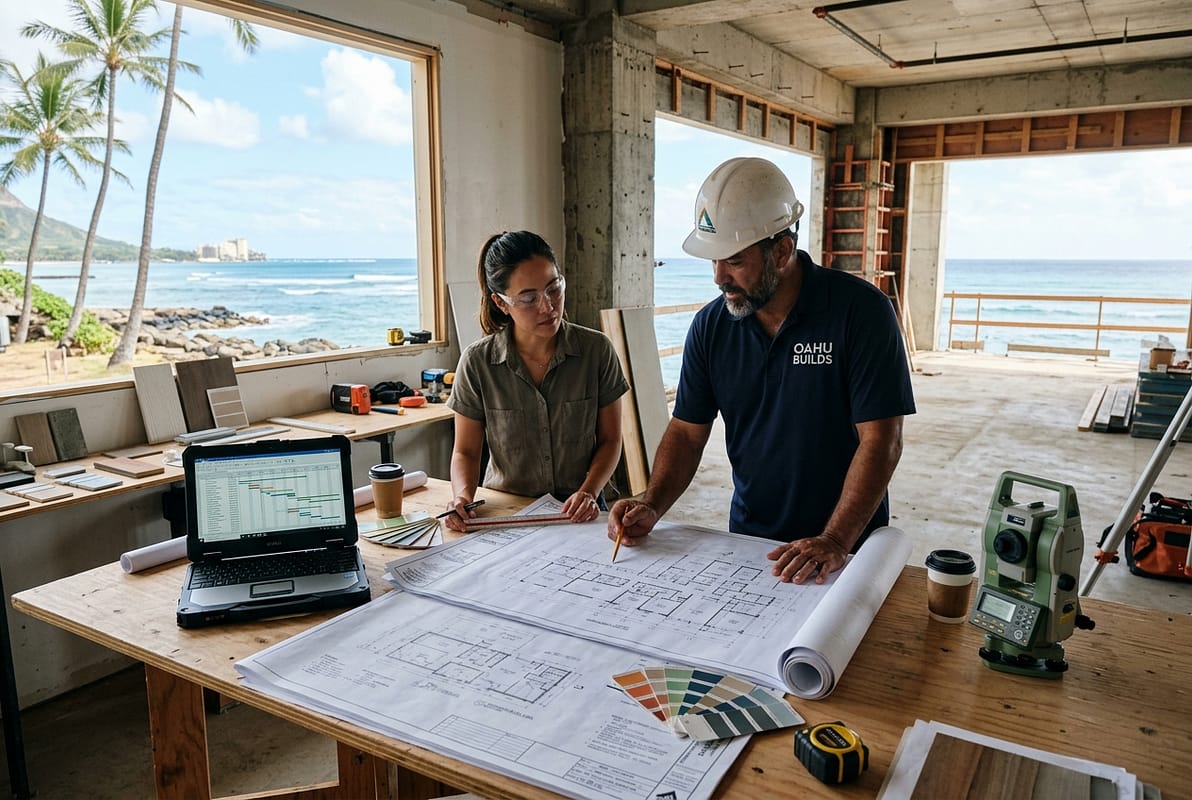
Assembling Your Team: The Architect, Engineer, and General Contractor
Your first move, even before signing a lease, should be to assemble your local team. You need professionals who live and breathe Hawaii’s unique construction environment.
- Architect: You need an architect who has a proven track record of getting restaurant plans approved by the DPP and DOH. They’ll know the specific code interpretations and the key people inside each department. They can anticipate a DOH inspector’s concerns about workflow or a DPP reviewer’s questions about ADA compliance.
- MEP Engineer: Your Mechanical, Electrical, and Plumbing engineer is crucial. They’ll design the systems that are the lifeblood of your restaurant—HVAC, kitchen ventilation, gas lines, and plumbing for grease interceptors. An engineer who understands BWS requirements from day one is invaluable.
- General Contractor: Bringing a GC like Warrior Construction on board early, during the design phase, is a smart move. We can provide pre-construction services, offering real-time cost feedback on design choices. We can identify long-lead items immediately and advise on material selections that hold up to Hawaii’s salt air and humidity. This collaborative approach, often called Design-Build, prevents sticker shock later when the project goes out to bid.
Lease Negotiation and Due Diligence on the Space
With your core team in place, we can properly evaluate potential locations. Before you sign anything, our team performs due diligence on the space. We look at the existing electrical capacity, the condition of the plumbing, access for a grease interceptor, and the viability of running new ventilation. We’ve seen clients fall in love with a space in an old Waikiki building only for us to discover it needs a $100,000 electrical service upgrade just to power the kitchen.
This is also when you negotiate your Tenant Improvement (TI) allowance with the landlord. Be realistic. A typical TI allowance might be $90 per square foot, but as we detailed in our guide to Oahu restaurant build-out costs, a full build-out can easily run $350-$550 per square foot. The TI allowance is a help, but you will be funding the vast majority of the project.
Conceptual Design and Commercial Kitchen Layout
Once the lease is signed, we move into intensive design. This is where your vision starts to take shape on paper. The most important part of this is the commercial kitchen layout. The layout dictates everything: plumbing and electrical locations, ventilation requirements, and, most importantly, your workflow.
We work with your chef and our architect to lay out the cookline, prep areas, dishwashing station, and storage. Every decision has a ripple effect. For example, the type of oven you choose dictates the size of your ventilation hood, which in turn impacts your mechanical engineering plans and your DOH review. This is the stage where we finalize the equipment schedule, identifying every single piece that needs to be ordered. Getting this right is fundamental to creating an efficient and approvable design.
Which Agencies Are Involved in a Honolulu Restaurant Permit? (Months 5-10)
Welcome to the longest and most challenging part of the oahu restaurant build out timeline: the multi-headed beast of Honolulu permitting. This isn’t a single application; it’s a series of parallel reviews by independent agencies that don’t always communicate with each other. A good contractor acts as the quarterback, managing submissions and responses across all fronts.
The DPP Building Permit: The Main Event
The Department of Planning and Permitting is the primary gatekeeper. We submit the full architectural and engineering plans for review against the building, electrical, plumbing, and mechanical codes. As mentioned, the city’s own data from Q1 2026 shows an average wait of 14 weeks just for the first set of comments.[2]
After that, the plans go back to the architect and engineers to address the comments, and then we resubmit. This back-and-forth can happen two or three times. We advise all our clients to budget a minimum of six months for the DPP process. Anyone who tells you they can get a full set of restaurant plans permitted in Honolulu in three months is either brand new or not being honest. A complete and well-coordinated initial submission is the best way to minimize the number of review cycles.
The Department of Health (DOH) Plan Review: The Real Boss of Your Kitchen
While the DPP permit is the main event, the Department of Health is the agency that holds the most power over your restaurant’s future. The DOH has its own, separate plan review process focused entirely on food safety.[1] They scrutinize every detail of your kitchen and food service areas:
- Equipment Specifications: Is all your equipment NSF-certified?
- Finishes: Are the floors, walls, and ceilings smooth, non-absorbent, and easily cleanable? This is why you see so much FRP (Fiberglass Reinforced Plastic) and quarry tile.
- Sink Locations: They have strict rules for the placement of your 3-compartment sink, hand-wash sinks, and food prep sinks to prevent cross-contamination.
- Workflow: They analyze the flow from the receiving door to storage, to prep, to the cookline, to the customer, ensuring there are no points where raw and cooked foods might cross paths.
Here’s the crucial part: DOH approval is required before you can get your food establishment permit, and their inspectors have the final say on-site. We’ve seen projects with a fully issued DPP building permit get stopped dead during a final inspection because a DOH inspector demanded a hand-wash sink be moved three feet to the left. Their word is law in the kitchen.
Board of Water Supply (BWS): Grease Interceptors and Big Delays
If you are cooking with fats, oils, or grease, you will need a grease interceptor. This is a large tank, often several hundred gallons, that gets installed underground to capture grease from your kitchen drains before it enters the city sewer system. The Board of Water Supply has to review and approve the size, type, and location of this interceptor.
This process can be a major source of delay, easily adding four months to your pre-construction schedule. For a recent project in Kailua, we had to coordinate between the BWS, the DPP plumbing reviewer, and the landlord to find a suitable location in the parking lot. This involved geotechnical surveys, traffic control plans for the excavation, and extensive plumbing work to tie into the sewer main. The BWS review process for this alone took over 16 weeks before we could even think about applying for the building permit.
The Honolulu Liquor Commission: Floor Plans and Public Hearings
If you plan to serve alcohol, the Liquor Commission is your fourth partner. The process for getting a new liquor license in Hawaii is lengthy and involves a thorough review of your business plan, your personal history, and your proposed floor plan. You have to clearly define the area where alcohol will be stored, served, and consumed.
The commission’s approval is tied to this specific floor plan. If you make a significant change to your layout during construction—say, moving the bar or expanding a dining patio—you may have to go back to the Liquor Commission for an updated approval. The process also includes a public hearing, where the community has a chance to weigh in on your application. For some neighborhoods, this can be a simple formality; for others, it can become a significant hurdle. Starting the liquor license process as early as possible is absolutely critical.
How Long Is the Actual Construction Phase in Hawaii? (Months 11-18)
After ten months or more of planning and waiting, seeing demolition start is a huge milestone. The construction phase for a typical 2,500-4,000 square foot restaurant on Oahu usually takes between six and eight months. This timeline is dictated less by the physical work and more by the immense logistical challenges of building in the middle of the Pacific.
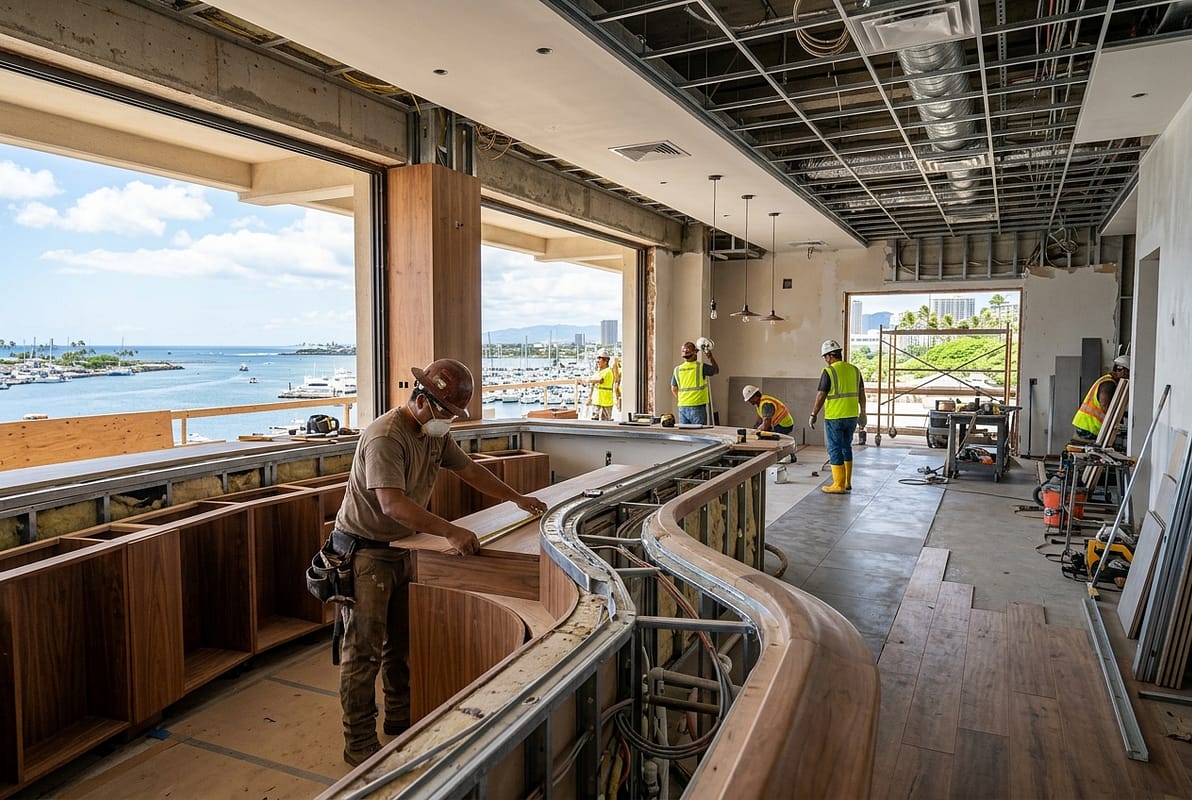
Demolition, Framing, and Rough-Ins
The first few months of construction move quickly and are exciting to watch. We start by demolishing the existing space back to a shell. Then comes framing the new walls, which defines the kitchen, bar, dining rooms, and restrooms. Immediately following framing are the rough-ins for all the systems designed by our engineers: plumbing lines for all the sinks and drains, electrical conduit for all the outlets and equipment, and the ductwork for your HVAC and kitchen ventilation.
This is when we often uncover surprises, especially in older buildings in areas like Chinatown or Kaimuki. It’s not uncommon to open a wall and find old, unpermitted plumbing or electrical wiring that has to be completely replaced to meet current code. This is why a healthy contingency fund (we recommend 15-20%) is so important for any restaurant construction project in Hawaii.
The Supply Chain Reality: Waiting 16+ Weeks for Equipment
Here is where the oahu restaurant build out timeline can stretch. The entire construction schedule hinges on the arrival of key equipment from the mainland. As a contractor, we can have the walls framed and the rough-ins done in six weeks, but we can’t close the ceilings until the massive custom ventilation hood is installed. We can’t do the final gas line connections until the cookline equipment arrives. We can’t pour the final flooring until the walk-in cooler is assembled.
The Hawaii Contractors Association’s 2026 outlook confirms what we see every day: specialty items like custom hoods, walk-ins, and specific commercial HVAC units have a minimum 16-week lead time from order to arrival at Honolulu Harbor.[3] Add in potential shipping delays or port congestion, and that can easily become 20 weeks. Our project managers order these items the moment the DOH approves the kitchen plan to get them in the production queue as early as possible.
Finishes, Final Inspections, and Punch List
Once the big equipment is on site and installed, the final phase of construction begins. This includes hanging drywall, painting, installing flooring and tile, setting up the bar with its custom millwork, and installing light fixtures. The final weeks are a whirlwind of activity as we push to the finish line.
The project isn’t over when the last tile is laid. We then have to schedule a series of final inspections with all the agencies. This includes a final building inspection with the DPP, but also separate final inspections for electrical, plumbing, and mechanical. Then, the Fire Department comes to inspect and test your fire suppression and alarm systems. Finally, the Department of Health inspector does their final walkthrough to grant you the permit to operate. Coordinating all these inspections can take a few weeks. After we have all our sign-offs, we do a final walkthrough with you to create a “punch list” of any small, cosmetic items that need to be addressed before we hand over the keys.
What Are the Most Common Delays We See on Oahu Restaurant Jobs?
Every project has its unique challenges, but after 20+ years in Hawaii construction, we see the same patterns of delays on restaurant projects. Understanding these ahead of time helps set realistic expectations for the oahu restaurant build out timeline.
Real-World Example: A 4-Month Grease Interceptor Delay in Kailua
We recently worked on a tenant improvement for a new cafe in Kailua. The city’s requirements for a new grease interceptor were the single biggest hurdle. Because the building was on a busy street with limited space, coordinating the installation became a massive project in itself.[4] The BWS plan review took 12 weeks. Then we had to get a separate street usage permit from the city to excavate in the sidewalk area. We had to hire a specialized subcontractor for the excavation and a different one for the plumbing tie-in. The entire process, from initial BWS submission to having the installed interceptor approved, added a solid four months to the pre-construction timeline before we could even start work inside the space.
Real-World Example: A Last-Minute DOH Sink Relocation
On a fast-casual project in Kapolei, we had our building permit in hand and were about 80% complete with construction. The walls were painted, the floor was in, and the equipment was being set. The DOH inspector came for a preliminary walkthrough. He took one look at the kitchen and said the hand-wash sink for the cookline was too far from the fryer station—a potential cross-contamination risk. Even though the sink location was exactly as shown on the DPP-approved plans, the DOH has ultimate authority. We had to cut open a finished tile wall, pay a plumber for an emergency change order to run new water and drain lines, and then patch the wall and tile. It was a $5,000 change order that delayed the final inspections by two weeks.
Real-World Example: A Custom Ventilation Hood Stuck at the Port
For a fine dining restaurant in Kaka’ako, the centerpiece of the open kitchen was a beautiful, 18-foot custom ventilation hood with a special powder-coated finish. We ordered it 20 weeks in advance. It was manufactured on time on the mainland, but the container ship it was on was delayed by two weeks due to a storm. Then, once it arrived at Honolulu Harbor, it got stuck in a backlog at the port for another ten days. That three-week delay had a huge ripple effect. We couldn’t install the Ansul fire suppression system, close the ceiling, or install the custom lighting above the cookline until that hood was hoisted into place. It pushed our entire finish schedule back, which in turn delayed the final inspections and the owner’s planned hiring and training schedule.
Frequently Asked Questions
How much does a restaurant build-out cost per square foot on Oahu in 2026?
For a standard ‘second-generation’ space (a former restaurant), budget $350-$450 per square foot. For a ‘cold dark shell’ that needs all new systems, it’s closer to $500-$650 per square foot. Fine dining with high-end finishes and custom millwork can easily exceed $750 per square foot. These costs are significantly higher than the mainland due to shipping and labor.
What is the most unpredictable part of the oahu restaurant build out timeline?
The permitting and agency review phase is by far the most unpredictable. While construction can be scheduled, we have no control over the workload at the DPP or DOH. A city-wide hiring freeze or a backlog from a major storm can add months to review times unexpectedly. We tell clients to hope for six months in permitting but be mentally prepared for ten.
Can I save money by buying used equipment?
Sometimes, but it comes with risks. All equipment must be NSF-certified and in good working order to pass DOH inspection. You also need the exact manufacturer spec sheets for your architect and engineer to include in the permit drawings. Often, the headache of ensuring a used piece of equipment meets all requirements isn’t worth the savings compared to buying new with a warranty.
How long does the Hawaii liquor license process take?
The liquor license process should be started concurrently with your design phase. From submitting the application to the final approval from the Honolulu Liquor Commission, it’s realistic to plan for a 6 to 9-month process. It involves extensive paperwork, background checks, a public hearing, and final inspections, so it cannot be rushed.
What’s the biggest mistake new restaurant owners make in Hawaii?
The most common and costly mistake is underestimating the timeline and the amount of working capital needed. They sign a lease and expect to be open in 6 months, but the reality is closer to 18. This means they are paying rent for a full year on a space that isn’t generating any revenue. Properly understanding the long oahu restaurant build out timeline and having at least 12-15 months of rent and operating capital set aside is critical.
Why is the Department of Health review separate from the building permit?
The DPP is focused on life safety and building codes—structural integrity, fire safety, electrical loads, and ADA accessibility. The DOH’s mission is entirely different; they are focused on public health and preventing foodborne illness. Their regulations cover workflow, sanitation, and food safety protocols, which are outside the scope of the building code, necessitating their own specialized review process.
Building a restaurant in Hawaii is a marathon, not a sprint. The process is complex, the costs are high, and the timeline is long. But for those who plan properly, assemble the right local team, and have the patience and capital to see it through, the reward of opening your doors to the community is unmatched.
Navigating the gantlet of permits and construction logistics requires a contractor who has been through it dozens of time. If you’re considering opening a restaurant on Oahu, the most important step you can take is to partner with a team that understands the true oahu restaurant build out timeline.
Our team at Warrior Construction specializes in restaurant construction and tenant improvements. We can help you navigate every phase, from initial site selection and budgeting to final inspections. Contact us to discuss your vision.


