
The True Cost of a Home Addition on Oahu: A 2026 Budget Breakdown
When you love your neighborhood but need more space, a home addition seems like the perfect solution. But the single most common question we get from homeowners in Honolulu, Kailua, and Kapolei is always the same: what will it actually cost? In 2026, the real oahu home addition cost for a quality, ground-floor addition is between $800 and $1,000 per square foot. Consequently, a common 600-square-foot master suite or family room addition will land in the $480,000 to $600,000 range, from initial sketches to final walkthrough. This number often surprises people, especially when they hear new custom homes can sometimes be built for less per square foot. The truth is, additions are far more complex than building from scratch.
This guide breaks down the real numbers our team at Warrior Construction uses for budgeting projects on Oahu today. We’re not going to give you vague ranges. Instead, we’ll walk through the specific line items, from the $40,000 in soft costs you’ll spend before we even break ground to the hidden expense of bringing your entire roof up to modern hurricane code. Understanding these costs is the first step to a successful project. Let’s get into the details.
What is the Real Oahu Home Addition Cost Per Square Foot in 2026?
Snippet Answer: For a standard 600-square-foot ground-floor addition in 2026, you should budget between $800 and $1,000 per square foot, for a total project cost of $480,000 to $600,000. This is often higher than a new custom build because of the surgical complexity of tying into an existing home.
For over two decades, we’ve been building on Oahu, and one thing has remained constant: sticker shock over the price of additions. A homeowner might look at the cost of a new custom home, which UHERO’s 2026 forecast places between $650 to $850 per square foot for mid-grade finishes[1], and assume an addition would be similar or cheaper. In reality, the opposite is true. Additions require a level of precision and problem-solving that makes them inherently more expensive on a per-foot basis.
Think of it like surgery. Building a new home is like having a wide-open operating field. Conversely, an addition is like performing microsurgery, carefully connecting new systems (plumbing, electrical, structural) to an older, existing body without causing damage. This intricacy, coupled with Oahu’s unique challenges, drives the higher construction cost per square foot oahu homeowners experience.
Why Additions Cost More Than New Builds
There are several key factors that inflate the per-square-foot cost of an addition compared to a new build. Understanding these is crucial for realistic budgeting.
- Structural Integration: We can’t just bolt a new room onto your house. A structural engineer must design a system to seamlessly transfer loads from the new structure to the old one. This involves complex connections, reinforcing the existing foundation, and often adding new beams within the existing house, which means opening up walls and ceilings you thought were untouched.
- Site Constraints & Access: On a new build, we have the whole lot to work with. For an addition, we’re often working in a tight backyard with limited access for excavation equipment, material deliveries, and our crew. This means more manual labor and carefully planned logistics, which adds time and money. On a recent project in Manoa, we had to use a mini-excavator and conveyor belts to move soil out of a backyard, adding a week and several thousand dollars to the site work budget.
- Demolition & Discovery: Opening up an older home in Hawaii is always an adventure. We frequently uncover hidden termite damage, outdated knob-and-tube wiring, or corroded plumbing that must be addressed to meet current building codes. This ‘discovery’ phase can add unforeseen costs that simply don’t exist on a new construction site.
- Matching Existing Finishes: Making an addition look like it was always there is an art. Sourcing 30-year-old siding, matching the exact texture of an old plaster wall, or weaving new hardwood floors into an existing pattern is far more labor-intensive and expensive than installing new materials throughout a whole house.
- Systems Integration: Tying a new bathroom into an old cast-iron sewer line or connecting a new electrical subpanel to an already maxed-out main panel requires careful planning and skilled tradespeople. Upgrading these existing systems to handle the new load is a common and necessary expense.
Sample Budget for a 600 Sq. Ft. Master Suite Addition
To make this tangible, here’s a high-level budget breakdown for a typical 600-square-foot master suite addition (bedroom, walk-in closet, full bathroom) in a place like Mililani or Ewa Beach, targeting a total cost of $540,000 ($900/sq. ft.).
- Soft Costs (Pre-Construction): $35,000
- Architectural & Engineering Plans: $22,000
- Surveying & Geotechnical Report: $5,000
- Honolulu DPP Permit Fees & Expediter: $8,000
- Site Work & Foundation: $65,000
- Demolition & Hauling: $10,000
- Excavation & Grading: $15,000
- Concrete Slab Foundation & Footings: $40,000
- Structure & Exterior: $150,000
- Framing (Lumber & Labor): $50,000
- Roofing & Structural Tie-in to Existing House (including code upgrades): $45,000
- Windows & Doors (Impact-rated): $30,000
- Siding, Trim & Exterior Paint: $25,000
- Interior & Finishes: $160,000
- Plumbing (New lines & tie-in): $25,000
- Electrical (New subpanel, wiring, fixtures): $25,000
- HVAC (Split AC System): $15,000
- Insulation & Drywall: $20,000
- Flooring (LVT/Tile): $15,000
- Bathroom (Vanity, tile shower, fixtures): $40,000
- Interior Paint & Trim: $20,000
- General Contractor Fee (Overhead & Profit, ~20%): $90,000
- Contingency Fund (10%): $40,000 (This is non-negotiable for an addition project)
As you can see, the costs add up quickly, and this is for a standard, mid-grade project. High-end finishes, complex rooflines, or challenging site conditions can easily push the total cost over the $1,000 per square foot mark.
Why Are Pre-Construction ‘Soft Costs’ So High in Honolulu?
Snippet Answer: Expect to invest $25,000 to $40,000 in ‘soft costs’ before we even break ground. This covers the essential team of architects, structural engineers, and surveyors needed to produce permit-ready plans for the Honolulu Department of Planning and Permitting (DPP).
Many homeowners are surprised that they need to spend a significant amount of money—often the price of a new car—long before a single nail is hammered. These are the ‘soft costs,’ and in Honolulu, they are substantial. These are the professional services required to design a safe, legal, and buildable project. Cutting corners here is the fastest way to cause massive budget overruns and delays down the road.
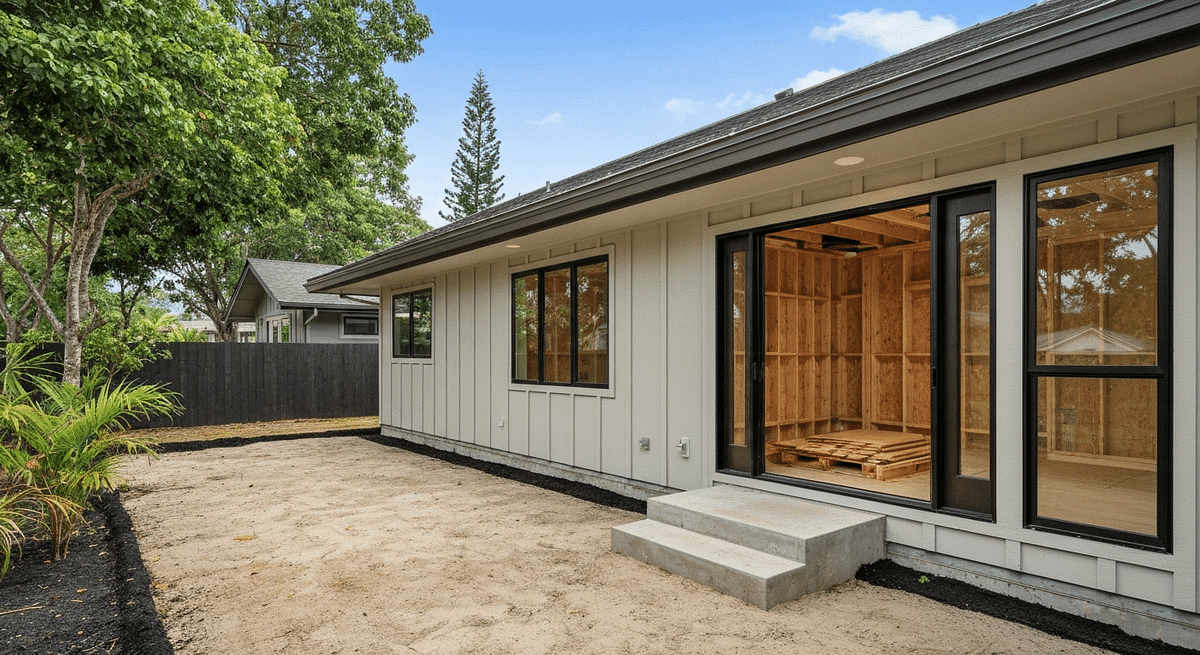
Architectural & Engineering Fees: The Blueprint for Success
Your architect is the visionary who translates your ideas into a functional design that works with your existing home’s layout and style. But more importantly, they create the detailed construction documents that we, the builders, use to price and build the project. For a 600 sq. ft. addition, architectural fees typically run from $15,000 to $25,000.
The structural engineer is just as critical. They are responsible for making sure the new addition won’t compromise your existing home’s integrity and that the entire structure meets Hawaii’s stringent hurricane building codes. Their work involves calculating loads, specifying beam sizes, designing foundation connections, and detailing the hurricane straps and clips. Engineering fees for an addition usually fall between $5,000 and $8,000.
Additionally, you’ll likely need a surveyor to map your property lines and topography ($2,500 – $4,000) and potentially a geotechnical engineer to analyze the soil conditions ($2,500 – $6,000), especially if you’re on a hillside or in an area with expansive clay soil.
The Honolulu DPP Gauntlet: Permit Fees & Timelines
Getting a home addition permit in Honolulu is a marathon, not a sprint. The official permit fees from the Department of Planning and Permitting (DPP) are based on project valuation, but the real cost is in the time and professional help needed to navigate the system[2]. As builders, we are upfront with our clients: you should realistically budget 6 to 9 months just for the permit approval process. During this time, your plans are reviewed by multiple departments—zoning, building, electrical, plumbing, and sometimes the Board of Water Supply. Each department can have its own backlog and review cycles.
For example, a recent client in Kailua wanted to add a family room. The initial plan was slightly too close to the side yard setback. This triggered a months-long process of applying for a zoning variance, which involved community notifications and a public hearing. This delay added nearly four months to the pre-construction timeline. For this reason, we almost always work with a professional permit expediter. Their expertise and relationships within the DPP can help avoid common mistakes and keep the process moving, and their fees (typically $3,000 – $5,000) are well worth the investment.
What are the Biggest Hidden Costs When Building an Addition in Hawaii?
Snippet Answer: The biggest budget surprises usually come from three areas: bringing the *entire* existing roof structure up to current hurricane code, the high cost of foundation work on Hawaii’s unique volcanic soil, and the frustratingly long lead times for materials shipped from the mainland. These aren’t just possibilities; we plan for them on every addition project.
After decades of building here, we’ve seen it all. The budget items that catch homeowners off guard are almost always specific to Hawaii. Mainland construction guides don’t prepare you for the realities of building on a rock in the middle of the Pacific. Understanding these potential costs upfront is the key to keeping your project on track.
The Hurricane Code Ripple Effect: Roof & Structural Upgrades
Here’s the single biggest ‘gotcha’ in Hawaii addition projects: when you add on and touch the roof, the city often requires you to bring the *entire* roof structure of the existing home up to the current hurricane code. This doesn’t just mean the new part; it means retrofitting the old part, too. This is a crucial safety requirement based on lessons learned from past hurricanes like Iniki.
What does this involve? Our crew has to go into your attic and systematically add new metal connectors (hurricane straps and clips) at every connection point from the rafters down to the foundation. If the existing roof sheathing is too thin, we may need to replace the entire roof deck. This process can easily add $20,000 to $35,000 to a project that you didn’t anticipate[3]. It’s pure labor and materials with no aesthetic benefit, but it’s non-negotiable for safety and for passing your final inspection.
Foundation Work on Volcanic & Expansive Soils
Oahu’s ground isn’t uniform. Building in the rocky terrain of Hawaii Kai is completely different from the expansive clay soils found in Central Oahu. Volcanic rock can be difficult and expensive to excavate, requiring heavy machinery and sometimes rock-breaking attachments. On the other hand, expansive soils swell and shrink dramatically with moisture, which can crack a poorly designed foundation.
A geotechnical report is essential. It tells us what we’re dealing with and allows the engineer to design the right foundation. This could be a standard slab-on-grade, a post-and-pier foundation to elevate the structure, or even deep-drilled piers on a steep hillside lot. The complexity of the foundation directly impacts the cost of adding a room hawaii homeowners must factor into their plans. A simple slab might cost $50-$60 per square foot, while a complex foundation on a difficult site can exceed $150 per square foot.
Material Logistics: Oahu’s 4-6 Month Lead Times
Almost every high-value component of your addition—windows, doors, trusses, cabinetry, specialty tile—is coming from the mainland on a boat. As a recent Pacific Business News report highlighted, these supply chains are long and unforgiving[4]. We have to be incredibly organized with procurement. We are ordering custom windows and roof trusses 4 to 6 months in advance, often before we even have the permit in hand.
This long lead time has two major impacts on your budget. First, it extends the project timeline and your carrying costs. Second, it reduces flexibility. If you change your mind about the window style after they’ve been ordered, it could delay the project by half a year. We work with our clients to finalize these critical decisions very early in the design process to lock in pricing and get the orders placed, mitigating the risk of costly delays while building an addition in hawaii.
How Long Does a Home Addition Project Take on Oahu?
Snippet Answer: From our first conversation to your final walkthrough, a 600 sq. ft. addition typically takes 12 to 18 months. A significant portion of that time, around 6 to 9 months, is spent just waiting for the Honolulu DPP to approve the permit.
The construction itself is often the shortest part of the process. The long timeline for a home addition on Oahu is driven by the extensive planning, design, and permitting phases that happen before we ever set foot on site. It’s a two-part journey, and setting realistic expectations for both is key to a low-stress experience.
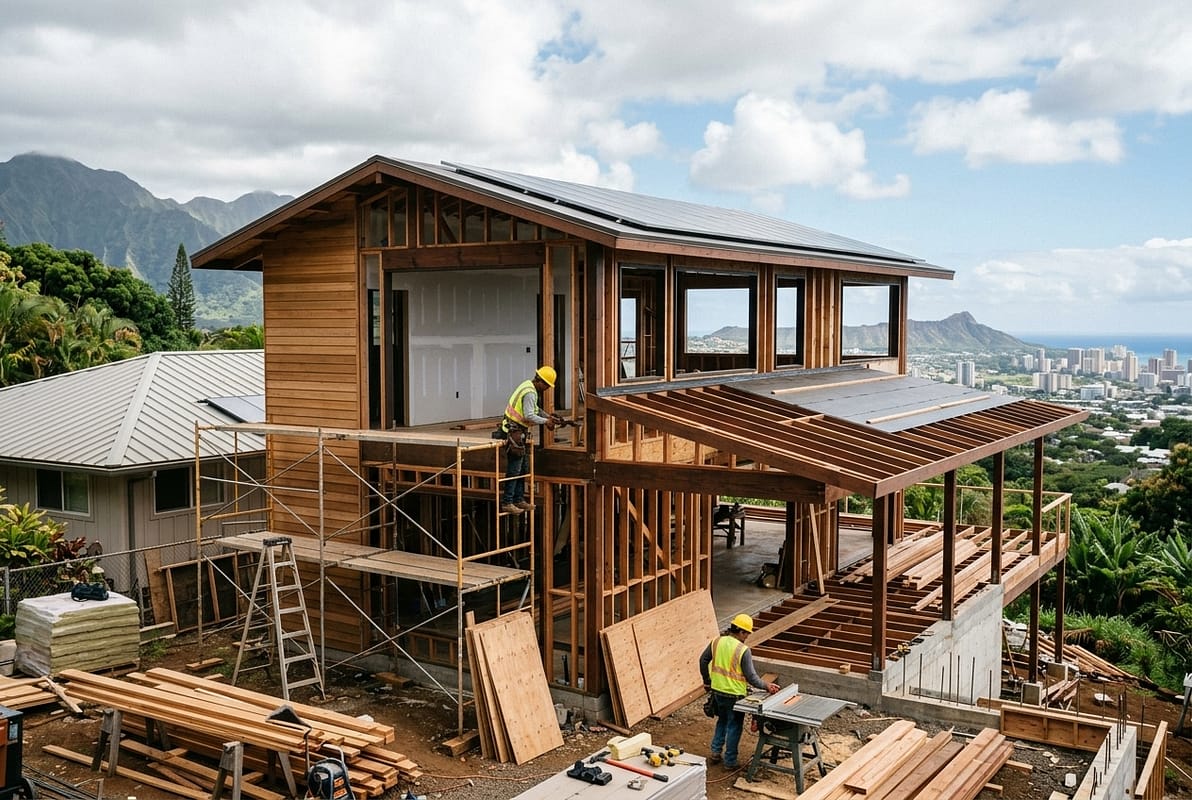
Phase 1: Design & Permitting (8-12 months)
This is the ‘thinking and waiting’ phase. It’s where all the critical decisions are made and the groundwork is laid for a smooth construction process.
- Initial Consultation & Feasibility (1 month): We meet with you, discuss your goals, and develop a preliminary budget and scope of work.
- Design Development (2-3 months): You work with an architect to develop the design. This involves creating floor plans, elevations, and selecting major materials. Our team provides feedback on constructability and cost throughout this stage.
- Construction Documents (1-2 months): The architect and engineer create the detailed blueprints that are required for permitting and construction.
- Permit Submission & Review (6-9 months): This is the longest and most unpredictable part. We submit the plans to the Honolulu DPP and wait for them to be reviewed and approved. This home addition permit honolulu process is the main bottleneck for most residential projects on the island.
Phase 2: Construction (4-6 months)
Once we have that precious building permit in hand, our team can finally get to work. This phase moves much faster and you’ll see progress every day.
- Site Prep & Foundation (3-4 weeks): We clear the site, perform any necessary demolition, excavate, and pour the new foundation.
- Framing & Roofing (4-6 weeks): The walls go up, the roof structure is built, and we tie everything into the existing house. This is when the new space really takes shape.
- Exterior & Rough-Ins (4-6 weeks): Windows, doors, and siding are installed. Simultaneously, plumbers and electricians run the new pipes and wires inside the walls.
- Interior Finishes (6-8 weeks): This is the longest part of the construction phase. Drywall, painting, flooring, tile work, cabinet installation, and final fixture connections all happen during this time.
- Final Inspections & Punch List (2 weeks): We walk through the project with you and the city inspector to get final approvals and address any small, remaining items.
What Does a Real Oahu Home Addition Project Look Like?
To put all this theory into practice, let’s consider a recent, though fictionalized for privacy, example: the Tanaka family’s project in Manoa. They owned a classic 1960s single-wall construction home and wanted to add a 550-square-foot ground-floor master suite to accommodate their aging parents.
Their initial budget was around $350,000, based on some online calculators. Our preliminary estimate came in closer to $470,000, which led to an important conversation about the realities of their project. Here’s why the cost was higher:
- The Hurricane Code Trigger: Their existing roof was a simple gable, but tying in the new addition’s roofline required significant structural changes. This triggered the requirement to retrofit the *entire* 1,400 sq. ft. existing roof with hurricane straps, adding an unexpected $28,000 to the budget right away.
- Hidden Termite Damage: Upon opening the exterior wall to connect the addition, we found extensive, old termite damage in the home’s main support beams. This wasn’t visible during the initial inspection. The required structural repairs and extensive fumigation added another $22,000 and two weeks to the schedule. This is a very common scenario in older Hawaii homes.
- DPP Review Delays: The Manoa neighborhood has specific design guidelines. The DPP reviewer required several small changes to the window placements and exterior trim details to better match the area’s character. Each revision cycle between the architect and the city added about three weeks to the permitting timeline, which ultimately stretched to just over 8 months.
In the end, the Tanaka’s project took 15 months from our first meeting to completion, with a final cost of approximately $485,000. While higher than their initial hope, the final result was a seamless, safe, and beautiful addition that perfectly met their family’s needs. Their story is a perfect illustration of why building in a contingency fund and having a realistic view of the oahu home addition cost and timeline is so vital.
What Does This Mean for Hawaii Homeowners?
Navigating a major construction project like a home addition can feel overwhelming, but being informed is your best defense against budget shock and stress. The high oahu home addition cost is a reality driven by skilled labor shortages, island logistics, and complex building codes. Accepting this is the first step.
Here are our direct recommendations for anyone considering an addition in 2026:
- Budget Conservatively: When you’re planning, use the $800-$1,000 per square foot figure as your starting point. Don’t rely on mainland cost estimators. If your budget is firm, consider reducing the square footage slightly to ensure you can afford quality materials and craftsmanship.
- Start the Process Early: Given the 8-12 month design and permitting timeline, you should start talking to architects and builders at least 18 months before you want the project to be completed.
- Hire a Cohesive Team: The best projects happen when the homeowner, architect, and builder work as a team from the very beginning. In a design-build approach, the builder is involved during the design phase, providing real-time cost feedback to keep the plans aligned with your budget.
- Protect Yourself with a Contingency: For an addition to an older home in Hawaii, we insist on a contingency fund of at least 10-15% of the construction cost. This isn’t a ‘nice-to-have’; it’s a critical part of the budget that covers the inevitable surprises, like the termite damage the Tanaka family found.
- Compare Apples to Apples: When getting bids, make sure each contractor is pricing the exact same scope of work and level of finishes. A low bid is often a sign that something has been left out, and you’ll pay for it later in change orders. Focus on experience, communication, and a detailed proposal—not just the bottom-line number.
Frequently Asked Questions
Is it cheaper to add a room or build a new house on Oahu?
Counterintuitively, it is often more expensive per square foot to add a room than to build a new house. A typical addition costs $800-$1,000/sq. ft., while a new build can be $650-$850/sq. ft. This is due to the complexities of structural tie-ins, matching existing finishes, limited site access, and the potential for discovering and repairing hidden issues in the old structure.
How much does a simple 20×20 (400 sq. ft.) room addition cost on Oahu?
Using our 2026 cost data, you should budget between $320,000 and $400,000 for a 400 sq. ft. ground-floor addition. This would cover a complete project, from architectural plans and permits to construction and final finishes for a space like a large family room or a simple in-law suite without a full kitchen.
Can I avoid getting a permit for a small addition in Honolulu?
No. Any project that adds square footage or alters the structural frame of your home requires a building permit from the Honolulu DPP. Attempting to build without one can result in stop-work orders, significant fines, and the potential need to tear down the unpermitted work. It will also create major problems when you try to sell your home in the future.
Does adding a bathroom to an addition dramatically increase the cost?
Yes, significantly. Adding a bathroom involves extensive plumbing and electrical work, plus expensive fixtures, tile, and waterproofing. A bathroom can add $40,000 to $70,000 to the total cost of an addition compared to just building ‘dry’ living space like a bedroom or office. The cost comes from both the materials and the highly skilled labor required.
How does a second-story addition compare in cost to a ground-floor one?
A second-story addition is almost always more expensive, often 20-40% more per square foot than a ground-floor project. The increased cost comes from the extensive structural work required to reinforce the entire first floor and foundation to carry the new load. You can learn more in our detailed Oahu second-story addition cost guide.
Are there financing options specifically for home additions in Hawaii?
Yes, the most common financing tools are a home equity line of credit (HELOC) or a cash-out refinance if you have sufficient equity in your home. For larger projects, a construction loan may be more appropriate. We always recommend talking to a local lender who understands the high construction costs and long project timelines in Hawaii.
Ready to Plan Your Oahu Home Addition?
Understanding the true oahu home addition cost is the first step toward making your vision a reality. While the numbers can be daunting, a well-planned, professionally executed addition can add tremendous value and enjoyment to your home for decades to come. The key is to partner with a team that is transparent about costs, experienced with Hawaii’s unique building environment, and committed to quality.
If you’re ready to take the next step and discuss the possibilities for your home, our team at Warrior Construction is here to help. We can provide a realistic preliminary budget and walk you through the entire process, from design to completion. Contact us today to schedule a consultation and start planning your home addition.


